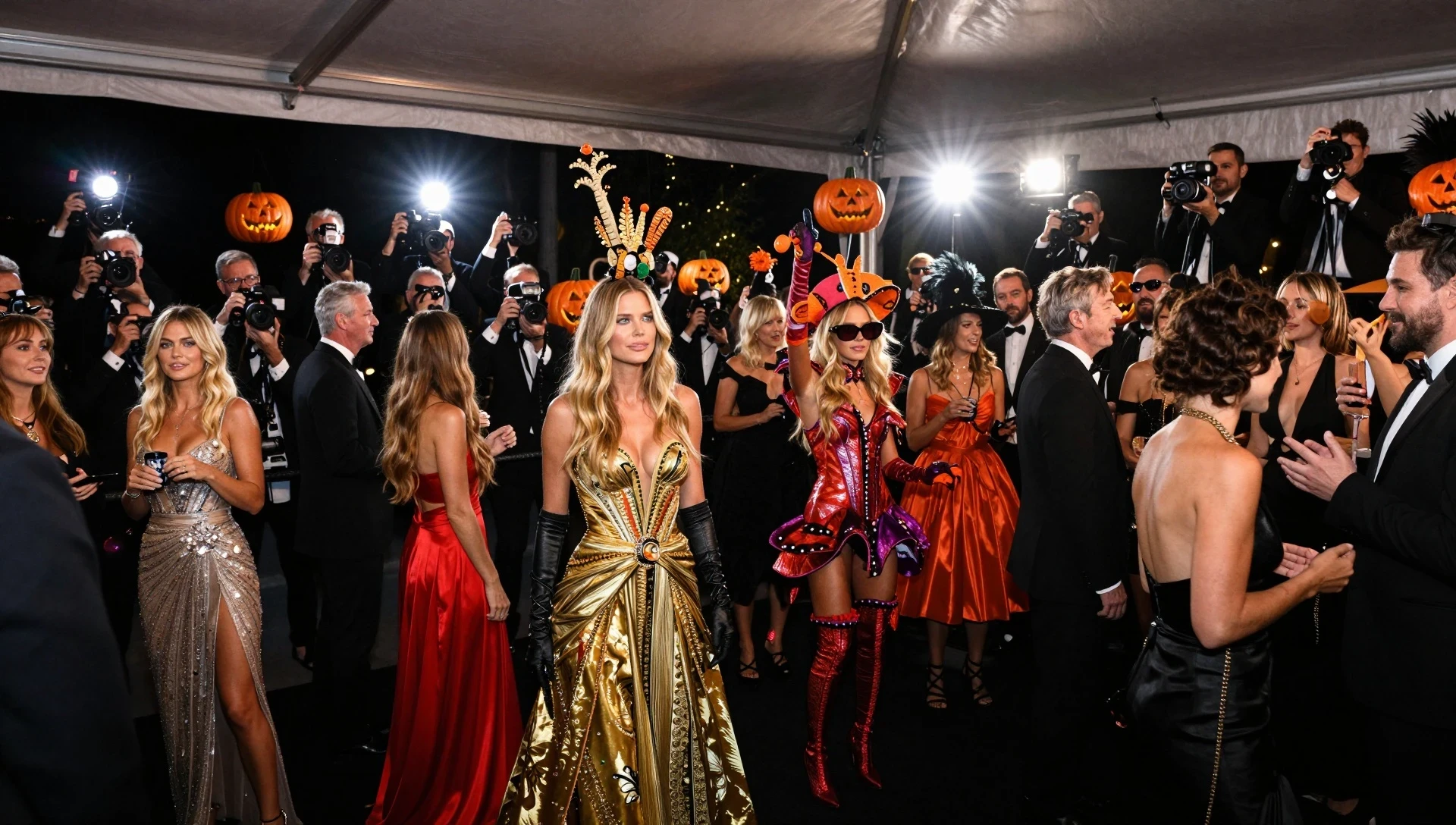
Heidi Klum's annual Halloween party functions less as a private celebration than as a calibrated media event, one that converts costume craft into measurable attention across broadcast, digital and social channels.
The BBC's brief video report on the gathering confirms a familiar pattern: a celebrity-hosted occasion, a guest list of costumed public figures, and a news cycle that rewards spectacle with distribution. What appears frivolous on the surface is, in operational terms, a tightly managed production with predictable inputs and outputs.
The mechanics deserve scrutiny. Klum has staged these parties for more than two decades, building a reputation for elaborate prosthetics and multi-hour makeup transformations that generate pre-event anticipation and post-event analysis.
On This Page
Each iteration produces a cluster of assets — red-carpet footage, behind-the-scenes clips, costume reveals — that media outlets repackage at low cost. The BBC item is one node in that network, not an isolated curiosity.
This analysis examines the event through three lenses: the production economics behind celebrity-hosted spectacle, the media distribution logic that determines which images travel, and the cultural function of Halloween as a sanctioned space for public identity play.
Each lens reveals a different set of incentives, and together they explain why a costume party reliably outperforms far more consequential news in engagement terms.
TL;DR Heidi Klum's annual Halloween party is a media production as much as a social gathering. Its value lies in predictable attention generation: elaborate costumes create visual assets, celebrity guests supply distribution, and news outlets like the BBC convert the spectacle into low-cost content. The event illustrates how entertainment economics reward anticipation, transformation and shareability over substance, and why Halloween functions as a commercially rational platform for public identity play.
The Production Economics of Celebrity-Hosted Spectacle
Celebrity-hosted events operate on a simple exchange: the host supplies access and spectacle, guests supply star power, and media supplies reach. Klum's party has refined this exchange over roughly two decades, converting a seasonal tradition into a recognizable brand property with annual recurrence and reliable anticipation. The economics are favorable because the host absorbs costume costs while media absorbs distribution costs.
Costume Investment as Brand Capital
Klum's costumes are not accessories but capital expenditure. Reports across past years describe prosthetics, full-body makeup and multi-hour preparation sessions involving specialist teams. That investment generates a return measured in coverage volume rather than ticket revenue, since the party itself is not a commercial ticketing operation. The costume is the product; the coverage is the revenue.
The strategic logic mirrors product launches. A distinctive, photographable costume guarantees image reproduction across outlets that cannot afford original reporting on entertainment. Each year's transformation resets expectations, creating a recurring narrative hook that a static format could never sustain. Novelty is the asset being depreciated and replaced annually.
Guest costumes extend the model. When attendees arrive in elaborate dress, they generate secondary assets at no cost to the host, multiplying the visual inventory available to editors. The party therefore functions as a distributed content factory, with guests as unpaid contributors who gain exposure in exchange for participation.
Risk management matters here. Costume failures, wardrobe malfunctions or underwhelming outfits become their own news stories, so the production carries reputational exposure. Klum's consistent escalation of ambition is partly a hedge: high-variance spectacle generates more coverage than safe choices, and the host's established reputation absorbs occasional misses.
Guest List as Distribution Network
The guest list performs a function analogous to a distribution agreement. Inviting actors, musicians and models with large followings ensures that party content reaches audiences the host cannot access alone. Each attendee's social post extends the event's reach without incremental cost to the organizer, creating a multiplier effect on visibility.
Selection is therefore strategic rather than purely social. Guests with strong visual identities and active audiences generate more usable content than those with quieter profiles. The resulting mix of established names and emerging figures keeps the event relevant across demographic segments while maintaining the host's central position in the narrative.
Reciprocity sustains the arrangement. Attendees gain association with a prestigious annual event and access to its photographic output, while the host gains reach. This mutual benefit explains the party's durability: it is a stable coalition of interests rather than a one-sided favor, which reduces the coordination costs that typically erode recurring social events.
Exclusivity reinforces value. A guest list that is difficult to join makes attendance a signal, and signals retain worth only when scarcity is credible. The party's longevity depends on maintaining that scarcity while still generating enough content to satisfy media demand, a balance the host has managed with unusual consistency.
Risk, Reputation and Annual Recurrence
Recurring events accumulate reputational stakes. A single weak year invites commentary that the format has declined, and entertainment media are quick to frame repetition as fatigue. Klum's approach counters this by escalating ambition, treating each party as a fresh production rather than a rerun of a proven formula.
Reputational risk also flows from guests. Controversial attendees can redirect coverage toward scandal rather than spectacle, and costume choices can trigger cultural criticism. The host's team must therefore manage both creative ambition and public sensitivity, a dual constraint that distinguishes professional productions from informal gatherings.
Recurrence itself is the core asset. An annual event builds anticipation cycles, editorial relationships and audience habits that a one-off party cannot replicate. Media outlets plan coverage in advance, sponsors understand the format, and audiences expect the reveal. That predictability is precisely what makes the event valuable to outlets operating on tight budgets.
The financial logic remains indirect. There is no ticket revenue to report and no obvious product to sell, yet the event supports brand value, endorsement pricing and media relationships.
Its return is realized across a portfolio of activities rather than on a single balance sheet, which is why the party persists despite its apparent cost.
Media Distribution Logic and the Attention Economy
The BBC's coverage illustrates how legacy outlets treat celebrity spectacle as efficient filler. A short video item requires minimal original reporting, carries inherent visual appeal and reliably attracts clicks. For a global broadcaster balancing costly foreign correspondence against audience demand, such content offers favorable economics per unit of engagement.
Why Spectacle Travels Faster Than Substance
Visual content with immediate emotional legibility outperforms complex reporting in sharing metrics. A striking costume requires no context to be understood, while policy analysis demands prior knowledge and sustained attention. Platforms reward the former, and editors respond to platform incentives even when their institutional mission favors the latter.
This asymmetry is structural, not a failure of journalistic judgment. Attention is finite, and content competing for it is abundant. Spectacle wins because it imposes low cognitive cost on the audience, and low-cost content scales. The BBC item is a rational allocation of resources given those constraints, not an anomaly.
Comparisons across coverage types make the point. A celebrity costume reveal typically generates engagement within hours, while an investigative piece may build audience over days. The former suits the news cycle's rhythm; the latter requires patience that algorithmic distribution rarely rewards. Outlets therefore maintain both, assigning each to different slots.
The consequence is a media diet weighted toward the visually immediate. Halloween coverage is a clear case: it fills airtime and page views with content that is cheap to produce and easy to promote. Understanding this pattern clarifies why entertainment stories dominate feeds even when audiences claim to want more serious fare.
The Editorial Calendar and Seasonal Predictability
Halloween occupies a fixed slot in the editorial calendar, which makes coverage planning straightforward. Outlets know when costume content will arrive and can allocate resources accordingly. This predictability lowers production risk and allows smaller newsrooms to participate in a global conversation without original reporting capacity.
Seasonal events also solve a scheduling problem. Late October is otherwise a quiet period for entertainment news, so Halloween content faces limited competition for audience attention. The result is disproportionate visibility for material that would struggle in a crowded news week, a dynamic that benefits hosts and outlets alike.
Klum's party has become a fixture within that calendar, functioning as an anchor event that other coverage references. Its recurrence allows outlets to build annual features, comparisons and retrospectives around it. Over time, the event has acquired institutional status in entertainment journalism, which further secures its coverage.
The calendar effect extends to advertising. Brands plan seasonal campaigns around Halloween, and celebrity content provides a natural adjacency. Coverage of the party therefore sits within a commercial ecosystem that rewards timely spectacle, reinforcing the incentives that keep such events prominent.
Platform Incentives and the Shareability Threshold
Social platforms optimize for content that generates rapid interaction, and costume imagery meets that criterion efficiently. Images are legible at a glance, provoke comment and invite comparison, all of which drive the engagement signals that algorithms amplify. The party's output is therefore well matched to platform mechanics.
Shareability has a threshold: content must be striking enough to prompt action but simple enough to require no explanation. Elaborate costumes clear this bar reliably, while nuanced reporting often does not. The gap between the two explains much of the divergence between what audiences say they value and what they actually share.
Platform incentives also shape production. Hosts know that certain costume types generate more discussion, and they design accordingly. The feedback loop between audience response and creative choice is tight, producing an annual optimization process that gradually refines the spectacle toward maximum shareability.
This dynamic has costs. Content optimized for sharing tends toward the visually extreme, and subtlety is penalized. The party's escalating ambition is partly a response to platform pressure, not merely artistic preference, which illustrates how distribution mechanics influence creative decisions upstream.
We Also Published
Halloween as Sanctioned Identity Play
Halloween occupies a distinctive cultural position: it is the one major occasion on which public figures can adopt radically different appearances without professional justification. That license makes the holiday valuable to celebrities, who can experiment with persona while framing the result as seasonal participation rather than reinvention.
The Cultural Function of Costumed Public Appearance
Costume allows a controlled departure from established image. A public figure known for a particular look can appear unrecognizable for one night, generating curiosity without the risk of a permanent rebrand. The holiday provides cover for experimentation, and the temporary frame limits reputational exposure.
This function has deep roots. Masking and disguise appear across cultures as licensed inversion, a temporary suspension of normal identity rules. Halloween inherits that tradition in commercial form, converting ritual license into a platform for publicity. The party is a modern instance of an old cultural pattern.
Audiences participate in the same logic. Costume content invites viewers to decode references, judge execution and compare interpretations, which makes consumption an active rather than passive experience. That interpretive engagement explains why costume imagery sustains discussion longer than ordinary celebrity photography.
The result is a mutually beneficial arrangement. Public figures gain a sanctioned space for reinvention, audiences gain participatory entertainment, and media gain content that generates discussion. Halloween's cultural license is the enabling condition for all three, which is why the holiday supports such elaborate commercial activity.
Authenticity, Craft and the Spectacle of Effort
Audiences reward visible effort. A costume requiring hours of prosthetics signals commitment in a way that a purchased outfit does not, and that signal translates into favorable coverage. Craft becomes a proxy for sincerity, distinguishing the host's production from routine celebrity appearances and sustaining audience goodwill.
This preference for effort has commercial implications. It raises the bar for competitors, making elaborate production the expected standard rather than an exception. Hosts who attempt similar events must match the investment or accept unfavorable comparison, which concentrates attention on a small number of well-resourced productions.
Effort also mitigates criticism. When a costume clearly involved substantial work, audiences are more forgiving of imperfect execution and more inclined to discuss the process rather than judge the result. The narrative shifts from evaluation to appreciation, a favorable frame for the host.
The craft narrative extends to documentation. Behind-the-scenes footage of preparation converts labor into content, extending the event's coverage window beyond the party itself. The production process becomes a secondary spectacle, multiplying the assets generated by a single occasion.
Commercial Spillovers and Brand Value
The party's commercial value is realized indirectly, through brand associations rather than direct sales. A host known for ambitious production attracts endorsement interest from fashion, beauty and entertainment brands seeking association with creativity and spectacle. The event functions as a portfolio piece in that negotiation.
Spillovers extend to guests and collaborators. Makeup artists, designers and fabricators gain visibility from participation, building their own reputations on the platform the party provides. The event therefore supports a small ecosystem of creative professionals whose work feeds back into future productions.
Media outlets capture value too. Coverage of the party generates advertising inventory during a commercially active season, and the content's shareability extends its reach beyond the outlet's core audience. The transaction is mutually beneficial, which explains its persistence despite the absence of direct monetization.
Longevity compounds these effects. Two decades of consistent production have built a recognizable property with accumulated recognition, making each new iteration more valuable than a debut would be. The party's brand equity is the product of repetition, and that equity now underwrites its continued coverage.
Reading the Signal Beneath the Spectacle
The BBC's brief report on Klum's party is a small item, but it indexes a large system. Celebrity spectacle, media economics and cultural license converge in an event that appears trivial yet operates with considerable precision. Understanding that system clarifies how attention is manufactured, distributed and monetized in contemporary entertainment.
What the Coverage Reveals About News Priorities
Coverage choices reveal institutional priorities more reliably than mission statements. When a global broadcaster allocates airtime to a costume party, it signals that engagement metrics carry weight in editorial decisions. That is not scandalous; it is an accurate description of how modern newsrooms balance competing objectives.
The item's brevity is itself informative. Short-form video coverage of entertainment events requires minimal investment and yields measurable returns, making it an efficient component of a mixed content strategy. Its presence alongside serious reporting reflects portfolio logic rather than a collapse of standards.
Audiences should read such coverage as a data point about attention economics, not as evidence about what matters. The distinction is important: what gets covered and what is important are related but not identical, and the gap between them is where media literacy becomes useful.
Comparisons across outlets would sharpen the picture. Outlets with different funding models and audiences allocate entertainment coverage differently, and those differences reveal their underlying incentives. A single BBC item is a starting point for that analysis, not a conclusion.
Limits of the Spectacle Model
The model has boundaries. Escalation cannot continue indefinitely, and audiences eventually tire of formats that rely on novelty alone. Sustaining attention across decades requires periodic reinvention, which is why the party's format has shifted over time rather than repeating a fixed template.
Cultural criticism also constrains the model. Costume choices that borrow from marginalized cultures invite backlash, and public sensitivity has increased over time. Productions must therefore navigate a narrower range of acceptable references, adding creative constraints that did not exist when the format began.
Economic fragility is another limit. The event depends on media appetite for celebrity content, which is subject to platform shifts and changing audience habits. A decline in entertainment coverage would erode the returns that justify the production, leaving the party exposed to forces beyond its control.
These limits do not diminish the model's current effectiveness. They simply define its boundaries. Recognizing them allows a clearer assessment of what such events can and cannot achieve, and of the conditions under which their economics remain favorable.
Conclusion: A Small Event With a Large Footprint
Klum's party is best understood as a compact case study in attention economics. It demonstrates how spectacle is produced, how media distributes it and how culture licenses it, all within a single recurring occasion. The BBC's report is a trace of that system, not the system itself.
The analytical payoff lies in the pattern. Similar dynamics govern film premieres, product launches and political rallies, where spectacle competes for finite attention. Recognizing the shared mechanics allows observers to evaluate such events on their actual terms rather than their stated purposes.
For media consumers, the practical lesson is to distinguish coverage volume from significance. For producers, the lesson is that attention is engineered, not accidental. Both insights follow from taking a costume party seriously enough to examine its economics, which is precisely what the event rewards.
The party will recur, and coverage will follow. What changes is the surrounding system: platforms, audiences and cultural norms shift, altering the returns on spectacle. Tracking those shifts through recurring events offers a useful, if unconventional, way to read the broader media landscape.
From our network :
- Forbidden Matrix Patterns and Visible Lattice Points: A Geometric DictionaryExplore how multidimensional 0–1 matrices encode geometric truths, linking forbidden patterns to visible lattice points and hypergraph theory, with applications in combinatorics and computational geometry.
- University Language Proficiency Exams: Why Institutional Tests Demand Different Preparation Than IELTS and TOEFLDiscover why university-specific language proficiency examinations differ fundamentally from IELTS and TOEFL, and learn strategic preparation approaches for institutional assessment success.
- Live Online English Classes for Kids: Do They Actually Reduce Anxiety?A ten-week study reveals that synchronous online English classes can significantly reduce child language anxiety while improving listening and reading skills. Discover what makes these programs effective and how parents can select the right one.
- CISA’s Ten-Advisory Wave: Why Generic Patching Fails in OT and How to Build Product-Specific PlaybooksCISA released ten ICS advisories in one week, exposing critical infrastructure risks. Generic patching fails in OT. Learn to build product-specific remediation playbooks.
- Mobile Learning and VR in English: What Global Evidence Reveals About Effective Language TechnologyA systematic review across 14 countries reveals which language-learning technologies genuinely work. Mobile learning, AI, and VR show measurable benefits when pedagogically integrated. This evidence-based guide helps educators and learners select technology that delivers real return on investment.
- How AI Agents Will Change the Way We Manage Personal FinancesExplore how AI agents are transforming personal finance through automated budgeting, bill payment, and investment management, while examining the critical security protocols and governance frameworks required for safe deployment.
- The Final Descent: How ESA Retired the Legendary Cluster Constellation After 24 Years of Space Weather ScienceAfter 24 years mapping Earth’s magnetosphere, ESA’s Cluster mission concluded with a precisely controlled reentry over the South Pacific. This analysis explores the scientific legacy, engineering decisions, and debris mitigation principles behind one of space exploration’s most responsible retirements.
- The Hidden Cost of AI Convenience: Why Over-Permissioned Agents Are a Security Time BombDiscover why AI agents with excessive permissions create dangerous single points of failure, and learn how implementing least privilege principles can protect your organization from exploitation.
- Committed Mediterranean Precipitation Decline: Why Emissions Cuts Alone Cannot Restore Winter RainsNew NOAA research reveals that Mediterranean winter rains may decline irreversibly even with emissions cuts. Explore the science of committed climate change and regional impacts.
RESOURCES
- Heidi Klum and Butterfinger Celebrate 25 Years of Halloween Magic ...ferrero.comSep 30, 2026 ... Butterfinger marks the milestone celebration with signature party experiences, a limited-time dessert collaboration at New York City's Crazy ...
- Heidi Klum's Halloween costumes are always epic. See how she's ...apnews.comOct 30, 2024 ... NEW YORK (AP) — Halloween has plenty of traditions, from candy to jack-o'-lanterns — and the annual spectacle of Heidi…
- Heidi Klum and Butterfinger Celebrate 25 Years of Halloween Magic ...prnewswire.comSep 30, 2026 ... For a quarter century, Heidi Klum's Halloween party has captivated ... Halloween spectacle. "Halloween and Butterfinger are a perfect ...
- Social | Heidi Klum's Halloween Party Tickets, New York City - Royistroyist.comKlum's Halloween celebration is widely documented in both entertainment journalism and social media, adding to its influence and enduring cultural presence.
- Heidi Klum Transforms Into Medusa for Her 24th Annual Halloween ...vokemag.comNov 4, 2025 ... Heidi Klum Transforms Into Medusa for Her 24th Annual Halloween Party ... spectacles designed primarily for social media documentation. The ...
- At Sean "Diddy" Combs' sex trafficking trial, the spectacle is outside ...yahoo.comJun 14, 2025 ... ... media feeds with the most explosive moments. The federal trial ... Heidi Klum reveals Halloween costume as her iconic…
- The most talked-about looks at this year's Met Gala - BBCbbc.co.ukMay 4, 2026 ... Domingo isn't afraid to take big fashion swings, and this unusual suit has costume elements while remaining sleek. Yes, that…
- TV News Live Coverage for Funeral of Queen Elizabeth IIhollywoodreporter.comSep 16, 2022 ... Heidi Klum attends her 25th annual Halloween Party presented by Apothic and Butterfinger at Cathédrale on · Heidi Klum Reveals…
- 'TRL' Revival Set At MTV, VMA Moon Man Becomes Gender Neutraldeadline.comJul 30, 2017 ... 7 Heidi Klum's 2026 Halloween Party Photos · 8 'Nobody Wants This' Actress Tovah Feldshuh Insists "Tensions Are Not Rising"…
- The 2026 Met Gala was a parade of major fails Monday night, as ...facebook.comMay 5, 2026 ... I think they mis-read the invitation and thought it said halloween costume party ... Heidi Klum and Katy Perry went…
- Vogue: Fashion, Beauty, Celebrity, Fashion Shows | Voguevogue.comPre-Halloween, Heidi Klum Embraces Pumpkin Orange for a Family Night Out. Celebrity Style ; Designer Francesca Miranda Created 5 Custom Looks for Her Daughter-In ...
- 'Teacup': Peacock Screens First Look of Horror series At Comic Condeadline.comJul 25, 2024 ... 1 Heidi Klum's 2026 Halloween Party Photos. 2 'It: Welcome to Derry' Surprise Halloween Episode Now Streaming On HBO Max.…
- The Delightful Spectacle of Gwyneth Paltrow's Ski Trial - The Cutthecut.comMar 30, 2023 ... ... media spectacle. In short: Retired optometrist Terry Sanderson is suing Paltrow, claiming that she crashed into him on the…
- Donald Trump: How the media created the president - BBC Newsbbc.comNov 14, 2016 ... 00:00:54, play videoGhoulish guests arrive for Heidi Klum's Halloween bash ... Five teenagers stabbed at Halloween party. 3. Democrat ...
- 01
- 02
- 03
- 04
- 05
- 06
- 07
- 08
0 Comments