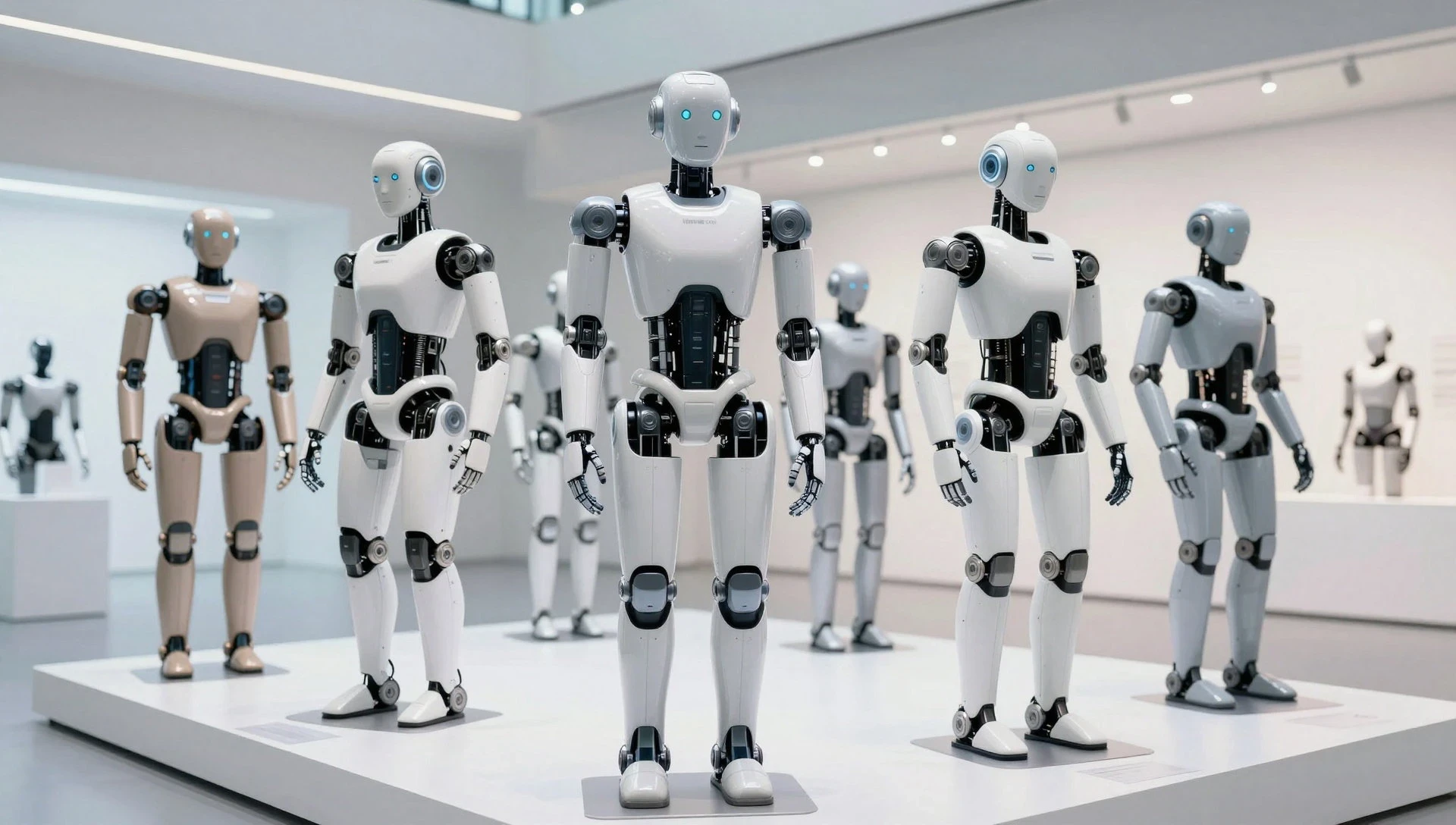
The Chiba exhibition, staged in the industrial belt east of Tokyo, has become an unlikely bellwether for how quickly artificial intelligence is migrating from software into the physical economy. Thirty companies and organizations from Japan and abroad gathered to display humanoid machines that no longer merely walk and wave, but perform consequential work: driving excavators, judging the dimensions of parcels, and sorting goods inside logistics warehouses. The event matters less for its spectacle than for what it reveals about intent. Robotics firms are no longer asking whether humanoids can be built; they are asking where they can be deployed profitably, and which labor shortages justify the capital expenditure required to put them on a factory floor or a construction site.
Two exhibits captured the strategic divergence now shaping the sector. A construction company demonstrated a robot taught through AI to operate heavy machinery, accelerating and braking with enough fluency to draw crowds, and admitted that development had begun only two months earlier. A China-based developer showed a humanoid capable of assessing the size and shape of items so they can be sorted, noting that the machine is already working in logistics warehouses and that much of its underlying technology relies on Japanese components. Together, these displays sketch a supply chain in which Japanese precision parts, Chinese assembly and deployment speed, and shared AI training methods converge on the same crowded exhibition floor.
The labor arithmetic behind this enthusiasm is difficult to ignore. Japan's construction industry faces a chronic shortage of skilled operators, a demographic squeeze that no recruitment campaign has solved, and logistics operators confront similar pressure as e-commerce volumes rise. Humanoid robots promise a form of labor that is retrainable, replicable, and indifferent to shift length. Yet the exhibition also exposed how early the industry remains: prototypes developed in weeks, deployment confined to controlled warehouse environments, and executives openly describing the sector as nascent. What follows is an examination of the Chiba showcase, the technologies on display, and the economic and industrial questions it raises.
On This Page
- The Chiba Exhibition as a Barometer of Commercial Intent
- Construction Robotics and the Machinery-Operation Breakthrough
- Warehouse Sorting and the Chinese Humanoid Already at Work
- The Labor Shortage Economics Driving Humanoid Adoption
- An Industry Still in Its Early Stages
- Reading the Exhibition Beyond the Headlines
TL;DR An exhibition in Chiba City near Tokyo gathered thirty companies and organizations from Japan and abroad to display AI-powered humanoid robots, including a construction machine taught to drive heavy equipment and a Chinese-built humanoid already sorting goods in logistics warehouses. The displays highlight how AI training is moving into physical labor, how Japanese components remain embedded in foreign robotics supply chains, and how both construction and logistics are turning to humanoids to offset severe labor shortages. Industry participants caution that the sector is still in its early stages, with most deployments confined to controlled environments and rapid prototyping only now giving way to commercial trials.
The Chiba Exhibition as a Barometer of Commercial Intent
Trade exhibitions rarely announce a technological shift on their own, but they do reveal when an industry stops experimenting and starts selling. The Chiba gathering, held near Tokyo and running through Friday, assembled thirty companies and organizations whose presence signals that humanoid robotics has acquired a commercial vocabulary. Exhibitors were not merely demonstrating balance and gait; they were describing deployment sites, component sourcing, and timelines measured in months rather than decades. That shift from laboratory curiosity to procurement conversation is the real story, and it explains why construction firms, logistics operators, and component suppliers converged on the same venue with such evident urgency.
Why Thirty Exhibitors Signal a Maturing Field
The number thirty is modest by the standards of consumer electronics trade shows, yet it represents a meaningful threshold for humanoid robotics. A decade ago, the field was dominated by a handful of university laboratories and flagship corporate research programs with little commercial follow-through. Today, the exhibitor list spans construction, logistics, component manufacturing, and software, suggesting that value chains are forming around the technology rather than remaining trapped inside single firms. When suppliers and integrators begin attending the same exhibition as end users, an industry is typically transitioning from proof of concept toward procurement, and the Chiba showcase fits that pattern closely.
Equally telling is the geographic mix. Japanese firms brought deep expertise in precision components and industrial machinery, while a Chinese developer arrived with a machine already operating in warehouses. That combination implies a division of labor rather than a contest. Japan supplies actuators, sensors, and mechanical subsystems; China supplies assembly capacity, deployment speed, and access to large domestic logistics markets. The exhibition therefore functioned as a map of interdependence, showing visitors that the humanoid supply chain is already international and that no single country currently controls every layer of it, from AI training pipelines to the servo motors that move a joint.
The Shift From Demonstration to Deployment
Demonstrations remain the currency of robotics exhibitions, but the language used by exhibitors has changed. Companies spoke of robots already working in logistics warehouses, of development cycles compressed into two months, and of ambitions to address labor shortages rather than to win research grants. That vocabulary reflects a broader transition in the sector: investors and customers now demand evidence of productive output, not just technical novelty. A humanoid that can accelerate and brake a piece of heavy machinery is impressive; a humanoid that can do so reliably across an eight-hour shift on a live construction site is a commercial proposition, and the gap between those two statements defines the industry's immediate challenge.
The compressed development timeline described by the construction exhibitor deserves scrutiny. Two months from inception to public demonstration is plausible when a team builds on existing AI training frameworks, simulation environments, and off-the-shelf hardware. It is far less plausible when the same team must certify a machine for operation near workers, integrate it with site safety protocols, and maintain it in dusty, vibration-heavy conditions. Rapid prototyping demonstrates capability; certification and reliability engineering determine whether deployment actually happens. The exhibition showcased the former convincingly and left the latter largely unaddressed, which is characteristic of an industry still in its early stages.
We Also Published
Construction Robotics and the Machinery-Operation Breakthrough
Construction sites have long resisted automation because they are unstructured, dirty, and dangerous in ways that reward human judgment. The Chiba exhibitor that taught a humanoid to drive heavy machinery approached the problem from an unusual angle: rather than redesigning the excavator, it trained the robot to operate existing equipment using AI. The machine learned to accelerate and brake, drawing crowds with the fluency of its control. That approach preserves the enormous capital already invested in construction fleets and sidesteps the certification burden of new machinery, which is precisely why it attracted attention from an industry desperate for operators rather than for new vehicles.
Teaching a Humanoid to Drive Existing Equipment
Training a humanoid to operate a standard excavator is a software problem wrapped inside a mechanical one. The robot must perceive levers, pedals, and gauges, translate those perceptions into motor commands, and modulate force with enough precision to avoid damaging equipment or endangering nearby workers. AI training methods, likely combining simulation with imitation learning from human operators, allow a machine to acquire these skills without explicit programming for every control. The exhibitor's claim that development began only two months ago suggests that much of this capability now comes from general-purpose models rather than bespoke engineering, a significant shift in how robotics projects are scoped and staffed.
The strategic appeal is straightforward. Construction firms own vast fleets of machinery and face a shrinking pool of licensed operators as the workforce ages. A humanoid that can be trained on existing controls offers a retrofit path, avoiding the cost of replacing equipment or redesigning sites around autonomous vehicles. It also preserves flexibility: the same robot could operate different machines across a project, moving from excavator to loader as the schedule demands. That versatility is the core economic argument for humanoid form factors over specialized automation, and construction is one of the few sectors where the argument is immediately legible to procurement departments.
Addressing Japan's Construction Labor Shortage
Japan's construction labor shortage is structural rather than cyclical. An aging workforce, declining entrants into skilled trades, and rising demand for infrastructure maintenance have combined to create vacancies that wage increases alone have not filled. The exhibitor explicitly framed its robot as a response to this shortage, which places the technology within a national policy conversation about productivity and immigration. Humanoid robots offer a politically palatable answer: they add capacity without altering labor migration rules, and they can be deployed incrementally as individual sites adopt them. Whether they can be deployed fast enough to matter is a separate and far harder question.
The shortage also shapes the economics of adoption. When skilled operators are scarce, the opportunity cost of an unfilled position rises, and the acceptable payback period for automation shortens. A robot that costs the equivalent of several annual salaries may become attractive if it can operate across multiple shifts and multiple machines. Yet construction sites present maintenance challenges that warehouses do not: dust, vibration, temperature swings, and irregular surfaces all degrade mechanical systems. The exhibitor's optimism is understandable, but the durability of humanoid hardware in field conditions remains an open question that no exhibition demonstration can resolve.
Warehouse Sorting and the Chinese Humanoid Already at Work
While the construction robot remained a prototype, the China-based exhibitor arrived with a machine already earning its keep. Its humanoid can judge the size and shape of items so they can be sorted, a task that sounds modest until one considers the variability of real parcels. Logistics warehouses handle objects of wildly different dimensions, weights, and packaging, and a robot that can perceive those differences and act on them addresses a genuine bottleneck. The exhibitor stated that the machine is already working in logistics warehouses, a claim that places it further along the deployment curve than most humanoids shown at comparable events.
Perception, Sizing, and Sorting in Live Logistics
Sorting is an ideal first commercial application for humanoid robotics because it combines high volume with forgiving tolerances. A robot that misjudges a parcel's dimensions can correct the error on the next attempt without catastrophic consequence, unlike a machine operating heavy equipment near people. Perception systems that estimate size and shape from visual and depth data have matured rapidly, and the physical manipulation required to move a parcel is well within the capability of current actuators. The result is a task where AI competence translates directly into labor substitution, which explains why logistics has become the proving ground for humanoid commercialization ahead of construction and manufacturing.
The warehouse environment also suits the economics of early adoption. Facilities are climate-controlled, floors are flat, workflows are standardized, and performance can be measured continuously against human benchmarks. That measurability matters to buyers who need to justify capital expenditure, and it allows vendors to demonstrate return on investment with concrete throughput figures. The exhibitor's claim of live deployment therefore carries more weight than a stage demonstration, because warehouse operators rarely tolerate machinery that cannot meet shift-level productivity targets. If the machine is genuinely working, it has already survived the least forgiving test that commercial robotics faces.
Japanese Components Inside a Chinese Robot
The most quietly significant detail from the exhibition was the exhibitor's acknowledgment that many Japanese parts are used in its technology. This admission complicates any simple narrative of national competition in robotics. Japan retains formidable strength in precision components, actuators, sensors, and reduction gears, and those subsystems remain difficult to replicate at scale and quality. A Chinese firm may lead in deployment speed and market access while depending on Japanese suppliers for the mechanical foundations of its machines. The humanoid supply chain is thus layered and interdependent, and the exhibition floor made that interdependence visible in a way that trade statistics rarely do.
For Japanese manufacturers, this represents both opportunity and vulnerability. Component supply is a profitable position that does not require winning the consumer-facing robot market, and it insulates firms from the volatility of platform competition. Yet it also cedes the higher-margin layers of software, AI training, and system integration to others. The exhibitor's stated ambition to help energize the humanoid sector suggests a collaborative posture rather than a confrontational one, and that framing may prove more accurate than headlines about national rivalry. The industry's early stage means that complementarity currently outweighs competition, though that balance will shift as volumes rise.
- 01
- 02
- 03
- 04
The Labor Shortage Economics Driving Humanoid Adoption
Every humanoid on the Chiba exhibition floor was, in economic terms, a response to a demographic curve. Japan's working-age population has been contracting for years, and the sectors most exposed to physical labor have felt the squeeze first. Construction and logistics both require skills that take time to acquire and offer working conditions that younger workers increasingly decline. Humanoid robots enter this gap not as a luxury but as a substitute for labor that cannot be recruited at any plausible wage. That framing explains why exhibitors emphasized shortages rather than efficiency, and why buyers in both sectors are willing to tolerate early-stage technology.
Demographics, Wages, and the Cost of Vacant Positions
The economics of labor shortage are often misunderstood as a simple wage story. In reality, a vacant position imposes costs beyond its salary: delayed projects, overtime for existing staff, quality erosion, and lost revenue from work that cannot be accepted. When those costs accumulate, the effective price of automation rises relative to the cost of doing nothing, and the payback period for a robot shortens. Humanoid vendors understand this arithmetic well, which is why their pitches emphasize unfilled roles rather than headcount reduction. The construction exhibitor's reference to a serious labor shortage was not rhetorical framing; it was a statement of the market condition that makes its product viable.
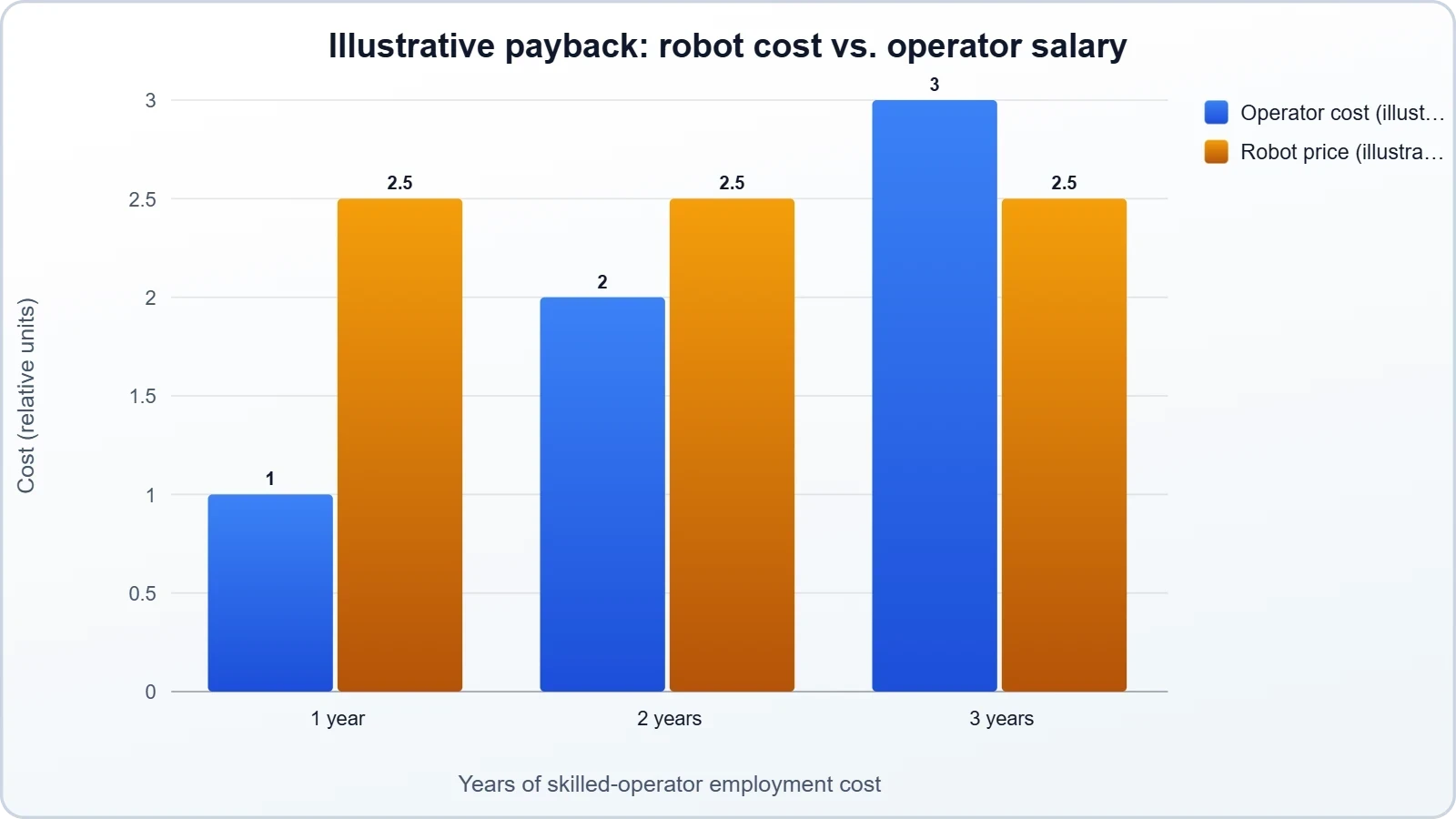
Wage inflation reinforces the same logic. As skilled operators become scarcer, their compensation rises, and the differential between human and robotic labor narrows. A machine that costs the equivalent of two or three years of a skilled operator's total employment cost becomes attractive if it can work multiple shifts and be retrained for new tasks. The calculation is complicated by maintenance, supervision, and integration expenses, but the direction of travel is clear. In sectors where shortages are acute and tasks are repetitive enough to automate, the economic case for humanoids strengthens with every year that demographics worsen.
Where Humanoids Fit and Where They Do Not
Humanoid robots are not a universal solution, and the exhibition implicitly acknowledged this by focusing on two sectors with unusually favorable conditions. Construction machinery operation and warehouse sorting share characteristics that suit current technology: defined tasks, measurable outputs, and environments where a mistake is recoverable. Sectors requiring fine dexterity in unpredictable settings, nuanced human interaction, or rapid adaptation to novel situations remain far from commercial deployment. The form factor's versatility is real, but versatility is not the same as competence, and buyers will judge machines by their performance on specific tasks rather than by their theoretical range.
The more interesting question is how humanoids will interact with existing automation. Warehouses already deploy conveyor systems, automated guided vehicles, and robotic arms, and a humanoid must justify itself against those cheaper, specialized alternatives. Its advantage lies in tasks that require mobility and general-purpose manipulation, where fixed automation cannot easily follow. Construction offers a similar dynamic: autonomous vehicles and teleoperation already exist, and humanoids must demonstrate that their flexibility outweighs their complexity. The exhibition suggested that vendors understand this competitive landscape, and their emphasis on existing equipment and live warehouses reflects a pragmatic search for niches where humanoids win.
An Industry Still in Its Early Stages
The most candid statement from the exhibition came from the Chinese developer, which described the humanoid robot industry as still being in its early stages. That assessment deserves more attention than the more optimistic claims surrounding it, because it comes from a firm with a machine already working in warehouses. Early-stage industries are characterized by rapid iteration, uncertain standards, fragmented supply chains, and business models that have not yet stabilized. Humanoid robotics exhibits all four. The two-month development timeline celebrated at the show is a symptom of iteration speed, not of maturity, and the absence of shared safety standards remains a significant obstacle to broader deployment.
Prototypes, Standards, and the Missing Certification Layer
Certification is the unglamorous infrastructure that turns prototypes into products. Construction equipment, industrial machinery, and warehouse systems all operate under safety regimes that specify how machines must behave around people. Humanoid robots that move autonomously through shared spaces sit awkwardly within those regimes, because they combine mobility, manipulation, and AI-driven decision-making in ways existing standards did not anticipate. Until certification pathways mature, deployments will remain confined to segregated areas and supervised trials. The exhibition did not address this gap directly, but its emphasis on controlled environments and existing equipment hints at a pragmatic strategy of fitting into established categories wherever possible.
Standards development is underway in several jurisdictions, but it moves at the pace of committees rather than startups. Vendors face a familiar dilemma: they need standards to scale, but they cannot wait for standards to begin selling. The result is a patchwork of voluntary guidelines, customer-specific safety protocols, and insurer-driven requirements that varies by sector and country. For buyers, this uncertainty raises integration costs and lengthens procurement cycles. For vendors, it favors firms with the resources to navigate regulatory complexity, which may accelerate consolidation once the initial wave of prototypes gives way to commercial competition.
What the Chiba Showcase Signals for the Next Five Years
Looking beyond the exhibition, the trajectory seems clearer than the timeline. AI training methods are becoming general-purpose, hardware costs are falling, and labor shortages are intensifying across advanced economies. Those three forces point toward steady, incremental adoption in logistics and construction before broader diffusion into other sectors. The Chiba exhibitors positioned themselves along that path with unusual clarity, emphasizing existing equipment, live warehouses, and component supply rather than speculative capabilities. Their restraint is itself a signal of maturity, and it suggests that the next five years will be defined by unglamorous integration work rather than by dramatic breakthroughs.
The geographic dimension will matter as much as the technological one. Japan's component strength and China's deployment speed are complementary today, but both governments view robotics as strategically important, and policy support could accelerate domestic capabilities on either side. The exhibitor's acknowledgment of Japanese parts in a Chinese robot may read differently in five years if supply chain localization becomes a policy priority. For now, the Chiba showcase presented an industry that is international, interdependent, and genuinely early, with the most consequential decisions about standards, safety, and business models still ahead of it.
Reading the Exhibition Beyond the Headlines
Exhibitions reward spectacle, and humanoid robots are exceptionally good at providing it. A machine that accelerates and brakes a piece of heavy machinery draws crowds for reasons that have little to do with procurement decisions. Yet the Chiba showcase contained enough substance beneath the spectacle to justify careful reading. The exhibitors described deployment sites, component sourcing, and development timelines, and they acknowledged the industry's early stage with unusual candor. Those details matter more than the demonstrations themselves, because they indicate where capital is flowing and which problems vendors believe they can solve first.
Separating Demonstration Value From Commercial Value
The distinction between a compelling demonstration and a viable product is the central analytical lens for any robotics exhibition. A demonstration proves that a capability exists under controlled conditions; a product proves that the capability can be delivered reliably, maintained affordably, and supported over years of operation. The construction robot's two-month development timeline is impressive as a demonstration and largely irrelevant as a product metric, because the hard work of certification, durability testing, and service infrastructure has not yet begun. Buyers who confuse the two will overpay for prototypes, and vendors who conflate them will underestimate the capital required to reach commercial scale.
Commercial value, by contrast, is visible in the details exhibitors choose to emphasize. The Chinese developer's mention of live warehouse deployment and Japanese component sourcing signals a firm that has already confronted integration and supply chain realities. The construction exhibitor's focus on existing machinery signals an understanding of customer capital constraints. These are the marks of companies thinking about deployment rather than publicity. Investors and analysts reading exhibition coverage should weight such details heavily, because they reveal which firms have moved past the demonstration phase and which remain dependent on favorable staging.
What Buyers and Policymakers Should Watch Next
For buyers, the next milestones to watch are certification announcements, multi-site deployments, and published reliability data. A vendor that can point to machines operating across several facilities over many months has demonstrated something far more valuable than a stage performance. For policymakers, the relevant questions concern standards, workforce transition, and supply chain resilience. Humanoid robots promise to alleviate labor shortages, but they also raise questions about skills, liability, and the concentration of manufacturing capability. The Chiba exhibition did not answer those questions, but it made them concrete by showing machines that are close enough to deployment to require answers.
The broader lesson is that physical AI is following a trajectory familiar from software: rapid capability gains, followed by a slower and less visible period of integration, standards, and business model development. The Chiba exhibitors are living through that second phase now, and their candor about the industry's early stage is a useful corrective to inflated expectations. Humanoid robots will not transform construction sites or warehouses overnight, but the direction of travel is established, the economic incentives are aligned, and the machines on display in Chiba are close enough to real work to make the next few years genuinely consequential.
From our network :
- University Language Proficiency Exams: Why Institutional Tests Demand Different Preparation Than IELTS and TOEFLDiscover why university-specific language proficiency examinations differ fundamentally from IELTS and TOEFL, and learn strategic preparation approaches for institutional assessment success.
- The Final Descent: How ESA Retired the Legendary Cluster Constellation After 24 Years of Space Weather ScienceAfter 24 years mapping Earth’s magnetosphere, ESA’s Cluster mission concluded with a precisely controlled reentry over the South Pacific. This analysis explores the scientific legacy, engineering decisions, and debris mitigation principles behind one of space exploration’s most responsible retirements.
- Forbidden Matrix Patterns and Visible Lattice Points: A Geometric DictionaryExplore how multidimensional 0–1 matrices encode geometric truths, linking forbidden patterns to visible lattice points and hypergraph theory, with applications in combinatorics and computational geometry.
- The Hidden Cost of AI Convenience: Why Over-Permissioned Agents Are a Security Time BombDiscover why AI agents with excessive permissions create dangerous single points of failure, and learn how implementing least privilege principles can protect your organization from exploitation.
- Committed Mediterranean Precipitation Decline: Why Emissions Cuts Alone Cannot Restore Winter RainsNew NOAA research reveals that Mediterranean winter rains may decline irreversibly even with emissions cuts. Explore the science of committed climate change and regional impacts.
- Live Online English Classes for Kids: Do They Actually Reduce Anxiety?A ten-week study reveals that synchronous online English classes can significantly reduce child language anxiety while improving listening and reading skills. Discover what makes these programs effective and how parents can select the right one.
- Mobile Learning and VR in English: What Global Evidence Reveals About Effective Language TechnologyA systematic review across 14 countries reveals which language-learning technologies genuinely work. Mobile learning, AI, and VR show measurable benefits when pedagogically integrated. This evidence-based guide helps educators and learners select technology that delivers real return on investment.
- CISA’s Ten-Advisory Wave: Why Generic Patching Fails in OT and How to Build Product-Specific PlaybooksCISA released ten ICS advisories in one week, exposing critical infrastructure risks. Generic patching fails in OT. Learn to build product-specific remediation playbooks.
- How AI Agents Will Change the Way We Manage Personal FinancesExplore how AI agents are transforming personal finance through automated budgeting, bill payment, and investment management, while examining the critical security protocols and governance frameworks required for safe deployment.
RESOURCES
- AI-powered humanoid robots on show | NHK WORLD-JAPAN Newswww3.nhk.or.jp6 hours ago ... The latest AI-powered humanoid robots are on display at an exhibition in Chiba City near Tokyo.
- Mitsubishi Electric will exhibit at CEATEC 2026 at Makuhari Messe ...facebook.comSep 3, 2026 ... Makuhari Messe, Chiba, Japan, Exhibition Hall 8 ... At CES 2026, Hyundai Motor Group brings its human- centered AI Robotics…
- NexTech Week Tokyo | RX Japan Ltd.nextech-week.jpAI EXPO TOKYO is Japan's LARGEST* trade show for AI tech companies to introduce their technologies to various industries. Backed up by technology mature,…
- The Combined Exhibition of Advanced Technologies 2026 opened ...facebook.comOct 13, 2026 ... CHIBA, Japan - The Combined Exhibition of Advanced ... humanoid robots and AI their own pavilion for the first time…
- Exhibitions List of Next-generation Technology - RX Japanrxjapan.jpChiba. Humanoid Robot EXPO [Autumn]. 11th - 13th November 2026 Chiba (Makuhari Messe). This exhibition is Japan's first specialized event focusing on completed ...
- Cohosted CEATEC, mobility show features collaborations across ...english.kyodonews.netOct 13, 2026 ... CHIBA, Japan - The Combined Exhibition of Advanced Technologies ... Japan's entertainment robots diversify with AI, offer comfort · Japan ...
- Mitsubishi Electric to Exhibit at CEATEC 2026mitsubishielectric.comAug 31, 2026 ... ... Chiba, Japan, from October 13 to 16. CEATEC is a comprehensive digital ... Through collaboration enabled by physical AI,…
- AI EXPO TOKYO Autumnen.jufair.comThis Chiba AI exhibition covers 30000㎡ with 600 exhibitors and expects ... Japan International Exhibition on Humanoid Robots and Embodied Intelligence.
- Humanoid robots stole the spotlight at Japan's premier tech ...instagram.comOct 17, 2026 ... Beyond delivering an entertaining show, these fluid moves demonstrated major advancements in AI ... exhibition in Chiba, near Tokyo, Japan.
- MinebeaMitsumi to Exhibit at "CEATEC 2026"minebeamitsumi.comOct 5, 2026 ... (hereinafter "MinebeaMitsumi") will exhibit at "CEATEC 2026", which will be held at Makuhari Messe (Chiba ... AI servers, humanoid robots ...
- Physical AI in spotlight at Japan's electronics show CEATECmainichi.jpOct 13, 2026 ... Hitachi Ltd. is displaying a humanoid robot equipped with an in-house AI robotics platform. When instructed to "read the meter"…
- Data, IT & Tech Events - RX Globalrxglobal.comAsia » Japan > Chiba. 11th - 13th November 2026. Makuhari Messe. Event website. Humanoid Robot EXPO [Autumn] event logo. Humanoid Robot EXPO [Autumn].…
- AI EXPO TOKYO 2026 November Chiba - Canton Fair netcantonfair.net9 hours ago ... The expo features products and solutions related to AI, humanoid robots, blockchain, quantum computing, and talent and organizational reform ...
- RX: Global Events - In the business of building businessesrxglobal.comAI EXPO TOKYO [AUTUMN]. 11. November 2026 Chiba, Asia » Japan · Event. BLOCKCHAIN ... HUMANOID ROBOT EXPO [AUTUMN]. 11. November 2026 Chiba ·…
- China showcases humanoid robots at Spring Festival gala - CBCcbc.caFeb 17, 2026 ... The program's opening sketch also prominently featured Bytedance's AI chatbot Doubao, while four Noetix humanoid robots appeared alongside ...
- 01
- 02
- 03
- 04
- 05
- 06
- 07
- 08
0 Comments