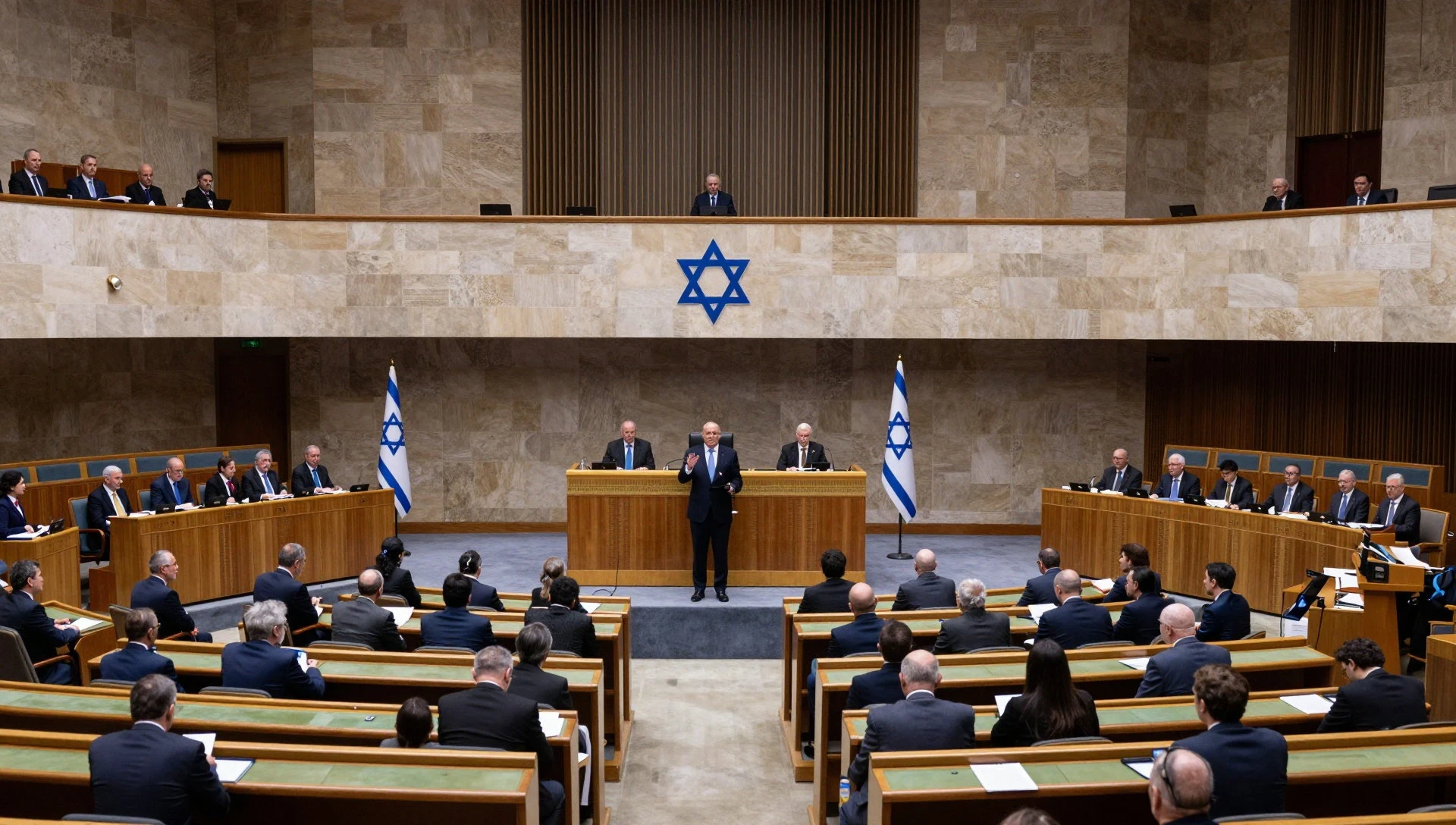
Israel's election has produced a parliamentary arithmetic that neither camp can resolve alone. With 99% of ballots counted, Prime Minister Benjamin Netanyahu's Likud party and its allies are projected to hold 53 of the Knesset's 120 seats, leaving the bloc seven short of the 61 required for a governing majority.
The opposition, meanwhile, commands no counter-coalition capable of crossing that threshold either. The result is not a defeat for any single party but a structural deadlock in which the largest blocs are each mathematically insufficient.
Turnout reached its highest level in nearly three decades, a figure that ordinarily signals a decisive public verdict. Here it deepened existing fractures instead. The opposition accused Netanyahu of attempting to delegitimize the contest, while Likud alleged foreign interference and claimed Arab-led parties "stole" the election once the coalition lost its majority.
On This Page
Both narratives contest the legitimacy of the count itself, not merely its outcome, which raises the stakes of any negotiated path forward.
The likeliest resolution is another election. Netanyahu and opposition figure Gadi Eisenkot both face constrained routes to power, since neither can assemble 61 seats without depending on Arab parties. Separately, Serbian police shot dead a young man outside Israel's embassy in Belgrade after what authorities described as a terrorist attack.
During the campaign, Netanyahu shared an AI-generated image purporting to show Arab-Israelis queuing to vote; BBC Verify found it had been generated or manipulated by artificial intelligence.
TL;DR Israel's election has ended in deadlock. Netanyahu's Likud-led bloc is projected at 53 of 120 Knesset seats with 99% counted, short of the 61 needed to govern, while the opposition also lacks a viable majority. Record turnout has coincided with mutual accusations of delegitimization and foreign interference, and neither Netanyahu nor Gadi Eisenkot can form a government without Arab-party support. New elections appear the most probable outcome. The campaign was further complicated by an AI-generated image of Arab-Israeli voters that BBC Verify identified as manipulated.
The Arithmetic of a 120-Seat Knesset and the Collapse of Coalition Logic
Israel's single nationwide constituency and pure proportional representation make coalition mathematics unusually unforgiving. A bloc holding 53 seats is not close to power in any practical sense; it is seven mandates away from the 61-seat threshold, and every one of those mandates must come from a party willing to join.
The system rewards discipline among allied lists and punishes fragmentation, which is precisely what the partial count reveals.
Why 53 Seats Is a Structural Ceiling, Not a Near Miss
The gap between 53 and 61 is not a rounding error to be closed by persuasion. It represents seven individual legislators whose parties have already positioned themselves outside the Netanyahu bloc.
In a 120-seat chamber, a bloc of 53 controls roughly 44% of the floor, meaning it cannot pass a confidence motion, cannot block a rival's, and cannot dictate committee composition without external partners.
Coalition formation in Israel has historically depended on small parties extracting disproportionate concessions at the moment of maximum leverage. That dynamic now works against the larger blocs. Each potential partner knows its seven seats are indispensable, and each can demand portfolio and policy terms that the Likud leadership may find incompatible with its base.
The opposition faces a mirror-image problem. Its aggregate strength is real but distributed across parties with divergent positions on security, religion and state, and economic policy. Assembling 61 seats from that spread requires concessions no less painful than those demanded of the right, and the arithmetic offers no shortcut around the Arab parties.
This is why analysts converge on repeat elections rather than a creative coalition. When both blocs are internally coherent but externally insufficient, the system has no built-in tiebreaker. The Knesset can dissolve, the president can assign the mandate to form a government, but neither mechanism manufactures the missing seats.
Record Turnout and the Paradox of Heightened Participation
The election recorded the highest voter turnout in nearly three decades, a statistic that normally implies a decisive mandate. Instead, participation rose while the chamber's balance stayed locked. Higher turnout expanded the electorate without altering the ratio between blocs, which suggests mobilization occurred on both sides rather than asymmetrically.
That symmetry matters for interpretation. When turnout surges and the seat split barely moves, the result reflects entrenched preferences rather than a swing. Parties on both flanks succeeded in bringing supporters to the polls, and each can credibly claim that its base responded. The deadlock is therefore a product of balanced intensity, not apathy.
High participation also raises the political cost of any outcome that appears to override the vote. A coalition stitched together from parties that lost seats, or a repeat election that produces identical arithmetic, will be judged against an electorate that has demonstrably engaged. Legitimacy claims become harder to sustain when turnout is this visible.
For comparative context, turnout in the low-to-mid seventies has historically accompanied Israel's most contested races. The current figure sits at the upper end of that band, reinforcing the impression of a public that voted in large numbers precisely because it expected the result to matter. The deadlock then reads as a divided verdict rather than an indifferent one.
Two Candidates, One Constraint: The Arab-Party Dependency
Both Netanyahu and Gadi Eisenkot confront the same structural constraint from opposite directions. Each leads a bloc that cannot reach 61 without relying on Arab parties, and each has political reasons to resist that reliance. The dependency is symmetrical, which is what makes the impasse so resistant to negotiation.
For Netanyahu, partnering with Arab-led parties would fracture his coalition's ideological core and invite defections from partners who built their campaigns on opposition to such alliances. For Eisenkot, the obstacle is different but no less binding: his bloc's internal composition limits how far he can move toward those same parties without losing centrist support.
The result is a bargaining environment in which the pivotal actors are parties that neither major candidate can comfortably accommodate. In coalition theory, this is a classic "core" problem: the winning set exists mathematically but is politically inadmissible. The seats are available; the politics are not.
This is why the most likely outcome is a return to the polls rather than a breakthrough. Repeat elections do not resolve the underlying dependency; they simply re-run the same arithmetic under new conditions. Until the bloc structure shifts by several seats in one direction, the constraint persists.
We Also Published
Legitimacy Contests, Information Warfare and the AI Image Dispute
The dispute over legitimacy has become as consequential as the seat count itself. The opposition accused Netanyahu of trying to delegitimize the election, while Likud alleged foreign interference and asserted that Arab-led parties "stole" the election after the coalition lost its majority.
These are not routine post-election complaints; they are competing claims about whether the count can be trusted at all.
Such claims carry structural weight in a deadlock. If neither side accepts the result as valid, the institutional mechanisms for forming a government lose their authority. A president's mandate assignment, a Knesset dissolution vote, or a coalition agreement all presuppose that the underlying seat distribution is accepted. Contested legitimacy removes that foundation.
How Competing Fraud Narratives Shape Coalition Options
When a bloc alleges that its opponents "stole" an election, it constrains its own future bargaining. Accepting a coalition that includes those same parties would contradict the fraud claim. The narrative therefore narrows the space for compromise precisely when compromise is most needed, hardening positions that might otherwise soften.
The opposition's counter-accusation operates similarly. By framing the incumbent's conduct as an attempt to delegitimize the vote, it raises the political price of any arrangement that appears to reward that conduct.
Both narratives function as commitment devices, locking each side into positions that make a negotiated outcome harder to defend to its base.
This dynamic is familiar from comparative cases where close results produce fraud allegations. The pattern typically extends the political crisis beyond election night, shifting disputes from vote counts to institutional legitimacy. In Israel's case, the absence of a majority amplifies that shift, because no single actor can resolve the impasse unilaterally.
The practical consequence is that repeat elections become the least contested exit. A new vote allows both sides to claim vindication without conceding the fraud argument. It also defers, rather than resolves, the underlying question of whether the current count is accepted as legitimate.
The AI-Generated Image and the Verification Standard
During the campaign, Netanyahu shared an AI-generated image that claimed to show Arab-Israelis queuing to vote. BBC Verify analysis found that the image had been generated or manipulated by artificial intelligence. The episode places synthetic media at the center of an already contested information environment.
The significance lies less in the image itself than in its timing and audience. Shared by a leading candidate during an active campaign, it entered the information stream with the implicit endorsement of a major political figure. Verification by an established outlet then converted it into a documented case rather than a disputed claim.
Detection, however, arrives after distribution. By the time forensic analysis is published, the image has already circulated through networks that may never encounter the correction. This asymmetry between spread and verification is the core vulnerability that synthetic media introduces into electoral competition.
The broader implication concerns trust in visual evidence. When a candidate's campaign material can be shown to be AI-generated, voters face a general credibility problem: authentic images become easier to dismiss as fabricated. That erosion affects all participants, including those who did not use synthetic content.
- 01
- 02
- 03
- 04
Security Incident in Belgrade and the Regional Context
Separately from the election, Serbian police shot dead a young man outside Israel's embassy in Belgrade in the early hours of Wednesday after what authorities called a terrorist attack. The incident places Israeli diplomatic security within a wider regional threat environment that runs parallel to the domestic political crisis.
Embassy attacks are typically assessed through the lens of state-level threat perception, and this case follows that pattern. Authorities characterized the episode as terrorism, a designation that carries specific legal and intelligence implications. The timing, coinciding with a contested election, adds a security dimension to an already charged political moment.
For Israeli politics, security incidents during coalition negotiations have historically influenced the salience of security-focused parties. Whether this episode shifts any seat or bargaining position is unclear, but it reinforces the environment in which the deadlock must be resolved. Security credibility remains a central currency in Israeli coalition politics.
The regional dimension also matters for external actors. Diplomatic missions operate under host-country protection, and incidents of this kind test bilateral security cooperation. Serbia's response, including the fatal shooting of the assailant, will be examined for both its operational effectiveness and its proportionality.
What the Deadlock Means for Governance and the Road Ahead
The immediate consequence of the impasse is a caretaker government operating without a fresh mandate. Routine administration continues, but contentious legislation, budget decisions and major appointments face delay. In a system where coalition discipline drives policy output, a 53-seat bloc cannot deliver the legislative program its voters expected.
Repeat elections carry their own costs. Campaigns consume public resources, freeze long-term decision-making and fatigue an electorate that just delivered record turnout. Yet the arithmetic offers no alternative that both blocs can accept. The most likely outcome remains a new vote, with the same structural constraint waiting on the other side.
Comparative Lessons from Repeat Elections
Israel has held repeat elections before, and the pattern is instructive. When bloc structures remain stable across successive votes, the deadlock persists until a marginal shift of a few seats breaks the symmetry. Repeat elections therefore function as a mechanism for incremental adjustment rather than decisive resolution.
Comparative evidence from other proportional systems suggests the same conclusion. Where coalition thresholds are high and party fragmentation is significant, repeated elections tend to produce small oscillations rather than realignments. The system corrects slowly, and only when a pivotal party's position changes materially.
For voters, this creates a specific form of frustration: participation is high, preferences are clear, and yet the outcome is indeterminate. The record turnout in this election makes that frustration more visible, because it demonstrates that the public engaged with a process that could not produce a government.
The lesson for institutional design is that thresholds and fragmentation interact. A 61-seat requirement in a 120-seat chamber is a simple majority, but in a multi-party system it becomes a supermajority in practice. Any reform debate would need to address that gap between formal and effective thresholds.
Scenarios for the Next Twelve Months
Three scenarios dominate. The first is a repeat election within months, producing either the same arithmetic or a marginal shift. The second is a fragile coalition assembled through concessions to Arab-led parties, which both candidates have strong incentives to avoid. The third is an extended caretaker period with limited policy output.
Probability favors the first scenario. Repeat elections have resolved similar impasses before, and the structural constraint is symmetrical enough that neither side can break it through negotiation alone. A marginal shift of a handful of seats in one direction would be sufficient to change the outcome.
The second scenario remains possible but politically expensive. Any coalition relying on Arab-led parties would require both candidates to reverse stated positions and manage internal dissent. The resulting government would likely be unstable, with a narrow majority vulnerable to defection on any contested vote.
The third scenario is the default if neither of the first two materializes. Caretaker governance is functional but constrained, and it defers the hard choices that a majority government would face. In a region with active security challenges, that deferral carries its own risks.
Institutional Trust and the Longer Horizon
Beyond the immediate arithmetic, the election raises questions about institutional trust. Competing fraud narratives, an AI-generated campaign image and record turnout combine to produce a public that is engaged but divided about the process itself. Trust in electoral administration becomes a variable that shapes future outcomes.
Verification infrastructure matters in this context. The BBC Verify finding demonstrates that independent analysis can establish facts about synthetic media, but it also shows that detection arrives after distribution. Strengthening pre-distribution verification, and the incentives for campaigns to use it, would address part of the problem.
For Israel's political system, the deeper issue is whether the bloc structure can realign. Repeat elections adjust margins; they do not restructure alignments. A durable resolution requires either a shift in voter coalitions or a change in the institutional rules that convert votes into seats.
Until one of those occurs, the deadlock is likely to recur. The 53-seat projection is not an anomaly but a snapshot of a stable equilibrium. Understanding that equilibrium, rather than treating each election as a discrete event, is the more useful analytical frame for the period ahead.
From our network :
- How AI Agents Will Change the Way We Manage Personal FinancesExplore how AI agents are transforming personal finance through automated budgeting, bill payment, and investment management, while examining the critical security protocols and governance frameworks required for safe deployment.
- Mobile Learning and VR in English: What Global Evidence Reveals About Effective Language TechnologyA systematic review across 14 countries reveals which language-learning technologies genuinely work. Mobile learning, AI, and VR show measurable benefits when pedagogically integrated. This evidence-based guide helps educators and learners select technology that delivers real return on investment.
- The Final Descent: How ESA Retired the Legendary Cluster Constellation After 24 Years of Space Weather ScienceAfter 24 years mapping Earth’s magnetosphere, ESA’s Cluster mission concluded with a precisely controlled reentry over the South Pacific. This analysis explores the scientific legacy, engineering decisions, and debris mitigation principles behind one of space exploration’s most responsible retirements.
- Forbidden Matrix Patterns and Visible Lattice Points: A Geometric DictionaryExplore how multidimensional 0–1 matrices encode geometric truths, linking forbidden patterns to visible lattice points and hypergraph theory, with applications in combinatorics and computational geometry.
- CISA’s Ten-Advisory Wave: Why Generic Patching Fails in OT and How to Build Product-Specific PlaybooksCISA released ten ICS advisories in one week, exposing critical infrastructure risks. Generic patching fails in OT. Learn to build product-specific remediation playbooks.
- Live Online English Classes for Kids: Do They Actually Reduce Anxiety?A ten-week study reveals that synchronous online English classes can significantly reduce child language anxiety while improving listening and reading skills. Discover what makes these programs effective and how parents can select the right one.
- Committed Mediterranean Precipitation Decline: Why Emissions Cuts Alone Cannot Restore Winter RainsNew NOAA research reveals that Mediterranean winter rains may decline irreversibly even with emissions cuts. Explore the science of committed climate change and regional impacts.
- The Hidden Cost of AI Convenience: Why Over-Permissioned Agents Are a Security Time BombDiscover why AI agents with excessive permissions create dangerous single points of failure, and learn how implementing least privilege principles can protect your organization from exploitation.
- University Language Proficiency Exams: Why Institutional Tests Demand Different Preparation Than IELTS and TOEFLDiscover why university-specific language proficiency examinations differ fundamentally from IELTS and TOEFL, and learn strategic preparation approaches for institutional assessment success.
RESOURCES
- Resources will be updated soon.
- 01
- 02
- 03
- 04
- 05
- 06
- 07
- 08
0 Comments