The death of Jesús de Miguel, a 30-year-old striker for Club Deportivo Tenerife, has confronted Spanish football with one of its most harrowing afternoons in recent memory. During a second-division fixture against FC Andorra at the Heliodoro Rodríguez López stadium, the forward collided with opposing goalkeeper Jesús Owono, who had rushed from his goal to clear the ball near the end of a match level at 2-2. What followed was not merely a sporting interruption but a medical emergency that unfolded in front of thousands of spectators, players and broadcast cameras, transforming a routine league encounter into a scene of collective shock.
The sequence of events reported by Spanish media and confirmed in part by the club describes a rapid deterioration that few anticipated in the immediate aftermath of the challenge. De Miguel was reported to have suffered a cardiac arrest on the pitch and was resuscitated before being transported to hospital, where he was placed in intensive care. Tenerife later disclosed that his condition had worsened neurologically, and the club announced his death at 8:00 am local time the following morning. The referee abandoned the match, Owono was sent off, and an investigation was opened under judicial supervision, reflecting the gravity with which authorities are treating the incident.
Beyond the clinical facts, the episode has resonated across the football world as a reminder of the physical vulnerability that persists even in elite sport, where fitness monitoring and medical protocols are assumed to be exhaustive. Tributes arrived from Real Madrid, Barcelona, Atlético Madrid, the Spanish football federation, and figures as varied as Kylian Mbappé, Lionel Messi, Rafael Nadal and Mikel Arteta. The RFEF postponed Copa del Rey and Copa de la Reina fixtures, UEFA scheduled a minute's silence across its club competitions, and Tenerife's president acknowledged that the squad would require professional psychological support. This analysis examines the incident's meaning, its institutional response, and the questions it raises about player welfare.
On This Page
TL;DR Jesús de Miguel, a 30-year-old Tenerife striker, died after a collision with FC Andorra goalkeeper Jesús Owono during a 2-2 second-division match, having reportedly suffered a cardiac arrest and subsequent neurological deterioration. The match was abandoned, an investigation opened under judicial supervision, and Spanish football responded with postponed fixtures, a league-wide minute's silence and condolences from clubs, players and global sporting figures. The tragedy has renewed scrutiny of on-pitch medical protocols, the psychological burden carried by the opposing player involved, and the duty of care clubs owe to athletes and their families.
The Anatomy of an On-Field Tragedy
The collision itself was, in footballing terms, unremarkable: a goalkeeper leaving his area to clear a ball, a striker contesting the space, two bodies arriving at speed. Such moments occur dozens of times each weekend across professional leagues, and the vast majority end with a whistle, a free kick and a brief exchange of apologies. What distinguishes this incident is the catastrophic medical consequence that followed, one that unfolded within the ordinary choreography of a competitive match and left players, officials and spectators powerless to intervene beyond calling for stretchers and medical staff.
Reconstructing the Sequence of Events
Accounts indicate the collision occurred near the end of the match at the Heliodoro Rodríguez López stadium, with the score at 2-2 and the contest finely balanced. Owono, the Andorra goalkeeper, had advanced from his goal line to clear the ball and fouled De Miguel in the middle of the pitch. The referee dismissed Owono, and the match was abandoned rather than completed, a decision that reflected the seriousness of the scene rather than any disciplinary calculation. Spanish media subsequently reported that De Miguel had suffered a cardiac arrest and was resuscitated at the ground before being transferred to hospital.
The clinical trajectory described by Tenerife — intensive care, then a neurological worsening, then death announced at 8:00 am local time — suggests a period of guarded hope that ultimately collapsed. The club's statement, quoted widely, declared that "no words can ease the pain, nothing can lessen this great feeling of sadness," language that acknowledged the inadequacy of public condolence in the face of private grief. Spanish police sources told AFP that an investigation had been opened under judicial supervision, a standard procedure in Spain when a death occurs in circumstances requiring independent scrutiny.
The Medical and Sporting Context
Cardiac events in professional football are rare but not unknown, and the sport has invested heavily in screening programmes, defibrillator availability and pitch-side emergency protocols since high-profile cases in previous decades. The fact that a player reportedly received resuscitation at the stadium indicates that immediate intervention was attempted, though the outcome demonstrates the limits of even well-rehearsed emergency response. Neurological deterioration following cardiac arrest is a recognised complication, and the club's decision to communicate that development publicly reflected an effort to keep supporters informed during an agonising wait.
The abandonment of the match raises its own set of considerations. Referees are empowered to suspend play when player safety is compromised, and the decision to call off the fixture rather than resume after a lengthy stoppage was widely accepted as appropriate. Tenerife's president, Felipe Minambres, indicated that the club's next two matches — against Granada in the league on November 7 and at Badajoz in the Copa del Rey on November 10 — were set to be postponed following discussions with the Spanish football federation, a recognition that competitive obligations must yield to mourning and recovery.
Institutional Mourning and the Language of Condolence
The response from football's institutions was swift and unusually coordinated, spanning club, national federation and continental governing body. The Royal Spanish Football Federation postponed all Copa del Rey and Copa de la Reina matches scheduled for the week, framing the decision as a gesture of respect and solidarity rather than a logistical necessity. UEFA announced that a minute's silence would be observed before that week's Champions League, Europa League and Conference League fixtures, extending the mourning across European competition and ensuring that the tragedy registered far beyond the Spanish second division in which it occurred.
Clubs, Players and Public Grief
Condolences arrived from across the footballing spectrum. FC Andorra, the club whose goalkeeper was involved in the collision, sent its "most sincere condolences" to De Miguel's family, teammates and Tenerife, a gesture that carried particular weight given the circumstances. Gerard Piqué, Andorra's majority shareholder, wrote on social media: "I am so deeply sorry. Rest in peace, Jesús." Real Madrid, Barcelona, Atlético Madrid and the Spanish federation issued messages, and Real Madrid held a minute's silence before training, a small ritual that has become football's standard vocabulary for collective mourning.
Individual tributes amplified the sense of loss. Kylian Mbappé wrote on Instagram of "immense sadness, there are no words," while Real Madrid coach José Mourinho described the death as "shocking" and sad, adding that it must also be "very, very, very difficult" for Owono. Arsenal coach Mikel Arteta called the incident "heartbreaking," and Rafael Nadal and Lionel Messi posted messages of condolence. The breadth of these responses — from active players to retired champions to managers with no connection to Spanish football — illustrates how a single death can momentarily unify a sport otherwise defined by rivalry.
The Weight Carried by the Opposing Player
Mourinho's remark about Owono deserves particular attention, because it identifies a dimension of the tragedy that institutional statements rarely address: the psychological burden borne by the player whose challenge, entirely within the rules of competitive contact, preceded a fatal outcome. Owono was sent off, a routine disciplinary consequence, but no red card can capture the moral weight of having been involved in a collision that killed a fellow professional. The absence of malice does not diminish the emotional aftermath, and the goalkeeper now faces a recovery process that no amount of professional support can fully guarantee.
This is where Tenerife's acknowledgment that the squad would need professional help becomes instructive. Felipe Minambres said the team would require psychological assistance to cope with the tragedy, a statement that treats mental health as a legitimate component of club duty rather than an afterthought. Football's medical protocols are typically designed around physical injury, but the death of a teammate or opponent generates a form of trauma that requires specialist intervention, and the willingness of a club president to say so publicly represents a meaningful shift in how the sport discusses psychological welfare.
Player Welfare and the Limits of Medical Protocol
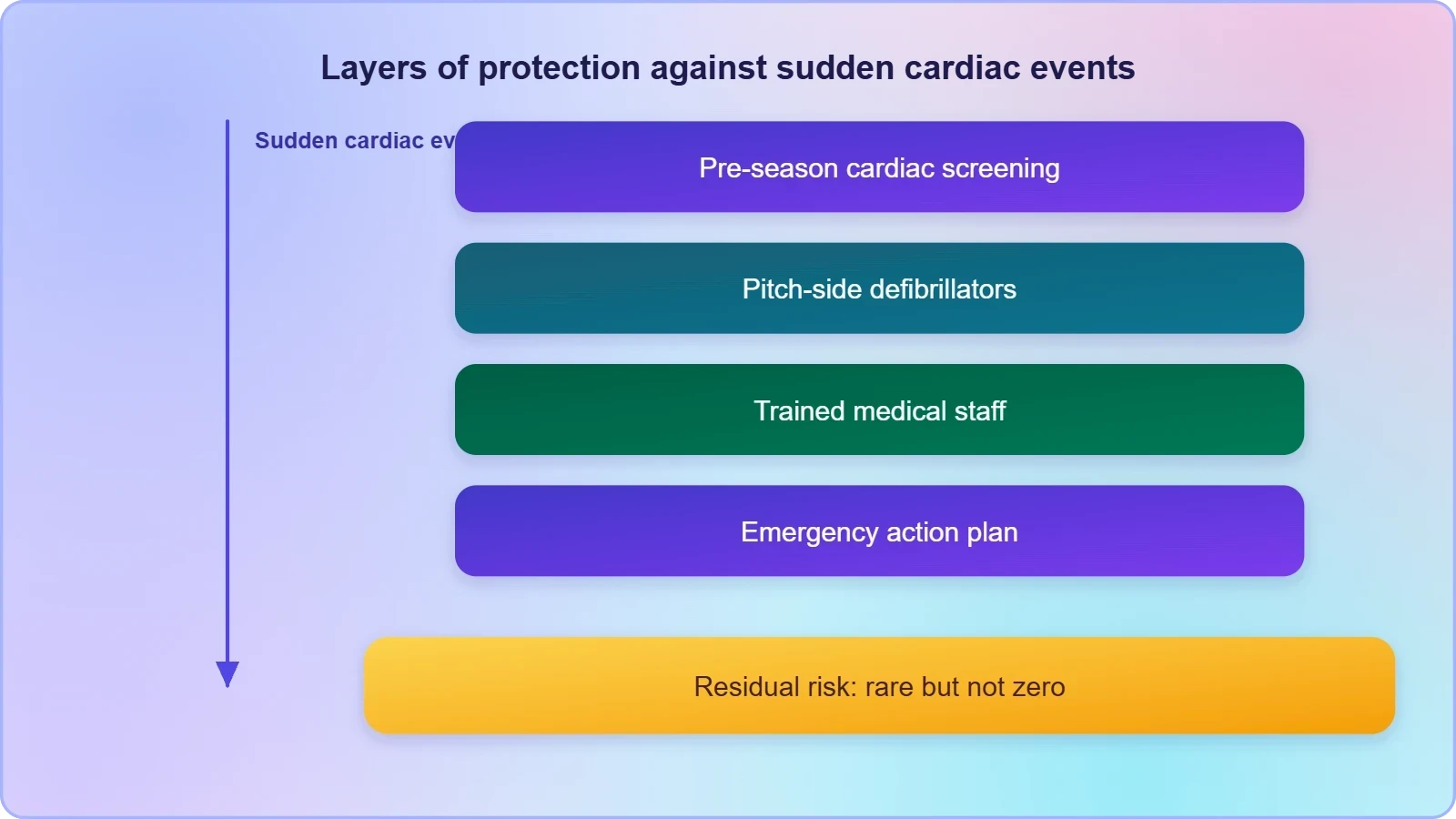
Professional football has become markedly more sophisticated in its approach to player health over the past two decades, with mandatory pre-season cardiac screening, pitch-side defibrillators and trained medical staff now standard across major leagues. Yet the death of a 30-year-old athlete in the middle of a competitive match exposes the boundary between preparation and outcome. Screening can identify known risk factors, and emergency response can restore circulation, but neither can guarantee survival when a cardiac event occurs during physical exertion, and the sport must reckon with the uncomfortable truth that its protocols reduce risk rather than eliminate it.
Screening, Response and Residual Risk
Cardiac arrest in athletes is statistically rare, but its occurrence on live television carries a disproportionate symbolic weight because it contradicts the assumption that elite fitness equates to invulnerability. Medical literature consistently notes that while screening programmes detect conditions such as hypertrophic cardiomyopathy, a proportion of events occur in athletes with no previously identified abnormality. The reported resuscitation of De Miguel at the stadium suggests that emergency protocols functioned as intended, yet the subsequent neurological deterioration illustrates that restoring a heartbeat is only the first stage of a chain whose later links may fail despite best efforts.
The investigation opened under judicial supervision will examine the circumstances surrounding the collision and the medical response, a process that serves both legal and preventive purposes. Spanish authorities routinely place such inquiries under judicial oversight when a death occurs in circumstances requiring independent assessment, and the findings may inform future guidance on pitch-side emergency procedures. For clubs and leagues, the more immediate question is whether existing protocols are sufficiently rehearsed and whether stadium medical teams have the equipment, staffing and authority to act without hesitation in the critical minutes after a collapse.
The Psychological Dimension of Club Duty
Tenerife's public acknowledgment that its squad would need professional help reframes the conversation around welfare in a way that extends beyond cardiology. A team that witnesses a colleague's death on the pitch, and a goalkeeper who was directly involved in the collision, require sustained psychological support that cannot be delivered through a single counselling session. The club's decision to postpone fixtures against Granada and Badajoz, pending discussions with the RFEF, reflects an understanding that competitive rhythm must be interrupted to allow mourning, and that returning to play too quickly can compound trauma rather than dispel it.
There is also a broader cultural question about how football discusses mortality. The sport's vocabulary of resilience and next-man-up mentality can leave little room for visible vulnerability, and the instinct to resume fixtures quickly may conflict with the needs of players who are grieving. Mourinho's observation that the situation must be "very, very, very difficult" for Owono is a rare public acknowledgment that the opposing player is also a victim of circumstance, deserving of sympathy rather than blame, and that the sport's disciplinary framework is poorly equipped to address moral injury of this kind.
- 01
- 02
- 03
- 04
The Judicial Inquiry and Questions of Accountability
Spanish police sources told AFP that an investigation into the incident has been opened under judicial supervision, a development that moves the matter beyond the realm of sporting governance into the legal sphere. Such inquiries are not necessarily indicative of suspected wrongdoing; they are a procedural mechanism for establishing facts when a death occurs in circumstances that require independent examination. The investigation will likely consider the nature of the collision, the adequacy and timing of the medical response, and whether any regulatory obligations were unmet, with findings potentially informing future safety standards.
What the Investigation Will Examine
The scope of a judicial inquiry in this context typically encompasses witness statements from players and officials, video evidence, medical records and testimony from pitch-side staff. The central questions are factual rather than accusatory: what happened in the moments before and after the collision, how quickly medical assistance arrived, and whether the stadium's emergency infrastructure performed as designed. The fact that De Miguel was reportedly resuscitated at the ground suggests that intervention began promptly, but the inquiry may still examine whether any delay or deficiency contributed to the eventual outcome.
For FC Andorra and its goalkeeper, the investigation carries an additional dimension, since Owono's challenge, while apparently a standard foul, will be scrutinised within a legal framework rather than a disciplinary one. Spanish law distinguishes between negligent and accidental harm, and the inquiry's conclusions will determine whether the matter proceeds further or is closed as a tragic accident. Regardless of outcome, the process imposes a further burden on a player already grappling with the psychological consequences of the incident, and the football community's expressions of sympathy for Owono reflect an awareness of that weight.
Precedent and Regulatory Implications
Football has confronted similar tragedies before, and the regulatory responses have generally focused on improving emergency preparedness rather than assigning individual blame. The widespread adoption of defibrillators at stadiums, the expansion of cardiac screening and the standardisation of pitch-side protocols all emerged from earlier incidents that exposed gaps in provision. The De Miguel case is likely to prompt a review of whether current standards are uniformly applied across lower divisions, where resources are thinner than in the top flight, and whether the medical teams at second-division grounds meet the same benchmarks as their elite counterparts.
There is also a question about the adequacy of support for players who witness such events. The sight of a colleague receiving CPR on the pitch is profoundly distressing, and the psychological aftermath can affect performance, relationships and mental health for months or years. Clubs that invest in counselling and structured debriefing after traumatic incidents are better positioned to protect their squads, and the willingness of Tenerife's leadership to acknowledge that need publicly may encourage other clubs to treat psychological support as a core obligation rather than an optional extra.
We Also Published
A Sport United in Grief and Reflection
The breadth of the response — from Real Madrid's minute of silence to messages from Messi and Nadal, from UEFA's continental gesture to the postponement of domestic cup fixtures — demonstrates football's capacity for collective mourning when a tragedy transcends club loyalties. Rivalries that structure the sport's daily discourse were suspended, however briefly, in recognition that a 30-year-old man had died while doing his job. The tributes were not merely ceremonial; they signalled that the football community understood the incident as a human loss rather than a fixture disruption, and that the appropriate response was solidarity rather than scheduling efficiency.
Solidarity Across Rivalries
The involvement of FC Andorra added a layer of moral complexity that the sport handled with notable grace. Rather than allowing the collision to become a source of recrimination, Andorra offered condolences to De Miguel's family and Tenerife, and Piqué's personal message expressed sorrow without defensiveness. Mourinho's explicit sympathy for Owono extended that grace to the individual most directly implicated, recognising that a goalkeeper who came out to clear a ball and collided with an opponent carries a burden no disciplinary process can address. These gestures matter because they establish a template for how football might respond to future tragedies.
The presence of figures from outside Spanish football — Mbappé, Messi, Nadal, Arteta — reflects the sport's globalised character and the way in which local tragedies now resonate internationally within hours. Social media accelerates both the spread of news and the expression of condolence, creating a shared space of grief that can be genuinely supportive but also fleeting. The challenge for football's institutions is to translate that momentary solidarity into durable commitments: better medical provision, sustained psychological support, and a willingness to treat player welfare as a continuous obligation rather than a reactive one.
What Endures After the Tributes Fade
Tributes fade, fixtures resume, and the news cycle moves on, but the structural questions raised by De Miguel's death will persist. The judicial investigation will produce findings, the RFEF may review its protocols, and clubs may reconsider their psychological support arrangements. Whether those processes yield meaningful change depends on whether the sport treats this incident as an anomaly to be mourned and forgotten or as evidence of gaps that require systematic attention. The precedent of previous tragedies suggests that reform tends to follow scrutiny, and the scrutiny here has been unusually broad.
For Tenerife, the immediate task is to support a squad in mourning and to honour the memory of a player who died in the club's colours. For Spanish football, the task is to ensure that the lessons of this incident are absorbed rather than archived. The most fitting tribute to Jesús de Miguel would be a sport that takes the physical and psychological safety of its players more seriously than it did before, and that extends that care to everyone affected by a collision that no one could have foreseen.
The Human Cost Behind the Headlines
Amid the statements, investigations and scheduling decisions, the irreducible fact remains that a family lost a son, a partner or a father, and a squad lost a teammate. Jesús de Miguel was 30 years old, a striker plying his trade in Spain's second division, a professional whose career unfolded largely outside the glare that attends the sport's biggest names. His death has been mourned by Mbappé and Messi, but it will be felt most acutely by those who knew him daily: the Tenerife players who shared a dressing room with him, the staff who prepared his kit, and the supporters who watched him play at the Heliodoro Rodríguez López stadium.
Remembering the Person Behind the Player
Public tributes tend to compress a life into a few sentences, and the coverage of De Miguel's death has inevitably focused on the circumstances rather than the man. Yet the scale of the response — from the RFEF's postponements to the minute's silence across European competitions — suggests that the football community recognised something beyond a statistical loss. A 30-year-old athlete in the prime of his career, struck down in an ordinary moment of competitive contact, represents a confrontation with mortality that resonates because it could happen to anyone who steps onto a pitch.
The club's statement, with its admission that "no words can ease the pain, nothing can lessen this great feeling of sadness," captured the inadequacy of public language in the face of private grief. Tenerife's president spoke of professional help for the squad, a practical acknowledgment that mourning requires structure and support. These are the responses that matter most in the immediate term, and they deserve to be reported alongside the tributes from global stars, because they reflect how a club cares for its people when the cameras have moved on.
Lessons for a Sport That Plays On
Football will continue, as it must, and the next round of fixtures will proceed with a minute's silence and black armbands before the rhythm of competition reasserts itself. The question is what the sport carries forward from this moment. If the answer is only a series of ceremonial gestures, then the death of Jesús de Miguel will have been mourned without being learned from. If the answer includes a genuine review of medical provision, psychological support and the treatment of players involved in such incidents, then the tragedy may leave a legacy that protects others.
The judicial investigation will establish facts, and the football authorities will decide what to do with them. Supporters, meanwhile, will remember a striker who died doing what he had trained his whole life to do, and they will expect the institutions that profit from his profession to honour that memory with more than words. That expectation is the most durable form of accountability, and it is one that the sport's governing bodies would do well to anticipate rather than resist.
From our network :
- The Final Descent: How ESA Retired the Legendary Cluster Constellation After 24 Years of Space Weather ScienceAfter 24 years mapping Earth’s magnetosphere, ESA’s Cluster mission concluded with a precisely controlled reentry over the South Pacific. This analysis explores the scientific legacy, engineering decisions, and debris mitigation principles behind one of space exploration’s most responsible retirements.
- Live Online English Classes for Kids: Do They Actually Reduce Anxiety?A ten-week study reveals that synchronous online English classes can significantly reduce child language anxiety while improving listening and reading skills. Discover what makes these programs effective and how parents can select the right one.
- University Language Proficiency Exams: Why Institutional Tests Demand Different Preparation Than IELTS and TOEFLDiscover why university-specific language proficiency examinations differ fundamentally from IELTS and TOEFL, and learn strategic preparation approaches for institutional assessment success.
- CISA’s Ten-Advisory Wave: Why Generic Patching Fails in OT and How to Build Product-Specific PlaybooksCISA released ten ICS advisories in one week, exposing critical infrastructure risks. Generic patching fails in OT. Learn to build product-specific remediation playbooks.
- How AI Agents Will Change the Way We Manage Personal FinancesExplore how AI agents are transforming personal finance through automated budgeting, bill payment, and investment management, while examining the critical security protocols and governance frameworks required for safe deployment.
- Forbidden Matrix Patterns and Visible Lattice Points: A Geometric DictionaryExplore how multidimensional 0–1 matrices encode geometric truths, linking forbidden patterns to visible lattice points and hypergraph theory, with applications in combinatorics and computational geometry.
- Mobile Learning and VR in English: What Global Evidence Reveals About Effective Language TechnologyA systematic review across 14 countries reveals which language-learning technologies genuinely work. Mobile learning, AI, and VR show measurable benefits when pedagogically integrated. This evidence-based guide helps educators and learners select technology that delivers real return on investment.
- The Hidden Cost of AI Convenience: Why Over-Permissioned Agents Are a Security Time BombDiscover why AI agents with excessive permissions create dangerous single points of failure, and learn how implementing least privilege principles can protect your organization from exploitation.
- Committed Mediterranean Precipitation Decline: Why Emissions Cuts Alone Cannot Restore Winter RainsNew NOAA research reveals that Mediterranean winter rains may decline irreversibly even with emissions cuts. Explore the science of committed climate change and regional impacts.
RESOURCES
- Resources will be updated soon.
- 01
- 02
- 03
- 04
- 05
- 06
- 07
- 08
0 Comments