
Manitoba's decision to abandon the twice-yearly clock change and settle permanently into daylight time represents far more than a minor administrative adjustment. It is a deliberate policy choice that reshapes the daily rhythm of an entire province, trading brighter winter evenings for darker winter mornings.
Premier Wab Kinew confirmed the shift in a September 17 interview with 680 CJOB, framing it as a direct response to overwhelming public preference rather than an arbitrary bureaucratic decision.
The province reports that 92 per cent of Manitobans wanted the seasonal switching to end, a figure that lends the move considerable democratic weight.
On This Page
- The Policy Decision and Its Democratic Mandate
- Operational Consequences for IT and Scheduling Systems
- Business Adaptation and the Chamber's Pragmatic Response
- Health, Safety, and the Human Cost of Darker Mornings
- Economic Ripple Effects and Cross-Border Coordination
- What Manitoba's Decision Signals for Time Policy
What makes this transition instructive is how it distributes its consequences across very different constituencies. Information technology teams must audit servers, scheduling platforms, and time-zone databases that were configured around the old fall-back assumption.
Construction crews, farmers, and outdoor trades face winter start times that will now begin in genuine darkness rather than the muted dawn they previously knew. Meanwhile, the Winnipeg Chamber of Commerce has adopted a pragmatic posture, with president Loren Remillard acknowledging the disruption while insisting that business will simply find ways to adapt to what residents chose.
Manitoba now joins Alberta, British Columbia, the Northwest Territories, and parts of Northwestern Ontario in ending the seasonal time change, forming a quiet but growing bloc of jurisdictions that have concluded the ritual of shifting clocks twice a year no longer serves them.
This analysis examines the operational, economic, and human dimensions of that decision, from system reconfiguration to workplace safety, and considers what other regions contemplating similar moves can learn from Manitoba's experience.
TL;DR Manitoba has permanently adopted daylight time, ending the twice-yearly clock change after 92 per cent of residents expressed support for the move. The decision brings darker winter mornings that affect IT systems, construction schedules, and daily routines, while business leaders describe the shift as noticeable but manageable. Manitoba joins Alberta, British Columbia, the Northwest Territories, and parts of Northwestern Ontario in abandoning seasonal time changes, signalling a broader Canadian drift toward fixed-time governance.
The Policy Decision and Its Democratic Mandate
Permanent daylight time is not a neutral technical setting; it is a governance choice with measurable distributional effects across a population. Manitoba's government anchored its decision in consultation data showing near-unanimous public appetite for ending the clock change, which gives the policy a legitimacy that purely administrative reforms often lack.
Premier Wab Kinew's public confirmation in mid-September positioned the move as responsive rather than imposed, a distinction that matters enormously for public acceptance.
Reading the 92 Per Cent Mandate
A 92 per cent preference figure is unusually decisive for any policy question, and it suggests that clock-changing fatigue had accumulated well beyond the usual complaints. Residents rarely agree on anything at that scale, so the number should be read as a signal that the inconvenience of biannual adjustment had become a genuine irritant. The government has used that consensus to justify a permanent structural change rather than another temporary review.
Yet consensus on ending the switch does not automatically translate into consensus on which time to keep. Permanent daylight time means winter sunrises arrive later, and some residents who wanted stable clocks may have preferred permanent standard time instead.
The province has effectively resolved that ambiguity in favour of daylight time, and the practical consequences of that specific choice are what businesses now confront.
Manitoba Within a Wider Canadian Pattern
Manitoba is not acting in isolation. Alberta, British Columbia, the Northwest Territories, and parts of Northwestern Ontario have already ended seasonal time changes, creating a patchwork of fixed-time jurisdictions across the country.
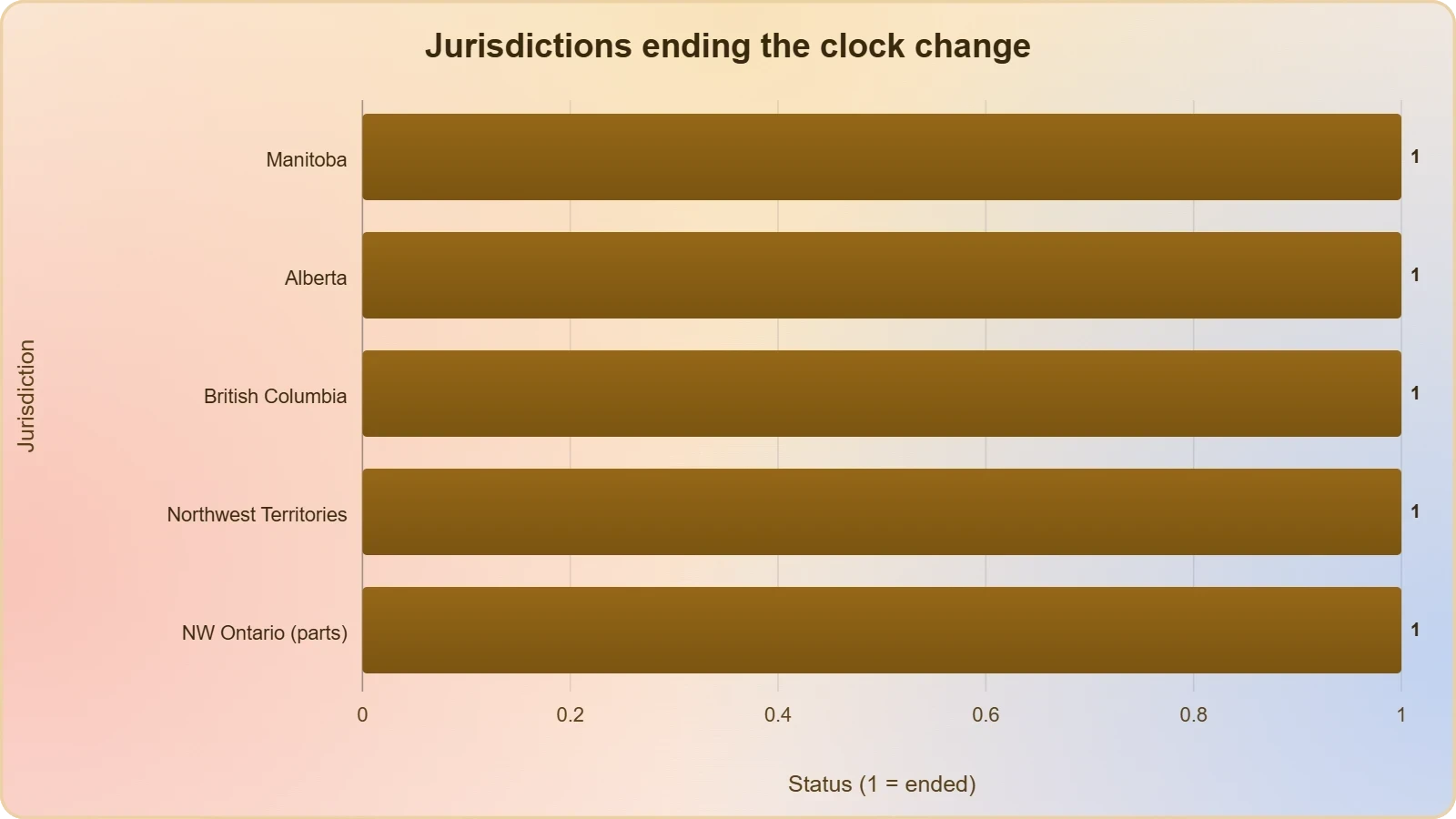
That clustering reduces the coordination problem considerably, since neighbouring provinces sharing the same approach limit the confusion that fragmented time zones would otherwise create for travellers and traders.
Still, the Canadian landscape remains uneven, with some provinces retaining the traditional switch. For businesses operating across provincial boundaries, the result is a calendar of regional exceptions that must be tracked carefully. Manitoba's move therefore strengthens a continental trend without yet producing the uniform national standard that logistics planners might prefer.
Operational Consequences for IT and Scheduling Systems
Behind every clock change sits an invisible layer of software that assumes the change will happen. Manitoba's permanent shift invalidates that assumption for any system configured to observe the old fall-back transition, and the remediation burden falls squarely on IT teams.
Servers, calendaring platforms, payroll systems, and time-zone databases all encode regional rules that must now be corrected or risk producing silent, compounding errors.
Time-Zone Databases and Server Configuration
Most modern operating systems rely on the IANA time-zone database, which publishes regional rule updates that administrators must apply deliberately. A jurisdiction abandoning seasonal change requires a rule revision, and systems that fail to receive it may continue shifting clocks automatically.
The result can be appointments logged an hour off, batch jobs firing at the wrong moment, and audit trails that no longer reconcile cleanly.
Prudent IT teams will treat the transition as a change-management event rather than a routine patch. That means inventorying every service that references Manitoba time, testing scheduled tasks against the new rules, and confirming that third-party vendors have updated their own configurations.
The work is unglamorous but consequential, since undetected drift in time handling can quietly corrupt financial and operational records.
Workforce Scheduling and Payroll Alignment
Payroll and shift-scheduling systems face a parallel challenge, because hourly workers are paid according to recorded clock times. When the seasonal fall-back disappears, the familiar extra hour that appeared once a year vanishes from the calculation, and any system that anticipated it must be recalibrated. Employers should verify that overtime thresholds and shift differentials still compute correctly under the new fixed regime.
Construction firms and trades face the most visible scheduling adjustment, since winter work will now begin before sunrise for much of the season. Site managers may need to revisit start times, lighting provisions, and safety briefings to account for crews working in darkness. These are practical adaptations rather than crises, but they require deliberate planning rather than passive acceptance.
Business Adaptation and the Chamber's Pragmatic Response
The Winnipeg Chamber of Commerce has chosen accommodation over resistance, and its public stance offers a useful model for how institutions absorb policy shifts they did not design. Loren Remillard's remark that the North American time map now looks "a lot uglier" than it did in October is candid without being obstructive.
His conclusion that business adjusts and will find ways to adapt reflects a mature recognition that the decision belongs to residents.
Reading the Chamber's Position
Chamber leaders occupy an awkward position when a popular policy imposes costs on members, since opposing it outright risks appearing indifferent to public will. Remillard's framing threads that needle by acknowledging disruption while affirming adaptability.
The message reassures members that the sky has not fallen, and it signals to government that business expects practical support rather than symbolic gestures.
That posture also buys credibility for future advocacy. A chamber that accepts a democratic outcome gracefully retains standing to press for transitional assistance, such as guidance on scheduling adjustments or support for affected trades.
Confrontation would have spent political capital on a fight the province had already decided, with little prospect of reversal.
Consumer Behaviour and Seasonal Commerce
Darker mornings alter consumer routines in ways that ripple through retail and services. Commuters may shift errands to evening hours, when daylight now lingers longer, potentially reshaping foot traffic patterns for shops and restaurants. Businesses that track hourly demand should watch for gradual changes rather than assuming last year's patterns will hold.
Seasonal industries face sharper adjustments. Outdoor recreation, landscaping, and agriculture depend on usable daylight, and a later winter sunrise compresses the productive morning window. Operators in these sectors will need to rebalance staffing and equipment schedules, and some may discover offsetting benefits from extended evening light during warmer months.
Health, Safety, and the Human Cost of Darker Mornings
Time policy is ultimately health policy, because circadian rhythms respond to light exposure rather than to legislative intent. Later winter sunrises mean many Manitobans will commute and begin work before dawn, reducing morning light exposure that helps regulate sleep and alertness.
The consequences are subtle but real, and they deserve more attention than the abstract debate over clock settings usually receives.
Circadian Effects and Sleep Quality
Morning light is a powerful synchroniser of the body's internal clock, and delaying sunrise effectively pushes the biological morning later for people whose schedules remain fixed. Researchers studying permanent daylight time have noted associations with reduced sleep duration and increased fatigue during winter months. These effects are not catastrophic, but they accumulate across a season.
Public health researchers have long cautioned that permanent daylight time may be less favourable to circadian health than permanent standard time, which aligns clock time more closely with solar time. Manitoba has chosen the option residents preferred rather than the one sleep scientists might recommend. That tension between democratic preference and physiological evidence is worth acknowledging honestly.
Workplace Safety in Low-Light Conditions
Construction sites, warehouses, and outdoor workplaces become more hazardous when work begins in darkness, particularly during winter when surfaces may be icy. Employers carry a duty to provide adequate lighting, high-visibility equipment, and clear safety briefings for crews starting before sunrise. These measures are familiar from northern winters but will now apply more broadly.
Road safety also warrants attention, since darker commutes coincide with pedestrian traffic and school journeys. Municipalities may need to review street lighting and crossing provisions in areas where morning activity now occurs before dawn.
The costs are modest relative to the risks, and proactive planning can prevent avoidable incidents during the first winter under the new regime.
Economic Ripple Effects and Cross-Border Coordination
Time zones are infrastructure, and infrastructure changes generate externalities that extend well beyond the jurisdiction that acts. Manitoba's fixed offset alters its relationship with trading partners, transport schedules, and financial markets, even if the effects are modest in aggregate.
Firms operating across provincial and international borders must now track a regional exception that did not previously exist.
- 01
- 02
- 03
- 04
Trade, Transport, and Market Timing
Logistics operators depend on predictable time alignment to coordinate shipments, customs filings, and driver hours. A province that no longer shifts with its neighbours introduces a seasonal offset that must be modelled explicitly in routing software.
The adjustment is manageable, but it adds a layer of complexity that automated systems must be taught to handle.
Financial and professional services face subtler timing questions, since meetings and market hours are scheduled against reference clocks. Manitoba firms dealing with Toronto, Chicago, or New York will experience a shifting offset relative to those centres during parts of the year. Calendar tools that assume synchronized seasonal changes may produce confusion unless configured correctly.
Precedent for Other Jurisdictions
Manitoba's experience offers a template for other regions weighing similar moves, particularly those where public opinion strongly favours ending the clock change. The province has demonstrated that a government can act on a clear mandate, absorb the transitional friction, and rely on business pragmatism to close the gap. That is a useful precedent for legislators elsewhere.
It also illustrates the limits of unilateral action. Without continental coordination, each jurisdiction that abandons seasonal change adds another exception to an already complicated map. The long-term resolution likely lies in broader agreement, but in the meantime, Manitoba's decision shows that waiting for perfect harmony is not the only option available.
What Manitoba's Decision Signals for Time Policy
Manitoba's adoption of permanent daylight time is best understood as a case study in how modern governments handle low-stakes but high-salience policy questions. The clock change was never a major ideological battleground, yet it generated persistent public irritation that eventually demanded resolution. By acting on a clear mandate, the province converted diffuse annoyance into a settled rule.
Lessons for Legislators and Administrators
The first lesson is that consultation data matters enormously when a policy imposes uneven costs. Manitoba's 92 per cent figure gave the government cover to proceed despite predictable objections from affected sectors.
Administrators elsewhere should invest in credible polling before committing, because a strong mandate is the most effective answer to interest-group resistance.
The second lesson concerns implementation. A time change touches systems, schedules, and habits simultaneously, and the transition succeeds or fails on the quality of operational preparation. Governments that pair policy announcements with practical guidance for employers and IT teams will encounter far less friction than those that leave adaptation entirely to the market.
The Unfinished Question of Continental Alignment
Manitoba has resolved its own question but not the broader North American one. As more jurisdictions abandon seasonal change, the continent drifts toward a patchwork of fixed offsets that no single authority coordinates.
That fragmentation is tolerable in the short run but inefficient over time, particularly for industries that operate across borders continuously.
The eventual resolution likely requires federal leadership in both Canada and the United States, or at minimum a coordinated regional compact among neighbouring provinces and states. Until then, Manitoba's decision stands as a pragmatic local answer to a continental question, and as evidence that public preference can move policy even without perfect harmony.
From our network :
- Mobile Learning and VR in English: What Global Evidence Reveals About Effective Language TechnologyA systematic review across 14 countries reveals which language-learning technologies genuinely work. Mobile learning, AI, and VR show measurable benefits when pedagogically integrated. This evidence-based guide helps educators and learners select technology that delivers real return on investment.
- Forbidden Matrix Patterns and Visible Lattice Points: A Geometric DictionaryExplore how multidimensional 0–1 matrices encode geometric truths, linking forbidden patterns to visible lattice points and hypergraph theory, with applications in combinatorics and computational geometry.
- Live Online English Classes for Kids: Do They Actually Reduce Anxiety?A ten-week study reveals that synchronous online English classes can significantly reduce child language anxiety while improving listening and reading skills. Discover what makes these programs effective and how parents can select the right one.
- The Hidden Cost of AI Convenience: Why Over-Permissioned Agents Are a Security Time BombDiscover why AI agents with excessive permissions create dangerous single points of failure, and learn how implementing least privilege principles can protect your organization from exploitation.
- University Language Proficiency Exams: Why Institutional Tests Demand Different Preparation Than IELTS and TOEFLDiscover why university-specific language proficiency examinations differ fundamentally from IELTS and TOEFL, and learn strategic preparation approaches for institutional assessment success.
- Committed Mediterranean Precipitation Decline: Why Emissions Cuts Alone Cannot Restore Winter RainsNew NOAA research reveals that Mediterranean winter rains may decline irreversibly even with emissions cuts. Explore the science of committed climate change and regional impacts.
- How AI Agents Will Change the Way We Manage Personal FinancesExplore how AI agents are transforming personal finance through automated budgeting, bill payment, and investment management, while examining the critical security protocols and governance frameworks required for safe deployment.
- CISA’s Ten-Advisory Wave: Why Generic Patching Fails in OT and How to Build Product-Specific PlaybooksCISA released ten ICS advisories in one week, exposing critical infrastructure risks. Generic patching fails in OT. Learn to build product-specific remediation playbooks.
- The Final Descent: How ESA Retired the Legendary Cluster Constellation After 24 Years of Space Weather ScienceAfter 24 years mapping Earth’s magnetosphere, ESA’s Cluster mission concluded with a precisely controlled reentry over the South Pacific. This analysis explores the scientific legacy, engineering decisions, and debris mitigation principles behind one of space exploration’s most responsible retirements.
RESOURCES
- Manitoba Will Move to Permanent Daylight Saving Timenews.gov.mb.caSep 17, 2026 ... The Manitoba government is working closely with organizations, businesses and industry partners as it works to implement permanent DST, the ...
- Permanent Daylight Time: What It Means for Manitoba Businessesmbchamber.mb.caSep 18, 2026 ... The Manitoba government recently announced that the province will remain on daylight saving time permanently, ending the twice-yearly time ...
- Outlook Time Zone Changes for British Columbia, Alberta, and ...support.microsoft.com2 days ago ... Effective November 1, 2026, users in the Canadian provinces of British Columbia, Alberta, and Manitoba will stay on permanent Daylight…
- Manitoba time change could have some impacts in North Dakota ...grandforksherald.comSep 28, 2026 ... PEMBINA, N.D. — The Manitoba government earlier this month announced a permanent adoption of daylight saving time, meaning residents will…
- More Canadian provinces are ending time changes. What ... - CBCcbc.ca5 days ago ... Researchers are raising concerns as parts of Canada move to permanent daylight time, warning that later winter sunrises could have ...
- Manitoba has adopted permanent daylight savings time ... - Facebookfacebook.comSep 20, 2026 ... Winter will have provinces who stayed with DST getting up and going to school/work in the dark and children walking…
- Manitoba to stick with daylight time year-round : r/canada - Redditreddit.comSep 17, 2026 ... The adaptation is so distinct that residents in Xinjiang use an unofficial time ... Manitoba adopts permanent daylight time |…
- Businesses adjust to darker mornings and schedules in new ...globalnews.ca19 hours ago ... Businesses adjust to darker mornings and schedules in new Manitoba Standard Time. Manitobans are adapting to a new time zone…
- Manitoba wrong to choose daylight over standard time, sleep ...reddit.comSep 19, 2026 ... ... time, but plenty of people are driving to work before sunrise already. ... Manitoba adopts permanent daylight time |…
- How does daylight saving time work in Canada's western provinces?cwf.caMar 6, 2026 ... ... Standard Time, to adapt to any time zone changes. Manitoba. The Province of Manitoba announced a move to permanent…
- Manitoba adopts permanent daylight time - The Weather Networktheweathernetwork.comSep 17, 2026 ... The province is working with organizations, businesses and industry partners to adapt to the change, he said. Manitoba enacted the…
- Eligibility - Skilled Worker Overseas - Manitoba Immigrationimmigratemanitoba.com... work experience, education, and adaptability. If you do not have a ... Manitoba as permanent residents. Frequently asked questions. Can children support ...
- Manitoba's switch to permanent daylight savings time will mean ...sasktoday.caOct 21, 2026 ... Cross border workers adjust. For Elkhorn resident Brady Rhodes, crossing the provincial boundary is part of his regular work schedule.…
- Businesses will need to adapt - Okanagan Edgeokanaganedge.net4 days ago ... Manitoba Chambers of Commerce gauged members' views on the time change and found 54% supported the move to permanent daylight…
- Daylight saving time - Wikipediaen.wikipedia.orgBritish Columbia, Alberta, Manitoba, parts of northwestern Ontario, and the Northwest Territories switched to using permanent DST in 2026. Procedure.
- 01
- 02
- 03
- 04
- 05
- 06
- 07
- 08
0 Comments