On a single Tuesday afternoon in early November 2026, Wall Street delivered a compact lesson in how modern equity markets actually process fear. A selloff rooted in anxiety over artificial intelligence spending gave way to a measured recovery, with the S&P 500 closing up 0.37% and the tech-heavy Nasdaq climbing 0.83%, while the Dow slipped 0.38% as Apple dragged on the index. The episode matters less for its daily percentages than for what it reveals: capital markets now treat AI capital expenditure as a structural pillar of valuation, and any tremor in that pillar is felt across semiconductors, infrastructure, and the broader growth complex within hours.
The mechanics of the rebound deserve careful reading. Nvidia recovered 2.3% after four consecutive sessions of decline, and chipmakers including Advanced Micro Devices, Broadcom, and Micron Technology moved higher alongside it. That synchronized bounce was not accidental. It reflected a rapid reassessment by institutional investors who concluded that concerns about AI spending were cyclical noise rather than a signal of demand destruction. Meanwhile, Apple's weaker-than-expected margin forecast, attributed to rising memory chip costs, illustrated a subtler tension: the same component inflation that pressures device makers also signals robust demand across the semiconductor supply chain.
Beneath the ticker tape, three forces converged to shape the session. The Nasdaq had entered correction territory on Monday, down 10% from its October 6 peak, capping its largest monthly decline since March 2025. Midterm elections unfolded without the disruption many feared, and falling Brent crude, down to $103 a barrel from $117 at the end of October, offered relief on the inflation front. This analysis unpacks each of these threads, examines the historical pattern of post-election market behavior, and considers what the episode signals about the durability of the AI investment cycle heading into 2027.
On This Page
- The Anatomy of an AI-Driven Selloff and Recovery
- Apple's Margin Warning and the Cost of Components
- Oil, Elections, and the Macro Backdrop
- Historical Patterns of Post-Election Market Behavior
- The AI Investment Cycle and Year-to-Date Performance
- Regulatory Risk and the Political Dimension of AI
- What the Rebound Signals for Investors
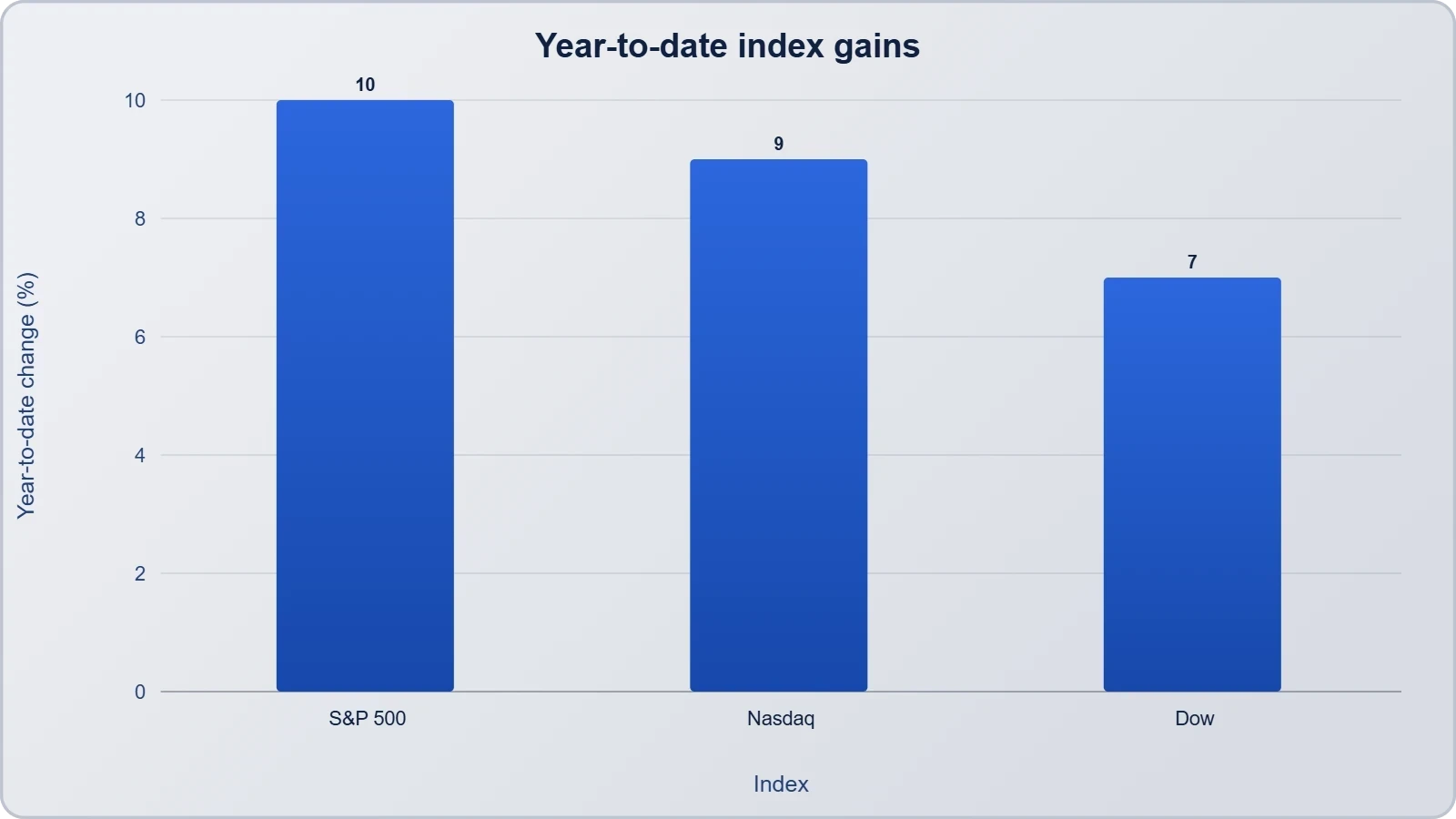
TL;DR US technology stocks rebounded on Tuesday afternoon after an AI spending scare triggered a brief but sharp selloff, with the S&P 500 gaining 0.37% and the Nasdaq rising 0.83% while the Dow fell 0.38% on Apple's margin warning. Nvidia's 2.3% recovery led chipmakers higher, ending a correction that had pushed the Nasdaq 10% below its October 6 peak. Falling oil prices, settling midterm election results, and continued confidence in AI infrastructure spending all contributed to the turnaround. Year-to-date, the S&P 500 remains up 10%, the Nasdaq 9%, and the Dow 7%, underscoring that the AI investment thesis, however volatile, continues to anchor American equity valuations.
The Anatomy of an AI-Driven Selloff and Recovery
The selloff that preceded Tuesday's rebound was neither long nor deep, but its composition was instructive. Investors had spent weeks questioning whether the enormous capital expenditures flowing into data centers, GPU clusters, and power infrastructure could generate returns commensurate with their scale. When that doubt crystallized into selling pressure last week, the Nasdaq bore the brunt, sliding into correction territory by Monday, exactly 10% below its October 6 peak. The October decline was the index's largest monthly fall since March 2025, a reminder that momentum in growth equities can reverse with remarkable speed when the underlying narrative wobbles.
Why the Correction Was Shallow and Short-Lived
The recovery arrived quickly because the selling thesis lacked a fundamental trigger. No major AI customer announced cancellations, no hyperscaler cut capital guidance, and no earnings report invalidated the demand story. Instead, the pressure came from valuation anxiety, the kind of sentiment-driven repricing that tends to exhaust itself once prices adjust. When Nvidia stabilized after four down sessions and chip peers followed, the market effectively voted that AI infrastructure spending remains intact. The episode resembled a pressure valve release rather than a structural break, and the speed of the bounce confirmed that most institutional portfolios remain positioned for continued AI-driven growth.
Apple's contribution to the session tells a complementary story. Its 1.9% decline, driven by a weaker profit margin forecast tied to higher memory chip costs, weighed on the Dow precisely because it inverted the usual narrative. Rising memory prices hurt device manufacturers but benefit memory producers, which is part of why Micron and Broadcom advanced. This divergence within technology itself demonstrates that "AI spending" is not a monolith; it redistributes value across the supply chain, rewarding component suppliers while compressing margins for assemblers. Investors who treat tech as a single trade miss these internal rotations, which often determine relative performance far more than index-level moves.
The Semiconductor Supply Chain as Market Bellwether
Semiconductor equities have become the market's de facto AI sentiment gauge, and Tuesday's session reinforced that role. Nvidia's 2.3% gain after four losing sessions functioned as a psychological anchor, but the broader chip complex, from AMD to Broadcom to Micron, moved in sympathy because their fortunes are intertwined with the same data center buildout. When investors worry about AI spending, they sell chips first; when they conclude the worry is overdone, they buy chips first. This reflexive relationship means chipmaker price action often leads index-level moves by hours or days, giving attentive investors an early read on whether a selloff is deepening or exhausting itself.
The memory cost dynamic adds a layer of complexity worth monitoring. Higher memory prices, the very factor behind Apple's margin warning, represent revenue growth for Micron and pricing power across the memory oligopoly. This creates a zero-sum texture within technology that index-level analysis obscures. A portfolio holding both device makers and memory producers may experience offsetting moves that mask genuine dispersion underneath. For analysts, the lesson is to decompose "tech exposure" into its supply chain segments, because the AI cycle distributes gains and pains unevenly, and the companies absorbing cost inflation are often different from those capturing it.
Apple's Margin Warning and the Cost of Components
Apple's 1.9% decline carried outsized weight because of what it signified rather than its magnitude. The company's weaker-than-expected profit margin forecast, explicitly attributed to higher memory chip costs, marked a rare admission that component inflation is biting at the device layer. Apple has historically managed its supply chain with legendary discipline, locking in favorable pricing and hedging exposure. When even Apple flags cost pressure, it suggests the memory upcycle has gathered enough force to challenge the most sophisticated procurement operations in the industry, a signal that reverberates through hardware manufacturers globally.
Reading Margin Guidance as a Macro Signal
Margin guidance from a company of Apple's scale functions as a macroeconomic indicator in miniature. Memory chips are inputs into smartphones, laptops, and increasingly into edge AI devices, so their pricing reflects demand from data centers competing for the same fabrication capacity. When hyperscalers absorb memory output for AI training clusters, consumer device makers face tighter supply and higher prices. Apple's warning therefore encodes information about the intensity of AI infrastructure demand, indirectly confirming that the spending concerns driving last week's selloff may have been overstated. The market's willingness to buy chip stocks while selling Apple shows investors understood this transmission mechanism clearly.
There is also a strategic dimension. Apple's margin compression could accelerate its push toward vertical integration, custom silicon, and alternative supplier arrangements, potentially reshaping its relationship with memory vendors over the medium term. Investors should watch whether the company responds with pricing actions, absorbing costs or passing them to consumers, because that choice affects inflation dynamics in consumer electronics. For now, the market treated the warning as a company-specific headwind rather than an industry-wide alarm, which is why the Dow's decline remained contained while the Nasdaq advanced. The divergence itself is the story: cost inflation at the device layer coexisting with prosperity at the component layer.
Oil, Elections, and the Macro Backdrop
Two macro variables softened the ground for Tuesday's recovery. First, Brent crude fell to $103 a barrel from $117 at the end of October, a decline that eased inflation expectations and improved the outlook for consumer spending. Lower energy costs function like a tax cut for households, and with many Americans citing cost of living as their primary voting concern, the timing mattered. Second, the midterm elections concluded without the chaos some investors had priced in. Although results pointed toward Democratic gains in the House and possibly the Senate, markets processed the outcome calmly, consistent with the historical pattern of relief following resolution of uncertainty.
Why Elections Matter Less Than Investors Fear
Wall Street's pre-election nervousness is a well-documented behavioral pattern: uncertainty compresses risk appetite, and once votes are counted, that compression releases regardless of the outcome. CNBC's historical data from 1980 to 2024 shows the market tends to rise after midterm elections, a regularity rooted in the removal of ambiguity rather than partisan preference. Investors may have legitimate concerns about expanded AI regulation under divided or Democratic-leaning government, but regulatory risk unfolds slowly, through legislation and agency rulemaking, while earnings and capital expenditure decisions unfold quarterly. The market's muted reaction suggests investors are prioritizing the AI earnings cycle over political forecasting.
Oil's decline deserves equal attention because it interacts with the AI story in underappreciated ways. Data centers are voracious electricity consumers, and energy costs feed directly into the operating economics of AI infrastructure. Cheaper crude, alongside possible new negotiations with Iran and Russia, reduces the input cost trajectory for the entire digital economy. It also relieves pressure on the Federal Reserve's inflation calculus, potentially supporting the easier financial conditions that growth equities require. When oil falls and elections resolve simultaneously, the market receives a double dose of clarity, which is precisely the environment in which risk assets tend to recover from sentiment-driven selloffs.
Historical Patterns of Post-Election Market Behavior
History offers a reassuring but imperfect guide. CNBC's dataset covering midterm elections from 1980 through 2024 shows that US equities have tended to rise in the twelve months following midterm votes, with the S&P 500 posting gains in the large majority of post-election years. The mechanism is straightforward: elections resolve uncertainty about fiscal policy, regulation, and legislative control, allowing investors to price known risks rather than a distribution of possible outcomes. The pattern does not guarantee returns, but it explains why the market's pre-election anxiety so often gives way to post-election relief, a rhythm visible in Tuesday's session.
What the Data Says and What It Cannot Promise
Investors should treat historical post-election performance as context, not prophecy. The sample of midterm elections is small, and each cycle unfolds against a unique macro backdrop; the 2026 environment features an AI capital expenditure boom, elevated but falling oil prices, and a Federal Reserve navigating a delicate inflation path. The historical tendency for markets to rise after elections reflects the general upward drift of equities and the resolution of uncertainty, not a mechanical law. What the data legitimately supports is a behavioral insight: selling into election uncertainty has historically been a poor strategy, because the relief rally often begins before the results are fully digested.
The more actionable lesson concerns positioning. Markets that enter an election nervous and exit relieved tend to reward investors who maintain exposure through the anxiety. Tuesday's session fit this template precisely: the selloff peaked as uncertainty crested, and the recovery began as clarity returned. For long-term investors, the episode reinforces the value of distinguishing between sentiment-driven volatility and fundamental deterioration. The AI spending concerns that triggered last week's decline never produced evidence of demand destruction, and once the market recognized that absence, prices recovered quickly. Discipline through political noise remains one of the most reliable edges available to patient capital.
- 01
- 02
- 03
- 04
The AI Investment Cycle and Year-to-Date Performance
Despite October's turbulence, the year-to-date scorecard remains firmly positive: the S&P 500 is up 10%, the Nasdaq 9%, and the Dow 7%. Those figures matter because they contextualize the correction. A 10% drawdown from an October peak, following months of strong gains, represents profit-taking and sentiment adjustment rather than wealth destruction. The AI investment cycle, particularly in chips and infrastructure, continues to underwrite American equity valuations, and the capital flowing into data centers shows no sign of abating. Tuesday's rebound was, in this light, a reaffirmation that the structural thesis survives episodic anxiety.
Where the Capital Is Actually Flowing
The spending concerns that triggered the selloff deserve scrutiny on their merits. Hyperscalers continue to commit tens of billions of dollars annually to GPU clusters, custom accelerators, networking fabric, and the power infrastructure required to run them. Each dollar of that spending flows to Nvidia, Broadcom, Micron, and a widening ecosystem of suppliers, which is why chip stocks function as the cycle's leading indicator. Skeptics argue that returns on these investments remain unproven, and that is a legitimate long-term question. But in the near term, the spending is contracted, financed, and underway, which is why the market treated last week's selloff as an opportunity rather than an exit.
The infrastructure dimension is often underestimated. AI workloads demand electricity, cooling, and land at industrial scale, pulling utilities, construction firms, and equipment makers into the cycle. Falling oil prices ease operating costs across this ecosystem, reinforcing the economics of continued buildout. Investors monitoring the AI thesis should therefore watch power markets and capital expenditure guidance as closely as chip order books. The cycle's durability depends on whether revenue from AI services eventually justifies the infrastructure spending, a question that will resolve over years, not sessions. Tuesday's recovery simply confirmed that, for now, the market believes the answer will be yes.
We Also Published
Regulatory Risk and the Political Dimension of AI
Investors expect Democrats to win at least a majority in the House and possibly gain Senate seats, an outcome that could increase regulatory scrutiny of artificial intelligence. The market's calm response suggests that regulatory risk, while real, is being priced as a slow-moving variable rather than an immediate threat. AI oversight proposals typically move through committee hearings, agency rulemaking, and legislative negotiation over quarters or years, giving companies time to adapt. Moreover, both parties have shown interest in AI governance, meaning regulation is a question of degree and design rather than existence, which reduces the binary risk investors once feared.
How Regulation Could Reshape the AI Trade
The specific shape of future regulation matters enormously for equity valuations. Rules governing data privacy, model transparency, and compute thresholds could raise compliance costs for smaller AI developers while entrenching advantages for incumbents with legal and engineering resources. Conversely, aggressive antitrust action against hyperscalers could disrupt the integration strategies that currently drive infrastructure spending. Investors should monitor committee assignments and early legislative drafts for signals, but should resist overreacting to campaign rhetoric. The historical pattern is that industries facing new oversight adapt, litigate, and lobby, and the resulting rules rarely match the most alarming proposals floated during election season.
There is also a geopolitical overlay. AI leadership has become a matter of national competitiveness, and both parties support domestic semiconductor manufacturing through industrial policy. That bipartisan consensus protects much of the chip supply chain from adverse regulation, even as consumer-facing AI applications face stricter scrutiny. The net effect is likely to be uneven: infrastructure and manufacturing incentives persist, while application-layer companies confront compliance burdens. For portfolio construction, this argues for attention to regulatory exposure within the AI complex, distinguishing between companies that benefit from industrial policy and those that face heightened oversight risk in the years ahead.
What the Rebound Signals for Investors
The most durable takeaway from Tuesday's session is methodological. Markets distinguished between sentiment and fundamentals with unusual clarity, selling AI stocks on valuation anxiety and buying them back once no fundamental deterioration appeared. That behavior rewards investors who maintain a framework for separating narrative from evidence. The AI spending concerns were real but unproven; the demand data remained strong; the correction therefore functioned as a valuation reset rather than a regime change. Recognizing this pattern in real time is difficult, but the discipline of asking whether a selloff reflects changed facts or changed feelings remains the most reliable guide through episodes like this one.
Positioning for a Volatile but Intact Uptrend
For portfolio construction, the episode argues for diversification within technology rather than away from it. The divergence between Apple and the chipmakers shows that supply chain positioning determines outcomes even when the sector-level narrative is uniform. Investors might consider balancing exposure across memory producers benefiting from pricing power, accelerator designers riding data center demand, and infrastructure suppliers tied to the buildout. Simultaneously, the year-to-date gains of 10%, 9%, and 7% across the major indices suggest that staying invested through drawdowns has been rewarded, and that the cost of panic-selling during sentiment-driven corrections has been high.
Risk management still matters. The Nasdaq's 10% correction from its October peak, and October's status as the worst month since March 2025, remind investors that AI-linked equities carry genuine volatility. Position sizing, rebalancing discipline, and attention to valuation can mitigate the psychological pressure that forces poor decisions during drawdowns. The market's message on Tuesday was ultimately constructive: the AI investment cycle remains intact, the macro backdrop improved with falling oil and resolved elections, and the historical pattern favors post-election gains. But the message came wrapped in volatility, and investors who respect that volatility while maintaining exposure are best positioned to capture the cycle's returns.
From our network :
- Mobile Learning and VR in English: What Global Evidence Reveals About Effective Language TechnologyA systematic review across 14 countries reveals which language-learning technologies genuinely work. Mobile learning, AI, and VR show measurable benefits when pedagogically integrated. This evidence-based guide helps educators and learners select technology that delivers real return on investment.
- University Language Proficiency Exams: Why Institutional Tests Demand Different Preparation Than IELTS and TOEFLDiscover why university-specific language proficiency examinations differ fundamentally from IELTS and TOEFL, and learn strategic preparation approaches for institutional assessment success.
- Committed Mediterranean Precipitation Decline: Why Emissions Cuts Alone Cannot Restore Winter RainsNew NOAA research reveals that Mediterranean winter rains may decline irreversibly even with emissions cuts. Explore the science of committed climate change and regional impacts.
- Live Online English Classes for Kids: Do They Actually Reduce Anxiety?A ten-week study reveals that synchronous online English classes can significantly reduce child language anxiety while improving listening and reading skills. Discover what makes these programs effective and how parents can select the right one.
- The Hidden Cost of AI Convenience: Why Over-Permissioned Agents Are a Security Time BombDiscover why AI agents with excessive permissions create dangerous single points of failure, and learn how implementing least privilege principles can protect your organization from exploitation.
- Forbidden Matrix Patterns and Visible Lattice Points: A Geometric DictionaryExplore how multidimensional 0–1 matrices encode geometric truths, linking forbidden patterns to visible lattice points and hypergraph theory, with applications in combinatorics and computational geometry.
- How AI Agents Will Change the Way We Manage Personal FinancesExplore how AI agents are transforming personal finance through automated budgeting, bill payment, and investment management, while examining the critical security protocols and governance frameworks required for safe deployment.
- The Final Descent: How ESA Retired the Legendary Cluster Constellation After 24 Years of Space Weather ScienceAfter 24 years mapping Earth’s magnetosphere, ESA’s Cluster mission concluded with a precisely controlled reentry over the South Pacific. This analysis explores the scientific legacy, engineering decisions, and debris mitigation principles behind one of space exploration’s most responsible retirements.
- CISA’s Ten-Advisory Wave: Why Generic Patching Fails in OT and How to Build Product-Specific PlaybooksCISA released ten ICS advisories in one week, exposing critical infrastructure risks. Generic patching fails in OT. Learn to build product-specific remediation playbooks.
RESOURCES
- Resources will be updated soon.
- 01
- 02
- 03
- 04
- 05
- 06
- 07
- 08
0 Comments