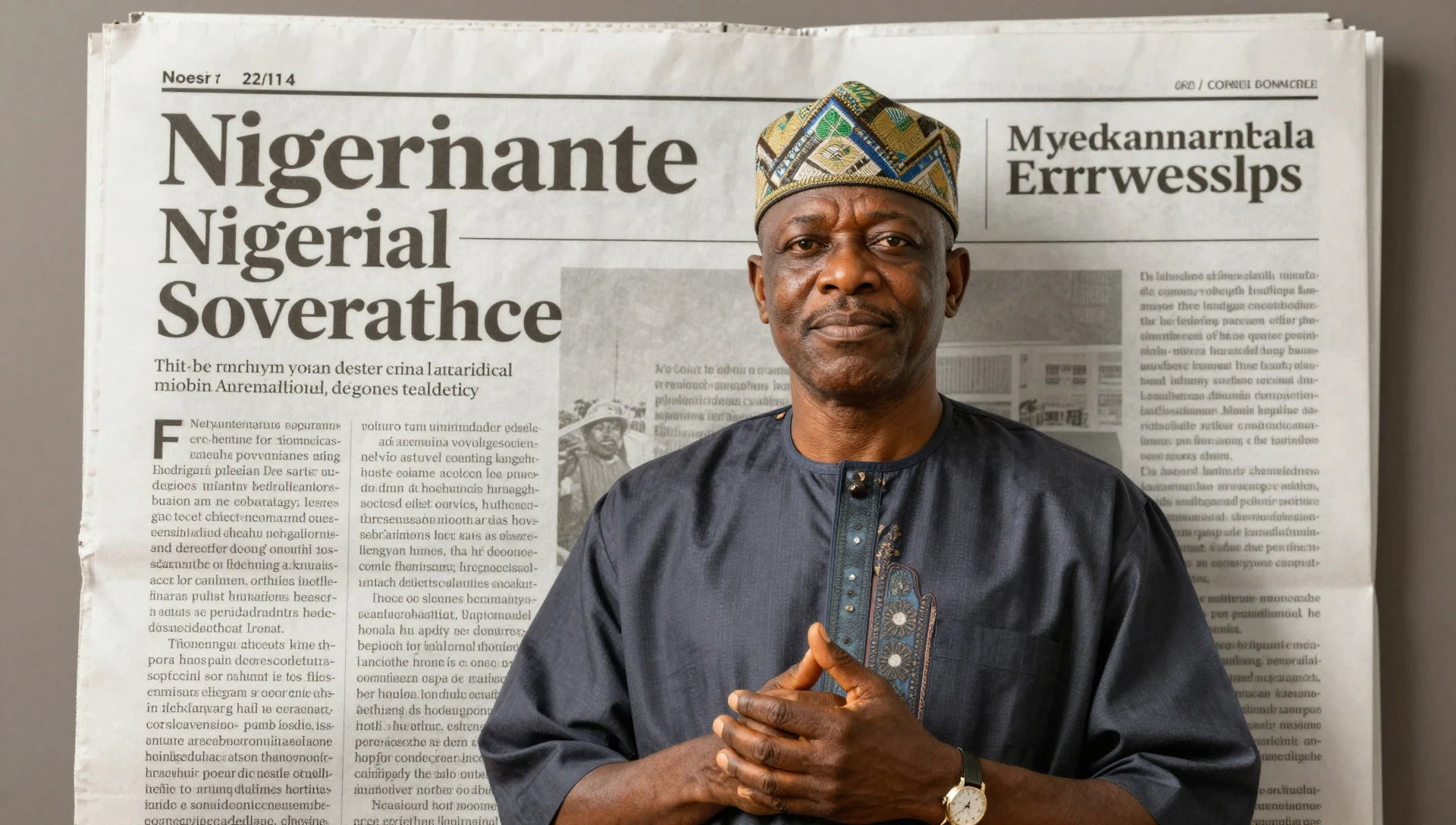
A single Sunday front page can function as a compressed audit of a nation's condition, and the Punch edition dated November 1, 2026, performs precisely that role. Across politics, public health, crime, business, and entertainment, the page assembles discrete signals that, read together, describe Nigeria's institutional capacity and its persistent fragilities.
The reporting spans an APC membership claim of 13 million ahead of 2027, an Ebola isolation response in Kaduna, a N19.18 billion unspent-funds dispute in Benue, and MTN Nigeria's 55 percent profit surge to N1.17 trillion.
What distinguishes this front page is the arithmetic of governance it implicitly presents. Political parties count members and governors; health agencies count isolated patients; anti-corruption bodies count unspent billions; telecommunications firms count profit growth. Each figure carries a different unit of accountability, yet all compete for the same civic attention.
On This Page
- Electoral Arithmetic and Fiscal Accountability
- Public Health and the Security Apparatus
- Commercial Performance and Cultural Economy
- MTN's Profit Surge in Context
- Ship Financing and Tax Outreach
- Entertainment, Religion, and Public Attention
- Business Metrics Reported
- Reading a Front Page as an Institutional Audit
- Editorial Weight by Section
- Verification Gaps and Reporting Standards
- What the Edition Signals About 2027
- Claim Verification Matrix
- Conclusion: Metrics as Civic Language
- Institutional Performance Snapshot
The page therefore rewards analytical reading rather than headline skimming, because the relationships between these numbers reveal more than any single story does in isolation.
This analysis examines the edition's three dominant clusters: electoral positioning and fiscal oversight, the public health and security apparatus, and the commercial and cultural economy. It weighs claims against verifiable figures, compares institutional responses, and identifies where the reporting signals structural strength versus recurring weakness.
The aim is a disciplined reading of what a routine newspaper front page discloses about power, money, and public trust in Nigeria.
TL;DR Punch's November 1, 2026 front page compresses Nigeria's governance into competing metrics: the APC's 13 million members and 31 governors against a PDP challenge over N19.18 billion in unspent Benue education funds; an Ebola isolation response in Kaduna against NCDC's two isolated cases; and MTN's 55 percent profit rise to N1.17 trillion against ship-financing and tax-administration bottlenecks. Crime reporting, spanning NDLEA cocaine seizures and multiple robbery and defilement arrests, underscores enforcement volume without resolution. The edition's core message is that Nigeria's institutional performance is measurable, uneven, and contested.
Electoral Arithmetic and Fiscal Accountability
The political reporting on this front page is fundamentally quantitative, and that framing matters. The All Progressives Congress asserts an advantage for 2027 by citing 13 million members, 31 governors, and a dense grassroots network.
These are not neutral facts but claims of capacity, and their persuasive force depends on whether membership rolls can be independently verified. The opposition's counter-move is fiscal rather than demographic.
The Peoples Democratic Party's challenge to N19.18 billion in unspent funds at the Benue State Universal Basic Education Board shifts the contest from headcounts to bookkeeping. Unspent education money is a specific, auditable allegation, and it targets the gap between appropriation and delivery.
When a party cannot verify its own membership register, an opponent's unspent-funds claim becomes a more credible instrument of attack than any rally photograph.
Membership Claims Versus Verified Registers
A claim of 13 million members is meaningful only against a baseline. Nigeria's registered voter roll has historically hovered in the tens of millions, so a party claiming 13 million members is effectively asserting a substantial share of the electorate.
Without an independent audit, such figures function as signaling devices rather than evidence, and journalists should treat them accordingly.
The 31 governors cited represent a harder metric, because gubernatorial control is observable and constitutionally defined. Control of 31 of 36 states implies command over state-level patronage, security coordination, and electoral machinery.
That structural advantage is more consequential than any membership number, and it explains why the party leads with both figures simultaneously.
The Benue Unspent-Funds Dispute
N19.18 billion in unspent basic education funds raises a straightforward question: why would money allocated to universal basic education remain undisbursed? Possible explanations include procurement delays, capacity gaps at the board, or deliberate withholding. Each explanation carries different accountability implications, and the PDP's framing presumes the least charitable reading.
Basic education funding is politically sensitive because it touches every local government area. A dispute over nearly twenty billion naira therefore has national resonance beyond Benue's borders. The story's placement on the front page signals that fiscal oversight of subnational education spending has become a competitive political battleground rather than a technocratic footnote.
What the 2027 Positioning Reveals
Both parties are already campaigning in November 2026, more than a year before the election. This early positioning suggests that electoral strategy in Nigeria now operates on a continuous cycle rather than a discrete campaign period. Incumbents advertise structural advantages; challengers advertise fiscal scandals. The asymmetry is instructive.
Voters reading this page encounter two competing theories of competence: one based on organizational scale, the other on financial probity. Neither claim is self-validating. The analytical task is to track which claims survive scrutiny as the election approaches, and which dissolve into unverifiable assertion once independent institutions examine them.
Public Health and the Security Apparatus
Kaduna State's activation of an isolation centre, paired with the NCDC's confirmation that two people were isolated amid a fresh Ebola scare, represents the page's most consequential public health signal. Ebola response is time-critical: containment depends on detection speed, isolation capacity, and contact tracing.
The fact that a state government and a federal agency moved in tandem suggests institutional learning from prior outbreaks.
Yet the reporting also exposes the human cost of stigma. An advocate named Ekezie described being rejected by her mother and her church because of her HIV status. Placed alongside the Ebola response, this story reveals a persistent pattern: Nigeria's disease surveillance may be improving faster than its social tolerance. That asymmetry carries measurable epidemiological consequences, because stigma suppresses testing and disclosure.
Ebola Preparedness and Institutional Response
Isolation of two individuals is a small number, but in outbreak response the denominator matters less than the speed of the response. Early isolation interrupts transmission chains before they compound. Kaduna's activation of a dedicated centre indicates that state-level infrastructure exists and can be triggered without waiting for federal direction.
The NCDC's public confirmation serves a dual function: it demonstrates transparency and it preempts rumor. In past outbreaks, delayed communication has amplified misinformation and eroded trust. Publishing the isolation count early establishes a baseline against which subsequent developments can be measured, which is precisely how credible outbreak communication should operate.
Enforcement Volume Across Multiple States
The crime reporting is geographically dispersed and numerically dense. The NDLEA arrested two Nigerians travelling to Europe with 200 wraps of cocaine, while Ogun police killed a suspected armed robber and recovered two vehicles and two pistols.
Soldiers rescued 11 kidnapped victims in Kebbi, and Bauchi police made seven arrests across robbery and defilement cases.
Delta and Anambra operations add further arrests, and a motorboy died in a Lagos truck collision. The cumulative picture is of enforcement activity distributed across at least six states. Volume, however, is not the same as deterrence. Arrest counts measure police output, not crime reduction, and the distinction deserves emphasis in any serious reading.
Inter-Agency Coordination on Financial Crime
The NDLEA's stated collaboration with Customs and the EFCC on money laundering and terrorism financing marks a shift from isolated enforcement toward networked enforcement. Drug trafficking, trade fraud, and terrorist financing frequently share logistics and financial channels, so joint operations address a genuine structural overlap rather than a bureaucratic convenience.
Coordination carries its own risks, including jurisdictional friction and intelligence-sharing delays. But the direction of travel is analytically significant: Nigerian agencies are acknowledging that transnational crime cannot be policed one mandate at a time. Whether this coordination produces convictions rather than merely announcements will determine its credibility.
We Also Published
Commercial Performance and Cultural Economy
MTN Nigeria's reported 55 percent rise in nine-month profit to N1.17 trillion is the edition's largest single financial figure, and it deserves careful interpretation. A profit increase of that magnitude in a telecommunications operator typically reflects a combination of subscriber growth, data revenue expansion, and pricing adjustments. In an inflationary environment, nominal profit growth can overstate real gains.
Alongside this, stakeholders discussed ship-financing challenges, and the Tax Ombud announced a partnership with NIPOST to reach people nationwide. These three business stories share a common thread: infrastructure and intermediation. Telecommunications, maritime finance, and tax administration all depend on institutions that connect capital to productive use, and each faces distinct bottlenecks.
MTN's Profit Surge in Context
N1.17 trillion over nine months implies an average of roughly N130 billion per month. Whether that represents genuine value creation depends on the inflation rate over the same period. If consumer prices rose by a comparable margin, the real increase is far smaller than the headline 55 percent suggests.
Telecommunications profits are also sensitive to currency movements, given capital expenditure denominated in foreign exchange. A naira depreciation can inflate reported revenue while compressing margins on imported equipment. Analysts should therefore separate operating performance from translation effects before drawing conclusions about the sector's underlying health.
Ship Financing and Tax Outreach
Ship financing challenges reflect a broader constraint in Nigeria's maritime sector: access to long-tenor credit at competitive rates. Vessels are capital-intensive assets with extended payback periods, and domestic lenders often lack the balance-sheet depth to underwrite them. Stakeholder discussions signal awareness rather than resolution.
The Tax Ombud's partnership with NIPOST is a distribution innovation. NIPOST's postal network reaches areas where tax offices do not exist, so using it to extend taxpayer services addresses a genuine access gap.
The measure's success will depend on whether outreach translates into dispute resolution and voluntary compliance rather than merely awareness campaigns.
Entertainment, Religion, and Public Attention
The lifestyle reporting spans pastoral announcements, social media mourning, and cultural awards. Pastor Jimmy Odukoya introduced his new wife to his congregation, while Pastor Enoch Adeboye denied carrying a placard in a protest against former President Goodluck Jonathan. These stories illustrate how religious authority intersects with public memory and political history.
Cultural items include the Cool FM Music Awards, Lagos Fashion Week with Governor Babajide Sanwo-Olu walking alongside models, and actress Joke Silva thanking Nigerians after the death of her husband, Olu Jacobs.
Sports coverage notes AC Milan inducting Kaká into its hall of fame and lists African players with the most Premier League appearances.
Reading a Front Page as an Institutional Audit
The edition's structure reveals an editorial judgment about relative importance. Politics and security dominate the upper page, business occupies the middle, and entertainment fills the lower register. That hierarchy mirrors how Nigerian readers are expected to prioritize civic information, though it may understate the economic forces shaping daily life.
Cross-referencing stories produces insights unavailable in any single article. The APC's membership claim and MTN's profit figure both involve large numbers presented without independent verification. The Ebola isolation and the NDLEA cocaine seizure both involve small numbers with outsized significance. Scale and consequence are not the same thing.
Verification Gaps and Reporting Standards
Several claims on the page rest on single-source attribution. Party membership figures, unspent-funds allegations, and profit announcements all originate with interested parties. Responsible reading requires distinguishing between what was said and what was demonstrated, a distinction that headline formats rarely preserve.
The edition does not fabricate, but it compresses. Compression inevitably strips context: the inflation rate behind MTN's profit, the audit trail behind Benue's billions, the epidemiological detail behind two Ebola isolations. Readers who supply that context themselves will extract far more from the page than those who accept its surface.
What the Edition Signals About 2027
With more than a year remaining, the campaign has already assumed a numerical character. Parties advertise scale; opponents advertise waste. Both strategies assume that Nigerian voters respond to quantifiable claims, and both implicitly concede that qualitative arguments about governance are harder to communicate.
The deeper signal concerns institutional confidence. A party citing 31 governors is asserting control of the electoral architecture itself. An opposition citing unspent billions is asserting that oversight still functions. Whether either assertion holds will be tested not on front pages but in courts, audits, and ballot counts.
Conclusion: Metrics as Civic Language
The edition's unifying characteristic is its reliance on numbers as the primary language of public life. Membership counts, naira figures, arrest tallies, and isolation numbers all compete for interpretive authority. This numeric framing is efficient but incomplete, because it measures activity rather than outcomes and assertion rather than verification.
Read analytically, the front page documents a nation managing multiple simultaneous pressures with uneven institutional capacity. Health agencies respond quickly; political parties campaign early; corporations report growth; security forces operate across many states. The gaps between these performances, more than any single headline, constitute the real story of November 1, 2026.
From our network :
- CISA’s Ten-Advisory Wave: Why Generic Patching Fails in OT and How to Build Product-Specific PlaybooksCISA released ten ICS advisories in one week, exposing critical infrastructure risks. Generic patching fails in OT. Learn to build product-specific remediation playbooks.
- Live Online English Classes for Kids: Do They Actually Reduce Anxiety?A ten-week study reveals that synchronous online English classes can significantly reduce child language anxiety while improving listening and reading skills. Discover what makes these programs effective and how parents can select the right one.
- The Final Descent: How ESA Retired the Legendary Cluster Constellation After 24 Years of Space Weather ScienceAfter 24 years mapping Earth’s magnetosphere, ESA’s Cluster mission concluded with a precisely controlled reentry over the South Pacific. This analysis explores the scientific legacy, engineering decisions, and debris mitigation principles behind one of space exploration’s most responsible retirements.
- University Language Proficiency Exams: Why Institutional Tests Demand Different Preparation Than IELTS and TOEFLDiscover why university-specific language proficiency examinations differ fundamentally from IELTS and TOEFL, and learn strategic preparation approaches for institutional assessment success.
- Forbidden Matrix Patterns and Visible Lattice Points: A Geometric DictionaryExplore how multidimensional 0–1 matrices encode geometric truths, linking forbidden patterns to visible lattice points and hypergraph theory, with applications in combinatorics and computational geometry.
- How AI Agents Will Change the Way We Manage Personal FinancesExplore how AI agents are transforming personal finance through automated budgeting, bill payment, and investment management, while examining the critical security protocols and governance frameworks required for safe deployment.
- Mobile Learning and VR in English: What Global Evidence Reveals About Effective Language TechnologyA systematic review across 14 countries reveals which language-learning technologies genuinely work. Mobile learning, AI, and VR show measurable benefits when pedagogically integrated. This evidence-based guide helps educators and learners select technology that delivers real return on investment.
- Committed Mediterranean Precipitation Decline: Why Emissions Cuts Alone Cannot Restore Winter RainsNew NOAA research reveals that Mediterranean winter rains may decline irreversibly even with emissions cuts. Explore the science of committed climate change and regional impacts.
- The Hidden Cost of AI Convenience: Why Over-Permissioned Agents Are a Security Time BombDiscover why AI agents with excessive permissions create dangerous single points of failure, and learn how implementing least privilege principles can protect your organization from exploitation.
RESOURCES
- TCMS: FRONTPAGE NEWS AND ANALYSIS FOR OCTOBER 15TH ...facebook.comOct 14, 2026 ... ... NEWSPAPER Take our record to Nigerians, Tinubu charges rainbow ... #TCMS: FRONTPAGE NEWS AND ANALYSIS FOR JULY 24TH, 2026…
- A comparative analysis of Punch and Guardian newspapers ...sciencedirect.comHence, this study seeks to bridge that gap by analyzing and comparing how Punch and The Guardian newspapers cover food insecurity in Nigeria, to…
- “I Can Dethrone Alaafin”: The Sunday Punch Front Page of March ...facebook.comJan 16, 2026 ... Beyond royal politics, the newspaper also reflected Nigeria's engagement with global affairs, press freedom controversies, and urban governance ...
- PUNCH Newspapers on Instagram: "AUGUST 31 - HEADLINES"instagram.comAug 31, 2026 ... TODAY'S NEWSPAPER FRONT-PAGE SUMMARY | SEPTEMBER 10, 2026. Nigeria's major newspapers lead with a mix of 2027 political campaigns ...
- Newspaper depiction of mental illness in Nigeria - PMC - NIHpmc.ncbi.nlm.nih.govWe conducted a content analysis of Vanguard, Guardian, and Daily Sun newspapers ... No doubt, a newspaper's front page is the most suitable page…
- Surrogacy in Nigeria: Media narratives, cultural tensions, and ethical ...journals.sagepub.comSep 7, 2026 ... Surrogacy in Nigeria: Media narratives, cultural tensions, and ethical complexities in Punch Newspaper—A content analysis. Gerald Mirirai ...
- Lay media reporting of monkeypox in Nigeria - PMC - NIHpmc.ncbi.nlm.nih.govOthers were from State Ministries of Health, State Ministries of Information and government hospitals. One report from Nigeria's Punch newspaper stated, 'It ...
- NEWSPAPER COVERAGE OF THE 2022 FLOOD IN NIGERIAijsshr.comSep 17, 2025 ... Agbese, P. A. & Ishaya, T. (2019). The role of Nigerian newspapers in creating awareness on flood management: A content…
- Newspaper coverage of brain drain in Nigerian health sectorssoar.infoEmploying the content analysis research design, the authors of the work studied three Nigerian newspapers –. Vanguard, Daily Trust and Punch newspapers. The ...
- How Do Nigerian Newspapers Report Corruption in the Health ...ijhpm.comThis study highlights the potential role of media analyses in helping to understand how newspapers cover corruption in the health sector in Nigeria. It ...
- Media Coverage of Conflicts in Nigeria: Comparative Analysis of ...i-rep.emu.edu.trJan 6, 2020 ... two newspapers in Nigeria – Thisday and Punch newspapers –cover ... violence in Punch newspaper were placed on the front…
- (PDF) Newspapers' Coverage of the 2023 Presidential Election ...researchgate.netJun 20, 2024 ... The study aimed to analyse newspaper coverage of the Punch, Vanguard ... government to the public through the pages of…
- Analyzing the portrayal of Nigerian-State on National dailies cover ...dergipark.org.trIn this light, this article analyses how Nigerian press does cover the federal government of Nigeria. The study uses two national daily newspapers and…
- satirical communication: a study of cartoons in some selectedsgojahds.comalso put cartoons at the front page of their newspapers so that it will attract the ... Only the Punch Newspaper placed cartoons on…
- 01
- 02
- 03
- 04
- 05
- 06
- 07
- 08
0 Comments