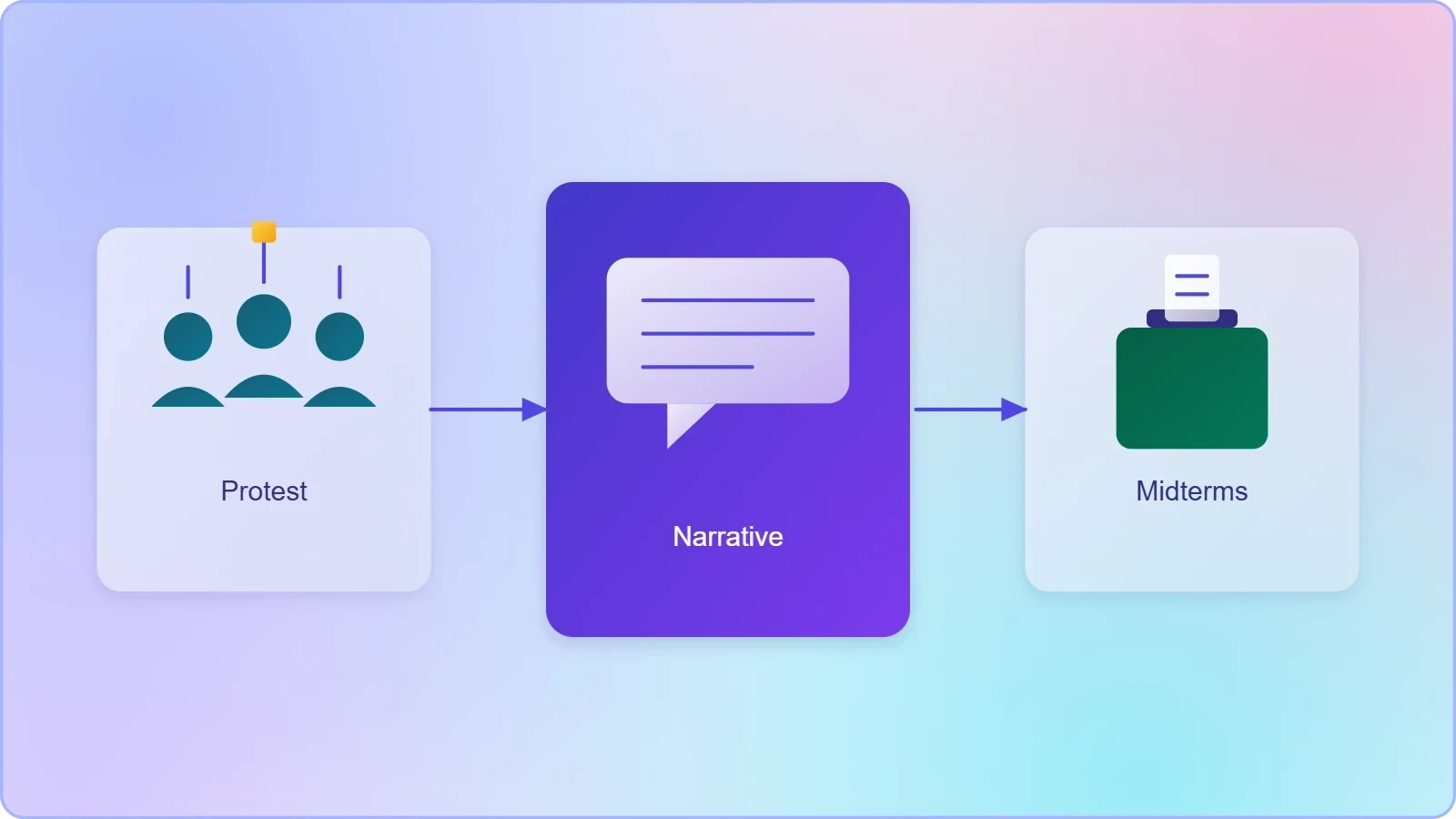
Political rhetoric rarely travels in a straight line, and the autumn of 2026 delivered a textbook illustration of how foreign upheaval can be repackaged as domestic ammunition. When President Donald Trump projected footage of French street violence onto rally screens in Wichita, Kansas, he was not merely reporting on events abroad.
He was constructing a narrative bridge between the burning cars of Paris and the ballot boxes of America, asking voters to see their own future reflected in someone else's chaos.
The episode deserves careful dissection because it reveals how modern campaigns convert distant crises into emotional arguments about immigration, order, and cultural survival. Trump's advisers openly described the French unrest as a potential "October surprise," a late-breaking shock capable of reshaping midterm prospects that had looked grim for Republicans.
On This Page
Yet the factual record of what actually happened in France diverges sharply from the story told on those rally screens, and that gap is where the real analysis begins.
What follows examines the mechanics of this political maneuver, the contested causes of the French demonstrations, and the broader question of how evidence and narrative collide in democratic contests.
The stakes extend well beyond one election cycle, touching on how voters evaluate claims, how leaders abroad respond to being used as props, and whether the truth can survive the speed of a campaign rally.
TL;DR President Trump used footage of violent French protests at rallies in Kansas and North Carolina to warn that similar unrest would follow a Democratic midterm victory, framing the chaos as evidence of failed liberal immigration policies. His advisers hoped the foreign unrest could serve as an "October surprise" to boost Republican fortunes. However, reporting indicates the French demonstrations began as a student movement over school funding before expanding to cost-of-living and fuel-price grievances, with little evidence linking the violence to immigrants. French far-right leader Marine Le Pen simultaneously weaponized the same scenes against President Emmanuel Macron, illustrating how the same images can be conscripted into competing national narratives.
The Rally Stage as a Narrative Machine
The Wichita rally followed a deliberate choreography: footage first, candidate second. Large screens displayed burning churches and fires sourced largely from Fox News before Trump took the stage, priming the audience emotionally before any words arrived.
This sequencing matters because it bypasses analytical reasoning and speaks directly to fear, ensuring the crowd interprets subsequent claims through a lens of visceral alarm rather than scrutiny.
Trump then translated the imagery into a warning about domestic consequences, telling supporters that the scenes demonstrated what Democrats allegedly want for America. He returned to the theme in North Carolina the following Tuesday night, insisting such unrest would never happen under his watch.
The repetition across states signals a coordinated messaging strategy rather than an offhand remark, suggesting the French footage had been folded into a broader closing argument.
The Strategic Logic of the October Surprise
Campaign advisers reportedly viewed the French violence as a possible "October surprise," a late-cycle event capable of jolting a race that had been trending poorly for Republicans. The calculation is cynical but not irrational: late-breaking shocks historically move undecided voters because they arrive after most minds have hardened but before ballots are cast. Foreign disorder offers a particularly potent shock because it feels both distant and imminent.
By describing burned cars, graffiti, and looted shops as warnings about liberal policies, especially immigration, the campaign converted a foreign news event into a domestic policy argument. The implicit syllogism runs: France pursued permissive immigration, France burned, therefore America must reject permissive immigration. Whether the premise survives factual scrutiny becomes secondary to whether the emotional logic lands before Election Day.
Why Imagery Outperforms Argument
Television footage of flames and shattered glass carries an evidentiary weight that statistics cannot match, which explains its recurring role in populist communication. A viewer need not understand French immigration law to feel alarm at a burning church; the image supplies its own conclusion. This asymmetry between emotional immediacy and factual complexity gives imagery a structural advantage in any campaign.
The footage also arrived pre-branded by a sympathetic network, reducing the interpretive work required of the audience. When the source already aligns with the message, viewers experience confirmation rather than persuasion, and the rally becomes a ceremony of shared certainty.
That dynamic makes the subsequent factual corrections, however well documented, unusually difficult to dislodge once the emotional impression has set.
What Actually Happened on French Streets
The demonstrations that produced the footage began as a student movement calling for better funding and improvements at schools, a grievance rooted in educational policy rather than immigration. Labor unions and other groups subsequently joined the protests, broadening the coalition to include concerns about high living costs and record fuel prices. This origin story matters enormously because it contradicts the causal chain presented at the rallies.
Reporting found little evidence that the violence over the weekend was carried out by illegal immigrants or immigrants of any kind, undermining the central claim of the campaign narrative. French political leaders themselves disagree about what caused the violence and have blamed each other, a fragmentation that resists any single tidy explanation. The picture that emerges is one of overlapping grievances, opportunistic disorder, and contested responsibility.
Students, Unions, and the Fuel Price Trigger
The student movement supplied the moral energy, but the fuel price surge supplied the combustible material that widened participation. When record prices at the pump coincide with general cost-of-living anxiety, protest becomes a channel for diffuse economic frustration rather than a single-issue campaign. Unions seized that momentum, transforming scattered campus demands into a broader confrontation with the state.
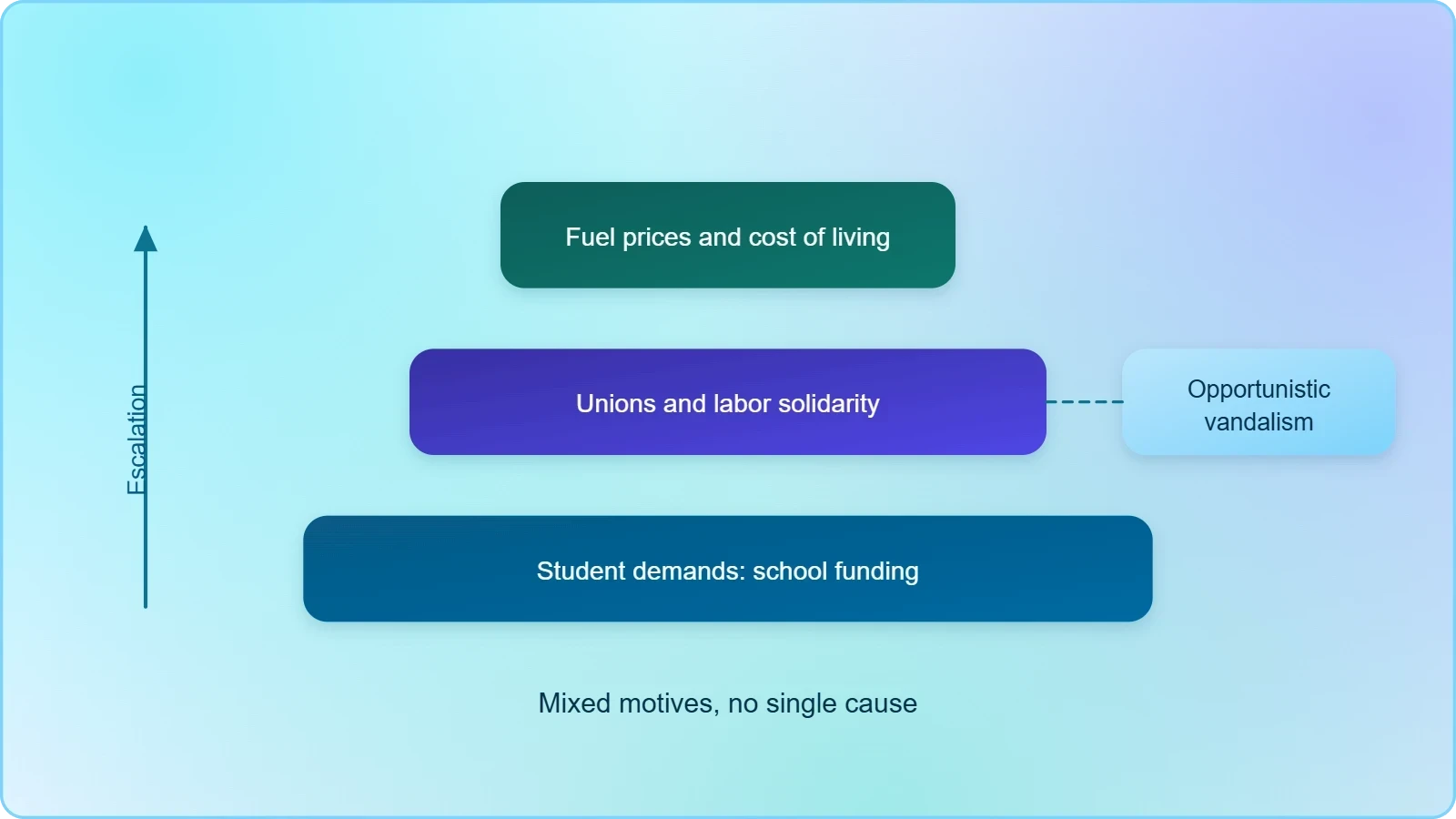
This layered composition explains why the violence defied easy attribution. A movement that begins with school funding and expands through labor solidarity and fuel costs cannot be reduced to a story about migration without doing violence to the facts.
The complexity is not incidental; it is the essential feature that the rally narrative had to flatten in order to function.
The Attribution Problem in Modern Unrest
Assigning blame for disorder is inherently difficult when crowds are fluid, motives are mixed, and participants arrive for different reasons. The French case exemplifies this problem: a legitimate student protest, a union mobilization, and opportunistic vandalism coexisted in the same streets and the same news footage. Any single-cause explanation, whether immigration or austerity, necessarily distorts the whole.
This attribution vacuum is precisely what makes such events politically useful. When causation is genuinely murky, advocates can project their preferred explanation onto the chaos without fear of immediate refutation, because no definitive account exists to contradict them.
The murkiness becomes the message's shield, and the burden of proof shifts to those who would challenge the narrative.
Le Pen's Parallel Playbook
Marine Le Pen, the far-right leader of the National Rally, deployed the same scenes toward a different national audience, declaring that France was caught between "violence and powerlessness." She suggested only her firm hand could restore order, converting the unrest into a referendum on her own leadership credentials. The symmetry with Trump's messaging is striking and instructive.
Le Pen, running for president, has sought to make migration a central issue, blaming the violence on delinquents from poor urban areas where many migrants live. Her framing differs from Trump's in target but not in structure: both leaders used the imagery to indict incumbent centrists for failing to control migration from the Middle East and Africa. The same footage served two campaigns simultaneously.
Convergent Populist Grammar
The convergence reveals a shared populist grammar in which disorder abroad or at home becomes proof of elite incompetence and popular neglect. Both leaders positioned themselves as the only credible guarantors of order, and both treated the violence as symptomatic of a deeper cultural failure rather than a discrete policy dispute. The rhetorical architecture is nearly identical across the Atlantic.
This convergence also complicates any claim that the French footage was uniquely American in its deployment. The images were genuinely transnational property, available to any leader willing to read them as evidence of civilizational decay. What varied was the local villain: Democrats in Kansas, Macron and European centrists in Paris.
We Also Published
- 01
- 02
- 03
- 04
The Factual Reckoning and Its Limits
Corrections to the rally narrative exist and are well documented, yet their political efficacy is another matter entirely. Reporting established that the violence lacked the immigrant authorship the campaign asserted, and that the protests originated in student demands rather than migration policy.
These findings matter for the historical record, but they arrive after the emotional impression has already been formed.
The limits of fact-checking in this environment are structural rather than incidental. A correction requires attention, context, and trust in the correcting institution, while the original claim required none of these.
When a narrative is built on imagery that feels self-evidently true, the burden of rebuttal is heavy and the reward for accepting it is often social friction with one's own political community.
Evidence, Burden of Proof, and Voter Judgment
Democratic accountability depends on voters' willingness to update beliefs when evidence contradicts preferred narratives, a willingness that partisan identity frequently suppresses. The French episode tests this capacity directly: the evidence was available, the contradiction was clear, and yet the political utility of the false version remained high. Utility and truth diverged, and utility often wins.
This divergence raises a deeper question about what campaigns owe the public when foreign events are conscripted into domestic argument. At minimum, accuracy about causation seems owed; at maximum, restraint in attributing motive to entire populations. The gap between minimum and maximum is where most contemporary political communication operates, and it is widening.
Foreign Crises as Domestic Instruments
The French episode belongs to a long tradition of importing foreign disorder into domestic political argument, a practice with deep roots in American campaign history. Foreign events offer the rhetorical advantage of distance: the audience cannot easily verify conditions abroad, and the speaker controls the interpretive frame through which those conditions are presented. Distance becomes a license for simplification.
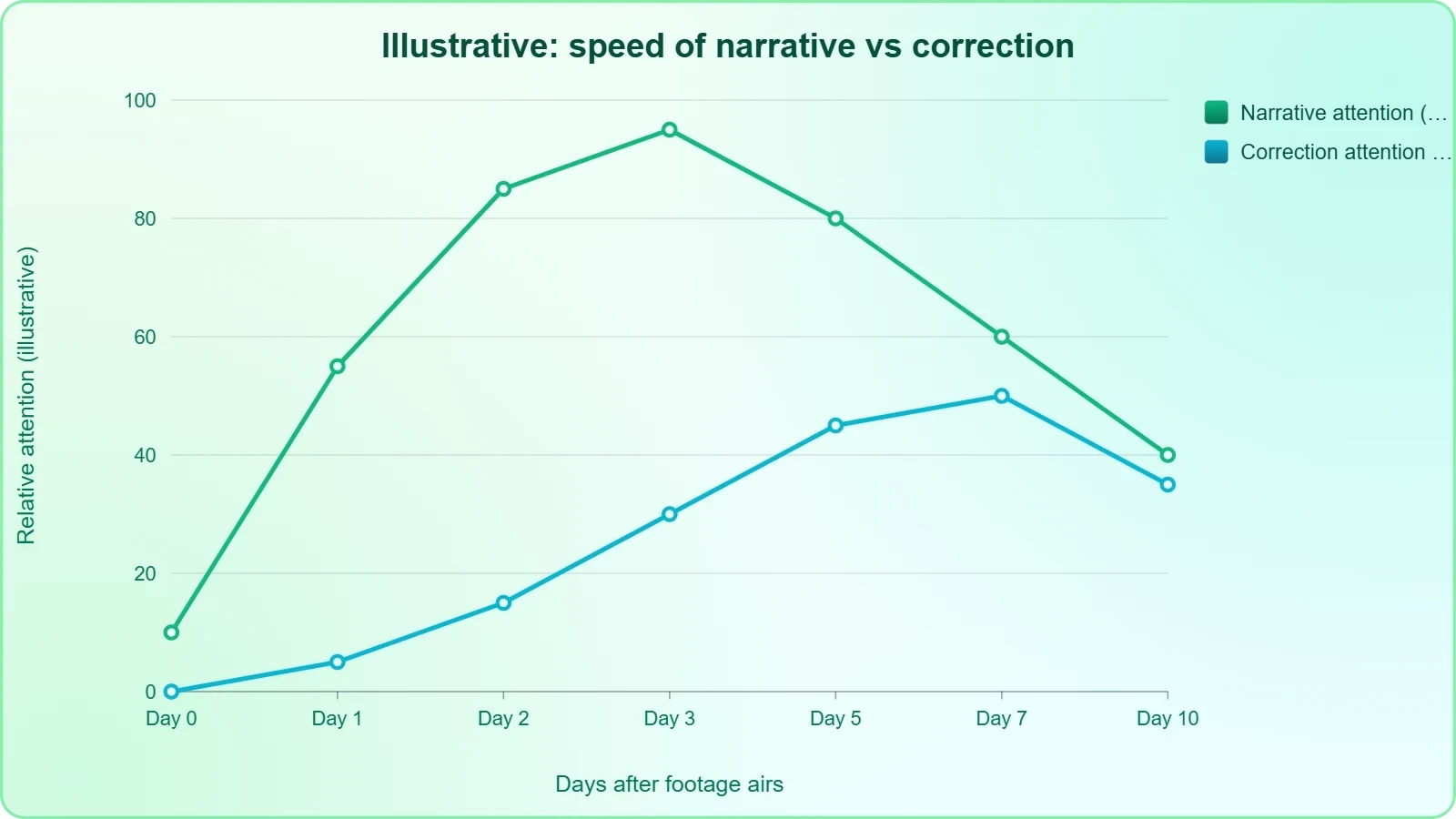
What distinguishes the 2026 iteration is the speed and seamlessness of the transmission. Footage captured on French streets appeared on Kansas screens within days, stripped of context and repackaged as prophecy.
The compression of that timeline means that corrective reporting competes with the narrative in real time rather than arriving comfortably afterward, a contest the narrative usually wins.
The Ethics of Borrowed Chaos
Using another nation's turmoil as a warning to one's own voters raises uncomfortable ethical questions about consent and distortion. The French public did not authorize the use of its streets as a campaign prop, and the causes of its unrest were rewritten to serve a foreign electoral purpose. The borrowing is rhetorical, but its consequences are real for those whose suffering was repurposed.
There is also a subtler cost: the erosion of the distinction between reporting on the world and weaponizing it. When every foreign crisis becomes raw material for domestic argument, the public loses the capacity to understand events on their own terms. Everything becomes evidence for a preexisting case, and nothing remains merely true.
What the Midterm Gamble Reveals
Beneath the specific claims about France lies a broader revelation about how contemporary campaigns assess their own persuasiveness. The decision to elevate foreign unrest suggests internal polling that found immigration and disorder to be the most mobilizing themes available, even at the cost of factual precision. The gamble was not on truth but on salience.
Whether that gamble succeeds depends on voters' priorities and their tolerance for loose causal reasoning. If the French footage moved even a small percentage of late-deciding voters toward Republicans, the campaign will regard the maneuver as vindicated regardless of its accuracy. Electoral outcomes, not fact-checks, will render the final verdict on this strategy.
The Longer Shadow on Democratic Discourse
The longer-term consequence may prove more significant than any single election result. Each successful deployment of borrowed chaos normalizes the practice, lowering the threshold for future distortions and raising the cost of correction.
What begins as an October surprise can become a permanent feature of the political calendar, available whenever a campaign needs a jolt.
For citizens, the lesson is a demanding one: the capacity to distinguish between an event and its rhetorical repackaging has become a basic civic skill. The French protests were real, their causes were complex, and their use in Kansas was a choice.
Recognizing that choice, and evaluating it honestly, is the minimum democracy requires of those who would govern themselves.
Conclusion: Truth, Timing, and the Campaign Mind
The French unrest of October 2026 will be remembered less for what happened on French streets than for what was made of it on American stages. Trump's use of the footage, and Le Pen's parallel deployment, demonstrated how identical images can be conscripted into different national arguments without either argument surviving factual scrutiny. The imagery was real; the causal story was not.
What remains is a cautionary case study in the relationship between evidence and electoral incentive. The reporting was clear, the correction was available, and the political utility of the false version was high enough to overwhelm both.
Until that calculus changes, foreign crises will continue to arrive on domestic screens pre-interpreted, and voters will be asked to mistake someone else's chaos for their own future.
From our network :
- University Language Proficiency Exams: Why Institutional Tests Demand Different Preparation Than IELTS and TOEFLDiscover why university-specific language proficiency examinations differ fundamentally from IELTS and TOEFL, and learn strategic preparation approaches for institutional assessment success.
- Mobile Learning and VR in English: What Global Evidence Reveals About Effective Language TechnologyA systematic review across 14 countries reveals which language-learning technologies genuinely work. Mobile learning, AI, and VR show measurable benefits when pedagogically integrated. This evidence-based guide helps educators and learners select technology that delivers real return on investment.
- The Final Descent: How ESA Retired the Legendary Cluster Constellation After 24 Years of Space Weather ScienceAfter 24 years mapping Earth’s magnetosphere, ESA’s Cluster mission concluded with a precisely controlled reentry over the South Pacific. This analysis explores the scientific legacy, engineering decisions, and debris mitigation principles behind one of space exploration’s most responsible retirements.
- Committed Mediterranean Precipitation Decline: Why Emissions Cuts Alone Cannot Restore Winter RainsNew NOAA research reveals that Mediterranean winter rains may decline irreversibly even with emissions cuts. Explore the science of committed climate change and regional impacts.
- CISA’s Ten-Advisory Wave: Why Generic Patching Fails in OT and How to Build Product-Specific PlaybooksCISA released ten ICS advisories in one week, exposing critical infrastructure risks. Generic patching fails in OT. Learn to build product-specific remediation playbooks.
- Forbidden Matrix Patterns and Visible Lattice Points: A Geometric DictionaryExplore how multidimensional 0–1 matrices encode geometric truths, linking forbidden patterns to visible lattice points and hypergraph theory, with applications in combinatorics and computational geometry.
- Live Online English Classes for Kids: Do They Actually Reduce Anxiety?A ten-week study reveals that synchronous online English classes can significantly reduce child language anxiety while improving listening and reading skills. Discover what makes these programs effective and how parents can select the right one.
- The Hidden Cost of AI Convenience: Why Over-Permissioned Agents Are a Security Time BombDiscover why AI agents with excessive permissions create dangerous single points of failure, and learn how implementing least privilege principles can protect your organization from exploitation.
- How AI Agents Will Change the Way We Manage Personal FinancesExplore how AI agents are transforming personal finance through automated budgeting, bill payment, and investment management, while examining the critical security protocols and governance frameworks required for safe deployment.
RESOURCES
- Nearly all Black Lives Matter protests are peaceful despite Trump ...theguardian.comSep 5, 2020 ... Nearly all Black Lives Matter protests are peaceful despite Trump narrative, report finds ... political violence in the United States.…
- 'Trump has many levers to disrupt the midterms, but far fewer means ...lemonde.frOct 15, 2026 ... OP-ED. The US president will likely not be able to 'steal' the November 3 midterm elections. However, he is expected…
- Trump seeks to regain control of the midterms narrative with focus ...reuters.comJul 16, 2026 ... Ask us anything about the midterm elections. Our colleagues will answer questions in the Politics U.S. newsletter every edition between…
- When Trump's narrative meets voters' realities | US midterm ...theguardian.comSep 25, 2026 ... ... political party that has seen its endorsees winning bigger than ever ... protests over schools and policing. 6h ago.…
- Trump hails Le Pen as 'conservative voice' amid France unrestlemonde.fr4 days ago ... Trump's comments come after he repeatedly used the protests roiling France to score political ... narrative on the French riots,…
- Five takeaways from Trump's midterm campaign rallies - Reutersreuters.com24 hours ago ... But in the last week or so Trump has seized on another narrative about France ... Notably, the French protests…
- Trump's bogus narrative about the GOP losing in the 2026 midtermsyahoo.comAug 31, 2026 ... ... political parties. In fact, in CNN polling dating to 2006, at least 50 ... Seen and heard at France…
- Trump blames France unrest on Islam, migrationfrance24.comOct 6, 2026 ... US President Donald Trump on Tuesday blamed France's mass student protests ... narrative ahead of tough midterm elections at home.
- Trump blames France unrest on Islam, migration - AFP.comafp.comUS President Donald Trump on Tuesday blamed France's mass student protests on Islam and migration, pushing his global right-wing narrative ahead of...
- Trump administration uses taxpayer money to air 2024 Trump ... - PBSpbs.orgSep 28, 2026 ... Lawmakers of both parties have criticized the new series of ads for their inherently political nature and the use of…
- French President Macron says blaming migration for riots is 'stupid'washingtonpost.com3 days ago ... In a swipe at President Donald Trump and others, Macron rebuked politicians he said were promoting misinformation that French protests,…
- 6 ways Trump's executive orders are targeting transgender peoplepbs.orgFeb 1, 2025 ... ... political narrative. If fully implemented, the order would cut off ... Second nationwide day of protests against the cost…
- What Trump's Comments About France Say About Him - The Atlantictheatlantic.com6 days ago ... The president's reaction to mass protests in France tells us more about his mentality and domestic politics than it does…
- Republicans are worried about Trump's deportation campaign, and ...politico.comJan 24, 2026 ... ... policy itself is driving voters' concerns. “If we don't change our approach, it will have a negative effect on…
- 01
- 02
- 03
- 04
- 05
- 06
- 07
- 08
0 Comments