When Patrick Bury, a senior associate professor of warfare and counterterrorism at the University of Bath, told France 24 that repairing Europe's defence systems would be costly, he compressed a much larger argument into a single sentence. The remark landed inside a broader conversation about the continent's readiness for a future conflict, and it carried an implicit verdict: the hardware and infrastructure that underpin European security have drifted into a condition that money alone cannot quickly fix. Repair, in this framing, is not routine maintenance but a structural reckoning with decades of underinvestment, fragmented procurement, and strategic complacency.
The observation matters because it reframes defence spending as a question of restoration rather than expansion. Governments habitually debate new platforms, new brigades, and new budgets, yet Bury's point directs attention to what already exists and has quietly decayed — ammunition stocks, air-defence inventories, rail networks built for civilian traffic, repair depots, and the industrial base that sustains them. Each of these carries a price tag that is easy to defer in peacetime and impossible to ignore once deterrence is tested. The cost he names is therefore both financial and temporal, since rebuilding capacity takes years that no procurement cycle can compress.
This analysis examines what that warning implies for Europe's defence posture, drawing on the wider public debate about continental readiness. It traces the systems in question, the money required to restore them, the industrial and political constraints that shape repair timelines, and the strategic consequences of delay. The aim is not to speculate about classified assessments but to read the visible evidence — public statements, alliance spending data, and industrial capacity figures — and to explain why a professor of counterterrorism would choose the word "costly" rather than "urgent" or "necessary."
On This Page
- The Strategic Context Behind Bury's Warning
- The Financial Scale of Restoring Defence Infrastructure
- Industrial Capacity as the Binding Constraint
- Counterterrorism and the Everyday Machinery of Security
- Political Economy and the Burden-Sharing Question
- What Repair Actually Requires in Practice
- The Strategic Consequences of Delay
TL;DR Patrick Bury of the University of Bath told France 24 that repairing Europe's defence systems will be costly, framing continental readiness as a restoration problem rather than a simple spending debate. His remark points to decayed ammunition stocks, thin air-defence inventories, strained repair infrastructure, and a fragmented industrial base that cannot be rebuilt overnight. The financial bill is substantial, but the deeper cost is time: rebuilding capacity takes years, and deterrence weakens while that work proceeds. This analysis maps the systems at stake, the money involved, the industrial bottlenecks, and the strategic price of deferring repair.
The Strategic Context Behind Bury's Warning
Bury's comment did not emerge in a vacuum. It arrived during a period in which European governments have repeatedly pledged higher defence budgets while struggling to convert those pledges into deliverable capability. The gap between announced spending and fielded readiness has become a defining feature of the continent's security debate, and it is precisely that gap which makes the word "repair" so pointed. Repair implies that something is broken, and the public record supports the diagnosis: stockpiles depleted by transfers to Ukraine, production lines running below sustainable rates, and maintenance backlogs accumulated over decades of peace dividend thinking.
The France 24 discussion in which he appeared also touched on the Russia-Ukraine war, a general strike in Spain, a storm in Portugal, and the arrest of a US soldier in the UK on suspicion of espionage. That roster of topics is itself instructive. It shows how defence readiness sits alongside economic disruption, natural disaster, and counterintelligence as part of a single continuum of European risk. Bury's contribution was to insist that the least dramatic item on that list — the quiet repair of systems — may be the most consequential for the continent's ability to withstand pressure.
From Peace Dividend to Repair Bill
For roughly three decades after the Cold War, European defence budgets were treated as a residual line item, trimmed annually in favour of social spending and infrastructure. The result was not collapse but slow attrition: fewer tanks in storage, thinner ammunition reserves, consolidated manufacturers, and a generation of engineers who never worked on military production lines. When the security environment shifted, the continent discovered that its institutional memory of mass mobilisation had atrophied alongside its physical stockpiles. Repairing systems therefore means rebuilding habits of production and maintenance as much as replacing metal.
The financial dimension is straightforward to state and difficult to absorb. Restoring depleted inventories to levels that would sustain a high-intensity conflict requires multi-year contracts, expanded factory capacity, and workforce training that cannot be improvised. Analysts across the continent have converged on the view that the bill runs into hundreds of billions of euros over a decade, spread unevenly across nations with vastly different fiscal positions. Bury's phrasing captures the political difficulty: a repair bill is less glamorous than a new weapons programme, and voters rarely reward maintenance.
Why Counterterrorism Expertise Speaks to Conventional Readiness
It may seem incongruous that a specialist in warfare and counterterrorism would comment on conventional system repair, but the connection is direct. Modern counterterrorism depends on the same logistics, intelligence architecture, and communications networks that underpin conventional forces. When those systems degrade, the state's ability to detect, track, and respond to asymmetric threats degrades with them. Bury's academic work sits at the intersection of irregular and regular conflict, which gives his warning a dual edge: repair matters not only for deterring a peer adversary but for sustaining the everyday machinery of domestic security.
That dual framing also explains why the cost he identifies is broader than procurement budgets. Counterterrorism capability rests on surveillance infrastructure, secure communications, forensic capacity, and interagency coordination — all of which require continuous investment to remain functional. A continent that defers repair in the conventional domain tends to defer it in the security domain as well, because the same fiscal and political pressures apply. The result is a compounding vulnerability that is invisible until a crisis exposes it, at which point the cost of remediation multiplies.
The Financial Scale of Restoring Defence Infrastructure
Quantifying the repair bill is an exercise in informed estimation rather than precise accounting, because no government publishes a consolidated figure for the restoration of degraded systems. What is available are proxies: alliance spending targets, national procurement plans, and industry capacity reports. Taken together, they suggest a requirement that dwarfs the annual increases announced since 2022. The North Atlantic Treaty Organization's guideline of spending two percent of gross domestic product on defence was designed for steady-state readiness, not for the simultaneous reconstruction of stockpiles, infrastructure, and industrial base that the current environment demands.
The distribution of that cost is politically fraught. Front-line states with smaller economies face proportionally larger burdens, while larger economies with deeper fiscal capacity often carry older, more diversified industrial bases that are slower to retool. Bury's observation that repair will be costly therefore carries an implicit question about burden-sharing: whether the continent can allocate restoration costs in a way that reflects both threat exposure and capacity to pay. That question has no technocratic answer, which is why the financial debate keeps returning to political ground.
Where the Money Actually Goes
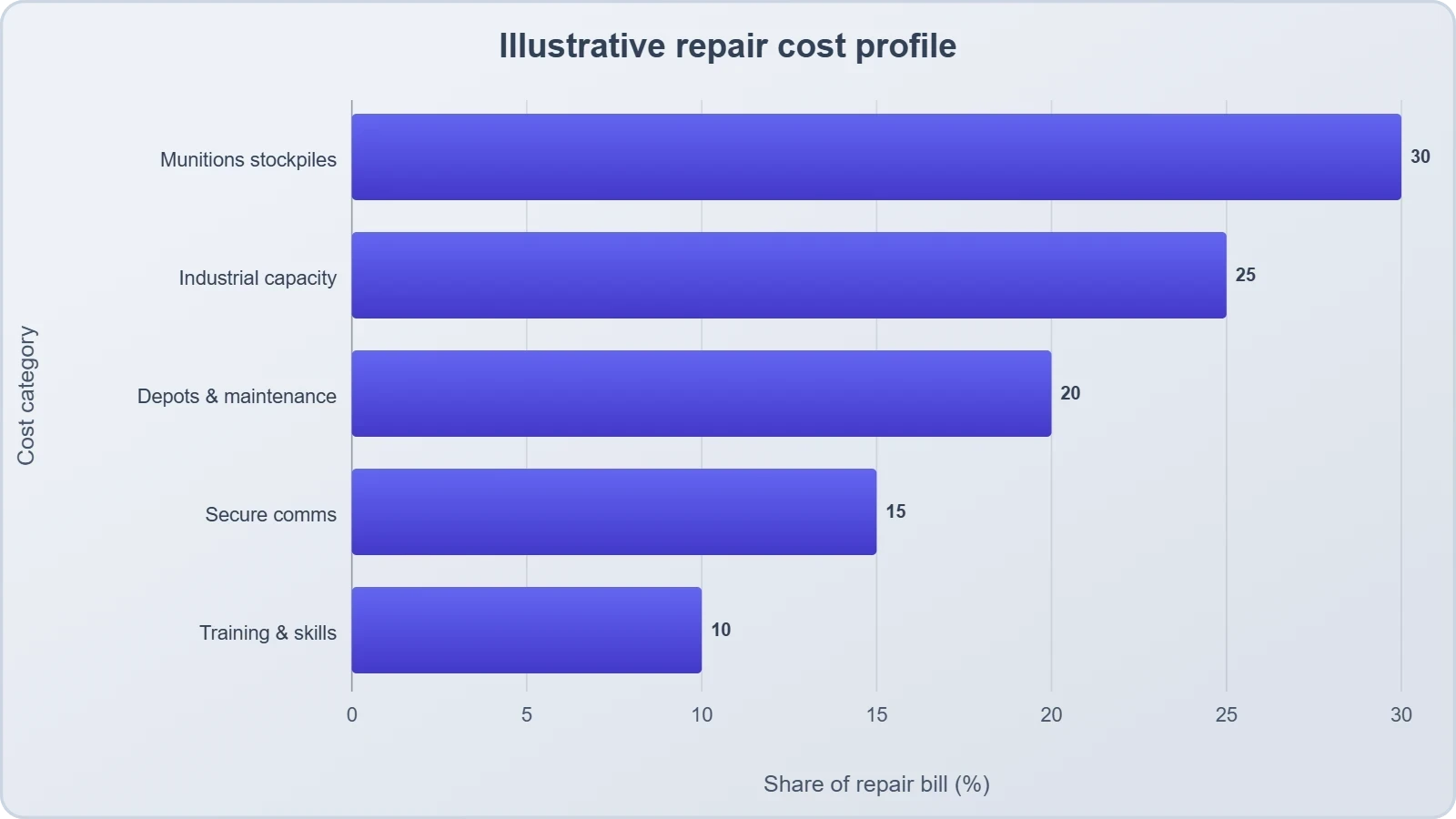
A common misconception treats defence spending as a single stream flowing into weapons. In reality, restoration spending divides into distinct categories with very different timelines. Munitions production requires factory expansion and raw material supply chains, typically a two-to-four year horizon. Platform maintenance requires depot capacity and skilled technicians, often constrained by workforce shortages rather than funding. Infrastructure repair — runways, ports, rail spurs, hardened storage — involves civil engineering and planning permission, which can stretch timelines further. Each category has its own cost curve, and conflating them obscures why the total bill is so large.
Industry executives have repeatedly noted that the binding constraint is not always money but order certainty. Factories will not expand capacity for contracts that may be cancelled after an election, and skilled workers will not train for jobs that appear temporary. Long-term framework agreements, multi-year commitments, and pooled multinational orders have therefore become central to the repair agenda. The financial cost Bury identifies is real, but the institutional cost of creating predictable demand may prove equally significant in determining whether repair actually happens.
The Time Cost That Money Cannot Buy
Every repair programme carries a temporal dimension that budget announcements rarely capture. Rebuilding an ammunition production line takes years; training a machinist takes years; restoring a neglected depot network takes years. During that interval, deterrence rests on what exists rather than what is planned. This is the crux of Bury's warning: the cost of repair is not simply the money spent but the vulnerability accepted while the work proceeds. A continent that begins late pays twice, once in expenditure and once in strategic exposure.
The temporal problem compounds across systems. Delayed ammunition production slows training, which reduces readiness, which in turn raises the perceived risk that prompts further spending. Delayed infrastructure repair constrains mobility, which limits the credibility of reinforcement plans. These feedback loops are why defence economists distinguish between the marginal cost of a single programme and the systemic cost of a degraded baseline. Repairing systems means interrupting those loops, and interruption is expensive precisely because it must happen quickly.
We Also Published
Industrial Capacity as the Binding Constraint
Money can be appropriated by parliaments, but capacity must be built by factories, shipyards, and workshops. Europe's defence industrial base emerged from three decades of consolidation, and its current configuration reflects peacetime efficiency rather than wartime surge. Production lines optimised for steady orders cannot double output without new tooling, additional shifts, and expanded supply chains. The repair agenda therefore runs directly into an industrial bottleneck that no budget line can dissolve, and Bury's warning implicitly acknowledges this by framing the problem as repair rather than purchase.
The supply chain dimension is especially stubborn. Modern defence systems depend on specialised components — propellants, semiconductors, precision optics, forgings — often produced by a handful of firms across multiple countries. Expanding one link in the chain without expanding the others produces no additional output. This is why European governments have begun experimenting with aggregated orders, stockpile-sharing arrangements, and emergency production authorities. Each of these mechanisms addresses a genuine constraint, but each also requires political coordination that moves slower than the threat environment.
Workforce Shortages and the Skills Gap
Behind every production line sits a workforce that cannot be conjured by contract. Welding, machining, electronics assembly, and quality assurance are skilled trades with multi-year training pipelines, and defence firms across the continent report persistent shortages. The problem is compounded by demographic pressure: many experienced technicians are approaching retirement, and younger workers have not been drawn to defence careers in sufficient numbers. Repairing systems therefore requires repairing the labour pipeline, a task that belongs as much to education policy as to defence ministries.
Some governments have responded with targeted programmes — apprenticeships, vocational partnerships, and reskilling incentives — but the scale remains modest relative to the gap. Industry representatives argue that order certainty is the precondition for workforce investment, since firms will not train workers for contracts that may not materialise. The skills gap thus mirrors the broader repair dilemma: it is solvable in principle, expensive in practice, and slow under any scenario. Bury's emphasis on cost captures this layered reality without reducing it to a single budget figure.
Fragmentation Across National Markets
Europe's defence market remains stubbornly national in structure, with duplicated platforms, incompatible standards, and procurement processes that rarely align across borders. Fragmentation raises the cost of repair because it prevents economies of scale and complicates the pooling of spare parts, maintenance capacity, and training. A continent that operates a dozen different artillery systems must stock a dozen different shell types, maintain a dozen different supply chains, and train a dozen different maintenance crews. Each duplication multiplies the repair bill.
Efforts to consolidate have advanced unevenly. Joint procurement initiatives and multinational framework agreements exist, but national industrial interests frequently override efficiency arguments. The political economy of defence production — jobs in specific constituencies, contracts with specific firms — makes rationalisation difficult even when the strategic case is clear. Repairing systems therefore involves repairing market structures as well, a task that requires sustained political capital rather than a single spending decision.
Counterterrorism and the Everyday Machinery of Security
Bury's academic specialty gives his warning a dimension that purely conventional analyses miss. Counterterrorism operates through systems — intelligence fusion, secure communications, surveillance infrastructure, forensic laboratories, and interagency coordination platforms — that are expensive to maintain and easy to neglect. When budgets tighten, maintenance is deferred, and deferred maintenance accumulates as latent risk. The same logic that applies to ammunition stockpiles applies to the databases, networks, and analytical capacity on which domestic security depends, and the consequences of failure are measured in incidents rather than inventories.
The connection between conventional repair and counterterrorism capability is not merely rhetorical. Many of the communications and logistics systems used in domestic security are shared with or derived from military infrastructure, and degradation in one domain propagates to the other. A continent that allows its defence systems to decay therefore weakens its civilian security architecture as well. Bury's remark, read in this light, is a warning about systemic interdependence rather than a narrow comment on military procurement.
Shared Infrastructure and Shared Vulnerability
Secure communications networks illustrate the point. Military and civilian security services increasingly rely on common encrypted platforms, satellite links, and data centres, which means that investment decisions in one domain affect capability in the other. Repairing these systems requires coordinated planning across ministries that traditionally operate in separate budget silos. The cost of coordination is political and administrative rather than purely financial, but it is no less real, and it explains why repair programmes often stall even when funding exists.
Surveillance and sensor infrastructure presents a similar picture. Border monitoring, critical infrastructure protection, and urban security networks depend on hardware that ages, software that requires updating, and personnel who need continuous training. Deferred renewal produces gaps that are invisible until an incident exposes them. The repair bill for these systems is rarely headline news, which is precisely why it tends to be postponed. Bury's framing invites attention to this unglamorous layer of security provision.
Interagency Coordination as a Repair Target
Not all systems are physical. Procedures, protocols, and coordination mechanisms are systems too, and they degrade when neglected. Counterterrorism depends on the ability of police, intelligence, military, and civilian agencies to share information quickly and accurately, which requires exercises, common standards, and trusted channels. These are maintained through continuous investment of time and attention, and they atrophy when organisations focus on other priorities. Repairing them is inexpensive relative to hardware but demanding in institutional commitment.
The strategic payoff is substantial. Well-maintained coordination systems shorten response times, reduce the risk of intelligence failure, and improve public confidence. Poorly maintained ones produce the fragmentation that inquiries into past attacks have repeatedly identified. Bury's warning about costly repair therefore extends beyond budgets to institutional habits, and the cost of neglecting them is measured in the credibility of the state's protective functions.
- 01
- 02
- 03
- 04
Political Economy and the Burden-Sharing Question
Repair costs money that governments would rather spend elsewhere, and the politics of allocation determines whether restoration actually occurs. Voters reward visible investments — new ships, new aircraft, new brigades — more readily than maintenance backlogs and depot upgrades. This asymmetry creates a persistent bias toward procurement over repair, even when the strategic return on maintenance is higher. Bury's warning is partly an attempt to correct that bias by naming the cost explicitly, forcing the political system to confront what deferral actually means.
The burden-sharing dimension adds further complexity. Front-line states argue that their exposure justifies disproportionate support, while larger economies argue that their contributions already reflect capacity. The result is a negotiation that recurs at every alliance summit without reaching a stable settlement. Repair programmes, being less visible than new platforms, are especially vulnerable to being traded away in these negotiations. A continent that cannot agree on who pays for maintenance will struggle to maintain anything at scale.
Public Opinion and the Visibility Problem
Defence spending enjoys broader public support in Europe than it did a decade ago, but that support is shallow when it comes to specific trade-offs. Maintenance budgets compete with healthcare, education, and infrastructure, and they lack the symbolic appeal of new equipment. Politicians therefore face an incentive to announce purchases and defer upkeep, which is precisely the pattern that produced the current repair backlog. Breaking that cycle requires making maintenance visible as a security contribution rather than an administrative cost.
Some governments have begun framing repair as industrial policy, linking depot upgrades and production expansion to regional employment and skills development. This framing has the advantage of aligning security and economic narratives, but it also risks entangling defence decisions in local politics. The balance is delicate, and it varies across member states with different industrial footprints. Bury's comment, by emphasising cost, implicitly invites a public conversation about what repair is worth relative to other priorities.
Election Cycles and Deferred Maintenance
Election cycles systematically disadvantage long-term maintenance. A government that invests in depot capacity may not see the benefit within its term, while a government that defers repair can claim fiscal discipline in the short run. The result is a structural bias toward deferral that persists across changes of administration. Repairing systems therefore requires institutional mechanisms — multi-year budgets, independent oversight, statutory maintenance targets — that insulate upkeep from electoral pressure.
Such mechanisms exist in some countries but are unevenly applied. Where they are absent, maintenance becomes a residual category that absorbs cuts during fiscal consolidation. The strategic consequence is a ratchet effect: each deferral raises the eventual cost, and each crisis reveals how far the backlog has grown. Bury's warning about costly repair is, in this sense, a warning about political time horizons as much as financial ones.
What Repair Actually Requires in Practice
Translating a warning into a programme requires specificity, and the repair agenda has several concrete components. The first is stockpile restoration, which means contracts for munitions at volumes that justify production expansion. The second is maintenance capacity, which means depots, tooling, and technicians capable of sustaining equipment through sustained use. The third is infrastructure, which means the ports, rail links, and storage facilities that move and protect material. The fourth is institutional, which means the procedures and agreements that allow multinational coordination to function under pressure.
Each component has a different cost profile and a different political constituency, which is why repair programmes tend to advance unevenly. Stockpiles attract attention after crises, depots attract attention when equipment fails, and infrastructure attracts attention when mobility is tested. The result is a reactive pattern in which repair follows failure rather than anticipating it. Bury's warning is an argument for reversing that pattern, treating repair as a continuous strategic function rather than an emergency response.
Setting Priorities Under Fiscal Constraint
No government can repair everything at once, so prioritisation is unavoidable. The sensible approach begins with capabilities that are both scarce and slow to regenerate: air defence interceptors, artillery ammunition, and the industrial lines that produce them. Next come enablers that multiply the value of existing forces: maintenance capacity, secure communications, and mobility infrastructure. Lower priority attaches to capabilities that can be regenerated quickly or substituted readily. This hierarchy is not universal, but it provides a framework for allocating limited funds.
Prioritisation also requires honesty about trade-offs. Money spent on depot upgrades is money not spent on new platforms, and the political system must accept that exchange. Defence economists argue that the marginal return on maintenance is often higher than on procurement in the current environment, precisely because the baseline has degraded so far. Bury's emphasis on cost is a reminder that repair is an investment with returns, not merely an expense to be minimised.
Measuring Whether Repair Is Working
Repair programmes need metrics, and the metrics must be meaningful rather than cosmetic. Counting budget allocations is insufficient; what matters is deliverable capability — rounds produced, platforms sustained, days of availability, and readiness rates. Some of these figures are classified, but aggregate indicators can be published to sustain public confidence and parliamentary oversight. Without measurement, repair becomes a rhetorical commitment that survives on announcements rather than outcomes.
The measurement challenge is compounded by the multi-year nature of repair. Benefits accrue slowly, while costs appear immediately, which creates a political mismatch. Governments that invest in robust reporting and independent evaluation are better placed to sustain programmes across electoral cycles. The alternative is a cycle of announcement, delay, and crisis that leaves the underlying backlog untouched. Bury's warning, read carefully, is an argument for treating repair as a governed process rather than an occasional project.
The Strategic Consequences of Delay
Delay in repair is not neutral. It shifts risk onto the present, narrowing the margin of error available to policymakers and commanders. A continent with thin stockpiles and strained maintenance capacity must make choices it would rather avoid: limiting support to partners, declining certain operations, or accepting higher escalation risk in crises. These are not hypothetical costs but the practical currency of strategic weakness, and they accumulate quietly until a crisis converts them into visible failure.
The deterrence dimension is equally important. Adversaries observe repair programmes as signals of resolve and capability, and they calibrate their behaviour accordingly. A visible, sustained restoration effort communicates seriousness; a pattern of announcements without delivery communicates the opposite. Bury's warning about cost is therefore also a warning about credibility, since the gap between pledged and delivered capability is precisely what adversaries exploit in their assessments.
Deterrence Credibility and the Repair Signal
Deterrence rests on the perception that resistance will be costly and credible. Repair programmes contribute to that perception by demonstrating that the continent can sustain operations over time, not merely initiate them. Conversely, visible maintenance failures — grounded aircraft, unavailable ammunition, delayed deployments — undermine deterrence by suggesting that capability exists mainly on paper. The signal value of repair is therefore disproportionate to its budget share, which is one reason analysts emphasise it despite its low political profile.
The signalling effect works in both directions. Allies observe repair programmes as evidence of reliability, which affects their own planning and burden-sharing decisions. Partners outside the alliance observe them as evidence of commitment, which shapes their alignment choices. A continent that repairs visibly strengthens its position in both relationships; one that defers repair weakens them without any single dramatic failure. Bury's comment, read as a signal, is an argument for making repair visible rather than treating it as back-office work.
Lessons for Allied and Partner Nations
The European experience carries lessons beyond the continent. Any alliance that enjoyed a prolonged period of low threat must eventually confront the maintenance backlog that peace allows to accumulate. The temptation is to treat new procurement as the answer, because it is visible and politically rewarding, while deferring the unglamorous work of restoration. The European case suggests that this temptation is costly, and that the bill for deferral compounds faster than most budgeting processes anticipate.
For partner nations with smaller budgets, the lesson is sharper: repair is not a luxury reserved for large economies but a basic function of credible defence. Prioritising maintenance, stockpiles, and workforce development over prestige purchases is difficult politically but strategically sound. The alternative is a force that looks capable in peacetime and fails under pressure. Bury's warning, stripped to its core, is that repair is expensive — but neglect is more expensive still, and the difference is paid in strategic autonomy.
Patrick Bury's brief remark on France 24 carries more analytical weight than its length suggests. By describing the repair of Europe's systems as costly, he identified the central challenge of continental defence in the current era: not the decision to spend, but the far harder work of restoring what has decayed. That work spans stockpiles, depots, infrastructure, industry, and institutions, and it cannot be compressed into a single budget cycle. The cost is real, but so is the alternative, and the strategic ledger favours beginning sooner rather than later.
From our network :
- University Language Proficiency Exams: Why Institutional Tests Demand Different Preparation Than IELTS and TOEFLDiscover why university-specific language proficiency examinations differ fundamentally from IELTS and TOEFL, and learn strategic preparation approaches for institutional assessment success.
- The Final Descent: How ESA Retired the Legendary Cluster Constellation After 24 Years of Space Weather ScienceAfter 24 years mapping Earth’s magnetosphere, ESA’s Cluster mission concluded with a precisely controlled reentry over the South Pacific. This analysis explores the scientific legacy, engineering decisions, and debris mitigation principles behind one of space exploration’s most responsible retirements.
- Mobile Learning and VR in English: What Global Evidence Reveals About Effective Language TechnologyA systematic review across 14 countries reveals which language-learning technologies genuinely work. Mobile learning, AI, and VR show measurable benefits when pedagogically integrated. This evidence-based guide helps educators and learners select technology that delivers real return on investment.
- CISA’s Ten-Advisory Wave: Why Generic Patching Fails in OT and How to Build Product-Specific PlaybooksCISA released ten ICS advisories in one week, exposing critical infrastructure risks. Generic patching fails in OT. Learn to build product-specific remediation playbooks.
- Committed Mediterranean Precipitation Decline: Why Emissions Cuts Alone Cannot Restore Winter RainsNew NOAA research reveals that Mediterranean winter rains may decline irreversibly even with emissions cuts. Explore the science of committed climate change and regional impacts.
- How AI Agents Will Change the Way We Manage Personal FinancesExplore how AI agents are transforming personal finance through automated budgeting, bill payment, and investment management, while examining the critical security protocols and governance frameworks required for safe deployment.
- Live Online English Classes for Kids: Do They Actually Reduce Anxiety?A ten-week study reveals that synchronous online English classes can significantly reduce child language anxiety while improving listening and reading skills. Discover what makes these programs effective and how parents can select the right one.
- Forbidden Matrix Patterns and Visible Lattice Points: A Geometric DictionaryExplore how multidimensional 0–1 matrices encode geometric truths, linking forbidden patterns to visible lattice points and hypergraph theory, with applications in combinatorics and computational geometry.
- The Hidden Cost of AI Convenience: Why Over-Permissioned Agents Are a Security Time BombDiscover why AI agents with excessive permissions create dangerous single points of failure, and learn how implementing least privilege principles can protect your organization from exploitation.
RESOURCES
- Defending Europe Without the United States: Costs and ...iiss.orgMay 15, 2025 ... This IISS report assesses the financial costs and defence industrial requirements for a European ... systems. Faster progress could be…
- Europe's main military powers to develop low-cost air-defence systemsreuters.comFeb 20, 2026 ... Europe's five biggest defence powers are teaming up on a multi-million euro project to bring low-cost air-defence systems like autonomous ...
- EDIP Forging Europe's Defencedefence-industry-space.ec.europa.eu... Service, and dual-use heavy industry conversion options for defence surge. ... European ammunition qualification system. To achieve this, JAQ will launch ...
- Europe Needs an ASAP Program for Air Defense - CSIScsis.orgMar 23, 2026 ... ... missile system is Europe's closest replacement for Patriot systems. ... defense production capacity and in firms developing cost-effective ...
- Kratos Defensekratosdefense.comKratos engineers and deploys technology and systems that continuously move national security forward, with the cost, speed, and reliability that make ...
- Defence Spending for Europe's Security – How Much Is Enough?intereconomics.euWages of soldiers and maintenance costs for military equipment in Russia are ... European autonomy in space: Space systems as a pillar of European…
- Oshkosh Defense: Military Vehicles for Global Defenseoshkoshdefense.comMilitary vehicles and lifecycle support for every mission. Oshkosh Defense delivers tactical platforms with advanced technology at commercial speed.
- NSPA signs contract to support PATRIOT air and missile defence ...nspa.nato.intMay 17, 2022 ... ... maintenance support for PATRIOT surface-to-air guided missile systems deployed in Europe. The contract will be running for the next…
- BAE Systems: Homebaesystems.comAt BAE Systems, we provide some of the world's most advanced, technology-led defence, aerospace and security solutions. We employ a skilled workforce of ...
- Building weapons together (or not) - How to strengthen the ...iss.europa.euNov 16, 2023 ... But how fragmented is the European defence industry in reality, and is it always better to have fewer producers of…
- White Paper for European Defence – Readiness 2030commission.europa.euMar 6, 2025 ... scale for the European defence industry in developing, producing and marketing weapons systems, ... consolidate, and provide cost-efficient ...
- Beyond Program Management: A Bold Fix for Aerospace and ...bain.comJun 10, 2025 ... US aerospace and defense program cost overruns have surged to almost $46 billion while delivery timelines have grown from 8…
- Drivers and Impact of European Defence Market Integrationtandfonline.comThe costs for service and maintenance, estimated at 20-30%, are partially ... cost-efficient weapon systems in high quantity. Kollias and Tzeremes ...
- Europe's Conscription Challenge: Lessons From Nordic and Baltic ...carnegieendowment.orgJul 8, 2024 ... ... systems of military service. It is useful to distinguish between at ... And these costs endure beyond the initial…
- Defending Europe with less Americaecfr.euJul 3, 2024 ... The joint effort to rally allies to send their Patriot air defence systems ... European security and imply costly additional…
- 01
- 02
- 03
- 04
- 05
- 06
- 07
- 08
0 Comments