
Australia's central bank has lifted its official cash rate to 4.85%, the highest setting since 2008, in a decisive move to restrain inflation that has proven more stubborn than policymakers anticipated.
The Reserve Bank of Australia delivered its fifth increase of the year, signalling that price stability remains the paramount objective even as household budgets strain under mounting repayment obligations. Governor Michele Bullock framed the decision as a necessary, if uncomfortable, trade-off between present hardship and future economic health.
The vote was not unanimous, and that split reveals genuine uncertainty inside the boardroom. Six members backed the increase while three preferred to hold steady, a division that underscores how finely balanced the judgment has become.
On This Page
Economists poring over the post-meeting statement noted the absence of explicit language about further tightening, a subtle omission that many read as a willingness to pause and observe how earlier increases ripple through the economy.
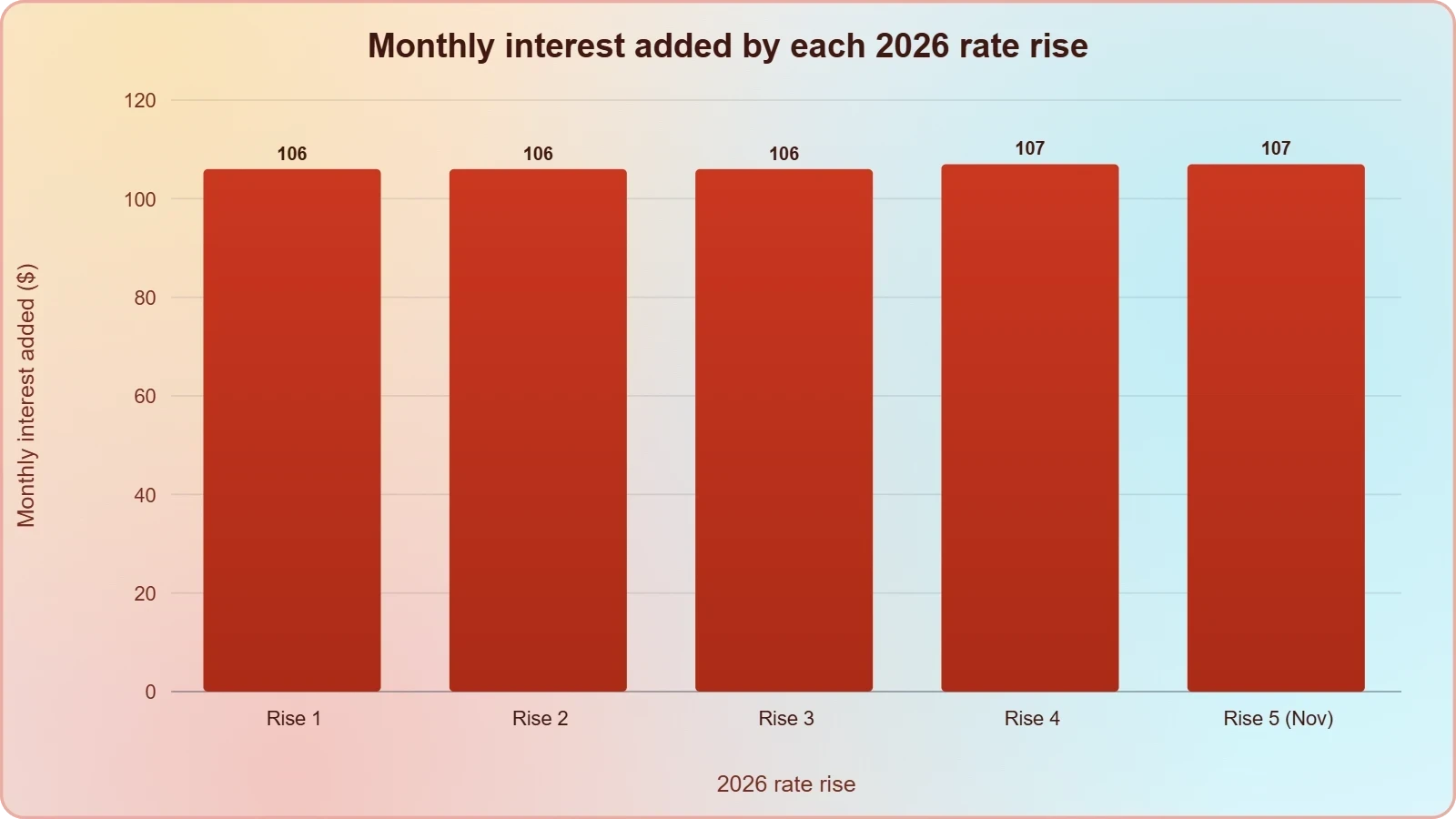
For the more than 3.3 million households carrying home loans, the arithmetic is immediate and unforgiving. Canstar calculations show monthly interest on a $700,000 mortgage climbing by $107, bringing the cumulative burden of this year's five rises to $532.
Behind those figures sit real families recalculating budgets, deferring purchases, and absorbing a cost-of-living squeeze that shows few signs of easing before the next calendar year.
TL;DR Australia's central bank raised its cash rate to 4.85%, the highest since 2008, marking the fifth hike of 2026 in a divided 6-3 board vote. Inflation hit 4.3% annually through September, driven partly by a Middle East oil shock, and is now forecast to stay above target until late 2027. Households with mortgages face an extra $107 monthly on a $700,000 loan, with cumulative 2026 increases reaching $532. Growth is running below trend, unemployment is rising, and public demand has softened as cost-of-living support unwinds.
The Policy Decision and Its Immediate Mechanics
Central banking is rarely a popularity contest, and the Reserve Bank's November decision illustrates why. Raising the cash rate to 4.85% places Australian monetary policy at its most restrictive stance in roughly eighteen years, a deliberate brake on demand designed to cool an economy still running hot on services inflation. The move follows four earlier increases in 2026, each calibrated against incoming data that repeatedly disappointed.
The Divided Board and the Signal Within
The 6-3 split matters far beyond the headline number. Dissenting members evidently judged that the cumulative tightening already in the pipeline deserved time to work through the system before adding further pain. Their position reflects a legitimate debate among central bankers globally about the lag between rate changes and their real-economy effects.
Equally telling is what the statement omitted. By declining to flag explicitly the possible need for further increases, the board left itself room to manoeuvre. Markets and economists interpreted that restraint as a tacit pause signal, suggesting the bank may now adopt a watching brief rather than a pre-committed hiking path.
Transmission to Household Balance Sheets
Monetary policy transmits through mortgages faster than through almost any other channel. With 3.3 million households exposed to variable or resetting loans, each basis point translates swiftly into cash-flow pressure. The $107 monthly increment on a $700,000 loan is not abstract; it is groceries, school fees, and fuel deferred or denied.
Cumulatively, the five 2026 increases add $532 to monthly repayments on that same loan, a figure that compounds the psychological weight of the decision. Consumer confidence typically sags when repayment burdens climb this sharply, and retail spending patterns tend to follow with a lag of one or two quarters.
Inflation Dynamics and the Oil Shock
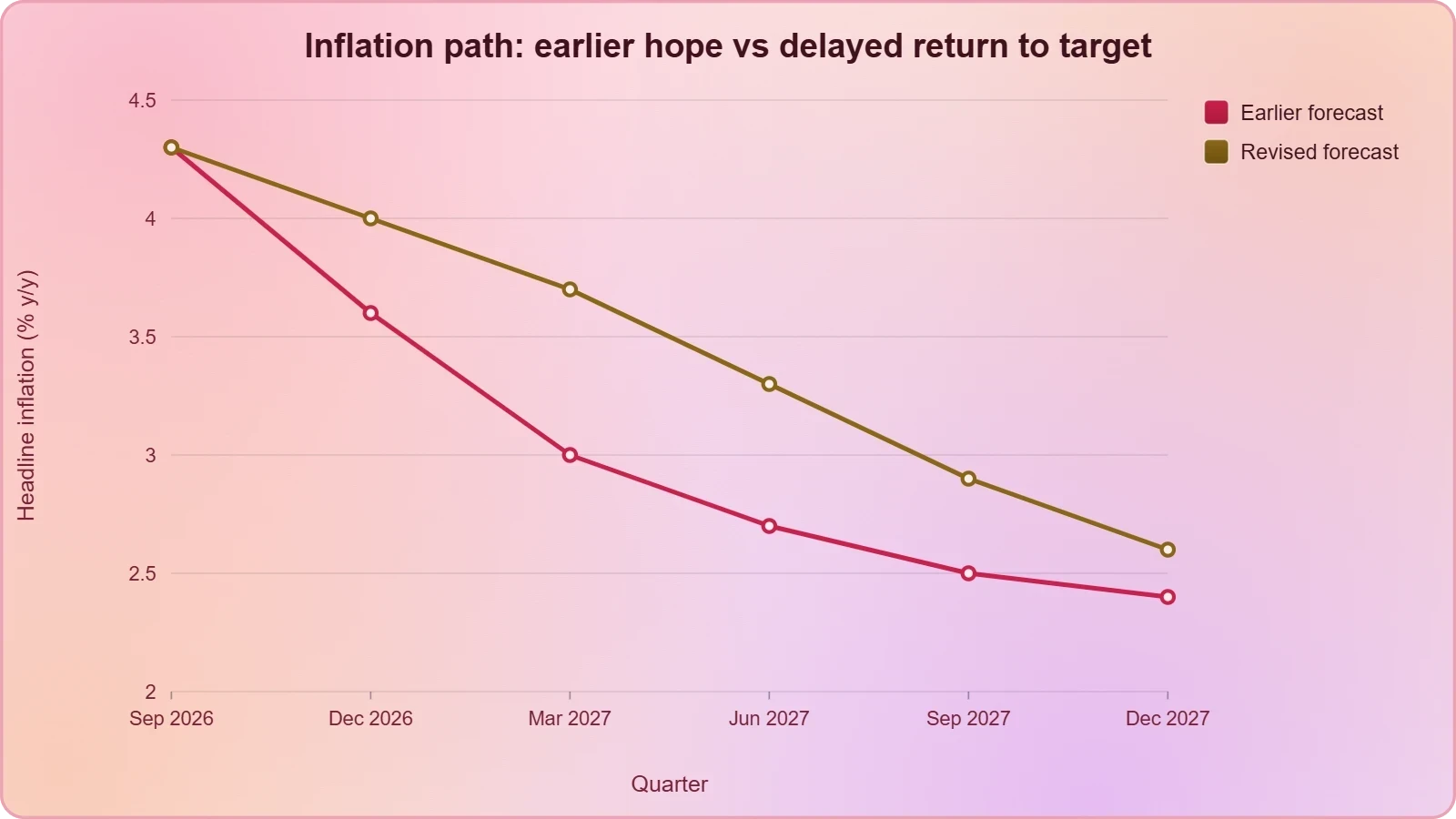
Headline inflation running at 4.3% through the year to September caught the bank off guard, exceeding its own projections and forcing a reassessment of the disinflation timeline. A significant portion of that overshoot traces to global energy markets, where conflict in the Middle East has pushed crude prices higher and fed directly into transport and input costs across the economy.
Why the Forecasts Slipped
The bank now expects inflation to climb further in the closing months of 2026 before returning beneath the 3% target band only by late 2027. That represents roughly a nine-month delay against earlier hopes, a slippage that compounds credibility pressures on the institution. Every forecast revision carries reputational cost.
Energy is the swing factor. Oil prices are projected to ease over the next eighteen months yet remain elevated by historical standards, offering motorists and businesses only partial relief at the pump. Persistent fuel costs seep into freight, manufacturing, and food prices, keeping underlying inflation stickier than headline measures suggest.
The Growth and Employment Trade-off
Restrictive policy is doing what it was designed to do, and the costs are becoming visible. Forecasts point to below-trend growth and rising unemployment, the classic Phillips curve trade-off playing out in real time. Public demand weakened in the first half of 2026 as cost-of-living support measures expired.
Spending moderation in defence, disability, and aged care services further dampened aggregate demand, reducing the fiscal tailwind that had cushioned earlier quarters. The bank's challenge is calibrating precisely enough to tame inflation without tipping an already-slowing economy into outright contraction.
Household Burden and Mortgage Arithmetic
Behind every rate decision sits a ledger of household finances, and Australia's is unusually exposed. The prevalence of variable-rate mortgages means policy transmission is swift and direct, unlike fixed-rate markets where adjustments lag by years. This structural feature amplifies both the effectiveness and the political sensitivity of each hike.
The $700,000 Loan in Focus
Canstar's benchmark of a $700,000 loan provides a useful lens. The latest increase adds $107 to monthly interest, and the cumulative effect of five 2026 rises reaches $532. For a household already managing tight discretionary budgets, that increment can tip the balance between comfort and constraint.
Repayment stress tends to surface first in savings drawdowns, then in reduced consumption, and finally in arrears. The sequence matters for policymakers because it determines how quickly demand cools. Early indicators suggest households are already trimming spending on discretionary categories well before formal delinquency rises.
Consumer Confidence and Spending Patterns
Confidence surveys consistently track rate movements with an inverse relationship. When repayment obligations climb, households postpone large purchases, renegotiate contracts, and build precautionary buffers. Retailers in discretionary categories feel this first, while essential spending proves more resilient to rate pressure.
The bank's calculus assumes this demand destruction is necessary and temporary. Critics counter that the burden falls unevenly, hitting younger borrowers and recent purchasers hardest while older, asset-rich households remain insulated. That distributional dimension fuels political debate around every rate decision.
Fiscal Demand and the Public Spending Pullback
Monetary policy does not operate in a vacuum, and the bank's statement drew attention to a quieter development: public demand came in weaker than expected during the first half of 2026.
As cost-of-living support measures wound down, the fiscal impulse that had supported household incomes faded, removing a cushion that had softened earlier rate increases.
Where Spending Moderated
Defence, disability, and aged care services all showed moderation in spending growth, according to the bank's assessment. These categories are substantial components of public expenditure, so even modest slowdowns shift aggregate demand meaningfully. The withdrawal of fiscal support amplifies the contractionary effect of higher rates.
This interaction between fiscal and monetary policy is often underappreciated in public debate. When governments tighten spending while central banks raise rates, the combined drag can exceed what either instrument would produce alone. Policymakers must therefore coordinate implicitly, even where formal mandates keep them separate.
Implications for the Growth Outlook
Below-trend growth and rising unemployment form the bank's base case, and the fiscal pullback reinforces that trajectory. The question is whether the slowdown remains orderly or accelerates beyond intention. History offers cautionary examples of central banks overtightening into weakening demand.
Australia's labour market has proven resilient through previous tightening cycles, but resilience has limits. Rising unemployment feeds back into consumption, which feeds back into inflation, creating a self-reinforcing dynamic that can overshoot in either direction. Careful monitoring of leading indicators becomes essential.
Global Energy, Geopolitics, and Imported Inflation
Australia's inflation problem is partly imported, and the bank acknowledged as much by citing a global oil shock tied to Middle East conflict. Energy prices transmit through every supply chain, from freight and aviation to agriculture and manufacturing, making them a persistent source of cost-push pressure that interest rates cannot directly address.
- 01
- 02
- 03
- 04
The Limits of Monetary Policy
Central banks can suppress demand, but they cannot drill for oil or negotiate ceasefires. This asymmetry means supply-side shocks leave monetary authorities with blunt instruments and uncomfortable choices. Raising rates to counter imported inflation risks suppressing activity without touching the underlying cause.
Oil prices are forecast to ease over the next eighteen months, yet remain relatively high by recent standards. That trajectory offers limited relief to motorists and businesses, and it keeps a floor beneath transport and logistics costs that feed into consumer prices across the economy.
Implications for Trade and Currency
Higher domestic rates typically support the currency, which partially offsets imported inflation by making foreign goods cheaper. That channel provides some relief, though its magnitude depends on global financial conditions and risk sentiment. Currency appreciation also pressures export competitiveness.
Australia's position as a commodity exporter complicates the picture further. Terms-of-trade shifts and global demand conditions influence the economy independently of domestic rate settings, meaning the bank must navigate multiple exogenous forces beyond its control.
Forward Guidance, Credibility, and the Road Ahead
The most scrutinised sentence in any central bank statement is often the one that is missing. By omitting explicit reference to further increases, the Reserve Bank signalled a shift from pre-commitment toward data dependence. That subtle change in communication carries significant weight for markets attempting to price the future path of rates.
Reading Between the Lines
Forward guidance has become a central tool of modern monetary policy, yet its effectiveness depends on credibility. Promising too much constrains future flexibility; promising too little leaves markets guessing. The bank's restrained language suggests a preference for optionality over precision at this juncture.
Economists widely interpreted the omission as a pause signal, though interpretations vary. Some see a genuine willingness to wait and observe; others detect caution about overcommitting. Either reading points toward a period of stability rather than an imminent further hike.
What to Watch Next
Quarterly inflation prints, labour force data, and global energy prices will dominate the coming months. Each release either validates or challenges the bank's forecast path, and each carries market-moving potential. Household spending indicators will reveal how quickly demand is cooling.
The bank's credibility rests on delivering inflation back to target without inflicting unnecessary economic damage. That balancing act has no perfect solution, only judgment calls made under uncertainty. The coming year will test both the institution's resolve and the economy's resilience.
From our network :
- Mobile Learning and VR in English: What Global Evidence Reveals About Effective Language TechnologyA systematic review across 14 countries reveals which language-learning technologies genuinely work. Mobile learning, AI, and VR show measurable benefits when pedagogically integrated. This evidence-based guide helps educators and learners select technology that delivers real return on investment.
- Committed Mediterranean Precipitation Decline: Why Emissions Cuts Alone Cannot Restore Winter RainsNew NOAA research reveals that Mediterranean winter rains may decline irreversibly even with emissions cuts. Explore the science of committed climate change and regional impacts.
- The Final Descent: How ESA Retired the Legendary Cluster Constellation After 24 Years of Space Weather ScienceAfter 24 years mapping Earth’s magnetosphere, ESA’s Cluster mission concluded with a precisely controlled reentry over the South Pacific. This analysis explores the scientific legacy, engineering decisions, and debris mitigation principles behind one of space exploration’s most responsible retirements.
- University Language Proficiency Exams: Why Institutional Tests Demand Different Preparation Than IELTS and TOEFLDiscover why university-specific language proficiency examinations differ fundamentally from IELTS and TOEFL, and learn strategic preparation approaches for institutional assessment success.
- CISA’s Ten-Advisory Wave: Why Generic Patching Fails in OT and How to Build Product-Specific PlaybooksCISA released ten ICS advisories in one week, exposing critical infrastructure risks. Generic patching fails in OT. Learn to build product-specific remediation playbooks.
- Forbidden Matrix Patterns and Visible Lattice Points: A Geometric DictionaryExplore how multidimensional 0–1 matrices encode geometric truths, linking forbidden patterns to visible lattice points and hypergraph theory, with applications in combinatorics and computational geometry.
- Live Online English Classes for Kids: Do They Actually Reduce Anxiety?A ten-week study reveals that synchronous online English classes can significantly reduce child language anxiety while improving listening and reading skills. Discover what makes these programs effective and how parents can select the right one.
- How AI Agents Will Change the Way We Manage Personal FinancesExplore how AI agents are transforming personal finance through automated budgeting, bill payment, and investment management, while examining the critical security protocols and governance frameworks required for safe deployment.
- The Hidden Cost of AI Convenience: Why Over-Permissioned Agents Are a Security Time BombDiscover why AI agents with excessive permissions create dangerous single points of failure, and learn how implementing least privilege principles can protect your organization from exploitation.
RESOURCES
- Australia inflation stubbornly high in August, defying run of rate hikesreuters.comSep 29, 2026 ... Sticky inflation already forced the Reserve Bank of Australia to lift interest rates to a 15-year high of 4.6% on…
- Statement by the Monetary Policy Board - Reserve Bank of Australiarba.gov.au16 hours ago ... At its meeting today, the Board decided to increase the cash rate target by 25 basis points to 4.85 per…
- 'Live' chance of interest rate hike at March RBA meeting amid oil ...theguardian.comMar 2, 2026 ... ... Australia · Middle East ... 'Live' chance of interest rate hike at March RBA meeting amid oil price spikes…
- Statement by the Monetary Policy Board - Reserve Bank of Australiarba.gov.auFeb 3, 2026 ... At its meeting today, the Board decided to increase the cash rate target by 25 basis points to 3.85 per…
- Australia inflation undershoots forecasts, markets pare rate hike betsreuters.comJul 28, 2026 ... ... inflation undershot forecasts and lessened pressure for a further hike in interest rates ... Australia, July 2, 2026. REUTERS/Hollie ...
- Australia's inflation rate rises to 4.3%, fuelling fears of fifth interest ...theguardian.com7 days ago ... ... rate hikes in 2026. A fierce political debate has erupted in Australia over what is driving the cost-of-living squeeze,…
- Consumer Price Index, Australia, September 2026abs.gov.au7 days ago ... Trimmed mean inflation was 3.6%, up from a revised 3.5% in the 12 months to August 2026. In the month…
- Australia central bank hikes rates to a near 1-year high as Iran war ...cnbc.comAustralia central bank hikes rates to a near 1-year high as Iran war raises inflation risks. Published Mon, Mar 16 202611:34 PM EDT Updated…
- Australia raises interest rates to 15-year high - Al Jazeeraaljazeera.comSep 29, 2026 ... Higher interest rates raise the cost of borrowing, including mortgages, cooling consumer demand and bringing down inflation. The latest hike…
- Australia Becomes First Major Economy to Hike Rates in 2026bloomberg.comFeb 2, 2026 ... Australia's central bank raised its key interest rate Tuesday, the first major monetary authority to hike this year, after judging…
- Unemployment rises to 4.6%, but a September interest rate hike still ...theconversation.comSep 24, 2026 ... Australia's unemployment rate. Official unemployment rate, August 2016 to August 2026, seasonally adjusted.
- CommBank economists forecast November RBA rate hike as ...commbank.com.au7 days ago ... CommBank economists forecast November RBA interest rate hike as inflation risks build ... A November increase would be the fifth…
- 01
- 02
- 03
- 04
- 05
- 06
- 07
- 08
0 Comments