When Florida Republicans redrew the state's congressional map, the maneuver was designed with a single, unambiguous purpose: to convert Democratic-held districts into reliable Republican strongholds. The plan targeted four seats, and the architects of that redistricting believed the new boundaries would deliver them. Instead, voters in at least three of those districts returned Democratic candidates to the U.S. House, according to projections from CNN's Decision Desk reported on the evening of Tuesday, November 3, 2026. The outcome stands as one of the more striking rebukes of a redistricting strategy in recent American electoral memory, and it carries implications that extend well beyond the Sunshine State's delegation.
The results themselves are concrete and consequential. In Florida's 22nd District, Democrat Pia Dandiya is projected to win, capturing a seat that the new map had placed within Republican reach. Two Democratic incumbents, Representative Jared Moskowitz and Representative Kathy Castor, are also projected to hold their seats. Castor's victory is especially pointed: she defeated Republican Mike Beltran, a candidate who carried the explicit backing of President Donald Trump. When a sitting president invests political capital in a district-level contest and the endorsed candidate loses, the result becomes a signal about the limits of presidential influence in down-ballot races, even in a state that has trended firmly Republican at the statewide level.
What makes this episode analytically rich is the gap between mechanical intent and democratic response. Redistricting is often treated as a near-deterministic instrument, a matter of drawing lines so precisely that the partisan outcome is effectively preordained. Florida's experience complicates that assumption. The map did what maps are supposed to do on paper, yet voters in the affected districts did not cooperate with the design. Understanding why requires looking at the specific mechanics of the redistricting, the individual dynamics of each race, and the broader national climate in which the 2026 midterms unfolded. The sections that follow examine each of these dimensions in turn.
On This Page
TL;DR Florida Republicans redrew congressional boundaries to target four Democratic-held House seats, but Democrats won at least three of them anyway, according to CNN Decision Desk projections reported on November 3, 2026. Democrat Pia Dandiya is projected to win Florida's 22nd District, while incumbents Jared Moskowitz and Kathy Castor are projected to retain their seats; Castor defeated Mike Beltran, a Trump-endorsed Republican. The results demonstrate that redistricting, however precisely engineered, cannot guarantee electoral outcomes when candidate quality, incumbency advantage, and national political currents intervene. The episode offers a case study in the limits of map-drawing as a partisan tool and raises questions about how both parties will approach redistricting in future cycles.
The Architecture of Florida's Redistricting Gambit
Florida's redistricting process in the run-up to the 2026 midterms was not a quiet administrative exercise. Republican mapmakers in the state legislature, working with the governor's office, produced boundaries explicitly calibrated to erode Democratic advantages in four congressional districts. The stated rationale centered on population shifts and the legal requirement to equalize district populations, but the partisan arithmetic was transparent to observers across the political spectrum. The map moved reliably Democratic precincts into neighboring districts and pulled Republican-leaning areas into the targeted seats, a technique as old as redistricting itself but executed here with particular ambition.
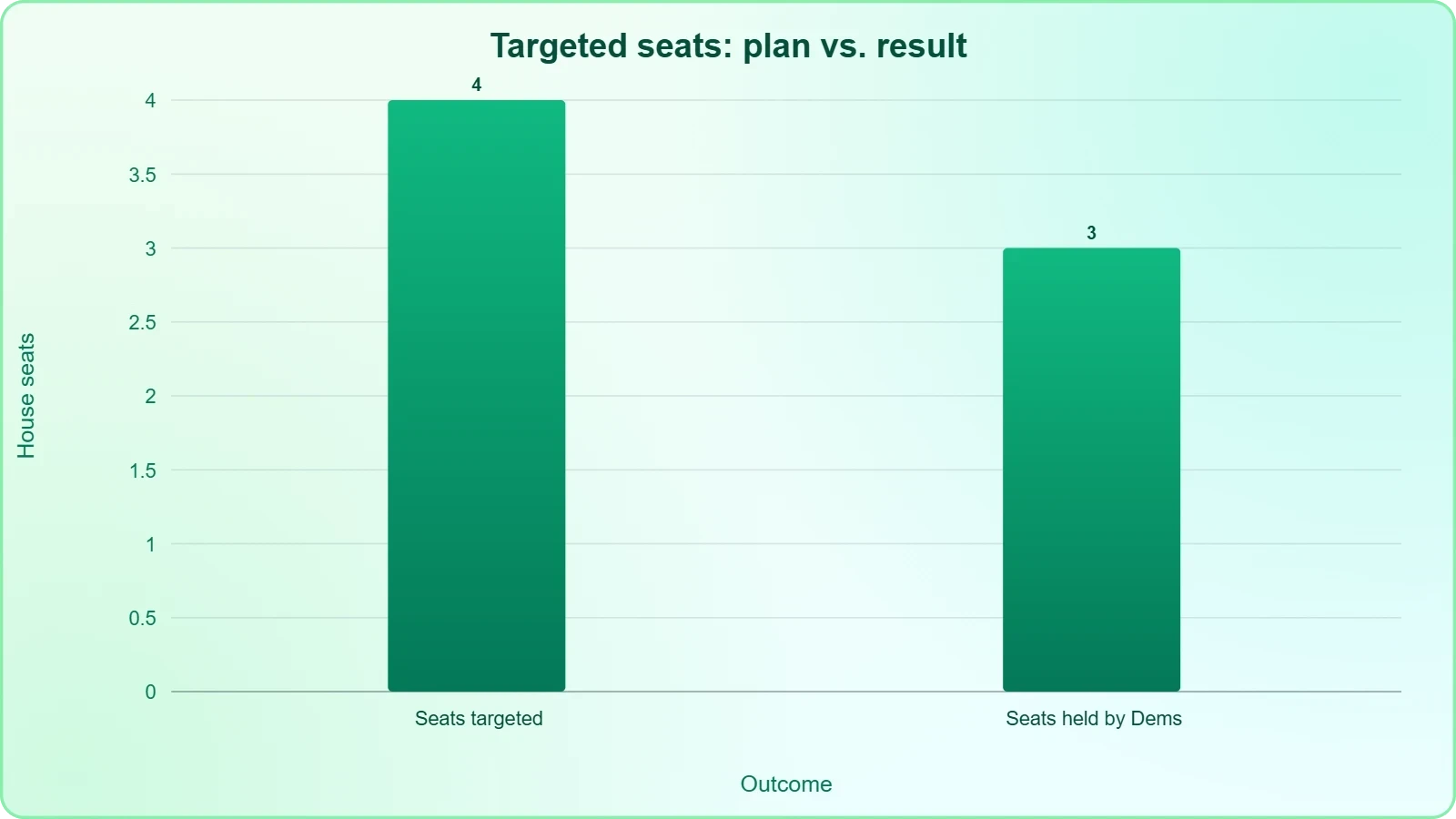
The strategy rested on a familiar assumption: that voters behave predictably according to their registration and past voting patterns, and that sufficiently careful line-drawing can lock in a desired result for a decade. Florida's Republican leadership had reason for confidence. The state had swung decisively toward the GOP in recent statewide elections, and the national environment heading into 2026 appeared favorable to the party holding the governor's mansion and a substantial legislative majority. Yet the map's designers appear to have underestimated two variables that repeatedly confound redistricting projections: the personal appeal of individual candidates and the volatility of midterm electorates.
The Targeted Districts and Their New Boundaries
The four districts selected for disruption shared a common profile: each had elected a Democrat in recent cycles while containing enough Republican-leaning territory to make a redrawn version competitive. Florida's 22nd District was among the most closely watched, its boundaries shifted to incorporate areas that had voted reliably Republican in prior elections. The redistricting also affected the districts held by Moskowitz and Castor, both of whom suddenly found themselves representing substantial numbers of new constituents whose voting histories differed markedly from their previous electorates. The mapmakers' calculation was that fresh boundaries would produce fresh outcomes.
That calculation collided with the reality of incumbency. Moskowitz and Castor had each built recognizable profiles in their communities, and both proved capable of appealing across the new lines. Castor, in particular, faced a challenger with presidential backing, which transformed her race from a routine incumbent defense into a contest with national visibility. The new boundaries may have changed the electorate on paper, but they could not erase the name recognition, constituent service records, and fundraising networks that incumbents accumulate over multiple terms. Redistricting can reshape a district, but it cannot instantly manufacture a challenger of comparable standing.
Why the Map Failed to Deliver
The most instructive aspect of the Florida result is the gap between the map's mechanical design and the electorate's actual behavior. Several factors converged to frustrate the Republican plan. First, midterm elections historically favor the party out of power at the national level, and 2026 was no exception; Democratic turnout in the targeted districts appears to have exceeded the levels the mapmakers anticipated. Second, the Trump endorsement of Beltran in Castor's district may have cut both ways, energizing Democratic voters who viewed the intervention as a nationalization of a local race. Third, the new boundaries themselves created confusion and backlash among voters who resented being shuffled between districts.
There is also a structural lesson here about the limits of redistricting as a tool. Maps can shift the partisan lean of a district by several points, but they cannot eliminate the underlying competitiveness of an area without producing boundaries so contorted that they invite legal challenge. Florida's map pushed against that boundary, and the result was a set of districts that remained winnable for Democrats who ran strong campaigns. The projections from CNN's Decision Desk suggest that at least three of the four targeted seats stayed Democratic, a outcome that mapmakers will need to study closely as they consider future redistricting cycles.
The Castor-Beltran Contest as a National Bellwether
Among the individual races, Kathy Castor's defense of her seat against Mike Beltran carries the greatest symbolic weight. Beltran entered the race with the endorsement of President Donald Trump, a fact that elevated a Tampa-area congressional contest into a proxy referendum on the president's down-ballot influence. When a president personally backs a challenger, the race becomes a test of whether that endorsement retains its power to move voters at the district level. Castor's projected victory suggests that in at least some competitive districts, the Trump imprimatur is no longer the decisive force it once appeared to be, particularly when the incumbent has deep local roots.
The mechanics of the Castor campaign also deserve attention. Facing new boundaries that included unfamiliar territory, Castor's team invested heavily in reintroducing her to voters who had not previously been in her district. That kind of retail politics, expensive and time-consuming, is precisely what redistricting is supposed to make harder for incumbents. Yet Castor's ability to execute it successfully points to a broader truth about American elections: the quality of a campaign and the strength of a candidate's connection to a community can outweigh structural disadvantages built into a map. Beltran's presidential backing, meanwhile, may have nationalized the race in ways that helped Castor among voters skeptical of outside interference.
Incumbency as a Counterweight to Map Design
Both Moskowitz and Castor benefited from the incumbency advantage, a phenomenon that political scientists have documented for decades. Incumbents enjoy name recognition, access to donor networks, and the ability to provide constituent services that challengers cannot match. Redistricting can dilute these advantages by introducing new voters, but it rarely eliminates them entirely, especially when the incumbent has served multiple terms and built a substantial public profile. The Florida results suggest that mapmakers who assume incumbents will simply fold under new boundaries are making a costly miscalculation.
There is a quantitative dimension to this as well. Political analysts often model district partisanship using past election results, producing a score that predicts the expected vote share for each party. A district that leans Republican by a few points is considered competitive, while one that leans by double digits is considered safe. Florida's new map appears to have produced several districts in the competitive range rather than the safe range, which left the outcomes dependent on candidate quality and turnout. When those factors broke toward the Democrats, the map's intended advantage evaporated. The lesson is that redistricting can shift probabilities, but it cannot set them to one.
The Role of National Political Currents
No congressional race occurs in a vacuum, and the 2026 midterms unfolded against a national backdrop that shaped outcomes in Florida and elsewhere. Midterm elections have historically punished the party holding the White House, and the dynamics of 2026 appear to have followed that pattern in many districts. Democratic voters, motivated by opposition to the national agenda, turned out at higher rates than the redistricting models may have assumed. Republican voters, meanwhile, may have been complacent in districts their party's mapmakers had declared safe, a phenomenon that has undone more than one carefully drawn plan.
The nationalization of local politics is another factor. In an era when voters consume political information through national media and social platforms, district-level races increasingly reflect national partisan identities rather than local concerns. This cuts against the logic of redistricting, which assumes that voters can be sorted by geography into predictable partisan blocs. If voters are primarily responding to national cues, then moving a few thousand of them from one district to another may have less effect than mapmakers expect. Florida's results are consistent with this interpretation: the boundaries changed, but the partisan behavior of voters did not shift as dramatically as the map required.
We Also Published
Implications for the 2026 Midterms and Beyond
The Florida results ripple outward in several directions. At the most immediate level, they affect the balance of power in the U.S. House, where every seat matters. Three Democratic holds in districts Republicans had counted on flipping represent a meaningful shortfall against the GOP's national expectations. If similar patterns hold in other states where Republicans pursued aggressive redistricting, the party's national gains in the House could fall well short of projections. The Florida outcome thus serves as an early indicator of how the 2026 midterms may be reshaping the congressional map in ways that defy pre-election modeling.
Beyond the immediate seat count, the results carry a warning for both parties about the limits of structural manipulation. Republicans invested significant political capital in redistricting, and the returns were disappointing. Democrats, meanwhile, have evidence that strong candidates and energetic turnout can overcome unfavorable boundaries, which may influence how they allocate resources in future cycles. The episode also feeds into the broader national debate over redistricting reform, providing ammunition to advocates who argue that map-drawing should be conducted by independent commissions rather than partisan legislatures. When a partisan map fails, it weakens the case for the practice on both practical and normative grounds.
What the Results Mean for Florida Politics
Within Florida, the outcome complicates the narrative of Republican dominance that has defined the state's politics in recent years. The GOP controls the governorship, both legislative chambers, and a majority of the congressional delegation, but the redistricting failure reveals that the party's grip is not absolute. Democratic candidates demonstrated that they can compete in redrawn districts when they field credible candidates and mobilize their base. For Florida Republicans, the lesson may be that future redistricting efforts need to be more conservative in their ambitions, producing safer districts rather than stretching to capture marginal ones.
The state's demographic evolution also plays a role. Florida has experienced significant population growth and diversification, particularly in suburban and exurban areas that were central to the redistricting changes. These communities are less predictable in their partisan behavior than the mapmakers assumed, and their voters may be more responsive to candidate quality than to district lines. As Florida continues to change, the assumptions underlying any redistricting plan will require constant revisiting. The 2026 results suggest that the state's political geography is more fluid than a static map can capture.
Lessons for Redistricting Strategy Nationally
Nationally, the Florida episode offers a case study that both parties will study closely. For Republicans, the lesson is that redistricting is a blunt instrument when applied to districts that remain fundamentally competitive. Drawing lines to create a slight Republican lean may produce a district that is winnable in a good year but vulnerable in a bad one. For Democrats, the lesson is that investment in candidate recruitment and turnout operations can pay dividends even in unfavorable terrain. The party that treats redistricting as a decisive weapon may find itself outmaneuvered by the party that treats it as one factor among many.
The broader implication is that American elections remain fundamentally contestable. Structural advantages matter, but they are not destiny. Voters retain the capacity to surprise the analysts and the mapmakers alike, and the Florida results are a reminder that democracy is not a spreadsheet. The projections from CNN's Decision Desk, reported on the evening of November 3, 2026, will be cited for years as evidence that the most carefully engineered electoral advantages can be undone by the simple act of voters choosing a different outcome than the one designed for them.
- 01
- 02
- 03
- 04
The Legal and Normative Debate Over Partisan Mapmaking
Florida's redistricting fight did not occur in a legal vacuum. The state's constitution contains provisions governing congressional redistricting, and the 2026 map was certain to face litigation regardless of the electoral outcome. The fact that the map failed politically does not resolve the legal questions it raised. Courts in Florida and across the country have struggled with the line between permissible political considerations and impermissible partisan gerrymandering, and the Florida case adds another chapter to that ongoing jurisprudence. The results may even strengthen the hand of plaintiffs who argue that the map was drawn with discriminatory intent.
The normative debate is equally significant. Defenders of partisan redistricting argue that it is a legitimate exercise of political power, no different from any other legislative decision, and that voters ultimately hold mapmakers accountable. Critics counter that gerrymandering undermines the principle that voters choose their representatives rather than the reverse. The Florida outcome complicates both positions. It shows that partisan maps can fail, which weakens the critics' claim that gerrymandering is an unstoppable threat. But it also shows that mapmakers will expend enormous effort trying to engineer outcomes, which strengthens the case for institutional safeguards.
How Courts Have Treated Similar Cases
Federal courts have generally declined to police partisan gerrymandering, treating it as a political question beyond judicial reach, though state courts have been more willing to intervene under state constitutional provisions. Florida's constitution includes a fairness requirement that has been invoked in past redistricting challenges. The 2026 map's explicit targeting of Democratic-held seats could provide grounds for a state court challenge, particularly if plaintiffs can demonstrate that the boundaries were drawn with the intent to disadvantage a particular party. The electoral failure of the map does not moot such a challenge, since the legal injury lies in the drawing itself rather than the result.
The timing of any litigation matters as well. Redistricting challenges often take years to resolve, and by the time courts rule, the map may have been used in multiple election cycles. This dynamic creates a strong incentive for mapmakers to push boundaries, knowing that legal remedies are slow and uncertain. Florida's experience may accelerate calls for faster judicial review or for independent commissions that remove mapmaking from legislative hands entirely. The 2026 results give reform advocates a concrete example to cite when arguing that the current system produces both unfair maps and unpredictable outcomes.
Public Opinion and the Politics of Fairness
Public opinion on redistricting is remarkably consistent across party lines: majorities of Americans, including majorities of both Republicans and Democrats, favor independent commissions over legislative mapmaking. This consensus exists because voters intuitively understand that allowing politicians to choose their own constituents is a conflict of interest. The Florida episode illustrates why that intuition is sound. A map designed to produce a predetermined outcome failed, wasting public resources and generating litigation, while the voters in the affected districts were subjected to confusing boundary changes and a barrage of nationalized campaign advertising.
The politics of fairness also cut against the mapmakers in a subtler way. When voters perceive that district lines have been manipulated for partisan advantage, they may respond by supporting the party they see as the victim of the manipulation. This backlash effect is difficult to measure but may have contributed to the Democratic turnout in the targeted Florida districts. Redistricting, in other words, can be counterproductive not only because it fails mechanically but because it can energize the very voters it was designed to dilute. The 2026 results offer suggestive evidence for this dynamic.
Reading the Results Through a Data Lens
For analysts who prefer quantitative framing, the Florida results offer a useful dataset. The redistricting produced districts with specific partisan lean scores, and the actual outcomes can be compared against those scores to measure how much candidate and turnout effects deviated from the map's expectations. Such comparisons are inherently approximate, since district-level polling is sparse and post-election analysis relies on aggregate returns, but they can still reveal patterns. The early evidence suggests that Democratic candidates outperformed the partisan lean of their new districts by margins large enough to overcome the map's intended advantage.
Turnout data will be particularly revealing once fully compiled. If Democratic turnout in the targeted districts exceeded the levels predicted by the mapmakers' models, that would confirm the midterm backlash hypothesis. If, instead, Republican turnout underperformed, that would point to complacency among voters who believed their party's map had made their districts safe. Either way, the data will help political scientists refine their models of how redistricting interacts with turnout and candidate quality. The Florida case is likely to become a standard reference in that literature.
Modeling District Partisanship and Its Limits
District partisanship is typically modeled using a composite of past election results, producing a score such as a Cook Partisan Voting Index or a similar metric. These scores are useful but imperfect, because they assume that voters behave consistently across election cycles and that national trends affect all districts equally. The Florida results challenge both assumptions. Voters in the redrawn districts appear to have responded to the specific candidates and the national environment in ways that the composite scores did not anticipate. The lesson is that partisanship scores are probabilistic, not deterministic, and should be treated as such.
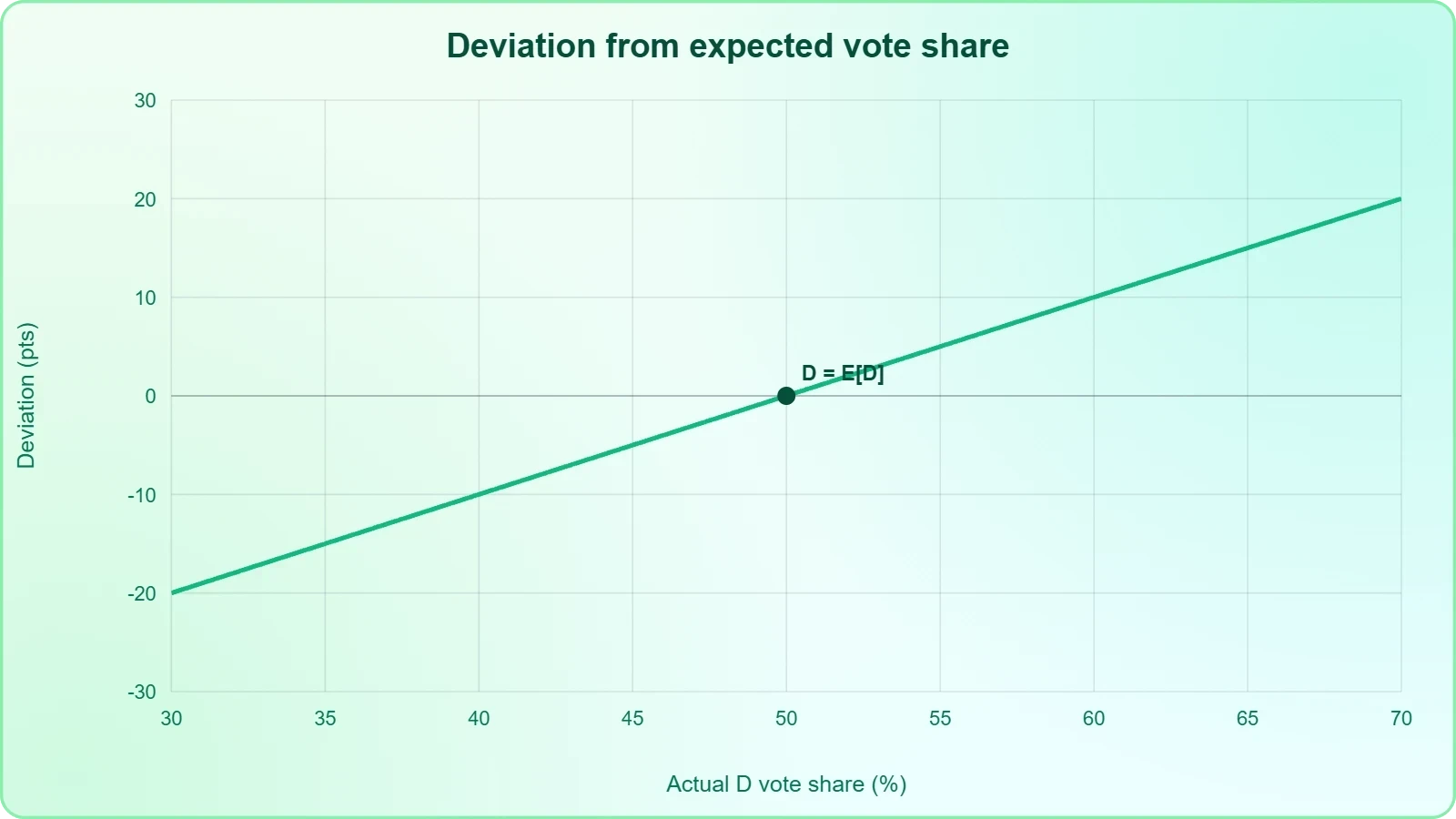
There is a mathematical way to express this. If a district's expected Democratic vote share is ##E[D]## and the actual share is ##D##, then the deviation ##\Delta = D - E[D]## captures the combined effect of candidate quality, turnout, and national trends. In Florida's targeted districts, ##\Delta## appears to have been positive for Democrats, meaning they outperformed expectations. Analysts can decompose ##\Delta## into components attributable to incumbency, national swing, and campaign-specific factors, though the decomposition requires assumptions that are themselves contestable. The exercise is valuable less for its precision than for the discipline it imposes on post-election narratives.
What Future Cycles Might Learn
Future redistricting cycles will inevitably draw on the Florida experience. Mapmakers may become more cautious, producing safer districts rather than stretching for marginal gains. Campaign strategists may invest more heavily in candidate recruitment in districts that appear unfavorable on paper, recognizing that map advantages are not insurmountable. And reformers may find new audiences for their arguments, since the Florida case demonstrates that partisan mapmaking can produce both unfairness and inefficiency. The 2026 midterms, in this reading, are a data point that will inform behavior for years to come.
The deeper lesson may be about the resilience of democratic contestation. Florida Republicans drew a map designed to produce a specific result, and the voters produced a different one. That is not a story of heroic resistance or of structural inevitability; it is a story of ordinary electoral dynamics operating within constraints that proved less binding than expected. The projections from CNN's Decision Desk, reported on November 3, 2026, record the outcome, but the meaning of that outcome will be debated and reinterpreted as the political system absorbs its implications.
Conclusion: A Map That Could Not Hold
The Florida redistricting experiment will be remembered as a case study in the limits of political engineering. Republicans drew boundaries with the explicit aim of capturing four Democratic-held seats, and Democrats won at least three of them. The outcome reflects the interplay of incumbency, candidate quality, national political currents, and the inherent unpredictability of voters. It does not prove that redistricting is ineffective, but it does demonstrate that maps are not destiny. The projections from CNN's Decision Desk, reported on the evening of November 3, 2026, provide the factual record on which that conclusion rests.
For Democrats, the results offer encouragement and a template: strong candidates, energetic turnout, and a willingness to compete in unfavorable terrain can overcome structural disadvantage. For Republicans, the results offer a caution: redistricting is a high-cost, high-risk enterprise that can backfire when it produces competitive rather than safe districts. For the broader public, the results offer a reminder that the democratic process retains its capacity to surprise, and that the most carefully laid plans of mapmakers remain subject to the judgment of the voters they seek to arrange.
From our network :
- The Final Descent: How ESA Retired the Legendary Cluster Constellation After 24 Years of Space Weather ScienceAfter 24 years mapping Earth’s magnetosphere, ESA’s Cluster mission concluded with a precisely controlled reentry over the South Pacific. This analysis explores the scientific legacy, engineering decisions, and debris mitigation principles behind one of space exploration’s most responsible retirements.
- How AI Agents Will Change the Way We Manage Personal FinancesExplore how AI agents are transforming personal finance through automated budgeting, bill payment, and investment management, while examining the critical security protocols and governance frameworks required for safe deployment.
- University Language Proficiency Exams: Why Institutional Tests Demand Different Preparation Than IELTS and TOEFLDiscover why university-specific language proficiency examinations differ fundamentally from IELTS and TOEFL, and learn strategic preparation approaches for institutional assessment success.
- The Hidden Cost of AI Convenience: Why Over-Permissioned Agents Are a Security Time BombDiscover why AI agents with excessive permissions create dangerous single points of failure, and learn how implementing least privilege principles can protect your organization from exploitation.
- Committed Mediterranean Precipitation Decline: Why Emissions Cuts Alone Cannot Restore Winter RainsNew NOAA research reveals that Mediterranean winter rains may decline irreversibly even with emissions cuts. Explore the science of committed climate change and regional impacts.
- Mobile Learning and VR in English: What Global Evidence Reveals About Effective Language TechnologyA systematic review across 14 countries reveals which language-learning technologies genuinely work. Mobile learning, AI, and VR show measurable benefits when pedagogically integrated. This evidence-based guide helps educators and learners select technology that delivers real return on investment.
- Forbidden Matrix Patterns and Visible Lattice Points: A Geometric DictionaryExplore how multidimensional 0–1 matrices encode geometric truths, linking forbidden patterns to visible lattice points and hypergraph theory, with applications in combinatorics and computational geometry.
- Live Online English Classes for Kids: Do They Actually Reduce Anxiety?A ten-week study reveals that synchronous online English classes can significantly reduce child language anxiety while improving listening and reading skills. Discover what makes these programs effective and how parents can select the right one.
- CISA’s Ten-Advisory Wave: Why Generic Patching Fails in OT and How to Build Product-Specific PlaybooksCISA released ten ICS advisories in one week, exposing critical infrastructure risks. Generic patching fails in OT. Learn to build product-specific remediation playbooks.
RESOURCES
- Who is winning redistricting after Florida's new congressional map ...votebeat.orgMay 4, 2026 ... Democrats will probably gain more House seats than Republicans in the 2026 ... RedistrictingElection Laws2026 Midterm Elections. Here's ...
- A state-by-state look at the narrowing redistricting battle for the U.S. ...pbs.orgApr 22, 2026 ... So far, Republicans believe they could win up to nine additional seats in states where they have redrawn congressional districts…
- The redistricting frenzy is scrambling the midterm elections. Here's ...stateline.orgMay 15, 2026 ... ... 2026 5:00 am Updated 12:01 pm. Tennessee Democrats lock arms on the Tennessee House floor in protest of a…
- States rush to redraw U.S. House districts ahead of the November ...pbs.orgApr 16, 2026 ... But Virginia voters are deciding Tuesday on a Democratic redistricting plan that could help the party win several additional House…
- State Redistricting Legal Challenges Intensify Ahead of 2026 Electionsmultistate.usMar 9, 2026 ... ... congressional maps that would likely increase either Republican or Democratic seats in the House. California Democrats Gain Six Additional…
- Redistricting ahead of the 2026 elections - Ballotpediaballotpedia.org7 days ago ... In the 2018 elections, the midterm elections during President Donald Trump's (R) first term, Democrats gained control of the House…
- Florida Redistricting 2026: DeSantis Calls Special Session | MultiStatemultistate.usApr 6, 2026 ... Recent special election results in Palm Beach County showed a 21-point swing toward Democrats, flipping a state House seat that…
- With Virginia vote, Democrats get ahead of Trump's redistricting - NPRnpr.orgApr 22, 2026 ... But the party in control of the White House usually loses seats in the midterms. Trump has pushed for mid-decade…
- Sabato's Crystal Ball - UVA Center for Politicscenterforpolitics.orgTHE FINAL 2026 RATINGS: Democrats Favored to Capture House, Senate ... Nearly 30 House rating changes push the number of seats at least leaning…
- An hour after SCOTUS guts Voting Rights Act, Florida House passes ...democracydocket.comApr 29, 2026 ... ... gerrymandering. The new map could deliver up to four more Republican congressional seats in time for the 2026 midterm…
- The U.S. House seats most likely to flip in 2026decisiondeskhq.substack.comOct 1, 2026 ... Just over a month out from the midterms, Democrats are now more clearly favored to flip control of the U.S.…
- Redistricting is rampant ahead of the US House midterm elections ...ap.orgMay 6, 2026 ... ... congressional redistricting effort that could improve ... Democratic-led Legislature that could help Democrats win five additional seats.
- Explainer: What's happening with gerrymandering in the United ...hks.harvard.eduMay 4, 2026 ... ... Democratic seats under the old map in Florida. The new map ... Q: Will the gerrymandering in Virginia and…
- Congress could get a lot Whiter with Democratic redistrictingwashingtonpost.comAug 27, 2026 ... The 2026 midterms are exposing Democrats' dilemma over race, power, and the House ... Democrats should prioritize maximizing House seats ...
- Virginia voters approve Democrats' redistricting plan, giving the ...nbcnews.comApr 21, 2026 ... "Virginia just changed the trajectory of the 2026 midterms," Virginia Democratic state House Speaker Don Scott said in a statement.…
- 01
- 02
- 03
- 04
- 05
- 06
- 07
- 08
0 Comments