When a cabinet minister steps down not because a court has found him personally culpable, but because the scale of a tragedy has made his continued presence untenable, the resignation becomes something more than an administrative event. It becomes a statement about the moral architecture a government claims to uphold. The departure of Spain's transport minister, Óscar Puente, in November 2026 belongs precisely to this category of political reckoning. Two catastrophic rail accidents within a single calendar year, the second claiming 69 lives and injuring more than 200 people, created a rupture that no amount of technical explanation could paper over.
What makes this episode instructive is the layered nature of the failure it exposes. The crash on the Madrid–Andalusia corridor was not a simple case of mechanical breakdown or lone operator negligence. Investigators described a compound of human and computer error, a safety system that had halted all traffic on the line, and yet a train that nonetheless proceeded into a stationary service. A red signal forbade movement; an authorization permitted it; the contradiction between the two remains, in Puente's own words, inexplicable. Understanding how such contradictions survive inside modern safety-critical infrastructure is the central analytical thread of this examination.
The political context sharpens every dimension of the story. Puente's announcement landed three weeks before a general election that Prime Minister Pedro Sánchez had called early amid corruption scandals, a housing affordability crisis, and municipal losses for the socialist PSOE. The minister's decision not to stand as a candidate, and Sánchez's public praise for a man who "stepped aside out of respect for the victims," frame resignation as an act of democratic dignity rather than defeat. This analysis unpacks the accountability norms, the engineering failures, and the electoral calculus that converge in a single resignation letter.
On This Page
- The Anatomy of Ministerial Accountability in Modern Democracies
- Reconstructing the Madrid–Andalusia Collision
- The Political Earthquake Three Weeks Before an Election
- Rail Safety Governance and the Limits of Technological Fixes
- Electoral Consequences and the Meaning of Resignation
- What the Puente Resignation Teaches About State Responsibility
TL;DR Spain's transport minister Óscar Puente resigned after two deadly train crashes within a year, the most recent killing 69 people and injuring over 200 on the Madrid–Andalusia line. The crash combined human and computer error: a safety system had stopped all traffic, yet one train was authorized to proceed past a red signal and struck a stationary train. An earlier January collision in Adamuz killed at least 41. Puente declined to contest the upcoming general election, and Prime Minister Pedro Sánchez framed the resignation as respect for victims. The episode raises enduring questions about ministerial accountability, rail safety governance, and the political cost of infrastructure failure.
The Anatomy of Ministerial Accountability in Modern Democracies
Ministerial resignation in the wake of disaster is a practice with deep roots in parliamentary tradition, yet its application remains strikingly inconsistent across democracies. The doctrine of ministerial responsibility once held that a minister must answer to parliament for everything done within a department, whether or not personal fault existed. Over the twentieth century, that strict standard eroded almost everywhere, replaced by a more pragmatic culture in which leaders cling to office until evidence of direct culpability emerges. Puente's decision therefore represents a deliberate reassertion of the older, sterner norm.
His reasoning deserves close attention because it separates two distinct questions that political commentary often conflates. The first is legal liability: whether a minister bears direct responsibility for operational decisions taken far below his office. The second is institutional accountability: whether the office itself can retain public trust after repeated catastrophic outcomes. Puente explicitly conceded that the accidents were different in nature and that direct responsibility was not established, yet concluded that a transport minister in a country like Spain cannot remain after two accidents of such severity in less than a year.
The Distinction Between Fault and Fitness for Office
This distinction between fault and fitness is the intellectual core of the resignation. In systems governed by regulatory agencies, safety boards, and independent investigators, ministers rarely possess the technical expertise to prevent a signal failure or a computer authorization error. Holding them personally blameworthy for such events would be unreasonable. But accountability is not solely about blame; it is also about the symbolic function of office. A minister who remains in place after repeated loss of life signals that the state treats catastrophe as routine, a message no government can afford to transmit.
Comparative practice illustrates how varied the response can be. In Japan, transport ministers have resigned after major rail incidents even when investigations pointed to operator failures, reflecting a cultural expectation that leadership absorbs institutional shame. In the United Kingdom, ministers have sometimes survived inquiries by pointing to independent regulators. Spain's own political culture, shaped by a strong tradition of public protest and a lively parliamentary opposition, tends to punish perceived indifference swiftly. Puente's resignation therefore aligns with a broader European pattern in which symbolic accountability still carries real weight.
Why Resignation Functions as a Governance Signal
Resignation also performs a forward-looking function that legal processes cannot replicate. By removing himself, a minister creates space for a successor to implement reforms without the baggage of defensiveness. It signals to rail workers, unions, and victims' families that the political system registers their grief as something more than a public relations problem. And it establishes a precedent that future ministers will remember when weighing whether to cut safety budgets or defer maintenance. The deterrent effect of resignation is difficult to measure but impossible to dismiss.
Critics argue that resignations can become ritualistic gestures that substitute for substantive change, allowing governments to declare the matter closed once a head has rolled. That risk is genuine. The test of Puente's departure will be whether it is followed by structural reform of the signaling and authorization systems implicated in the crash, or whether it merely resets the political conversation. Accountability that ends with a resignation letter, without accompanying institutional repair, is accountability in form only.
Reconstructing the Madrid–Andalusia Collision
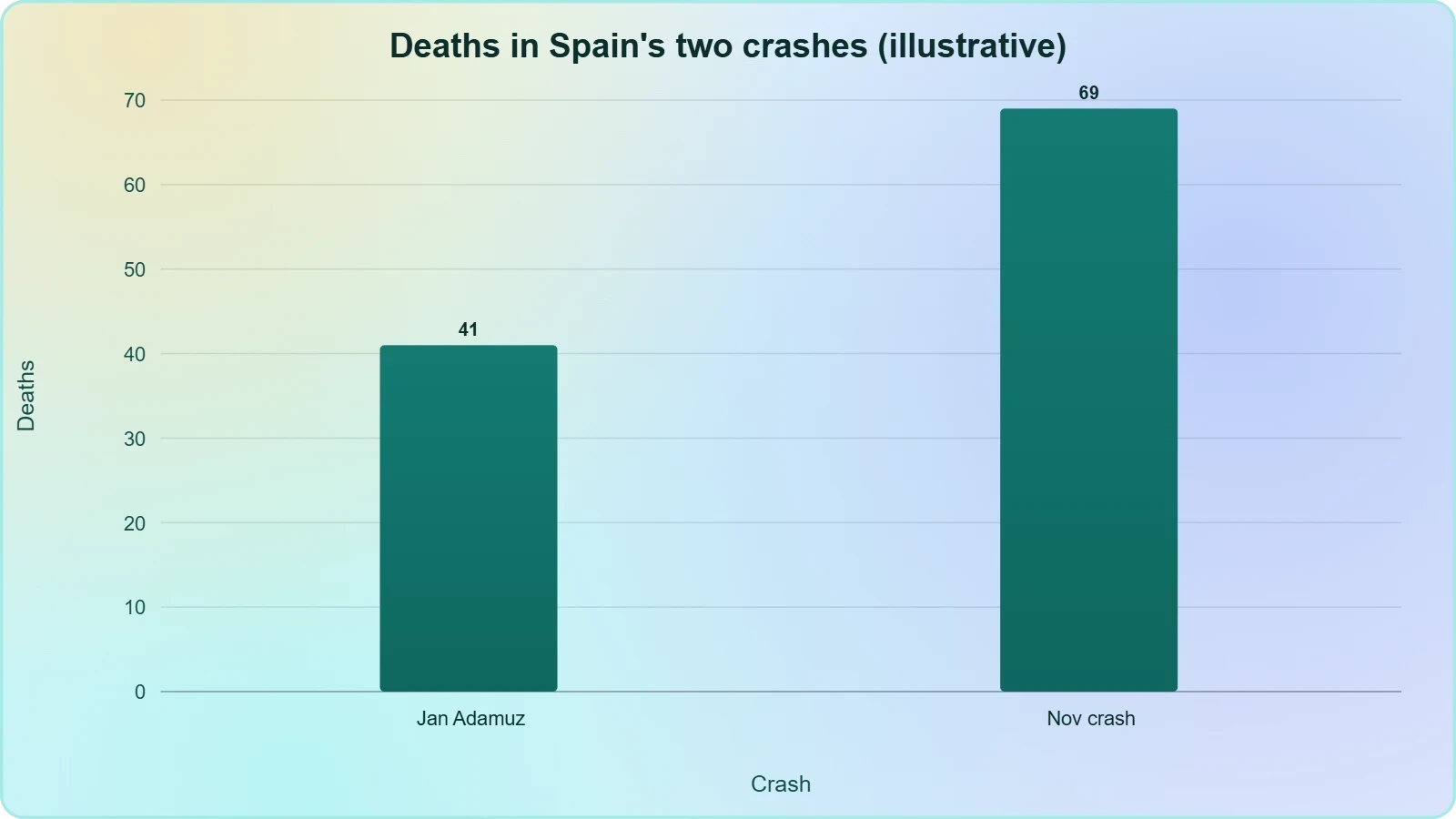
The crash that triggered the resignation occurred on the high-speed corridor linking Madrid with Andalusia, one of Spain's most heavily used long-distance routes. According to the account Puente gave to lawmakers, a safety system failure had already halted all rail traffic on the line, a protective measure designed to prevent exactly the kind of collision that followed. Despite that blanket stoppage, a train operated by Spain's national rail service entered the section and struck a stationary train at high speed. The death toll of 69, with more than 200 injured, made it one of the worst rail disasters in recent Spanish history.
The critical anomaly lies in the authorization chain. A red signal explicitly prohibited movement, yet the train was cleared to proceed. Puente described the decision as having been made under inexplicable circumstances, a phrase that acknowledges the absence of any coherent explanation rather than offering one. In safety engineering, this is the most troubling category of failure: not a component that broke, but a permission that should never have existed. The investigation must now determine whether the authorization originated in software logic, human override, or a breakdown in communication between control centers.
Human and Computer Error in Safety-Critical Systems
Modern rail networks rely on layered protection: automatic train protection systems, interlocking logic, centralized traffic control, and human signallers who supervise the automation. Each layer assumes the others may fail, a principle known as defense in depth. When a collision occurs despite these layers, the failure is almost never singular. The Madrid–Andalusia incident appears to fit the classic pattern in which automation and human judgment each contributed a partial error that, combined, defeated the safeguards. The safety system stopped traffic; the authorization overrode the stop; the train proceeded; the stationary train could not move.
Researchers in system safety describe this phenomenon as a "normal accident," a term coined to capture failures that emerge from the interaction of otherwise well-designed components rather than from any single broken part. The implication is uncomfortable for regulators, because it suggests that adding more automation does not automatically add more safety. Complexity itself can generate pathways to failure that no designer anticipated. The Spanish investigation will need to map the exact sequence of authorizations, signal states, and operator actions to establish where the protective layers were breached.
What the January Adamuz Collision Reveals
The November disaster did not arrive in isolation. In January of the same year, two high-speed trains collided head-on in the town of Adamuz, killing at least 41 people. At the time, it was Spain's deadliest rail accident in more than a decade, and it prompted its own round of questions about signaling, maintenance, and operational discipline. The fact that a second catastrophic collision followed within months transformed what might have been treated as an isolated tragedy into evidence of a systemic pattern, which is precisely the argument Puente invoked when explaining his resignation.
Head-on collisions on high-speed lines are theoretically impossible under functioning block signaling, since the system should prevent two trains from occupying the same track section in opposing directions. Their occurrence points to either equipment failure, procedural violation, or a gap in the design of the protection system itself. The Adamuz inquiry and the Madrid–Andalusia inquiry now run in parallel, and their findings will determine whether Spain faces a narrow technical problem or a broader governance deficit in its rail infrastructure.
The Political Earthquake Three Weeks Before an Election
Timing is everything in politics, and Puente's resignation arrived at the most volatile possible moment. Spain was three weeks away from a general election that Prime Minister Pedro Sánchez had called early, a decision driven by a convergence of pressures: several corruption scandals involving his government, a sustained controversy over housing affordability that had energized younger voters, and significant setbacks for the socialist PSOE in municipal elections. In that environment, a ministerial resignation over a mass-casualty disaster could either defuse public anger or amplify it into a verdict on the entire government.
The resignation also carried a personal dimension that shaped its political meaning. Puente announced he would not stand as a candidate in the forthcoming election, converting his departure from a temporary retreat into a permanent exit from electoral politics. That choice denied opponents the satisfaction of claiming they had driven him out while simultaneously denying his party the option of presenting him as a future asset. It was, in effect, a clean break designed to remove himself as a variable in the electoral equation.
Reading Sánchez's Response as Political Strategy
Sánchez's public response was carefully calibrated. On social media, he praised Puente for stepping aside out of respect for the victims and for the progressive project, adding that politicians like him dignify the country and demonstrate that not everyone is the same. The phrasing performs several tasks at once. It frames the resignation as an act of principle rather than an admission of failure, it draws an implicit contrast with political opponents whom voters might regard as less scrupulous, and it attempts to convert a moment of government crisis into a demonstration of the party's moral character.
Whether that framing succeeds depends on how voters interpret the underlying events. If the public reads the resignation as evidence that the government takes safety and grief seriously, Sánchez benefits. If the public reads it as evidence that the government presided over a preventable second disaster, the gesture becomes an indictment rather than a defense. The three-week window before the election leaves little time for the investigation to produce findings that might settle the question, which means the narrative battle will be fought over symbolism rather than evidence.
Protest, Unions, and the Pressure That Forced the Decision
Puente did not resign in a vacuum of public opinion. After the November collision, transport workers' unions and numerous politicians publicly called for his departure. On the night of the crash, hundreds of protesters gathered outside the transport ministry headquarters in Madrid, and police were present as some demonstrators carried placards demanding that Prime Minister Sánchez himself resign. The escalation from demands for a minister's exit to demands for the prime minister's exit illustrates how quickly a transport disaster can metastasize into a general crisis of confidence.
Union involvement added institutional weight to the pressure. Rail workers possess detailed knowledge of the operational conditions that contribute to accidents, and their public criticism carries credibility that partisan attacks lack. When the people who run the trains say the system is unsafe, the political cost of ignoring them rises sharply. Puente's resignation can therefore be read as a response not only to the crash itself but to the coalition of workers, victims' advocates, and opposition politicians that formed in its aftermath.
Rail Safety Governance and the Limits of Technological Fixes
Beneath the political drama lies a technical question of considerable importance: how did a safety system designed to prevent collisions fail so completely that a train was authorized to proceed past a red signal into an occupied section? Spain's high-speed network is among the most extensive in Europe, equipped with advanced signaling and automatic protection systems that have historically delivered strong safety records. The Madrid–Andalusia corridor carries millions of passengers annually, and its operators have invested heavily in centralized control. The collision therefore challenges assumptions about the reliability of layered technological protection.
Safety engineers distinguish between active and passive protection. Active systems intervene automatically to stop a train when danger is detected; passive systems rely on signals and procedures that humans must obey. The incident suggests a failure at the boundary between the two: an active system halted traffic, but a subsequent authorization, whether human or algorithmic, effectively neutralized that protection. Understanding this boundary is essential because it is precisely where automation and human discretion interact, and where responsibility becomes diffuse.
Signal Failures, Authorization Logic, and the Human Override
The phrase "authorized to proceed" is the crux of the investigation. In modern rail operations, authorization to move through a restrictive signal typically requires explicit permission from a controller, often documented and recorded. If such permission was granted while a safety system had stopped all traffic, the question becomes who granted it and on what basis. Puente's characterization of the decision as made under inexplicable circumstances indicates that no satisfactory rationale has yet emerged, which in itself is a finding about the robustness of the authorization process.
Human override exists because automation cannot anticipate every scenario, and controllers must retain discretion to resolve unusual situations. But discretion is also a vulnerability, since it creates a pathway by which protective systems can be bypassed. The design challenge is to make override difficult enough to prevent casual misuse while remaining accessible enough for legitimate emergencies. The Spanish case will likely prompt a review of how override permissions are logged, verified, and counter-checked across the network.
Learning from International Rail Accident Investigations
Spain is not the first country to confront a collision that defeated layered protection. Investigations into major rail disasters elsewhere have repeatedly identified the same themes: ambiguous procedures, inadequate training for rare scenarios, organizational pressure to maintain service, and the difficulty of maintaining situational awareness when automation behaves unexpectedly. The recurrence of these themes across jurisdictions suggests that the problem is structural rather than idiosyncratic, rooted in the inherent tension between safety and operational efficiency.
Effective post-accident reform typically combines technical upgrades with procedural and cultural change. Independent investigation bodies, mandatory reporting of near-misses, and separation of infrastructure management from service operation are among the measures that have improved safety records in various countries. Spain's response will be judged by whether it adopts such measures comprehensively or settles for targeted fixes that address the specific failure without confronting the broader governance questions the two crashes have raised.
We Also Published
Electoral Consequences and the Meaning of Resignation
With the general election only three weeks away, the resignation's electoral consequences are as uncertain as its moral clarity is sharp. Puente's departure removes a lightning rod for public anger, potentially depriving the opposition of a convenient target. Yet it also validates the opposition's central claim that the government's stewardship of transport safety was deficient. The net effect depends on whether voters credit the government for responding decisively or blame it for creating the conditions that made the response necessary, a calculation that varies with each voter's prior disposition.
Sánchez's early election call had already placed his government on the defensive. Corruption scandals had eroded trust, housing costs had alienated younger urban voters, and municipal losses had demonstrated the PSOE's vulnerability at the ballot box. The rail disasters added a dimension of physical safety and state competence to an already crowded field of grievances. In this context, the resignation functions as an attempt at damage limitation, a concession offered in the hope that it satisfies the demand for accountability before that demand hardens into an electoral verdict.
How Voters Weigh Symbolic Accountability
Political science research on accountability suggests that voters respond more strongly to whether leaders appear to take responsibility than to the technical details of who caused a failure. A minister who resigns signals that the system is capable of self-correction, which can reassure voters even as it acknowledges failure. A minister who clings to office signals defensiveness, which tends to intensify public anger. Puente's resignation therefore may have been electorally rational even if it was politically painful, because it allowed the government to occupy the moral high ground of accountability.
The counterargument is that resignation can appear as an admission that the government was at fault, inviting voters to conclude that the entire administration is unsafe. The framing battle between these interpretations will be fought in the three weeks remaining, with Sánchez emphasizing dignity and responsibility while opponents emphasize negligence and repetition. Which narrative prevails will depend on factors beyond any politician's control, including whether further revelations emerge from the ongoing investigations.
The Long Shadow Over Spanish Rail Policy
Beyond the immediate election, the two crashes will shape Spanish rail policy for years. Investment priorities, maintenance schedules, staffing levels, and the design of authorization systems will all be revisited under the shadow of 110 combined deaths. The political cost of future accidents has risen dramatically, which may paradoxically improve safety by making preventive investment more attractive to governments eager to avoid the fate that befell Puente. Tragedy often produces reform, and the question is whether this reform will be durable or merely symbolic.
The resignation also establishes a precedent that future ministers will carry in their calculations. Knowing that two severe accidents within a year can end a career regardless of direct fault creates a powerful incentive to prioritize safety over cost savings and operational convenience. Whether that incentive translates into better outcomes depends on institutional design, but the precedent itself is a form of accountability that no statute could easily replicate. Spain's rail passengers may ultimately benefit from a resignation that, at the time, looked only like political damage.
What the Puente Resignation Teaches About State Responsibility
The resignation of a transport minister after two deadly crashes is, at one level, a familiar story of political accountability in a parliamentary democracy. At another level, it is a case study in how modern states struggle to assign responsibility for failures that emerge from complex sociotechnical systems. No single person designed the authorization logic that permitted a train to proceed past a red signal, and no single person operated every layer of protection that failed. Yet the public demand for accountability is not satisfied by pointing to complexity, and Puente understood that better than most.
His decision to resign despite the absence of established direct fault represents a deliberate choice to privilege institutional trust over personal career. Whether that choice was wise, politically calculated, or both is a question historians will debate. What is clear is that it established a standard against which future Spanish ministers will be measured, and that standard is stricter than the one that prevailed before the two crashes. In that sense, the resignation is itself a reform, however modest, of the unwritten rules that govern ministerial conduct.
Accountability, Complexity, and the Democratic Expectation
Democratic systems face a persistent tension between the complexity of modern governance and the simplicity of public expectations. Citizens reasonably expect that when 69 people die in a train crash, someone will be held responsible. The machinery of investigation, however, moves slowly and often concludes that responsibility is distributed across many actors. Resignation bridges this gap by providing an immediate, visible act of accountability that satisfies the democratic expectation without prejudging the investigative outcome. It is a political solution to a problem that law alone cannot resolve quickly.
The risk is that such gestures can become substitutes for deeper reform, allowing institutions to declare closure prematurely. The test for Spain will be whether Puente's resignation is followed by transparent investigation, published findings, and concrete changes to the systems that failed. If it is, the resignation will be remembered as the beginning of a serious reckoning. If it is not, it will be remembered as a gesture that cost a career but changed nothing, which would be the most cynical outcome of all.
Lessons for Infrastructure Governance Beyond Spain
Other countries operate rail networks with similar technologies, similar organizational structures, and similar vulnerabilities. The Spanish experience offers lessons that transcend national borders. First, layered protection is only as strong as the weakest authorization pathway, and override mechanisms deserve sustained scrutiny. Second, repeated incidents within a short period should be treated as evidence of systemic weakness rather than coincidence. Third, political accountability and technical investigation must proceed in parallel, because neither alone can restore public confidence after a mass-casualty event.
Infrastructure governance ultimately rests on a simple proposition: the state must be able to guarantee that the systems it operates will not kill people through avoidable error. When that guarantee fails twice in a year, the response must be proportionate to the breach. Puente's resignation is one element of that response, but it is not the whole of it. The enduring lesson is that accountability must be matched by reform, and that the true measure of a state's seriousness lies not in who resigns but in what changes afterward.
From our network :
- How AI Agents Will Change the Way We Manage Personal FinancesExplore how AI agents are transforming personal finance through automated budgeting, bill payment, and investment management, while examining the critical security protocols and governance frameworks required for safe deployment.
- University Language Proficiency Exams: Why Institutional Tests Demand Different Preparation Than IELTS and TOEFLDiscover why university-specific language proficiency examinations differ fundamentally from IELTS and TOEFL, and learn strategic preparation approaches for institutional assessment success.
- Mobile Learning and VR in English: What Global Evidence Reveals About Effective Language TechnologyA systematic review across 14 countries reveals which language-learning technologies genuinely work. Mobile learning, AI, and VR show measurable benefits when pedagogically integrated. This evidence-based guide helps educators and learners select technology that delivers real return on investment.
- The Hidden Cost of AI Convenience: Why Over-Permissioned Agents Are a Security Time BombDiscover why AI agents with excessive permissions create dangerous single points of failure, and learn how implementing least privilege principles can protect your organization from exploitation.
- Forbidden Matrix Patterns and Visible Lattice Points: A Geometric DictionaryExplore how multidimensional 0–1 matrices encode geometric truths, linking forbidden patterns to visible lattice points and hypergraph theory, with applications in combinatorics and computational geometry.
- Live Online English Classes for Kids: Do They Actually Reduce Anxiety?A ten-week study reveals that synchronous online English classes can significantly reduce child language anxiety while improving listening and reading skills. Discover what makes these programs effective and how parents can select the right one.
- The Final Descent: How ESA Retired the Legendary Cluster Constellation After 24 Years of Space Weather ScienceAfter 24 years mapping Earth’s magnetosphere, ESA’s Cluster mission concluded with a precisely controlled reentry over the South Pacific. This analysis explores the scientific legacy, engineering decisions, and debris mitigation principles behind one of space exploration’s most responsible retirements.
- CISA’s Ten-Advisory Wave: Why Generic Patching Fails in OT and How to Build Product-Specific PlaybooksCISA released ten ICS advisories in one week, exposing critical infrastructure risks. Generic patching fails in OT. Learn to build product-specific remediation playbooks.
- Committed Mediterranean Precipitation Decline: Why Emissions Cuts Alone Cannot Restore Winter RainsNew NOAA research reveals that Mediterranean winter rains may decline irreversibly even with emissions cuts. Explore the science of committed climate change and regional impacts.
RESOURCES
- Resources will be updated soon.
- 01
- 02
- 03
- 04
- 05
- 06
- 07
- 08
0 Comments