North Carolina's Senate contest in November 2026 delivered a result that reshaped the balance of power in Washington and reversed nearly two decades of Republican dominance in the state's federal upper chamber. Democrat Roy Cooper, the state's former two-term governor, defeated Republican Michael Whatley, the former chair of the Republican National Committee, in a race that drew national attention from the moment it was called. The projection, issued by CBS in partnership with the BBC, confirmed what internal polling had hinted at for weeks: a state that had tilted reliably red in presidential years had elected a Democratic senator for the first time since 2008.
The outcome carries weight far beyond one seat. With Congress narrowly divided, every Senate race functions as a lever on legislative agendas, judicial confirmations, and the president's ability to advance domestic priorities. Cooper's victory handed Democrats a pickup in a state Donald Trump had carried comfortably in previous cycles, and it arrived during midterm elections in which the party was fighting to win control of Congress. The result also exposed internal fractures within the Republican coalition, particularly around the incumbent senator Thom Tillis, whose decision not to seek a third term followed his vote against the president's signature domestic policy package.
What makes this race instructive is the way it fused local economic anxiety with national political currents. Cooper campaigned almost exclusively on household costs — groceries, healthcare, energy, childcare, housing — while Whatley ran as an explicit extension of the president's agenda, promising to fight illegal immigration and dismantle Democratic policies. Voters in a state with a long tradition of ticket-splitting rewarded the cost-of-living message. The analysis below examines the structural, financial, and political dimensions of that choice, and what it signals about coalition arithmetic heading into the next electoral cycle.
On This Page
- The Anatomy of a Senate Flip in North Carolina
- The Republican Coalition and the Tillis Precedent
- What the Result Means for Congressional Control
- Economic Anxiety as the Decisive Electoral Variable
- Historical Parallels and the 2008 Precedent
- Implications for Governance and the Road Ahead
- Reading the Result Beyond the Headlines
TL;DR Roy Cooper's victory in North Carolina's 2026 Senate race marked the state's first Democratic Senate win since 2008, flipping a seat held by retiring Republican Thom Tillis. Cooper, a former governor and attorney general, defeated Michael Whatley, the president's handpicked former RNC chair, by centering his campaign on household costs — food, healthcare, energy, childcare, and housing — rather than national ideological themes. The result strengthened Democratic hopes of winning congressional control in the midterms and exposed Republican internal tensions stemming from Tillis's break with the president over the One Big Beautiful Bill Act. North Carolina's other Senate seat remains held by Republican Ted Budd, elected in 2023.
The Anatomy of a Senate Flip in North Carolina
A Senate flip rarely happens in isolation; it is the visible endpoint of accumulated structural pressures, demographic drift, candidate quality differentials, and national mood. North Carolina's 2026 result fits that pattern precisely. The state had not sent a Democrat to the Senate since Kay Hagan's 2008 victory, and Republicans had grown accustomed to treating it as a reliable firewall in the South. Yet the underlying fundamentals — a fast-growing urban corridor along the Research Triangle and Charlotte, a diversifying electorate, and persistent rural-urban income divergence — had been eroding that assumption for years. Cooper's candidacy converted latent vulnerability into an actual defeat.
The mechanics of the race matter as much as the macro story. Cooper entered the contest with near-universal name recognition after serving as governor from 2017 to 2025 and, before that, as the state's attorney general. That résumé gave him a credibility shield against attacks that a fresher Democratic candidate would have struggled to deflect. Whatley, by contrast, carried the liabilities of a Washington insider profile — a former Republican National Committee chairman chosen personally by the president — in a cycle where outsider credentials and cost-of-living empathy proved decisive with swing voters in suburban counties.
Candidate Profiles and the Credibility Gap
Roy Cooper's political biography is unusually well suited to a statewide federal race in a purple state. Two terms as attorney general built a reputation for consumer protection and law-and-order moderation, while two terms as governor — including years of divided government with a Republican legislature — demonstrated an ability to govern without alienating the center. At 69, he projected steadiness rather than novelty, and his campaign deliberately avoided the more polarizing vocabulary of national progressive politics. That positioning allowed him to hold Democratic base voters while making inroads among college-educated suburbanites and independents who had drifted toward Republicans in recent cycles.
Michael Whatley's profile presented the mirror image of those strengths. As former chairman of the Republican National Committee and the president's chosen candidate for the seat, he ran as an explicit instrument of the White House agenda. That strategy energized the Republican base but narrowed his appeal in the suburban counties where Senate races are now decided. His promise to carry out the president's agenda, fight illegal immigration, and roll back Democratic policies resonated in rural precincts but struggled to answer the kitchen-table questions — grocery bills, insurance premiums, utility rates — that Cooper's campaign placed at the center of the conversation.
The Cost-of-Living Coalition That Decided the Race
Cooper's victory speech in Raleigh distilled the campaign's central argument with unusual clarity. He told supporters that for many North Carolinians the middle class had come to feel like a distant dream, while the wealthiest Americans accumulated gains at everyone else's expense. That framing — less about ideology than about distributional fairness and household strain — proved remarkably durable across the state's disparate regions. It spoke to suburban parents facing childcare bills, rural households absorbing energy costs, and younger voters priced out of housing markets that had appreciated sharply through the preceding decade.
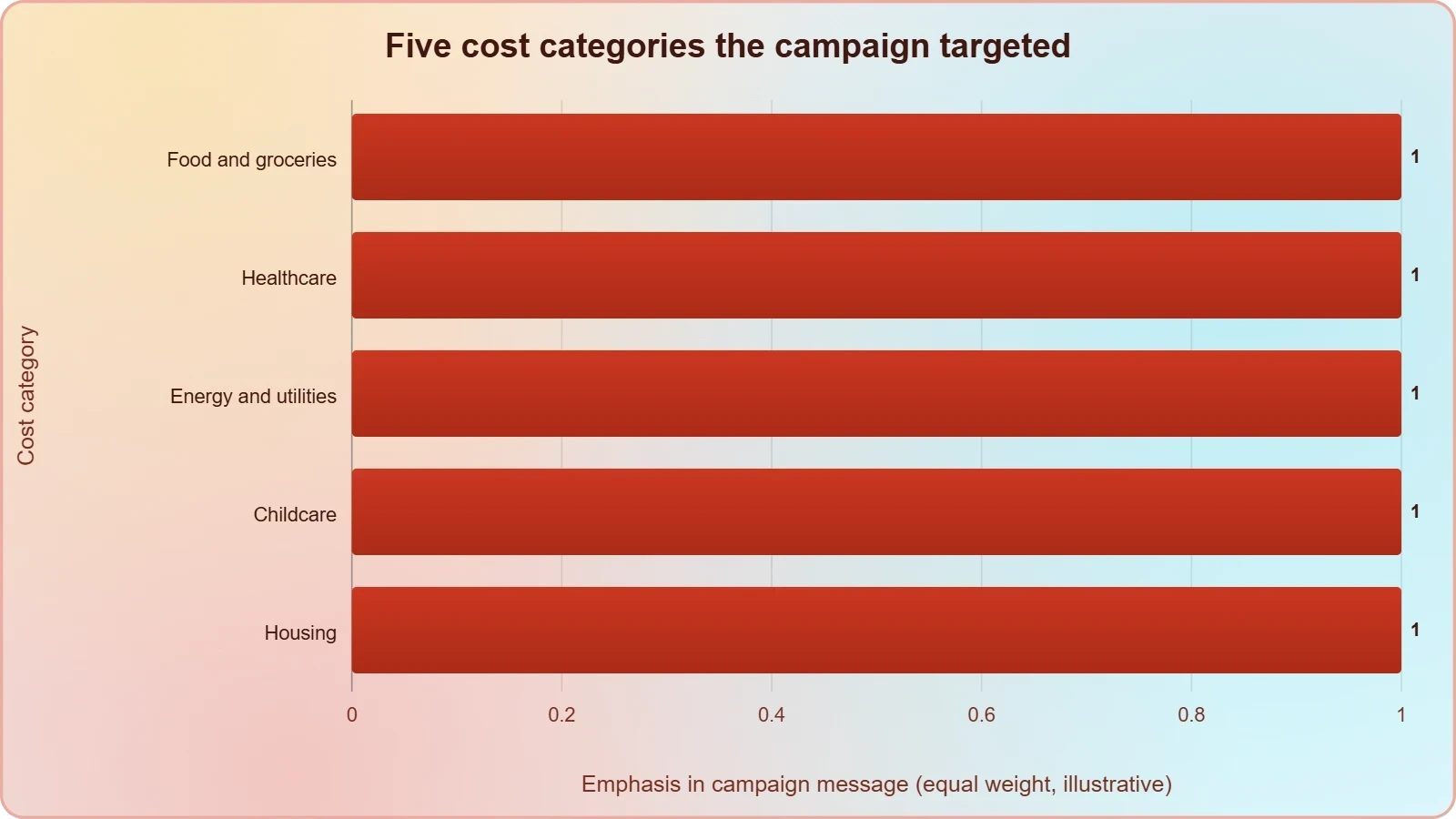
The campaign's decision to concentrate on five cost categories — food and groceries, healthcare, energy and utilities, childcare, and housing — reflected a deliberate reading of voter psychology. Rather than debating abstract fiscal policy, Cooper translated national economic conditions into monthly budget lines that every household recognizes. That specificity gave the message credibility and made it difficult for an opponent tied to Washington to counter without appearing defensive. In a state where median household costs had risen faster than wages for several consecutive years, the arithmetic of that appeal was straightforward.
The Republican Coalition and the Tillis Precedent
The Republican path to holding the seat was complicated long before ballots were cast, and the complications originated inside the party itself. Senator Thom Tillis, who had held the seat since 2015, declined to seek a third six-year term after voting against the president's domestic policy package, the One Big Beautiful Bill Act. That single vote represented a break from his party's leadership and invited immediate retaliation. The president publicly criticized Tillis, calling him "a talker and complainer," and threatened to support primary challengers against him. Tillis's retirement therefore removed an incumbent with deep donor networks and replaced him with a nominee defined largely by loyalty to the White House.
This sequence illustrates a recurring structural tension in contemporary American politics: the cost of ideological independence within a party that prizes alignment. Tillis's vote may have been defensible on policy grounds, but it triggered a sequence that ultimately cost Republicans a Senate seat. The party's selection of Whatley — a national figure rather than a state-rooted candidate — compounded the difficulty, because it framed the race as a referendum on the president rather than a choice between two North Carolinians. In competitive states, that framing is rarely advantageous for the party in power.
Primary Dynamics and General Election Consequences
Primary systems shape general election outcomes in ways that are often underestimated. When a party selects a nominee optimized for base enthusiasm rather than swing-district appeal, the general election coalition narrows accordingly. Whatley's candidacy fit that pattern: his credentials as former RNC chairman and his explicit alignment with the president made him formidable in a Republican primary but constrained his ability to reach independents and disaffected suburban voters. Cooper's campaign exploited that constraint relentlessly, framing the choice as between a governor who had balanced budgets and delivered services and a Washington operative promising to implement someone else's agenda.
The Tillis precedent also carries implications for incumbent behavior across the chamber. A senator who breaks with party leadership on a major fiscal package and subsequently faces presidential hostility, retirement pressure, and the loss of the seat sends a cautionary signal to colleagues weighing similar independence. Over time, such dynamics can reduce the Senate's appetite for deviation and concentrate agenda-setting power in the executive. Whether that consolidation improves legislative coherence or narrows representation remains an open question, but the North Carolina case offers an unusually clear data point for the debate.
We Also Published
What the Result Means for Congressional Control
Senate majorities are built from marginal seats, and North Carolina's shift alters the arithmetic of every subsequent legislative fight. A single seat changes committee ratios, procedural leverage, and the president's margin for error on nominations. In a chamber where a handful of votes determine outcomes on appropriations, judicial confirmations, and oversight, a flip in a state of North Carolina's size and growth trajectory carries outsized consequence. The Democratic Party's stated objective of winning control of Congress in the midterms gained a concrete foundation rather than a rhetorical one.
The result also reframes the map for the next cycle. North Carolina's population growth has concentrated in metropolitan counties that trend toward Democrats, while Republican margins in rural areas, though large, have not kept pace with statewide totals. If that demographic trajectory continues, the state may migrate from battleground to lean-Democratic territory in Senate contests, much as Virginia and Colorado did over the past two decades. That possibility forces both parties to reallocate resources and rethink which states constitute their defensive perimeter.
Seat Arithmetic and the 2028 Map
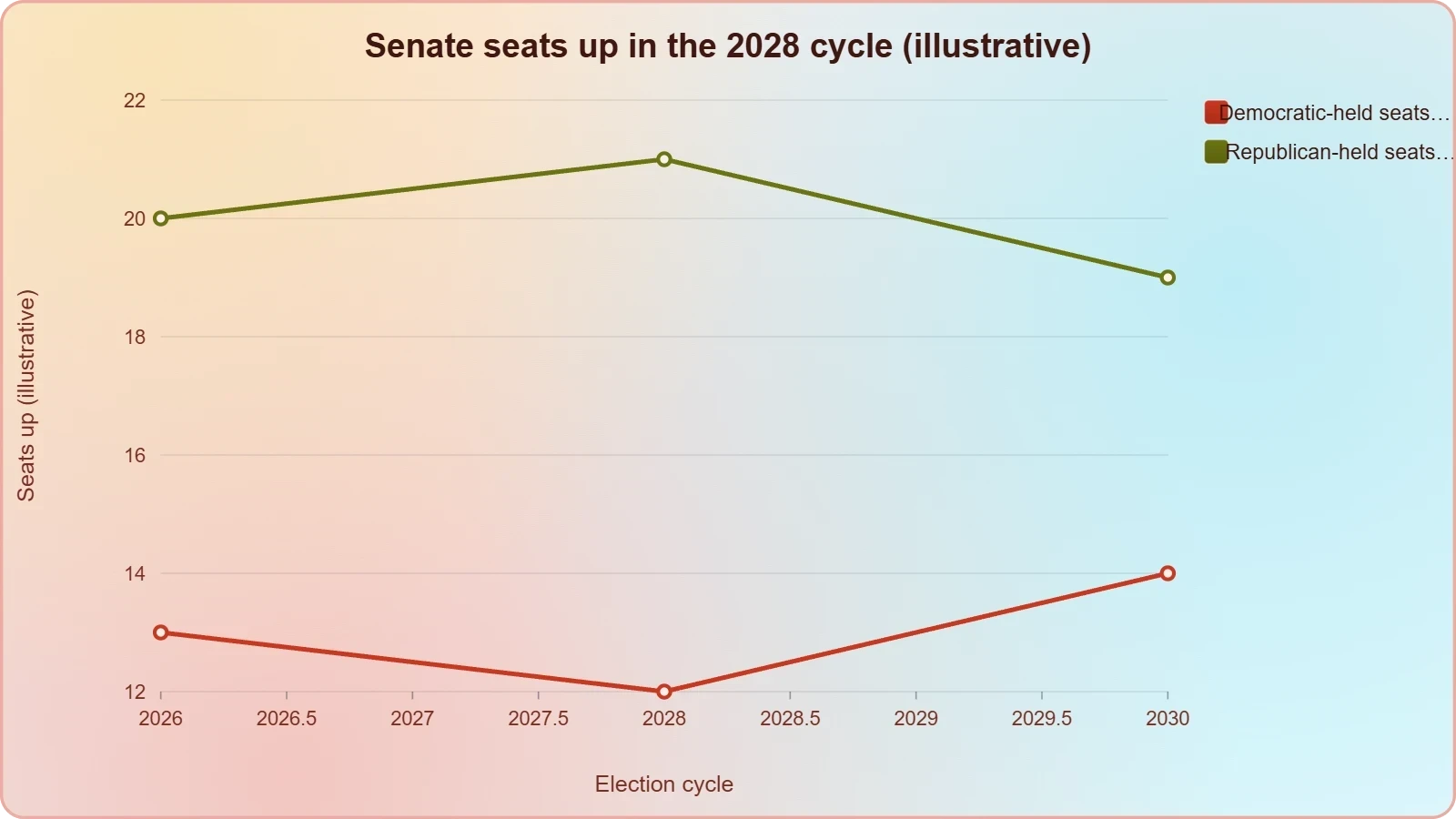
Projecting forward requires attention to which seats come up for election and which incumbents face retirement risk. North Carolina's other Senate seat, held by Republican Ted Budd, was won in 2023 for a first six-year term, meaning it will next be contested in 2028. Budd's position differs from Tillis's in important respects: he entered the chamber with presidential alignment intact and has not yet faced a major fiscal break with leadership. Whether that alignment holds through the next appropriations cycle will determine whether Republicans face a second consecutive competitive defense in the state.
For Democrats, the strategic question is whether Cooper's coalition can be replicated without Cooper. His personal brand — moderate, experienced, cost-focused — is not automatically transferable to another candidate. Building a durable statewide infrastructure around the cost-of-living message would require sustained investment in messaging, organizing, and candidate recruitment across the state's 100 counties. The 2026 result provides a template, but templates require maintenance, and the party that treats a single victory as permanent advantage often discovers otherwise within one cycle.
- 01
- 02
- 03
- 04
Economic Anxiety as the Decisive Electoral Variable
The North Carolina result reinforces a pattern visible across recent elections in advanced economies: voters punish incumbents and incumbent parties when household costs outpace wages, regardless of headline macroeconomic indicators. Cooper's speech captured this dynamic directly, contrasting the felt experience of the middle class with the visible accumulation of wealth at the top. That contrast is not merely rhetorical; it reflects measurable divergence in asset ownership, housing affordability, and real wage growth that has reshaped political coalitions in the United States and Western Europe alike.
What distinguishes the 2026 race is the precision with which the winning campaign translated macro conditions into specific budget categories. Rather than speaking generally about inflation, Cooper named groceries, healthcare, energy, childcare, and housing — five line items that appear in every household ledger. That translation from economic statistic to lived expense is a communications technique with broad applicability, and it explains why the message traveled across demographic groups that usually diverge politically. When a campaign can make abstract economics concrete, it gains access to voters who otherwise tune out political messaging.
Distributional Politics and the Middle-Class Message
The distributional argument Cooper advanced — that the richest Americans were gaining wealth at others' expense — sits within a long tradition of American populist rhetoric, but its 2026 iteration was notably moderate in tone. He did not propose sweeping redistribution or attack markets directly; he framed the issue as one of fairness and household relief. That calibration allowed him to appeal to swing voters who might reject more aggressive progressive framing while still signaling concern for working families. The rhetorical middle ground proved electorally productive in a state where both parties compete fiercely for suburban moderates.
For Republicans, the lesson is more uncomfortable. A campaign built primarily on cultural and immigration themes, however effective with the base, left the party without a compelling answer on household costs. Whatley's promise to roll back Democratic policies did not address the price of groceries or the cost of childcare in terms that undecided voters found persuasive. Closing that gap without abandoning the party's coalition will require a message that connects fiscal policy to family budgets — a challenge that extends well beyond North Carolina's borders.
Historical Parallels and the 2008 Precedent
The last Democratic Senate victory in North Carolina came in 2008, when Kay Hagan defeated incumbent Elizabeth Dole amid a national wave election and a financial crisis that dominated voter attention. The parallels to 2026 are instructive but imperfect. Both cycles featured intense economic anxiety, a national environment favoring Democrats, and a Republican nominee burdened by association with an unpopular national figure. The differences matter too: Hagan's win occurred during a presidential landslide, whereas Cooper's came in a midterm with a divided national electorate and a Republican president actively campaigning for his opponent.
That distinction suggests Cooper's victory was less a wave than a targeted breakthrough built on candidate quality and message discipline. Midterm elections typically favor the party out of power, but they rarely produce flips in states with strong incumbent party infrastructure unless the challenger is unusually well positioned. Cooper's four prior statewide victories gave him exactly that positioning. The historical record therefore supports a nuanced reading: structural conditions created the opening, but candidate-specific factors determined whether the opening was converted into a seat.
Lessons From Prior Southern Senate Flips
Southern Senate flips have historically followed recognizable patterns. Victories by Democrats in Virginia, Georgia, and North Carolina have generally involved moderate candidates with statewide executive experience, campaigns centered on economic rather than cultural themes, and substantial investment in suburban organizing. Losses have typically involved candidates perceived as ideologically extreme or insufficiently rooted in the state. The 2026 North Carolina result conforms closely to the winning pattern, which suggests the outcome was not anomalous but rather the predictable product of a well-executed strategy in favorable conditions.
For Republicans, the historical lesson is equally clear. When the party nominates candidates defined primarily by national loyalty rather than state-specific appeal, it cedes the moderate middle in states where that middle decides elections. The party's successful Southern Senate candidates have generally combined national alignment with distinct state identities and independent records. Recovering that balance in North Carolina and elsewhere will require deliberate recruitment choices rather than reactive endorsements, particularly in states where demographic change is steadily eroding traditional margins.
Implications for Governance and the Road Ahead
When a Senate seat changes hands, the consequences ripple through committee assignments, confirmation schedules, and the practical capacity of a president to staff an administration. Cooper's arrival alters the partisan composition of committees on which he serves and provides Democrats with an additional vote on judicial nominees and executive appointments. In a chamber where tie-breaking authority and procedural thresholds matter enormously, that single vote can determine whether a nomination advances or stalls. The practical effect is felt not in dramatic floor votes but in the quieter mechanics of scheduling and negotiation.
Beyond procedure, the result shapes the political calculations of every senator facing re-election in the coming cycles. Legislators read election results as signals about which messages and positions are viable. A Democratic win built on cost-of-living themes will encourage similar messaging from Democratic candidates nationwide, while a Republican loss tied to presidential alignment will prompt debate within the GOP about the limits of that strategy. These interpretive battles often matter more than the seat itself, because they determine the strategic direction of both parties over the following two years.
What to Watch in the Next Legislative Session
Several indicators will reveal how the new Senate balance translates into governing. The first is the confirmation calendar: the pace and success rate of judicial and executive nominations will show whether the majority's margin is sufficient to overcome procedural resistance. The second is appropriations: whether the chamber can pass spending bills on schedule or relies on continuing resolutions reveals the practical limits of narrow control. The third is oversight: committee investigations and subpoena fights will indicate how aggressively the new majority intends to pursue executive accountability.
For North Carolina specifically, the transition from Tillis to Cooper changes the state's representation on agriculture, energy, and judiciary matters, among others. Constituents who relied on Tillis's committee positions for federal resources and policy influence will now look to a senator from the opposing party. How effectively Cooper builds relationships across the aisle will determine whether the state retains its influence in areas where seniority and committee rank matter. That work begins immediately and will be judged over the full six-year term rather than in the first hundred days.
Reading the Result Beyond the Headlines
The temptation after any dramatic electoral outcome is to overinterpret it, to treat a single race as a verdict on an entire political era. North Carolina's 2026 Senate result resists that treatment. It was a genuine and consequential flip, but it emerged from a specific combination of candidate quality, message discipline, internal party conflict on the Republican side, and sustained economic pressure on household budgets. Remove any one of those factors and the outcome might have differed. Understanding the race requires holding all of them together rather than reducing the result to a single cause.
What the result does demonstrate with some confidence is that competitive states remain responsive to fundamentals. North Carolina's demographic and economic evolution created a genuine opening, and a well-positioned candidate converted it. That is a story about political mechanics rather than destiny. The state will remain contested in future cycles, and the party that adapts its message to the lived economic experience of its voters will hold the advantage. The 2026 race offers a clear case study in how that adaptation works — and what happens when one side fails to attempt it.
From our network :
- Live Online English Classes for Kids: Do They Actually Reduce Anxiety?A ten-week study reveals that synchronous online English classes can significantly reduce child language anxiety while improving listening and reading skills. Discover what makes these programs effective and how parents can select the right one.
- CISA’s Ten-Advisory Wave: Why Generic Patching Fails in OT and How to Build Product-Specific PlaybooksCISA released ten ICS advisories in one week, exposing critical infrastructure risks. Generic patching fails in OT. Learn to build product-specific remediation playbooks.
- Committed Mediterranean Precipitation Decline: Why Emissions Cuts Alone Cannot Restore Winter RainsNew NOAA research reveals that Mediterranean winter rains may decline irreversibly even with emissions cuts. Explore the science of committed climate change and regional impacts.
- University Language Proficiency Exams: Why Institutional Tests Demand Different Preparation Than IELTS and TOEFLDiscover why university-specific language proficiency examinations differ fundamentally from IELTS and TOEFL, and learn strategic preparation approaches for institutional assessment success.
- The Final Descent: How ESA Retired the Legendary Cluster Constellation After 24 Years of Space Weather ScienceAfter 24 years mapping Earth’s magnetosphere, ESA’s Cluster mission concluded with a precisely controlled reentry over the South Pacific. This analysis explores the scientific legacy, engineering decisions, and debris mitigation principles behind one of space exploration’s most responsible retirements.
- Forbidden Matrix Patterns and Visible Lattice Points: A Geometric DictionaryExplore how multidimensional 0–1 matrices encode geometric truths, linking forbidden patterns to visible lattice points and hypergraph theory, with applications in combinatorics and computational geometry.
- How AI Agents Will Change the Way We Manage Personal FinancesExplore how AI agents are transforming personal finance through automated budgeting, bill payment, and investment management, while examining the critical security protocols and governance frameworks required for safe deployment.
- Mobile Learning and VR in English: What Global Evidence Reveals About Effective Language TechnologyA systematic review across 14 countries reveals which language-learning technologies genuinely work. Mobile learning, AI, and VR show measurable benefits when pedagogically integrated. This evidence-based guide helps educators and learners select technology that delivers real return on investment.
- The Hidden Cost of AI Convenience: Why Over-Permissioned Agents Are a Security Time BombDiscover why AI agents with excessive permissions create dangerous single points of failure, and learn how implementing least privilege principles can protect your organization from exploitation.
RESOURCES
- Resources will be updated soon.
- 01
- 02
- 03
- 04
- 05
- 06
- 07
- 08
0 Comments