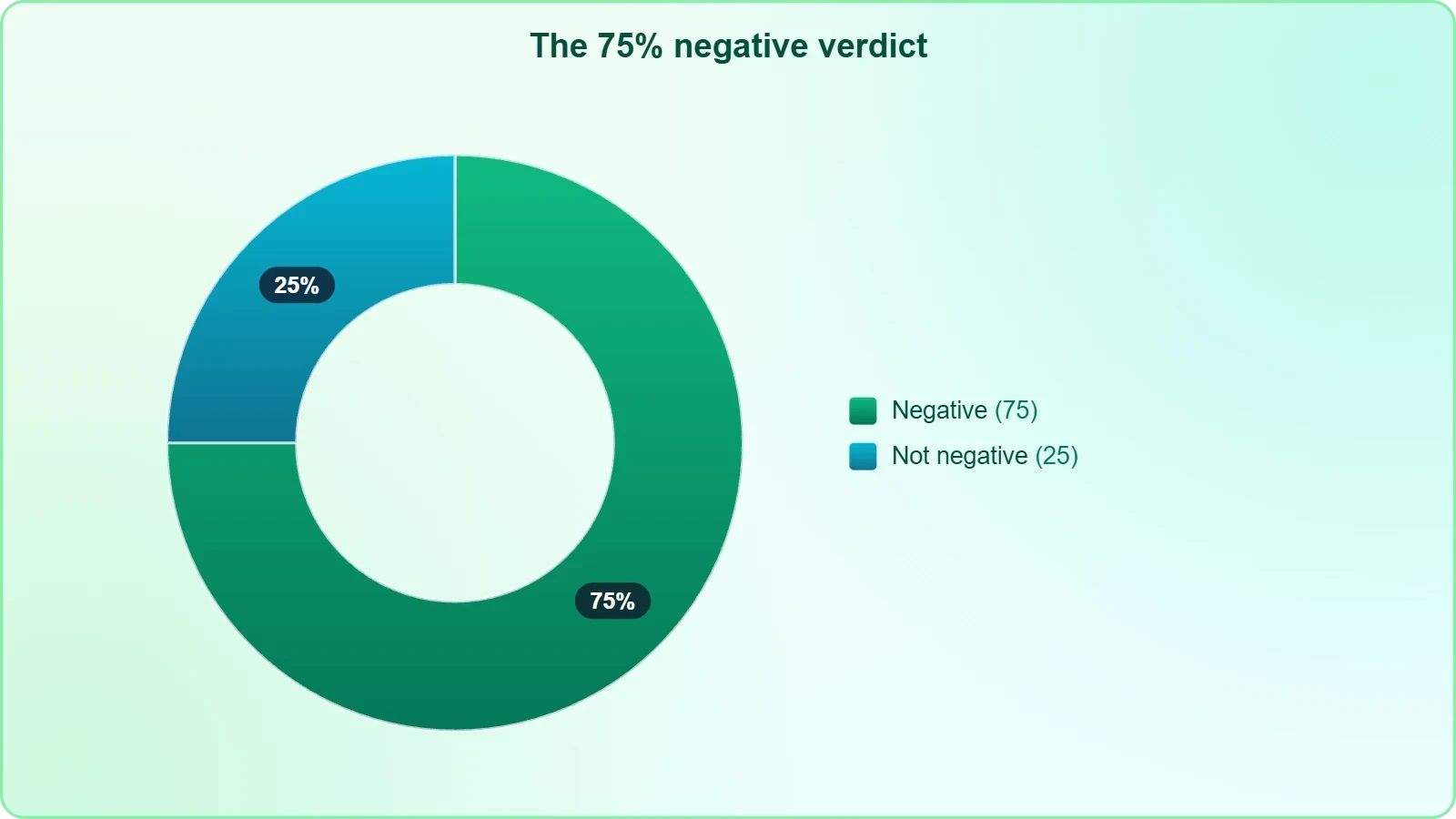
A single polling number rarely carries the weight of a national verdict, yet the CNN survey released on November 3, 2026, landed with precisely that force. Three in four American voters — 75 percent of respondents — described the economy as performing negatively, a figure that transforms an ordinary approval metric into a referendum on the economic stewardship of the Trump administration. The timing proved inseparable from the message: the poll surfaced on the same night CNN projected Democratic gains in the House and victories in Senate and gubernatorial contests across multiple states, binding economic sentiment directly to electoral consequence.
CNN chief political analyst David Axelrod framed the finding in unusually blunt terms, calling the public's negative assessment a "stunning indictment" of the cabinet's economic policy. That characterization matters because it moves the story beyond partisan spin into the realm of measurable political damage. When a strategist of Axelrod's experience reaches for language that severe, the implication is structural rather than cyclical — not a temporary dip in confidence but a durable collapse in the perceived competence of those managing the nation's finances.
What follows examines the anatomy of that 75 percent figure: the forces that produced it, the demographic and psychological contours beneath the headline number, the historical precedents that give it meaning, and the policy pathways available to an administration now governing against the grain of public economic opinion. The analysis treats the poll not as an isolated data point but as a diagnostic instrument — one that reveals how voters weigh inflation, wages, housing, and institutional trust when they render judgment on an economy they experience daily.
On This Page
- The Anatomy of a 75 Percent Verdict
- Axelrod's Indictment and the Language of Political Damage
- Midterm Projections and the Electoral Translation of Economic Pain
- Drivers of Economic Pessimism: Inflation Memory, Wages, and Housing
- Policy Pathways and the Governance Challenge Ahead
- Reading the Poll in Historical and Comparative Context
TL;DR A CNN poll released November 3, 2026, found that 75 percent of US voters view the economy negatively, a result CNN analyst David Axelrod called a "stunning indictment" of the Trump cabinet's economic policy. Released alongside midterm projections showing Democratic gains in the House and wins in Senate and governor races, the survey links economic pessimism directly to electoral punishment. This analysis unpacks the drivers of that sentiment — inflation memory, wage stagnation, housing costs, and eroding institutional trust — and assesses what the number means for governance, markets, and the political road ahead.
The Anatomy of a 75 Percent Verdict
A poll finding of this magnitude deserves forensic attention rather than reflexive commentary. Seventy-five percent is not a bare majority expressing mild dissatisfaction; it is a supermajority spanning partisan lines, income brackets, and regions, signaling that negative economic perception has become the default posture of the American electorate. When three of every four voters converge on the same assessment, the phenomenon transcends ideology and points toward lived experience — grocery receipts, rent statements, and loan payments that tell a story independent of official statistics.
The release context sharpens the meaning considerably. CNN published the finding on the same evening it projected Democratic advances in the House and victories in Senate and governor contests, effectively fusing economic sentiment to electoral outcome in a single news cycle. This juxtaposition suggests that voters did not merely feel pessimistic about the economy in the abstract; they translated that pessimism into ballots cast against the party holding executive power. The poll thus functions as both diagnosis and consequence.
Reading the Numbers Beneath the Headline
Headline polling figures compress enormous complexity into a single digit, and responsible analysis must unpack the layers. The 75 percent figure aggregates respondents who describe conditions as "somewhat negative" alongside those who choose "very negative" — a distinction with real political weight, since intensity of sentiment predicts turnout and persuasion more reliably than direction alone. A voter who feels mildly uneasy behaves differently from one who feels acute distress, and campaigns ignore that gradient at their peril.
Demographic composition further complicates the picture. Negative economic perception typically concentrates among lower- and middle-income households, younger workers facing housing barriers, and regions experiencing industrial transition. Yet a figure approaching three-quarters implies spillover into demographics that historically anchor optimistic sentiment — homeowners, retirees, and college-educated professionals. When pessimism breaches those traditional redoubts, the phenomenon suggests a systemic confidence problem rather than a localized grievance.
Why Supermajorities Signal Structural Doubt
Political scientists distinguish between directional sentiment and confidence erosion, and the CNN figure belongs firmly in the latter category. Directional sentiment fluctuates with gas prices and monthly jobs reports; confidence erosion persists through temporary improvements because it reflects a judgment about trajectory rather than level. A supermajority viewing the economy negatively implies that voters have stopped crediting favorable data points and started questioning the framework that produces them — a far more durable and politically dangerous condition.
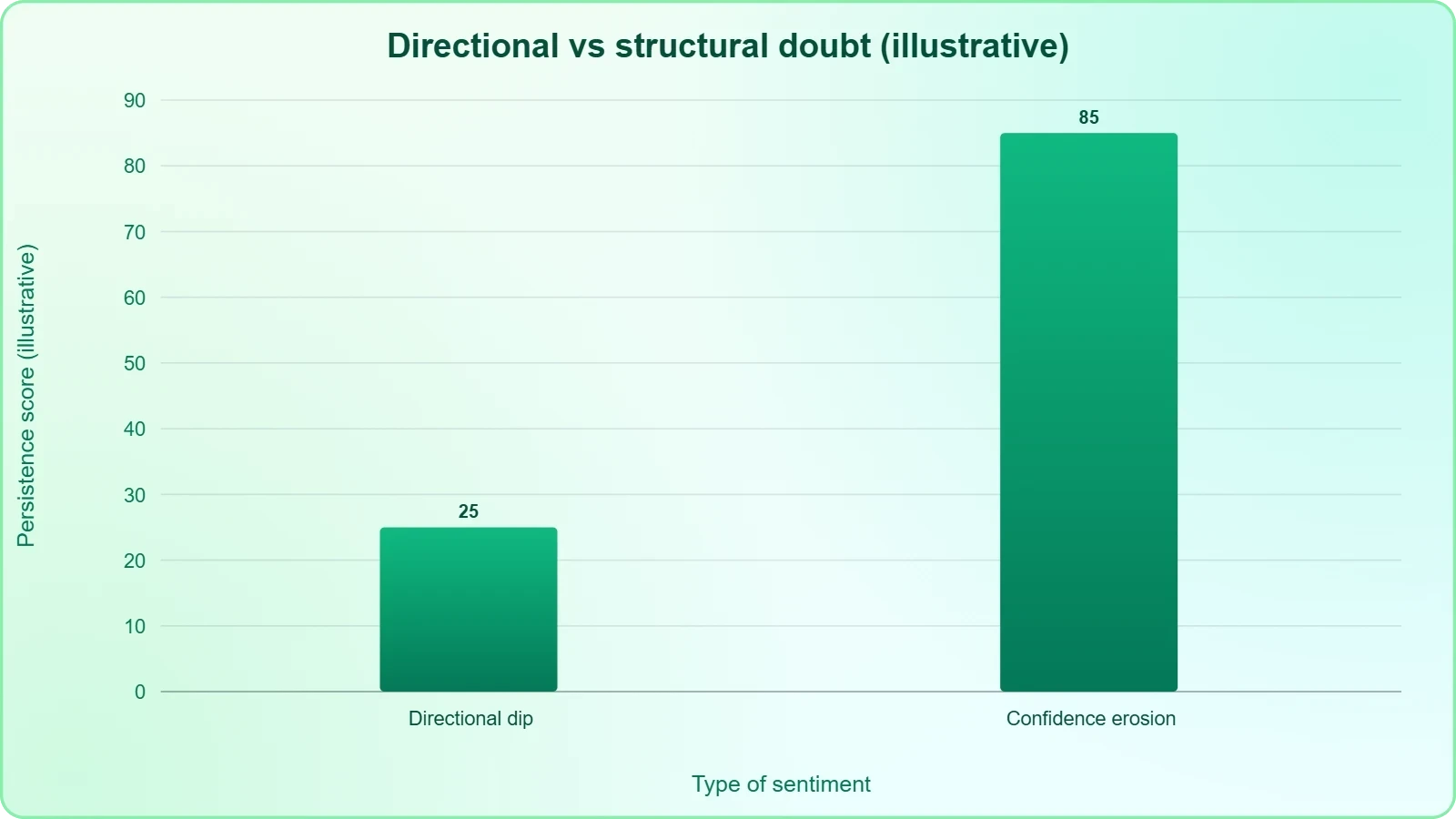
This distinction carries practical consequences for how the administration might respond. If the problem were directional, a strong inflation print or a robust employment report could shift perception within weeks. Structural doubt, by contrast, resists single data releases and requires sustained, visible improvement across multiple dimensions of household finance. The 75 percent figure therefore functions less as a snapshot than as a verdict on credibility — and credibility, once spent, is expensive to rebuild.
Axelrod's Indictment and the Language of Political Damage
David Axelrod's description of the poll as a "stunning indictment" merits close reading, because the vocabulary of political analysis often reveals more than the numbers it interprets. An indictment is a formal accusation of wrongdoing, and applying that term to economic policy implies that voters have moved beyond disagreement into judgment — that they regard the administration's stewardship not as a defensible alternative approach but as a failure warranting accountability. The word choice signals severity that ordinary polling commentary rarely reaches.
Axelrod's standing amplifies the remark's significance. As CNN's chief political analyst and a veteran of presidential campaigns, he speaks with the authority of someone who has watched sentiment shift across multiple cycles and knows the difference between a rough patch and a structural break. When such an analyst reaches for the language of indictment rather than disappointment, the implication is that the administration faces a credibility deficit rather than a messaging problem.
The Messenger and the Message
Analyst commentary occupies an ambiguous space in political communication: it is neither neutral reporting nor partisan advocacy, and its influence derives from perceived independence. Axelrod's characterization therefore does double duty — it interprets the poll for CNN's audience while simultaneously shaping how that audience understands the poll's implications. The framing effect is real, because voters who encounter the "indictment" language before encountering the raw numbers absorb an interpretive lens along with the data.
This dynamic explains why administrations monitor analyst commentary as closely as they monitor polling itself. A negative number can be contextualized, attributed to sampling error, or dismissed as an outlier; a negative number amplified by a respected analyst's severe framing becomes a narrative with momentum. The Trump cabinet thus confronts not merely an unfavorable statistic but an unfavorable statistic endowed with interpretive authority by a figure whose credibility spans partisan boundaries.
Precedents for Analyst-Driven Narrative Shifts
History offers instructive parallels for moments when commentary crystallized diffuse discontent into a coherent narrative. During the 1980 recession, analysts who labeled the downturn a "misery index" crisis gave voters a vocabulary for inchoate frustration, and that vocabulary proved electorally decisive. Similarly, the 2008 financial crisis acquired its political meaning partly through commentators who translated balance-sheet complexity into moral language about accountability and consequence.
The common thread is that economic pain becomes politically actionable only when it acquires narrative form. Raw statistics describe conditions; commentary assigns responsibility. Axelrod's "indictment" performs precisely this function for the 2026 poll, converting a diffuse 75 percent dissatisfaction into a focused question about who bears responsibility for the conditions producing it. That conversion is the mechanism by which polling shapes elections.
We Also Published
Midterm Projections and the Electoral Translation of Economic Pain
The poll's release alongside CNN's midterm projections — Democratic gains in the House, victories in Senate and governor contests across multiple states — illustrates the central axiom of American electoral behavior: voters punish incumbent parties for economic distress regardless of whether that distress originates domestically or abroad. The simultaneity of the two stories was not coincidental packaging but substantive linkage, because the same voters who reported negative economic views were the voters casting ballots against the governing party.
This translation from sentiment to ballot is the mechanism that gives economic polling its predictive power. Voters do not vote on GDP growth or unemployment rates in the abstract; they vote on the felt experience of those aggregates in their own lives, filtered through the narrative frameworks available to them. When 75 percent report negative economic perception and the same electorate delivers Democratic gains, the causal chain from household finance to electoral outcome is visible in real time.
Governor and Senate Races as Sentiment Barometers
Senate and gubernatorial contests serve as particularly sensitive barometers of economic sentiment because their outcomes aggregate statewide and regional variation rather than concentrating in gerrymandered districts. Democratic victories in multiple Senate and governor races therefore carry interpretive weight beyond their individual significance: they suggest that economic discontent translated into broad geographic rejection of the incumbent party's stewardship, not merely localized protest in competitive House districts.
Governor races are especially revealing because state executives are held responsible for conditions — employment, housing, infrastructure — that voters experience most directly. When voters simultaneously report negative national economic perception and elect governors from the opposition party, the pattern implies that economic judgment operates at multiple levels of government and that the incumbent party's brand has become a liability even in contests nominally about state administration.
The Mechanics of Economic Voting
Political economy research has long established that voters practice what scholars call "retrospective economic voting" — they evaluate incumbents on recent conditions rather than prospective promises. The 2026 poll fits this model precisely: voters rendered judgment on the economy as they experienced it during the administration's tenure, and that judgment carried directly into their ballots. The mechanism is simple in theory and devastating in practice, because it leaves incumbents little room to argue that conditions would have been worse under an alternative.
What complicates the 2026 iteration is the intensity of the negative assessment. Retrospective voting typically produces modest penalties when conditions are mixed; a 75 percent negative reading implies conditions perceived as uniformly poor, which in turn implies penalties approaching the maximum available in a polarized electorate. The Democratic gains projected by CNN are consistent with this arithmetic, suggesting that the electoral cost of economic discontent was substantial rather than marginal.
- 01
- 02
- 03
- 04
Drivers of Economic Pessimism: Inflation Memory, Wages, and Housing
Understanding why three-quarters of voters perceive the economy negatively requires moving beyond aggregate indicators to the specific pressures households experience. Inflation memory ranks foremost among these drivers: even as price growth moderates, consumers compare current prices against the pre-inflation baseline etched into their memory, and that comparison produces persistent dissatisfaction that official inflation statistics cannot capture. A grocery bill that has stabilized at a higher level still feels like a loss relative to the past.
Wage dynamics compound the effect. When nominal wage gains fail to outpace cumulative price increases, real purchasing power declines even in periods of nominal prosperity, and workers experience that decline as a direct reduction in living standards. The psychological asymmetry is well documented: losses loom larger than equivalent gains, so households that have recovered their pre-inflation purchasing power may still feel worse off because the recovery required effort and anxiety that the original level never demanded.
Housing Costs and Generational Economic Anxiety
Housing has become the sharpest edge of economic pessimism, particularly for younger voters who confront ownership costs that have outpaced income growth for decades. When rent consumes an ever-larger share of monthly income and down payments recede beyond reach, the economy's headline strength becomes abstract and its weakness becomes concrete. This generational dimension explains why negative sentiment penetrates demographics that aggregate statistics would predict to be comfortable.
The housing channel also explains the durability of pessimism. Unlike gasoline prices, which fluctuate visibly and frequently, housing costs adjust slowly and ratchet upward, creating a persistent drag on household budgets that no single policy announcement can reverse. Voters experiencing this drag have rational grounds for sustained negative assessment, and their assessment will not improve until the underlying affordability equation changes materially.
Institutional Trust as an Economic Variable
Economic perception does not form in a vacuum; it forms within a framework of institutional trust that determines how voters interpret official data. When trust in government statistics, media reporting, and policy institutions erodes, favorable data releases lose their power to reassure, and unfavorable experiences acquire outsized evidentiary weight. The 75 percent figure therefore reflects not only material conditions but also the credibility environment in which those conditions are assessed.
This trust dimension explains a persistent puzzle in economic polling: why sentiment often diverges from objective indicators. Voters who distrust the institutions producing the indicators discount them, relying instead on direct observation of prices and paychecks. In an environment of diminished trust, the administration's strongest economic arguments arrive pre-discredited, and the burden of proof shifts entirely onto lived experience — a standard that aggregate statistics rarely satisfy.
Policy Pathways and the Governance Challenge Ahead
An administration governing against a 75 percent negative economic reading confronts a governance challenge that transcends communication strategy. The available pathways divide broadly into three categories: policies that address material conditions directly, policies that address perception through visible intervention, and policies that address credibility by rebuilding institutional trust. Each pathway carries distinct political risks and timelines, and the administration's choices among them will determine whether the sentiment gap narrows or widens.
Material interventions — targeted relief, housing supply expansion, wage-support mechanisms — offer the most direct route to improved sentiment but operate on legislative and implementation timelines measured in quarters or years. Perception interventions, by contrast, can shift sentiment within weeks but risk appearing manipulative if unaccompanied by material change. The administration must therefore sequence its response carefully, pairing short-term visible action with credible long-term commitments.
The Credibility Rebuilding Imperative
Credibility rebuilding may prove the most consequential pathway precisely because it addresses the root of the sentiment gap. If voters discount favorable data because they distrust its sources, then restoring trust in those sources — through transparency, independent verification, and consistent communication — could allow improving conditions to register in public perception. This pathway is slow and unglamorous, but it targets the mechanism by which economic information becomes political judgment.
The alternative — continuing to contest unfavorable polling while conditions remain difficult — risks deepening the credibility deficit. Each dismissal of negative sentiment as partisan or methodologically flawed reinforces the impression that the administration is not listening, and that impression compounds the original economic grievance. The governance challenge, in short, is not merely to improve the economy but to persuade a skeptical electorate that improvement is real.
Market and Institutional Implications
Financial markets parse political polling through the lens of policy continuity, and a 75 percent negative reading combined with Democratic midterm gains introduces genuine uncertainty about the legislative environment ahead. Markets price expectations about taxation, regulation, and spending, and a governing party facing electoral repudiation may adjust its policy agenda in ways that ripple through asset prices. The poll therefore matters to investors not as sentiment but as a signal about the direction of economic governance.
Institutional implications extend beyond markets to the broader question of democratic accountability. A supermajority rendering negative economic judgment and translating it into electoral change demonstrates that the accountability mechanism functions, even when the resulting policy environment is uncertain. That demonstration carries its own stabilizing logic: voters who believe their economic grievances produce political consequences are more likely to remain engaged with the system than voters who believe their judgments are ignored.
Reading the Poll in Historical and Comparative Context
Placing the 75 percent figure in historical context clarifies both its severity and its meaning. Economic sentiment polling has recorded comparable negative readings during recessions, energy shocks, and financial crises, but those episodes typically featured objective contraction alongside subjective pessimism. The 2026 reading is notable for its coexistence with aggregate indicators that, by conventional measures, suggest a functioning economy — a divergence that points toward the distributional and psychological dimensions of economic experience.
Comparative context reinforces the point. Across advanced economies, similar divergences between headline data and public sentiment have appeared as inflation's cumulative effects outlast its flow effects. Voters in multiple democracies have registered dissatisfaction with economies that statisticians describe as healthy, suggesting that the measurement frameworks themselves may underweight the dimensions voters care about most: affordability, security, and the trajectory of their children's prospects.
What the Number Predicts and What It Does Not
The poll predicts continued political headwinds for the incumbent party with reasonable confidence, because economic sentiment is among the most reliable predictors of electoral outcomes. It does not predict the magnitude of future losses, the durability of the sentiment shift, or the specific policy responses that might alter it. Nor does it predict market performance, which depends on a broader set of variables including monetary policy, global conditions, and corporate earnings.
What the number does establish is a baseline against which future developments will be measured. If sentiment improves in subsequent surveys, the improvement will be meaningful precisely because it started from such a low point. If sentiment remains at 75 percent negative, the administration will have failed to address the conditions producing it, and the electoral consequences already visible in the midterm projections will likely extend into subsequent cycles.
The Road Through 2026 and Beyond
The months following the poll will test whether the administration can convert its remaining political capital into material improvement before sentiment hardens into a permanent feature of the electoral landscape. History suggests that economic sentiment can shift, but only when voters perceive change in their own circumstances rather than in aggregate statistics. The administration's task is therefore granular: to produce visible improvements in the specific costs — housing, food, energy, credit — that voters weigh most heavily.
Beyond the immediate political horizon, the poll raises a broader question about the relationship between economic measurement and democratic judgment. If official indicators and public perception diverge persistently, the credibility of both suffers, and the space for evidence-based governance narrows. Rebuilding that space requires not only better economic outcomes but a renewed commitment to transparency about what the numbers measure and what they leave out — a project that transcends any single administration or election cycle.
From our network :
- Mobile Learning and VR in English: What Global Evidence Reveals About Effective Language TechnologyA systematic review across 14 countries reveals which language-learning technologies genuinely work. Mobile learning, AI, and VR show measurable benefits when pedagogically integrated. This evidence-based guide helps educators and learners select technology that delivers real return on investment.
- Live Online English Classes for Kids: Do They Actually Reduce Anxiety?A ten-week study reveals that synchronous online English classes can significantly reduce child language anxiety while improving listening and reading skills. Discover what makes these programs effective and how parents can select the right one.
- University Language Proficiency Exams: Why Institutional Tests Demand Different Preparation Than IELTS and TOEFLDiscover why university-specific language proficiency examinations differ fundamentally from IELTS and TOEFL, and learn strategic preparation approaches for institutional assessment success.
- Committed Mediterranean Precipitation Decline: Why Emissions Cuts Alone Cannot Restore Winter RainsNew NOAA research reveals that Mediterranean winter rains may decline irreversibly even with emissions cuts. Explore the science of committed climate change and regional impacts.
- CISA’s Ten-Advisory Wave: Why Generic Patching Fails in OT and How to Build Product-Specific PlaybooksCISA released ten ICS advisories in one week, exposing critical infrastructure risks. Generic patching fails in OT. Learn to build product-specific remediation playbooks.
- The Hidden Cost of AI Convenience: Why Over-Permissioned Agents Are a Security Time BombDiscover why AI agents with excessive permissions create dangerous single points of failure, and learn how implementing least privilege principles can protect your organization from exploitation.
- The Final Descent: How ESA Retired the Legendary Cluster Constellation After 24 Years of Space Weather ScienceAfter 24 years mapping Earth’s magnetosphere, ESA’s Cluster mission concluded with a precisely controlled reentry over the South Pacific. This analysis explores the scientific legacy, engineering decisions, and debris mitigation principles behind one of space exploration’s most responsible retirements.
- How AI Agents Will Change the Way We Manage Personal FinancesExplore how AI agents are transforming personal finance through automated budgeting, bill payment, and investment management, while examining the critical security protocols and governance frameworks required for safe deployment.
- Forbidden Matrix Patterns and Visible Lattice Points: A Geometric DictionaryExplore how multidimensional 0–1 matrices encode geometric truths, linking forbidden patterns to visible lattice points and hypergraph theory, with applications in combinatorics and computational geometry.
RESOURCES
- Resources will be updated soon.
- 01
- 02
- 03
- 04
- 05
- 06
- 07
- 08
0 Comments