When Reuters reported in early November 2026 that CVS Health was quietly testing whether its sprawling retail pharmacy network and its insurance arm still belong under one corporate roof, the disclosure landed less as a shock and more as a confirmation of a tension that has been building for years. The company has spent the better part of a decade assembling a vertically integrated healthcare machine, pairing thousands of storefronts with one of the nation's largest health insurers and a pharmacy benefits manager. That architecture was once celebrated as a defensive moat. Now, according to people familiar with the matter, executives are weighing whether the parts are worth more apart than together.
The reported review is deliberately preliminary. No final decision has been announced, no timeline has been disclosed, and CVS has not publicly confirmed that any such exercise is underway. Yet the mere possibility of a separation carries enormous weight for investors, employees, and the millions of patients who interact with the company at the pharmacy counter or through their insurance plans. A breakup would reverse one of the most consequential merger strategies in modern American healthcare, and it would force a reckoning with the question that has shadowed the sector for a decade: does vertical integration actually create value, or does it merely create complexity?
Understanding what is really at stake requires looking past the headline and into the structural logic of the company. CVS is not a single business but a portfolio of businesses with different economics, different regulators, and different growth trajectories. The retail segment operates on thin margins and foot traffic, while the insurance segment lives on underwriting discipline and membership scale. When those two worlds share a balance sheet, capital allocation becomes a negotiation rather than a calculation. The reported review, in that light, is less about a dramatic split and more about a sober audit of whether the whole still justifies its parts.
On This Page
- The Strategic Logic Behind a Possible Separation
- What the Review Signals About Healthcare Consolidation
- Stakeholder Implications: Patients, Employees, and Investors
- Historical Context: The Arc of Healthcare Integration
- Reading the Silence: What CVS Has Not Said
- Conclusion: A Decision That Will Define CVS's Next Chapter
TL;DR CVS Health is reportedly exploring whether to separate its retail pharmacy business from its insurance operations, a move that would unwind one of the most ambitious vertical integration strategies in American healthcare. No decision has been made and the company has not confirmed the review, but the disclosure signals growing pressure on conglomerate structures in the sector. The core question is whether combining storefronts, insurance underwriting, and pharmacy benefits still creates durable value for shareholders and patients, or whether the parts would perform better as independent entities with clearer capital allocation, sharper management focus, and more transparent valuation.
The Strategic Logic Behind a Possible Separation
Vertical integration in healthcare rests on a seductive premise: if you own the pharmacy, the insurer, and the benefits manager, you can coordinate care, capture margin at every step, and keep patients inside your ecosystem. CVS built precisely that architecture, most notably through its 2018 acquisition of Aetna, which transformed a drugstore chain into a diversified health services conglomerate. For a time, the strategy appeared vindicated, as the company could point to cross-selling opportunities and data advantages that pure-play competitors lacked. But integration also imports complexity, and complexity has a cost that shows up in valuation multiples, regulatory scrutiny, and management bandwidth.
The reported review suggests that leadership is now stress-testing that premise. Splitting retail from insurance would create two entities with distinct investor bases: one valued on retail traffic and pharmacy margins, the other on underwriting results and membership growth. Such clarity can be liberating. It allows each business to pursue its own capital strategy, its own leadership priorities, and its own response to competitive threats. The trade-off is that separation forfeits the coordination benefits that justified the original combination, and it forces both entities to stand on their own financial footing in a sector where scale increasingly determines survival.
Why Conglomerate Structures Face Renewed Scrutiny
Healthcare conglomerates have always carried a discount relative to focused competitors, because investors struggle to value businesses with divergent risk profiles bundled together. A retail pharmacy generates predictable but low-margin cash flows tied to prescription volume and consumer traffic. An insurer generates volatile but potentially high-margin results tied to medical cost trends and pricing cycles. When these sit under one roof, analysts often apply a blended multiple that undervalues the stronger segment and overvalues the weaker one. That "conglomerate discount" is a persistent argument for separation, and it becomes more persuasive when the two businesses stop generating obvious synergies.
Regulatory and political pressure compounds the case. Integrated healthcare companies attract scrutiny from antitrust authorities, state insurance regulators, and lawmakers concerned about market concentration. A separation would reduce the surface area for such challenges, simplify compliance, and allow each entity to negotiate with the other at arm's length. In an environment where healthcare consolidation is politically charged, structural simplification can be a defensive posture as much as an offensive one. The reported review may therefore reflect not just financial calculus but also a strategic read of the regulatory weather ahead.
The Operational Realities of Untangling Two Businesses
Separating a retail network from an insurance arm is far harder than drawing a line on an org chart. The two businesses share contracts, data systems, real estate, and thousands of employees whose roles straddle both. Pharmacy counters serve insured members whose claims flow through the company's own benefits infrastructure. Untangling those relationships requires renegotiating supplier agreements, rebuilding information technology boundaries, and deciding how to allocate corporate overhead. Each of these steps consumes management attention and carries execution risk, which is precisely why companies often study separations for months before committing.
There is also the question of what a split would mean for customers. Patients who rely on CVS pharmacies and CVS-administered insurance plans could face changes in network design, formulary access, or service integration. Employees would confront uncertainty about which entity employs them and how benefits and career paths evolve. Investors would need to reassess two new securities rather than one familiar ticker. These stakeholder considerations do not necessarily block a separation, but they raise the bar for demonstrating that the move creates more value than it destroys.
We Also Published
What the Review Signals About Healthcare Consolidation
The CVS disclosure arrives at a moment when the entire healthcare sector is rethinking the merits of scale. For years, the dominant logic held that bigger was better: larger networks could negotiate tougher prices, spread fixed costs across more patients, and invest in data infrastructure that smaller players could not afford. That logic drove a wave of mergers across insurers, pharmacy chains, and providers. But the returns have been uneven, and investors have grown skeptical of deals that promise synergies without delivering measurable results. A review at CVS, one of the architects of the integration playbook, carries symbolic weight beyond its own balance sheet.
If CVS concludes that separation makes sense, it would validate a broader thesis that focused businesses outperform conglomerates in healthcare. That thesis has gained traction as activist investors and analysts press companies to simplify. The counterargument is equally serious: in a sector where care coordination and data integration are increasingly valuable, fragmentation could sacrifice long-term strategic advantage for short-term valuation gains. The review is therefore a live experiment in corporate strategy, and its outcome will inform how peers think about their own structures.
The Investor Calculus: Sum-of-the-Parts Versus Synergy
Financial analysts typically evaluate separations through a sum-of-the-parts lens, asking whether the combined market value of two independent companies would exceed the value of the current conglomerate. When the answer is yes, the case for separation becomes compelling, because it implies that management is destroying value through complexity. For CVS, the calculation hinges on whether the insurance arm would command a higher multiple as a standalone entity and whether the retail business could attract investors who currently avoid the stock because of insurance-related volatility.
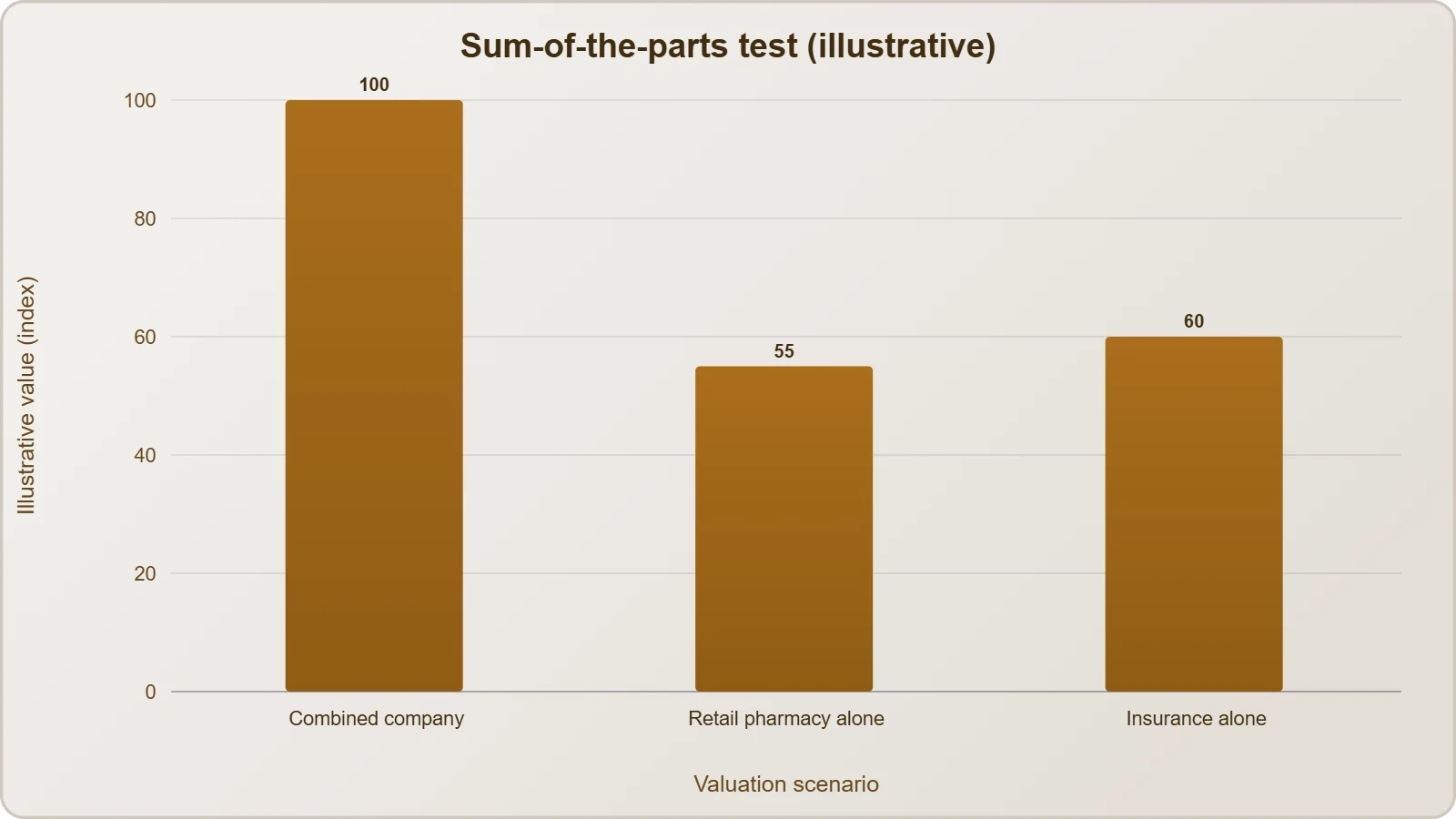
The synergy side of the ledger is harder to quantify but no less important. Integration can reduce costs through shared services, improve care coordination, and strengthen negotiating leverage with drug manufacturers and providers. If those benefits are real and durable, separation would destroy value. The reported review is essentially an attempt to measure both sides of that ledger with more rigor than public markets can provide. Until the company discloses its conclusions, investors are left to weigh competing narratives about which effect dominates.
Management Focus and Capital Allocation Discipline
One of the quieter arguments for separation is managerial. Running a retail network and an insurance company simultaneously demands expertise in logistics, consumer marketing, actuarial science, and regulatory affairs. Few leadership teams excel at all of these, and attention is a finite resource. A split would allow each entity to recruit leadership suited to its specific challenges and to allocate capital according to its own return thresholds rather than competing for funds inside a single corporate budget.
Capital allocation discipline is especially relevant in healthcare, where investment cycles are long and mistakes are expensive. A retail business might prioritize store renovations and digital pharmacy tools, while an insurer might prioritize claims technology and provider network development. When both compete for the same pool of capital, internal politics can distort decisions. Separation replaces that negotiation with market discipline, forcing each entity to justify its investments to its own shareholders. That clarity is one of the strongest arguments in favor of the review.
Stakeholder Implications: Patients, Employees, and Investors
For patients, the most immediate question is whether a separation would change how they access care. CVS pharmacies and CVS insurance plans are deeply intertwined in many communities, and a split could alter network design, formulary decisions, and the convenience of filling prescriptions at a store tied to one's insurer. In practice, the company would likely seek to preserve those relationships through commercial agreements, but the terms of such agreements would be negotiated rather than dictated internally. Patients may see little change in the short term, but the long-term structure of their care options could shift.
Employees face a different kind of uncertainty. A separation would require deciding which entity retains shared corporate functions, how benefits and retirement plans are divided, and where career paths lead. Retail staff and insurance professionals would find themselves in organizations with different cultures, different performance metrics, and different leadership. Such transitions are manageable but rarely frictionless. The reported review does not imply imminent changes, yet it introduces a variable that employees will watch closely, particularly in a labor market where healthcare talent is highly mobile.
Investor Perspectives and Valuation Transparency
Investors are likely to focus on valuation transparency. A separated CVS would produce two sets of financial statements with clearer segment economics, allowing analysts to value each business on its own merits. That transparency can attract new shareholders who previously avoided the stock because of its complexity. It can also expose weaknesses that were previously obscured by the combined structure, which is why some investors prefer conglomerates: they can hide underperformance in one division behind strength in another.
The market reaction to the report itself offers a useful signal. Even unconfirmed separation rumors tend to move share prices, because investors immediately begin pricing in the possibility of a sum-of-the-parts uplift. If the review ultimately concludes that separation is not warranted, the company will need to explain why the current structure creates more value than the market currently assigns it. That explanation will be scrutinized closely, and it may shape how investors judge management's credibility on capital allocation for years to come.
The Regulatory and Political Dimension
Healthcare consolidation is a politically sensitive topic, and any structural change at a company of CVS's scale will draw attention from regulators and lawmakers. A separation could be framed as a pro-competition move that reduces concentration, or it could be criticized as a financial engineering exercise that does not address underlying concerns about drug pricing and access. The framing matters, because political narratives can influence regulatory posture even when no formal approval is required for a corporate reorganization.
State insurance regulators would also play a role, since separating an insurance business from its parent requires careful attention to capital adequacy, policyholder protections, and licensing. These processes are technical but consequential, and they can extend timelines significantly. The reported review may therefore be as much about regulatory feasibility as about financial logic. Companies contemplating separations routinely consult with regulators before announcing anything, precisely because the path to completion is shaped by supervisory expectations.
Historical Context: The Arc of Healthcare Integration
The CVS review is best understood against the broader history of healthcare integration in the United States. For decades, the sector oscillated between consolidation and divestiture as companies sought the optimal scale for their businesses. The 1990s and 2000s saw a wave of mergers designed to create national platforms, followed by a period of selective unwinding as companies discovered that some combinations created more complexity than value. CVS's own history reflects this pattern, having grown through acquisitions while periodically pruning businesses that no longer fit its strategic direction.
The Aetna acquisition marked a high point in the integration narrative, promising to transform a pharmacy chain into a health services powerhouse. That promise has been tested by shifting reimbursement models, rising medical costs, and political pressure on drug pricing. The reported review suggests that the company is now asking whether the original thesis still holds, or whether the market has changed enough to warrant a different structure. History does not dictate the answer, but it provides a useful reminder that corporate structures are means to an end, not ends in themselves.
Lessons From Prior Separations in Healthcare
Other healthcare companies have traveled this road before, with mixed results. Some separations have unlocked substantial shareholder value by allowing focused management teams to pursue clear strategies. Others have foundered on the complexity of disentangling shared operations or on the loss of synergies that proved more valuable than expected. The lesson is that separation is not a guaranteed value creator; it is a strategic choice whose merits depend on execution, market conditions, and the specific economics of the businesses involved.
For CVS, the relevant precedent may be its own experience integrating Aetna. If the integration delivered the promised benefits, separation would be harder to justify. If it did not, the case for a split becomes stronger. The reported review is likely examining exactly this question, comparing realized synergies against original projections. That analysis, rather than any single headline, will determine whether the company ultimately decides to restructure or to reaffirm its current architecture.
What to Watch in the Coming Months
Investors and observers should watch for several signals as the review progresses. Any public confirmation from CVS would mark a significant escalation, as would the engagement of investment banks or legal advisors specializing in separations. Regulatory filings, management commentary on earnings calls, and changes in segment reporting would all provide clues about the direction of the review. Absent such signals, the report remains an unconfirmed possibility rather than a defined plan.
The broader healthcare landscape will also matter. If peers pursue similar restructurings, CVS may face pressure to follow. If the sector stabilizes and integration benefits become clearer, the case for separation may weaken. Either way, the review reflects a healthy process of strategic self-examination, and its outcome will inform how the industry thinks about the boundaries of the modern healthcare company for years to come.
Reading the Silence: What CVS Has Not Said
The most telling feature of the report may be what it leaves unsaid. CVS has not confirmed the review, has not disclosed its scope, and has not indicated whether other options are on the table. That silence is standard corporate practice for preliminary strategic exercises, but it also means that the public is working with an incomplete picture. Investors should treat the report as a signal of internal deliberation rather than a forecast of action, and they should be cautious about extrapolating from anonymous sourcing to definitive conclusions.
At the same time, silence should not be mistaken for inactivity. Large companies routinely conduct portfolio reviews without public disclosure, and the fact that information reached a major news organization suggests that the process has advanced beyond casual conversation. Whether that process culminates in a separation, a reorganization, or a reaffirmation of the status quo remains unknown. What is clear is that the question has been asked internally, and that alone is significant for a company whose identity has been built on integration.
How to Interpret Unconfirmed Strategic Reports
Unconfirmed reports about corporate strategy require careful interpretation. They often reflect genuine internal discussions, but they can also reflect the perspectives of advisors, investors, or other parties with their own agendas. The appropriate response is neither to dismiss them nor to treat them as certain, but to assess whether the underlying logic is plausible and whether the company's subsequent actions are consistent with the reported direction. In CVS's case, the logic of a separation is plausible enough that the report deserves serious attention.
Investors should also consider the incentives of the sources involved. Anonymous sourcing can protect individuals who face retaliation, but it can also be used to shape market perceptions. The responsible approach is to weigh the report against the company's public statements, its financial disclosures, and the broader strategic context. Over time, those signals will converge on a clearer picture, and the market will adjust accordingly. Until then, the report remains a hypothesis rather than a fact.
The Long-Term Question of Corporate Identity
Beyond the financial mechanics, the review raises a deeper question about corporate identity. CVS has positioned itself as a health services company that happens to operate pharmacies, rather than a pharmacy chain that happens to sell insurance. A separation would force the company to choose which identity it wants to own. That choice has implications for branding, customer relationships, and the narrative it presents to investors and regulators. It is, in essence, a question about what kind of company CVS wants to be in the next decade.
The answer will depend on how the company weighs the benefits of integration against the costs of complexity. If the review concludes that the current structure remains the best path forward, CVS will have reaffirmed its commitment to a distinctive model. If it concludes otherwise, the company will embark on one of the most consequential restructurings in modern healthcare. Either outcome will be instructive, and both will shape how the industry thinks about the limits and possibilities of vertical integration.
Conclusion: A Decision That Will Define CVS's Next Chapter
The reported review of CVS's structure is more than a routine corporate exercise. It represents a moment of strategic reckoning for a company that bet heavily on integration and now must decide whether that bet still pays. The outcome will affect patients, employees, investors, and the broader healthcare industry, and it will provide a case study in how modern conglomerates evaluate the boundaries of their businesses. Whether CVS ultimately separates or reaffirms its current structure, the process itself signals that the era of unquestioned consolidation may be giving way to an era of disciplined portfolio management.
For now, the responsible posture is one of informed patience. The report is unconfirmed, the review is preliminary, and no decision has been announced. But the questions it raises are real and consequential, and they deserve the attention of anyone who follows healthcare, finance, or corporate strategy. The answers will emerge over time, shaped by financial analysis, regulatory considerations, and the judgment of leadership. When they do, they will tell us something important about the future of integrated healthcare in America.
From our network :
- University Language Proficiency Exams: Why Institutional Tests Demand Different Preparation Than IELTS and TOEFLDiscover why university-specific language proficiency examinations differ fundamentally from IELTS and TOEFL, and learn strategic preparation approaches for institutional assessment success.
- Live Online English Classes for Kids: Do They Actually Reduce Anxiety?A ten-week study reveals that synchronous online English classes can significantly reduce child language anxiety while improving listening and reading skills. Discover what makes these programs effective and how parents can select the right one.
- Committed Mediterranean Precipitation Decline: Why Emissions Cuts Alone Cannot Restore Winter RainsNew NOAA research reveals that Mediterranean winter rains may decline irreversibly even with emissions cuts. Explore the science of committed climate change and regional impacts.
- Forbidden Matrix Patterns and Visible Lattice Points: A Geometric DictionaryExplore how multidimensional 0–1 matrices encode geometric truths, linking forbidden patterns to visible lattice points and hypergraph theory, with applications in combinatorics and computational geometry.
- Mobile Learning and VR in English: What Global Evidence Reveals About Effective Language TechnologyA systematic review across 14 countries reveals which language-learning technologies genuinely work. Mobile learning, AI, and VR show measurable benefits when pedagogically integrated. This evidence-based guide helps educators and learners select technology that delivers real return on investment.
- CISA’s Ten-Advisory Wave: Why Generic Patching Fails in OT and How to Build Product-Specific PlaybooksCISA released ten ICS advisories in one week, exposing critical infrastructure risks. Generic patching fails in OT. Learn to build product-specific remediation playbooks.
- The Final Descent: How ESA Retired the Legendary Cluster Constellation After 24 Years of Space Weather ScienceAfter 24 years mapping Earth’s magnetosphere, ESA’s Cluster mission concluded with a precisely controlled reentry over the South Pacific. This analysis explores the scientific legacy, engineering decisions, and debris mitigation principles behind one of space exploration’s most responsible retirements.
- How AI Agents Will Change the Way We Manage Personal FinancesExplore how AI agents are transforming personal finance through automated budgeting, bill payment, and investment management, while examining the critical security protocols and governance frameworks required for safe deployment.
- The Hidden Cost of AI Convenience: Why Over-Permissioned Agents Are a Security Time BombDiscover why AI agents with excessive permissions create dangerous single points of failure, and learn how implementing least privilege principles can protect your organization from exploitation.
RESOURCES
- Resources will be updated soon.
- 01
- 02
- 03
- 04
- 05
- 06
- 07
- 08
0 Comments