Indonesia's equity market has entered one of the most consequential stress tests in its modern financial history. The Jakarta Composite Index slipped below the psychologically significant 5,000-point threshold, closing at 4,904.29 after a 3.78 percent single-session decline, a level not witnessed since the depths of the COVID-19 shock in 2020. What makes this moment distinctive is not merely the magnitude of the fall but the institutional question sitting beneath it: how should a regulator respond when confidence in market integrity, rather than macroeconomic fundamentals, becomes the primary driver of capital flight?
The proximate trigger was a set of concerns raised by MSCI, the global index provider whose classifications shape the allocation decisions of trillions of dollars in passive and active funds. Questions about transparency and coordinated trading patterns prompted foreign investors to reassess their exposure, and the resulting selling pressure has pushed the benchmark down more than 40 percent since the start of the year, making it the worst-performing major equity market on the planet. The Financial Services Authority, known locally as OJK, now finds itself balancing enforcement credibility against the risk of further destabilizing an already fragile market.
This analysis examines the enforcement doctrine OJK has adopted, the legal architecture behind it, and the deeper question analysts are asking: whether administrative fines function as a genuine deterrent or simply a predictable line item for firms inclined toward misconduct. Understanding this episode requires looking beyond the index level to the institutional signals that determine whether global capital returns.
On This Page
- The Anatomy of a 40 Percent Collapse
- OJK's Enforcement Doctrine: The "Una Via" Principle
- Deterrence Theory and the Fine-as-Cost-of-Business Problem
- Market Confidence, Foreign Capital, and the MSCI Dimension
- Legal Architecture and the Revised Financial Sector Law
- What Comes Next for Indonesia's Capital Market
TL;DR Indonesia's Jakarta Composite Index has fallen below 5,000 points, down more than 40 percent year-to-date, after MSCI raised concerns about market transparency and coordinated trading. The financial regulator OJK is responding with a strengthened enforcement posture built on the "una via" principle, which forces it to choose between administrative sanctions and criminal proceedings rather than pursuing both. OJK says it will prioritize fines over prosecution, a stance endorsed by the Supreme Court's guidance that criminal action be reserved for serious violations. Analysts remain divided on whether this approach restores credibility or merely prices misconduct as a routine cost of doing business in Southeast Asia's largest economy.
The Anatomy of a 40 Percent Collapse
The scale of Indonesia's market decline demands careful decomposition, because a 40 percent year-to-date fall in a major index is rarely the product of a single cause. The Jakarta Composite Index, which tracks the performance of companies listed on the Indonesia Stock Exchange, has been weighed down by a confluence of forces: global risk aversion, domestic policy uncertainty, and, most damagingly, a credibility shock emanating from the index provider community. When MSCI signals reservations about a market's transparency standards, the reaction is mechanical rather than emotional, because passive funds tracking MSCI benchmarks must adjust weights, and active managers read the signal as a governance warning.
The 3.78 percent single-day drop that carried the index to 4,904.29 was not an isolated panic but the culmination of sustained pressure. Foreign outflows have compounded domestic caution, and the psychological weight of the 5,000 level matters because round numbers often anchor retail sentiment in emerging markets where participation is broad. The comparison to 2020 is instructive: during the pandemic crash, the decline was exogenous and universally shared, whereas the current episode is perceived as endogenous, tied to questions about how the market itself is governed. That distinction changes the recovery calculus entirely.
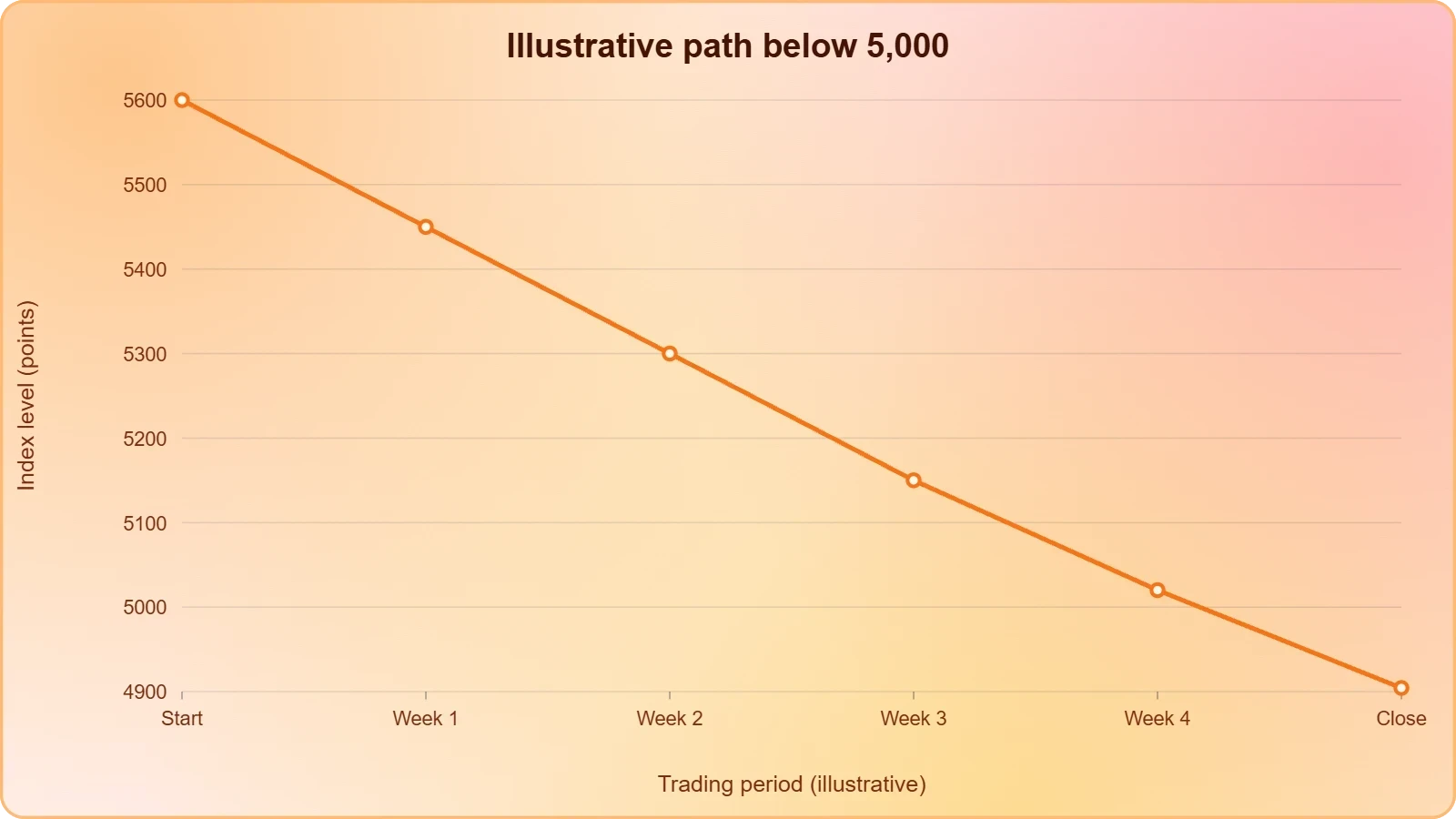
Why the 5,000 Threshold Matters
Round-number thresholds carry disproportionate psychological weight in retail-heavy markets, and Indonesia's investor base has expanded substantially in recent years through digital brokerage platforms. When an index breaks a level that has held through previous stress episodes, the behavioral response among less sophisticated participants tends to amplify selling rather than create buying opportunities. The 5,000 mark had functioned as a reference point for years, and its breach signals to a generation of newer investors that the market's floor is not as firm as assumed.
Beyond psychology, the threshold matters for margin financing and structured products. Brokers extend leverage against collateral values tied to index levels, and sustained declines trigger margin calls that force liquidation, creating reflexive downward pressure. The OJK and the Indonesia Stock Exchange are acutely aware that technical dynamics can overwhelm fundamental valuation when confidence is already impaired, which is why the enforcement question has become inseparable from the market stability question.
The MSCI Signal and Its Consequences
MSCI's concerns about transparency and coordinated trading represent a specific category of risk that global investors treat with particular severity. Coordinated trading, sometimes described as "gaming" or "banding" in local market parlance, undermines the price discovery function that index inclusion is meant to reward. When a provider of MSCI's stature raises such issues publicly, the reputational cost extends beyond the immediate selling pressure, because it invites scrutiny from other index compilers, proxy advisors, and sovereign wealth funds with long memories.
The consequences ripple through multiple channels. Passive funds tracking MSCI Indonesia indices must rebalance mechanically, but active managers face a more nuanced decision: they may retain exposure while demanding governance improvements, or they may exit entirely and wait for structural reform. The historical record suggests that markets which respond decisively to such signals recover foreign participation faster than those that treat the criticism as a public relations problem. Indonesia's response will be read as a test of institutional maturity.
OJK's Enforcement Doctrine: The "Una Via" Principle
At the center of Indonesia's regulatory response sits a legal doctrine with Latin roots and profound practical consequences. The "una via" principle, embedded in the newly revised Financial Sector Development and Strengthening Law, requires the Financial Services Authority to elect a single enforcement track: either administrative sanctions or criminal proceedings, but never both simultaneously. This is a deliberate departure from the previous approach, under which regulators could pursue fines and refer cases for prosecution in parallel, and it fundamentally reshapes the calculus for firms weighing compliance costs against potential gains from misconduct.
Agus Firmansyah, an OJK official, articulated the regulator's intent to function as a gatekeeper, investigating any signs of violations and acting decisively within its chosen track. The stated preference is administrative sanctions, principally fines, over criminal procedures. This prioritization reflects a pragmatic assessment of institutional capacity: administrative proceedings are faster, require a lower evidentiary threshold, and generate revenue, whereas criminal cases demand coordination with prosecutors and courts that can stretch over years. The Supreme Court has reinforced this hierarchy by recommending criminal proceedings be reserved as a last resort for serious violations.
Administrative Sanctions Versus Criminal Proceedings
The choice between administrative and criminal tracks is not merely procedural; it determines the nature of deterrence itself. Administrative fines operate on a cost-benefit logic, raising the expected cost of misconduct until it exceeds the expected gain. Criminal proceedings, by contrast, impose stigma, restrict liberty, and signal societal condemnation, which can deter even where fines are treated as trivial relative to profits. The "una via" doctrine forces regulators to choose which lever to pull, and the choice of fines as the default reveals a preference for speed and predictability over severity.
Critics note that this preference may be rational in the short term but corrosive over time. If market participants internalize the expectation that violations yield fines rather than prosecution, the fine becomes a licensing fee for misconduct, priced into business models rather than avoided. The effectiveness of the approach therefore hinges on calibration: fines must be large enough to bite, imposed consistently enough to be predictable, and paired with non-monetary consequences such as license restrictions or market bans that carry genuine operational weight.
The Supreme Court's Guidance and Judicial Restraint
The Supreme Court's recommendation that criminal proceedings serve as a last resort introduces a judicial dimension to what might otherwise appear a purely regulatory question. By signaling restraint, the judiciary aligns itself with the "una via" framework and reduces the risk of inconsistent outcomes across administrative and criminal forums. This coherence matters for legal certainty, which foreign investors weigh heavily when assessing emerging market risk, but it also raises the bar for what constitutes a "serious violation" warranting prosecution.
Defining seriousness becomes the pivotal interpretive question. Fraud involving systemic risk, deliberate manipulation of benchmark prices, or collusion affecting retail investors arguably meet the threshold, while technical reporting lapses may not. The absence of a clear statutory definition leaves discretion with regulators and courts, creating uncertainty that markets dislike. A transparent, published framework for escalation would strengthen the doctrine's credibility and give firms a clearer picture of where the line between fine and prosecution actually sits.
Deterrence Theory and the Fine-as-Cost-of-Business Problem
The most penetrating question raised by analysts cuts to the heart of enforcement economics: does a fine-based regime actually deter, or does it merely tax? The answer depends on a variable that regulators rarely control precisely, namely the relationship between the expected penalty and the expected profit from the violation. When fines are set below the gains from misconduct and detection probability is modest, rational actors treat the penalty as a cost of doing business, a line item to be budgeted rather than a risk to be avoided. This is the classic deterrence failure that haunts administrative enforcement regimes worldwide.
Indonesia's challenge is compounded by the structure of its market. Coordinated trading and transparency failures often involve sophisticated actors with the resources to model regulatory risk quantitatively. If those actors conclude that the worst-case outcome is a fine payable from a fraction of the proceeds, the enforcement regime becomes a fee schedule rather than a deterrent. The credibility of OJK's gatekeeper posture therefore depends less on the doctrine it announces than on the calibration of penalties and the consistency with which they are applied across politically connected and unconnected firms alike.
Calibrating Penalties for Credible Deterrence
Effective deterrence requires that the expected penalty exceed the expected gain, a principle that can be expressed formally. If a violation yields gain ##G## with detection probability ##p## and penalty ##F##, deterrence holds when ##p \times F > G##. Regulators who cannot raise detection probability must raise the fine, and those who cannot raise the fine must improve detection. Indonesia's enforcement capacity on both dimensions will determine whether the "una via" framework achieves its stated purpose or becomes a procedural formality.
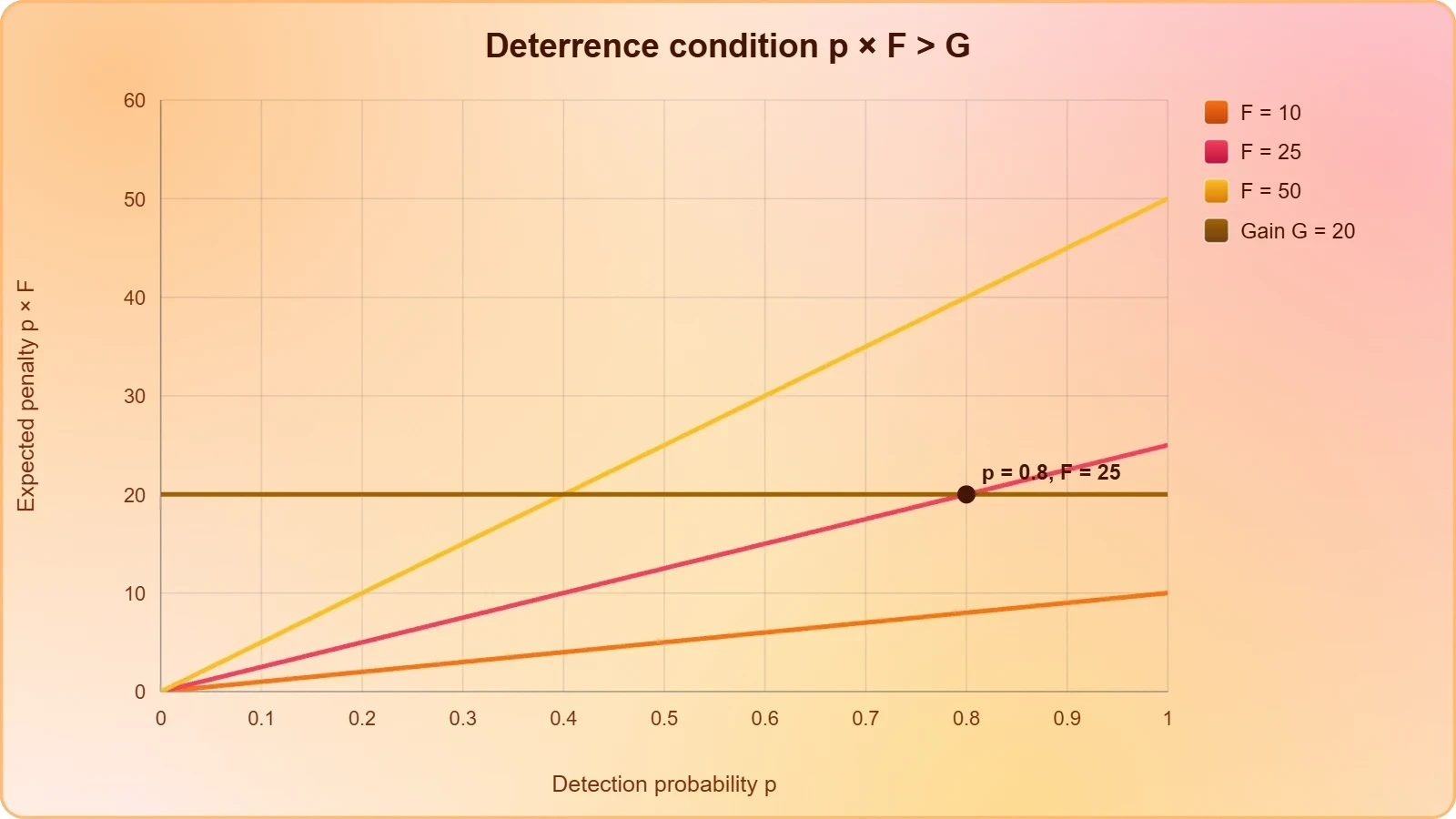
The formula is simple, but its application is not. Detection probability depends on surveillance technology, whistleblower channels, and the willingness of market participants to report misconduct, all of which require sustained investment. Penalty levels depend on statutory caps and judicial or administrative discretion, which can be constrained by concerns about proportionality or economic impact. A credible regime aligns both levers, and it publishes enough about its methodology that market participants can form accurate expectations rather than guessing.
Lessons From Comparable Emerging Markets
Comparative experience offers instructive parallels. South Korea's Financial Services Commission has combined substantial fines with criminal referrals for repeat offenders, creating a graduated escalation that firms take seriously. Brazil's securities regulator, CVM, has similarly paired administrative penalties with public sanction registers that impose reputational costs beyond the monetary amount. These regimes share a common feature: transparency about enforcement outcomes, which allows the market itself to discipline firms whose names appear repeatedly in sanction records.
Indonesia could adopt analogous mechanisms without abandoning the "una via" principle. A public enforcement database, mandatory disclosure of settlement terms, and escalation triggers tied to repeat violations would strengthen deterrence without requiring criminal prosecution in every case. The reputational channel is particularly powerful in markets where access to foreign capital depends on governance perceptions, because a firm's sanction history becomes a factor in institutional allocation decisions. Enforcement visibility, in other words, can substitute partially for enforcement severity.
We Also Published
- 01
- 02
- 03
- 04
Market Confidence, Foreign Capital, and the MSCI Dimension
Index providers occupy a peculiar position in global finance: they do not invest capital themselves, yet their classification decisions determine where trillions of dollars flow. MSCI's concerns about Indonesia therefore carry weight disproportionate to the size of any single fund it manages, because inclusion in MSCI benchmarks is a prerequisite for passive allocation. When transparency and coordinated trading become questions, the risk is not merely that existing investors sell but that future allocations are withheld, a slower and more damaging form of capital flight.
The Indonesian market's dependence on foreign participation amplifies this dynamic. Domestic institutional capital, while growing, remains insufficient to absorb the selling pressure that accompanies a loss of index credibility. The 40 percent decline is therefore best understood as a repricing of governance risk rather than a reassessment of corporate earnings. Companies whose fundamentals remain sound have seen valuations compress because the market's institutional infrastructure is being questioned, a distinction that matters enormously for policymakers deciding where to focus reform efforts.
Rebuilding Credibility With Global Index Providers
Restoring MSCI's confidence requires demonstrable action rather than declaratory commitments. Index providers typically respond to evidence of structural reform: clearer disclosure requirements, visible enforcement against coordinated trading, and independent oversight of exchange operations. The timeline matters, because MSCI conducts periodic market classification reviews and a negative decision can lock in exclusion for years. Indonesia's window for demonstrating progress is therefore narrow, and the enforcement doctrine OJK adopts will be read as a leading indicator of seriousness.
Engagement with index providers is itself a skill that regulators must cultivate. MSCI publishes consultation documents and invites market participant feedback, creating channels through which regulators can present reforms and receive candid assessments. Indonesia's participation in these processes, and its willingness to accept external benchmarking of its progress, will signal whether the current episode produces genuine institutional learning or merely a cyclical recovery followed by another crisis of confidence.
The Domestic Investor Base as a Stabilizer
One structural response to foreign capital volatility is the deepening of domestic investor participation. Indonesia's retail investor base has grown rapidly, and pension funds, insurance companies, and mutual funds hold increasing allocations to domestic equities. A larger and more patient domestic base can absorb foreign outflows and reduce the amplitude of index swings, but only if domestic investors have confidence in market integrity. The enforcement question thus connects directly to the stabilization strategy: credible regulation is the precondition for domestic capital to play its stabilizing role.
Policy incentives can accelerate this deepening. Tax advantages for long-term equity holdings, simplified retirement account structures, and financial literacy programs all expand the pool of domestic capital. None of these measures, however, can compensate for a perception that the market is rigged or poorly supervised. The sequencing matters: integrity first, then depth. Regulators who invert that order find that domestic investors behave like foreign ones, retreating at the first sign of governance failure.
Legal Architecture and the Revised Financial Sector Law
The revised Financial Sector Development and Strengthening Law provides the statutory foundation for OJK's enforcement posture, and its provisions deserve close reading because they determine what the regulator can and cannot do. The law formalizes the "una via" principle, resolving a long-standing ambiguity about whether administrative and criminal tracks could proceed concurrently. By mandating a single track, the legislature has effectively forced a strategic choice at the institutional level, one that OJK has resolved in favor of administrative efficiency over criminal severity.
This legislative choice reflects a broader philosophy about the purpose of financial regulation in an emerging economy. Criminal prosecution is resource-intensive, slow, and uncertain, requiring coordination across multiple agencies with varying priorities. Administrative enforcement, by contrast, can be executed within a single institution with clear timelines and measurable outcomes. For a regulator seeking to demonstrate activity and build institutional capability, the administrative track offers a more controllable path, even if its deterrent effect is theoretically weaker.
Institutional Capacity and Enforcement Realism
Enforcement doctrine must be matched to institutional capacity, and OJK's resources are finite. Investigating coordinated trading requires sophisticated surveillance systems capable of detecting patterns across accounts, brokers, and time zones. Building that capability takes years and significant investment, and the regulator's ability to pursue complex cases depends on whether it can attract and retain technical talent in competition with the private sector. A doctrine that promises more than the institution can deliver risks damaging credibility further.
Realism therefore argues for a graduated approach: pursue clear-cut administrative cases aggressively to establish a track record, invest in surveillance infrastructure, and reserve criminal referrals for cases where the evidence is overwhelming and the violation is egregious. This sequencing builds capability while maintaining deterrence, and it avoids the trap of announcing ambitious prosecutions that later collapse for lack of evidence. The credibility of enforcement depends on the ratio of successful actions to announced intentions.
Transparency as a Regulatory Strategy
Transparency offers a lower-cost path to deterrence than either fines or prosecution. Publishing enforcement decisions, including the identity of sanctioned firms and the nature of violations, imposes reputational costs that can exceed monetary penalties for firms dependent on institutional relationships. A public register of sanctions, updated promptly and searchable, allows investors to price governance risk accurately and creates market-based discipline that operates continuously rather than episodically.
Transparency also disciplines the regulator itself. When decisions are published with reasoning, patterns of leniency or selective enforcement become visible to journalists, academics, and international observers. This visibility can be uncomfortable, but it builds credibility over time by demonstrating that enforcement is rule-based rather than discretionary. For a market seeking to reassure global index providers, a transparent enforcement record is among the most persuasive evidence of institutional seriousness available.
What Comes Next for Indonesia's Capital Market
The path forward for Indonesia's capital market hinges on whether the current crisis produces durable institutional reform or a temporary stabilization followed by recurrence. The historical pattern in emerging markets suggests that governance shocks are resolved through visible, sustained action rather than declaratory policy, and that the market's recovery timeline is set by the credibility of that action. OJK's enforcement choices over the coming quarters will therefore be scrutinized not only by domestic participants but by the global allocators whose capital determines the index's trajectory.
Several scenarios are plausible. In the optimistic case, OJK pursues high-profile administrative cases against coordinated trading, publishes outcomes transparently, and engages MSCI with evidence of structural improvement, allowing index credibility to recover and foreign flows to return. In the pessimistic case, fines are set at levels that firms absorb without behavioral change, enforcement appears selective, and MSCI maintains its concerns, locking in exclusion and prolonging the capital drought. The difference between these outcomes lies in execution rather than doctrine.
Signals to Monitor in the Coming Quarters
Investors and analysts can track specific indicators to assess whether reform is genuine. The frequency and size of administrative sanctions, the publication of enforcement reasoning, the treatment of politically connected firms relative to others, and the outcome of MSCI's next classification review all provide evidence about institutional direction. Surveillance infrastructure investments, visible in budget allocations and hiring, offer a leading indicator of future enforcement capacity. Together, these signals form a dashboard for assessing whether the "una via" framework is producing credible deterrence.
The index level itself is a lagging indicator, reflecting outcomes rather than intentions. A sustained recovery above 5,000 would signal returning confidence, but the durability of that recovery depends on the institutional foundations laid during the downturn. Markets that emerge from governance crises stronger typically do so because the crisis forced reforms that would otherwise have been deferred. Indonesia's opportunity lies in treating the current stress as a catalyst rather than an interruption.
Balancing Enforcement With Market Stability
The tension between enforcement and stability is real but not irreconcilable. Aggressive enforcement can temporarily unsettle markets by revealing problems that were previously hidden, but the alternative, leniency in the name of stability, tends to produce larger crises later. The art lies in sequencing: establish the enforcement framework, communicate it clearly, apply it consistently, and allow markets to price the new regime gradually rather than all at once. Predictability, more than severity, is what markets ultimately reward.
Indonesia's regulators face a choice that will define the market's trajectory for years. The "una via" doctrine provides a workable framework, but its value depends entirely on implementation. If fines are calibrated to bite, if transparency is genuine, and if escalation is credible, the framework can restore confidence and attract the capital that has fled. If not, the market will learn to treat penalties as a cost of business, and the next crisis will be deeper and harder to reverse.
From our network :
- Live Online English Classes for Kids: Do They Actually Reduce Anxiety?A ten-week study reveals that synchronous online English classes can significantly reduce child language anxiety while improving listening and reading skills. Discover what makes these programs effective and how parents can select the right one.
- The Final Descent: How ESA Retired the Legendary Cluster Constellation After 24 Years of Space Weather ScienceAfter 24 years mapping Earth’s magnetosphere, ESA’s Cluster mission concluded with a precisely controlled reentry over the South Pacific. This analysis explores the scientific legacy, engineering decisions, and debris mitigation principles behind one of space exploration’s most responsible retirements.
- The Hidden Cost of AI Convenience: Why Over-Permissioned Agents Are a Security Time BombDiscover why AI agents with excessive permissions create dangerous single points of failure, and learn how implementing least privilege principles can protect your organization from exploitation.
- University Language Proficiency Exams: Why Institutional Tests Demand Different Preparation Than IELTS and TOEFLDiscover why university-specific language proficiency examinations differ fundamentally from IELTS and TOEFL, and learn strategic preparation approaches for institutional assessment success.
- CISA’s Ten-Advisory Wave: Why Generic Patching Fails in OT and How to Build Product-Specific PlaybooksCISA released ten ICS advisories in one week, exposing critical infrastructure risks. Generic patching fails in OT. Learn to build product-specific remediation playbooks.
- How AI Agents Will Change the Way We Manage Personal FinancesExplore how AI agents are transforming personal finance through automated budgeting, bill payment, and investment management, while examining the critical security protocols and governance frameworks required for safe deployment.
- Mobile Learning and VR in English: What Global Evidence Reveals About Effective Language TechnologyA systematic review across 14 countries reveals which language-learning technologies genuinely work. Mobile learning, AI, and VR show measurable benefits when pedagogically integrated. This evidence-based guide helps educators and learners select technology that delivers real return on investment.
- Forbidden Matrix Patterns and Visible Lattice Points: A Geometric DictionaryExplore how multidimensional 0–1 matrices encode geometric truths, linking forbidden patterns to visible lattice points and hypergraph theory, with applications in combinatorics and computational geometry.
- Committed Mediterranean Precipitation Decline: Why Emissions Cuts Alone Cannot Restore Winter RainsNew NOAA research reveals that Mediterranean winter rains may decline irreversibly even with emissions cuts. Explore the science of committed climate change and regional impacts.
RESOURCES
- Indonesia to hold follow-up meeting with MSCI this week after ...reuters.comFeb 9, 2026 ... Indonesia Stock Exchange (IDX) signage is seen on its building in ... As part of its push to tighten enforcement,…
- Indonesia grapples with stock market enforcement as index sinks ...thejakartapost.com22 hours ago ... To address violations in the capital market and restore market confidence, OJK is implementing the “una via” principle, which requires…
- Press Release: March 2026 Board of Commissioners Meeting - OJKojk.go.idMar 31, 2026 ... TPAKD capacity-building workshop (3 March 2026). Market Conduct Enforcement ... On 13 March 2026, OJK and the Indonesia Stock Exchange…
- As ASEAN approaches its 60th anniversary, the region stands at a ...instagram.comDec 5, 2024 ... ... Indonesia's equity market and whether global funds can continue to trust Indonesia's stock market. “MSCI proposal is not about…
- OJK Imposes Rp542 Billion in Fines Over Capital Market Violationsen.tempo.coFeb 9, 2026 ... Meanwhile, regarding the enforcement of criminal law, Eddy ... Indonesia Tightens Stock Market Rules Amid MSCI Concerns. Indonesia's ...
- Enhancing market transparency in greenngfs.nettransition to meet the goals of the Paris Agreement. The UN's Intergovernmental Panel on Climate Change. (IPCC) has warned that global greenhouse gas ...
- LSEG: Financial Markets Infrastructure and Datalseg.comFTSE Global Equity Index Series (GEIS) helps customers to benchmark global equity performance and build investment products through a transparent, rules-based ...
- US Monetary Policy Amid Geopolitical Tensions andimf.orgNov 11, 2024 ... Citi Research is a division of Citigroup Global Markets Inc. (the "Firm"), which does and seeks to do business with…
- Indonesia's Sustainable Transformation - PwCpwc.comDec 1, 2021 ... (POJK) No. 51/POJK.03/2017. IDX's ESG leaders outperformed their peers,. February 4, 2014 - January 29, 2021. 37.3%. Indonesia Stock Exchange.
- J.P. Morgan Asia Credit Index - Investment Grade (JACI IG)jpmorgan.comMay 27, 2024 ... ... Indonesia Stock Exchange and is registered and supervised by the Otoritas ... MSCI Inc., its affiliates and information providers…
- PT MERDEKA GOLD RESOURCES Tbkmerdekagoldresources.comJul 1, 2026 ... ... Indonesia with limited liability). GLOBAL OFFERING OF ... Hong Kong Exchanges and Clearing Limited, The Stock Exchange of Hong ...
- OECD Investment Policy Reviews: Indonesia 2020 (EN)oecd.orgallowed Indonesia to compensate for its loss of market shares in worldwide FDI. ... The ability to make and enforce contracts and resolve disputes…
- PD000245 - Documents & Reports - World Bankdocuments1.worldbank.orgJul 9, 2026 ... ... via Free Float and Transparency Reforms (IDX + OJK ... enhance stock market transparency and data quality, in light…
- Value. Focus. Growth. - Medco Energimedcoenergi.com(PROPER) to evaluate corporate compliance with Indonesia's ... As a company listed on the Indonesia Stock Exchange, MedcoEnergi prepares its Sustainability Report ...
- OJK Reveals It Cannot Impose Administrative and Criminal ... - VOIvoi.id3 days ago ... The regulation is part of the una via mechanism as regulated in the ... "If there is an indication of…
- 01
- 02
- 03
- 04
- 05
- 06
- 07
- 08
0 Comments