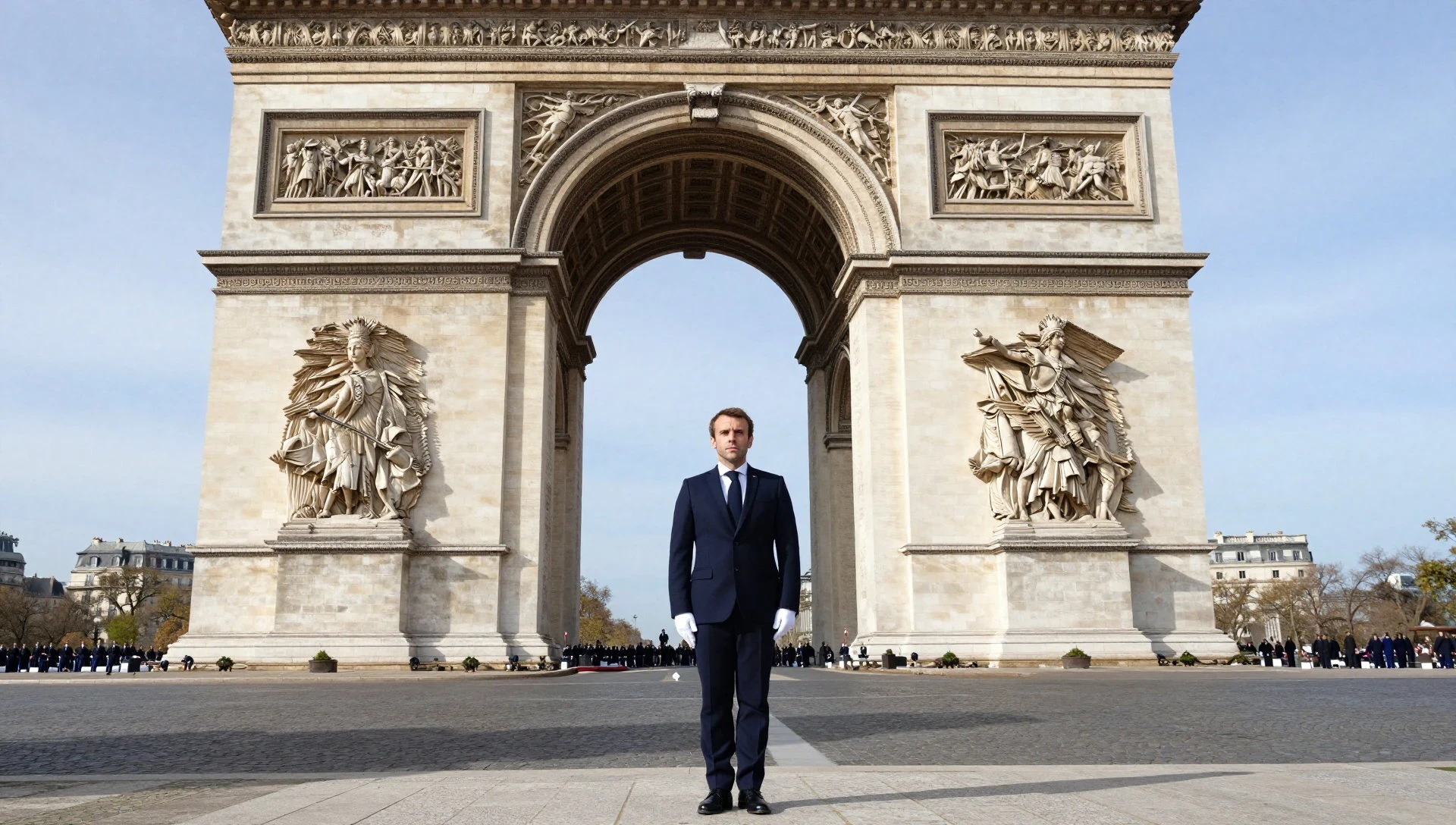
Armistice Day in France carries a weight that few national commemorations can match, and when a sitting president stands beneath the Arc de Triomphe on 11 November, the gesture is never merely ceremonial. The date marks the silencing of the guns on the Western Front in 1918, ending a conflict that consumed an estimated 1.4 million French lives and reshaped the political geography of Europe. Emmanuel Macron's presence at the Paris observance in 2026 therefore belongs to a long, carefully choreographed tradition in which the Republic rehearses its grief and reaffirms its unity.
What makes this annual ritual analytically interesting is the way it fuses private mourning with public messaging. The Tomb of the Unknown Soldier, interred beneath the arch in 1920, gives the ceremony its emotional anchor, while the attending dignitaries supply its political texture. Every wreath laid, every minute of silence observed, and every flame rekindled at the tomb communicates something about how contemporary France understands sacrifice, memory, and its own place in a volatile world. The ceremony is at once a funeral and a statement of national continuity.
This analysis examines the Armistice Day observance through the lens of institutional practice, historical memory, and political communication. It considers why the Arc de Triomphe remains the symbolic centre of the commemoration, how the ritual has evolved across more than a century, and what a presidential appearance signals to domestic and international audiences. The aim is to move beyond the headline and read the ceremony as a structured act of collective remembrance with real civic consequences.
On This Page
TL;DR French President Emmanuel Macron attended the Armistice Day ceremony at the Arc de Triomphe in Paris, honouring the dead of World War I on the anniversary of the 1918 armistice. The observance is a fixed feature of the French civic calendar, blending remembrance of the Unknown Soldier with presidential symbolism. This analysis explains the historical roots of the date, the architecture of the ceremony, the political meaning of presidential participation, and the wider European context in which remembrance is performed.
The Historical Foundations of 11 November
The armistice that took effect at the eleventh hour of the eleventh day of the eleventh month of 1918 was a military instrument, but it quickly became a cultural one. Signed in a railway carriage in the Forest of Compiègne, the agreement halted hostilities between Germany and the Allied powers after four years of industrialised slaughter. In France, the immediate task was reconstruction, yet almost as pressing was the question of how a shattered society would remember what it had endured. The answer, developed over the following decade, was a national liturgy of remembrance.
France formalised the observance with a law passed in 1922, designating 11 November a public holiday. The choice embedded the date in schools, municipal calendars, and family life, ensuring that remembrance would not depend on the enthusiasm of any single generation. War memorials rose in nearly every commune, inscribed with lists of local dead, turning abstract national loss into something neighbours could read by name. This decentralised architecture of memory gave Armistice Day a resilience that purely state-driven commemorations often lack.
The Tomb of the Unknown Soldier and the Flame
In November 1920, an unidentified French soldier was interred beneath the Arc de Triomphe, chosen from among several candidates to represent the hundreds of thousands who fell without a marked grave. Two years later, the Flame of Remembrance was lit at the tomb, and it has been rekindled every evening since, a daily act of maintenance that keeps the site alive between annual ceremonies. The flame transforms the monument from a static memorial into an ongoing obligation, tended by veterans' associations and civic volunteers alike.
The genius of the Unknown Soldier lies in its deliberate anonymity. Because the soldier represents no particular family, he can represent every family; because no region can claim him, all regions can. This design allows the state to speak through the tomb without appearing to privilege one narrative of the war over another. When a president bows before the slab, the gesture is legible to a Breton farmer, a Parisian student, and a descendant of colonial troops alike, which is precisely the point.
From National Grief to European Reconciliation
The meaning of Armistice Day has shifted considerably since the interwar years. After 1945, and especially after the Franco-German reconciliation formalised in the 1963 Élysée Treaty, the commemoration gradually acquired a European dimension. Remembering the dead of one war while building institutions to prevent the next became a coherent political project. The ceremony's language moved from vengeance to vigilance, from victory to the prevention of recurrence, a subtle but consequential reframing of what the date is for.
This evolution has not been without tension. Critics on both left and right have argued over how much the observance should emphasise patriotism versus pacifism, and whether the presence of foreign dignitaries dilutes a specifically French act of mourning. In practice, the ceremony holds these strands together through ritual rather than rhetoric. The silence, the wreath, and the flame do not argue a position; they create a space in which competing interpretations can coexist without breaking the unity the day is meant to express.
We Also Published
The Arc de Triomphe as Civic Stage
Few monuments in Europe carry as much symbolic freight as the Arc de Triomphe. Commissioned by Napoleon in 1806 and completed three decades later, it was conceived as a celebration of military triumph, yet it has spent the past century serving primarily as a site of mourning. That inversion is instructive. The same structure that once announced imperial glory now hosts the Republic's most solemn annual ritual, a reminder that national symbols are reinterpreted by the generations that inherit them rather than fixed by the intentions of their builders.
The arch's position at the head of the Champs-Élysées gives the ceremony a spatial logic that television amplifies. The avenue becomes a processional route, the monument a backdrop, and the surrounding streets a stage for the assembled public. Because the site sits at the junction of twelve radiating avenues, it functions as a symbolic centre from which the whole city, and by extension the whole nation, is imagined to radiate outward. The geography itself does political work.
Ritual Architecture: Wreaths, Silence, and the Flame
The ceremony follows a sequence refined over decades. The president arrives, reviews troops, and lays a tricolour wreath at the tomb; the flame is rekindled; a minute of silence is observed; and the Marseillaise is played. Veterans' associations, military units, and youth representatives are typically present, giving the event a generational layering that reinforces continuity. Each element is brief and repeatable, which is precisely why it endures: ritual works through familiarity rather than novelty.
The minute of silence deserves particular attention as a piece of civic technology. It suspends ordinary time and obliges participants to confront absence collectively, without words that might divide them. In a country as politically fractious as France, a shared silence is one of the few public acts that can be performed without contest. The wreath and the flame supply visual and sensory anchors, but the silence supplies the emotional core around which the rest of the ceremony is arranged.
Security, Logistics, and the Modern Observance
A modern presidential ceremony is also a substantial logistical operation. The perimeter around the Arc de Triomphe is closed, metro stations are adjusted, and security forces deploy in depth, reflecting the elevated threat environment that has shaped French public life since 2015. These arrangements are rarely discussed in coverage, yet they condition how the ceremony is experienced by the public and how it is framed by broadcasters. Security is the invisible infrastructure of remembrance.
Logistics also shape access. The ceremony is attended by invitation, with veterans, officials, and selected citizens occupying the privileged space near the tomb while the wider public watches from behind barriers or at home. This asymmetry is unavoidable but worth noting, because it determines whose experience of the day is intimate and whose is mediated. The televised image, carefully framed, becomes the version of the ceremony most citizens actually encounter.
Macron, the Presidency, and the Politics of Presence
For a French president, attendance at Armistice Day is not optional. The office is expected to embody the nation at moments of collective significance, and absence would be read as a statement in itself. Macron's participation therefore belongs to the constitutional grammar of the Fifth Republic, in which the president serves as guarantor of national unity. The ceremony offers a rare setting in which that role can be performed without the friction of partisan debate, at least on the surface.
Yet presence is never purely neutral. A president who stands at the tomb is also communicating with an electorate, and the images generated by the ceremony enter a wider political conversation about leadership, seriousness, and respect for institutions. In a period of fragmented politics and volatile public opinion, the ritual provides a stable backdrop against which a president can appear statesmanlike. Whether that translates into political capital is another matter, but the opportunity is structurally available.
Between Consensus and Contestation
Armistice Day is designed to produce consensus, but French politics has a habit of intruding. Debates over the meaning of patriotism, the treatment of colonial soldiers, and the place of pacifist traditions surface periodically around the commemoration. Historians have increasingly emphasised the contribution of troops from Africa and Asia, whose recognition was long delayed, and this scholarship has slowly reshaped official narratives. The ceremony's apparent unanimity rests on a foundation that has been actively contested and revised.
Presidents navigate this terrain by choosing which accents to emphasise. A speech may foreground reconciliation, or sacrifice, or the defence of democratic values, and each choice carries implications. Macron's public rhetoric has generally favoured a layered patriotism that acknowledges complexity while insisting on national cohesion. At the tomb, however, words matter less than bearing. The ceremony's power lies in the fact that it can absorb disagreement and still produce a coherent image of the Republic honouring its dead.
Public Opinion and the Limits of Symbolism
Symbolic politics has real limits, and French commentators are quick to point them out. A ceremony honouring the dead does not resolve disputes over pensions, immigration, or the cost of living, and voters are capable of separating solemnity from substance. The risk for any president is that ritual participation comes to look like a substitute for action rather than a complement to it. The ceremony's dignity can even sharpen criticism if the public perceives a gap between the gravity of the occasion and the quality of governance elsewhere.
Still, dismissing symbolism entirely would misread how political legitimacy works. Institutions endure partly because they are regularly performed, and the presidency is no exception. By showing up, observing the silence, and laying the wreath, a president reaffirms a set of commitments that transcend any single administration. The act is small, repeatable, and easy to mock, but it contributes to the slow accumulation of trust on which constitutional order depends.
Remembrance in a Wider European Frame
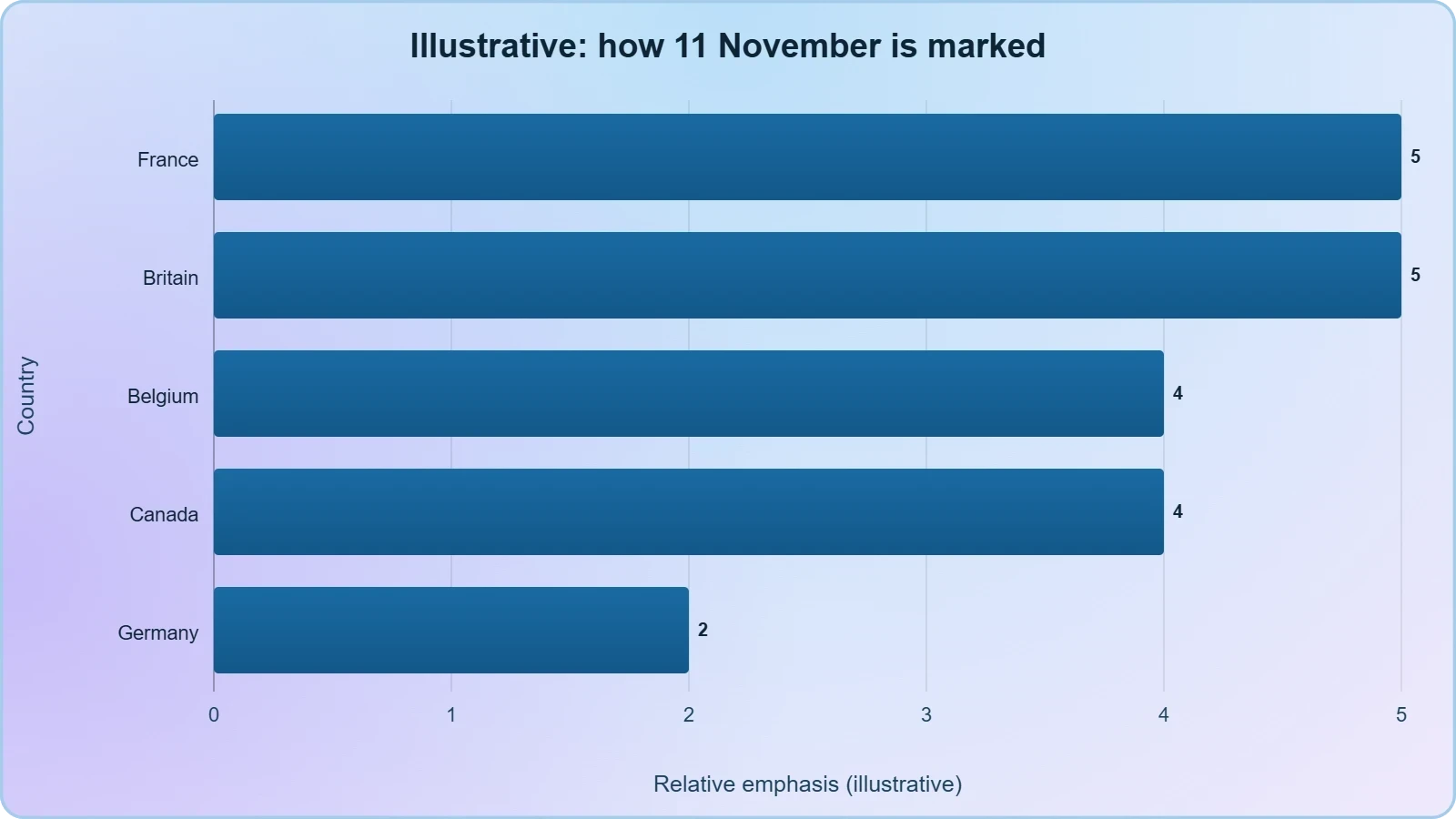
France is not alone in marking 11 November, and the comparative dimension sharpens the analysis. Britain observes Remembrance Day with poppies and a national service at the Cenotaph; Belgium and Canada hold their own ceremonies; Germany's commemorative culture centres on different dates and a more ambivalent relationship with military sacrifice. These variations reveal how national histories produce distinct rituals, even when the underlying event is shared. The armistice belongs to Europe as a whole, but its commemoration is refracted through each nation's self-understanding.
The European dimension has grown more pronounced as integration has deepened. Joint Franco-German commemorations, exchanges between schoolchildren, and shared historical scholarship have softened the sharper edges of national memory. At the same time, the resurgence of geopolitical tension has given the date renewed urgency, reminding publics that the peace the armistice inaugurated was neither inevitable nor permanent. Remembrance has become, in part, a way of talking about present security without appearing alarmist.
Memory, Education, and the Transmission Problem
The most serious challenge facing Armistice Day is generational. As the last veterans of the World Wars pass away, remembrance must be transmitted through education, family narrative, and cultural production rather than living testimony. Schools play a central role, and the French curriculum devotes substantial attention to the two world wars. Yet the risk of ritual becoming hollow is real, and educators increasingly emphasise critical engagement with sources rather than simple reverence, encouraging students to ask what remembrance is for.
Digital culture has changed the transmission problem in ambiguous ways. Archives are more accessible than ever, and genealogical research has become a popular hobby, allowing individuals to trace ancestors who fought. At the same time, attention is fragmented, and a ceremony that lasts an hour competes with an endless stream of content. The response has been to adapt: social media clips, interactive memorials, and documentary projects attempt to translate the ritual into formats that younger audiences find legible.
What the Ceremony Communicates Beyond France
For international observers, the Paris ceremony is a window onto how France understands itself. A country that has experienced invasion, occupation, and repeated political upheaval places considerable value on continuity, and the annual ritual demonstrates that continuity in visible form. The presence of foreign representatives, when it occurs, signals a willingness to situate national memory within a broader European story. The ceremony thus functions as a diplomatic instrument as well as a domestic one, communicating stability and historical awareness to partners abroad.
This communicative function matters in a period when democratic institutions face scepticism. A state that can stage a dignified, well-attended commemoration projects a certain competence, a capacity to organise collective life around shared values. That projection is not the same as legitimacy, but it contributes to the broader impression of institutional health. In this sense, the ceremony is part of the soft infrastructure of governance, as consequential in its way as any policy announcement.
Reading the Ceremony as Institutional Practice
Beyond history and politics, the Armistice Day observance is best understood as an institution in the sociological sense: a stable pattern of behaviour that coordinates expectations across many actors. It tells citizens what to do on a particular morning, tells officials where to stand, tells broadcasters what to film, and tells schools what to teach. Institutions of this kind reduce uncertainty and generate shared meaning, which is why they persist even when their original purpose has receded from living memory.
The ceremony also performs a function of temporal coordination. By fixing a date and an hour, it synchronises the nation's attention, creating a moment in which disparate individuals are doing the same thing at the same time. That synchrony is rare in modern life and contributes to the sense of collective identity the day is meant to foster. The eleventh hour of the eleventh day is not merely a historical fact; it is a recurring appointment with the past.
Continuity, Adaptation, and Institutional Resilience
Institutions survive by adapting without losing their core. Armistice Day has absorbed new elements over the decades, from the inclusion of former colonial troops in official narratives to the use of digital media to reach younger audiences. Yet the essential grammar, the wreath, the silence, the flame, remains intact. This combination of stability and flexibility is the hallmark of resilient ritual, and it explains why the ceremony has outlasted the generation that instituted it.
The French state's investment in the ceremony is also an investment in its own legitimacy. By maintaining the ritual, officials demonstrate that the Republic can honour obligations across time, including obligations to the dead. That demonstration has a moral dimension that is difficult to quantify but easy to recognise. A state that forgets its dead invites questions about how it treats the living, and French authorities are well aware of the connection.
What Observers Should Watch For
For analysts, the ceremony offers several signals worth monitoring. The composition of attendees reveals which groups the state wishes to recognise; the content of any presidential address indicates which themes are considered salient; and the scale of public participation suggests how strongly the ritual resonates beyond official circles. Changes in any of these elements can foreshadow broader shifts in national self-understanding, often before they surface in polling or partisan debate.
The international dimension is equally telling. The presence or absence of foreign representatives, and the way they are received, communicates the state of bilateral relationships. In a period of renewed European security concern, the ceremony's diplomatic subtext carries more weight than it did during the post-Cold War decades. Reading the ritual carefully therefore yields insights that a straightforward news report, focused on the fact of attendance, will inevitably miss.
Conclusion: Why the Eleventh Hour Still Matters
The Armistice Day ceremony at the Arc de Triomphe endures because it does several things at once and does them efficiently. It honours the dead, coordinates national attention, affirms institutional continuity, and provides a stage on which the presidency can perform its unifying role. Macron's attendance in 2026 is therefore both a personal act of respect and an institutional obligation, one that connects the present administration to a tradition stretching back more than a century.
Understanding the ceremony requires looking past the headline to the structures beneath it: the history of the armistice, the architecture of the monument, the choreography of the ritual, and the political calculations that surround it. Each layer contributes to a whole that is greater than the sum of its parts. The result is a commemoration that can absorb disagreement, adapt to new circumstances, and still communicate something stable about what France believes itself to be.
As the generation with direct memory of the World Wars recedes, the burden of remembrance passes to institutions and to citizens who must choose to participate. The ceremony's future depends less on the state's capacity to stage it than on the public's willingness to attend, whether in person or in attention. That willingness, renewed each November, is the real measure of whether the eleventh hour continues to matter.
From our network :
- The Final Descent: How ESA Retired the Legendary Cluster Constellation After 24 Years of Space Weather ScienceAfter 24 years mapping Earth’s magnetosphere, ESA’s Cluster mission concluded with a precisely controlled reentry over the South Pacific. This analysis explores the scientific legacy, engineering decisions, and debris mitigation principles behind one of space exploration’s most responsible retirements.
- Live Online English Classes for Kids: Do They Actually Reduce Anxiety?A ten-week study reveals that synchronous online English classes can significantly reduce child language anxiety while improving listening and reading skills. Discover what makes these programs effective and how parents can select the right one.
- Committed Mediterranean Precipitation Decline: Why Emissions Cuts Alone Cannot Restore Winter RainsNew NOAA research reveals that Mediterranean winter rains may decline irreversibly even with emissions cuts. Explore the science of committed climate change and regional impacts.
- University Language Proficiency Exams: Why Institutional Tests Demand Different Preparation Than IELTS and TOEFLDiscover why university-specific language proficiency examinations differ fundamentally from IELTS and TOEFL, and learn strategic preparation approaches for institutional assessment success.
- How AI Agents Will Change the Way We Manage Personal FinancesExplore how AI agents are transforming personal finance through automated budgeting, bill payment, and investment management, while examining the critical security protocols and governance frameworks required for safe deployment.
- Mobile Learning and VR in English: What Global Evidence Reveals About Effective Language TechnologyA systematic review across 14 countries reveals which language-learning technologies genuinely work. Mobile learning, AI, and VR show measurable benefits when pedagogically integrated. This evidence-based guide helps educators and learners select technology that delivers real return on investment.
- The Hidden Cost of AI Convenience: Why Over-Permissioned Agents Are a Security Time BombDiscover why AI agents with excessive permissions create dangerous single points of failure, and learn how implementing least privilege principles can protect your organization from exploitation.
- Forbidden Matrix Patterns and Visible Lattice Points: A Geometric DictionaryExplore how multidimensional 0–1 matrices encode geometric truths, linking forbidden patterns to visible lattice points and hypergraph theory, with applications in combinatorics and computational geometry.
- CISA’s Ten-Advisory Wave: Why Generic Patching Fails in OT and How to Build Product-Specific PlaybooksCISA released ten ICS advisories in one week, exposing critical infrastructure risks. Generic patching fails in OT. Learn to build product-specific remediation playbooks.
RESOURCES
- Honoring veterans on Armistice Day in Paris - Facebookfacebook.comNov 13, 2024 ... It was my honor to represent the National Society at the Arc de Triomphe for the official commemoration ceremonies. I…
- Commemoration Ceremony for Armistice Day in France - VOAvoanews.comNov 11, 2018 ... 3 French President Emmanuel Macron lights up the Tomb of the Unknown Soldier under the Arc de Triomphe during ceremonies,…
- attended the commemoration ceremony held at the Arc de Triomphe ...facebook.com2 hours ago ... France marks Armistice Day : Macron attends commemorative ceremony. French President Emmanuel #Macron attended the commemoration ceremony ...
- World leaders gather in Paris a century after WWI armistice - WHYYwhyy.orgNov 11, 2018 ... ... Macron and other leaders were still on their way to the centennial site at the Arc de Triomphe. Under…
- Centenary of End of WWI Marked With Paris Ceremony - VOAvoanews.comNov 11, 2018 ... ... Armistice Day at the Arc de Triomphe in Paris, France, Nov. 11, 2018. Macron, later on Sunday, hosted a…
- World leaders gather in Paris a century after WWI armisticemprnews.orgNov 11, 2018 ... ... ceremony for Armistice Day, 100 years after the end of World War I at the Arc de Triomphe in…
- Starmer, Macron discuss NATO amid ceremony in Paris for Armistice ...abcnews.comNov 11, 2024 ... Starmer and Macron visited the Arc de Triomphe, where they laid a ... of the Unknown Soldier to mark the…
- Honoring Lafayette and Commemorating Armistice Day | Today's DARblog.dar.orgNov 13, 2024 ... ... ceremonies. I deeply appreciate President Emmanuel Macron's ... Arc de Triomphe for the official commemoration ceremonies. I deeply ...
- Macron marks Armistice Day, 101 years after end of WWI - CBS Austincbsaustin.comNov 11, 2019 ... ... of the Unknown Soldier under Paris' Arc de Triomphe, as a giant tricolor flag flew overhead. Greeted by Prime…
- President Trump, first lady join world leaders to mark centennial ...abcnews.comNov 11, 2018 ... French President Emmanuel Macron delivers a speech during a ceremony at the Arc de Triomphe in Paris as part of…
- Readout of First Lady Melania Trump's Visit to Francetrumpwhitehouse.archives.govNov 11, 2018 ... ... Paris, France to ... of the 1918 Armistice Day” ceremony with President Macron and Mrs. Macron at the Arc…
- Macron leads French tributes to fallen soldiers on Armistice Dayfrance24.comNov 11, 2020 ... President Emmanuel Macron led France's traditional Armistice Day ceremony at Paris's Arc de Triomphe on Wednesday, honouring soldiers who ...
- Macron Sounds Warning on Nationalism as Leaders Mark Armistice ...wsj.comNov 11, 2018 ... French President Emmanuel Macron delivers a speech during in a ceremony at the Arc de Triomphe. 1 of 10. French…
- Armistice Day: Macron presides over commemoration ceremony for ...lemonde.fr2 hours ago ... ... of the November 11, 1918 Armistice, at the Arc de Triomphe in Paris, on November 11, 2026. JULIEN MUGUET…
- Commemorative ceremony marking the centenary of Armistice Dayen.kremlin.ruNov 11, 2018 ... A commemorative ceremony was held at the Arc de Triomphe which was attended by the heads of state of the…
- 01
- 02
- 03
- 04
- 05
- 06
- 07
- 08
0 Comments