The removal of David Walliams from the Australian children's film Fing! stands as one of the more consequential reputational collapses in contemporary family entertainment, and it unfolded with unusual speed. Within days of a joint investigation by The Guardian and ITV publishing serious allegations, the film's Australian producers stripped the comedian and author from both the finished movie and its publicity apparatus. What makes the episode instructive is not merely the severity of the claims but the breadth of the institutional response: a cameo erased, a screenplay credit left dangling, a distributor recalibrating its campaign, a streaming platform pulling the title from its catalogue, and a British broadcaster signalling its intention to walk away entirely.
The allegations themselves are grave. The investigation reported claims that Walliams groomed teenage fans, sexually assaulted a fifteen-year-old girl, and harassed young female colleagues. His lawyers have denied that he targeted teenagers or used his fame to manipulate them for sex. He also lost a High Court case brought to prevent being named in the UK media and chose not to appeal, a legal defeat that effectively removed the last barrier to full identification in British coverage. That combination — unproven but widely reported allegations, paired with a failed anonymity bid — created precisely the conditions under which commercial partners tend to retreat first and ask questions later.
Beneath the headlines sits a practical question that entertainment lawyers and studio executives confront with growing frequency: how does a finished, publicly funded film absorb the sudden liability of a credited creative figure? Fing! is a UK-Australia co-production directed by Australian filmmaker Jeffery Walker, starring Taika Waititi, Mia Wasikowska, Iona Bell and Blake Harrison, with a screenplay written by Walliams and Kevin Cecil. It was filmed in Queensland in 2025 with support from Screen Queensland, generated more than $24 million in local spending, and employed roughly 210 Queensland crew. The film remains scheduled for Australian release on January 14, even as its most famous behind-the-scenes name has been excised from the campaign.
On This Page
TL;DR Australian producers of the children's film Fing! removed David Walliams from the movie and its publicity after a Guardian/ITV investigation published allegations of grooming, sexual assault and harassment, all of which he denies through his lawyers. His cameo was cut, he was excluded from the Australian campaign, and streaming platform Stan pulled the title from its content list. US distributor Angel Studios confirmed he will have no involvement in release or promotion, while UK distributor Sky removed the film from its schedule and intends to exit as UK and Ireland licensee. The film, shot in Queensland in 2025 with over $24 million in local spending, is still slated for Australian release on January 14.
The Anatomy of a Fast-Moving Industry Retreat
When allegations of this magnitude surface, the entertainment industry's response rarely follows a single script. Instead, it unfolds as a cascade, with each commercial partner watching the others before committing to a position. In the Fing! case, the cascade ran from production to distribution to streaming to broadcasting in a matter of days, and each layer of the value chain made a slightly different calculation about how much distance to place between itself and the accused. Understanding that sequence reveals how reputational risk is actually priced and managed inside the film business, far from the moral clarity that public statements tend to project.
From Cameo Removal to Catalogue Deletion
The first and most surgical intervention came from the producers themselves. A spokesperson for distributor Transmission Films confirmed that Walliams would not take part in the Australian publicity campaign, which was refocused on the film's Australian production, its director and its lead cast. The same spokesperson confirmed that his cameo appearance had been removed from the finished film. This is the least disruptive form of remediation available: a brief on-screen appearance can be cut without touching the narrative architecture, and a publicity campaign can be re-centred on other faces without altering the release date or the underlying asset.
The next layer proved more consequential. Stan, the streaming platform that was to release Fing! after its cinema run, removed the title from its content list entirely, citing the seriousness of the allegations. That decision goes well beyond cosmetic distancing, because it removes a future revenue stream and signals to audiences that the platform does not wish to be associated with the property at all. For a children's film, the calculus is especially unforgiving: parental trust is the core currency of the genre, and any perceived ambiguity about a creator's conduct can contaminate the entire catalogue entry.
International Distributors Diverge
US distributor Angel Studios adopted a narrower position, stating that Walliams will have no involvement in the film's release or promotion. That formulation preserves the release while severing the individual, a middle path that many independent distributors favour when the underlying film has no other controversy attached. It acknowledges the allegations without abandoning the commercial asset, and it implicitly bets that audiences can separate a film from one of its credited writers. Whether that bet holds is an empirical question the box office will eventually answer, but the phrasing itself is carefully calibrated to avoid any admission about the film's quality or content.
Sky took the hardest line of any partner. The UK broadcaster removed Fing! from its schedule and stated its intention to exit its position as the UK and Ireland licensee altogether. Exiting a licensing agreement is a materially bigger step than pulling a title from a playlist, because it typically involves contractual unwinding, potential termination payments and the forfeiture of acquired rights. Sky's willingness to absorb those costs suggests that UK exposure carried particular sensitivity, plausibly because the allegations were first published in British media and because Walliams remains a familiar television figure in that market.
The Legal Architecture Behind the Silence
Walliams's legal position deserves careful parsing, because it shapes everything the public can and cannot conclude. His lawyers have denied that he targeted teenagers or used his fame to manipulate them for sex. Separately, he lost a High Court case seeking to prevent being named in the UK media and did not appeal that ruling. These are two distinct matters: a denial of conduct on one hand, and a failed attempt to suppress identification on the other. Conflating them is a common error in coverage, and the distinction matters for anyone trying to assess what the public record actually establishes versus what remains contested.
Anonymity, Injunctions and the Limits of Prior Restraint
English courts treat prior restraint — the suppression of publication before it occurs — with considerable caution, and the failure of an anonymity application is not a finding of guilt. It simply means the court was not persuaded that the balance of convenience justified concealment. Once that application failed and no appeal followed, British outlets could name Walliams freely, which in turn accelerated the commercial response. The sequence illustrates a structural feature of modern reputational crises: legal outcomes that are procedurally neutral can function as de facto accelerants, because partners read the absence of an injunction as a signal about the strength of the underlying defence.
For producers, the practical consequence is that contractual morality clauses and reputational termination provisions become the operative instruments. Most talent and writer agreements contain language allowing a studio to suspend or terminate involvement if conduct brings the production into disrepute, and many distribution agreements contain equivalent provisions allowing a licensee to exit. Sky's stated intention to exit as UK and Ireland licensee almost certainly rests on such a clause rather than on any finding of wrongdoing. The law of reputation, in other words, operates through contract long before it operates through courts.
What Denial Does and Does Not Settle
A denial issued through lawyers is a legal statement, not an evidentiary one, and it does not resolve the underlying factual dispute. What it does is preserve the accused's position for any future proceedings while preventing the silence that would otherwise be read as concession. For the film's producers, the denial is largely irrelevant to their commercial calculus: they must manage audience perception, not adjudicate truth. That asymmetry — where the accused needs a legal victory and the studio needs only the absence of visible risk — explains why the industry response can outrun the legal process by months or years.
The absence of criminal charges at the time of reporting is a significant fact that responsible coverage must foreground. Allegations published in a newspaper investigation carry weight but are not adjudicated findings, and the presumption of innocence remains intact. At the same time, private commercial actors are not courts and are not obliged to apply the criminal standard before deciding whom to promote. Holding both propositions simultaneously — that the allegations are serious and unproven, and that partners may legitimately distance themselves — is the only intellectually honest position available to an observer.
Public Money, Local Crews and the Queensland Calculation
The financial dimension of Fing! is frequently reduced to a footnote, yet it is central to understanding why the production's response took the shape it did. The film was shot in Queensland in 2025 with support from Screen Queensland, the state's screen agency. That agency reported that the production generated more than $24 million in local spending and employed approximately 210 Queensland crew members. These are not trivial figures for a state that actively competes for international productions, and they explain why the campaign was refocused on Australian production values, the director and the lead cast rather than abandoned outright.
The Political Economy of Screen Incentives
State screen agencies exist to attract production spending, and their public reporting is designed to demonstrate return on investment to taxpayers and legislators. A $24 million injection and 210 local jobs constitute a strong headline for any agency defending its budget. When a production becomes entangled in scandal, the agency faces a delicate communications problem: it cannot disown a project it subsidised without inviting questions about its due diligence, but it also cannot appear indifferent to serious allegations. Screen Queensland's silence on the allegations, paired with its factual accounting of the economic benefit, is a textbook example of institutional risk containment.
The deeper structural issue is that incentive schemes are typically evaluated at the point of approval, not continuously. A production qualifies based on projected spend, crew hires and local supplier usage, all assessed before cameras roll. Nothing in the standard framework anticipates a reputational shock arriving after principal photography has wrapped. That gap means agencies have limited formal tools to respond when a subsidised project becomes controversial, and their most plausible lever is informal pressure on producers rather than any clawback of funds already disbursed.
Why the Australian Release Survives
Despite the cascade of partner withdrawals, the Australian theatrical release remains scheduled for January 14. That survival is itself revealing. A domestic release can proceed on the strength of the local production story, the director's profile and a cast that includes Taika Waititi and Mia Wasikowska, none of whom carry any association with the allegations. The Australian market also has a direct stake in the film's performance, given the public support and the crew employment it generated. Pulling the release entirely would strand that investment and invite awkward questions about the state's exposure.
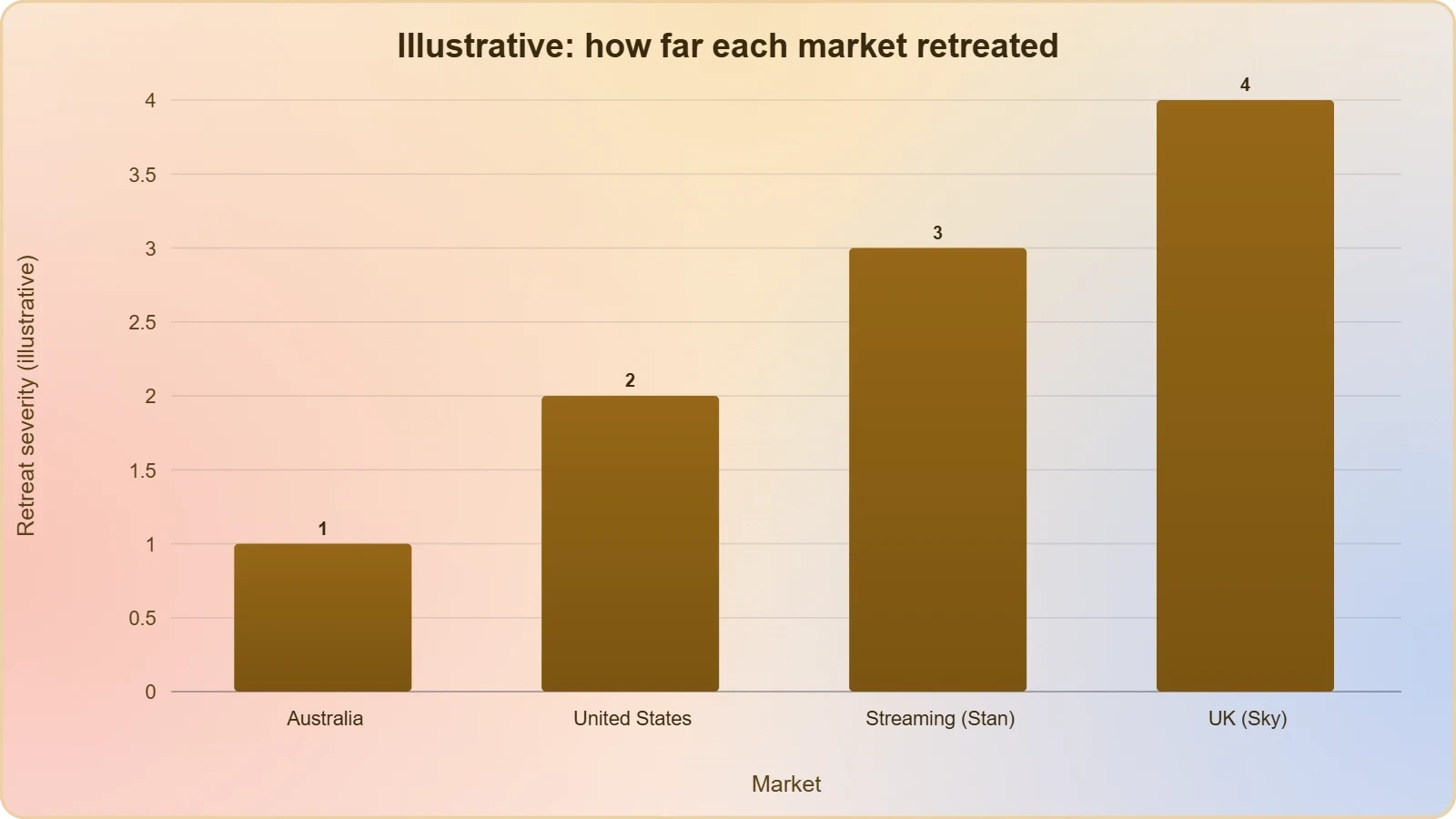
The commercial logic is therefore segmented rather than uniform. Australia keeps the film because the local narrative is salvageable and the sunk public investment is substantial. The United States keeps a version of the release while severing the individual. The United Kingdom, where the allegations originated and where Walliams's public profile is highest, exits altogether. This is not inconsistency for its own sake; it reflects genuinely different exposures to the same reputational event, priced market by market according to audience sensitivity and contractual flexibility.
The Source Material and the Children's Market Problem
Fing! is adapted from Walliams's 2019 book of the same name, a detail that complicates the remediation strategy considerably. A cameo can be cut and a publicity campaign can be redirected, but the underlying intellectual property remains his creation. The film's very title, premise and screenplay credit trace back to the author, and no amount of marketing repositioning can fully sever that connection. This is the structural difficulty that distinguishes author-driven children's properties from star-driven vehicles: the creator is embedded in the asset itself, not merely attached to it.
When the Author Is the Asset
Walliams built a substantial second career as a children's author, and his books have been adapted repeatedly for screen. That success makes him commercially valuable but also concentrates risk: a single reputational event can simultaneously affect a back catalogue, multiple adaptations in development, and any future licensing. Publishers and producers who have invested in author-led franchises face a problem with no clean solution, because the author's name is often inseparable from the brand identity that made the property attractive in the first place. Removing a cameo is easy; removing an authorship is not.
The screenplay credit presents a further wrinkle. Walliams co-wrote the script with Kevin Cecil, and writing credits are governed by guild and contractual rules that cannot simply be erased at a distributor's discretion. Even if his name were removed from promotional materials, the underlying credit would likely persist in some form. This creates an awkward asymmetry between what audiences see in marketing and what appears on screen, and it is precisely the kind of inconsistency that generates follow-up reporting and prolongs a story's commercial life.
Parental Trust as the Binding Constraint
Children's entertainment operates under a stricter reputational regime than adult-oriented content, and the reason is straightforward: the purchasing decision is made by parents on behalf of minors. A parent choosing a family film is not merely selecting entertainment but making an implicit judgment about values, and any association with serious allegations can trigger a categorical rejection that no marketing can overcome. This is why Stan's decision to remove the title from its content list carries more weight than a scheduling tweak; it reflects an assessment that the platform's family audience would not tolerate the association.
The genre also lacks the countervailing dynamic that sometimes protects adult properties, where controversy can generate curiosity-driven engagement. For a children's film, controversy is almost purely negative, because the audience most likely to be intrigued is the one least likely to be permitted to watch. Producers therefore face a market in which the reputational discount cannot be offset by heightened attention, which explains the speed and severity of the retreat documented here.
- 01
- 02
- 03
- 04
We Also Published
Precedent: How the Industry Handles Creator Controversy
The Fing! episode is not without precedent, and the pattern it follows has become familiar enough to constitute a de facto playbook. When serious allegations attach to a creative figure, the industry's first instinct is segmentation: isolate the individual, preserve the asset, and let each commercial partner calibrate its own distance. The sequence typically begins with promotional withdrawal, escalates to content removal, and culminates in contractual exit where exposure is highest. What varies is the speed of the cascade, which tends to correlate with the severity of the allegations and the sensitivity of the target audience.
The Segmentation Playbook
Segmentation works because modern film properties are bundles of separable rights and contributions. A cameo is separable. A publicity appearance is separable. A streaming window is separable. A territorial licence is separable. Each separation allows a partner to reduce association without destroying the whole. The limit of the approach is reached when the controversy attaches to something inseparable, such as authorship of the source material or a lead performance. Fing! sits awkwardly at that boundary: the cameo was separable, but the authorship was not, leaving the property in a partially remediated state that satisfies no one entirely.
There is also a timing dimension that practitioners increasingly recognise. The first mover in a cascade often sets the tone, and subsequent partners face pressure to match or exceed the initial response. In this case, the producers' decision to cut the cameo and exclude Walliams from publicity established a baseline that made Stan's catalogue removal and Sky's licence exit easier to justify internally. Early decisiveness, paradoxically, can accelerate the severity of the overall retreat by providing cover for more drastic action downstream.
What Comes Next for the Film
The Australian release on January 14 will serve as the first real test of whether segmentation can hold commercially. If the film performs respectably in its home market, it will demonstrate that a domestically rooted production narrative can survive the excision of a controversial contributor. If it underperforms, the result will reinforce the industry's inclination toward maximal distancing in future cases. Either outcome will be studied closely by producers weighing similar decisions, and the precedent will likely harden into something closer to a rule than a judgment call.
For Walliams, the consequences extend well beyond a single film. A lost anonymity bid, a public denial, and a cascade of partner withdrawals collectively constitute a reputational event from which recovery is slow and rarely complete. Whether any of the allegations are ultimately substantiated in a legal forum remains an open question, and that uncertainty should temper any final judgment. What is not uncertain is that the commercial machinery around him has already made its assessment, and it moved with a speed that says as much about the industry's risk appetite as about the allegations themselves.
Reading the Story Without Overreading It
Coverage of this kind invites two opposite errors. The first is to treat unproven allegations as established fact, which does a disservice to the presumption of innocence and to the legal process that has yet to run its course. The second is to treat commercial withdrawal as meaningless noise, which ignores the genuine institutional judgments being made by partners with real financial exposure. The responsible middle position is to report the allegations accurately, note the denial, record the procedural facts, and describe the commercial response without treating it as a verdict. That is what the public record supports, and nothing more.
What the Record Actually Establishes
The record establishes that a joint investigation published serious allegations; that Walliams denies them through his lawyers; that he lost a High Court anonymity bid and did not appeal; that his cameo was removed; that he was excluded from Australian publicity; that Stan removed the title from its content list; that Angel Studios confirmed no involvement in release or promotion; and that Sky removed the film from its schedule and intends to exit as UK and Ireland licensee. It also establishes the production's economic footprint in Queensland. These are verifiable facts, and they are sufficient to support a substantive analysis without speculation.
What the record does not establish is guilt, and readers should be alert to coverage that slides from reporting to adjudication. The distinction is not a technicality; it is the difference between describing a reputational event and pronouncing on a contested factual dispute. The film industry's response is itself a legitimate subject of scrutiny precisely because it operates outside the courtroom, applying commercial judgments that carry real consequences for the individuals involved, the crews who worked on the production, and the audiences the film was made for.
The Wider Signal for Co-Productions
For the co-production sector, the episode carries a practical lesson about concentration risk. A UK-Australia production with public support, a recognisable cast and a well-known source author is, by design, a diversified proposition. Yet a single contributor's reputational collapse was sufficient to trigger withdrawals across three markets. Producers assembling future slates may reasonably conclude that author-driven properties require more careful structuring, including clearer morality clauses, contingency plans for credit removal, and pre-agreed protocols for how a campaign can be re-centred at short notice.
Public funders face a parallel lesson. Incentive schemes that evaluate projects only at approval leave agencies without formal tools when a subsidised production becomes controversial after the fact. Expect greater attention to ongoing compliance provisions, reputational due diligence on key creatives, and contractual language that allows a funder to respond without appearing to prejudge contested allegations. None of this will prevent future crises, but it may make the response more orderly and less dependent on the improvisation that characterised the days following this particular investigation.
From our network :
- Forbidden Matrix Patterns and Visible Lattice Points: A Geometric DictionaryExplore how multidimensional 0–1 matrices encode geometric truths, linking forbidden patterns to visible lattice points and hypergraph theory, with applications in combinatorics and computational geometry.
- University Language Proficiency Exams: Why Institutional Tests Demand Different Preparation Than IELTS and TOEFLDiscover why university-specific language proficiency examinations differ fundamentally from IELTS and TOEFL, and learn strategic preparation approaches for institutional assessment success.
- Committed Mediterranean Precipitation Decline: Why Emissions Cuts Alone Cannot Restore Winter RainsNew NOAA research reveals that Mediterranean winter rains may decline irreversibly even with emissions cuts. Explore the science of committed climate change and regional impacts.
- Mobile Learning and VR in English: What Global Evidence Reveals About Effective Language TechnologyA systematic review across 14 countries reveals which language-learning technologies genuinely work. Mobile learning, AI, and VR show measurable benefits when pedagogically integrated. This evidence-based guide helps educators and learners select technology that delivers real return on investment.
- The Final Descent: How ESA Retired the Legendary Cluster Constellation After 24 Years of Space Weather ScienceAfter 24 years mapping Earth’s magnetosphere, ESA’s Cluster mission concluded with a precisely controlled reentry over the South Pacific. This analysis explores the scientific legacy, engineering decisions, and debris mitigation principles behind one of space exploration’s most responsible retirements.
- CISA’s Ten-Advisory Wave: Why Generic Patching Fails in OT and How to Build Product-Specific PlaybooksCISA released ten ICS advisories in one week, exposing critical infrastructure risks. Generic patching fails in OT. Learn to build product-specific remediation playbooks.
- Live Online English Classes for Kids: Do They Actually Reduce Anxiety?A ten-week study reveals that synchronous online English classes can significantly reduce child language anxiety while improving listening and reading skills. Discover what makes these programs effective and how parents can select the right one.
- How AI Agents Will Change the Way We Manage Personal FinancesExplore how AI agents are transforming personal finance through automated budgeting, bill payment, and investment management, while examining the critical security protocols and governance frameworks required for safe deployment.
- The Hidden Cost of AI Convenience: Why Over-Permissioned Agents Are a Security Time BombDiscover why AI agents with excessive permissions create dangerous single points of failure, and learn how implementing least privilege principles can protect your organization from exploitation.
RESOURCES
- David Walliams Cameo Dropped From Angel Studios' 'Fing ... - Varietyvariety.com22 hours ago ... ... allegations against author David Walliams. ... removed from the film, and its promotion and marketing entirely.
- Stan Drops David Walliams' 'Fing!' Following Allegationsau.variety.com12 hours ago ... ... film and TV in Australia and abroad. The film's producers have since confirmed that Walliams' cameo has been removed,…
- David Walliams Cut From Movie 'Fing!' After Allegations, Sky Exitsdeadline.com17 hours ago ... We have already removed content which features him from our platforms.” Watch on Deadline. AGC is handling sales on the…
- David Walliams cameo cut from Australian film after sexual ...theguardian.com2 hours ago ... Children's author and comedian, who wrote the book on which the movie Fing! is based, will also be removed from…
- David Walliams suffers another career blow after sexual misconduct ...pagesix.com4 hours ago ... We have removed his cameo appearance from 'Fing!,' and he will have no involvement in the film's release or promotion,”…
- David Walliams movie shot in Australia by local director drops ...abc.net.au13 hours ago ... ... allegations against David Walliams, Stan has removed Fing! from its content slate," a Stan spokesperson said. The film's US…
- David Walliams dropped from his own film after sexual misconduct ...the-independent.com8 hours ago ... David Walliams is being removed from new movie Fing! after sexual misconduct allegations were made against him. The 55-year-old comedian…
- Stan pulls David Walliams' Fing! after allegations - Mediaweekmediaweek.com.au10 hours ago ... The film's producers have also confirmed they have removed Walliams' cameo, with the actor to be cut from its US…
- David Walliams to be removed from Fing! after allegationsfemalefirst.co.uk9 hours ago ... Producers behind new family film Fing! have confirmed David Walliams' cameo appearance has been removed, and he won't be involving…
- David Walliams Cameo Dropped From Angel Studios' 'Fing ... - IMDbimdb.comHowever, according to the producers, the disgraced British comedian, actor and author is being removed from the film, and its promotion and marketing entirely.
- David Walliams cameo removed from Fing film after allegationsfacebook.com9 hours ago ... The producers of Fing! say they have removed David Walliams' cameo from the family fantasy film following sexual misconduct allegations ...
- 'Fing!' in limbo as Stan, Sky drop film following David Walliams ...if.com.au13 hours ago ... Stan has removed Jeffrey Walker's family feature Fing! from its upcoming slate following the publication of allegations against David ...
- Sky scraps UK release of David Walliams film Fing! - Female Firstfemalefirst.co.uk20 hours ago ... Sky have scrapped plans to release Fing! in the UK following the allegations against David Walliams.
- David Walliams removed from new children's film following allegationsindependent.co.uk8 hours ago ... Producers of the upcoming film Fing! have removed David Walliams' cameo appearance and confirmed he will have no involvement in…
- Sky drops David Walliams movie Fing! : News 2026 - Chortlechortle.co.uk7 hours ago ... A spokesman for Sky told The Sun: 'The allegations made against David Walliams are extremely serious. ... He is also…
- 01
- 02
- 03
- 04
- 05
- 06
- 07
- 08
0 Comments