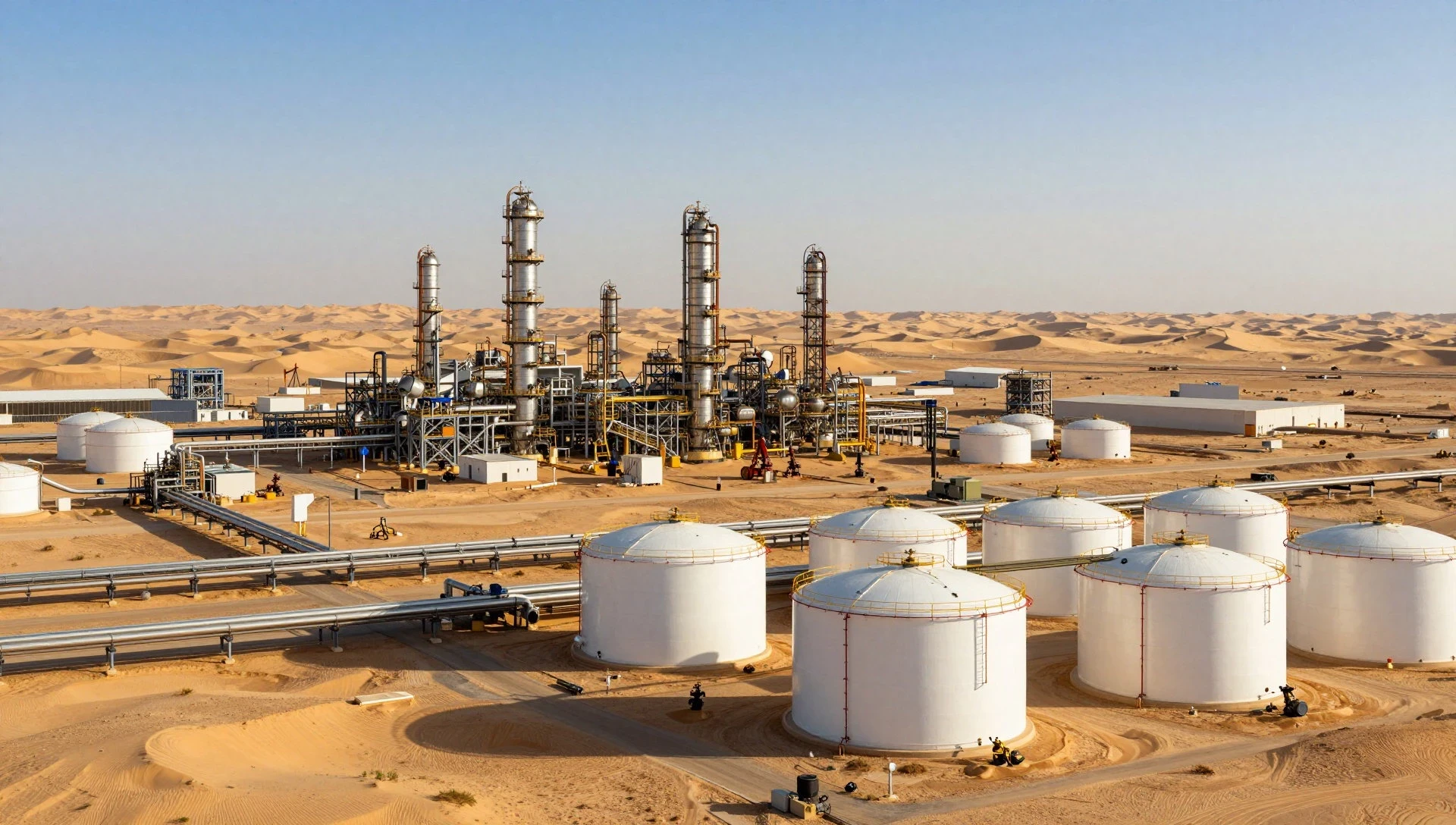
The International Energy Agency's monthly Oil Market Report, published on 13 November 2026, carried a conclusion that quietly rearranged the strategic furniture of the Middle East: the global oil market was projected to return to surplus in the fourth quarter of 2026 as Gulf exports recovered and worldwide production normalised.
For two years, regional conflict had embedded a "war premium" into crude prices — a risk charge that markets paid for the mere possibility of disruption to tankers, terminals and pipelines. That premium is now dissolving, not because the tensions have ended, but because the physical balance of supply and demand has shifted beneath them.
What makes the IEA's projection consequential is the distinction between price and leverage. A petrostate's diplomatic weight has never rested solely on the revenue it earns; it rests on the implicit threat that its output could be withheld, and on the willingness of importers to pay a premium for the assurance that it will not be.
On This Page
When the market is tight, that assurance is scarce and expensive, and the producer holding the marginal barrel commands attention in every capital. When the market is in surplus, the same producer is one of several suppliers competing for the same buyers, and the premium evaporates faster than the tension that created it.
This analysis examines how the November 2026 Oil Market Report reframes the fiscal and diplomatic position of Gulf producers. It traces the mechanics of the war premium, the arithmetic of breakeven budgets, the shifting geometry of buyer-seller relationships across Asia, and the way surplus conditions redistribute influence from those who hold oil to those who hold demand. The picture that emerges is not one of collapse but of recalibration — a slower, quieter erosion of a leverage that once seemed structural.
TL;DR The IEA's 13 November 2026 Oil Market Report projected a return to global surplus in Q4 2026 as Gulf exports recovered and production normalised, eroding the conflict-driven war premium and weakening the pricing leverage Gulf petrostates traditionally wielded during regional crises.
The Anatomy of a War Premium
A war premium is the portion of a crude price that exists because of perceived risk rather than physical shortage. It is measured indirectly — through the spread between spot and futures prices, through the cost of insuring a tanker transit, through the widening of benchmarks when a chokepoint is threatened. Traders pay it not for oil they need today but for the option of oil they might not receive tomorrow. It is, in essence, a premium on uncertainty, and it decays the moment the market believes supply can be replaced.
The premium's political function is subtler than its financial one. When importers are paying a risk charge, the producer whose stability underpins supply acquires an outsized voice in the rooms where energy security is discussed. That voice is not purchased with rhetoric; it is purchased with the credible ability to keep barrels flowing. The war premium, in this reading, is a form of diplomatic rent — a payment for reliability that accrues precisely when reliability is scarce.
Why the Premium Inflates During Conflict
Regional tension inflates the premium through three channels. The first is physical: the credible risk of damage to export terminals, refineries or shipping lanes removes barrels from the forward curve. The second is logistical: insurance and freight costs rise, and those costs are passed through to the buyer.
The third is psychological, and often the largest — the market prices the possibility of escalation before it prices the escalation itself, so the premium frequently peaks before any supply is actually lost.
This third channel explains why war premiums are so volatile. They are forward-looking and reflexive, rising on headlines and falling on reassurance. A producer that benefits from the premium therefore benefits from ambiguity as much as from conflict, because ambiguity sustains the risk charge without requiring the disruption that would destroy demand. The premium is most valuable to a petrostate when it is threatened but not realised.
The Surplus Signal and Its Meaning
The IEA's November 2026 projection punctured that ambiguity. A return to surplus in Q4 2026 implies that aggregate supply exceeds aggregate demand, which means the market holds a buffer. A buffer is the physical antidote to a risk premium: if a disruption occurs, the surplus absorbs it, and the price barely moves. Once traders believe a buffer exists, they stop paying for the option, and the premium collapses regardless of whether the underlying tension has eased.
The signal was reinforced by the report's own framing — Gulf exports recovering and global production normalising. Both phrases point in the same direction: the barrels that conflict had placed at risk were returning to the market, and the producers outside the region were not restraining output. The surplus was therefore not a forecast of abundance but a statement about the balance of bargaining power, and it favoured the buyer.
Fiscal Arithmetic Under a Surplus
Petrostate budgets are built on a breakeven price — the crude price at which government spending is covered by oil revenue. When prices carry a war premium, breakeven is comfortably exceeded and the fiscal position looks robust. When the premium disappears, the same budget must be funded from a lower price, and the gap is closed through borrowing, reserve drawdown or expenditure restraint. The IEA's surplus projection therefore lands directly on the fiscal ledger of every Gulf finance ministry.
The timing compounds the difficulty. A surplus emerges precisely when producers are exporting more, which means revenue per barrel falls even as volume rises. The two effects do not cancel neatly: volume gains accrue to the producer that can move barrels, while price losses apply to every barrel sold.
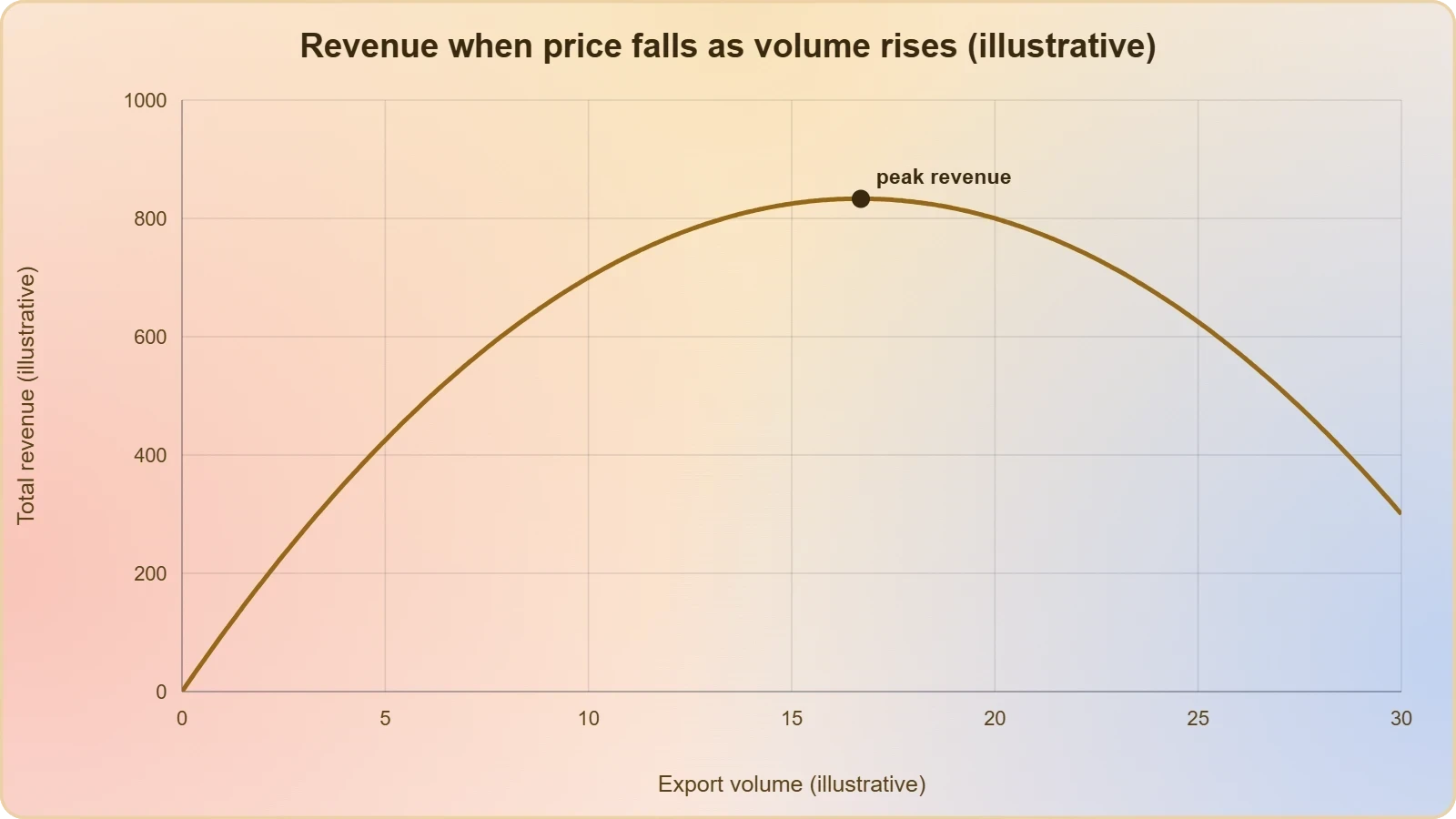
For producers with limited spare capacity, the arithmetic is unforgiving, and the fiscal buffer that sustained them through the conflict years becomes the resource that must now be spent.
Breakeven Prices and Budgetary Stress
The concept of a fiscal breakeven is straightforward: it is the price at which a government's oil revenue equals its planned expenditure. What matters analytically is the distance between breakeven and the prevailing market price. During a war premium, that distance is wide and positive, creating room for sovereign spending, subsidy and external investment. Under surplus conditions, the distance narrows or inverts, and the sovereign must choose between austerity and debt.
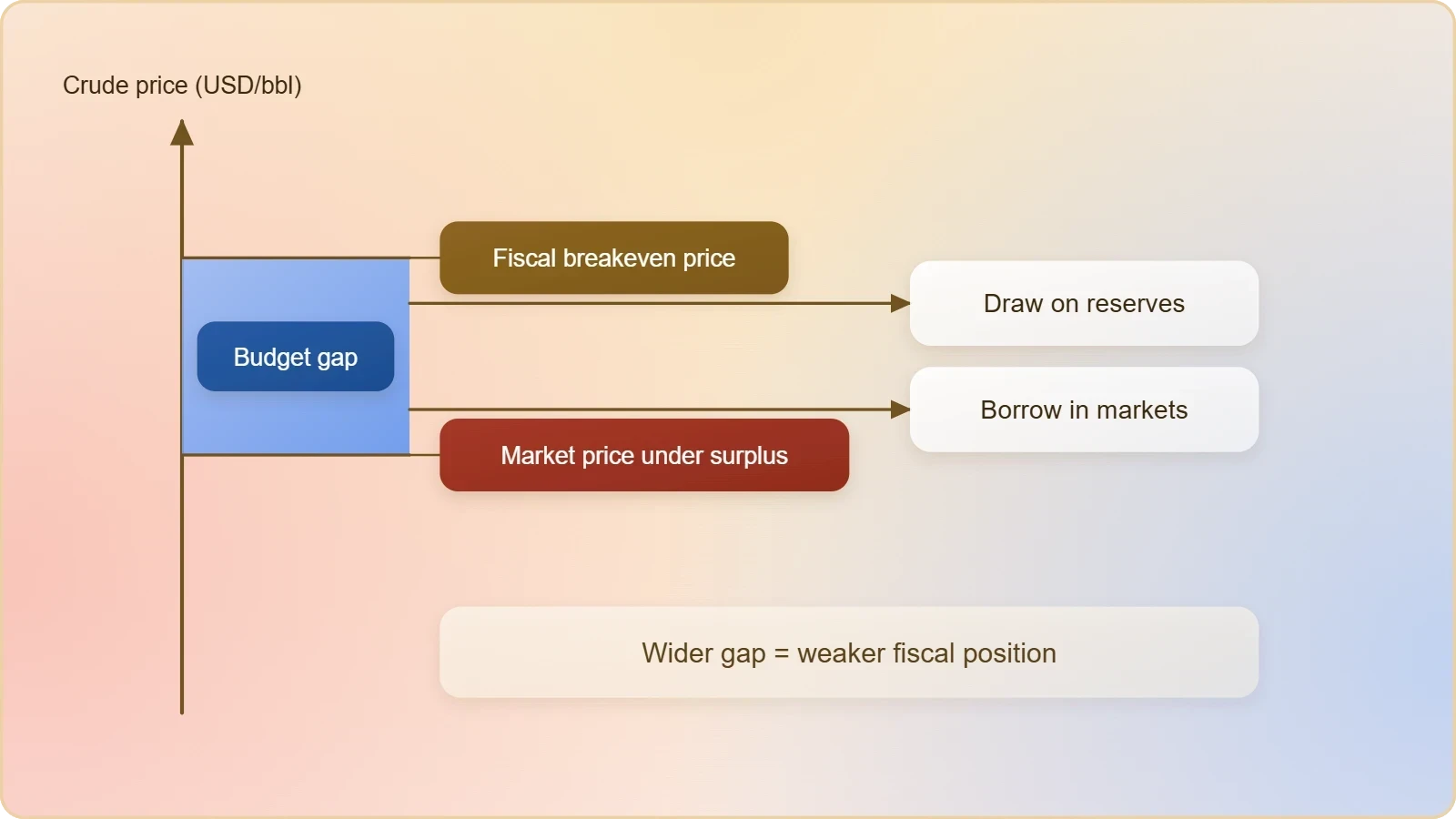
This is where the leverage question becomes concrete. A petrostate that must borrow to fund its budget is a petrostate that must maintain the confidence of lenders and the goodwill of buyers. Both constituencies become more attentive to fiscal discipline and less attentive to geopolitical posturing. The surplus does not bankrupt the Gulf; it reorders its priorities, shifting the centre of gravity from projection of power to management of the balance sheet.
Reserve Buffers and Sovereign Credibility
Sovereign reserve funds have long functioned as the shock absorber of petrostate finance, converting volatile oil revenue into stable, investable assets. Under a sustained surplus, those funds are drawn upon rather than added to, and the drawdown itself becomes a signal. Markets read a declining reserve position as a marker of fiscal stress, and the cost of external borrowing rises accordingly. Credibility, once spent, is expensive to rebuild.
The strategic implication is that reserve buffers buy time but not leverage. A producer can sustain a lower price for longer if its reserves are deep, but it cannot convert that endurance into pricing power while the market holds a surplus. Endurance is defensive; leverage is offensive. The surplus era rewards the former and denies the latter, which is precisely why the IEA's projection matters more than a single quarter's price move.
The Shifting Geometry of Buyer-Seller Power
Oil markets are frequently described as producer-dominated, but the description holds only when supply is tight. In a surplus, the marginal buyer becomes the scarce party, and the terms of trade migrate toward the importer. Asian refiners, long accustomed to securing term contracts on producer-friendly terms, find themselves courted rather than constrained. The direction of diplomatic travel reverses: instead of importers travelling to the Gulf to assure supply, Gulf exporters travel to Asia to assure demand.
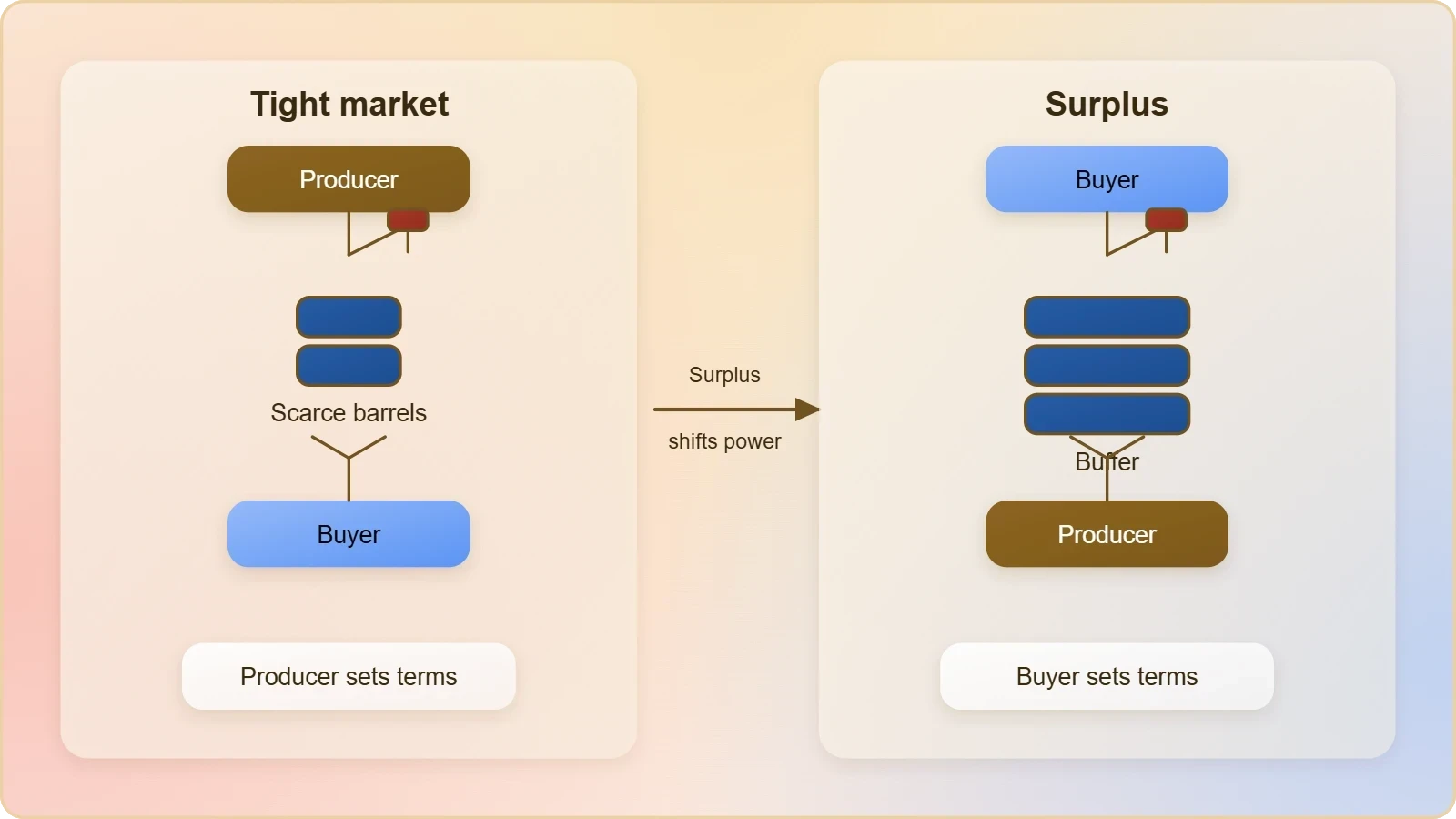
This reversal is not merely symbolic. It changes the content of the agreements that bind the two sides. In a tight market, contracts emphasise volume security and price formulas favourable to the seller. In a surplus, contracts emphasise market share, credit terms and downstream investment. The producer that once sold certainty now sells flexibility, and the buyer that once paid a premium now negotiates a discount. The war premium, in effect, was the price of the seller's advantage.
Asian Demand and the New Terms of Trade
Asia's refining complex is the principal destination for Gulf crude, and its bargaining position strengthens materially when supply exceeds demand. Refiners can diversify across suppliers, demand longer credit periods, and insist on pricing linked to benchmarks rather than to producer discretion. Each of these concessions transfers value from the exporter to the importer, and each is easier to extract when alternative barrels are available. The surplus is, in this sense, a slow redistribution of margin.
The redistribution has a diplomatic corollary. Gulf producers seeking to defend market share must invest in relationships rather than merely in logistics — refining joint ventures, storage arrangements, and long-dated supply agreements that lock in demand. These instruments bind the producer to the buyer's growth trajectory, which is a fundamentally different posture from the one available during a conflict-driven premium, when the buyer needed the producer more than the reverse.
Chokepoints, Insurance and Risk Pricing
The physical geography of the Gulf remains a source of latent risk, and chokepoints do not disappear when the market moves into surplus. What changes is how the market prices them. During tension, insurance premiums for transit through narrow waterways rise sharply and are passed through to the buyer.
Under surplus conditions, the same risk is absorbed by the buffer, and the insurance cost becomes a marginal rather than a dominant factor in the delivered price.
This is the mechanism by which surplus erodes the war premium most directly. The risk has not vanished; its price has. A producer that once benefited from the market's fear of disruption now finds that fear discounted, because the surplus provides an alternative route to supply. The chokepoint remains a vulnerability, but it is no longer a bargaining chip, and the distinction is the whole substance of the shift.
We Also Published
Reading the IEA Report as a Political Document
The Oil Market Report is published as a statistical assessment, but its political content is substantial. By projecting a surplus, the IEA signals to markets that the physical balance has shifted, and that signal itself changes behaviour. Traders reduce the risk premium, importers harden their negotiating positions, and producers reassess their fiscal plans.
The report does not merely describe the market; it participates in shaping expectations about it, which is why its monthly release is watched as closely in foreign ministries as in trading floors.
The November 2026 edition carried particular weight because it coincided with a recovery in Gulf exports. A surplus projection issued while regional tension persists is a stronger statement than one issued in calm conditions, because it asserts that supply has normalised despite the tension. That assertion, once accepted, removes the foundation of the war premium and with it a significant component of the producer's diplomatic leverage.
Forecast Credibility and Market Reflexivity
Forecasts influence the systems they describe. When a credible institution projects a surplus, producers may accelerate exports to capture revenue before prices soften, which deepens the surplus. Importers may delay purchases in anticipation of lower prices, which weakens spot demand. Both responses reinforce the original projection, a reflexivity that makes energy forecasts unusually self-fulfilling in the short run.
This reflexivity is why the IEA's framing matters as much as its numbers. The report's language — exports recovering, production normalising — describes a market returning to a pre-conflict equilibrium. If market participants accept that description, they price accordingly, and the premium disappears even before the surplus is fully realised in physical inventories. The forecast becomes the mechanism of its own confirmation.
What the Report Does Not Say
It is equally important to note what the projection does not assert. A surplus forecast is not a statement that tensions will ease, that chokepoints will remain open, or that producers will refrain from output restraint. It describes a balance of supply and demand under stated assumptions, and those assumptions can be overturned by disruption, policy change or demand shock. The surplus is a baseline, not a guarantee.
For analysts, this distinction guards against over-reading. The erosion of the war premium is a statement about current market structure, not a permanent condition. Should supply be disrupted or demand surprise to the upside, the premium could return quickly, and with it the leverage that surplus conditions have diluted. The IEA's projection describes a quarter, not an era, and the difference is material to any strategic assessment.
Corporate and Sovereign Responses to the New Balance
National oil companies and sovereign wealth funds are the instruments through which petrostates translate market conditions into strategy. Under a surplus, both face a common challenge: how to defend revenue and influence when the price mechanism no longer works in their favour.
The responses tend to cluster around three levers — output policy, downstream integration and external investment — each of which substitutes for the pricing power that the war premium once provided.
Output policy is the most visible lever and the least effective in a surplus. Coordinated restraint can support prices only if compliance is broad, and surplus conditions strain compliance because each producer has an incentive to defect and capture market share. Downstream integration and external investment are slower but more durable, converting a commodity relationship into an industrial one. The shift from selling barrels to owning assets is, in effect, a hedge against the disappearance of the premium.
National Oil Companies and Output Discipline
Output discipline is a collective action problem, and surpluses expose it. When prices are supported by a risk premium, restraint is cheap because the premium does the work. When the premium disappears, restraint must be enforced, and enforcement requires monitoring, credibility and the willingness to punish defection.
Each of these is harder to sustain when every participant can see the buffer in the market and knows that a single producer's restraint will not move the price.
The result is a familiar pattern: announced restraint, partial compliance, and a gradual drift toward market-share competition. For Gulf producers with low extraction costs, market-share competition is survivable but unattractive, because it converts a rent into a margin. The war premium had allowed them to earn the former; the surplus forces them to accept the latter, and the transition is felt most acutely in fiscal planning.
Sovereign Funds as Strategic Instruments
Sovereign wealth funds serve a dual purpose in this environment. Financially, they stabilise government revenue across price cycles. Strategically, they project influence through cross-border investment, acquiring stakes in the economies of the buyers who purchase their crude. Under a surplus, the strategic function becomes more important, because investment relationships substitute for the pricing leverage that the market no longer confers.
This substitution is not costless. External investment requires capital that a lower oil price makes scarcer, and it exposes the sovereign to the political risk of the jurisdictions in which it invests. Yet the alternative — relying on price alone to secure influence — is unavailable in a surplus.
The fund becomes the instrument of last resort, and its allocation decisions become a readable index of how a petrostate understands its own declining leverage.
- 01
- 02
- 03
- 04
Implications for Energy Security and Global Order
The disappearance of the war premium carries consequences beyond the Gulf. Energy security, for importers, is the assurance of affordable and uninterrupted supply, and a surplus delivers both without requiring political concessions. That changes the terms of the global energy conversation: importers no longer need to trade diplomatic alignment for supply assurance, and producers can no longer demand it. The surplus, in this sense, is a quiet redistribution of diplomatic capital.
For the broader international order, the shift reinforces a pattern in which commodity power is cyclical rather than structural. Producers who built influence on scarcity find that influence contingent on market conditions they do not fully control. Importers who built resilience through diversification and storage find that resilience pays off precisely when the cycle turns.
The lesson is not that petrostates are weak, but that their leverage is a function of the balance sheet of the world market, not of their own intent.
Importers, Strategic Reserves and Bargaining
Strategic reserves are the importer's counterpart to the producer's spare capacity. During tight markets, reserves are drawn to cushion price spikes; during surpluses, they are replenished at favourable prices. The ability to replenish cheaply is itself a form of leverage, because it allows importers to wait out producer attempts at restraint. A well-stocked reserve is a statement that the buyer can afford to be patient, and patience is a powerful negotiating posture.
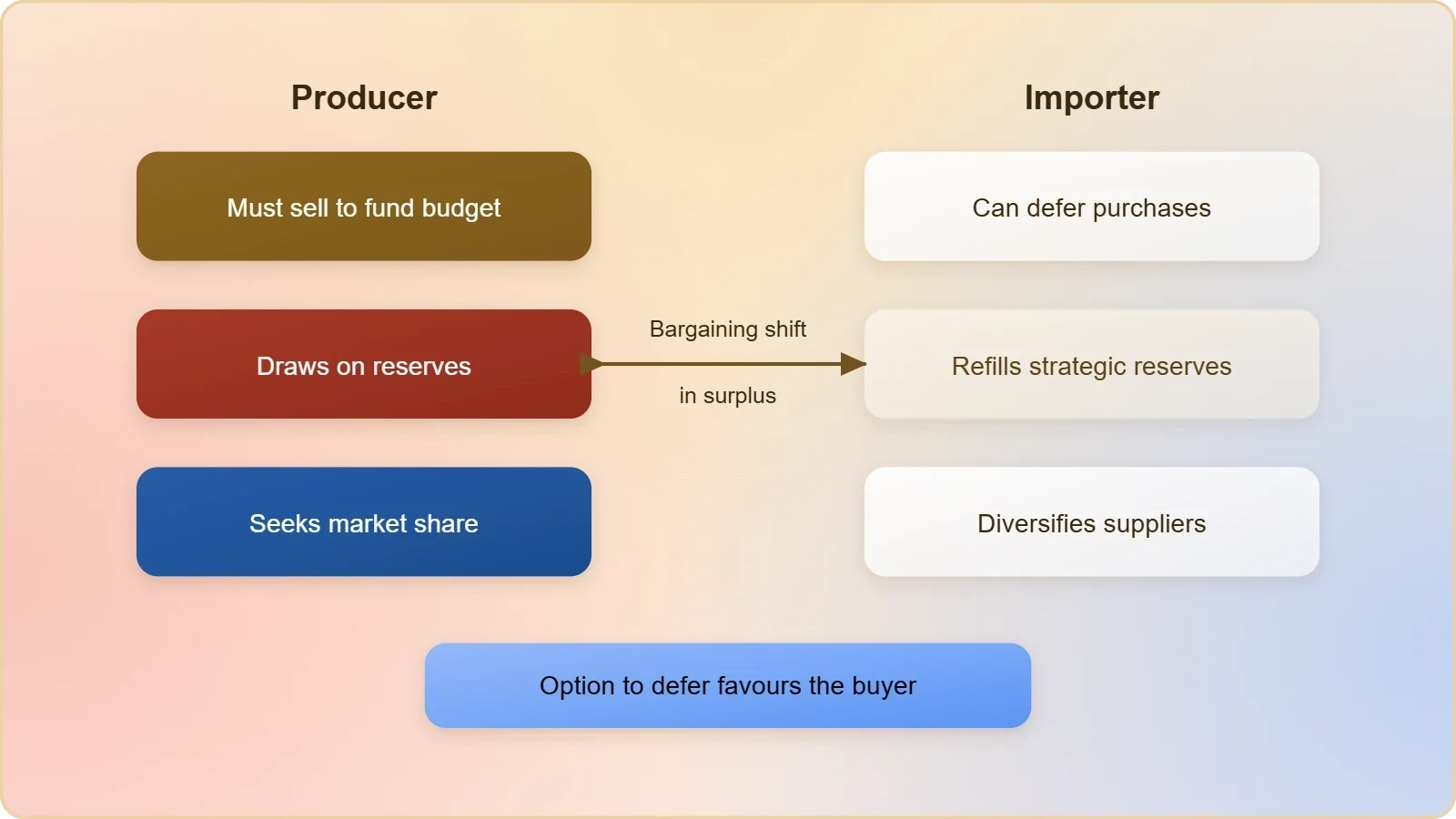
The combination of diversified supply and adequate reserves gives importers an option that producers lack: the option to defer. Producers must sell to fund budgets; importers can postpone purchases to secure better terms. In a surplus, that asymmetry dominates the negotiation, and it explains why the terms of trade migrate so decisively toward the buyer once the premium disappears.
Alliances, Basing and the Price of Protection
Security guarantees and military basing arrangements have long been intertwined with energy relationships. When a producer's oil is scarce, the protection of its export infrastructure is a shared interest, and the diplomatic price of that protection is correspondingly high. When oil is abundant, the same infrastructure is less strategically vital, and the calculus of protection shifts. The surplus does not sever security ties, but it changes their price.
This is the deepest implication of the IEA's projection. The war premium was never only a price signal; it was a measure of how much the world was willing to pay for the stability of a region that supplied it. As the premium fades, so does the willingness to pay, and the petrostates that once converted that willingness into influence must now find other currencies. The surplus is, in the end, a repricing of strategic relevance itself.
How to Read the Surplus Signal
For readers tracking energy geopolitics, the IEA's monthly report is best read as a balance sheet rather than a headline. The key figures are the projected supply-demand gap, the direction of Gulf exports, and the assumption set behind the production normalisation. A surplus is meaningful only relative to those assumptions, and the assumptions are where the analytical work begins.
The premium, after all, is a function of belief about the future, and the report is a structured statement of what the future is believed to hold.
The second discipline is to separate the price effect from the leverage effect. Prices can recover on a single disruption while leverage continues to erode, because leverage depends on the structural balance rather than on any single session. A producer whose fiscal breakeven exceeds the prevailing price has lost leverage even if the price rises on a given day. Reading the signal correctly means watching the balance, not the ticker.
Indicators Worth Tracking
Several observable measures translate the surplus thesis into a trackable set. Each is a reading of market structure rather than a recommendation, and each becomes more informative when read alongside the others rather than in isolation.
- Supply-demand gap — the projected difference between global production and consumption; a positive gap indicates a buffer.
- Gulf export volumes — the pace at which regional barrels return to the market; recovery narrows the risk premium.
- Fiscal breakeven prices — the crude price at which a producer's budget balances; the gap to market price measures fiscal room.
- Freight and insurance costs — the logistical channel of the premium; falling costs signal reduced perceived risk.
- Sovereign reserve balances — drawdowns indicate fiscal stress and rising borrowing costs.
- Term contract terms — credit periods and pricing formulas reveal which side holds the bargaining advantage.
Common Misreadings to Avoid
The most common misreading is to treat a surplus forecast as a permanent condition. Surpluses and deficits alternate, and a single quarter's projection describes a moment rather than an era. The second misreading is to equate lower prices with lower influence; a producer with deep reserves and low extraction costs can retain substantial influence even at softer prices, because endurance itself is a form of power. The third is to assume that the premium's disappearance means the risk has disappeared.
A final caution concerns attribution. The IEA's projection describes a balance under stated assumptions; it does not assign causes to price moves, and neither should its readers. The analytical value lies in the structure it reveals — who holds the buffer, who needs the sale, and who can afford to wait. Those questions, rather than any single price forecast, are what determine how the disappearance of the war premium reshapes the leverage of the Gulf.
Disclaimer: This article is an analytical commentary on the International Energy Agency's Oil Market Report published 13 November 2026 and on the geopolitical implications of a projected return to global oil surplus in Q4 2026. It is provided for information and education only and does not constitute investment, trading, legal or policy advice. No buy, sell or hold recommendation is made on any security, commodity, currency or fund.
Figures and projections are as reported in the source material and are subject to revision by the issuing institution. Readers should consult qualified professionals and the original IEA publication before acting on any information contained here.
Disclaimer: This article is for general information and education only. It describes what historical prices and technical indicators showed on the date mentioned and does not predict future movements. It is not investment advice, a recommendation, or an offer to buy or sell any security. Indicators are calculated from past data and can mislead, and all investments carry risk. Please consult a SEBI-registered investment adviser before making any financial decision.
From our network :
- Mobile Learning and VR in English: What Global Evidence Reveals About Effective Language TechnologyA systematic review across 14 countries reveals which language-learning technologies genuinely work. Mobile learning, AI, and VR show measurable benefits when pedagogically integrated. This evidence-based guide helps educators and learners select technology that delivers real return on investment.
- Live Online English Classes for Kids: Do They Actually Reduce Anxiety?A ten-week study reveals that synchronous online English classes can significantly reduce child language anxiety while improving listening and reading skills. Discover what makes these programs effective and how parents can select the right one.
- The Final Descent: How ESA Retired the Legendary Cluster Constellation After 24 Years of Space Weather ScienceAfter 24 years mapping Earth’s magnetosphere, ESA’s Cluster mission concluded with a precisely controlled reentry over the South Pacific. This analysis explores the scientific legacy, engineering decisions, and debris mitigation principles behind one of space exploration’s most responsible retirements.
- The Hidden Cost of AI Convenience: Why Over-Permissioned Agents Are a Security Time BombDiscover why AI agents with excessive permissions create dangerous single points of failure, and learn how implementing least privilege principles can protect your organization from exploitation.
- CISA’s Ten-Advisory Wave: Why Generic Patching Fails in OT and How to Build Product-Specific PlaybooksCISA released ten ICS advisories in one week, exposing critical infrastructure risks. Generic patching fails in OT. Learn to build product-specific remediation playbooks.
- How AI Agents Will Change the Way We Manage Personal FinancesExplore how AI agents are transforming personal finance through automated budgeting, bill payment, and investment management, while examining the critical security protocols and governance frameworks required for safe deployment.
- University Language Proficiency Exams: Why Institutional Tests Demand Different Preparation Than IELTS and TOEFLDiscover why university-specific language proficiency examinations differ fundamentally from IELTS and TOEFL, and learn strategic preparation approaches for institutional assessment success.
- Committed Mediterranean Precipitation Decline: Why Emissions Cuts Alone Cannot Restore Winter RainsNew NOAA research reveals that Mediterranean winter rains may decline irreversibly even with emissions cuts. Explore the science of committed climate change and regional impacts.
- Forbidden Matrix Patterns and Visible Lattice Points: A Geometric DictionaryExplore how multidimensional 0–1 matrices encode geometric truths, linking forbidden patterns to visible lattice points and hypergraph theory, with applications in combinatorics and computational geometry.
RESOURCES
- geopolitical characteristics and connotations in the Arab Gulf Statessciencedirect.comAn IEA report in 2021 supports this view, projecting that even with a net-zero target by 2050, the world will still consume 50 %…
- The petrochemical pivot: geostrategic globalization and the future of ...tandfonline.comWriting in the Financial Times, Lee Harris (2024) observed that 'petrochemicals hold the hope of the oil industry'. Over the past decade, ...
- Energy Insights 2026 - Baker Institutebakerinstitute.orgOct 14, 2026 ... ... oil market in 2026. The conflict has also evolved beyond the ... https://www.iea.org/reports/critical-minerals-market-review-2024 19 ...
- My TRT London: “US Energy Dominance” & global glut give Trump ...globalbarrel.comMar 3, 2026 ... https://www.iea.org/commentaries/as-oil-market-surplus-keeps-rising-something-s-got-to-give · https://www.cnbcafrica.com/2026/opec-agrees-modest ...
- The OPEC+ Phenomenon of Saudi-Russian Cooperation and ...bakerinstitute.orgOct 18, 2022 ... ... excess oil production capacity as global oil market conditions shifted toward oversupply. ... Were Riyadh to lose or refuse…
- The Global Energy Order – 2040: Contours of an Emerging Systemeng.globalaffairs.ruOct 1, 2026 ... ... (IEA, 2026e). Around 1.5 million tons of LNG per week—19% of global exports—were removed from the market (Petroleum Australia,…
- The great energy pivot: US oil and Chinese solar are the winners in ...theguardian.comApr 26, 2026 ... Estimated proven reserves of oil in Jan 2026, billions of barrels ... As doubts over the future market dominance of…
- Failing to Use the Balance Sheet to Manage Cycle Shockspreprints.orgMar 17, 2026 ... ... surplus oil revenues (International Energy Agency, 2020). ... Oil market report – April 2020. 2020. Available online: https://www ...
- Rival Energy Orders: Great Power Competition and the Politicization ...ondisc.nd.eduMar 27, 2026 ... The shale boom transformed the United States from the world's largest oil importer, one that still maintained a ban on…
- The Power to Compete: Europe's Energy Reset - Tony Blair Instituteinstitute.globalMay 5, 2026 ... ... oil and gas shaped markets, alliances and even wars. In the 21st ... Petrostates like the US and the…
- Low Prices, Strong Demand, and the Cracks in the Oil Glut Storyoilprice.comJan 25, 2026 ... Naturally, OPEC+ has a vested interest in a market with no surplus, but those who point that out often forget…
- EMBARGO COPY - Reclaim Financereclaimfinance.orgJun 9, 2026 ... For this 17th edition of the BOCC report, we have chosen to leverage ... 1 International Energy Agency. “Oil Market…
- The petrochemical pivot: geostrategic globalization and the future of ...pure.qub.ac.ukSep 17, 2026 ... The industry is also highly exposed to geopolitical risk, demonstrated by the recent disruption to oil, liquified natural gas. (LNG),…
- Energy Transition in the Middle East and North Africa: The Road to ...resourcegovernance.orgNov 30, 2023 ... Such cooperation could be especially beneficial between wealthy oil- and gas-producing Gulf states and non-fossil fuel rich MENA countries to ...
- The Birth of the Petro-State: How Oil Reshaped the Gulf (Part I)cambridge.orgOct 13, 2025 ... ... surplus value extracted from oil markets. In contrast, al-Tariki ... Gulf require a comprehensive analysis of this dynamic global…
- 01
- 02
- 03
- 04
- 05
- 06
- 07
- 08
0 Comments