
When a Home Secretary stands before the assembled chief constables of the United Kingdom and names a public suspicion out loud, the gesture carries constitutional weight. Shabana Mahmood's scheduled address on the perception of two-tier policing is precisely that kind of moment: an acknowledgment from the centre of government that a significant portion of the public no longer trusts the uniform to apply the law evenly. The speech does not concede that policing is actually two-tier; it concedes something subtler and arguably more damaging, that the perception has become corrosive and growing, and that perception alone can erode the consent on which British policing has always depended.
The immediate backdrop is the death of Henry Nowak, fatally stabbed in December 2025 by Vickrum Digwa and handcuffed by officers as he lay dying after his attacker falsely accused him of racial abuse. That sequence of events, amplified by Reform UK leader Nigel Farage's call for "pure cold rage," transformed a single tragedy into a national argument about who the police believe and whom they restrain. A More in Common poll finding that a third of Britons believe officers treat minority ethnic people more favourably than white people, a figure that has doubled in two years, gives the argument statistical ballast and explains why the Home Office has decided to act now rather than wait for sentiment to settle.
What follows examines the substance of the announcement rather than its theatre: the new impartiality standard being developed by the College of Policing, the tension between equality commitments and equal treatment, the symbolism of badges and lanyards, and the boundary Mahmood is drawing between community engagement and political activism. It also weighs the uncomfortable data she intends to cite about representation, and asks whether a consolidated guidance document can rebuild confidence that has been corroded by events, rhetoric and the sheer speed of digital outrage.
On This Page
- The Political Origins of the Two-Tier Policing Argument
- Inside the Impartiality Standard
- Equality, Equal Treatment and the Course-Correction Problem
- Community Engagement, Activism and the Boundary of Representation
- Reception, Risk and the Test of Credibility
- Conclusion: Consent, Perception and the Limits of a Standard
TL;DR UK Home Secretary Shabana Mahmood will announce a new "impartiality standard" for policing, developed by the College of Policing and subject to consultation next year, intended to consolidate guidance on equal treatment regardless of race, faith or other characteristics. The announcement responds to a doubling in public belief that police treat minority ethnic people more favourably, a perception sharpened by the Henry Nowak case and political intervention. Mahmood will simultaneously warn against "misguided attempts at course correction" that produce differential treatment, urge officers to avoid engagement with activist groups, and highlight the stalled proportion of black officers 33 years after Stephen Lawrence's murder.
The Political Origins of the Two-Tier Policing Argument
The phrase "two-tier policing" did not emerge from criminological research; it emerged from a political argument about whether institutions apply rules consistently across communities. In the British context, the accusation typically holds that police are slower to intervene in disturbances associated with minority communities, quicker to restrain white suspects, and more cautious about certain categories of crime for fear of appearing discriminatory. Whether or not the charge is empirically sustained in every instance, its political utility is considerable, because it converts individual incidents into evidence of systemic bias and offers voters a simple explanation for complex institutional behaviour.
Mahmood's rhetorical strategy is to accept the perception as real while disputing the inference. By describing the perception as corrosive and growing, she validates public unease without endorsing the claim of systematic bias. By acknowledging that there have been examples of differential treatment that harmed policing, she concedes enough ground to make her defence of the majority of officers credible. This is a familiar governing manoeuvre, but it is executed here with unusual directness, because the alternative, denying that any perception exists, has plainly failed to hold the centre ground against Reform UK's insurgency.
From Individual Cases to National Narrative
The Nowak case illustrates how rapidly a single encounter can become a national narrative. A dying man in handcuffs, an attacker's false accusation of racial abuse, and a subsequent political intervention combined to produce a story that resonated far beyond its facts. Policing scholars have long noted that public confidence is shaped less by aggregate statistics than by salient, emotionally legible incidents, and digital media accelerates that dynamic by stripping context and compressing timelines. The Home Secretary's speech is, in part, an attempt to reinsert institutional context into a debate that has been conducted largely through fragments.
Farage's demand for "pure cold rage" is itself a case study in how grievance is mobilised. The language deliberately bypasses institutional channels and invites an emotional response that no police force can satisfy. When a political actor frames a death as proof of institutional betrayal, the resulting anger cannot be discharged through a consultation document or a revised code of practice. This is the asymmetry Mahmood confronts: her instruments are procedural and slow, while the counter-narrative is immediate and visceral, and the gap between those tempos is where public trust is currently being lost.
The Polling Arithmetic Behind the Announcement
The More in Common finding that a third of Britons believe minority ethnic people receive more favourable treatment, double the level of two years earlier, is the quantitative hinge of the entire announcement. A doubling in two years is not a gradual drift; it suggests a step change in public belief, plausibly driven by high-profile cases and sustained political messaging. For a Home Secretary, such a shift is actionable because it implies that confidence is not merely low but actively reorganising around a specific proposition about fairness, which is far harder to reverse than diffuse dissatisfaction.
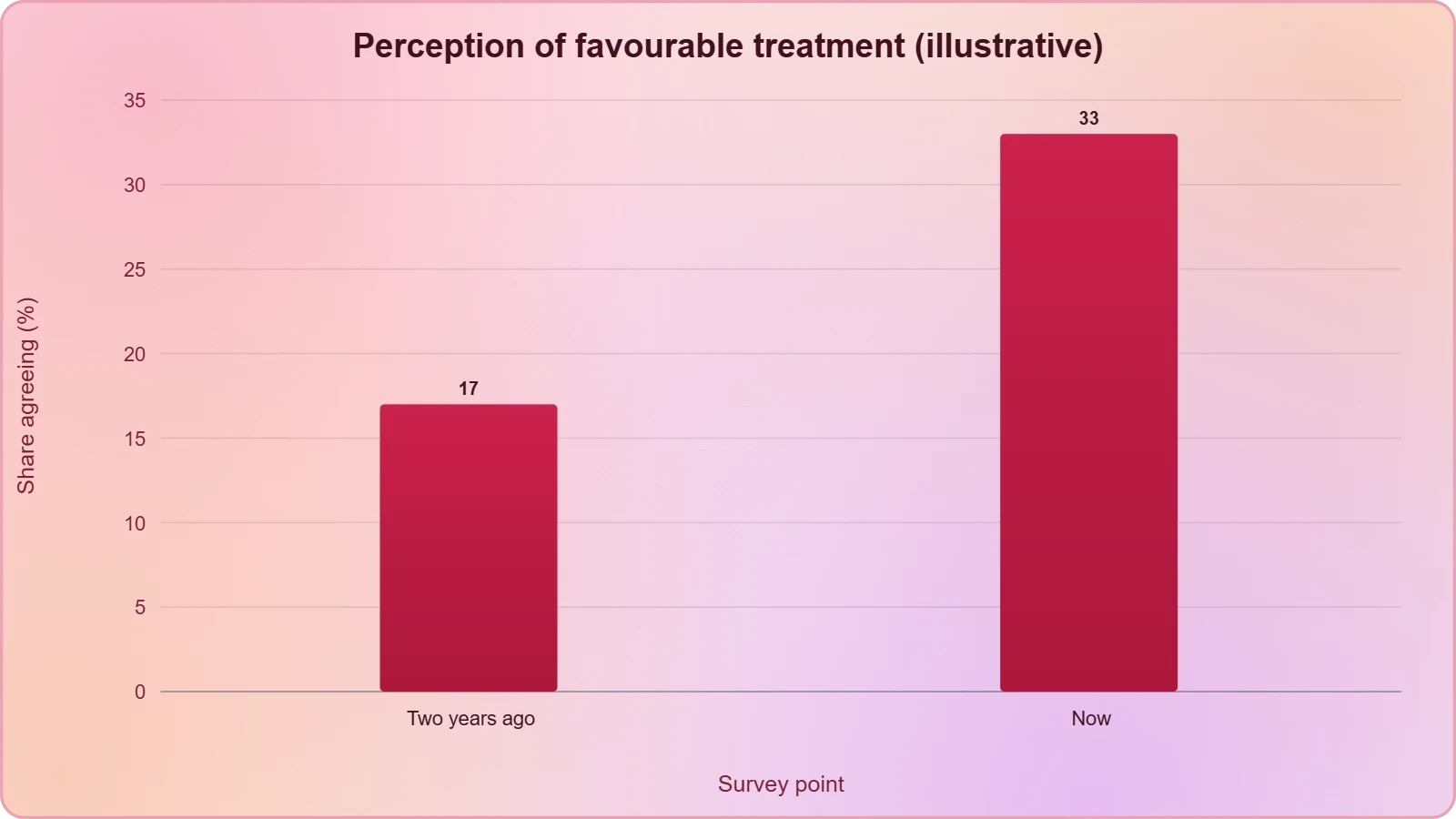
Polling of this kind also carries methodological caveats that deserve attention. Belief that a group receives favourable treatment is a perception measure, not an observation of police conduct, and it can rise for reasons unrelated to actual practice, including media framing and partisan cueing. Yet dismissing perception as mere misperception is politically untenable, because consent-based policing depends on what the public believes rather than on what internal audits demonstrate. The impartiality standard is therefore best understood as an instrument aimed at the perception gap, not at a proven operational failure.
Inside the Impartiality Standard
The centrepiece of the announcement is a new impartiality standard to be developed by the College of Policing, with consultation scheduled for next year. Its stated purpose is consolidative rather than revolutionary: to bring guidance on key impartiality principles into a single place so that officers can act with confidence regardless of a person's race, faith or other characteristics. Consolidation matters more than it might appear, because fragmented guidance produces inconsistent interpretation, and inconsistency at the point of contact is precisely what the public experiences as differential treatment, whatever the underlying intent of the policy architecture.
The standard is also designed to give the public a legible promise. When citizens know that a single document governs how officers approach questions of fairness, they gain a reference point against which to judge conduct, and police gain a defence when conduct is misrepresented. This dual function, reassuring the public and shielding the institution, is characteristic of codes that operate in politically charged terrain. The risk is that a document intended to settle disputes becomes another site of contestation, with rival readings of its principles mobilised by competing advocacy groups during the consultation itself.
Consolidation as a Governance Technique
Bringing guidance into one place is a recognisable governance technique with a mixed record. On the positive side, consolidation reduces the scope for selective citation, makes training more coherent, and allows oversight bodies to audit against a single benchmark. On the negative side, it can flatten genuine tensions, such as the tension between treating everyone identically and responding to the specific vulnerabilities of particular communities, into a formula that satisfies no one. The College of Policing will therefore have to decide whether the standard is a rulebook, a set of principles, or a framework for professional judgement, and that choice will determine its practical effect.
Consultation timing is equally consequential. A standard subject to consultation next year will not be operational during the period of maximum political heat, which means the government is offering a process as its answer to an immediate crisis of confidence. Processes can absorb pressure, but they can also be read as delay. If the consultation becomes a forum in which the underlying dispute about the existence of two-tier policing is relitigated, the standard may emerge weaker and more ambiguous than its architects intended, having been negotiated rather than asserted.
Symbols, Lanyards and the Limits of Guidance
The standard will extend to scenarios that might seem peripheral but are symbolically loaded: wearing symbols on badges and lanyards, and behaviour at community-led events. These details matter because they are the visible surface of impartiality. A badge or lanyard carrying a political or campaign symbol communicates affiliation, and affiliation is exactly what a public suspicious of differential treatment is primed to notice. Guidance in this area is an attempt to prevent small signals from accumulating into a broader impression that officers bring external commitments to the exercise of discretion.
Yet guidance on symbols also exposes the limits of any code. The meaning of a badge is not fixed by a policy document; it is read by a public that may interpret the same emblem as solidarity or as bias depending on context and prior belief. A standard can prohibit certain displays, but it cannot legislate the interpretive frame through which those displays are understood. This is why the symbolic provisions, though modest in scope, will be scrutinised closely: they test whether the standard can shape perception, or merely regulate conduct while perception continues to move independently.
Equality, Equal Treatment and the Course-Correction Problem
The most intellectually contested passage of the speech concerns what Mahmood calls misguided attempts at course correction. Her argument is that some approaches intended to promote equality, including the former police anti-racism commitment, have risked undermining confidence in impartial policing by implying that fair policing does not mean treating everyone the same. The line she intends to deliver is blunt: to the public, it was patently absurd to tell officers that fair policing does not mean treating everyone the same. This is a direct challenge to a strand of equality practice that emphasises differentiated responses over formal uniformity.
The tension is genuine and not easily resolved by rhetoric. Equality before the law is a foundational principle, but policing also requires attention to vulnerability, community context and the differential impact of enforcement. The difficulty is that these two commitments can be described in ways that sound indistinguishable to a public already primed to detect favouritism. If officers are told that equal treatment is not the same as identical treatment, the nuance may be professionally necessary but publicly corrosive, because the audience hears an admission that discretion will be exercised along group lines.
The Anti-Racism Commitment and Its Discontents
The former police anti-racism commitment serves as the concrete example of course correction gone awry. Such commitments were designed to address institutional racism following the Stephen Lawrence inquiry, and they reflected a legitimate diagnosis of how organisations can reproduce disadvantage through routine practice. But commitments of this kind can drift from operational guidance into declaratory politics, and when they do, they generate a backlash that is disproportionate to their practical effect. The Home Secretary's critique targets that drift rather than the original diagnosis, which is a distinction her opponents will be quick to dispute.
There is a defensible reading of her position that deserves serious engagement. If a policy communicates to officers that treating people identically is insufficient or even suspect, it creates ambiguity at the exact moment when split-second decisions are made. Ambiguity in turn produces inconsistency, and inconsistency is the raw material of two-tier allegations. On this reading, restoring a clear default of identical treatment, with carefully bounded exceptions for vulnerability, is a way of protecting both officers and the public from the consequences of muddled guidance.
Representation and the Stephen Lawrence Legacy
Mahmood will describe as shameful the fact that 33 years after the murder of black teenager Stephen Lawrence, the proportion of black officers remains virtually unchanged. This is a striking admission from a Home Secretary whose broader argument cautions against certain equality frameworks, and it complicates any simple narrative that she is retreating from the diversity agenda. The representation deficit is an institutional fact that no amount of guidance on impartiality can address, because it concerns who wears the uniform rather than how those who wear it are instructed to behave.
The juxtaposition is politically deliberate. By pairing a critique of course correction with an acknowledgment of stalled representation, Mahmood signals that her objection is to method rather than to goal. She is arguing, in effect, that some equality instruments have damaged the credibility needed to pursue equality itself. Whether that argument persuades the communities most affected by the representation deficit is another matter, and the gap between a shamefaced admission and a credible remedy will be the measure by which the speech is ultimately judged.
We Also Published
- 01
- 02
- 03
- 04
Community Engagement, Activism and the Boundary of Representation
Mahmood's instruction on community engagement is among the most quotable passages of the speech, and it draws a line that will be contested. She will say that engagement should mean attending a residents' association meeting and discussing local issues, over tea and biscuits or tea and samosas, but that it does not mean engaging with activist groups and campaigners who are pushing an agenda and not representing a community. The formulation is deliberately warm in its imagery and firm in its exclusion, using the conviviality of the tea table to mark the boundary of legitimate consultation.
The underlying claim is about representation: activist groups, on this account, speak for themselves rather than for the communities they invoke. That claim is empirically contestable, since many campaigners are embedded in community networks and articulate grievances that residents share but do not organise around. Yet the political logic is clear. If officers treat advocacy organisations as proxies for communities, they grant those organisations standing and influence, and they expose policing to the charge that its priorities are set by the loudest rather than the most representative voices.
The Tea Table as Political Metaphor
The tea and samosas image does considerable rhetorical work. It evokes a Britain where community relations are conducted through ordinary sociability, and it implicitly contrasts that warmth with the adversarial posture of campaigners. For an audience of chief constables, the metaphor offers a practical test: is this engagement with residents or with activists? For critics, the same metaphor will read as a demand that officers prefer congenial interlocutors over inconvenient ones, which is a serious charge for an impartiality standard to bear.
There is also a question of whose sociability is being described. The reference to samosas signals an inclusive vision of British community life, but it also risks reducing engagement with minority communities to a culinary register. The more substantive point is that informal settings can surface concerns that formal consultation misses, and that officers who only meet organised representatives may develop a distorted picture of local sentiment. Whether the metaphor lands as inclusion or as condescension will depend on audiences already disposed to interpret the Home Secretary's intentions in sharply different ways.
When Engagement Becomes Political
The warning against becoming drawn into political activism raises a boundary problem that policing has never fully solved. Officers must engage with communities that have political grievances, and they must do so without endorsing those grievances or appearing to take sides. The line between listening and aligning is thin, and it is policed as much by perception as by conduct. A meeting with a residents' association can be read as community policing; a meeting with a campaign group can be read as capitulation, even when the operational content of the two encounters is identical.
Mahmood's guidance effectively asks officers to make judgements about the legitimacy of interlocutors, which is itself a politically loaded task. Who decides whether a group represents a community or pushes an agenda? In practice, that judgement will be made locally, under pressure, and with imperfect information, and it will be scrutinised by whoever feels excluded. The standard can offer principles, but it cannot remove the discretion at the heart of the decision, and discretion is precisely what a suspicious public distrusts.
Reception, Risk and the Test of Credibility
The speech will be received through filters that its author cannot control. Police leaders will welcome the clarity and the political cover, since a Home Secretary willing to name the perception problem relieves them of the burden of defending against an accusation they cannot easily rebut. Civil liberties and race equality organisations will focus on the critique of anti-racism commitments and the warning against activist engagement, reading both as a retreat from the Lawrence legacy. Political opponents will note that a consultation scheduled for next year delivers nothing immediately, and that the government is responding to a narrative it has spent years failing to counter.
The deeper risk is that the impartiality standard becomes a document that satisfies the already persuaded while confirming the suspicions of the unconvinced. Standards of this kind tend to be judged by their most contested applications rather than their general principles, and the first high-profile case in which an officer's conduct is measured against the new framework will shape its reputation more than any consultation response. If that case is read as evidence of differential treatment, the standard will be cited as proof that guidance cannot cure what ails policing; if it is read as even-handed, it may begin to rebuild the confidence the Home Secretary seeks.
The Measurement Problem
Success will be difficult to measure, which is itself a political vulnerability. Public perception surveys can track whether belief in two-tier policing rises or falls, but they cannot isolate the effect of a guidance document from the effect of the cases, controversies and political interventions that dominate the news cycle. The government may therefore find itself in the position of having commissioned a remedy whose efficacy cannot be demonstrated, while the underlying sentiment continues to move according to forces entirely outside the College of Policing's control.
A more rigorous approach would combine perception tracking with operational data on stop and search, use of force and complaint outcomes, disaggregated by protected characteristics and published consistently. Such data would not settle the argument, because interpretation is always contested, but it would provide a common factual reference against which claims of differential treatment could be assessed. The absence of a robust measurement framework is arguably the weakest element of the announcement, since it leaves the standard's defenders reliant on anecdote and assertion in precisely the debate where evidence matters most.
What Would Genuine Impartiality Require
Beyond guidance, genuine impartiality depends on recruitment, training, supervision and accountability, and on the everyday culture of a police station rather than the text of a national standard. The representation deficit Mahmood describes is a recruitment and retention problem that has resisted three decades of initiatives, and no consolidation of principles will change who applies to join. Similarly, the perception of differential treatment is shaped by the distribution of policing resources and the intensity of enforcement in particular neighbourhoods, which are questions of political economy rather than professional ethics.
This is not to dismiss the standard, but to locate it accurately. It can clarify expectations, reduce ambiguity and give the public a reference point, and those are real goods. It cannot substitute for the harder work of building a service that looks like the public it serves and behaves consistently under pressure. The Home Secretary's speech is best understood as an attempt to reset the terms of a debate that has escaped institutional control, and its success will depend less on the elegance of its principles than on whether the institutions can deliver the visible consistency those principles promise.
Conclusion: Consent, Perception and the Limits of a Standard
The announcement is best read as an attempt to defend the principle of consent-based policing against a narrative that has outrun institutional explanation. British policing has always depended on the public's willingness to cooperate, and that willingness is contingent on a belief that the law applies equally. When a third of the public believes otherwise, the problem is not merely reputational; it is operational, because cooperation, reporting and witness testimony all depend on the confidence that the police will act fairly. Mahmood's speech acknowledges this dependency and tries to address it at the level of principle.
Whether a consolidated impartiality standard can deliver is a question that will be answered over years rather than months. The document can reduce ambiguity, clarify expectations and provide a reference point for accountability, and those are meaningful contributions. But the perception of two-tier policing is sustained by salient cases, political mobilisation and the visible distribution of enforcement, none of which a guidance document can control. The Home Secretary has named the problem with unusual candour; the harder task of demonstrating that the name is matched by a remedy remains ahead.
From our network :
- The Hidden Cost of AI Convenience: Why Over-Permissioned Agents Are a Security Time BombDiscover why AI agents with excessive permissions create dangerous single points of failure, and learn how implementing least privilege principles can protect your organization from exploitation.
- Forbidden Matrix Patterns and Visible Lattice Points: A Geometric DictionaryExplore how multidimensional 0–1 matrices encode geometric truths, linking forbidden patterns to visible lattice points and hypergraph theory, with applications in combinatorics and computational geometry.
- Mobile Learning and VR in English: What Global Evidence Reveals About Effective Language TechnologyA systematic review across 14 countries reveals which language-learning technologies genuinely work. Mobile learning, AI, and VR show measurable benefits when pedagogically integrated. This evidence-based guide helps educators and learners select technology that delivers real return on investment.
- How AI Agents Will Change the Way We Manage Personal FinancesExplore how AI agents are transforming personal finance through automated budgeting, bill payment, and investment management, while examining the critical security protocols and governance frameworks required for safe deployment.
- Live Online English Classes for Kids: Do They Actually Reduce Anxiety?A ten-week study reveals that synchronous online English classes can significantly reduce child language anxiety while improving listening and reading skills. Discover what makes these programs effective and how parents can select the right one.
- University Language Proficiency Exams: Why Institutional Tests Demand Different Preparation Than IELTS and TOEFLDiscover why university-specific language proficiency examinations differ fundamentally from IELTS and TOEFL, and learn strategic preparation approaches for institutional assessment success.
- CISA’s Ten-Advisory Wave: Why Generic Patching Fails in OT and How to Build Product-Specific PlaybooksCISA released ten ICS advisories in one week, exposing critical infrastructure risks. Generic patching fails in OT. Learn to build product-specific remediation playbooks.
- Committed Mediterranean Precipitation Decline: Why Emissions Cuts Alone Cannot Restore Winter RainsNew NOAA research reveals that Mediterranean winter rains may decline irreversibly even with emissions cuts. Explore the science of committed climate change and regional impacts.
- The Final Descent: How ESA Retired the Legendary Cluster Constellation After 24 Years of Space Weather ScienceAfter 24 years mapping Earth’s magnetosphere, ESA’s Cluster mission concluded with a precisely controlled reentry over the South Pacific. This analysis explores the scientific legacy, engineering decisions, and debris mitigation principles behind one of space exploration’s most responsible retirements.
RESOURCES
- Home secretary plans to tackle 'perception of two-tier policing' - BBCbbc.co.uk17 hours ago ... ... Policing, the standards-setting body for ... "Impartiality cannot be seen in isolation but needs to be considered alongside how…
- Shabana Mahmood to set out plans to tackle 'corrosive' perception ...theguardian.com6 hours ago ... Mahmood will announce that a new “impartiality standard” is being ... two-tier policing in the UK. Nowak, who was fatally…
- Accountability & Standards - Two-tier policingdevonandcornwall-pcc.gov.ukAug 5, 2024 ... ... impartiality and the need to ... Reviews of public order policing have highlighted “The British model of policing places…
- Home secretary plans to tackle 'perception of two-tier policing' - BBCbbc.com17 hours ago ... Home Secretary Shabana Mahmood is to announce stronger guidance on police impartiality to tackle what she calls the "corrosive and…
- Shabana Mahmood will order police to end the “corrosive ...facebook.com2 hours ago ... uk/news/2026/11/18/police-given- impartiality-guidance-tackle-two-tier- policing/?WT. mc_id=tmgoff_fb_photo_guidance-tackle-two -tier-policing/.
- Sign In - Policing Insightpolicinginsight.comNews Police given impartiality guidance to tackle two-tier policing. The ... The reform of UK policing.
- Mahmood forces officers to tackle 'two-tier' policing - The Telegraphtelegraph.co.uk8 hours ago ... Home Secretary will unveil guidance for officers on Wednesday to adopt new 'impartiality standard'
- The truth about “two-tier policing” | LSE British Politicsblogs.lse.ac.ukAug 15, 2024 ... Rioters, far right activists, as well as owner of X Elon Musk, have been propagating the idea of “two-tier policing”.
- Restoring British Policing - NationBuilderassets.nationbuilder.comLaw and Impartial Policing Standard. ... The outcome will be consistent enforcement, restored public confidence and an end to two-tier policing or the perception ...
- An inspection into activism and impartiality in policinghmicfrs.justiceinspectorates.gov.ukSep 10, 2024 ... All police officers in England and Wales swear allegiance to the Crown through the oath that they take on joining…
- The Telegraph on X: "Shabana Mahmood will order police to end ...x.com5 hours ago ... Shabana Mahmood will order police to end the “corrosive” perception of two-tier policing. ... impartiality standard”, where they treat everyone…
- Nigel Farage: “The CPS is doubling down on two-tier justice”reformparty.ukJul 2, 2026 ... Reform UK is Britain's fastest growing political party. Join us to fix broken Britain with common sense policies on immigration,…
- Guidance for ethical and professional behaviour in policingcollege.police.ukJan 24, 2024 ... For the avoidance of doubt, the Code of Ethics does not set the standards against which conduct should be assessed.…
- How the Far-Right Is Using the Racist Myth of 'Two-Tier Policing' to ...bylinetimes.comJun 9, 2026 ... From the 1999 Macpherson Inquiry to the 2023 Casey Review, a quarter-century of official findings record racial bias in British…
- Ethical policing principles - College of Policingcollege.police.ukJan 24, 2024 ... We earn the public's confidence when we listen to what they have to say, make decisions that are fair and…
- 01
- 02
- 03
- 04
- 05
- 06
- 07
- 08
0 Comments