
Modern air-defense procurement is rarely a story about missiles alone. When the Pentagon moves to accelerate production of Patriot interceptors, the visible constraint appears to be factory floor space or congressional funding, yet the binding limitation often hides several tiers deeper in the industrial supply chain. A Wall Street Journal report has surfaced precisely such a hidden bottleneck: a shortage of rayon, the cellulose-derived fiber more commonly associated with cigarette filters and tire cord, is complicating Washington's push to build more Patriot missiles. The disclosure is striking because it reframes a high-technology weapons program as a problem of commodity chemistry and specialized textile manufacturing.
The Patriot system, formally designated the MIM-104 and produced by Raytheon (now RTX), has become the West's most recognizable surface-to-air missile family. Its interceptors rely on an intricate stack of solid rocket propellant, guidance electronics, and composite motor casings, and rayon plays a quiet but consequential role in how those solid motors are fabricated. The report does not specify the exact application, but the broader defense-industrial context explains why a fiber with roots in the 19th-century textile trade can gate the output of a weapon that costs several million dollars per round. Understanding that paradox requires looking at how propellant grains are formed, cured, and bonded inside a motor case.
What follows is a structured reading of the rayon constraint: why the fiber matters to solid rocket manufacturing, how single-source dependencies accumulate in defense supply chains, what the Patriot production ramp actually demands, and how allied stockpile pressures compound the problem. The analysis also weighs the strategic implications for Ukraine, Indo-Pacific deterrence, and the wider question of whether Western munitions industrial bases can scale at the speed contemporary conflicts demand. Each section pairs the reported fact with the industrial logic behind it, so the shortage reads not as an isolated curiosity but as a case study in supply-chain fragility.
On This Page
TL;DR The Pentagon wants more Patriot interceptors, but a reported rayon shortage is constraining production. Rayon is a cellulose-based fiber used in solid rocket motor manufacturing, where it typically serves as a reinforcing and bonding component in propellant or insulation systems. Because defense-grade rayon is a niche, single- or few-source material, a disruption at one mill can ripple into multi-year missile delivery schedules. The episode illustrates how advanced weapons depend on unglamorous commodity inputs, why stockpile replenishment is slower than headline budgets suggest, and why allied governments are now auditing tier-three suppliers as rigorously as prime contractors.
The Industrial Logic Behind a Fiber Bottleneck
Solid rocket motors are deceptively simple in concept and extraordinarily demanding in execution. A propellant grain must burn predictably from ignition to burnout, withstand storage across decades of temperature cycling, and bond flawlessly to the motor case insulation. Manufacturers use fibrous materials in several of these interfaces, and rayon has historically appeared in the liner and insulation chemistry that separates the hot propellant from the casing. When a specialized fiber becomes scarce, engineers cannot simply substitute a commodity alternative without re-qualifying the entire motor, a process measured in years rather than weeks.
Why Rayon Enters a Missile Motor at All
Rayon's appeal lies in its chemistry rather than its strength. Regenerated cellulose burns cleanly and carbonizes into a char layer that can insulate underlying structures from extreme heat, which is why the fiber has long been used in ablative heat shields and rocket motor insulation. In defense applications, the material is typically processed into felt, cord, or fabric that is impregnated with phenolic resins and cured into composite structures. The resulting part must pass stringent lot-acceptance testing, and any change in fiber source, denier, or finish can invalidate prior qualification data.
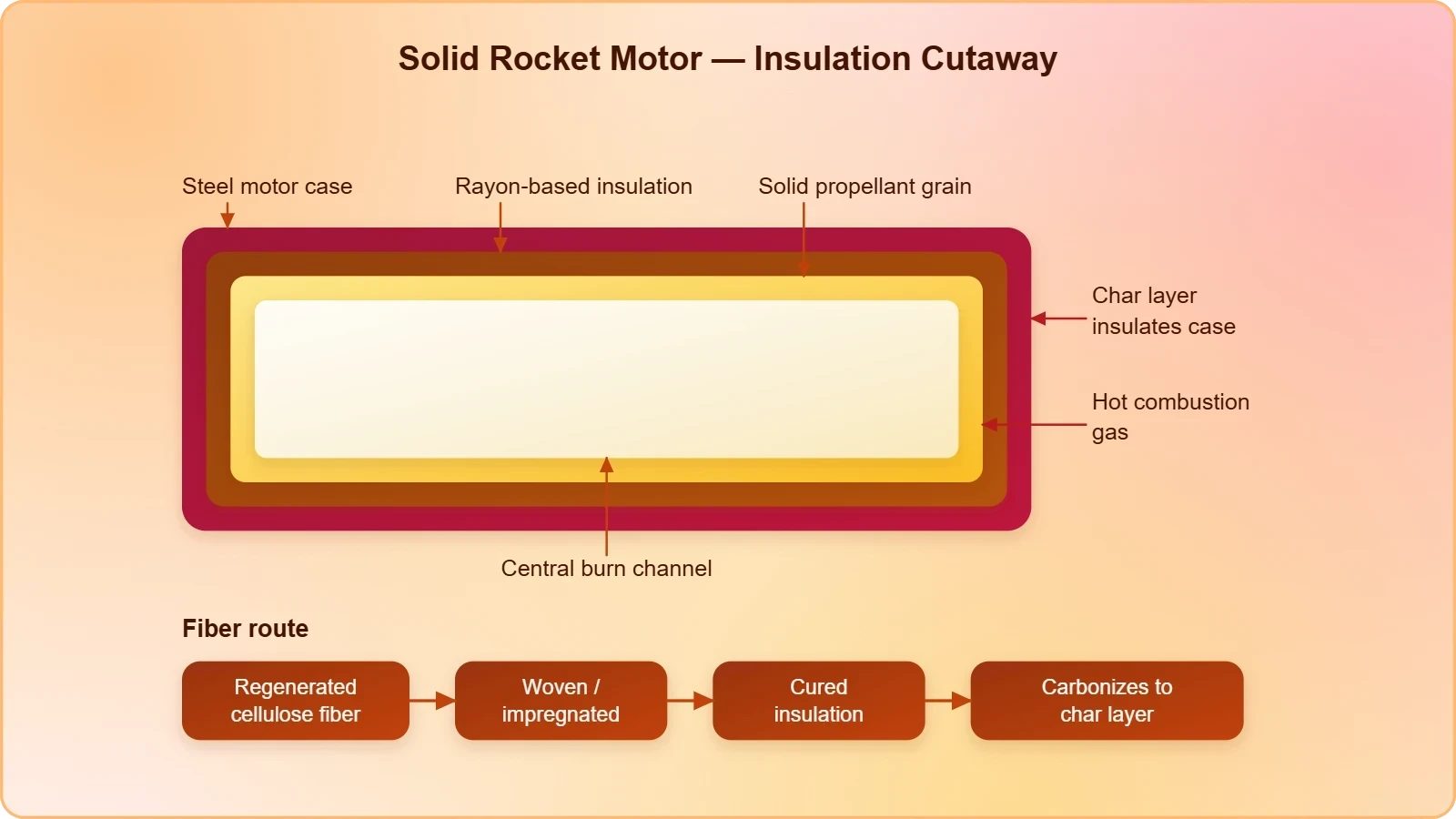
That qualification burden explains why a shortage bites so sharply. A prime contractor cannot walk into a textile market and buy an equivalent spool of rayon; the material must meet military specifications governing purity, sulfur content, and mechanical consistency, and the supplier must be audited and approved. The Wall Street Journal report does not detail the precise Patriot application, but the pattern is familiar across the solid rocket motor sector, where obscure inputs such as graphite grades, ammonium perchlorate, and specialty binders have repeatedly emerged as rate-limiting factors in munitions production.
The Difference Between Capacity and Output
Announcing a production increase and actually shipping more interceptors are two different achievements separated by capital investment, workforce training, and supplier readiness. A missile plant can add shifts and tooling, yet output remains capped by whichever component arrives slowest. Defense economists describe this as the "weakest link" property of complex assembly: the bill of materials may contain thousands of parts, but throughput is governed by the scarcest one. Rayon, in this framing, is not a trivial input but a structural chokepoint that can idle expensive capacity upstream.
Historical precedent reinforces the point. During previous munitions surges, shortages surfaced in propellant chemicals, precision bearings, and even the skilled welders needed for rocket motor cases. Each bottleneck was individually modest yet collectively decisive. The rayon constraint fits this pattern precisely, and it suggests that the Pentagon's Patriot ramp will be paced less by congressional appropriations than by the willingness of a handful of specialty mills to expand defense-grade output under long-term contracts.
We Also Published
Single-Source Dependencies in Defense Supply Chains
Defense procurement has a structural tendency toward concentration. Because military specifications are exacting and volumes are modest, the pool of qualified suppliers for any given specialty material is often one or two firms. That concentration is efficient in peacetime and perilous in a surge. When the Pentagon asks for more interceptors, it is effectively asking a small number of mills, chemical plants, and machine shops to expand simultaneously, and any one of them can become the constraint that defines the entire program's delivery curve.
How Niche Materials Become Strategic
Rayon production in the West has contracted for decades as apparel and industrial demand migrated to Asia. What remains is a specialized base serving filtration, medical, and defense niches, and defense-grade grades represent a small fraction of that output. A mill that runs a particular line for a particular customer has little incentive to hold surge capacity, and restarting an idled line requires capital, trained operators, and environmental permitting. The result is a material that is cheap per kilogram yet strategically precious, a category that also includes certain rare earths, tungsten alloys, and high-purity chemicals.
Governments have begun to recognize this asymmetry. The U.S. Department of Defense has increasingly funded supplier resilience programs, and the 2022 National Defense Industrial Strategy explicitly calls for mapping tier-three and tier-four dependencies. Yet mapping is easier than remediating. Building a new qualified rayon line takes years, and the business case depends on guaranteed orders that only multi-year procurement commitments can provide. The Patriot rayon shortage is therefore less an anomaly than a predictable outcome of a procurement system optimized for cost and compliance rather than surge resilience.
The Qualification Trap
Even when an alternative supplier exists, qualification stands in the way. A new fiber source must be tested for lot-to-lot consistency, aged under accelerated conditions, and validated in static motor firings before it can enter a flight-certified missile. Each step consumes months and significant engineering labor, and failures reset the clock. This is why defense contractors often prefer to wait out a shortage rather than re-qualify, and why a temporary disruption can persist as a multi-year schedule slip even after raw material availability improves.
The qualification trap also shapes allied behavior. Countries seeking to co-produce interceptors or establish licensed assembly lines discover that the binding constraint is not factory construction but access to qualified subcomponents and materials. Japan, which has explored Patriot-related co-production, and European partners expanding their own interceptor capacity both confront the same tier-three realities. The lesson is that sovereignty in defense manufacturing is only as deep as the supply chain beneath the final assembly line.
The Patriot Production Ramp and Its Real Constraints
Patriot interceptors are among the most sought-after munitions in the world, and demand has outstripped supply since Russia's full-scale invasion of Ukraine. The United States has committed to raising annual output substantially, with RTX and its partners investing in new facilities and expanded lines. Yet the arithmetic of stockpile replenishment is unforgiving: each interceptor takes years to produce, each launch consumes a multi-million-dollar round, and allied orders compete with American inventory needs. A materials bottleneck at the rayon stage therefore translates directly into fewer interceptors available for any customer.
What a Production Increase Actually Requires
Scaling a missile line involves more than pouring concrete. New tooling must be designed and validated, technicians trained, test ranges scheduled, and suppliers brought under contract with appropriate surge clauses. Propellant mixing and casting are particularly sensitive operations with strict safety and environmental oversight, and motor production is often the pacing item. If rayon-derived insulation or liner materials are on the critical path, then the entire ramp inherits that dependency, and no amount of final-assembly capacity can compensate for a missing input.
The financial dimension is equally instructive. Interceptor unit costs have risen as volumes and complexity increased, and governments are negotiating multi-year framework agreements to give industry the demand certainty needed to invest. Those agreements only work if every tier responds. A mill asked to double defense-grade rayon output needs its own capital, its own workforce, and its own raw material pulp supply, which introduces yet another layer of dependency. The ramp is thus a cascade of commitments, and the slowest commitment sets the pace.
Allied Demand and Stockpile Arithmetic
Ukraine's air-defense needs have absorbed large quantities of interceptors, while Japan, Germany, and other partners have placed orders that stretch delivery timelines. The strategic math is straightforward: if annual production rises from several hundred to a higher figure, but consumption in active conflict and allied replenishment remain elevated, net stockpile growth stays modest. A rayon shortage that trims even a fraction of planned output compounds this squeeze, delaying the point at which inventories return to desired levels and widening the window of vulnerability for partners reliant on American production.
Analysts have begun to model interceptor inventories explicitly, treating them as a finite strategic reserve rather than an inexhaustible industrial product. In such models, production rate and consumption rate determine the time to depletion, and small changes in either variable produce outsized effects. A materials bottleneck is effectively a downward revision to the production rate, which shortens the runway. That is why the rayon story matters beyond its immediate industrial detail: it alters the strategic timeline on which air-defense planning depends.
- 01
- 02
- 03
- 04
Strategic Consequences for Allies and Deterrence
Air defense has become the defining military requirement of the current decade, and Patriot is the anchor of Western capability. Any constraint on interceptor output therefore carries strategic weight beyond the factory gate. Allies that have donated systems to Ukraine now face their own inventory gaps, and the promise of replacement depends on production schedules that a rayon shortage can quietly undermine. Deterrence rests on credible capacity, and credibility erodes when delivery timelines slip for reasons invisible to the public but obvious to adversaries analyzing industrial indicators.
Europe, Japan, and the Co-Production Question
European governments have launched initiatives to expand interceptor manufacturing, and Japan has moved to deepen its role in Patriot-related production. These efforts are strategically sound but technically demanding, because co-production requires transferring not just assembly drawings but qualified material sources. If the underlying rayon supply is concentrated and constrained, new assembly lines inherit the same bottleneck. The result is a paradox: more nominal capacity without proportionally more output, unless the materials tier is expanded in parallel with final assembly.
This dynamic has prompted a rethink of what industrial sovereignty means. Owning the factory is insufficient if the fiber, propellant chemicals, and precision components arrive from a single foreign source. European defense planners now speak of "supply-chain depth" as a strategic metric, and the rayon episode gives that phrase concrete meaning. Co-production agreements that ignore tier-three materials risk creating the appearance of resilience while leaving the underlying vulnerability intact, a distinction that matters greatly in a prolonged conflict scenario.
Reading the Shortage as a Warning Signal
The most useful way to interpret the rayon report is as a diagnostic. It reveals that the Western munitions base still contains single points of failure in unglamorous places, and that surge capacity cannot be conjured without long-lead investment. It also suggests that future bottlenecks will likely surface in similarly obscure materials, from specialty graphite to high-purity solvents. Governments that systematically audit and diversify these inputs will ramp faster; those that focus only on headline assembly capacity will discover their limits at the worst possible moment.
For industry, the implication is that supplier resilience is becoming a competitive advantage. Prime contractors that can demonstrate mapped, diversified, and qualified supply chains will win favor with governments increasingly attentive to industrial risk. For policymakers, the lesson is that procurement reform must reach below the prime tier, funding capacity where it is scarcest and accepting the higher unit costs that resilience entails. The rayon shortage is small in itself, but it points to a large and enduring truth about how modern military power is actually produced.
From Commodity Chemistry to Strategic Capacity
The rayon shortage is a reminder that military capability is ultimately a physical phenomenon. Missiles are not abstractions of strategy; they are manufactured objects assembled from materials that must be mined, refined, spun, woven, impregnated, and cured before they ever reach a launch rail. When a fiber supply tightens, the consequences travel upward through the supply chain and outward into alliance politics. Recognizing that chain of causation is the first step toward managing it, and the Pentagon's push for more Patriots will be judged not by announcements but by deliveries.
What to Watch Next
Several indicators will reveal whether the constraint is being resolved. Watch for long-term supply agreements between defense primes and specialty fiber producers, for investment announcements in domestic rayon or alternative insulation capacity, and for qualification testing of substitute materials. Watch also for changes in Patriot delivery schedules and for allied statements about interceptor availability. Each of these signals indicates whether the bottleneck is being addressed at its source or merely absorbed as a schedule risk that quietly accumulates across the program.
Beyond Patriot specifically, the episode invites a broader audit of munitions inputs. Governments would be well served by publishing tier-three dependency maps, funding surge capacity in the scarcest materials, and treating supplier resilience as a criterion in contract awards. Such measures are unglamorous and expensive, but they determine whether industrial bases can respond when demand spikes. The alternative is a recurring pattern in which strategic ambitions outrun material reality, and in which obscure commodities repeatedly dictate the pace of rearmament.
A Closing Assessment
Read carefully, the Wall Street Journal report is less about rayon than about the architecture of modern defense production. It shows that the West's ability to sustain air defense depends on a web of specialized suppliers whose importance is invisible until they falter. It also shows that surge capacity is a function of foresight, not improvisation. The Pentagon's Patriot ambitions are achievable, but only if the materials tier receives the same attention as the assembly line, and only if governments accept that resilience carries a price worth paying.
The strategic takeaway is clear and durable. Air-defense superiority is not merely a matter of technology or tactics; it is a matter of industrial depth, and depth is built one qualified supplier at a time. A cellulose fiber with origins in the textile mills of the nineteenth century now sits on the critical path of twenty-first-century deterrence. That juxtaposition is the real story, and it will remain relevant long after this particular shortage is resolved, because the next bottleneck is already forming somewhere deeper in the chain.
From our network :
- The Final Descent: How ESA Retired the Legendary Cluster Constellation After 24 Years of Space Weather ScienceAfter 24 years mapping Earth’s magnetosphere, ESA’s Cluster mission concluded with a precisely controlled reentry over the South Pacific. This analysis explores the scientific legacy, engineering decisions, and debris mitigation principles behind one of space exploration’s most responsible retirements.
- University Language Proficiency Exams: Why Institutional Tests Demand Different Preparation Than IELTS and TOEFLDiscover why university-specific language proficiency examinations differ fundamentally from IELTS and TOEFL, and learn strategic preparation approaches for institutional assessment success.
- CISA’s Ten-Advisory Wave: Why Generic Patching Fails in OT and How to Build Product-Specific PlaybooksCISA released ten ICS advisories in one week, exposing critical infrastructure risks. Generic patching fails in OT. Learn to build product-specific remediation playbooks.
- Live Online English Classes for Kids: Do They Actually Reduce Anxiety?A ten-week study reveals that synchronous online English classes can significantly reduce child language anxiety while improving listening and reading skills. Discover what makes these programs effective and how parents can select the right one.
- Forbidden Matrix Patterns and Visible Lattice Points: A Geometric DictionaryExplore how multidimensional 0–1 matrices encode geometric truths, linking forbidden patterns to visible lattice points and hypergraph theory, with applications in combinatorics and computational geometry.
- Mobile Learning and VR in English: What Global Evidence Reveals About Effective Language TechnologyA systematic review across 14 countries reveals which language-learning technologies genuinely work. Mobile learning, AI, and VR show measurable benefits when pedagogically integrated. This evidence-based guide helps educators and learners select technology that delivers real return on investment.
- How AI Agents Will Change the Way We Manage Personal FinancesExplore how AI agents are transforming personal finance through automated budgeting, bill payment, and investment management, while examining the critical security protocols and governance frameworks required for safe deployment.
- Committed Mediterranean Precipitation Decline: Why Emissions Cuts Alone Cannot Restore Winter RainsNew NOAA research reveals that Mediterranean winter rains may decline irreversibly even with emissions cuts. Explore the science of committed climate change and regional impacts.
- The Hidden Cost of AI Convenience: Why Over-Permissioned Agents Are a Security Time BombDiscover why AI agents with excessive permissions create dangerous single points of failure, and learn how implementing least privilege principles can protect your organization from exploitation.
RESOURCES
- The Pentagon Urgently Needs More Patriot Missiles. It's ... - WSJwsj.com14 hours ago ... ... supply chain of a top U.S. missile maker for an urgent conversation. The subject: rayon. The material in question…
- Critical rayon shortage threatens US Patriot missile productionjpost.com3 hours ago ... Jerusalem Post/Defense & Tech. Pentagon struggles to boost Patriot missile output amid rayon shortage, supply bottleneck - report. Rayon ...
- A humble fabric is snarling production plans for the Patriot missile ...facebook.com12 hours ago ... ... supply chain for this particular type of rayon. Spread it out ... A global shortage of interceptor missiles for…
- The Pentagon faces a critical bottleneck in ramping up production of ...instagram.com2 hours ago ... The supply chain begins with rayon thread produced at a factory ... Patriot missile shortage. THAAD missile shortage. Patriot production ...
- The U.S. Defense Industrial Base: Background and Issues for ...congress.govSep 23, 2024 ... ... defense supply chains in times of crisis." Although a majority of defense contractors are small businesses, they collectively receive…
- NPS-AM-24-091.pdfdair.nps.eduFactors like development expenses, supply chain costs, and defense strategies, such as deploying two interceptors for each incoming missile, tilt the ...
- FY 2026 Mandatory Funding Allocation Plan 1comptroller.war.govEnhancement of Department of Defense. Resources for Munitions and Defense Supply Chain. Resiliency. 610.0. 24,770.7. -. -. -. 25,380.7. SEC. 20005. Enhancement ...
- H. Rept. 119-231 - STREAMLINING PROCUREMENT FOR ...congress.gov... missile is hampered by supply chain shortfalls for solid rocket motors. ... Defense to identify and address supply chain management risk for their…
- The American Missile Crisis | Contrary Researchresearch.contrary.comMay 26, 2026 ... Resolving this bottleneck by building a second, independent propulsion supply chain should be a strategic priority for the US defense…
- Fiscal Year 2017 Annual Industrial Capabilities Report to Congressbusinessdefense.govApr 12, 2018 ... The defense industrial base and its supply chain support the U.S. economy, ... missiles sector when a supply chain issue…
- h.r._3838_fy26_ndaa_as_reported_to_the_house.pdfarmedservices.house.govAug 20, 2025 ... ... DEFENSE AUTHORIZATION ACT FOR. FISCAL YEAR 2026 ... Missile Procurement, Army ...
- Defense Acquisition Research Journal #94 - WarUwaru.eduWhat metrics do different industries use for measuring the effectiveness of their supply chain management? ... on Patriot Missile purchases. This is a ...
- US Rocket Propulsion Assessment - Bureau of Industry and Securitybis.govmissiles and missile defense). 6 ... China and the Propulsion Supply Chain. Quotes Regarding China and the Supply Chain. • “Chinese suppliers dump tungsten.
- Philippe Lemoine (@phl43) / Xx.com... supply chains in the military industry are today. The Pentagon ...
- Ammunition Surveillance Procedures - Army Safetysafety.army.milNov 22, 2016 ... (Defense Contract Management ... verification that the unit missile stocks are correctly listed on the property book and unit supply-enhanced ...
- 01
- 02
- 03
- 04
- 05
- 06
- 07
- 08
0 Comments