
When Joanne Young stepped outside Winchester Crown Court and chose to speak with her name fully visible, she converted a private catastrophe into a public reckoning. For years she had been drugged and raped by her husband, Philip Young, who then invited other men to abuse her while she was incapacitated. Her decision to waive lifelong anonymity was not a gesture of spectacle but an act of civic instruction: she wanted women and girls who had suffered similar violence to understand that they could be believed, understood, and heard inside a system that has historically treated sexual violence with corrosive suspicion. Her statement carried a dignity that made the moment feel less like a verdict and more like a turning point.
Yet the deeper significance of that day lay in a phrase uttered quietly by a prosecutor, almost lost beneath the emotional weight of Young's address. James Foster, a specialist prosecutor in the Crown Prosecution Service's Wessex complex casework unit, explained that the case had been built using a "suspect-centric approach," proving to a jury that Philip Young could not provide consent on his victim's behalf and that each defendant played a distinct part in the abuse. That single phrase signals a structural shift in how sexual offences are investigated and prosecuted, one that would have been difficult to imagine a decade ago when rape prosecutions were collapsing across England and Wales.
This analysis examines what the Young case reveals about the machinery of criminal justice reform, where it has genuinely advanced, and where the courts remain dangerously behind. It traces the arc from the Guardian's 2018 revelations about falling prosecution rates to the present moment of cautious optimism, weighing the evidence for real change against the persistent gaps in conviction rates, victim support, and institutional culture. The story is neither a triumph nor a failure but a study in partial progress, and understanding its contours matters for anyone who believes the justice system should serve those it has too often abandoned.
On This Page
- The Anatomy of a Landmark Prosecution
- The 2018 Reckoning and the De Facto Decriminalisation Debate
- Reading the Green Shoots Without Overstating Them
- The Human Cost Behind the Legal Machinery
- Comparative Perspective: How Other Jurisdictions Handle Sexual Offences
- What the Young Verdict Means for Future Survivors
- Conclusion: Catching Up Is Not the Same as Arriving
TL;DR Joanne Young's decision to waive anonymity after years of drugging and rape by her husband and the men he invited to abuse her has become a landmark moment for England's criminal justice system. The case's "suspect-centric" prosecution approach, championed by specialist CPS prosecutors, represents a meaningful departure from the victim-scrutinising practices that once drove rape prosecutions down by 60% between 2016-17 and 2019-20. Yet conviction rates, court backlogs, and institutional scepticism remain stubborn obstacles. The Young verdict is best read as evidence that reform is possible rather than proof that it is complete, a signal of green shoots in a system still catching up with the promises it has made to survivors.
The Anatomy of a Landmark Prosecution
The Young case did not emerge from a single dramatic breakthrough but from years of accumulated procedural reform inside police forces and the Crown Prosecution Service. Investigators built a case that centred on the suspect's conduct rather than the victim's credibility, a reversal of the historical default in sexual offence cases. Instead of asking why a victim did not resist, did not report sooner, or did not behave as expected, prosecutors constructed a narrative in which Philip Young's orchestration of abuse and the complicity of the men he invited became the evidentiary spine. This methodological inversion is what allowed a jury to convict multiple defendants in a case involving drugging, incapacitation, and prolonged exploitation.
What makes the approach notable is its evidentiary logic. Consent cannot be manufactured by a third party, and a husband cannot extend permission to strangers to assault his wife. By proving that Philip Young could not provide consent on the victim's behalf, prosecutors closed a legal loophole that defendants might otherwise have exploited. Each defendant was then shown to have played a specific, provable part in the abuse, which prevented the diffusion of responsibility that often frustrates juries in multi-defendant sexual offence trials. The result was a prosecution that treated the victim's incapacitation as the central fact rather than as a complication to be explained away.
From Victim-Scrutiny to Suspect-Centricity
For much of the past two decades, the implicit operating assumption in many rape investigations was that the victim's account required forensic-level scepticism before it could be trusted. Prosecutors were trained to identify "weak cases" and remove them from the system, a practice the Guardian exposed in 2018 when it reported on CPS training events advising exactly that. The consequence was a collapse in prosecutions even as reported incidents rose, creating what campaigners described as the de facto decriminalisation of rape. The suspect-centric model reverses this logic by directing investigative energy toward the accused's behaviour, communications, and patterns rather than toward the complainant's demeanour and history.
This shift is not merely rhetorical. Suspect-centric investigations typically involve earlier forensic capture, more thorough digital evidence gathering, and a willingness to pursue cases where the victim's memory is fragmented by trauma or intoxication. In the Young case, the drugging itself became a prosecutorial asset rather than a liability, because it established the impossibility of consent and the premeditation of the abusers. The model also encourages police to look for corroborating patterns across multiple victims and defendants, which is precisely how a network of invited abusers can be dismantled rather than treated as isolated incidents.
The Evidentiary Architecture of Consent
Consent law in England and Wales has evolved through statutes and case law to recognise that agreement must be freely given by someone with the capacity to give it. When a victim is drugged into unconsciousness, capacity is absent by definition, and any sexual act becomes unlawful regardless of prior relationship or marital status. The Young prosecution leaned heavily on this principle, using toxicology, witness testimony, and the defendants' own communications to establish that the victim could not have consented. Marital rape has been a crime in England and Wales since 1991, but prosecutions involving spouses remain relatively rare, which makes the Young convictions symbolically significant.
The case also illustrates how digital evidence has transformed sexual offence prosecutions. Messages between Philip Young and the men he invited, along with records of drug acquisition and travel, provided the connective tissue that turned individual assaults into a coherent pattern of orchestrated abuse. Prosecutors no longer need to rely solely on the victim's testimony to establish the sequence of events; they can reconstruct the architecture of abuse from the suspects' own digital footprints. This evidentiary richness is one reason the suspect-centric approach has gained traction, because it produces cases that are provable without requiring the complainant to carry the entire burden of proof alone.
The 2018 Reckoning and the De Facto Decriminalisation Debate
The Guardian's 2018 investigation into falling rape prosecutions was a watershed moment in public understanding of how the criminal justice system was quietly failing survivors. The numbers were stark: prosecutions fell from 5,190 in 2016-17 to 2,102 in 2019-20, a decline of roughly 60%, even as the volume of incidents reported to police climbed steadily. The reporting revealed that the CPS had held training events for prosecutors advising them to "take the weak cases out of the system" in order to boost conviction rates. That phrase, once exposed, became a symbol of an institutional logic that prioritised statistical performance over the pursuit of justice for victims.
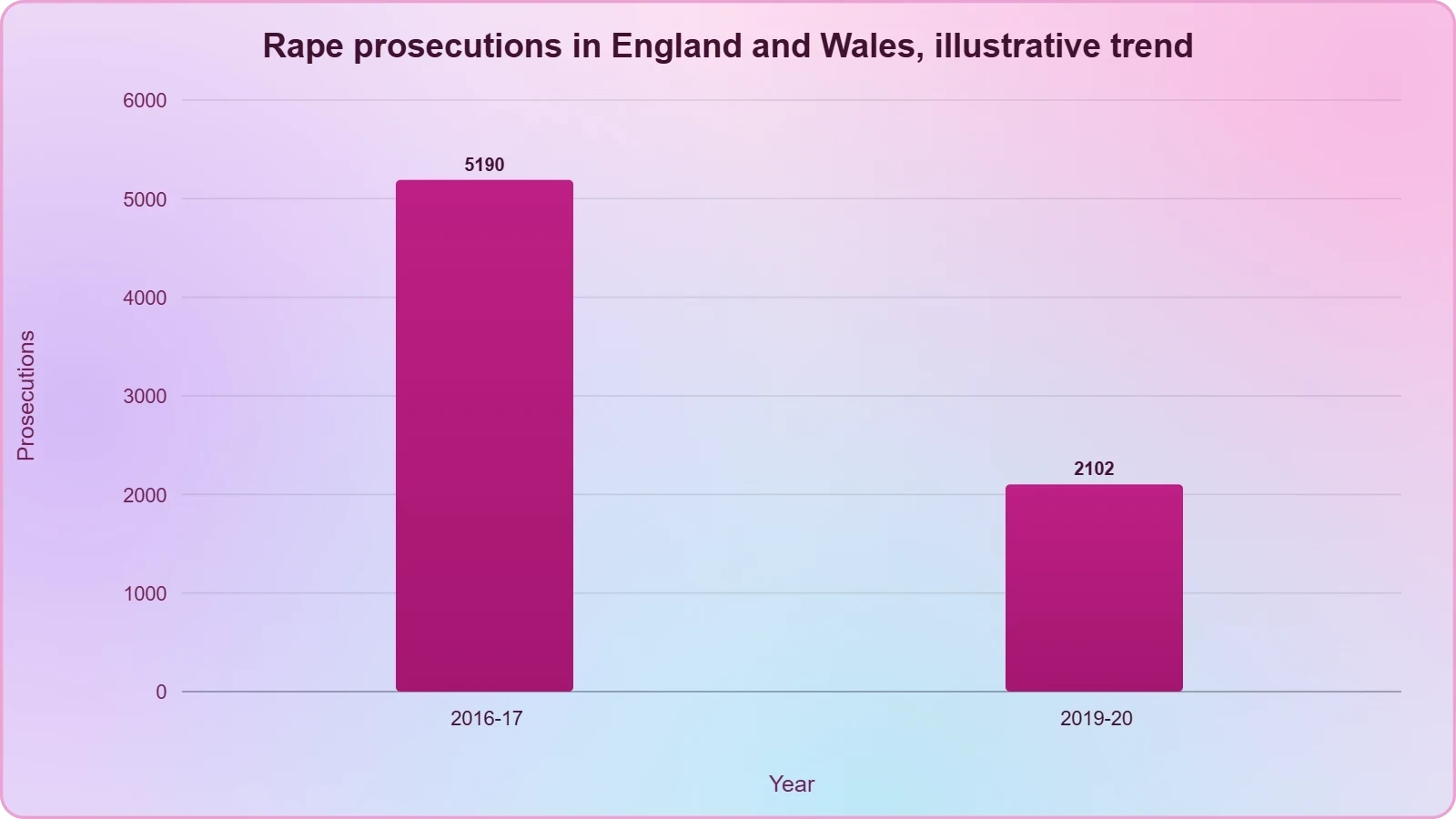
What made the revelation so damaging was not simply the numbers but the underlying incentive structure they exposed. Conviction rate targets, when applied to a shrinking pool of prosecutions, can create a perverse dynamic in which the easiest cases are pursued and the hardest are quietly shelved. Sexual offence cases are frequently the hardest, involving traumatised complainants, fragmented evidence, and juries that may harbour scepticism about consent. If prosecutors are measured on conviction rates rather than on the thoroughness of their case-building, the rational institutional response is to avoid difficult cases altogether. The Guardian's reporting forced a public reckoning with that logic and catalysed reforms that are only now beginning to bear fruit.
Institutional Incentives and Statistical Distortion
Performance metrics in criminal justice are notoriously prone to gaming, and rape prosecutions offer a particularly acute example. A conviction rate calculated as convictions divided by prosecutions will rise if prosecutors simply decline to charge marginal cases, even if the absolute number of convictions falls. This is not necessarily the result of individual malice; it can emerge from a well-intentioned desire to protect victims from the ordeal of a trial likely to end in acquittal. But the aggregate effect is a system that appears to be improving while actually delivering less justice, a statistical illusion that the Guardian's reporting punctured decisively.
Reformers have since argued that the metric itself must change. Rather than measuring conviction rates alone, the system should track the proportion of reported offences that result in a charge, the time taken to reach a charging decision, and the support provided to victims throughout the process. Some police forces have adopted suspect-centric investigation targets that measure the quality of evidence gathering rather than the outcome of trials. These are early steps, but they represent a recognition that what gets measured gets managed, and that the wrong measurements can actively harm the people the system is meant to protect.
The Long Shadow of Victim-Blaming Culture
Beneath the statistical story lies a cultural one. For decades, sexual offence trials have been shaped by assumptions about how a "real" victim behaves: reporting immediately, resisting physically, presenting emotional distress in culturally legible ways. Complainants who were intoxicated, who knew their attacker, who delayed reporting, or who returned to the relationship were routinely treated as unreliable. These assumptions seeped into charging decisions, cross-examination strategies, and jury deliberations, creating a system in which the victim's credibility was perpetually on trial alongside the accused's conduct. The Young case, involving a husband, drugging, and multiple strangers, challenged every one of those assumptions simultaneously.
Legal reforms have attempted to address this culture directly. Section 41 of the Youth Justice and Criminal Evidence Act 1999 restricts questioning about a complainant's sexual history, and the use of pre-recorded evidence and special measures has been expanded to reduce trauma. Yet campaigners argue that courtroom culture changes more slowly than statute. The dignity of Joanne Young's public statement stands in contrast to the private indignities that many survivors still describe, and the gap between legal principle and courtroom practice remains one of the most persistent obstacles to genuine reform.
Reading the Green Shoots Without Overstating Them
The phrase "green shoots" is apt precisely because it captures both promise and fragility. The Young prosecution demonstrates that a suspect-centric approach can produce convictions in complex, multi-defendant cases involving drugging and marital rape. It shows that specialist prosecutors, working within dedicated complex casework units, can build evidentiary architectures robust enough to withstand the pressures of trial. And it shows that victims who choose to speak publicly can shape the narrative in ways that reinforce institutional accountability. These are genuine achievements, and they deserve recognition rather than reflexive cynicism.
But green shoots are not a harvest. The same system that produced the Young convictions continues to face enormous backlogs, chronic underfunding, and a conviction rate for reported rapes that remains among the lowest for any serious crime. The courts are, as the original reporting observed, still catching up. Reform at the prosecutorial level cannot compensate for a police service stretched thin, a legal aid sector in crisis, or a court estate struggling with delays that force victims to wait years for resolution. Celebrating the Young verdict without acknowledging these structural constraints would be a disservice to the very survivors the case was meant to empower.
What Genuine Progress Would Require
Real progress would require sustained investment across the entire justice pipeline, from the moment a report is made to the moment a sentence is served. It would require police forces to adopt suspect-centric investigation as standard practice rather than as a specialist exception. It would require the CPS to abandon conviction-rate targets in favour of metrics that reward thorough case-building and victim support. And it would require courts to process cases swiftly enough that survivors are not forced to relive their trauma after years of waiting. Each of these is achievable, but none is inevitable, and each depends on political will that has historically waxed and waned.
Progress would also require a cultural shift within the legal profession itself. Defence advocacy is a cornerstone of justice, but the line between vigorous defence and the re-traumatisation of complainants is not always respected. Training for judges, barristers, and juries on the neurobiology of trauma and the dynamics of coercive control has expanded, but it remains uneven. The Young case offers a template for how a prosecution can centre the victim's experience without sacrificing the defendant's right to a fair trial, and that template should be studied, codified, and taught rather than treated as a one-off success.
The Human Cost Behind the Legal Machinery
Legal reform is ultimately measured not in statutes or training manuals but in the lives it protects and the harm it prevents. Joanne Young's case involved years of calculated abuse, facilitated by a husband who weaponised intimacy and a network of men who accepted his invitation to assault an unconscious woman. The human cost of that abuse cannot be captured in prosecution statistics, and neither can the courage required to waive anonymity and face the public gaze. When Young spoke outside court, she was doing something the system rarely asks of victims and rarely rewards: she was converting her suffering into a resource for others.
The psychological toll of sexual violence extends far beyond the courtroom. Survivors often contend with trauma responses that complicate memory, sleep, and trust, and the process of reporting and testifying can retraumatise them. Specialist support services, including Independent Sexual Violence Advisers, have become essential to helping victims navigate the system, but funding for these services has been precarious. The Young case illustrates why such support matters: a victim who feels believed and supported is more able to participate in the legal process, and that participation is often what makes prosecution possible.
Why Public Testimony Matters
Waiving anonymity is a profoundly personal decision, and it is not one that should ever be expected of survivors. But when someone like Joanne Young chooses to speak publicly, the effect ripples outward. Her statement communicated that abuse within marriage is not a private matter but a public crime, that drugging and orchestration are aggravating features rather than mitigating context, and that the men who participate in such abuse are not anonymous accessories but convicted criminals. Public testimony also exerts pressure on institutions, because it makes the gap between rhetoric and reality visible to a wider audience.
There is a risk, however, in allowing individual courage to substitute for systemic accountability. Celebrating a survivor's bravery can inadvertently suggest that the burden of reform rests on victims rather than on the institutions that failed them. The more appropriate response is to treat Young's testimony as a demand rather than a gift: a demand that the reforms her case exemplified be extended to every survivor, regardless of whether they choose to speak publicly or remain anonymous. The system should not require exceptional courage to deliver ordinary justice.
Support Structures and Their Limits
England and Wales have developed a relatively sophisticated architecture of victim support, including specialist courts, pre-recorded cross-examination, and independent advisers. Yet access to these provisions remains uneven, and survivors in rural areas, those without stable housing, and those from marginalised communities often fall through the gaps. The Young case benefited from specialist prosecution and presumably from strong support, but not every case receives the same attention. Scaling good practice from flagship cases to routine ones is one of the central challenges facing reformers, and it is a challenge that requires resources as much as goodwill.
Support structures also need to extend beyond the trial. Conviction does not end trauma, and survivors often need counselling, housing assistance, and financial support long after the verdict. Restorative justice options, where appropriate and safe, can offer another route to closure, though they must never be imposed. The measure of a justice system is not only how many perpetrators it convicts but how well it cares for those it has harmed, and on that measure the current system still has considerable distance to travel.
Comparative Perspective: How Other Jurisdictions Handle Sexual Offences
England and Wales are not alone in grappling with low rape conviction rates and institutional scepticism. Comparative analysis reveals that jurisdictions with stronger conviction outcomes tend to share certain features: specialised sexual offence courts, robust victim support, and investigative protocols that prioritise suspect behaviour over complainant credibility. Scotland, for example, has experimented with a specialist sexual offences court designed to reduce delays and improve the quality of evidence. Nordic countries have invested heavily in forensic early evidence collection and multidisciplinary investigation teams, which can preserve evidence before it degrades.
Continental legal systems that employ investigating magistrates sometimes gather evidence more proactively than adversarial systems, which rely heavily on police and prosecution initiative. This can be an advantage in sexual offence cases where the complainant's account is fragmented and corroborating evidence must be sought independently. However, inquisitorial systems have their own challenges, including limited victim participation and variable transparency. No jurisdiction has solved the problem entirely, which suggests that the issue is not merely procedural but cultural, rooted in deeper assumptions about credibility, consent, and the value of victims' testimony.
Lessons from Specialist Courts
Specialist sexual offence courts, where they exist, offer several advantages. Judges and advocates develop expertise in trauma-informed practice, cases move more quickly, and victims encounter a more predictable and supportive environment. The model has been piloted in several jurisdictions with promising results, though rigorous evaluation remains limited. The principal obstacle to wider adoption is cost, since specialist courts require dedicated facilities, trained staff, and coordinated support services. But the cost of not investing is also substantial, measured in failed prosecutions, retraumatised victims, and eroded public confidence.
England and Wales have moved cautiously toward specialisation through dedicated rape and serious sexual offence units within police forces and the CPS. These units concentrate expertise and improve case-building, as the Young prosecution demonstrates. The next step would be to extend specialisation to the courts themselves, ensuring that trials are conducted by judges and advocates with genuine expertise in sexual offence law and trauma-informed practice. Such a reform would not guarantee convictions, but it would reduce the variability that currently leaves outcomes dependent on which court a case happens to reach.
Data, Transparency, and Accountability
Transparency is another area where comparative practice offers lessons. Several jurisdictions publish detailed data on charging decisions, case outcomes, and victim attrition at each stage of the process, allowing researchers and campaigners to identify where cases are being lost. England and Wales have improved their data publication in recent years, but significant gaps remain, particularly regarding the reasons for no-fault decisions and the experiences of victims who withdraw. Better data would enable targeted reform and would make it harder for institutions to hide behind aggregate statistics that obscure individual failures.
Accountability mechanisms also matter. Independent oversight bodies, such as inspectors of constabulary and prosecution, can identify systemic problems and recommend changes, but their recommendations are not always implemented. The Young case suggests that specialist expertise and sustained attention can produce results, but it also raises the question of how many similar cases have been lost because they did not receive the same care. Transparent data and robust oversight are the mechanisms by which good practice can be identified, replicated, and made standard rather than exceptional.
- 01
- 02
- 03
- 04
We Also Published
What the Young Verdict Means for Future Survivors
For survivors watching the Young case from a distance, the verdict carries a dual message. On one hand, it demonstrates that a prosecution can succeed even in circumstances that once seemed hopeless: a marital relationship, drugging, multiple defendants, and a victim whose memory was compromised. On the other, it raises the question of whether such a prosecution would have been possible without specialist attention and sustained institutional commitment. The answer, honestly, is that it might not have been, and that uncertainty is precisely why the case matters. It shows what is achievable when the system chooses to invest, and it exposes how much depends on that choice.
The verdict also has implications for how consent is understood in law and in public discourse. By establishing that a husband cannot consent on his wife's behalf and that each participant in a coordinated assault bears individual criminal responsibility, the case reinforces a principle that should be obvious but has often been contested: consent is personal, ongoing, and incapable of delegation. This principle has implications beyond the courtroom, shaping how institutions from universities to workplaces understand their obligations to prevent and respond to sexual violence. Legal precedent can ripple outward, and the Young case is likely to be cited in future prosecutions and policy debates.
Rebuilding Trust in Reporting
One of the most damaging effects of the collapse in rape prosecutions was the message it sent to survivors: that reporting was futile, that disbelief was likely, and that the ordeal of the process would not be matched by the outcome. Rebuilding trust requires more than individual verdicts, however significant. It requires visible, sustained improvement in how reports are handled, how victims are supported, and how quickly cases progress. The Young case offers a narrative of hope, but hope is fragile when it rests on exceptional circumstances rather than systemic guarantees. The challenge for reformers is to make the exceptional ordinary.
Trust also depends on honesty about what the system can and cannot deliver. Not every report will result in a charge, and not every charge will result in a conviction. What survivors deserve is a process that takes their account seriously, investigates thoroughly, explains decisions transparently, and supports them regardless of outcome. The Young case demonstrates that such a process is possible; the task now is to ensure that it is routine. That requires political commitment, adequate funding, and a culture within policing and prosecution that values thoroughness over expedience.
The Role of Media and Public Scrutiny
Media scrutiny played a decisive role in exposing the collapse in prosecutions, and it continues to shape the reform agenda. Investigative journalism can hold institutions accountable in ways that internal reviews often cannot, and the Guardian's 2018 series is a case study in how sustained reporting can force change. But media attention is uneven, focusing on cases that fit particular narratives while neglecting others. Survivors from marginalised communities, those abused in institutional settings, and those whose cases lack dramatic details may receive little coverage, which can leave their experiences invisible to policymakers.
Responsible reporting also carries obligations. Coverage of sexual violence must avoid sensationalism, respect survivors' choices about anonymity, and resist narratives that imply the system is either wholly broken or wholly fixed. The Young case has been reported with commendable restraint, centring the survivor's voice and the prosecutor's explanation rather than lurid detail. That approach models how journalism can contribute to reform without exploiting trauma, and it sets a standard that other outlets would do well to follow as they cover the ongoing evolution of sexual offence justice.
Conclusion: Catching Up Is Not the Same as Arriving
The courts are catching up, but catching up is not the same as arriving. The Young case demonstrates that suspect-centric prosecution, specialist expertise, and survivor courage can combine to produce convictions in cases that once would have been abandoned. It shows that the reforms advocated by campaigners for years are not merely theoretical but can be operationalised to real effect. Yet it also shows how much remains dependent on individual commitment, specialist resources, and favourable circumstances. A justice system that delivers only when everything aligns is not yet a just system; it is a system with pockets of excellence surrounded by persistent failure.
The path forward requires treating the Young case as a template rather than an exception. Suspect-centric investigation should be standard practice, not a specialist novelty. Victim support should be adequately funded and universally accessible. Court backlogs should be addressed with the urgency that the human cost demands. Conviction-rate targets should be replaced with metrics that reward thoroughness and transparency. And the cultural assumptions that once made victims' credibility the central question in sexual offence trials should continue to be challenged, in courtrooms, in police stations, and in public discourse. None of this is easy, but the Young verdict proves that it is possible.
Joanne Young's faith in the justice system was, in her own words, a sign of real change. That faith was hard-won and is not yet universally justified. The measure of whether her case becomes a turning point will be taken not in the courtroom where she spoke but in the thousands of cases that follow, in the experiences of survivors who never attract media attention, and in the willingness of institutions to treat reform as a permanent obligation rather than a periodic campaign. The green shoots are real, but they need cultivation, resources, and time before they can be called a harvest.
From our network :
- CISA’s Ten-Advisory Wave: Why Generic Patching Fails in OT and How to Build Product-Specific PlaybooksCISA released ten ICS advisories in one week, exposing critical infrastructure risks. Generic patching fails in OT. Learn to build product-specific remediation playbooks.
- How AI Agents Will Change the Way We Manage Personal FinancesExplore how AI agents are transforming personal finance through automated budgeting, bill payment, and investment management, while examining the critical security protocols and governance frameworks required for safe deployment.
- Mobile Learning and VR in English: What Global Evidence Reveals About Effective Language TechnologyA systematic review across 14 countries reveals which language-learning technologies genuinely work. Mobile learning, AI, and VR show measurable benefits when pedagogically integrated. This evidence-based guide helps educators and learners select technology that delivers real return on investment.
- The Hidden Cost of AI Convenience: Why Over-Permissioned Agents Are a Security Time BombDiscover why AI agents with excessive permissions create dangerous single points of failure, and learn how implementing least privilege principles can protect your organization from exploitation.
- Live Online English Classes for Kids: Do They Actually Reduce Anxiety?A ten-week study reveals that synchronous online English classes can significantly reduce child language anxiety while improving listening and reading skills. Discover what makes these programs effective and how parents can select the right one.
- Committed Mediterranean Precipitation Decline: Why Emissions Cuts Alone Cannot Restore Winter RainsNew NOAA research reveals that Mediterranean winter rains may decline irreversibly even with emissions cuts. Explore the science of committed climate change and regional impacts.
- Forbidden Matrix Patterns and Visible Lattice Points: A Geometric DictionaryExplore how multidimensional 0–1 matrices encode geometric truths, linking forbidden patterns to visible lattice points and hypergraph theory, with applications in combinatorics and computational geometry.
- University Language Proficiency Exams: Why Institutional Tests Demand Different Preparation Than IELTS and TOEFLDiscover why university-specific language proficiency examinations differ fundamentally from IELTS and TOEFL, and learn strategic preparation approaches for institutional assessment success.
- The Final Descent: How ESA Retired the Legendary Cluster Constellation After 24 Years of Space Weather ScienceAfter 24 years mapping Earth’s magnetosphere, ESA’s Cluster mission concluded with a precisely controlled reentry over the South Pacific. This analysis explores the scientific legacy, engineering decisions, and debris mitigation principles behind one of space exploration’s most responsible retirements.
RESOURCES
- Calls for consent defence change after Joanne Young rape casebbc.com5 hours ago ... Society has progressed, crime has progressed. So why hasn't the law progressed with it?" Warning: This story discusses sexual violence…
- Joanne Young's faith in the justice system is a sign of real changes ...theguardian.com2 hours ago ... ... crime should, of course, be unremarkable. But, until quite recently, in cases of rape, sexual assault and domestic abuse,…
- 4 British Men Convicted of Sexually Assaulting Joanne Youngnytimes.com18 hours ago ... ... criminal justice system. “It's a relief not just for me and my ... Young's case echoed that of Gisèle…
- Joanne Young praised for bravery in exposing rape by husband and ...theguardian.com10 hours ago ... ... criminal justice system”. Saying that she now lived “with a pain that's hard to put into words”, Young added:…
- Four men convicted of sexual offences against Joanne Young in ...cps.gov.uk1 day ago ... ... Joanne Young, whose courageous testimony helped bring this case to justice.” Siobhan Blake, the CPS' National lead for Rape…
- Joanne Young, who waived her right to anonymity, spoke of her ...facebook.com20 hours ago ... "Without that part of the justice system, it's not really full justice" ... cases in the criminal court. We get…
- Refuge responds to Joanne Young case verdictrefuge.org.ukWe need to see higher conviction rates for violence against women and girls, alongside mandatory training for professionals in the criminal justice system, ...
- Four UK men on trial accused of raping or assaulting drugged womanreuters.comOct 27, 2026 ... ... Joanne Young, who has waived her legal right to anonymity. Jumpstart your morning with the latest legal news delivered…
- Know This: Research and knowledge sharing briefing (edition 8)interventionsalliance.co.ukFeb 9, 2026 ... Crucial reforms to give rape victims a fairer trial (December 2025) ... Young on Friday in connection with alleged offences…
- Woman drugged and raped by men in scheme organised by husbandabc.net.au22 hours ago ... Victims of Crime Helpline: 1800 819 817. Joanne Young only learned that her husband of two decades, Philip Young, was…
- this post references rape and sexual assault that readers may find ...instagram.com8 hours ago ... Joanne Young said the trial's outcome was a "relief" and not just ... criminal justice system,” Young said. Young waived…
- Welcome to Texas, prison rape capital of the U.S.justdetention.orgMar 22, 2012 ... According to Joanne Mariner of Human Rights Watch, prison rapists tend to target young ... prison rape reform because it's…
- Global News Podcast - 播客podcasts.apple.comAbusers convicted in Joanne Young case echoing Pelicot. In the first trial of its kind in England, four men have been convicted of raping…
- Dame Nicole Jacobs (@CommissionerDA) / Xx.comGovt's early release scheme has caused untold damage to DA victims' confidence in the criminal justice system. If the PM wants to have difficult…
- 4 men found guilty of sex crimes against British womanorlandosentinel.com23 hours ago ... Joanne Young said her case raised “serious questions” over how the law deals with consent and urged the government to…
- 01
- 02
- 03
- 04
- 05
- 06
- 07
- 08
0 Comments