
When the ballots were counted and the gavels fell, President Trump did something that four years of rhetoric had trained his supporters not to expect: he accepted the outcome. Speaking to Fox News on election night, as Democrats reclaimed both chambers of Congress, he offered a shrug of a concession — "Sure, I'll accept the results. Why wouldn't I?" Within days, that composure evaporated, replaced by familiar insinuations that the same election he had acknowledged was somehow dishonest. The sequence captures something essential about the current state of American electoral confidence: acceptance at the top does not automatically translate into trust at the base.
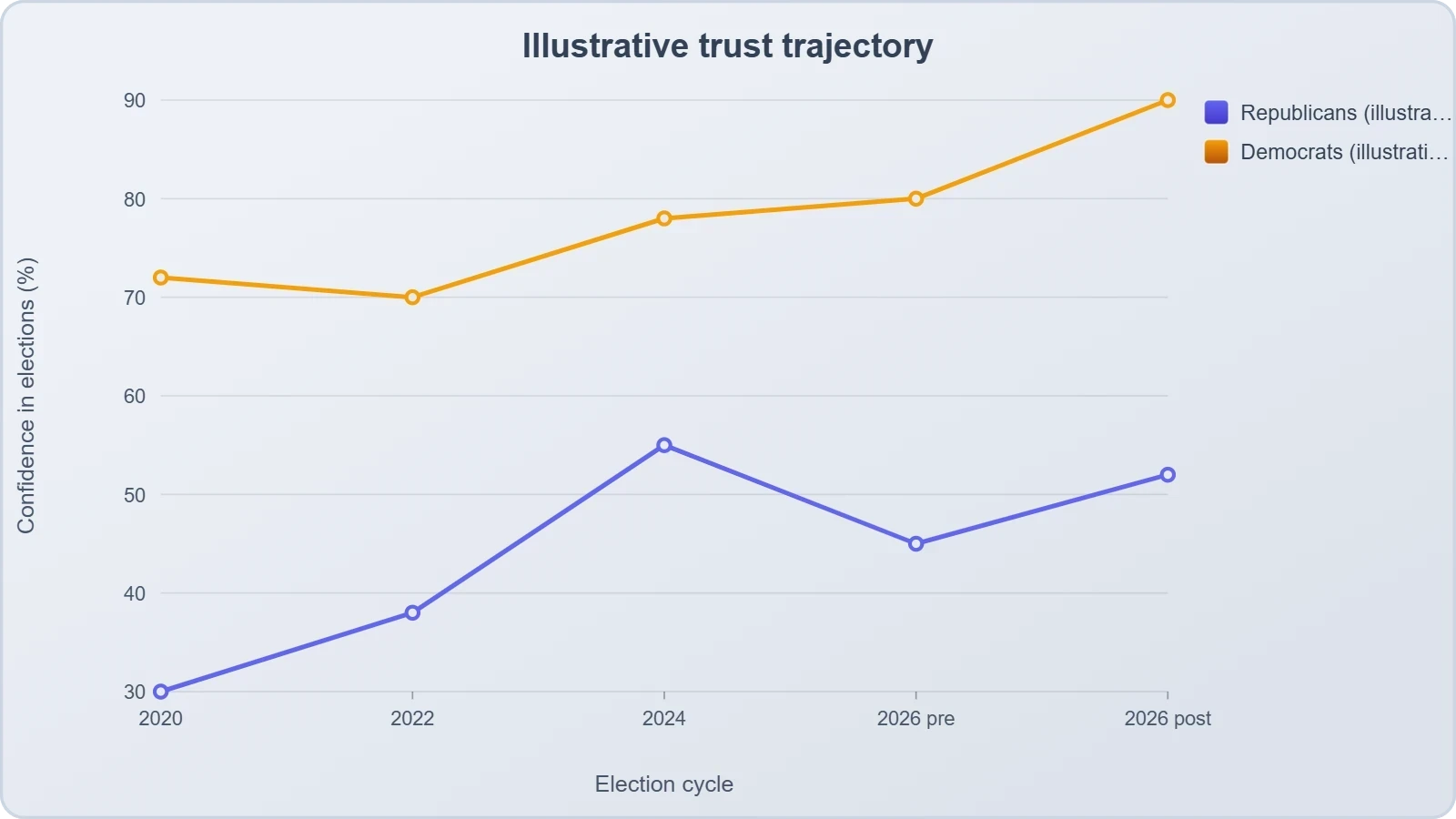
New survey data from the University of California San Diego's Center for Transparent and Trusted Elections quantifies that disconnect with unusual clarity. Nationwide, 66% of Americans judged the midterms free and fair, a marked improvement over pre-election expectations when fewer than half anticipated honest contests. Yet beneath that encouraging headline sits a stark partisan fracture. Only 52% of Republican voters said they trusted votes were counted accurately — a collapse from the more than 80% confidence Republicans expressed after the 2024 election Trump won. The gap between a president's public posture and his voters' private doubts is the real story buried in the aggregate numbers.
This analysis examines what that divergence means for governance, for the machinery of future elections, and for the political incentives that keep election skepticism alive long after the ballots are certified. It weighs the evidence from candidate-level results, the trajectory of trust over successive cycles, and the structural forces that make one party's confidence swing so violently depending on who wins. The picture that emerges is neither a simple vindication of the system nor a straightforward indictment of it, but a portrait of a democracy learning to live with a durable, asymmetric distrust.
On This Page
TL;DR President Trump initially accepted the 2026 midterm results before reverting to conspiracy claims, and UC San Diego polling shows only 52% of Republicans trusted the vote count — down from over 80% after the 2024 election. While 66% of Americans overall judged the midterms fair, that figure was buoyed by Democrats and independents, masking a widening partisan trust gap. Election-denying candidates for statewide oversight posts largely lost, and major losing figures conceded, suggesting institutional resilience. Yet the persistence of GOP doubt signals that election skepticism remains a durable feature of the political landscape, not a fading aberration.
The Anatomy of a Trust Collapse
Trust in elections is rarely a stable quantity; it behaves more like a market that rallies and crashes with the news cycle. The UC San Diego data reveals a Republican confidence curve that has swung more dramatically than that of any other voting bloc in recent memory. After the 2024 presidential contest, more than four in five Republicans expressed faith in vote counting. Two years later, that number had fallen by roughly thirty percentage points. Such volatility is not incidental — it tracks closely with whether the party's standard-bearer won or lost, and with the signals he sends afterward.
The Losing-Party Effect and Its Amplifiers
Political scientists have long documented a "losing-party effect": supporters of the vanquished side tend to express less confidence in electoral integrity than supporters of the winner. This is a normal, if unflattering, feature of partisan psychology. What distinguishes the current Republican case is the magnitude and durability of the swing. Thad Kousser, co-director of the UC San Diego center, noted that many voters remain "unconvinced that they can trust elections," and that these doubters are "predominantly located in one [political] party." The concentration matters because it transforms a diffuse national skepticism into a bloc-specific conviction.
The amplification comes from elite messaging. When a president who spent years alleging a stolen 2020 election reverses course to accept a result and then reverses again to question it, the whiplash teaches supporters that acceptance is tactical rather than principled. Lauren Prather, the center's other co-director, warned against reading the 66% national figure as evidence of broad contentment, observing that it "really buries the lede a little bit about the partisan gap." In other words, the aggregate number flatters the system while the subgroup data exposes its fragility.
Why the Aggregate Number Misleads
The national 66% figure invites a complacent reading: two-thirds of the country believes the midterms were fair, so the system is healthy. But aggregation conceals distribution. That 66% was assembled from near-unanimous Democratic confidence, strong independent support, and a Republican bloc split almost evenly. Remove any one pillar and the structure looks far less sturdy. The pre-election baseline — fewer than half of adults expecting free and fair contests — makes the post-election improvement look like a relief, but the improvement was driven almost entirely by voters whose side won.
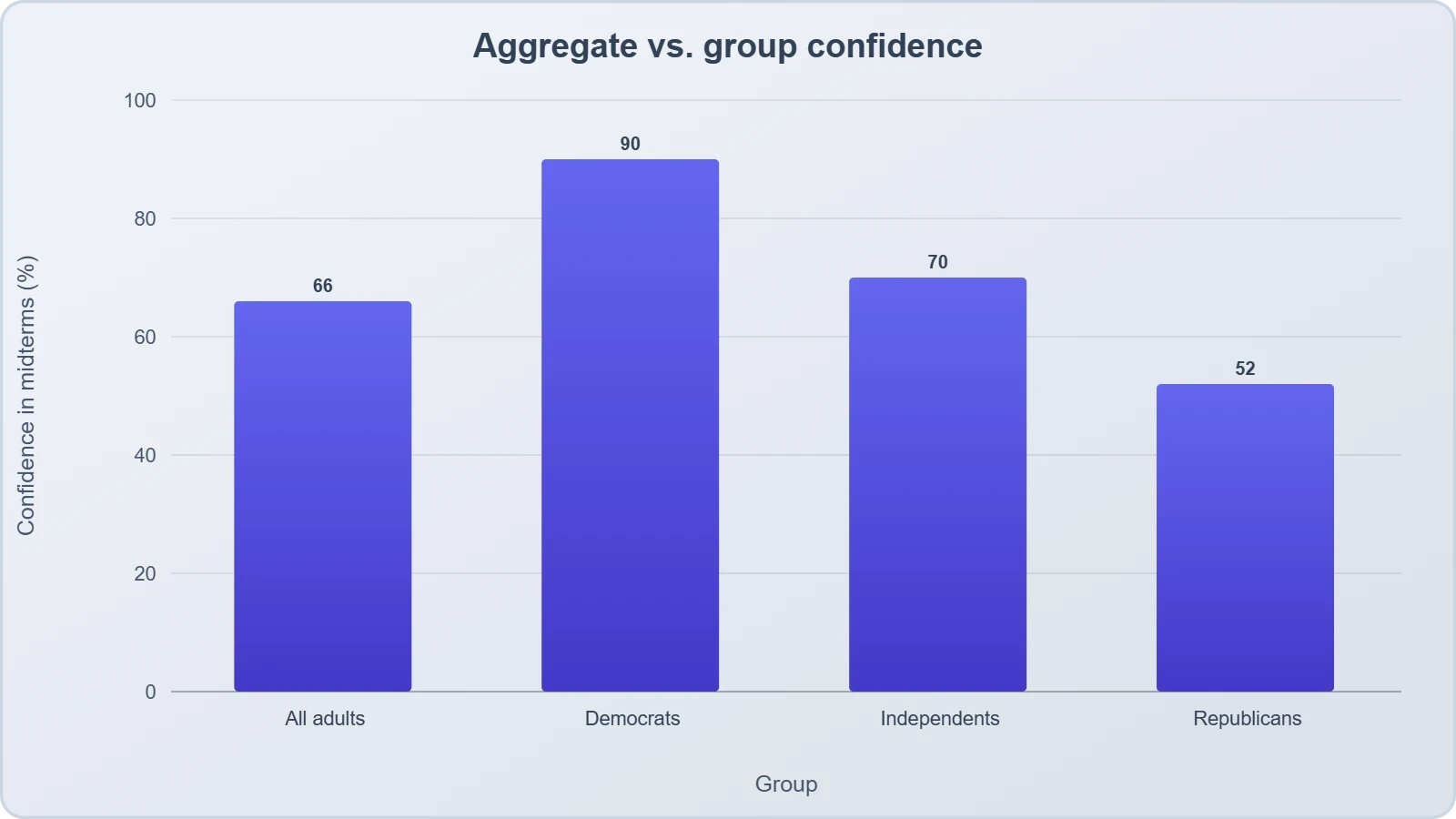
This is the statistical equivalent of a mirage. The overall number rose not because Republicans came around but because Democrats and independents, many of whom had feared federal interference before Election Day, exhaled once the votes were tallied. Their confidence was earned by outcome, not by process. When trust is contingent on victory, it is not really trust in elections at all — it is trust in winning, dressed in civic language. The distinction matters enormously for anyone trying to gauge the actual health of democratic institutions.
Institutional Resilience Beneath the Doubt
Against the grim polling sits a genuinely encouraging set of electoral facts. The vast majority of candidates who denied or questioned prior election results — those running for positions with direct authority over statewide election administration — lost their races in 2026, according to tracking by the advocacy group States United Action. Fewer election deniers will hold office next year than before. That outcome suggests voters, whatever they tell pollsters about distrust, were unwilling to hand the machinery of elections to people who had preemptively refused to certify them.
The Concession That Mattered
Concessions are the unglamorous ritual that keeps democratic transitions peaceful, and this cycle produced them at the highest levels. Trump himself conceded on election night, and high-profile losing candidates followed suit. Election experts pointed to these concessions as evidence that the guardrails held under pressure. A concession does not require the conceder to believe the process was flawless; it requires only that he prioritize the transfer of power over the gratification of grievance. That so many did so, even while their supporters harbored doubts, is a meaningful data point about elite behavior.
Yet the concession also illustrates the limits of elite signaling. Trump's acceptance lasted days before he began asking, publicly, whether anyone really believed the election was honest. The reversal demonstrates that a single concession cannot undo years of conditioning. If anything, the brief acceptance followed by renewed doubt may be more corrosive than consistent denial, because it teaches supporters that acknowledgment of results is a temporary tactic to be abandoned once the cameras move on. The ritual was performed, but its meaning was hollowed out.
Guardrails Under Strain
Institutional resilience is not the same as institutional immunity. The fact that deniers lost does not mean denial is losing; it may simply mean that denial, as a campaign strategy, has not yet been optimized for down-ballot races. The polling suggests a large reservoir of voters receptive to claims of corruption, and reservoirs do not drain on their own. The guardrails held this cycle partly because the specific candidates carrying the denial banner were weak, and partly because the national mood tilted against the party that had spent years questioning elections. Neither condition is permanent.
Moreover, the machinery of election administration is being contested in quieter ways. The Trump administration's pursuit of voter-roll reviews and the push by GOP state officials to revive mail-voting restrictions for 2028 represent a slower, more bureaucratic front in the same conflict. These efforts do not require a mob or a conspiracy theory; they operate through rulemaking, litigation, and administrative pressure. The risk is that trust erodes not through dramatic refusals to certify but through a thousand procedural skirmishes that make voting harder and results more contestable.
The Partisan Asymmetry of Doubt
What makes the current moment distinctive is not that losing parties doubt elections — that is ancient — but that the doubt has become asymmetric and identity-bound. Democratic confidence in 2026 was near-unanimous, and independent confidence was strong. Republican confidence alone collapsed. When trust in a shared institution splits cleanly along partisan lines, the institution stops functioning as a shared reference point. Elections become something one side believes in and the other side tolerates only when it wins, which is a fundamentally different political equilibrium from the one the American system was designed around.
Identity, Not Information
Attempts to explain the gap through information deficits — assuming Republicans simply lack facts about election security — tend to fail because the doubt is not really epistemic. It is expressive. Believing that elections are rigged has become a way of signaling loyalty to a political identity, and no amount of audit data or certification will dislodge a belief that serves a social function. This is why confidence rebounded to over 80% after 2024 and collapsed after 2026: the belief tracks partisan standing, not evidence. Information cannot fix a problem that information did not create.
The implication is uncomfortable for reformers. Proposals to restore trust through transparency, paper trails, and post-election audits are worthwhile on their own merits, but they address a rational-actor model of distrust that does not match reality. If the doubt is identity-driven, then the remedy must operate at the level of elite signaling and partisan incentive, not at the level of technical assurance. Kousser's observation that the unconvinced are "predominantly located in one party" is a diagnosis of a political problem wearing the costume of an administrative one.
The Feedback Loop Between Rhetoric and Reality
Election denial is not a static belief; it is a feedback system. A leader questions a result, supporters absorb the doubt, pollsters record the doubt, commentators cite the polling as evidence of a crisis, and the leader cites the crisis as justification for further questioning. Each turn of the loop reinforces the next. The UC San Diego data showing a receptive audience for Trump's post-election conspiracy theorizing is not merely a description of public opinion — it is an input into the next cycle of the same machine. The 52% figure will be cited, in turn, as proof that something must be wrong.
The Cost of Normalized Doubt
The costs of this loop are cumulative and often invisible until they crystallize. When a substantial share of one party doubts the legitimacy of elections, it becomes harder to staff polling places, harder to recruit election officials, and harder to pass bipartisan election administration reforms. It also raises the temperature of every close race, transforming routine recounts into existential contests. The 2026 cycle avoided the worst outcomes because concessions were made and deniers lost, but the underlying conditions that produced the doubt remain fully intact and will meet the 2028 election with two more years of reinforcement.
There is also a cost to the doubters themselves. A politics in which every loss is presumed illegitimate deprives its participants of the ability to learn from defeat, to diagnose why majorities rejected them, and to build coalitions for the next contest. The Republican confidence collapse is, in this sense, a strategic liability as much as a civic one. Parties that believe the game is rigged stop practicing; parties that believe it is winnable adapt. The irony is that the very skepticism meant to explain away losses may make future losses more likely by discouraging the introspection that recovery requires.
- 01
- 02
- 03
- 04
What the 2028 Election Inherits
The 2026 midterms leave behind a mixed inheritance. On the positive side, the system survived a stress test: results were accepted at the top, deniers lost down-ballot, and the machinery of certification held. On the negative side, the reservoir of Republican distrust is deeper than it was two years ago, and the conditions that fill it — elite messaging, partisan identity, and a media ecosystem that rewards grievance — have not changed. The 2028 election will arrive with a base that has been told, repeatedly and recently, that elections cannot be trusted, and with a leadership that has demonstrated it will say so when it suits the moment.
The Reform Agenda and Its Limits
Reformers face a genuine dilemma. The technical fixes that experts recommend — auditable paper trails, risk-limiting audits, transparent chain-of-custody procedures, clearer certification deadlines — are all worth pursuing and would make elections more secure. But they will not, on their own, restore confidence among voters whose doubt is rooted in identity rather than information. Investing exclusively in technical reform risks producing a system that is demonstrably more trustworthy and a public that trusts it no more. The gap between objective integrity and perceived legitimacy is the central challenge of the coming cycle.
Closing that gap requires addressing the incentive structure that makes denial profitable. As long as questioning results energizes a base without costing elections, some politicians will do it. The 2026 results offer a modest counter-incentive: deniers lost. If that pattern holds, denial may gradually become a liability rather than an asset. But one cycle is not a trend, and the polling suggests the audience for denial remains large. The most honest assessment is that the guardrails held this time, the underlying pressure has not relented, and the next test is already being prepared.
We Also Published
Reading the Numbers Without Flinching
The temptation, confronted with a 66% national confidence figure, is to declare the system healthy and move on. The temptation, confronted with a 52% Republican figure, is to declare the system broken and despair. Neither reading survives contact with the full dataset. What the numbers actually describe is a democracy in which the formal machinery is functioning and the informal consensus that sustains it is fraying along a single, predictable seam. The task for analysts and citizens alike is to hold both truths simultaneously, resisting the comfort of the aggregate and the fatalism of the subgroup.
Toward a Clearer Diagnosis
A clearer diagnosis begins with abandoning the assumption that distrust is a knowledge problem awaiting better information. It is a political problem awaiting better incentives. The confidence rebound after 2024 and the collapse after 2026 demonstrate that Republican trust is responsive to outcomes, not procedures. Any strategy that ignores this will spend its resources on audits that persuade no one and reforms that reassure the already-reassured. The productive question is not how to prove elections are fair, but how to make accepting elections fair again — how to lower the political payoff of denial and raise its cost.
That is a slower and less satisfying project than a technical fix, but it is the one the evidence supports. It involves supporting candidates who concede, rewarding officials who certify, and building media habits that do not treat every close race as a crime scene. It also involves patience: trust that took years to erode will not be rebuilt in a single cycle. The 2026 midterms showed that the system can survive a stress test. Whether it can survive the next one depends on whether the seam that split along partisan lines is repaired or widened.
The Wider Meaning for Democratic Legitimacy
Step back from the specific figures and a larger pattern comes into view. The health of a democracy depends less on the technical accuracy of its vote counts — which in the American case is high — than on the willingness of losers to accept that accuracy. That willingness is a cultural inheritance, passed down through concessions, rituals, and elite norms, and it can be depleted. The 2026 data suggests the inheritance has been drawn down substantially within one party, even as the technical machinery has held. The gap between how elections actually work and how they are perceived is the space in which democratic crises incubate.
This is not a uniquely American story, but the American version has a distinctive shape because of the outsized role of a single leader in shaping his party's relationship with electoral reality. Trump's brief acceptance followed by renewed questioning is a case study in how elite behavior can simultaneously reassure and destabilize. It reassured those watching the transfer of power and destabilized those watching the aftermath. The lesson for other democracies is that the ritual of concession is necessary but not sufficient; it must be followed by a sustained posture of acceptance, or it becomes theater.
What remains is a question of civic responsibility that no dataset can answer. Institutions can be fortified, audits can be published, and candidates who deny results can be defeated, but none of these things compels a voter to trust a process that his political identity has taught him to suspect. That final step belongs to citizens, to leaders, and to the slow, unglamorous work of rebuilding a shared premise. The 2026 midterms bought the system time. Whether that time is used to repair the seam or to widen it is the open question on which the next cycle turns.
From our network :
- The Hidden Cost of AI Convenience: Why Over-Permissioned Agents Are a Security Time BombDiscover why AI agents with excessive permissions create dangerous single points of failure, and learn how implementing least privilege principles can protect your organization from exploitation.
- Mobile Learning and VR in English: What Global Evidence Reveals About Effective Language TechnologyA systematic review across 14 countries reveals which language-learning technologies genuinely work. Mobile learning, AI, and VR show measurable benefits when pedagogically integrated. This evidence-based guide helps educators and learners select technology that delivers real return on investment.
- University Language Proficiency Exams: Why Institutional Tests Demand Different Preparation Than IELTS and TOEFLDiscover why university-specific language proficiency examinations differ fundamentally from IELTS and TOEFL, and learn strategic preparation approaches for institutional assessment success.
- CISA’s Ten-Advisory Wave: Why Generic Patching Fails in OT and How to Build Product-Specific PlaybooksCISA released ten ICS advisories in one week, exposing critical infrastructure risks. Generic patching fails in OT. Learn to build product-specific remediation playbooks.
- Committed Mediterranean Precipitation Decline: Why Emissions Cuts Alone Cannot Restore Winter RainsNew NOAA research reveals that Mediterranean winter rains may decline irreversibly even with emissions cuts. Explore the science of committed climate change and regional impacts.
- Forbidden Matrix Patterns and Visible Lattice Points: A Geometric DictionaryExplore how multidimensional 0–1 matrices encode geometric truths, linking forbidden patterns to visible lattice points and hypergraph theory, with applications in combinatorics and computational geometry.
- The Final Descent: How ESA Retired the Legendary Cluster Constellation After 24 Years of Space Weather ScienceAfter 24 years mapping Earth’s magnetosphere, ESA’s Cluster mission concluded with a precisely controlled reentry over the South Pacific. This analysis explores the scientific legacy, engineering decisions, and debris mitigation principles behind one of space exploration’s most responsible retirements.
- Live Online English Classes for Kids: Do They Actually Reduce Anxiety?A ten-week study reveals that synchronous online English classes can significantly reduce child language anxiety while improving listening and reading skills. Discover what makes these programs effective and how parents can select the right one.
- How AI Agents Will Change the Way We Manage Personal FinancesExplore how AI agents are transforming personal finance through automated budgeting, bill payment, and investment management, while examining the critical security protocols and governance frameworks required for safe deployment.
RESOURCES
- Most Republicans doubt the midterms were fair, a poll finds - NPRnpr.org2 hours ago ... ... distrust in the elections process among Republicans. Less than half of Republican voters nationwide considered the midterm elections "free ...
- Republicans more skeptical than Democrats of nationwide election ...pbs.orgNov 1, 2024 ... Voters generally show more distrust toward nationwide voting results compared to the tallies done by their own local election offices,…
- After The 2022 Midterms, Do Americans Trust Elections?yankelovichcenter.ucsd.eduNov 27, 2022 ... and independents that election results accurately reflected the vote, with Republicans especially voicing concerns ... distrust, Republicans ...
- Distrust in election process grips Nevada community | PBS Newspbs.orgJul 29, 2022 ... Midterm Election Results. View the latest called races and outcomes ... READ MORE: Idaho Republicans considers resolution to reject 2020…
- How rural voters are feeling about Trump as the midterms approach ...ap.orgSep 23, 2026 ... ... voting for Republican Sen. Susan Collins in 2020. Collins and ... AP-KFF Elections Midterms Polling results. By Ali Swenson,…
- Trump's election fraud claims spread distrust before midterms ...reuters.comApr 23, 2026 ... Poll shows sharp partisan divide on election fraud beliefs, with Republicans most distrustful ... results point to the enduring impact…
- "Lawmakers Want Colleagues to Promise They Will Accept Midterm ...electionlawblog.orgOct 7, 2026 ... “Lawmakers Want Colleagues to Promise They Will Accept Midterm Election Results” ... WSJ: Democrats and anti-Trump Republicans have grown ...
- Harvard Youth Poll - Institute of Politicsiop.harvard.eduOct 22, 2026 ... Young Americans are approaching the 2026 midterm elections under financial pressure and deeply concerned about the country's future, ...
- Two Years After Election Turmoil, GOP Voters Remain Skeptical on ...pewresearch.orgOct 31, 2022 ... Today, with the midterm elections approaching, widespread GOP distrust persists – and in some cases has deepened. ... midterm election.
- Trump is already claiming the California recall is riggedcalvoter.orgSep 8, 2021 ... ... election results. Republican-turned-independent ... Warnings about pervasive fraud have helped erode Republican distrust in elections.
- After the Midterms, America's Pessimists Hold the Key to 2028 - fesdc.fes.deOct 29, 2026 ... ... midterms will be a distrust election, and 2028 will be an alienation election. ... Republican Party moves forward after…
- Republican and Democratic voters agree on one thing—the need for ...rochester.eduFeb 26, 2021 ... ... congressional supporters in the aftermath ... Republicans distrust the election results and favor moving on without consequences for Trump.
- Voters distrust delayed election results, but a prebunking message ...pmc.ncbi.nlm.nih.govSimilar to the overall results, the magnitude of this effect would mean that for a Republican ... https://apnews.com/article/2022-midterm-elections-covid- ...
- THE DANGERS OF MASS MAIL-IN VOTINGrepublicanpolicy.house.govJun 20, 2024 ... ... vote counting, creating suspicion ... National Public Radio. https://www.npr.org/2022/11/08/1134235552/midterm-election-results-pre-canvassing- ...
- 'A win the size of Texas': Democrats celebrate shrinking Republican ...theguardian.comNov 4, 2026 ... Voters watched results in near disbelief as James Talarico claimed victory in Senate race and Gina Hinojosa was elected state's…
- 01
- 02
- 03
- 04
- 05
- 06
- 07
- 08
0 Comments