
The global financial architecture is undergoing a quiet yet decisive strategic realignment as monetary authorities recalibrate their ambitions for state-issued digital tokens. For nearly a decade, the narrative surrounding monetary innovation was dominated by the prospect of general-purpose or retail central bank digital currencies directly accessible to ordinary citizens. Visionaries heralded an era where sovereign electronic tokens would replace physical banknotes, democratize access to financial services, and provide an unassailable digital alternative to private banking platforms and commercial payment networks.
However, the concluding deliverables of landmark international research initiatives, including the
’s multi-year central bank digital currency framework, demonstrate a clear retreat from retail deployment. Central bankers across leading advanced economies have confronted the stark trade-offs of entering the retail payment arena, ranging from severe commercial bank disintermediation to insoluble public privacy anxieties. Consequently, institutional attention has pivoted away from consumer wallets toward the less visible, highly technical domain of interbank settlements, foreign exchange liquidity, and wholesale financial plumbing.
This retreat does not signify the abandonment of digital ledger modernization, but rather an acknowledgement of institutional boundaries and economic realities. Central banks are built to oversee systemic liquidity, act as lenders of last resort, and regulate money creation rather than manage millions of consumer ledger accounts, customer service complaints, and everyday point-of-sale payment interactions. By shifting resources to wholesale settlement layers and cross-border connectivity, policymakers are choosing to enhance financial infrastructure where systemic efficiency gains can be achieved without compromising macroeconomic stability.
TL;DR Central banks worldwide have quietly shelved broad plans for retail consumer digital currencies, guided by findings from the International Monetary Fund and major monetary authorities. Instead of issuing state-backed digital dollars or euros into consumer smartphone wallets, central bankers are prioritizing wholesale digital settlement infrastructure to upgrade cross-border payments, preserve commercial bank deposits, and avoid immense operational and privacy controversies.
On This Page
- The Strategic Reversal in Retail Central Bank Digital Currencies
- Structural Vulnerabilities and Commercial Bank Disintermediation
- Privacy Friction and Public Resistance Against Digital Cash
- Operational Realities and Technological Cost Traps
- The Rise of Wholesale Interbank Settlement Architecture
- The Future Trajectory of Sovereign Digital Financial Plumbing
The Strategic Reversal in Retail Central Bank Digital Currencies
The pivot away from retail-oriented sovereign tokens marks one of the most significant monetary policy reassessments of the modern era. When decentralized cryptocurrencies and corporate payment initiatives first surged into global prominence, monetary institutions feared losing sovereign monetary transmission to unregulated private rails. Early policy papers framed consumer digital cash as an indispensable defensive measure designed to safeguard public trust, maintain the anchor of central bank money, and promote financial inclusion across underbanked populations. Yet, comprehensive technical pilots and extensive macro simulations have shown that consumer digital cash creates far more systemic friction than genuine economic utility.
The Influence of the IMF CBDC Virtual Handbook

The completion of the IMF CBDC Virtual Handbook has served as an authoritative benchmark for finance ministries and monetary authorities worldwide. By systematically detailing the complex operational, legal, and stability implications of currency digitalization, the guidance underscored that retail payment markets in most jurisdictions are already exceptionally well-served by competitive private payment rails. Modern fast-payment systems, instant peer-to-peer applications, and ubiquitous card networks leave negligible structural voids for an official state retail token to fill. Policymakers realized that building parallel consumer-facing architecture would duplicate existing commercial solutions without providing compelling added value to the broader populace.
Furthermore, the guidance clarified that sovereign credibility does not require central banks to manage consumer user interfaces or maintain direct digital accounts for millions of citizens. Attempting to replicate commercial customer service, dispute resolution, and fraud mitigation mechanisms places an enormous administrative burden on central bank staff while yielding minimal tangible improvements in financial access. Consequently, international analytical consensus converged on the reality that digital sovereignty is far better protected through robust wholesale settlement rails, modernized interbank clearing protocols, and stringent oversight of private payment service operators rather than deploying state-run digital cash into public hands.
From Public Panacea to Bureaucratic Retrenchment
Initial interest in retail tokens was largely driven by institutional anxiety over the rapid ascent of private payment platforms and speculative decentralized assets. Central bankers worried that without a direct digital liability issued to the public, the monetary anchor could erode as physical cash usage steadily diminished. This defensive impulse spurred accelerated exploratory initiatives in Washington, Frankfurt, London, and Tokyo. However, as exploratory committees conducted field research, the political and operational realities of implementing sovereign digital payment instruments proved far more contentious and economically volatile than early academic theoretical modeling had suggested.
Regulatory consultations in multiple developed nations surfaced intense resistance from commercial lenders, privacy advocates, and parliamentary oversight bodies. Lawmakers questioned the rationale behind committing hundreds of millions of dollars in public capital toward state digital wallets when private payment rails function with extreme reliability. The realization that digital cash would require capping consumer balances to prevent sudden runs on the commercial banking sector further diluted consumer appeal. With caps severely restricting utility, enthusiasm for retail digital legal tender quickly waned across central banking boardrooms.
Structural Vulnerabilities and Commercial Bank Disintermediation

The primary macroeconomic hazard deterring central banks from deploying consumer-facing digital cash is the existential threat of bank disintermediation. The modern fractional reserve banking system depends fundamentally on commercial bank deposits to finance productive real-world lending, industrial credit lines, and residential mortgages. If citizens gain frictionless access to an uncollateralized, credit-risk-free claim on the sovereign monetary authority, the natural equilibrium of retail bank deposits is disrupted. In periods of geopolitical instability or economic stress, digital flight from regional banks into sovereign digital accounts could unfold at unprecedented velocity.
Deposit Flight Dynamics During Systemic Stress
The core mathematical relationship governing systemic deposit vulnerability under an unconstrained digital currency model highlights the sensitivity of bank liabilities to sudden flight. When confidence in a mid-sized lender wavers, the velocity of capital transfers accelerates drastically if moving funds requires only a mobile app interaction transferring balances directly into central bank reserves. Under fractional reserve arrangements, aggregate commercial bank lending capacity ##L_c## depends heavily on stable customer deposits ##D_r## and the regulatory reserve requirement ##R_r##, expressed fundamentally as:
where ##\alpha## represents the systemic risk premium demanded by wholesale funding counterparties. If a substantial portion of ##D_r## migrates permanently into non-lending sovereign digital wallets, the contraction in private credit generation is pronounced. Central bankers quickly recognized that during financial panic, consumer runs on troubled financial institutions would no longer be bounded by the logistical frictions of standing in line at physical branches or transporting paper cash. The frictionless speed of digital transfers could convert localized liquidity pinches into full-blown insolvency events within minutes.
The Moral Hazard of Re-Intermediation
To neutralize the threat of deposit flight, theoretical architects proposed that central banks could re-intermediate fleeing funds by recycling collected digital currency balances back to commercial banks via institutional lending facilities. However, this palliative mechanism introduces severe moral hazard into the financial ecosystem. If the central bank becomes the primary supplier of commercial liquidity, monetary authorities must inevitably establish underwriting criteria, collateral margins, and allocation quotas for private financial institutions, effectively deciding which banks receive liquidity injections and on what specific terms.
Such expansive interventions would subtly transition monetary authorities from passive market overseers into centralized arbiters of domestic capital allocation. Commercial banks, freed from the discipline of cultivating private depositor loyalty, would become structurally reliant on central bank funding channels. Regulators globally viewed this dynamic as an unacceptable distortion of free-market banking principles. Rather than assuming the burden of redistributing trillions of dollars in commercial funding, central banks determined that leaving consumer deposits securely housed within the regulated private banking sector was the only prudent choice.
Privacy Friction and Public Resistance Against Digital Cash
Beyond technical and balance-sheet considerations, the prospect of retail digital currency encountered unprecedented political and civil backlash centered around transactional confidentiality. Unlike physical legal tender, which affords citizens total anonymity for routine everyday transactions, any digital payment system must conform to international standards on anti-money laundering and combating the financing of terrorism. Creating a completely anonymous sovereign digital currency was legally impossible, while creating a fully traceable, state-managed monetary database proved politically toxic across mature democracies.
The Surveillance State Narrative and Legislative Resistance
Public consultations held across North America and Europe revealed deep suspicion toward government-administered ledgers. Civil liberties groups, legal scholars, and libertarian organizations quickly organized around the argument that consumer tokens would equip governments with an unheralded surveillance instrument. Unlike commercial financial institutions, where transactional records are fragmented across hundreds of private entities shielded by customer privacy statutes, a unified central bank payment ledger could grant regulatory agencies direct, centralized visibility into citizen expenditures, donations, and individual lifestyles.
In the United States, this apprehension manifested as bipartisan legislative friction. Several states moved proactively to prohibit the use of central bank digital currencies within their jurisdictions, while federal legislators drafted statutory bans preventing the Federal Reserve from ever issuing a retail token directly to individuals. In Europe, despite extensive assurances from monetary authorities that zero-knowledge proofs and tiered anonymity thresholds would be engineered into the digital euro, civil resistance remained staunch. Central bankers realized that pushing forward with consumer cash risked eroding the fundamental public trust essential for broad central bank credibility.
The Programmability Paradox
A major selling point initially promoted by digital currency theorists was "programmability"—the ability to attach smart contract logic directly to monetary units. Technocrats suggested that conditional stimulus disbursements, targeted welfare programs, and time-expiring subsidies could be executed with precision. However, this theoretical functionality became the ultimate public relations vulnerability. The broader public perceived programmable currency not as an innovative convenience, but as a coercive policy mechanism through which state planners could dictate consumption behaviors, punish disfavored industries, or force artificial consumer velocity.
Central banks attempted to calm public outrage by clarifying that sovereign money would always remain strictly fungible and never subject to conditional expiration or spending restrictions. Yet, by stripping out programmability to preserve monetary neutrality, central banks systematically undermined the unique value proposition of their proposed digital cash. If a central bank digital token is stripped of conditional logic, capped at modest balances to protect commercial banks, and subjected to standard identity checks, it offers consumers zero distinct advantages over commercial electronic bank balances or existing digital wallet applications.
Operational Realities and Technological Cost Traps
Developing, deploying, and maintaining enterprise consumer technology requires an operational apparatus radically different from managing monetary policy. Central banks are elite bureaucratic institutions populated by monetary economists, econometricians, and legal scholars. They are not engineered to function as consumer fintech platforms responsible for rolling out continuous mobile updates, remediating user authentication errors, managing customer contact centers, or combating retail-level cyber fraud. Confronting the true operational expenditures of retail deployment was instrumental in shifting institutional priorities.
The Cybersecurity Surface Area Dilemma
Every software system possesses an attack surface directly proportional to the number of endpoints and external integrations it maintains. A wholesale settlement network interfaces exclusively with a tightly regulated cohort of commercial banks, clearing houses, and custodians. These connections operate across dedicated private networks protected by hardware security modules, enterprise-grade identity controls, and strict mutual authentication protocols. In stark contrast, a retail currency must interface with tens of millions of consumer smartphones running outdated operating systems, compromised with third-party software, and exposed to continuous phishing schemes.
If a consumer wallet is breached or manipulated, public anger immediately directs its focus toward the central bank itself. Even if the underlying monetary core remains completely secure, social engineering attacks, account takeovers, and fraudulent chargeback disputes at the user interface level directly damage institutional trust. Monetary authorities realized they would be forced into becoming consumer fraud investigators of last resort. For organizations whose mandates focus exclusively on broad macroeconomic equilibrium and price stability, managing retail cybersecurity claims presented an intolerable reputational hazard.
The Two-Tier Intermediary Fallacy
In an attempt to sidestep operational bloat, many central banks designed "two-tier" architectures where commercial banks or fintech intermediaries would handle consumer onboarding, identity verification, and frontend application support. The central bank would simply maintain the underlying master ledger. However, this theoretical model quickly collapsed under commercial reality. Private financial institutions questioned why they should shoulder substantial operational costs, compliance obligations, and cybersecurity risks to distribute a sovereign product that actively competes with their own revenue-generating deposit bases and credit cards.
Without charging interchange fees or monetizing consumer purchase data—both of which undermine the public-utility nature of state money—private intermediaries have no viable business model to support retail token distribution. Central banks realized that they would either have to subsidize commercial banks directly using public funds or build their own redundant frontend payment infrastructure from scratch. Confronted with this expensive policy dilemma, monetary authorities chose to shelve consumer interfaces entirely, focusing their limited technology capital where private intermediaries are eager to participate: backend wholesale clearing networks.
- 01
- 02
- 03
- 04
We Also Published
The Rise of Wholesale Interbank Settlement Architecture
While consumer-facing digital cash plans have been quieted, development in wholesale interbank digital currencies is accelerating at a historic pace. Wholesale systems modernize the existing clearing channels that central banks maintain with commercial lenders. Instead of focusing on retail coffee purchases or peer-to-peer bill splitting, wholesale modernization tackles multitrillion-dollar frictions: cross-border settlements, securities tokenization, foreign exchange counterparty risks, and synchronized delivery-versus-payment mechanisms across global markets.
Project mBridge and Multilateral Settlement Hubs
The clearest manifestation of the wholesale shift is Project mBridge, a collaborative multi-central bank initiative coordinated with the Bank for International Settlements Innovation Hub. By connecting monetary authorities and commercial lenders across multiple jurisdictions on a purpose-built distributed ledger, mBridge facilitates real-time cross-border payments and foreign exchange transactions using wholesale sovereign digital assets. Unlike traditional correspondent banking, which routes capital through multiple intermediary institutions across several business days, transactions settle atomically within seconds.
This wholesale architecture bypasses the painful political and civil trade-offs that stalled consumer digital cash. Because all network participants are regulated financial institutions, existing compliance and anti-money laundering frameworks map directly onto the digital ledger without infringing upon individual privacy rights. Sovereign monetary transmission remains intact, commercial lenders preserve their retail deposit bases, and international trade participants realize dramatic reductions in fees and settlement latency. For central bankers looking for genuine productivity enhancements, wholesale clearing networks present a vastly superior return on capital expenditure.
Eliminating Herstatt Risk and Trapped Capital
A persistent vulnerability in traditional international finance is foreign exchange settlement risk, historically known as Herstatt risk. This danger arises when one party in an FX transaction transfers its currency leg but fails to receive the counterparty currency due to operational lags, time-zone differentials, or counterparty insolvency during the settlement window. Conventional settlement engines mitigate this risk using bilateral credit lines and massive liquidity buffers pre-funded inside foreign correspondent accounts known as Nostro and Vostro balances.
Wholesale digital currencies resolve this inefficiency through cryptographic Payment-versus-Payment (PvP) mechanisms. Using smart contracts and interconnected wholesale ledgers, the transfer of Currency A occurs if and only if the transfer of Currency B executes simultaneously. If either counterparty defaults or fails to provide liquidity, the entire transaction reverts automatically without capital loss. By eliminating counterparty risk in real-time interbank markets, central banks can unlock hundreds of billions of dollars in trapped international liquidity, making wholesale digital finance a foundational efficiency upgrade for the real global economy.
The Future Trajectory of Sovereign Digital Financial Plumbing
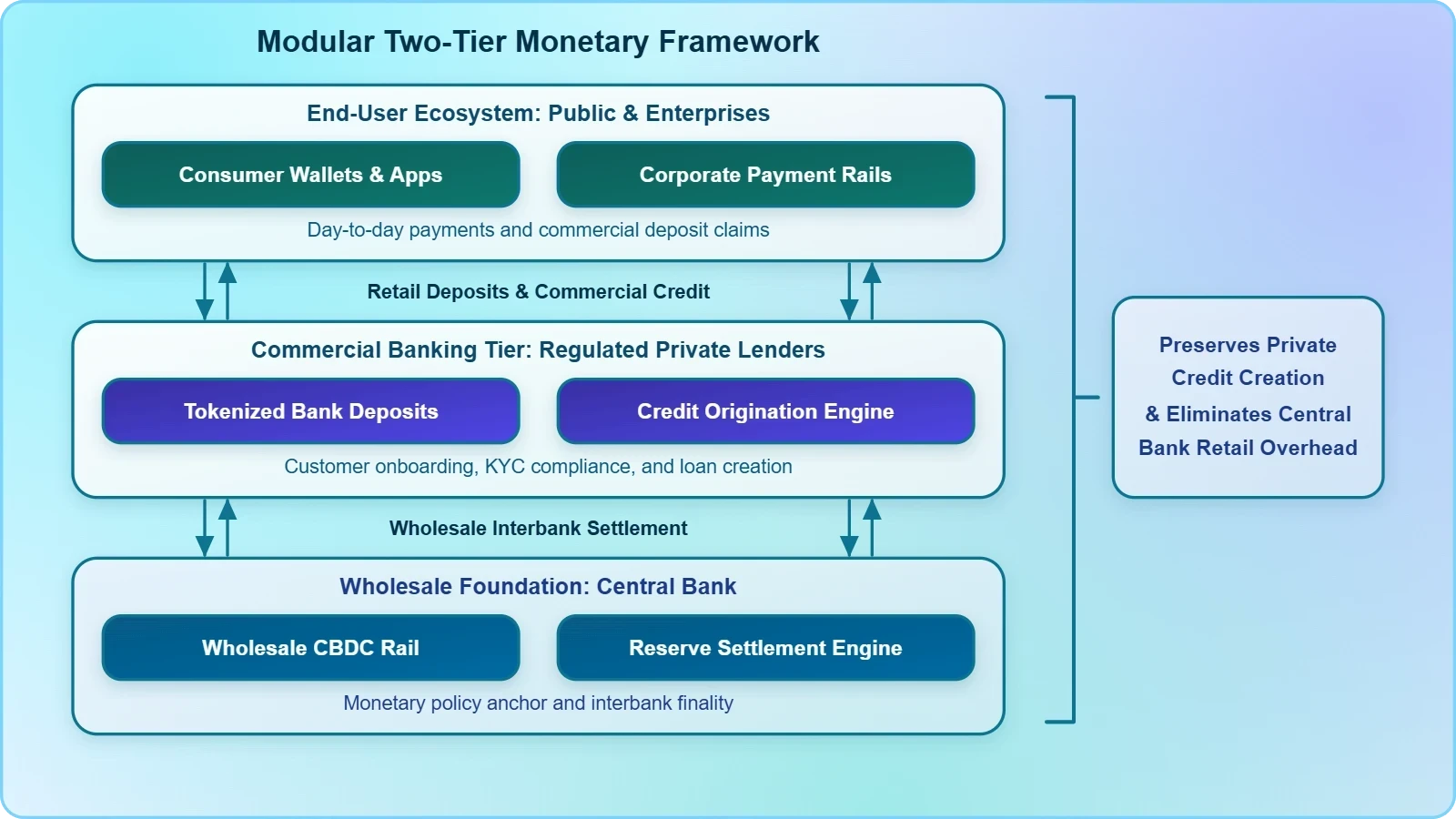
The quiet abandonment of consumer digital currencies does not imply that public finance will remain static. Instead, the future of state-issued digital money is coalescing around a modular paradigm. In this evolving model, central banks operate as foundational liquidity anchors and settlement infrastructure providers, while licensed commercial entities innovate at the client-facing periphery. Rather than attempting to displace commercial money, monetary institutions are building the digital rails upon which regulated commercial bank deposits, tokenized bonds, and asset-backed stablecoins can clear with absolute institutional certainty.
Tokenized Commercial Deposits Over Retail Tokens
Rather than adopting state-issued digital dollars or euros, financial markets are embracing tokenized commercial deposits. Under this paradigm, balances held at licensed private lenders are represented as cryptographic tokens on permissioned ledgers. These tokenized balances retain full deposit insurance protections, earn conventional interest yields, and support credit creation just like traditional checking balances. However, they gain the technological advantages of ledger-based finance: continuous 24/7 programmability, automated escrow capabilities, and atomic settlement against tokenized financial assets.
Central banks strongly support this structural evolution because it preserves the proven two-tier monetary architecture that has governed market economies for generations. Monetary authorities retain ultimate regulatory authority and manage the wholesale base money layer, while private commercial institutions continue to bear credit risks, maintain underwriting standards, and interact directly with consumers. By integrating tokenized commercial deposits with wholesale central bank settlement infrastructure, the financial sector achieves the operational benefits of modernization without destabilizing private credit markets or compromising civil liberties.
A Practical Realignment in Sovereign Monetary Strategy
The quiet shelving of consumer digital cash represents a triumph of financial realism over ideological hype. In the early stages of digital currency development, excitement outpaced practical economic assessment. Policymakers have now undertaken rigorous empirical pilots, analyzed consumer adoption barriers, and evaluated the immense structural costs of displacing private commercial banking. The conclusion reached across global monetary centers is unambiguous: consumer retail payments are already highly efficient, and injecting state digital cash creates grave macroeconomic vulnerabilities with negligible public reward.
By reallocating institutional resources toward wholesale settlement mechanisms, cross-border multilateral ledgers, and tokenized interbank liquidity rails, central banks are executing their mandates responsibly. They are upgrading the deep, systemic financial plumbing where efficiency improvements yield trillions of dollars in real economic value without placing government surveillance tools into consumer wallets. The digital transformation of sovereign finance is proceeding with purpose—not through state applications on consumer smartphones, but through the silent, invisible modernization of the global interbank architecture.
From our network :
- University Language Proficiency Exams: Why Institutional Tests Demand Different Preparation Than IELTS and TOEFLDiscover why university-specific language proficiency examinations differ fundamentally from IELTS and TOEFL, and learn strategic preparation approaches for institutional assessment success.
- The Final Descent: How ESA Retired the Legendary Cluster Constellation After 24 Years of Space Weather ScienceAfter 24 years mapping Earth’s magnetosphere, ESA’s Cluster mission concluded with a precisely controlled reentry over the South Pacific. This analysis explores the scientific legacy, engineering decisions, and debris mitigation principles behind one of space exploration’s most responsible retirements.
- Committed Mediterranean Precipitation Decline: Why Emissions Cuts Alone Cannot Restore Winter RainsNew NOAA research reveals that Mediterranean winter rains may decline irreversibly even with emissions cuts. Explore the science of committed climate change and regional impacts.
- The Hidden Cost of AI Convenience: Why Over-Permissioned Agents Are a Security Time BombDiscover why AI agents with excessive permissions create dangerous single points of failure, and learn how implementing least privilege principles can protect your organization from exploitation.
- Forbidden Matrix Patterns and Visible Lattice Points: A Geometric DictionaryExplore how multidimensional 0–1 matrices encode geometric truths, linking forbidden patterns to visible lattice points and hypergraph theory, with applications in combinatorics and computational geometry.
- How AI Agents Will Change the Way We Manage Personal FinancesExplore how AI agents are transforming personal finance through automated budgeting, bill payment, and investment management, while examining the critical security protocols and governance frameworks required for safe deployment.
- CISA’s Ten-Advisory Wave: Why Generic Patching Fails in OT and How to Build Product-Specific PlaybooksCISA released ten ICS advisories in one week, exposing critical infrastructure risks. Generic patching fails in OT. Learn to build product-specific remediation playbooks.
- Live Online English Classes for Kids: Do They Actually Reduce Anxiety?A ten-week study reveals that synchronous online English classes can significantly reduce child language anxiety while improving listening and reading skills. Discover what makes these programs effective and how parents can select the right one.
- Mobile Learning and VR in English: What Global Evidence Reveals About Effective Language TechnologyA systematic review across 14 countries reveals which language-learning technologies genuinely work. Mobile learning, AI, and VR show measurable benefits when pedagogically integrated. This evidence-based guide helps educators and learners select technology that delivers real return on investment.
RESOURCES
- Wholesale and retail CBDCs – what exactly is the difference?weforum.orgFeb 6, 2024 ... Central bank digital currencies (CBDCs) come in two main forms: retail and wholesale. · A retail CBDC is used by…
- Demystifying wholesale central bank digital currencyecb.europa.euSep 26, 2022 ... Wholesale CBDC refers to the settlement of interbank transfers and related wholesale transactions in central bank reserves.
- CBDCs: What are the distinctions between wholesale and retail?cfainstitute.orgApr 25, 2024 ... Wholesale CBDCs are designed for financial institutions and large-value settlement, while retail CBDCs serve individuals and may broaden ...
- The Fed - Examining CBDC and Wholesale Paymentsfederalreserve.govSep 8, 2023 ... Examining CBDC and Wholesale Payments. Jon Durfee, Jesse Leigh ... For a retail experiment example, see BISIH and Bank of…
- Public demand and financial implications for retail CBDCsciencedirect.comCBDCs are categorized into two types as a digital form of cash: retail and wholesale, depending on their target users. A wholesale CBDC is…
- results of the 2024 BIS survey on central bank digital currencies and ...bis.orgAug 22, 2025 ... ... retail CBDC, a wholesale CBDC or both. At an aggregate level, the exploration of wholesale CBDCs is at more…
- Assessing the Case for Retail CBDCs: Central Banks' Considerationskansascityfed.orgMay 26, 2022 ... Endnotes · 1. Retail (or general-purpose) CBDCs are available for public use (like cash), while wholesale CBDCs are mainly for…
- CBDCs in Europe: retail and wholesale projects to followflow.db.comNov 16, 2023 ... The European Central Bank (ECB) has decided to continue its retail CBDC project. What does this decision mean for the…
- About Tokenised Money | RBArba.gov.auIt would be designed for use in wholesale payment and settlement systems. ... Retail CBDC: A retail central bank digital currency, or 'retail CBDC',…
- A Breakdown of the Different CBDC Models | Cato at Liberty Blogcato.orgFeb 10, 2023 ... ... (CBDC) designs that subtly change how one might operate in practice. Generally, these CBDC models fall into two categories:…
- Retail Central Bank Digital Currency: Design Considerations ...rba.gov.auSep 17, 2020 ... We can further distinguish between retail CBDC, which would be like a digital version of cash that is essentially universally…
- Cross-Border Payments with Retail Central Bank Digital Currenciesimf.orgMay 14, 2024 ... ... wholesale CBDC considerations for future work, although many of the discussions are applicable to wholesale CBDC and other forms…
- Wholesale CBDC: as decisive as Retail CBDC, and actively ...banque-france.frOct 3, 2023 ... The use of wholesale CBDCs has the potential to address a number of friction costs and issues regarding deadlines and…
- Wholesale CBDC Global Developments - Payments Canadapayments.ca... retail CBDC versus a wholesale. CBDC, motivations for wholesale CBDC issuance range from increased circulation and access to central bank money to enhancing ...
- 01
- 02
- 03
- 04
- 05
- 06
- 07
- 08
0 Comments