The Reserve Bank of Australia's decision to lift the cash rate to 4.85 percent in November 2026 marked the fifth tightening of the year, and it landed with unusual force because the vote itself was split. Six board members backed a quarter-point increase while three argued for holding at 4.60 percent, a division that reveals genuine disagreement inside the central bank about how much pain the economy can absorb. Governor Michele Bullock framed the choice candidly: the board understood the strain on households, but the majority judged inflation expectations the more dangerous threat. That tension between price stability and household solvency sits at the heart of this story.
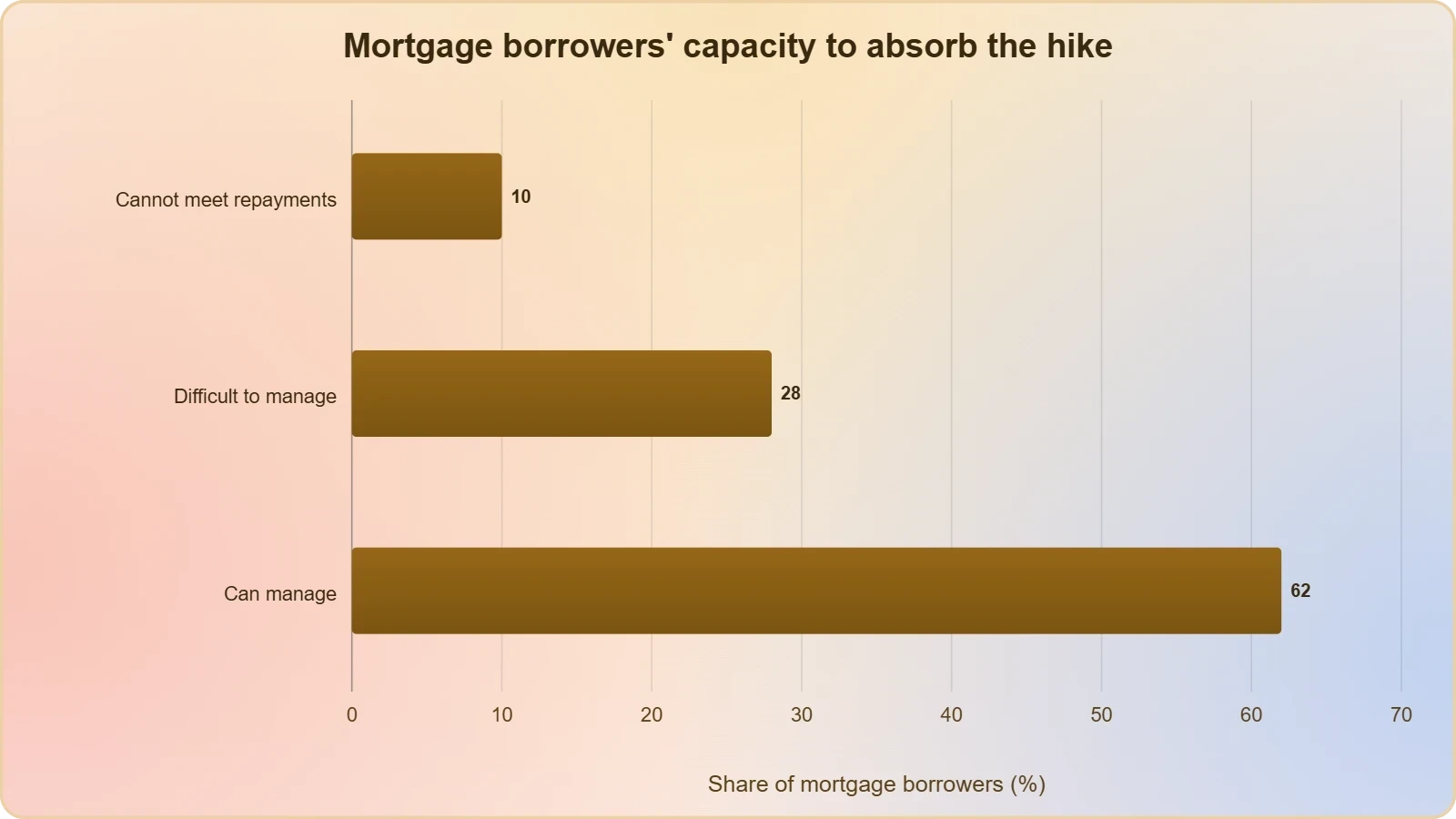
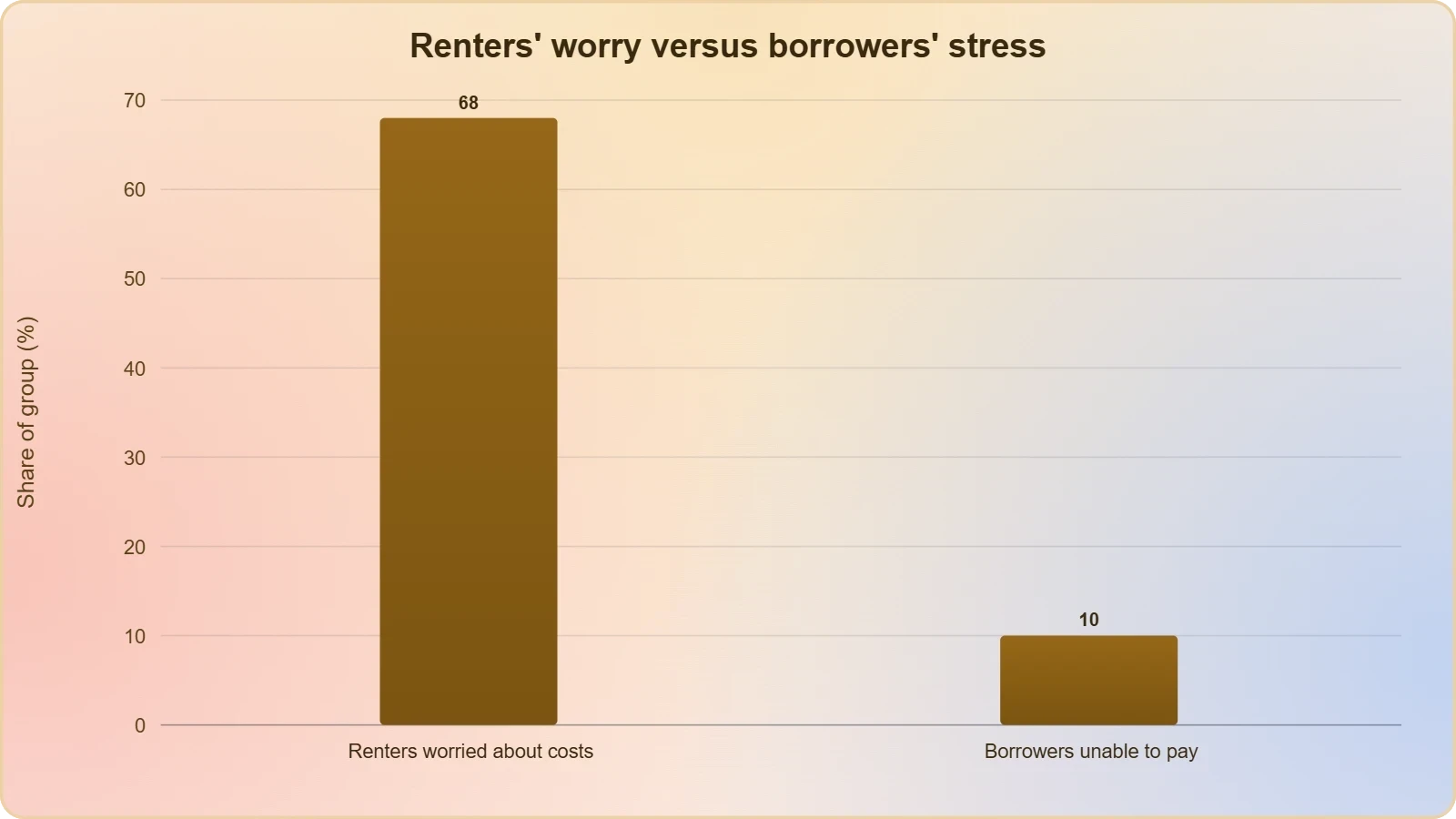
The human arithmetic behind the decision is stark. Canstar's survey found one in ten mortgage borrowers saying they could not meet higher repayments if the increase took effect, while another 28 percent described the added cost as difficult to manage. Among renters, 68 percent worried about the knock-on effect on rent and living costs. These are not abstract statistics; they describe a transmission mechanism where a central bank decision in a boardroom becomes a rent increase, a missed payment, or a relocation notice within weeks. The article gives those numbers faces through Laura Mayer and Lina Pugliese, two Australians whose circumstances illustrate how monetary policy reaches into ordinary lives.
What makes this episode analytically rich is the forward-looking dimension. Economists such as Betashares chief economist David Bassanese expect at least one more hike, with two additional increases in the first half of 2027 not ruled out, as the RBA tries to slow demand and anchor inflation expectations. That prospect matters because rate cycles are cumulative: each increase compounds the burden of the last, and households already stressed by four previous hikes have little buffer left. Understanding this story requires looking at the split vote, the household stress data, the rental channel, the labour market backdrop, and the credibility calculus that drives central bankers to accept short-term hardship for longer-term stability.
On This Page
- The Split Vote and the Logic of Central Bank Credibility
- Household Stress in Numbers: Mortgages, Renters, and Real Lives
- The Transmission Mechanism: How a Rate Hike Reaches a Kitchen Table
- The Forward Path: More Hikes and the Risk of Overshooting
- Distributional Consequences and the Politics of Monetary Tightening
- Lessons for Borrowers, Savers, and Policymakers
TL;DR Australia's Reserve Bank raised its cash rate by 25 basis points to 4.85 percent in November 2026, its fifth increase of the year, on a 6–3 split vote. Governor Michele Bullock acknowledged household strain but said the majority prioritized containing inflation. Survey data shows one in ten mortgage borrowers could not absorb higher repayments, 28 percent would find them hard to manage, and 68 percent of renters fear rising housing costs. Economists expect further tightening, possibly two more hikes in the first half of 2027, meaning household pressure is likely to intensify before it eases.
The Split Vote and the Logic of Central Bank Credibility
A 6–3 split is not a routine detail; it is a signal about how contested the inflation outlook has become inside the Reserve Bank of Australia. When three board members vote to hold, they are effectively arguing that the economic damage from further tightening now outweighs the risk of entrenched inflation. The majority took the opposite view, and Governor Bullock's public explanation was notably honest about the trade-off: the board knew households were suffering, but judged that failing to act would cost more later. Central banking is fundamentally an exercise in credibility management, and a divided committee that still acts sends a message that the institution will tolerate internal disagreement rather than drift.
The dissenters pointed to concrete evidence of stress: softening conditions in housing and a rising unemployment rate. Those are exactly the indicators that typically precede a sharper downturn, and the three hold votes reflect a legitimate reading of the data. Yet the majority weighed inflation expectations more heavily, reasoning that if households and businesses begin to assume persistent price growth, the eventual cost of restoring stability rises dramatically. This is the classic Taylor-rule dilemma in practice, where the appropriate policy rate depends on how much weight one assigns to the output gap versus the inflation gap. The split vote simply makes that weighting visible.
Why the Majority Prioritized Inflation Expectations
Inflation expectations are self-fulfilling in a way few economic variables are. If workers bargain for higher wages anticipating rising prices, and firms set prices anticipating higher costs, the inflation the central bank fears becomes embedded regardless of current demand conditions. Bullock's framing that the economy has suffered a major shock and people feel poorer acknowledges the real income squeeze, but the majority concluded that allowing inflation to persist would prolong that squeeze rather than relieve it. The logic is uncomfortable but coherent: a short, sharp period of restrictive policy is preferable to a long, grinding erosion of purchasing power.
There is also an institutional dimension. The RBA emerged from a period of intense public scrutiny over its forecasting and decision-making, and its credibility with markets depends on demonstrating that it will act when inflation runs above target. A hold decision in the face of elevated inflation would invite questions about whether political pressure or public sympathy had influenced the board. By raising rates despite acknowledging household pain, the majority reinforced the bank's independence and its commitment to its mandate, even at the cost of short-term unpopularity.
The Dissent as a Warning Signal
The three dissenting votes deserve more attention than they typically receive. They represent an informed, evidence-based judgment that the economy is closer to breaking point than the majority believes. Housing stress and rising unemployment are not trivial concerns; they are the leading edges of a potential recession. When a third of the board sees those signals clearly enough to vote against the majority, it suggests the margin for error in policy is narrow. Markets and commentators should read the dissent as a caution that further tightening carries real risk of overshooting.
Historically, split votes at central banks have often preceded turning points in policy cycles. The dissenters are not necessarily right, but their presence indicates that the case for restraint is no longer overwhelming. For households and businesses planning ahead, the split vote is a reminder that the path of rates is genuinely uncertain, and that forecasts of further hikes, while plausible, are not foregone conclusions. Prudent financial planning should account for both scenarios rather than assuming the tightening cycle continues indefinitely.
Household Stress in Numbers: Mortgages, Renters, and Real Lives
Aggregate rate decisions acquire meaning only when translated into household budgets, and the Canstar survey does that translation with uncomfortable clarity. One in ten mortgage borrowers stated they would be unable to meet higher repayments once the increase took effect, a figure that represents hundreds of thousands of households if extrapolated across the mortgage market. A further 28 percent said the increase would not be easy to manage, which is a softer but still significant signal of financial fragility. Together, these responses suggest that a meaningful share of borrowers is operating with little or no buffer against further cost increases.
The renter data is arguably more striking. Sixty-eight percent of renters said they were worried about the impact on rent or living costs, reflecting the reality that landlords frequently pass through higher mortgage costs to tenants. Renters are structurally more exposed to rate hikes than owner-occupiers because they have no equity to draw on and no ability to fix their housing cost through a mortgage refinance. When rates rise, renters face the transmission of that increase through a market they do not control, often with limited notice and few alternatives in a tight rental market.
Laura Mayer and the Rent Shock
Laura Mayer's experience illustrates the rental transmission channel with brutal specificity. Her rent rose 32 percent in a single increase this year, a jump she attributes directly to rising interest rates, and she fears she will have to move if landlords continue passing on higher costs. A 32 percent increase in one step is far beyond typical annual rent adjustments and suggests a landlord recouping a significant mortgage cost increase in a single move. For a renter, that kind of shock can force relocation, disrupt schooling and employment, and consume savings that might otherwise provide a buffer.
Mayer's statement that housing costs cause her constant stress and affect every part of her life captures something that economic models often miss: the psychological burden of housing insecurity is itself economically consequential. Stressed households make different consumption decisions, defer major purchases, and are less productive at work. The RBA's mandate does not include household wellbeing directly, but the feedback loop between financial stress and economic activity is real. When rent consumes a growing share of income, discretionary spending falls, which is precisely the demand reduction the central bank is trying to achieve, though the human cost is unevenly distributed.
Lina Pugliese and the Redundancy Trap
Lina Pugliese's situation exposes a different vulnerability: the intersection of job loss and rising debt costs. At 60, recently made redundant, and finding work very difficult, she is afraid to check her bank account and feels the RBA does not care about her situation. Her case highlights a structural problem with using interest rates as the primary inflation tool. Rate hikes are designed to slow demand by making borrowing more expensive, but they do so indiscriminately, hitting those with the least capacity to absorb the shock hardest. A redundant worker with a mortgage has no wage income to adjust and no easy way to refinance.
The perception that the central bank does not care is politically significant even if institutionally inaccurate. Central bankers repeatedly emphasize that their mandate serves long-term household welfare by preserving the value of money, but that argument is difficult to hear when one's immediate financial survival is at stake. Pugliese's fear of checking her bank account is a symptom of a broader erosion of trust between monetary authorities and the public they serve. Restoring that trust requires not just better communication but demonstrable evidence that the pain is temporary and evenly shared.
The Transmission Mechanism: How a Rate Hike Reaches a Kitchen Table
Monetary policy operates through several channels simultaneously, and understanding the Australian case requires tracing each one. The most direct is the cash-flow channel: borrowers with variable-rate mortgages see repayments rise almost immediately, reducing disposable income and forcing either spending cuts or savings drawdowns. The second is the wealth channel, where higher discount rates lower asset prices, making households feel poorer and spend less. The third is the exchange rate channel, where higher rates tend to strengthen the currency and reduce import prices. Each channel works with different lags and affects different households unevenly.
The rental channel is often underweighted in policy discussion but is central to the Australian experience. Landlords with variable-rate investment loans face higher interest costs and, in a tight rental market, can pass a substantial portion to tenants. The 32 percent single-step increase reported by Laura Mayer is an extreme but not isolated example. When rental supply is constrained and vacancy rates are low, tenants have little bargaining power, and the pass-through is rapid. This means rate hikes can raise measured inflation in the short term through the housing component even as they work to reduce it elsewhere.
The Cash-Flow Channel and Variable-Rate Exposure
Australia's mortgage market is unusual among advanced economies in its heavy reliance on variable-rate loans, which means rate changes transmit to household budgets faster and more completely than in fixed-rate-dominated markets such as the United States. A borrower on a variable rate sees the full 25 basis point increase reflected in their next repayment, with no lag and no ability to renegotiate. This rapid transmission is why the RBA's decisions have such immediate political salience and why household stress indicators respond quickly to policy changes.
The cash-flow channel is also regressive in its incidence. Households with large mortgages relative to income, typically younger first-home buyers, bear a disproportionate share of the adjustment. Older households who have paid down their mortgages or hold savings benefit from higher deposit rates. This distributional asymmetry is inherent in interest rate policy, but it becomes politically acute when the burden falls on a generation already locked out of affordable housing. The RBA cannot target its tools at specific groups, which is precisely why fiscal policy often needs to complement monetary tightening.
The Expectations Channel and Wage-Price Dynamics
The expectations channel is the least visible but arguably the most important for the RBA's decision. If households and firms believe inflation will remain elevated, they adjust behavior accordingly: workers demand larger wage increases, firms preemptively raise prices, and the inflation becomes self-sustaining. The majority's vote to hike was fundamentally a bet that acting now, even at the cost of household stress, would prevent this expectation from becoming entrenched. The dissenters implicitly judged that the expectation risk was smaller than the demand-destruction risk, a difference in weighting rather than in facts.
Wage-price dynamics in Australia have been relatively contained compared with some peer economies, but the RBA is watching closely for signs of acceleration. If wage growth begins to outpace productivity growth persistently, the case for further tightening strengthens. Conversely, if unemployment rises faster than expected, the dissenters' position gains credibility. The expectations channel thus makes the RBA's future decisions highly data-dependent, and the split vote reflects genuine uncertainty about which way the data will break.
- 01
- 02
- 03
- 04
The Forward Path: More Hikes and the Risk of Overshooting
David Bassanese's forecast that the RBA may raise rates at least once more, with two additional hikes in the first half of 2027 not ruled out, reflects a reading of the inflation data that sees persistent underlying pressure. The logic is that slowing demand sufficiently to bring inflation back to target requires a real interest rate high enough to restrain spending, and with inflation elevated, the nominal rate must rise further to achieve that. If the RBA pauses too early, the argument goes, inflation expectations could re-anchor upward and force even more painful tightening later.
Yet the case for further hikes is not airtight. Each increase raises the risk of overshooting, where policy becomes so restrictive that it triggers a sharper-than-intended downturn. The dissenters' concerns about housing stress and rising unemployment are precisely the indicators that would signal overshooting. Central banks historically struggle to calibrate the endpoint of a tightening cycle, often erring on the side of doing too much rather than too little because the cost of entrenched inflation is seen as more damaging. The question is whether that historical bias is appropriate in the current Australian context.
Scenarios for the First Half of 2027
Three broad scenarios are plausible. In the first, inflation proves sticky and the RBA delivers one or two more hikes, pushing the cash rate toward 5.35 percent and deepening household stress before a pause. In the second, inflation moderates faster than expected and the RBA holds at 4.85 percent, allowing households a period of stability. In the third, unemployment rises sharply and the RBA is forced to consider cuts earlier than anticipated, potentially reversing some of the tightening. The probability distribution across these scenarios is what markets are trying to price.
For households, the practical implication is that planning should assume rates stay elevated for longer rather than falling quickly. Borrowers should stress-test their budgets against a further 50 basis points of tightening, build buffers where possible, and avoid taking on new fixed obligations. Renters should factor in the possibility of further rent increases and consider the trade-offs of longer leases or relocation. The uncertainty is genuine, and the split vote is a reminder that even the central bank does not have a single confident view of the path ahead.
What Would Change the RBA's Mind
The most important variable is the labour market. If unemployment rises materially above the RBA's estimates of full employment, the case for further hikes weakens considerably because demand destruction would already be underway. Conversely, if unemployment remains low and wage growth accelerates, the majority's position strengthens. Inflation data, particularly the trimmed mean measure that strips out volatile items, will be the other key input. A sustained decline in underlying inflation would give the RBA room to pause without losing credibility.
Global conditions also matter. Australia is a small open economy, and rate decisions in the United States, Europe, and China affect its exchange rate, export demand, and imported inflation. If major central banks begin cutting while the RBA holds or hikes, the Australian dollar could strengthen sharply, tightening financial conditions without any domestic decision. The RBA must therefore weigh domestic inflation against global monetary conditions, adding another layer of complexity to an already difficult calibration.
We Also Published
Distributional Consequences and the Politics of Monetary Tightening
Interest rate policy is distributionally neutral in theory but profoundly unequal in practice. Borrowers bear the immediate cost of higher repayments, while savers benefit from higher deposit rates. Younger households, who typically carry larger mortgages relative to income, absorb more of the adjustment than older households who have accumulated savings. Renters, who have no direct exposure to mortgage rates but face pass-through into rents, are affected through a channel they cannot control. The aggregate inflation benefit, meanwhile, accrues to society as a whole over time, creating a mismatch between who pays and who benefits.
This distributional asymmetry has political consequences. When the RBA raises rates, the government of the day often faces public anger even though it does not control monetary policy. The perception that the central bank is indifferent to household suffering, articulated by Lina Pugliese, can erode trust in institutions more broadly. Central banks have responded by improving communication and emphasizing their long-term mandate, but the gap between institutional logic and lived experience remains wide. Managing that gap is as much a political challenge as an economic one.
Intergenerational Equity and Housing
Australia's housing market amplifies the intergenerational dimension of rate policy. Younger households who bought at high prices with large mortgages are most exposed to rate increases, while older households who bought decades ago and have paid down debt benefit from higher savings rates. The rate hike thus transfers income from younger, more indebted households to older, less indebted ones, even as it works to cool the housing market that created the affordability crisis in the first place. This tension is central to the political economy of Australian monetary policy.
The rental market adds another layer. Renters, who are disproportionately younger and lower-income, face pass-through of rate increases without any offsetting benefit. They do not own the asset whose price may fall, and they do not receive higher deposit rates. They simply pay more for shelter. When 68 percent of renters express worry about living costs, they are responding rationally to a policy transmission channel that hits them hardest. Addressing this requires supply-side housing policy, not just monetary calibration.
Institutional Trust and Communication
The RBA's communication strategy has evolved significantly, with Governor Bullock adopting a more direct and empathetic tone than some predecessors. Acknowledging that people feel poorer and that the board is aware of household strain is a meaningful shift from technocratic detachment. Yet communication alone cannot resolve the underlying tension: the central bank must impose short-term pain for long-term gain, and no amount of explanation makes that pain feel fair to those bearing it. The split vote, by making the disagreement visible, may actually help by showing that the decision was contested rather than automatic.
Trust in central banks is built over decades and lost quickly. The RBA's credibility depends on delivering on its inflation target without triggering unnecessary economic damage. If the tightening cycle ends with inflation controlled and unemployment only modestly higher, the institution's standing will be reinforced. If it ends in a sharp recession, the cost in trust and future policy credibility will be severe. The stakes of the next few decisions are therefore higher than the usual quarterly calibration, and the dissenters' caution deserves serious weight in that assessment.
Lessons for Borrowers, Savers, and Policymakers
For borrowers, the central lesson is that rate cycles are cumulative and buffers matter more than forecasts. A household that can absorb a 50 basis point increase without distress is in a fundamentally different position from one that cannot, regardless of what economists predict. Practical steps include stress-testing budgets against further increases, prioritizing high-interest debt repayment, and exploring fixed-rate options where available. The split vote and the prospect of further hikes mean that assuming relief is imminent would be a risky planning assumption.
For savers, higher rates offer a genuine benefit that is often overlooked in coverage focused on borrower stress. Deposit rates have risen alongside the cash rate, and savers who shop around can earn meaningfully more on their balances than they could a few years ago. The distributional story is not purely negative; it is a transfer from borrowers to savers, and households in a position to save should ensure they are capturing the higher returns available rather than leaving funds in low-yield accounts.
Practical Financial Resilience
Resilience in a high-rate environment comes down to a few disciplined practices. Maintaining an emergency fund covering several months of essential expenses is the single most effective buffer against repayment shocks. Reviewing mortgage terms and refinancing where beneficial can reduce costs without changing the underlying rate environment. Avoiding new variable-rate debt during a tightening cycle is prudent, and locking in fixed rates for essential borrowing can provide certainty. These are not novel recommendations, but the survey data suggests many households have not acted on them.
Renters face different constraints because they cannot refinance their housing cost. Practical strategies include negotiating longer leases to lock in current rents, budgeting for potential increases, and maintaining flexibility about location. Where possible, building a rental buffer fund can reduce the risk of forced relocation. Policy solutions, however, are ultimately more important than individual coping strategies, because renters cannot control the pass-through mechanism that drives their costs. Supply-side reforms and tenant protections are the structural answers.
What Policymakers Should Take From the Split
The split vote is a gift to policymakers because it makes the trade-offs explicit. Fiscal authorities can use it as a signal that targeted support for stressed households may be appropriate, complementing rather than contradicting monetary policy. The RBA can use it to communicate that its decisions are genuinely contested and data-dependent, which may help rebuild trust. And commentators can use it to resist the temptation to present monetary policy as a technocratic certainty when it is in fact a judgment call under uncertainty.
The deeper lesson is that inflation control and household welfare are not opposing goals but are in tension over different time horizons. Short-term pain can serve long-term stability, but only if the pain is temporary and the adjustment is successful. If the RBA overshoots and triggers a severe downturn, the long-term welfare case collapses. The dissenters' caution is therefore not softness but a legitimate concern about the risk of policy error. Balancing that concern against inflation risk is the central challenge of the months ahead.
From our network :
- The Hidden Cost of AI Convenience: Why Over-Permissioned Agents Are a Security Time BombDiscover why AI agents with excessive permissions create dangerous single points of failure, and learn how implementing least privilege principles can protect your organization from exploitation.
- Live Online English Classes for Kids: Do They Actually Reduce Anxiety?A ten-week study reveals that synchronous online English classes can significantly reduce child language anxiety while improving listening and reading skills. Discover what makes these programs effective and how parents can select the right one.
- University Language Proficiency Exams: Why Institutional Tests Demand Different Preparation Than IELTS and TOEFLDiscover why university-specific language proficiency examinations differ fundamentally from IELTS and TOEFL, and learn strategic preparation approaches for institutional assessment success.
- How AI Agents Will Change the Way We Manage Personal FinancesExplore how AI agents are transforming personal finance through automated budgeting, bill payment, and investment management, while examining the critical security protocols and governance frameworks required for safe deployment.
- Committed Mediterranean Precipitation Decline: Why Emissions Cuts Alone Cannot Restore Winter RainsNew NOAA research reveals that Mediterranean winter rains may decline irreversibly even with emissions cuts. Explore the science of committed climate change and regional impacts.
- Forbidden Matrix Patterns and Visible Lattice Points: A Geometric DictionaryExplore how multidimensional 0–1 matrices encode geometric truths, linking forbidden patterns to visible lattice points and hypergraph theory, with applications in combinatorics and computational geometry.
- CISA’s Ten-Advisory Wave: Why Generic Patching Fails in OT and How to Build Product-Specific PlaybooksCISA released ten ICS advisories in one week, exposing critical infrastructure risks. Generic patching fails in OT. Learn to build product-specific remediation playbooks.
- Mobile Learning and VR in English: What Global Evidence Reveals About Effective Language TechnologyA systematic review across 14 countries reveals which language-learning technologies genuinely work. Mobile learning, AI, and VR show measurable benefits when pedagogically integrated. This evidence-based guide helps educators and learners select technology that delivers real return on investment.
- The Final Descent: How ESA Retired the Legendary Cluster Constellation After 24 Years of Space Weather ScienceAfter 24 years mapping Earth’s magnetosphere, ESA’s Cluster mission concluded with a precisely controlled reentry over the South Pacific. This analysis explores the scientific legacy, engineering decisions, and debris mitigation principles behind one of space exploration’s most responsible retirements.
RESOURCES
- Resources will be updated soon.
- 01
- 02
- 03
- 04
- 05
- 06
- 07
- 08
0 Comments