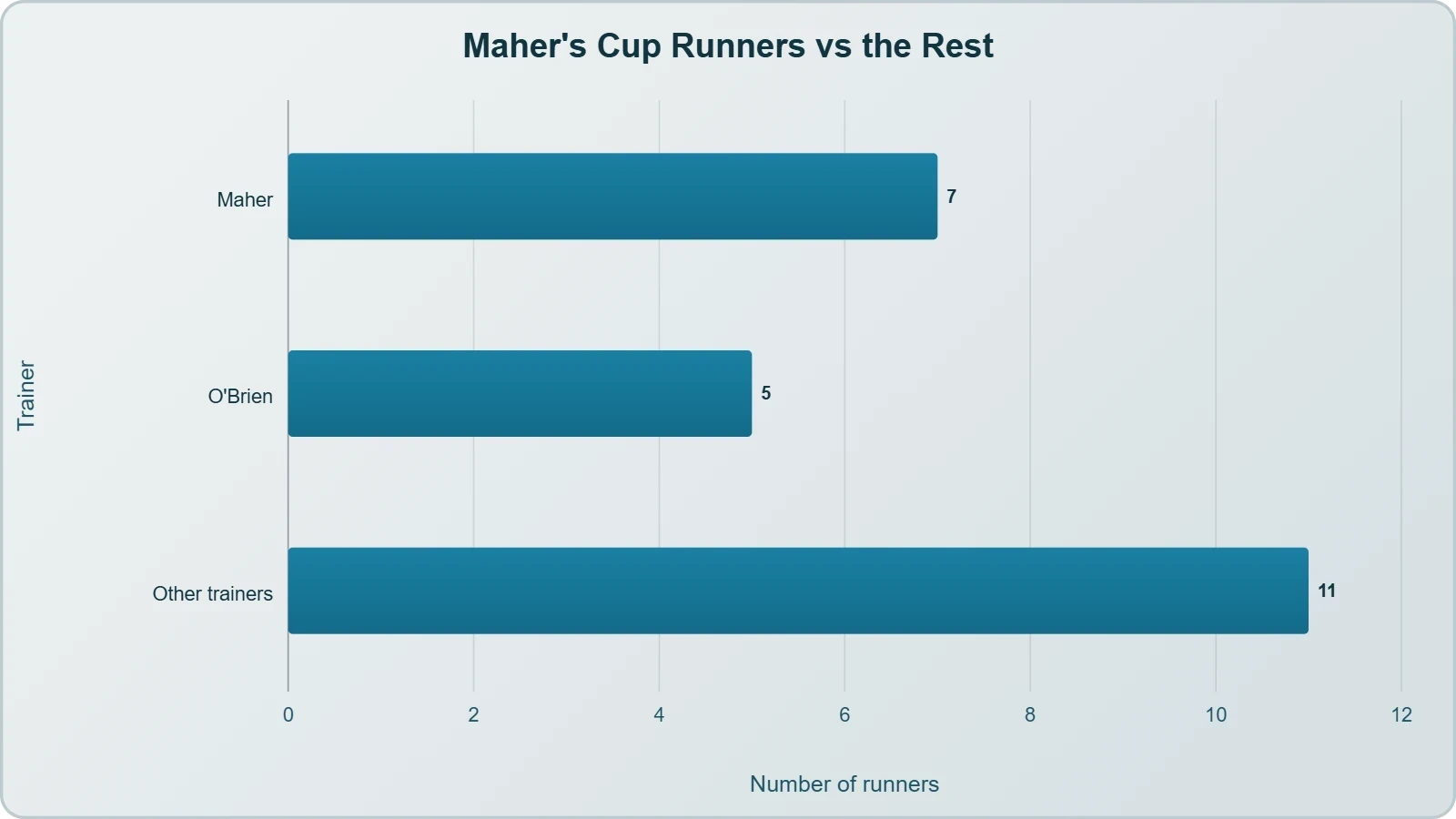
Ciaron Maher's achievement at Flemington on the first Tuesday of November 2026 belongs to that rare category of sporting results that rewrites the record book rather than merely adding a line to it. When Point of Law, Zahrann and Juja Kibo crossed the line in that order, the Irish-born, Warrnambool-based trainer became the first person in the 166-year history of the Melbourne Cup to prepare the first three finishers in a single running. The feat was not a fortunate accident of a wide barrier draw or a soft track; it was the product of a stable operating at industrial scale, entering seven runners and watching four of them fill the top five and five of them occupy the top six.
The race itself unfolded with a tactical audacity that made the result even more remarkable. Maher's Royal Supremacy, ridden by Ben Allen, seized the lead early and at one stage led by roughly twenty lengths, a margin that turned the 3,200-metre contest into something closer to a time trial than a handicap. Rival jockeys declined to chase hard in the opening stages, and the leader duly tired in the straight. What followed was a demonstration of stable depth: as Royal Supremacy faded, his stablemates swept past, with Ethan Brown threading Point of Law along the inside rail to win by 3.75 lengths.
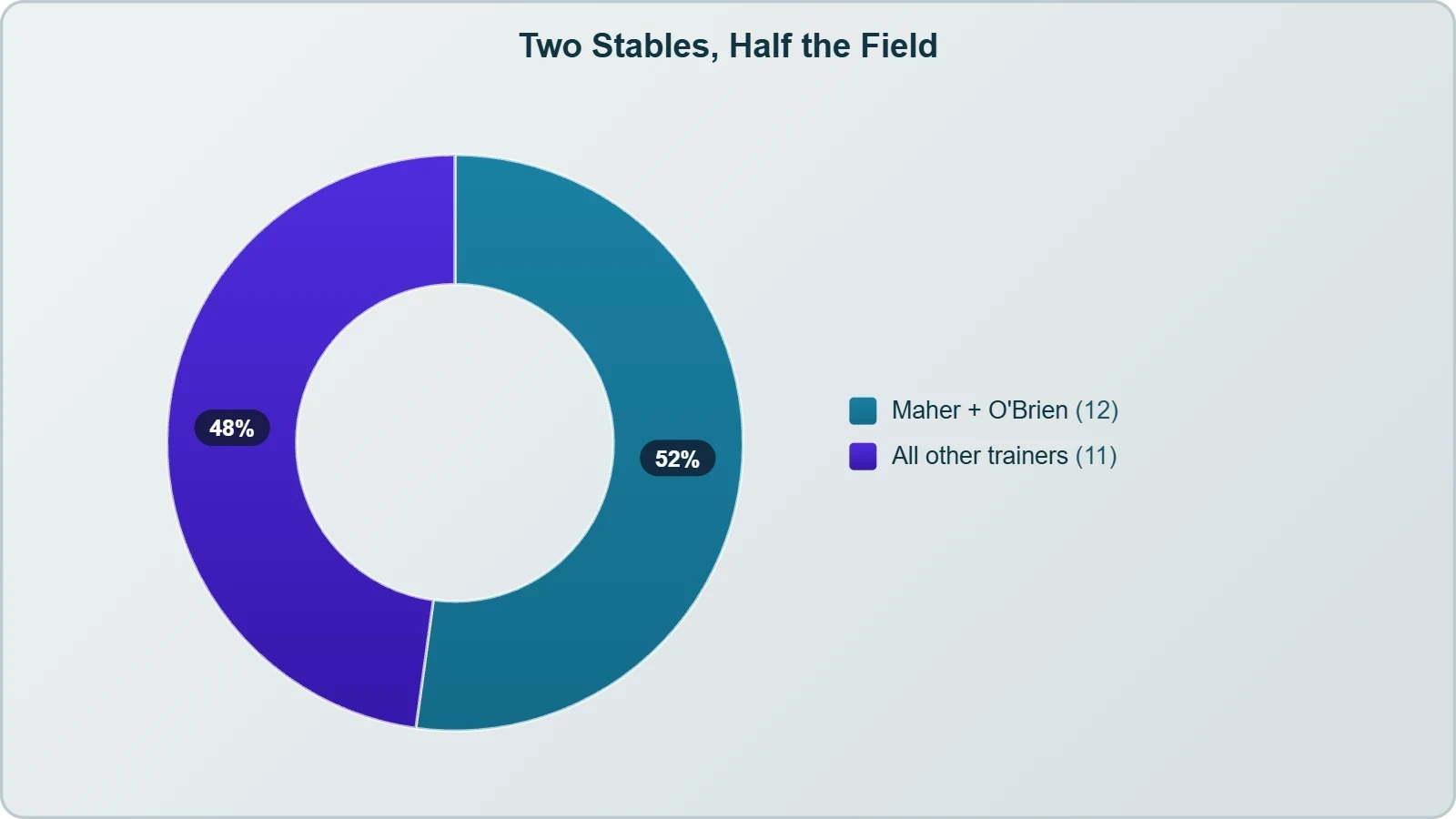
Beyond the trivia and the trifecta dividends, the result raises a genuine structural question about the modern thoroughbred industry. Maher and Irish trainer Joseph O'Brien between them saddled twelve of the twenty-three starters, and the only non-Maher horse in the top five was O'Brien's Sons And Lovers. When a single operation can so thoroughly dominate a handicap designed to equalise opportunity, the sport confronts an uncomfortable tension between celebrating excellence and protecting competitive integrity. This analysis examines the race, the stable economics behind it, and what the sweep means for the future of Australia's most famous race.
On This Page
- The Anatomy of an Unprecedented Melbourne Cup Sweep
- Ciaron Maher and the Economics of a Super-Stable
- The International Dimension: O'Brien, Imports and the Global Field
- Handicapping, Ballot Conditions and the Integrity of the Race
- What the Result Means for Owners, Punters and the Sport's Future
- Historical Context: How Rare Is a Stable Trifecta?
- Conclusion: A Historic Result and an Open Question
TL;DR Ciaron Maher became the first trainer in Melbourne Cup history to saddle the first three finishers, with Point of Law defeating stablemates Zahrann and Juja Kibo at Flemington. Maher entered seven runners and held four of the top five and five of the top six, while he and Joseph O'Brien supplied twelve of the twenty-three starters between them. The result, built on a bold front-running ride by Royal Supremacy that opened a twenty-length lead before tiring, is widely described as unprecedented. It also sharpens debate over whether concentrated stable power is healthy for a handicap race built on the principle of equal opportunity.
The Anatomy of an Unprecedented Melbourne Cup Sweep
The 2026 Melbourne Cup will be remembered less for the winning margin than for the identity of the horses behind it. Point of Law's 3.75-length victory was decisive, but the story lay in the placings: Zahrann in second and Juja Kibo in third, both carrying the same maroon-and-white silks of the Maher operation. No trainer in more than a century and a half of the race had ever returned to the mounting yard with the trifecta in their own name, and the statistical improbability of the outcome deserves careful unpacking before the celebrations are allowed to settle.
What made the sweep possible was not simply the number of runners but their quality. A large string alone does not produce a one-two-three; it produces scattered midfield finishes. Maher's seven entrants were individually rated highly enough to contend, and the stable's preparation clearly peaked them together on the same afternoon. That convergence of quantity and quality is the real anomaly, and it is the detail that separates this result from the routine advantage enjoyed by powerful stables in major handicaps around the world.
The Race as It Unfolded
Royal Supremacy's aggressive early tempo was the tactical hinge on which the entire result turned. Ben Allen allowed the horse to stride clear, and the margin ballooned to approximately twenty lengths, a gap that forced every rival into a decision. Chase and risk emptying your own mount, or concede the lead and trust in superior finishing speed. The field collectively chose patience, and that patience proved correct when the leader's condition gave out in the straight, but it also handed the Maher stable a perfect setup for its closers.
Ethan Brown's ride on Point of Law was the execution that converted tactical chaos into a famous win. Finding a clear path along the inside rail, Brown produced a surge that none of the tiring leaders could answer. Zahrann and Juja Kibo followed through for the minor placings, and the only interloper in the top five was Sons And Lovers, trained by Joseph O'Brien. The finish, in other words, was almost entirely a private affair between two of the world's most powerful racing operations.
Reading the Numbers Behind the Result
The raw arithmetic of the race tells its own story about concentration of power. Twenty-three horses started after one withdrawal, and twelve of them represented just two trainers. That is more than half the field controlled by a pair of operations, a figure that would have been unthinkable in the era when the Cup was dominated by small owner-trainer partnerships and locally bred stayers. The table below summarises the key structural metrics of the 2026 running.
Ciaron Maher and the Economics of a Super-Stable
Maher's rise from a small Warrnambool base to the summit of Australian racing is a case study in the consolidation of the training profession. Over the past decade he has built a multi-site operation with stables in Victoria and New South Wales, a syndication network that spreads ownership risk across hundreds of small investors, and a bloodstock strategy that buys both proven stayers and promising imports. The 2026 Cup result is the visible tip of an organisational structure that few rivals can match for scale, data capability or purchasing power.
The economics are straightforward once the scale is understood. A stable with seven Cup runners has seven chances at the prize, seven sets of owners sharing the cost of preparation, and a marketing engine that attracts further investment with every major win. Syndication turns a single expensive horse into dozens of affordable shares, and each share-holder becomes a stakeholder in the stable's success. That model has transformed ownership in Australia, but it has also widened the gap between the handful of operations that can mobilise capital at this level and the smaller trainers who cannot.
Scale, Syndication and the Modern Training Model
The syndication model is not new, but its sophistication is. Modern stables use digital platforms to market shares, provide owners with training updates and race-day analytics, and manage the administrative burden of dozens of partnerships per horse. This professionalisation lowers the barrier to entry for casual owners while simultaneously concentrating decision-making power in the hands of a few elite trainers. The result is a feedback loop: success attracts capital, capital buys better horses, and better horses produce more success.
Maher's operation exemplifies this loop. His seven Cup entrants were not all blue-blooded imports; several were shrewd purchases identified through form analysis and veterinary data. The stable's ability to prepare a large string to peak on the same day reflects investment in sports science, trackwork monitoring and staff depth that smaller yards simply cannot replicate. In that sense, the sweep was earned through organisational excellence as much as through luck or a favourable draw.
What the Sweep Means for Competition
The uncomfortable question, which the original reporting raised without resolving, is whether such dominance is good for the sport. Handicap racing is built on the principle that weights can equalise opportunity, allowing a modest stable to beat a giant on the right day. When one trainer fills the first three placings, that principle looks strained. Punters may enjoy backing the winner, but they also value competitive fields, and a race that becomes a private trial for two stables risks losing the unpredictability that makes it compelling.
There is a counter-argument worth taking seriously. Maher's success is not the result of anti-competitive behaviour; it is the reward for decades of investment, expertise and hard work. Penalising excellence would be perverse. The more productive response lies in structural design: handicapping rules, ballot conditions and prize-money distribution can all be calibrated to preserve opportunity without punishing success. The debate is really about how the sport balances meritocracy against the spectacle of open competition.
The International Dimension: O'Brien, Imports and the Global Field
The 2026 Cup was as much an international contest as a domestic one. Joseph O'Brien, son of the legendary Aidan and a Melbourne Cup-winning trainer in his own right, brought a strong contingent from Ireland, and his Sons And Lovers was the only horse to break the Maher stranglehold on the top five. The presence of twelve runners from just two trainers, one Australian and one Irish, illustrates how thoroughly the race has become a global event in which a small number of elite operations dominate the entry list.
This internationalisation has enriched the race's quality but complicated its identity. European stayers bring stamina and class, and their presence has raised the standard of the field. Yet the logistics of transporting horses across the world, the quarantine requirements and the cost of campaigning abroad all favour operations with deep resources. The Cup's traditional appeal to local owner-breeders and small trainers is being tested by a globalised marketplace in which the best-prepared international raiders and the largest domestic stables compete on unequal terms.
Why European Stayers Keep Coming
The Melbourne Cup's handicap conditions and generous prize money make it one of the few races in the world where a European stayer can be competitive against a large field on a flat, galloping track. O'Brien's willingness to travel reflects a calculated assessment that the race offers value that domestic European handicaps do not. The same logic drives Australian stables to buy European-bred horses, and the result is a field increasingly composed of imports prepared by a handful of specialist trainers.
For the sport, this cross-border traffic is a strength when it produces genuine competition and a weakness when it entrenches the advantage of the biggest operations. The 2026 result sits awkwardly between those poles. O'Brien's presence added international prestige, but his solitary top-five finisher also underlined how completely the race was controlled by two stables. The global field, in other words, did not dilute the concentration of power; it reinforced it.
The Local Trainer's Shrinking Window
For the small Australian trainer, the Cup remains the dream that justifies a year of preparation, but the arithmetic is increasingly unforgiving. A yard with one or two entrants must beat seven Maher runners, a strong O'Brien contingent and a field of well-credentialled imports. The handicap is supposed to bridge that gap, and occasionally it does, but the 2026 running showed how quickly a well-resourced stable can turn a handicap into a procession when its horses are simply better prepared and better placed.
This is not a story of villainy; it is a story of professionalisation. The trainers who thrive in the modern era are those who treat racing as a business, invest in data and staff, and build networks of owners who share the risk. The small trainer who relies on intuition and a single good horse is not excluded, but the margin for error has narrowed. The Cup's romance survives, but it now competes with the cold logic of scale.
- 01
- 02
- 03
- 04
Handicapping, Ballot Conditions and the Integrity of the Race
The Melbourne Cup is a handicap, and handicapping is the mechanism by which the race attempts to manufacture uncertainty. Weights are assigned to compress the gap between the best and the rest, giving a well-weighted outsider a theoretical chance against a higher-rated rival. When a stable's horses finish first, second and third, the handicap has not failed in a technical sense, but it has failed in its purpose. The weights did not produce a competitive finish; they produced a stable procession, and that outcome invites scrutiny of how the system is calibrated.
Ballot conditions, which determine which horses gain a start, are the other lever available to administrators. A trainer with seven qualified runners has already won a significant battle before the field jumps, because entry itself is a scarce resource. Tightening ballot criteria, adjusting weight scales or capping the number of runners per trainer are all options that have been debated in racing jurisdictions around the world. Each carries trade-offs, and none is a complete solution to the underlying concentration of resources.
How Handicaps Are Supposed to Work
The theory of handicap racing rests on a simple proposition: if two horses of different ability carry different weights, the slower horse can be made competitive. In practice, the relationship between weight and performance is non-linear, and the handicapper's task is to estimate it accurately across a field of twenty-plus runners. The 2026 result suggests that when a stable's horses are collectively superior, the weight scale cannot fully offset the advantage, especially when the stable controls the pace of the race through a front-runner.
Royal Supremacy's twenty-length lead is instructive here. A front-runner from a powerful stable can dictate tempo in a way that suits its own stablemates, and the other jockeys' decision not to chase hard effectively ceded control of the race. Whether that was a collective tactical error or a rational response to the leader's quality is debatable, but the outcome demonstrates how pace control amplifies the advantage of a multi-runner stable. Handicapping addresses weight, not tactics.
Regulatory Options and Their Trade-offs
Racing administrators have several tools at their disposal, each with costs. Capping runners per trainer would directly limit concentration but could exclude deserving horses and invite legal challenge. Adjusting the weight scale to penalise stable depth is difficult to justify on form grounds. Increasing prize money down the field would reward broader participation but not necessarily improve competitiveness at the front. The most promising approach may be a combination of ballot reform and transparency about stable entries, allowing the market and the public to see concentration before the race.
None of these measures would have prevented Maher's sweep, and it is worth being honest about that. The result was an outlier produced by an exceptional stable on an exceptional day. Regulation should target structural distortions, not punish a single remarkable achievement. The value of the debate lies in anticipating the future, when the economics of scale may make such results less exceptional and more routine.
We Also Published
What the Result Means for Owners, Punters and the Sport's Future
For owners, the Maher sweep is a powerful advertisement for the syndication model. A share in a Cup-winning stable is now a realistic aspiration for thousands of Australians who could never afford a horse outright, and the visibility of a one-two-three finish will drive demand for future offerings. The flip side is that ownership becomes an investment in a brand as much as in an animal, and the emotional connection that once defined racing ownership is increasingly mediated by spreadsheets and shareholder updates.
For punters, the result was a puzzle wrapped in a dividend. Backing the winner was straightforward for those who trusted the stable's depth, but the trifecta and first-four returns were shaped by a field in which one trainer held most of the cards. The betting public values both value and uncertainty, and a race dominated by a single operation reduces the latter even as it rewards the former. Bookmakers and totes will adapt, but the long-term health of turnover depends on fields that feel genuinely open.
The Punter's Perspective on a Predictable Result
Punting is a market in probabilities, and the 2026 Cup compressed those probabilities into a narrow band. When four of the top five finishers come from one stable, the form guide becomes a stable roster, and the analytical work of comparing horses across yards is replaced by the simpler question of which Maher runner will peak. That is not necessarily bad for the informed punter, who can exploit stable confidence, but it narrows the intellectual appeal of the race for the casual follower.
The deeper issue is integrity of information. In a field where one stable controls a large share of runners, the flow of inside knowledge becomes concentrated, and the market's ability to price each horse independently is reduced. Regulators watch closely for any suggestion of stable tactics that disadvantage rivals, and the 2026 running, while entirely legitimate, will sharpen scrutiny of how multi-runner stables manage pace and positioning.
Lessons for the Next Generation of Trainers
The Maher model offers a template for ambitious young trainers: build scale, embrace syndication, invest in data and staff, and target the biggest races with multiple entries. That template is demanding, requiring capital and business acumen as much as horsemanship, but it is replicable in a way that the old apprenticeship route is not. The next decade is likely to see further consolidation, with a handful of super-stables dominating the major carnivals and smaller yards specialising in niches.
Whether that future is desirable is a question the sport must answer for itself. The 2026 Melbourne Cup demonstrated that excellence, properly resourced, can produce a result of historic proportions. It also demonstrated that the same excellence can make a great race feel less like a contest and more like a coronation. The task for administrators, owners and trainers alike is to preserve the conditions under which the next small stable can still dream of beating the giants.
Historical Context: How Rare Is a Stable Trifecta?
To appreciate the scale of Maher's achievement, it helps to place it against the long history of the Melbourne Cup. First run in 1861, the race has produced legendary performances from Phar Lap, Makybe Diva and Bart Cummings, yet no trainer had ever returned the first three finishers until 2026. Cummings, the race's most successful trainer with twelve wins, never achieved the feat, and neither did any of the great European raiders who have targeted the race in the modern era.
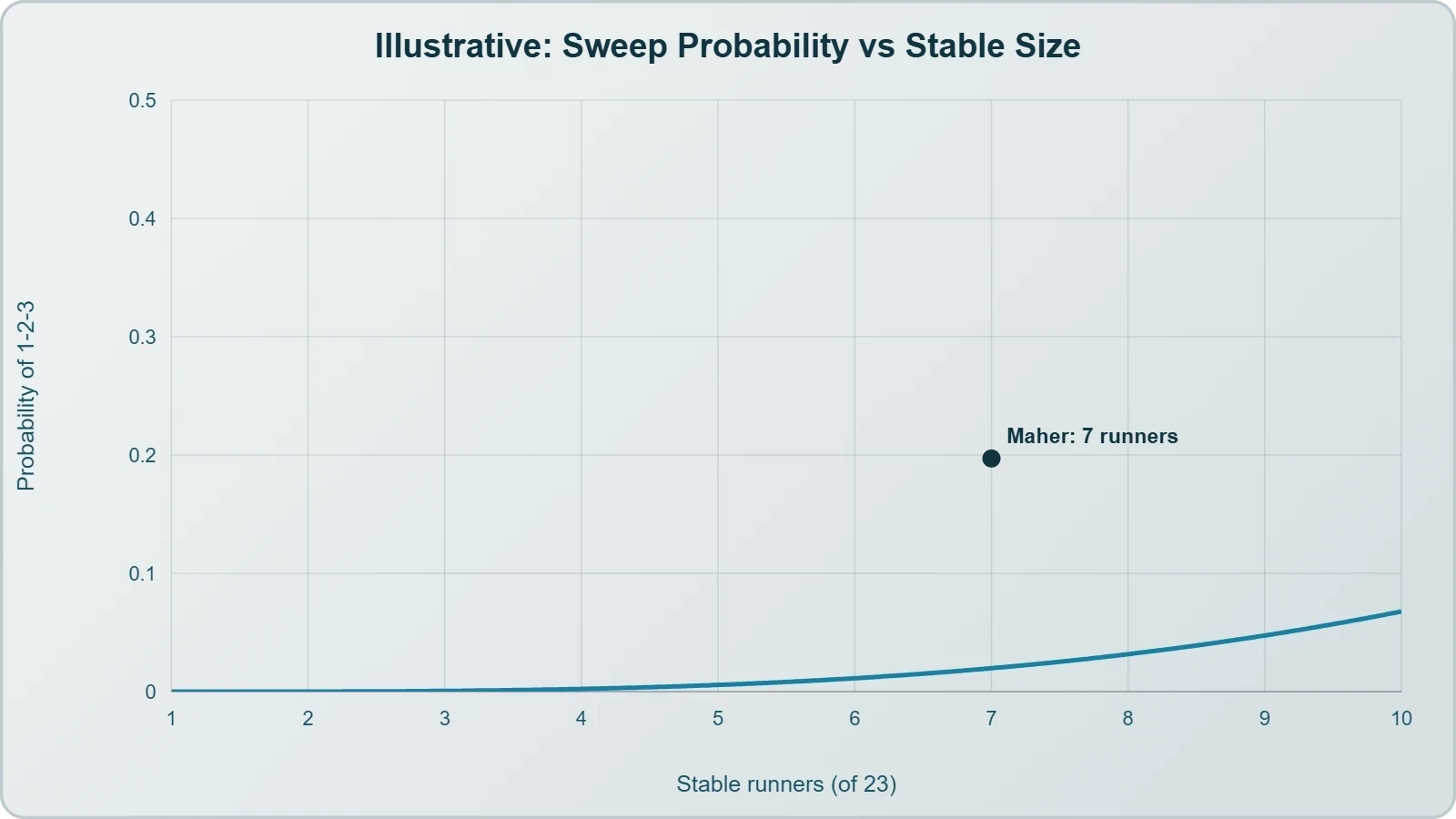
The rarity is partly a matter of field size and partly a matter of probability. With twenty-plus runners, the chance of any single stable filling the first three placings is small even for a dominant operation, and the handicapper's weights are designed to prevent it. That Maher achieved it with seven runners, rather than the maximum permitted field, makes the result more impressive still. It is the kind of outcome that statisticians would describe as a low-probability event that becomes more likely as stable concentration increases.
Great Trainers and Their Cup Records
Bart Cummings remains the benchmark against whom all Australian trainers are measured, and his twelve Cup victories were built on a patient, intuitive approach to preparing stayers. Cummings rarely saddled large numbers in a single Cup, preferring to target the race with a small team of carefully selected horses. His record is a reminder that dominance can be achieved through quality rather than quantity, and that the two models are not mutually exclusive.
Maher's achievement does not diminish Cummings's legacy; it extends it into a new era. The modern trainer must be a businessman, a data analyst and a horseman simultaneously, and the 2026 sweep is the clearest evidence yet that the profession has changed. Whether the change is for the better is a matter of perspective, but the historical record now contains a line that no future trainer can ignore.
Statistical Improbability and the Role of Chance
Probability theory offers a useful lens. If each of Maher's seven runners had an independent chance of finishing in the top three, the probability of all three placings going to his stable would be small but not negligible. In reality, the runners are not independent: they share training methods, jockeys, and tactical instructions, which increases the correlation of their outcomes. That correlation is precisely what makes a stable trifecta more likely than a naive calculation would suggest, and it is also what makes the result a structural signal rather than a pure fluke.
The mathematical expression for the probability of a stable sweep, assuming ##n## runners from a stable in a field of ##N##, can be approximated by the hypergeometric distribution when outcomes are treated as random. In practice, the stable's runners are stronger than average, so the true probability is higher than the random baseline. The 2026 result sits at the extreme tail of that distribution, which is why it is described as unprecedented rather than merely unusual.
Conclusion: A Historic Result and an Open Question
Ciaron Maher's one-two-three at Flemington is a genuine landmark in Australian sport, a result that will be cited for decades whenever the Melbourne Cup is discussed. Point of Law's victory, Zahrann's second and Juja Kibo's third represent the culmination of a training operation built on scale, data and syndication, and they deserve to be celebrated as such. The race was run fairly, the horses were prepared impeccably, and the margin of 3.75 lengths was emphatic rather than fortunate.
Yet the result also leaves an open question that the sport cannot avoid. When a single stable can fill the first three placings and hold four of the top five, the handicap's promise of equal opportunity looks fragile. The answer is not to penalise Maher but to examine the structures that allowed such concentration to develop, and to ensure that the next small trainer with a good horse still has a realistic path to the winner's circle. The Melbourne Cup's enduring appeal depends on that balance being preserved.
From our network :
- Mobile Learning and VR in English: What Global Evidence Reveals About Effective Language TechnologyA systematic review across 14 countries reveals which language-learning technologies genuinely work. Mobile learning, AI, and VR show measurable benefits when pedagogically integrated. This evidence-based guide helps educators and learners select technology that delivers real return on investment.
- CISA’s Ten-Advisory Wave: Why Generic Patching Fails in OT and How to Build Product-Specific PlaybooksCISA released ten ICS advisories in one week, exposing critical infrastructure risks. Generic patching fails in OT. Learn to build product-specific remediation playbooks.
- The Final Descent: How ESA Retired the Legendary Cluster Constellation After 24 Years of Space Weather ScienceAfter 24 years mapping Earth’s magnetosphere, ESA’s Cluster mission concluded with a precisely controlled reentry over the South Pacific. This analysis explores the scientific legacy, engineering decisions, and debris mitigation principles behind one of space exploration’s most responsible retirements.
- Live Online English Classes for Kids: Do They Actually Reduce Anxiety?A ten-week study reveals that synchronous online English classes can significantly reduce child language anxiety while improving listening and reading skills. Discover what makes these programs effective and how parents can select the right one.
- How AI Agents Will Change the Way We Manage Personal FinancesExplore how AI agents are transforming personal finance through automated budgeting, bill payment, and investment management, while examining the critical security protocols and governance frameworks required for safe deployment.
- Committed Mediterranean Precipitation Decline: Why Emissions Cuts Alone Cannot Restore Winter RainsNew NOAA research reveals that Mediterranean winter rains may decline irreversibly even with emissions cuts. Explore the science of committed climate change and regional impacts.
- The Hidden Cost of AI Convenience: Why Over-Permissioned Agents Are a Security Time BombDiscover why AI agents with excessive permissions create dangerous single points of failure, and learn how implementing least privilege principles can protect your organization from exploitation.
- University Language Proficiency Exams: Why Institutional Tests Demand Different Preparation Than IELTS and TOEFLDiscover why university-specific language proficiency examinations differ fundamentally from IELTS and TOEFL, and learn strategic preparation approaches for institutional assessment success.
- Forbidden Matrix Patterns and Visible Lattice Points: A Geometric DictionaryExplore how multidimensional 0–1 matrices encode geometric truths, linking forbidden patterns to visible lattice points and hypergraph theory, with applications in combinatorics and computational geometry.
RESOURCES
- Resources will be updated soon.
- 01
- 02
- 03
- 04
- 05
- 06
- 07
- 08
0 Comments