The 2026 United States midterm elections delivered a split verdict that has become the defining signature of modern American politics: Democrats reclaimed the House of Representatives, yet the Senate remained a live battlefield where control had not been formally settled as counting continued. The result, reported in the early hours of 4 November 2026, instantly reshaped the legislative arithmetic in Washington and forced both parties into a period of strategic recalibration. For Democrats, capturing the House represented a tangible rebuke of the incumbent governing coalition and a restored foothold on the levers of oversight, appropriations, and legislative agenda-setting.
What makes this particular cycle analytically rich is the asymmetry between the two chambers. House races are fought across hundreds of districts with distinct local textures, while Senate control hinges on a small handful of statewide contests where national tides and candidate quality collide. One early projection placed the Democratic Party's probability of securing a Senate majority at roughly 95 percent, a figure that, if borne out, would convert a divided outcome into something closer to a governing mandate. That tension between confirmed House control and an unresolved Senate is the emotional and analytical core of the story.
The scene in Atlanta, where supporters of Democratic Senator Jon Ossoff gathered to watch early returns break in his favour, captured the mood of a party sensing momentum without yet claiming closure. Midterm elections function as referenda on presidential power, and 2026 appears to have followed that historical rhythm. This analysis unpacks the structural forces, the demographic and geographic patterns, the financial stakes, and the governing consequences that flow from a House flipped and a Senate hanging in the balance.
On This Page
TL;DR Democrats won control of the US House of Representatives in the 4 November 2026 midterms, while Senate control remained undecided even as one projection put their chances of a Senate majority at 95 percent. The outcome restores Democratic oversight power in the lower chamber and, if the Senate follows, would hand the party a unified legislative front against the incumbent administration. The result reflects the historical pattern of midterm backlash, hinges on a narrow set of statewide Senate contests, and carries immediate consequences for budgeting, investigations, judicial confirmations, and the 2028 presidential landscape.
The Anatomy of a Split Verdict
Midterm elections in the United States are rarely a single story; they are a bundle of simultaneous verdicts rendered by different electorates in different geographies. The 2026 cycle produced precisely this layered outcome, with the House falling decisively to Democrats while the Senate remained a contest of inches. Understanding why requires separating the mechanics of the two chambers, because the same national mood can produce wildly different institutional results depending on district lines, state boundaries, and the staggered nature of Senate terms.
The House result, reported as counting progressed, signalled that Democratic candidates converted voter discontent into seat gains across enough districts to cross the majority threshold. The Senate, by contrast, is a slower, more idiosyncratic instrument. Only a third of its seats are contested in any cycle, and the map's partisan lean often predetermines most outcomes before a single ballot is cast. The remaining competitive races become nationalised referenda, and in 2026 those contests evidently remained too close to call in the immediate aftermath.
Why the Two Chambers Diverge
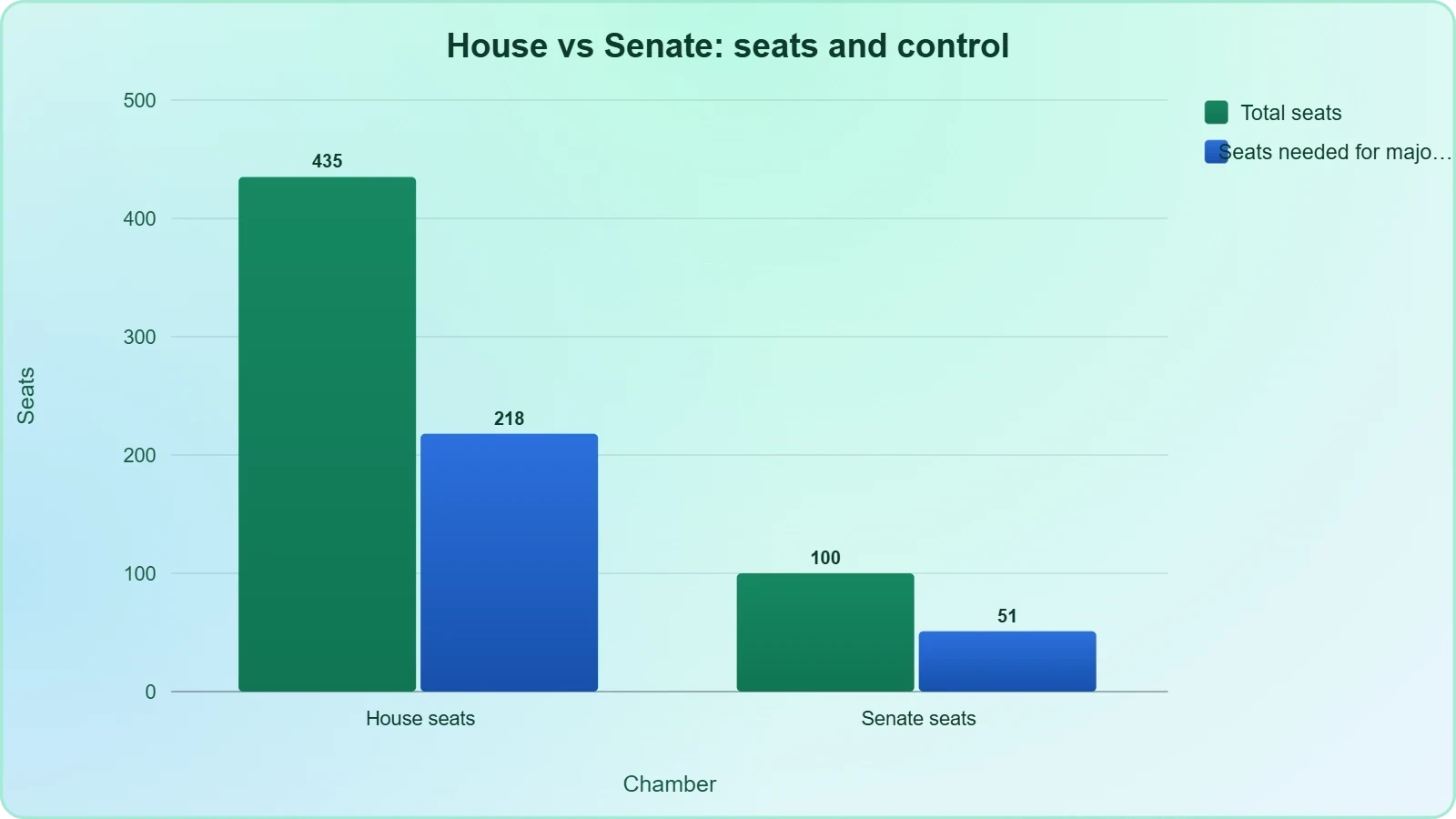
The House's 435 districts are redrawn periodically and often engineered to favour one party, yet a sufficiently strong national wave can overwhelm even favourable maps. In 2026, Democratic gains in suburban and exurban districts appear to have been the decisive vector, mirroring patterns seen in prior wave elections where college-educated voters swung sharply against the governing party. The concentration of competitive seats in affluent, high-turnout suburbs made those communities the true battleground of the House fight.
The Senate operates under entirely different constraints. With 100 seats and a staggered six-year term structure, only about 33 or 34 seats are up in any given cycle, and many are in states with entrenched partisan identities. Control therefore rests on perhaps five to eight genuinely competitive races. A 95 percent probability of a Democratic majority, as one report suggested, implies that the remaining uncounted ballots were concentrated in areas favourable to Democratic candidates, but probability is not certainty until certification.
The Ossoff Signal in Georgia
Georgia has evolved into one of the most closely watched states in American politics, and the gathering of Jon Ossoff's supporters in Atlanta offered an early barometer of Democratic fortunes. Ossoff, who first rose to national prominence through a closely watched special election and later won a Senate seat in a runoff, represents the party's ability to compete in a traditionally Republican-leaning Southern state by assembling coalitions of suburban moderates, urban progressives, and a significant share of Black voters.
Early results breaking in his favour suggested that this coalition held together in 2026. Georgia's importance extends beyond a single seat: it functions as a bellwether for whether Democrats can sustain competitiveness in the Sun Belt, a region whose demographic transformation has made it central to both parties' long-term electoral math. A strong Ossoff performance would reinforce the argument that the Sun Belt, not just the industrial Midwest, is now a genuine battleground.
The Historical Rhythm of Midterm Backlash
American midterm elections have long functioned as a corrective mechanism, and the 2026 result fits comfortably within that tradition. Since the modern two-party era took shape, the president's party has almost invariably lost House seats in midterm cycles, with only a handful of exceptions tied to extraordinary circumstances such as the post-9/11 rally or the 2002 cycle. This structural regularity means that a Democratic House victory in 2026 was, in a broad sense, the expected outcome rather than a shock.
What varies is the magnitude. Wave elections such as 1994, 2010, and 2018 produced large seat swings that redefined the political landscape for years. The 2026 result appears to sit somewhere on that spectrum, substantial enough to flip the chamber but perhaps not so overwhelming as to suggest a total realignment. The distinction matters because the size of a majority determines how much legislative and investigative leverage the new majority actually wields.
Referendum Dynamics and Presidential Approval
Midterms are frequently described as referenda on the sitting president, and the empirical record supports this framing. Voters who disapprove of the administration's performance tend to turn out in disproportionate numbers, and opposition parties benefit from a phenomenon political scientists call "surge and decline," in which the enthusiasm that powered a presidential victory two years earlier dissipates by the midterm. The 2026 cycle appears to have followed this script, with Democratic candidates capitalising on dissatisfaction among swing voters.
The referendum framing also explains why the Senate proved more resistant to the national tide. Senate races are more candidate-centric, and incumbency advantages, state-level idiosyncrasies, and the personal brands of individual senators can insulate candidates from a national wave. A party can win the House decisively while losing or narrowly holding Senate seats in states where the presidential approval drag is offset by local factors.
The Suburban Battleground
The geography of the 2026 House result points squarely at the suburbs. Over the past several cycles, affluent suburban districts have become the fulcrum of American politics, swinging between parties based on education levels, demographic change, and the salience of issues such as housing, schools, and public safety. Democratic gains in these areas were the engine of House control, and the party's ability to hold them will determine whether 2026 marks a durable shift or a temporary correction.
Suburban voters are notably sensitive to governance competence and to the tone of national politics. Their movement toward Democrats in 2026 suggests that the governing coalition's messaging failed to resonate with this critical bloc. For Republicans, the lesson is that suburban erosion, if unaddressed, threatens not just House seats but statewide competitiveness in Senate and presidential races, since suburbs constitute a large share of the electorate in most swing states.
The Senate Question: Probability Versus Certainty
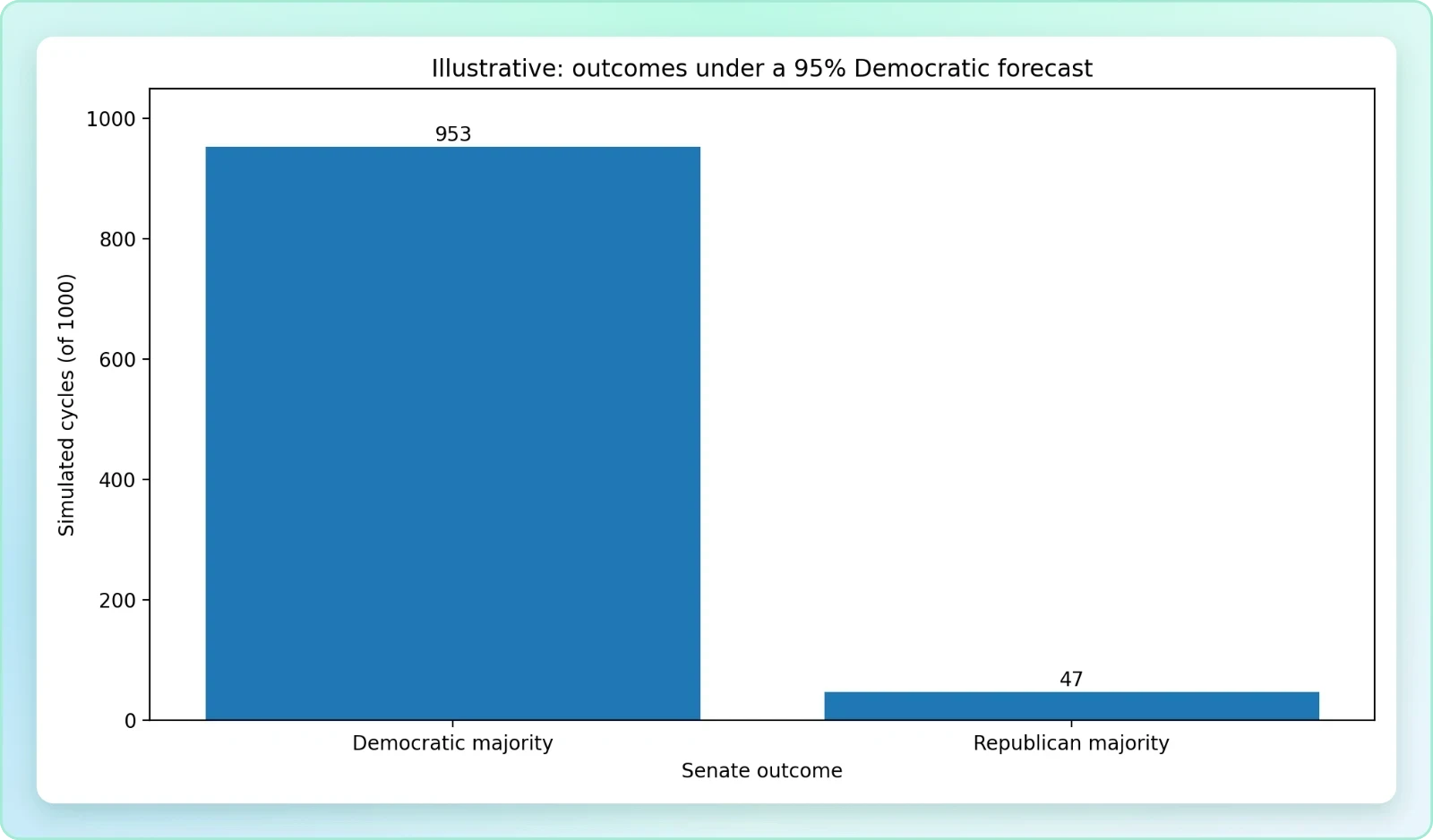
The most consequential unresolved element of the 2026 midterms is the Senate, where control remained undecided even as one report placed the Democratic Party's chance of a majority at 95 percent. That figure deserves careful interpretation. In probabilistic forecasting, 95 percent represents strong confidence but not certainty, and the remaining 5 percent encompasses scenarios such as late-counted mail ballots, recount triggers, or a single race breaking unexpectedly. The gap between a 95 percent probability and a confirmed majority is where political uncertainty lives.
The Senate's importance cannot be overstated. A Democratic Senate would confirm judicial nominees, ratify or block treaties, and provide the votes needed to advance legislation passed by the House. A Republican Senate, by contrast, would function as a firewall, preserving the minority party's ability to block Democratic priorities and to continue shaping the federal judiciary. The difference between these two worlds is the difference between divided government and unified Democratic control.
How Senate Majorities Are Actually Decided
Senate control is determined by a small number of races in states that are neither reliably red nor reliably blue. In 2026, the competitive map likely included a mix of Sun Belt states such as Georgia, Arizona, and Nevada, alongside Rust Belt states like Pennsylvania, Michigan, and Wisconsin. Each of these contests has its own dynamics, but they share a common feature: they are decided by margins narrow enough that turnout, candidate quality, and late-breaking events can tip the outcome.
The 95 percent projection implies that Democratic candidates were leading or favoured in enough of these races to make a majority highly likely. But the mechanics of counting matter enormously. Mail ballots, provisional ballots, and military and overseas ballots are often counted after election night, and in close races these can shift the margin. The 2020 and 2022 cycles both demonstrated that early leads can narrow or expand as counting proceeds, which is why responsible analysts resist declaring outcomes prematurely.
The Georgia Bellwether
Georgia's Senate race, featuring Jon Ossoff, exemplifies the modern Senate contest. The state has become a genuine battleground, with Democrats winning statewide races in 2020 and 2022 by assembling a coalition that includes substantial suburban support, strong urban turnout, and a meaningful share of rural Black voters. Ossoff's early strength in 2026 suggested that this coalition remained intact, but Georgia's history of razor-thin margins and runoff elections means that nothing is final until every ballot is counted.
The Atlanta gathering of Ossoff supporters served as a real-time indicator of Democratic morale. Such gatherings are as much about signalling confidence as about celebrating results, and they matter because perceived momentum can influence fundraising, volunteer recruitment, and media narratives in the days following an election. If Ossoff ultimately prevails, Georgia will have confirmed its status as a cornerstone of the Democratic Senate map for the remainder of the decade.
Governing Consequences of a Flipped House
A Democratic House majority immediately changes the balance of power in Washington, even if the Senate remains in Republican hands. The House controls the power of the purse, the authority to launch investigations, and the ability to set the legislative agenda in the lower chamber. For a Democratic caucus, these tools translate into oversight hearings, subpoena power, and the capacity to force uncomfortable votes on the governing party's priorities. The shift is not merely symbolic; it is operational.
The most immediate consequence is the budget. A House majority can refuse to pass appropriations bills, demand concessions, and use the debt ceiling as leverage. This creates the conditions for fiscal brinkmanship, government shutdowns, and protracted negotiations. The 2026 result therefore sets up a period of legislative friction, in which the House majority and the administration must find a modus vivendi or risk governing paralysis.
Oversight, Investigations, and Accountability
Congressional oversight is one of the most consequential and least visible powers a majority holds. With control of committees, Democrats can investigate executive branch conduct, demand documents, compel testimony, and publicise findings. These investigations can shape public opinion, damage political opponents, and generate the kind of sustained media coverage that influences future elections. The 2026 House majority will almost certainly use this power aggressively.
The strategic calculation is delicate. Oversight that appears partisan or excessive can backfire, energising the opposition and alienating swing voters. Democrats must therefore balance accountability with restraint, choosing investigations that resonate with the public and avoiding the appearance of political vendetta. The party's handling of this balance will shape its reputation heading into the 2028 presidential cycle.
Legislative Gridlock and the Art of the Possible
Divided government is often described as gridlock, but the reality is more nuanced. A Democratic House and a Republican Senate can still pass legislation in areas of overlap, such as infrastructure, defence authorisation, and certain regulatory reforms. The question is whether the parties can find common ground or whether they retreat into partisan trench warfare. History suggests both outcomes are possible, depending on leadership, timing, and the salience of shared priorities.
The 2026 result creates a negotiating dynamic in which each chamber can claim a mandate. Democrats will argue that their House victory reflects public demand for a change in direction, while Republicans will point to their Senate position as a check on overreach. This mutual claim-making is the essence of divided government, and it typically produces a mix of compromise and confrontation rather than pure paralysis.
We Also Published
- 01
- 02
- 03
- 04
Financial Markets and the Economic Signal
Markets are forward-looking, and the 2026 midterm result carries implications for fiscal policy, regulation, and the broader economic outlook. A Democratic House majority raises the probability of increased oversight of financial institutions, tougher environmental and consumer protections, and resistance to tax cuts favoured by the governing party. At the same time, divided government reduces the likelihood of sweeping legislative change, which markets often interpret as a stabilising factor.
The historical record suggests that markets respond more to uncertainty than to ideology. When control of government is divided, policy predictability can increase because neither party can implement its full agenda. The 2026 result, with a flipped House and an unresolved Senate, introduces a period of uncertainty that markets will price in gradually as the Senate outcome becomes clear and the contours of the new Congress take shape.
Sector-by-Sector Implications
Different sectors respond differently to political change. Healthcare, energy, and financial services are particularly sensitive to congressional control because they are heavily regulated and subject to oversight. A Democratic House could intensify scrutiny of pharmaceutical pricing, fossil fuel permitting, and banking practices, creating headwinds for some companies while opening opportunities for others. Defence contractors, by contrast, often benefit from bipartisan support regardless of which party controls Congress.
Investors should also watch the appropriations process. A House majority that refuses to pass spending bills can trigger shutdowns, which disrupt government services and create market volatility. The 2026 result therefore introduces a fiscal risk premium that will persist until the new Congress demonstrates an ability to govern. The magnitude of that premium depends on leadership style and the willingness of both parties to negotiate.
What the Result Means for 2028
Midterm elections are also auditions for the next presidential cycle, and the 2026 result will shape the strategic environment for 2028. A Democratic House victory provides the party with a platform for oversight, legislative proposals, and national messaging, all of which can build momentum for a presidential run. Conversely, a strong Republican Senate performance would give the governing party a defensive redoubt and a claim to continued relevance despite the House loss.
The result also influences candidate recruitment and fundraising. Parties that perform well in midterms attract stronger candidates and donors for the next cycle, while parties that underperform face internal recriminations and leadership challenges. The 2026 outcome, with its split verdict, creates a more ambiguous signal than a clean wave, which may leave both parties with contested narratives about what the results actually mean.
Leadership and Internal Party Dynamics
Election results always trigger internal reckonings. A Democratic House majority will elevate a new leadership team with control over committee gavels and the legislative calendar, while Republicans will debate whether their Senate performance represents a firewall or a warning. These internal dynamics matter because they determine the party's message discipline, its ability to negotiate, and its capacity to avoid self-inflicted wounds in the run-up to 2028.
Leadership contests are often proxies for deeper ideological debates. The 2026 result will intensify arguments about which constituencies the parties should prioritise, how aggressively to pursue oversight, and whether to compromise or confront. These debates are healthy in a democracy but can also produce fragmentation. The parties that manage them effectively will enter the 2028 cycle with a clearer sense of purpose.
The Long Shadow of Uncertainty
The unresolved Senate introduces a prolonged period of uncertainty that will shape political behaviour for weeks or months. Candidates, donors, and activists will hedge their bets, waiting for clarity before committing resources or making strategic decisions. This uncertainty is itself a political force, creating incentives for caution and delaying the kind of decisive action that follows a clear outcome.
Ultimately, the 2026 midterms will be remembered as a cycle that delivered a split verdict: a House flipped, a Senate hanging in the balance, and a nation signalling both discontent and ambivalence. The full meaning of the result will only become clear as the Senate resolves and the new Congress begins to govern. What is already evident is that American politics remains closely divided, and that neither party can claim a durable mandate from this election alone.
Reading the Result Through a Global Lens
American midterm elections resonate far beyond US borders, and the 2026 result will be scrutinised by allies and adversaries alike for signals about the direction of American foreign policy. A Democratic House majority can constrain executive action on trade, defence spending, and international agreements, while an unresolved Senate leaves partners uncertain about the durability of commitments. For governments in Europe, Asia, and the Middle East, the split verdict introduces a layer of ambiguity into their calculations about Washington.
The global dimension is particularly salient in areas where congressional approval matters, such as arms sales, treaty ratification, and sanctions legislation. A House majority can block or condition these measures, and a Senate majority determines whether they can be ratified at all. The 2026 result therefore has direct implications for US relationships with NATO allies, Indo-Pacific partners, and adversaries seeking to exploit perceived American division.
Alliances, Trade, and Strategic Ambiguity
Alliances depend on predictability, and divided government introduces a measure of unpredictability into American commitments. Partners will watch closely to see whether the new House majority seeks to condition military assistance, challenge executive trade actions, or demand greater congressional oversight of foreign policy. These dynamics can reassure allies who favour congressional checks or unsettle those who prefer a unified American voice.
Trade policy is another area where congressional control matters. A Democratic House may resist tariff expansions, demand labour and environmental standards in trade agreements, and scrutinise executive actions. The net effect is likely to be a more contested trade policy environment, in which the administration must negotiate with Congress as well as with foreign partners. This complexity is a feature of the American system, not a bug.
Democratic Legitimacy and the Global Narrative
Elections are also exercises in narrative, and the 2026 midterms will be interpreted internationally as a statement about the health of American democracy. High turnout, orderly counting, and peaceful transfers of power reinforce the legitimacy of American governance, while disputes over results can undermine it. The early reporting of the 2026 results, with clear projections and public gatherings, suggests a relatively orderly process, though the unresolved Senate will keep attention focused on counting integrity.
The global narrative matters because democracies are judged partly by their ability to conduct free and fair elections and to accept the outcomes. The 2026 result, whatever its final shape, will be cited by both defenders and critics of American democracy. The manner in which the transition unfolds, including how the Senate outcome is resolved, will shape that narrative for years to come.
From our network :
- Live Online English Classes for Kids: Do They Actually Reduce Anxiety?A ten-week study reveals that synchronous online English classes can significantly reduce child language anxiety while improving listening and reading skills. Discover what makes these programs effective and how parents can select the right one.
- How AI Agents Will Change the Way We Manage Personal FinancesExplore how AI agents are transforming personal finance through automated budgeting, bill payment, and investment management, while examining the critical security protocols and governance frameworks required for safe deployment.
- The Final Descent: How ESA Retired the Legendary Cluster Constellation After 24 Years of Space Weather ScienceAfter 24 years mapping Earth’s magnetosphere, ESA’s Cluster mission concluded with a precisely controlled reentry over the South Pacific. This analysis explores the scientific legacy, engineering decisions, and debris mitigation principles behind one of space exploration’s most responsible retirements.
- CISA’s Ten-Advisory Wave: Why Generic Patching Fails in OT and How to Build Product-Specific PlaybooksCISA released ten ICS advisories in one week, exposing critical infrastructure risks. Generic patching fails in OT. Learn to build product-specific remediation playbooks.
- University Language Proficiency Exams: Why Institutional Tests Demand Different Preparation Than IELTS and TOEFLDiscover why university-specific language proficiency examinations differ fundamentally from IELTS and TOEFL, and learn strategic preparation approaches for institutional assessment success.
- The Hidden Cost of AI Convenience: Why Over-Permissioned Agents Are a Security Time BombDiscover why AI agents with excessive permissions create dangerous single points of failure, and learn how implementing least privilege principles can protect your organization from exploitation.
- Mobile Learning and VR in English: What Global Evidence Reveals About Effective Language TechnologyA systematic review across 14 countries reveals which language-learning technologies genuinely work. Mobile learning, AI, and VR show measurable benefits when pedagogically integrated. This evidence-based guide helps educators and learners select technology that delivers real return on investment.
- Forbidden Matrix Patterns and Visible Lattice Points: A Geometric DictionaryExplore how multidimensional 0–1 matrices encode geometric truths, linking forbidden patterns to visible lattice points and hypergraph theory, with applications in combinatorics and computational geometry.
- Committed Mediterranean Precipitation Decline: Why Emissions Cuts Alone Cannot Restore Winter RainsNew NOAA research reveals that Mediterranean winter rains may decline irreversibly even with emissions cuts. Explore the science of committed climate change and regional impacts.
RESOURCES
- Resources will be updated soon.
- 01
- 02
- 03
- 04
- 05
- 06
- 07
- 08
0 Comments