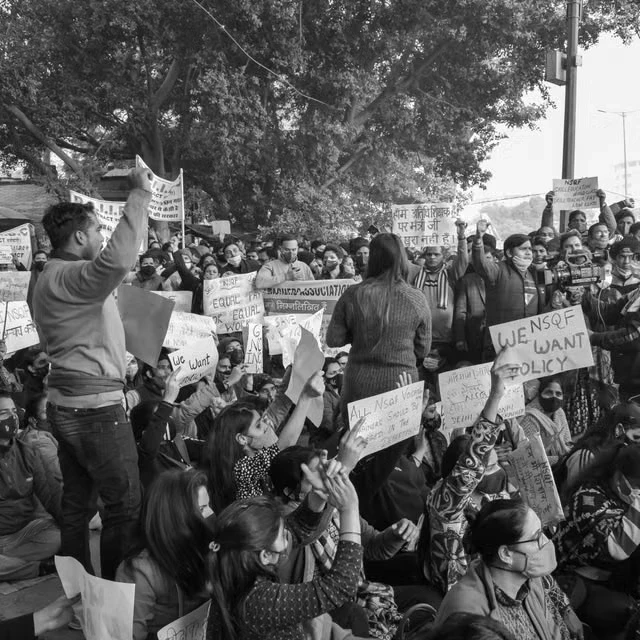
Public dissent around electoral oversight rarely remains confined to the street; it moves swiftly into the machinery of policing, crowd control, and state messaging. In this case, the reported detention of YouTuber Dhruv Rathee in Gurugram, just hours before a protest at Jantar Mantar, signals precisely that kind of escalation.
The episode sits at the intersection of political mobilisation, preventive enforcement, and the symbolic weight of a high-profile critic entering a live protest climate.
The core issue is not merely whether one individual was detained, but what that detention suggests about the atmosphere surrounding the planned demonstration against the Chief Election Commissioner. Reports of intensified security, transport restrictions, and wider police action across Delhi indicate a broader strategy of containment.
On This Page
When a protest is framed in advance by surveillance and movement controls, the event ceases to be only a gathering; it becomes a test of how far public assembly can proceed under pressure.
Rathee’s presence in the story matters because he is not an ordinary marcher in anonymity. As a prominent digital commentator, his involvement amplifies the visibility of the protest and sharpens the political message attached to it.
His Instagram video questioning restrictions at Kartavya Path also shows the modern protest cycle in full view: public criticism, online amplification, and immediate institutional response, all unfolding in the same news window.
TL;DR Dhruv Rathee’s reported detention in Gurugram ahead of a Jantar Mantar protest against the Chief Election Commissioner reflects a tightly managed security response to a politically charged demonstration. The incident underscores the growing tension between protest rights and preventive policing, especially when prominent online voices, transport controls, and alleged nationwide detentions converge around one event.
What Happened and Why It Mattered
The reported detention took place on the morning of October 10, 2026, in Gurugram, where Rathee was staying with his parents. According to intelligence-linked accounts, police arrived early, entered the residence after the door was opened, and removed him to an undisclosed location. The timing, just before the planned Delhi protest, made the move politically significant and immediately newsworthy.
The immediate sequence of events
Reports say around 50 police personnel were stationed outside the flat late on Friday night, suggesting the operation was pre-planned rather than spontaneous. The coordinated involvement of Delhi Police and Gurugram police points to an inter-jurisdictional security decision. That detail matters because it shows the authorities were acting on a wider operational map, not a single local complaint.
Rathee had reportedly travelled to Delhi to join the protest at Jantar Mantar. His detention, therefore, did not occur in isolation; it directly affected the event’s expected momentum. In protest politics, removing a visible participant before assembly can be as consequential as dispersing a crowd after it forms, because it shapes the public narrative before the first slogan is raised.
The political significance of pre-protest detention
Preventive detention or preventive removal before a protest is a powerful signal from the state. It suggests that authorities expect disruption, possible disorder, or heightened political embarrassment. In this case, the action also conveyed that the protest was being treated not as a routine civic gathering, but as a sensitive political flashpoint requiring advance control.
Such measures are often defended on grounds of law and order, but they also attract criticism for narrowing democratic space. When a public figure is detained ahead of a rally, the incident can magnify attention rather than reduce it. Instead of muting the issue, the state may end up broadcasting its own anxiety about the scale or symbolism of the protest.
The Protest Context and the Security Climate
The reported protest was not unfolding in a neutral atmosphere. Delhi authorities had allegedly tightened restrictions on movement, transport, and access, creating a pressure-cooker setting around the capital. In such conditions, even before any crowd gathers, the state effectively begins defining the boundaries of acceptable political expression.
Restrictions that shape mobilisation
According to the report, measures included possible metro station closures, train cancellations, and temporary suspension of mobile internet services in parts of central Delhi. These are not minor inconveniences; they are logistical levers that can cripple turnout and fragment coordination. Their strategic effect is to make assembly harder, slower, and more uncertain.
From an administrative perspective, such restrictions are often portrayed as precautionary. From a civic perspective, they can appear as pre-emptive containment of dissent. The distinction is critical, because the same action can be read either as public safety or political suppression depending on the evidence, scope, and proportionality of the response.
The role of public figures in protest visibility
Rathee’s participation gave the protest an outsized digital reach. A visible online personality can convert a local demonstration into a national conversation within minutes, especially when the issue already touches institutional accountability. That influence explains why his detention would draw so much scrutiny: he was not simply attending; he was potentially helping frame the public meaning of the event.
His Instagram video from Kartavya Path, questioning the proposed restrictions, further complicated the official narrative. Online commentary before a protest can serve as both mobilisation and criticism, and authorities often respond accordingly. The modern protest landscape is therefore double-layered: one battle occurs on the street, and another unfolds on social platforms where perception is won or lost.
TL;DR The report portrays a tightly managed protest moment in which police action, transport controls, and digital amplification converged around one politically sensitive demonstration. Rathee’s detention is best understood not as a standalone event, but as part of a broader effort to shape the size, tone, and visibility of public dissent before it could fully materialize.
Allegations, Claims, and the Need for Caution
Any responsible reading of the incident must distinguish between reported facts, alleged motivations, and political interpretation. The source attributes information to intelligence-linked and police-related reporting, which means some details remain unverified in the public domain. Good analysis therefore requires precision: describe what is reported, but do not overstate what has not yet been formally established.
Why source discipline matters
In fast-moving political stories, the temptation is to convert every allegation into certainty. That is poor practice. A disciplined reading respects the difference between confirmed detention, reported police deployment, and the broader claims made by protest organisers about nationwide detentions of supporters. Those distinctions are essential for accurate public understanding.
They are also important for reputational fairness. Prominent figures attract strong assumptions, and political reporting often hardens nuance into slogans. Careful journalism, by contrast, keeps the borders visible between direct observation, attributed statements, and interpretive conclusions, which is exactly what this event demands.
The protest organisers’ allegations
The report notes that CJP and Left groups alleged supporters were detained from across the country ahead of the protest. If accurate, that would indicate the operation extended beyond a single city and into a wider preventive framework. Such a claim raises the stakes considerably, because it implies the protest environment was being managed nationally, not locally.
Even so, allegations must be weighed against available confirmation. In politically charged episodes, both organisers and authorities have incentives to frame events in ways that support their position. The mature response is neither reflexive belief nor reflexive dismissal, but a careful reading of evidence as it emerges.
We Also Published
- 01
- 02
- 03
- 04
How the Incident Shapes Public Debate
This episode is likely to reverberate beyond the immediate protest, because it combines celebrity, dissent, and policing in one compact frame. Once a prominent content creator enters a political confrontation, the story gains algorithmic reach and emotional charge. That makes the event more than an isolated detention; it becomes a lens through which broader questions of civic freedom are judged.
The optics of authority
Authorities often seek to project firmness when protests are deemed sensitive. Yet firmness without transparency can produce the opposite of calm: it invites suspicion. In this case, the optics of a large police presence, late-night surveillance, and a morning detention will naturally prompt questions about proportionality, due process, and the intended message to potential participants.
Those questions are not mere commentary; they are central to democratic legitimacy. The state’s credibility is strengthened when it can explain its actions clearly and narrowly. It is weakened when preventive measures appear broad, opaque, or disproportionate to the threat actually posed by assembly.
The long tail of digital amplification
Because Rathee is a digital-first public voice, any action against him is instantly reframed through social platforms, clips, reposts, and commentary. That speed of circulation means the narrative will not remain local. Whether the event is remembered as a security necessity or a crackdown depends heavily on how convincingly each side explains itself in public.
This is the modern politics of attention: institutional action no longer ends with the act itself. It triggers a second round of judgment online, where perception hardens fast and nuance evaporates. For that reason, incidents like this should be assessed not only for their legal dimension, but for the broader democratic signal they send.
The Larger Democratic Lesson
The deeper lesson is simple and unyielding: democratic systems are judged not only by elections, but by how they tolerate challenge between elections. When a protest over the conduct of electoral oversight triggers broad restrictions and the reported detention of a prominent critic, the public inevitably asks whether the system is secure or merely defensive.
Freedom, accountability, and institutional confidence
Healthy institutions do not fear scrutiny; they answer it. They explain restrictions narrowly, justify security decisions specifically, and avoid broad actions that make ordinary dissent look dangerous. That standard becomes especially important when the protest concerns the very architecture of democratic trust, such as election administration.
Confidence in institutions grows when citizens feel they can protest without being presumptively treated as a threat. Conversely, the use of sweeping preventive measures can create the impression that legitimacy is fragile. That perception, once formed, is difficult to reverse and often more damaging than the protest itself.
What readers should take away
The responsible takeaway is not a slogan but a framework. Read the detention as part of a larger security response. Read the restrictions as instruments of crowd management with political consequences. Read the allegations carefully, with attention to attribution and proof. Above all, recognise that the conflict is as much about democratic tone as it is about a single morning in Gurugram.
That is why the story matters. It illustrates how, in contemporary India, protest, policing, and digital influence increasingly collide in real time. When they do, the real contest is not just over who stands at Jantar Mantar, but over who controls the meaning of public action before the crowd even arrives.
Closing Assessment
The reported detention of Dhruv Rathee in Gurugram is best understood as part of a wider, highly managed response to a politically sensitive protest. Whether one views the police action as prudent prevention or excessive control depends on the evidence that eventually emerges, but the immediate meaning is unmistakable: the authorities sought to shape the protest environment before it could fully materialize.
That is the central fact pattern worth retaining. A public critic, a charged demonstration, heavy security, and an atmosphere of pre-emptive restriction combined to create a story about power as much as protest. In democratic societies, those are not peripheral details; they are the substance of the debate itself.
From our network :
- Forbidden Matrix Patterns and Visible Lattice Points: A Geometric DictionaryExplore how multidimensional 0–1 matrices encode geometric truths, linking forbidden patterns to visible lattice points and hypergraph theory, with applications in combinatorics and computational geometry.
- Committed Mediterranean Precipitation Decline: Why Emissions Cuts Alone Cannot Restore Winter RainsNew NOAA research reveals that Mediterranean winter rains may decline irreversibly even with emissions cuts. Explore the science of committed climate change and regional impacts.
- Mobile Learning and VR in English: What Global Evidence Reveals About Effective Language TechnologyA systematic review across 14 countries reveals which language-learning technologies genuinely work. Mobile learning, AI, and VR show measurable benefits when pedagogically integrated. This evidence-based guide helps educators and learners select technology that delivers real return on investment.
- How AI Agents Will Change the Way We Manage Personal FinancesExplore how AI agents are transforming personal finance through automated budgeting, bill payment, and investment management, while examining the critical security protocols and governance frameworks required for safe deployment.
- The Final Descent: How ESA Retired the Legendary Cluster Constellation After 24 Years of Space Weather ScienceAfter 24 years mapping Earth’s magnetosphere, ESA’s Cluster mission concluded with a precisely controlled reentry over the South Pacific. This analysis explores the scientific legacy, engineering decisions, and debris mitigation principles behind one of space exploration’s most responsible retirements.
- Live Online English Classes for Kids: Do They Actually Reduce Anxiety?A ten-week study reveals that synchronous online English classes can significantly reduce child language anxiety while improving listening and reading skills. Discover what makes these programs effective and how parents can select the right one.
- CISA’s Ten-Advisory Wave: Why Generic Patching Fails in OT and How to Build Product-Specific PlaybooksCISA released ten ICS advisories in one week, exposing critical infrastructure risks. Generic patching fails in OT. Learn to build product-specific remediation playbooks.
- The Hidden Cost of AI Convenience: Why Over-Permissioned Agents Are a Security Time BombDiscover why AI agents with excessive permissions create dangerous single points of failure, and learn how implementing least privilege principles can protect your organization from exploitation.
- University Language Proficiency Exams: Why Institutional Tests Demand Different Preparation Than IELTS and TOEFLDiscover why university-specific language proficiency examinations differ fundamentally from IELTS and TOEFL, and learn strategic preparation approaches for institutional assessment success.
RESOURCES
- Dhruv Rathee detained ahead of protest at Jantar Mantar - The Hinduthehindu.com3 days ago ... Dhruv Rathee detained ahead of Jantar Mantar protest as Delhi-Gurugram police arrest him from a Gurugram flat amid heightened security.
- Popular YouTuber Dhruv Rathee has been detained ahead of the ...instagram.com3 days ago ... Social media posts claim that YouTuber Dhruv Rathee was arrested by Delhi Police ahead of the Jantar Mantar protest. According…
- Dhruv Rathee Detained from Gurugram Residence Ahead of Delhi ...facebook.com3 days ago ... Many detained protesters back at Jantar Mantar — straight from police stations Read here https: //indianexpress.com/article/cities/delhi ...
- YouTuber and political commentator Dhruv Rathee has reportedly ...instagram.com3 days ago ... ... ahead of the Cockroach Janta Party (CJP) protest at Delhi's Jantar ... [Dhruv Rathee detained, Gurugram, Delhi Police, CJP…
- YouTuber Dhruv Rathee Detained Ahead Of CJP Protest At Jantar ...facebook.com3 days ago ... LIVE: YouTuber Dhruv Rathee Detained Ahead Of CJP Protest At Jantar Mantar | V6 News.
- India's 'Cockroach' movement says many members detained ahead ...reuters.com5 days ago ... [1/10]Indian social media influencer and activist Dhruv Rathee ... Jantar Mantar protest site in New Delhi. Delhi Police said the ...
- India's 'Cockroach' leaders released from detention after police ...aljazeera.com2 days ago ... The CJP had planned to gather thousands of people at Jantar Mantar, a designated protest site in central New Delhi.…
- YouTuber Dhruv Rathee detained in Gurugram ahead of CJP's ...hindustantimes.com3 days ago ... Were other people detained ahead of the CJP protest in Delhi? Why did police increase security before the Jantar Mantar…
- Dhruv Rathee Detained From Gurugram Home Ahead Of CJP ...ndtv.com3 days ago ... ... ahead of the Cockroach Janta Party's (CJP) proposed protest at Jantar Mantar, police sources said. Rathee has come to…
- YouTuber Dhruv Rathee released after detention - Daily Sundaily-sun.com2 days ago ... Dhruv Rathee detained ahead of CJP's Jantar Mantar protest ... The CJP, a political satire group, alleged in a post…
- 01
- 02
- 03
- 04
- 05
- 06
- 07
- 08
0 Comments