
The Gem Granites POCSO investigation has crossed a decisive threshold, transforming from a localized inquiry into a coordinated legal operation with international reach.
Chennai police have now issued Look Out Circulars against five suspects linked to the sprawling case surrounding R. Veeramani, the octogenarian founder of the granite conglomerate.
These circulars represent far more than procedural paperwork; they signal that investigators believe key evidence or knowledge may attempt to flee the jurisdiction.
On This Page
What began as individual complaints has metastasized into eight separate POCSO cases and one abetment-to-suicide case dating back to 2004. Eight accused individuals already occupy Puzhal central prison, while the principal figures remain poised for imminent custody and confrontation with seized evidence.
The Special Investigation Team's interception of Veeramani's daughter Archana at Chennai International Airport underscores the gravity with which authorities now treat any movement connected to this network.
This analysis dissects the legal architecture, investigative mechanics, and institutional implications of the case. It examines how Look Out Circulars function as enforcement instruments, why the SIT's airport interception matters, and what the anticipated charge sheets reveal about the trajectory of one of Tamil Nadu's most sensitive prosecutions.
TL;DR Chennai police issued Look Out Circulars against five suspects in the Gem Granites POCSO cases involving founder R. Veeramani, barring them from leaving India. The SIT intercepted Veeramani's daughter Archana at Chennai airport, questioned her about financial transactions, and registered a ninth case. Eight accused are jailed, with Veeramani, Shanti, and Mahendra Simhan facing imminent custody as investigators prepare charge sheets.
The Legal Architecture of Look Out Circulars and Custodial Strategy
Look Out Circulars operate as one of the most potent administrative tools available to Indian investigative agencies, functioning at the intersection of policing and immigration control.
Issued against individuals wanted by police, they empower the Bureau of Immigration to halt movement through land, air, and sea ports nationwide.
In the Gem Granites matter, their deployment against five suspects reveals a calculated strategy to freeze the network's mobility.
How Look Out Circulars Function as Enforcement Instruments
A Look Out Circular is essentially a standing alert embedded within the immigration system's digital infrastructure, activated the moment a flagged individual attempts border transit.
The Bureau of Immigration enforces these circulars across every authorized port of entry and exit, creating a comprehensive national perimeter. Unlike arrest warrants, LOCs require no judicial approval, granting investigators rapid, unilateral response capability.
Critically, LOCs serve dual purposes in complex sexual offence investigations: they prevent physical flight and simultaneously pressure suspects to cooperate. When individuals know their passports are effectively neutralized, the calculus of evasion shifts dramatically toward negotiation and disclosure. Investigators clearly intend to leverage this psychological dimension alongside the practical containment.
The five unnamed suspects reportedly may hold or know about documents and information connected to the POCSO cases. This phrasing suggests authorities suspect evidentiary concealment or destruction rather than mere physical absconding.
By sealing the borders, the SIT protects the integrity of a documentary record that could prove pivotal at trial.
Legal scholars note that LOC issuance in high-profile cases often attracts judicial scrutiny regarding proportionality and due process. However, when offences involve minors under the POCSO Act, courts have generally shown deference to investigative urgency.
The Chennai police's move reflects confidence that the evidentiary stakes justify extraordinary containment measures.
The Airport Interception of Archana and Financial Trail
The SIT's interception of Archana at Chennai International Airport on Friday represents the investigation's most dramatic operational moment to date. She was about to leave the country when authorities halted her, then questioned her extensively about Veeramani's activities and monetary transactions. The timing suggests intelligence-driven targeting rather than coincidence.
Police specifically probed money transactions executed to avoid police action, a line of inquiry that elevates the case beyond sexual offences into potential obstruction and financial concealment.
Such transactions, if substantiated, could attract separate charges under anti-corruption and criminal conspiracy provisions. The financial dimension may ultimately prove as consequential as the underlying POCSO allegations.
Archana, reportedly hospitalized due to illness, was later permitted to return home rather than detained. This calibrated approach balances investigative necessity against humanitarian considerations, while the LOC net presumably remains active.
Her release does not signal exoneration; it reflects tactical sequencing in a case where evidence-gathering precedes formal custody.
The interception also demonstrates the SIT's surveillance capabilities and willingness to act decisively at international transit points. Families of high-profile accused often possess the resources and networks for rapid departure.
By striking at the airport, investigators delivered an unmistakable message about the reach of their operation.
Custodial Plans for Veeramani, Shanti, and Mahendra Simhan
The SIT has declared that Veeramani, Shanti, and her husband Mahendra Simhan will soon be taken into custody for questioning and confronted with evidence seized thus far.
This confrontational approach signals that investigators have accumulated substantial material and now seek to test competing narratives against documentary and testimonial proof.
Veeramani, in his eighties, presents unusual custodial considerations given his age and health profile. Yet the gravity of eight POCSO cases and an abetment-to-suicide matter spanning two decades leaves little room for leniency arguments. Courts will weigh his advanced age against the severity of allegations involving minors.
Shanti and Mahendra Simhan's inclusion suggests investigators view them as central facilitators rather than peripheral associates. Their anticipated confrontation with seized evidence indicates the SIT has constructed a documentary spine linking multiple complainants. The charge sheets will reveal precisely how these threads converge.
Eight accused individuals already lodged in Puzhal central prison establish the case's custodial momentum. Each arrest strengthens the prosecution's narrative architecture while pressuring remaining suspects toward cooperation.
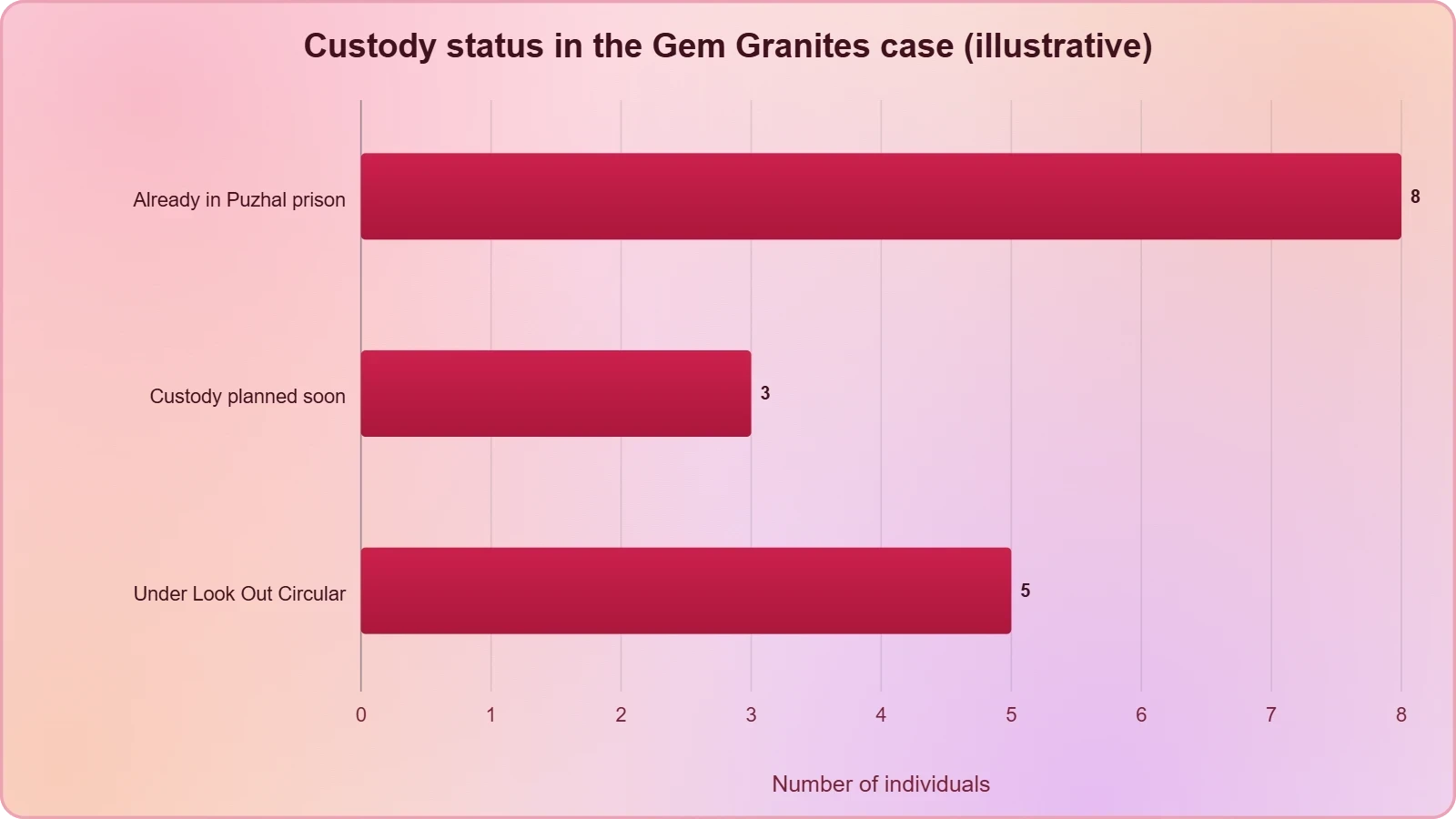
The SIT's stated expectation of completing investigations soon reflects confidence in the evidentiary foundation.
Evidentiary Confrontation and Charge Sheet Preparation
The SIT's commitment to confronting suspects with seized evidence reveals a prosecution strategy built on documentary and material proof rather than testimony alone.
This approach anticipates defense challenges by anchoring allegations in tangible records, potentially including financial trails, communications, and physical exhibits gathered across multiple locations.
Charge sheet preparation in multi-complainant POCSO cases demands meticulous sequencing, as each victim's account must withstand independent scrutiny. The designated court will receive filings expected soon, according to the SIT's statement. Premature filing risks acquittal; excessive delay invites judicial displeasure and defense motions.
The 2004 abetment-to-suicide case involving a minor girl adds historical depth that complicates the defense's timeline. Linking conduct across two decades requires robust archival evidence and witness continuity.
Investigators appear confident that such continuity exists, given their public declaration of imminent completion.
Prosecutorial success will hinge on whether the evidentiary confrontation yields corroboration or contradiction. When suspects face seized material directly, narratives often fracture under pressure. The SIT's confrontational design suggests they expect precisely such fractures to strengthen the state's case.
Institutional Accountability and the Broader POCSO Enforcement Context
The Gem Granites prosecution unfolds against a national backdrop of intensifying POCSO enforcement, where courts and legislatures have demanded faster investigations and harsher penalties.
Tamil Nadu's response, embodied in the dedicated SIT, reflects a broader institutional shift toward specialized handling of sexual offences against children. The case's prominence tests whether that machinery functions under maximum public scrutiny.
The Special Investigation Team Model Under Pressure
Dedicated SITs represent an institutional acknowledgment that ordinary police stations lack the bandwidth for sprawling, multi-victim sexual offence cases. By consolidating investigative authority, the model enables coordinated evidence-gathering, witness protection, and prosecutorial liaison. Chennai's SIT now operates under intense media and judicial observation.
The team's public statements, including confirmation of the airport interception and custody plans, indicate a communication strategy designed to project competence and transparency.
Such visibility cuts both ways: it builds public confidence while creating expectations that any procedural lapse will attract immediate criticism. The SIT's credibility is now inseparable from the case's outcome.
Resource allocation within the SIT likely spans forensic analysis, financial investigation, and victim support services. The financial inquiry triggered by Archana's questioning suggests dedicated economic offences expertise embedded within the team. This multidisciplinary composition mirrors best practices advocated by child protection bodies nationwide.
Judicial oversight will scrutinize whether the SIT respected procedural safeguards, particularly in handling minor victims and their families. POCSO mandates child-friendly procedures, and any deviation could undermine otherwise strong evidence. The team's professionalism in this dimension may prove decisive at trial.
Corporate Reputation and the Granite Industry's Reckoning
Gem Granites built its identity on exporting India's finest granite to global markets, with R. Veeramani celebrated as an industry pioneer. The POCSO allegations now threaten to recast that legacy entirely, transforming a business icon into a cautionary tale about unchecked power. Corporate reputation, once polished like the stone itself, faces irreversible erosion.
The granite industry's structure, characterized by family-controlled enterprises and opaque labor arrangements, has historically shielded insiders from external scrutiny. This case may catalyze demands for greater transparency in how such businesses manage personnel and contractual relationships. Industry associations have remained conspicuously silent, a silence that itself invites interpretation.
Business historians note that founder-led conglomerates often concentrate both authority and vulnerability in a single individual. When that individual faces criminal prosecution, the entire enterprise's governance architecture comes under examination.
Gem Granites now confronts questions about succession, operational continuity, and whether institutional safeguards ever existed.
International buyers and partners may reassess relationships as the legal process unfolds, particularly given global supply chain due diligence norms. Reputational contagion can spread quickly through export networks.
The company's response, or absence thereof, will shape whether the damage remains personal or becomes institutional.
Victim Protection and the Long Road to Justice
Eight POCSO cases represent eight distinct journeys toward justice, each requiring sustained institutional commitment beyond arrest and charge sheet. Survivors of child sexual abuse face protracted court proceedings, social stigma, and psychological tolls that often outlast the legal process itself. The SIT's efficiency must be matched by victim support infrastructure.
Tamil Nadu's child protection machinery includes specialized courts, support persons, and compensation schemes mandated under POCSO. Whether these mechanisms function effectively in a case of this magnitude will determine whether justice remains merely procedural or becomes genuinely restorative. Advocacy groups will monitor every stage.
The 2004 abetment case adds a haunting temporal dimension, reminding observers that delayed justice can span generations. A minor girl's death two decades ago now intersects with contemporary prosecutions, raising questions about what institutional failures permitted such prolonged impunity. The charge sheets may illuminate those failures.
Public attention, while valuable for accountability, carries risks for survivors navigating trauma. Media scrutiny must balance transparency against privacy protections that POCSO explicitly guarantees.
The case's outcome will be measured not only in convictions but in whether victims emerge with dignity intact.
We Also Published
Investigative Trajectory and the Road Ahead
The Gem Granites case now enters its most consequential phase, where investigative momentum must convert into judicially sustainable outcomes. Charge sheets filed in the designated court will either vindicate the SIT's aggressive posture or expose evidentiary gaps that defense counsel will exploit. Every subsequent move carries disproportionate weight.
Anticipated Charge Sheets and Judicial Scrutiny
Charge sheets in POCSO matters must satisfy stringent evidentiary thresholds, particularly regarding victim testimony corroboration and procedural compliance. The SIT's stated confidence suggests substantial material has been assembled, but courts apply independent scrutiny regardless of investigative enthusiasm. Judicial skepticism is a feature, not a flaw.
Defense strategies will likely challenge LOC legality, question the timing of Archana's interception, and probe whether financial transaction allegations constitute genuine obstruction or investigative overreach. Each challenge tests the prosecution's preparation depth. The designated court's rulings will establish precedents for similar high-profile cases.
Timeline management becomes critical as public expectations intensify. Courts increasingly resist indefinite investigations in sexual offence cases, mindful of victim trauma and evidentiary decay. The SIT's promise of imminent completion aligns with judicial preferences for expeditious resolution.
Appellate pathways will remain open regardless of trial court outcomes, meaning final justice may be years distant. The case's ultimate legacy may lie less in verdicts than in institutional reforms it catalyzes. That possibility lends the proceedings significance beyond individual accountability.
Lessons for Corporate Governance and Law Enforcement
The case delivers uncomfortable lessons about how concentrated wealth and founder authority can create environments where accountability mechanisms atrophy. Corporate boards, industry peers, and regulators must ask whether similar vulnerabilities exist elsewhere. Silence from the granite sector suggests introspection has yet to begin.
For law enforcement, the SIT model demonstrates that specialized teams can act decisively even against powerful interests. The airport interception and LOC deployment show that mobility can be constrained regardless of resources. These tactics will likely be studied and replicated in comparable investigations nationwide.
Yet the case also exposes how long impunity can persist when victims lack institutional support. The 2004 abetment matter went unprosecuted for two decades, a failure that demands explanation. Contemporary efficiency cannot erase historical neglect, but it can establish corrective precedent.
Ultimately, the Gem Granites prosecution will be judged by whether it delivers justice to survivors while reinforcing the principle that no fortune, reputation, or network places anyone beyond legal reach. That principle, once tested, either strengthens or corrodes public faith in institutions.
Public Trust and the Visibility of Justice
High-profile prosecutions function as public referenda on institutional integrity, and the Gem Granites case carries that burden heavily. Every procedural misstep will be amplified, every delay interpreted as deference to power. The SIT operates knowing that its conduct will shape perceptions far beyond Chennai.
Transparency, balanced against victim privacy, becomes the governing principle. The SIT's willingness to publicize its actions suggests awareness of this dynamic. Yet visibility without substance invites cynicism; only demonstrable progress sustains credibility.
The coming charge sheets will be read as evidence of either seriousness or theater.
Civil society organizations, legal commentators, and survivor advocates will scrutinize outcomes against the case's extraordinary facts. Their assessments will influence whether the public concludes that justice is attainable regardless of wealth. That conclusion, more than any single verdict, determines the case's enduring significance.
The Gem Granites saga ultimately asks whether India's child protection architecture can withstand pressure from entrenched power. The answer will emerge not from press statements but from courtrooms where evidence meets scrutiny.
Until then, the Look Out Circulars remain a promise that flight is no longer an option.
From our network :
- Committed Mediterranean Precipitation Decline: Why Emissions Cuts Alone Cannot Restore Winter RainsNew NOAA research reveals that Mediterranean winter rains may decline irreversibly even with emissions cuts. Explore the science of committed climate change and regional impacts.
- Forbidden Matrix Patterns and Visible Lattice Points: A Geometric DictionaryExplore how multidimensional 0–1 matrices encode geometric truths, linking forbidden patterns to visible lattice points and hypergraph theory, with applications in combinatorics and computational geometry.
- The Final Descent: How ESA Retired the Legendary Cluster Constellation After 24 Years of Space Weather ScienceAfter 24 years mapping Earth’s magnetosphere, ESA’s Cluster mission concluded with a precisely controlled reentry over the South Pacific. This analysis explores the scientific legacy, engineering decisions, and debris mitigation principles behind one of space exploration’s most responsible retirements.
- Live Online English Classes for Kids: Do They Actually Reduce Anxiety?A ten-week study reveals that synchronous online English classes can significantly reduce child language anxiety while improving listening and reading skills. Discover what makes these programs effective and how parents can select the right one.
- The Hidden Cost of AI Convenience: Why Over-Permissioned Agents Are a Security Time BombDiscover why AI agents with excessive permissions create dangerous single points of failure, and learn how implementing least privilege principles can protect your organization from exploitation.
- CISA’s Ten-Advisory Wave: Why Generic Patching Fails in OT and How to Build Product-Specific PlaybooksCISA released ten ICS advisories in one week, exposing critical infrastructure risks. Generic patching fails in OT. Learn to build product-specific remediation playbooks.
- Mobile Learning and VR in English: What Global Evidence Reveals About Effective Language TechnologyA systematic review across 14 countries reveals which language-learning technologies genuinely work. Mobile learning, AI, and VR show measurable benefits when pedagogically integrated. This evidence-based guide helps educators and learners select technology that delivers real return on investment.
- University Language Proficiency Exams: Why Institutional Tests Demand Different Preparation Than IELTS and TOEFLDiscover why university-specific language proficiency examinations differ fundamentally from IELTS and TOEFL, and learn strategic preparation approaches for institutional assessment success.
- How AI Agents Will Change the Way We Manage Personal FinancesExplore how AI agents are transforming personal finance through automated budgeting, bill payment, and investment management, while examining the critical security protocols and governance frameworks required for safe deployment.
RESOURCES
- Gem Granites Veeramani case: Chennai Police issue LOC ...thehindu.com17 hours ago ... Chennai police issue LOC on five suspects tied to Veeramani's POCSO cases, as new charges and investigations unfold.
- The Chennai police have issued a look out circular (LOC) against ...instagram.comSep 24, 2026 ... Immigration officials at the Chennai airport on Friday detained Archana, daughter of POCSO case accused R Veeramani of Gem Granite,…
- Police conduct searches at five places linked to Gem Granites ...thehindu.comSep 23, 2026 ... The searches included two bungalows belonging to Veeramani. The police have also issued a Look Out Circular (LOC) against Prakash,…
- CCB conducts searches at five locations in #GemGranites casefacebook.comSep 23, 2026 ... Meanwhile, a Look Out Circular (LOC) ... Kannan, IPS, over the handling of the POCSO case against GEM Granites Veeramani…
- Chennai Police have registered another case against businessman ...instagram.com5 hours ago ... Investigators are also looking into possible money transactions connected to the case ... GEM Granites, R Veeramani, Veeramani case, POCSO…
- https://www.dtnext.in/news/tamilnadu/look-out-notice-against ...facebook.comSep 24, 2026 ... ... POCSO case against granite baron, R Veeramani. After Prakash's ... Gem Veeramani POCSO case. Vijay questioned M.K. Stalin on…
- The Hindu - Xx.com16 hours ago ... The Greater Chennai Police have issued a Look Out Circular (LOC) against five suspects in the 'Gem Granites' owner Veeramani…
- Veeramani's properties searched, LoC issued against businessmannewindianexpress.comSep 24, 2026 ... Senior BJP leader H Raja on Wednesday demanded that the Pocso case against GEM Veeramani be transferred to the CBI…
- Vijay Kumar S on Xx.com19 hours ago ... Breaking Chennai Police issue Look Out Circular (LOC) against 5 ... POCSO Act case booked against Veeramani @chennaipol…
- Fresh case registered against granite baron Veeramani in minor ...newindianexpress.com13 hours ago ... CHENNAI: The Greater Chennai Police (GCP) have issued lookout circulars (LoCs) against five persons, including Archana, daughter of Gem Granites ...
- Manupatra Legal Tech Suite – AI-Powered Research, Case ...manupatra.aiR Veeramani, 84, chairman of Gem Granites, is lodged in Puzhal Central ... for Singapore and the search for her brother and another associate…
- Pocso case: 8th case filed against granite baron Veeramanidtnext.in6 hours ago ... ... cases against him to eight. Meanwhile, Look Out Circular (LOC) notices have been issued against five suspects to prevent…
- Police to issue blue corner notice against Prakash | Chennai Newstimesofindia.indiatimes.com4 days ago ... ... cases involving Gem Granites chairman R Veeramani. A Look Out Circular (LOC) ... A special Pocso court in Chennai…
- As Veeramani probe widens, police look within, cops are summonedindianexpress.comSep 26, 2026 ... The investigation into the POCSO case against granite businessman R Veeramani ... Meanwhile, a Look Out Circular has been issued…
- 01
- 02
- 03
- 04
- 05
- 06
- 07
- 08
0 Comments