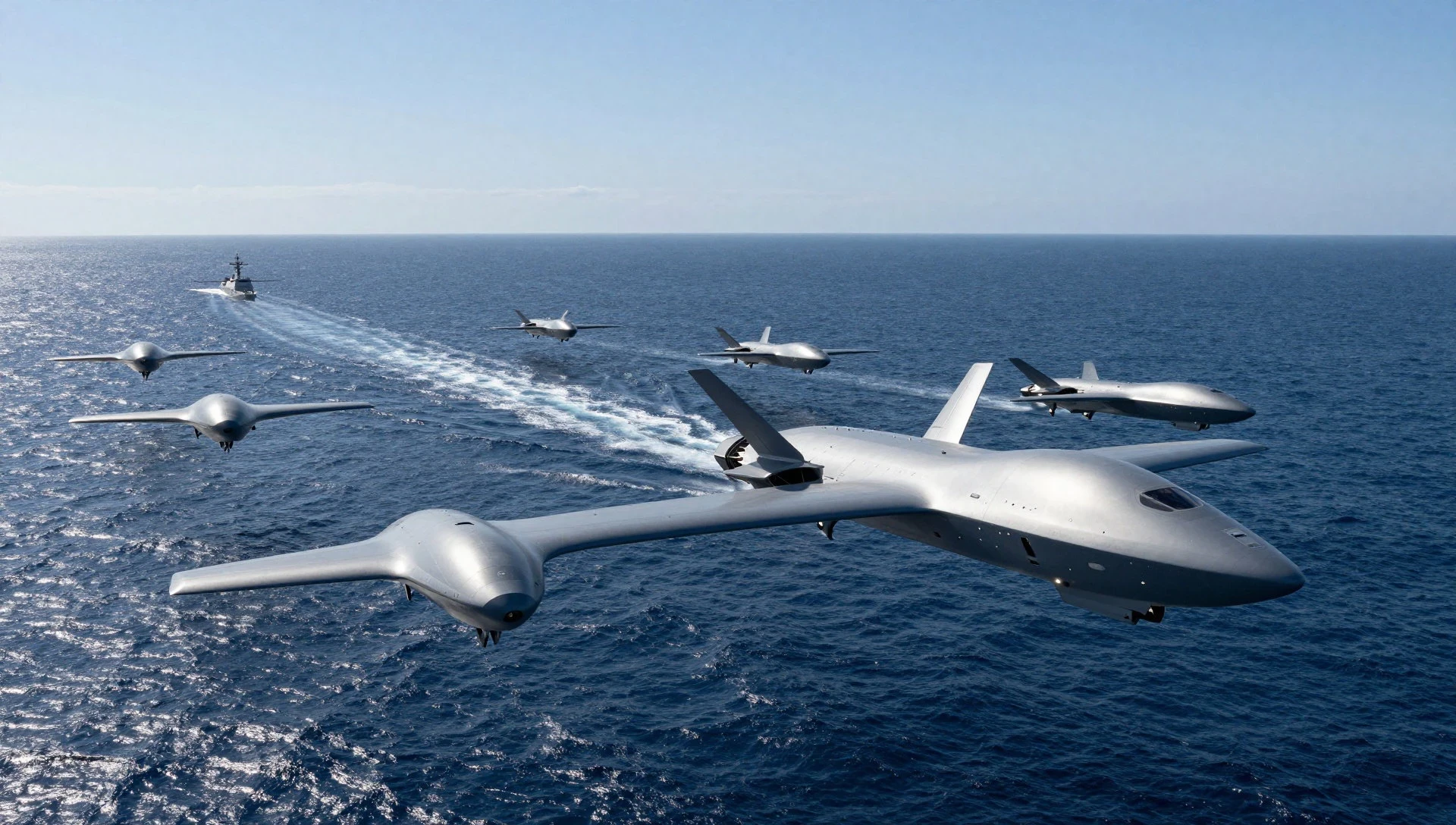
The Northern Navies Initiative, signed in Oslo aboard the aircraft carrier HMS Prince of Wales, marks a deliberate shift in how European naval powers intend to confront Russian maritime activity in the North Atlantic and Baltic approaches. Led by the United Kingdom and joined by nine partners from the Joint Expeditionary Force, the arrangement binds together sea drones, advanced sensors, artificial intelligence systems and conventional warships into a single interoperable surveillance and deterrence architecture. Its significance lies less in any single platform than in the connective tissue it creates between ten separate navies that have historically operated on parallel but rarely merged tracks.
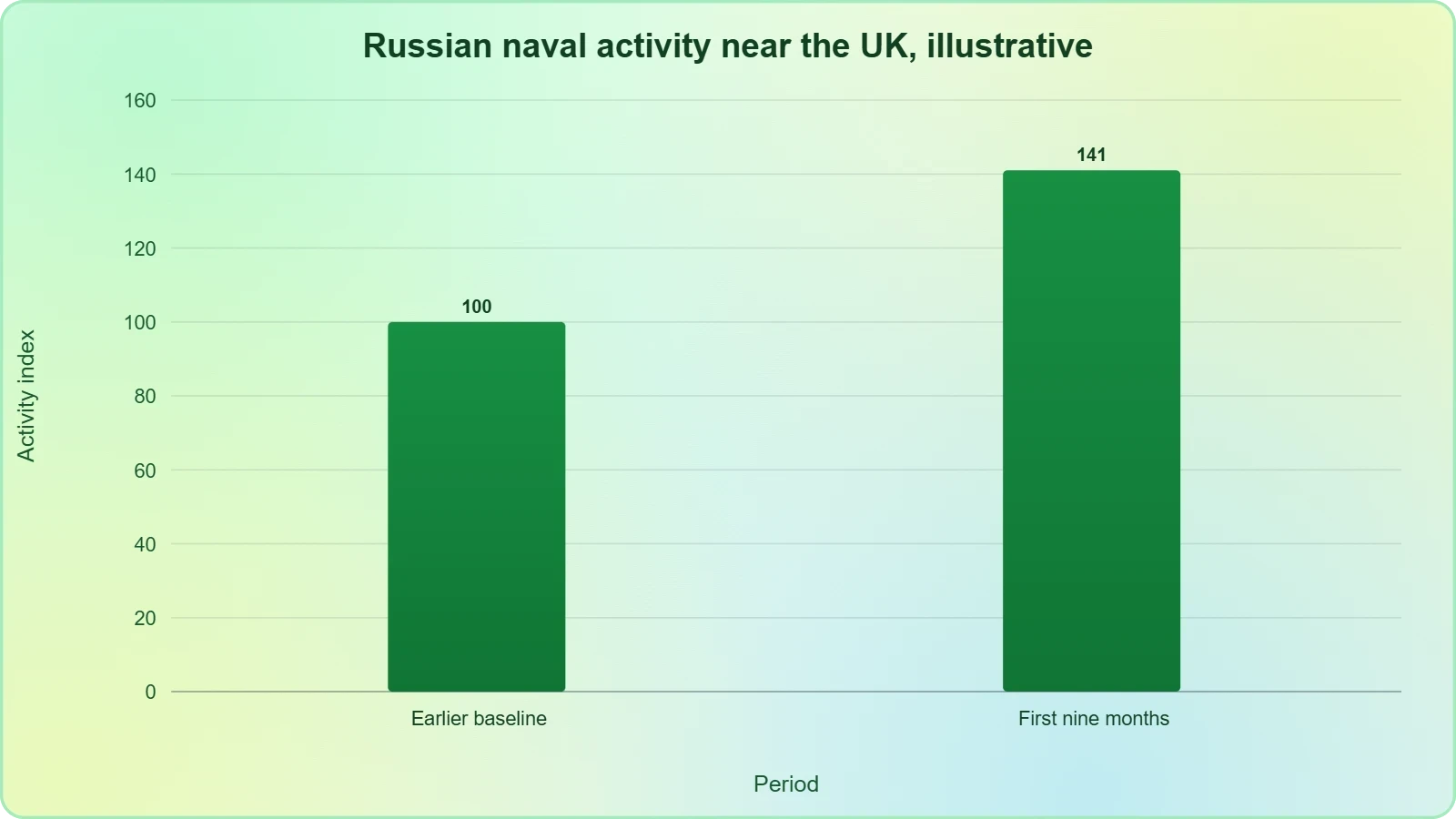
At the centre of the plan sits a straightforward but consequential idea: a British uncrewed vessel could be paired with a Danish, Norwegian or Dutch warship, with operational control passed between allied commanders as circumstances demand. That kind of handover, executed without friction, transforms ten modest national fleets into something closer to one distributed maritime force. Defence readiness minister Luke Pollard framed the initiative as a direct response to a documented surge in Russian naval activity around the United Kingdom, which he said rose by 41 percent during the first nine months of the year, a figure that gives the alliance its political justification.
The financial commitment is concrete rather than aspirational. Britain has earmarked £90 million, roughly $121 million, for drones, sensors and AI systems intended to help the Royal Navy detect and counter undersea threats in the North Atlantic while protecting critical infrastructure such as subsea cables and pipelines. Analysts describe the initiative as an important step toward credible deterrence, arguing that no single Western European nation can defend itself alone against a revisionist power with global naval reach. The following analysis examines the plan's structure, its technological logic, its strategic implications and the questions it leaves unresolved.
On This Page
- The Strategic Logic Behind the Northern Navies Initiative
- Technology, Interoperability and the Undersea Domain
- Russia's Maritime Posture and the Deterrence Calculus
- The Ten-Nation Coalition and the Joint Expeditionary Force
- Funding, Industrial Capacity and Implementation Hurdles
- Implications for European Security and the Wider Balance of Power
TL;DR The United Kingdom has assembled a ten-nation naval coalition, the Northern Navies Initiative, linking sea drones, sensors, AI systems and warships across the Joint Expeditionary Force to counter growing Russian maritime activity. Backed by £90 million ($121 million) in British funding, the plan enables allied navies to share autonomous platforms, transfer operational control of vessels and sustain one another's ships in allied ports, effectively merging ten fleets into a single surveillance and deterrence network. Officials cite a 41 percent rise in Russian naval activity around the UK as justification, while analysts stress that interoperability and clear command structures are now essential to credible European defence.
The Strategic Logic Behind the Northern Navies Initiative
The initiative emerges from a sober assessment of the maritime threat environment facing Northern Europe. Russian submarines, surveillance vessels and undersea capabilities have become more active in the North Atlantic, the Baltic Sea and the waters around the British Isles, raising concerns about the security of subsea infrastructure that carries the bulk of Europe's data and energy traffic. The Northern Navies Initiative is designed to close the gaps that separate national surveillance efforts, allowing allied forces to detect, track and respond to intrusions with a speed and coherence that individual navies could not achieve alone.
From National Fleets to a Distributed Maritime Force
The Royal Navy's own description captures the ambition precisely: the goal is to create "one large maritime force instead of 10 separate ones." That phrase signals a departure from traditional coalition warfare, in which nations contribute contingents to a shared command but retain separate logistics, communications and sensor architectures. Here, the emphasis falls on interoperability at the machine level, with autonomous platforms able to connect to one another's command and control systems. The result is a network in which one nation's task group could direct allied sensors and uncrewed vessels, extending reach without requiring every member to field every capability.
This model has practical consequences for how operations unfold. A Royal Navy frigate could transfer operational responsibility to another Joint Expeditionary Force member without losing momentum, and a warship could repair, refuel and resupply in an allied port rather than returning home. Such arrangements reduce transit times, extend endurance and allow smaller navies to contribute meaningfully to missions that would otherwise exceed their individual capacity. The initiative therefore functions as a force multiplier, extracting more deterrent value from existing fleets rather than demanding entirely new ones.
The Political and Institutional Context
The Joint Expeditionary Force provides the institutional scaffolding for the plan. Comprising the UK alongside Denmark, Estonia, Finland, Iceland, Latvia, Lithuania, the Netherlands, Norway and Sweden, the grouping was designed for rapid response in Northern Europe and the High North. By anchoring the drone-sharing arrangement within this existing framework, the initiative avoids the delays and diplomatic complexity of building a new alliance from scratch. It also reinforces the JEF's stated purpose of allowing members to "act early, combine quickly and transition seamlessly into NATO command should the Alliance need to mobilise at scale."
That final clause matters enormously. The initiative is explicitly nested within NATO's broader architecture, ensuring that interoperability developed among the ten partners feeds directly into the alliance's collective defence planning. First Sea Lord General Gwyn Jenkins, speaking after the agreement was signed, framed the moment in terms of multiplying threats and the obligation to meet them before they crystallise. His remarks reflect a wider consensus among European defence officials that the window for building resilience is narrowing, and that peacetime cooperation must be institutionalised before a crisis tests it.
We Also Published
Technology, Interoperability and the Undersea Domain
The technological core of the initiative rests on autonomous systems equipped with advanced sensors designed to detect and monitor submarine activity. Undersea threats are notoriously difficult to track, requiring persistent surveillance across vast ocean spaces where manned vessels cannot be everywhere at once. Uncrewed surface and subsurface platforms offer a partial answer, extending sensor coverage at lower cost and without exposing sailors to risk. By pooling these systems across ten navies, the initiative multiplies the number of listening posts and patrol nodes available to any single commander, creating a denser and more resilient surveillance picture.
Shared Platforms and Transferable Control
The most innovative element is the principle of transferable control. Pollard described a model in which British drones could be teamed with a British, Danish or Norwegian warship, with control handed to an allied nation's vessel as operational needs dictate. This requires common data standards, compatible communication links and agreed protocols for authority transfer, all of which demand sustained technical and doctrinal work. The payoff is substantial: a warship from one nation could direct another nation's uncrewed systems, ensuring that sensors and shooters remain paired even as formations shift and commanders reassign assets in real time.
Future autonomous platforms will connect to one another's command and control systems, according to the Royal Navy, enabling the kind of machine-to-machine coordination that modern naval warfare increasingly demands. This is not simply a matter of hardware compatibility but of trust, training and legal authority. Navies must be confident that an allied system will behave predictably, that data will be shared securely and that responsibility for outcomes is clearly assigned. The initiative's success will therefore depend as much on doctrine and exercises as on procurement budgets, a point analysts have consistently emphasised when assessing similar multinational efforts.
Protecting Critical Undersea Infrastructure
Beyond countering submarines, the initiative addresses a vulnerability that has moved to the top of European security agendas: the protection of subsea cables, pipelines and power interconnectors. These assets carry the data and energy on which modern economies depend, yet they lie largely undefended on the seabed. Enhanced detection and monitoring, enabled by networked sensors and autonomous patrols, offers a means of identifying suspicious activity before damage occurs. The £90 million investment in drones, sensors and AI is explicitly framed around this mission, linking the initiative to the broader defence of critical national infrastructure across Northern Europe.
The emphasis on infrastructure protection also reflects lessons drawn from recent incidents in the Baltic and North Sea, where damage to undersea cables and pipelines has prompted heightened vigilance and, in some cases, criminal investigations. While attribution remains contested in several cases, the pattern has convinced European governments that the undersea domain requires dedicated, persistent attention. The Northern Navies Initiative positions the participating navies to provide that attention collectively, sharing the burden of patrol and surveillance across a geography that no single nation could cover alone.
Russia's Maritime Posture and the Deterrence Calculus
The initiative's stated rationale rests on a measurable shift in Russian naval behaviour. According to figures cited by defence minister Luke Pollard, Russian naval activity around the United Kingdom increased by 41 percent during the first nine months of the year. That statistic, drawn from reporting by The Guardian, has become the central evidentiary anchor for the plan. Officials argue that such a sustained increase in violations and incursions cannot be met with business-as-usual patrol patterns, and that a coordinated allied response is proportionate to the scale of the challenge.
Reading the 41 Percent Increase
Interpreting that figure requires care. Naval activity encompasses a wide range of behaviours, from routine transits and exercises to close approaches, sensor probing and infrastructure reconnaissance. A 41 percent rise could reflect any combination of these, and the strategic significance depends on which categories dominate. What matters politically, however, is that the number has been accepted across the UK government as sufficient justification for a new multinational framework. It has shifted the debate from whether Russian activity constitutes a threat to how allies should organise themselves to counter it collectively.
The broader European assessment aligns with this reading. Guntram Wolff, a senior fellow at the Brussels-based think tank Bruegel, described the alliance as "a very important initiative" and argued that no single Western European nation can credibly defend itself. That judgment reflects a structural reality: the maritime geography of Northern Europe is vast, the threats are distributed across it, and national budgets and fleet sizes vary widely. Credible deterrence therefore requires aggregation, and the initiative represents one of the more concrete attempts to achieve it in the naval domain.
Deterrence Through Visible Readiness
Pollard's remark that sailing a warship to Norway constitutes "a really important deterrent signal that we stand ready to defend every single inch of NATO territory" captures the logic of visible readiness. Deterrence in the maritime domain is not only about capability but about perception, and the movement of allied vessels into contested waters communicates resolve in ways that planning documents cannot. The initiative institutionalises such signals, making them routine rather than exceptional and embedding them in a standing framework of cooperation that adversaries must factor into their calculations.
Wolff's emphasis on deepening interoperability, strengthening joint manoeuvres and ensuring clear command structures in crises points to the operational foundations of credible deterrence. These are unglamorous but essential elements: without them, political declarations of solidarity remain vulnerable to the friction of real operations. The Northern Navies Initiative addresses each in turn, pairing high-profile announcements with the quieter work of aligning systems, procedures and authorities so that cooperation holds under pressure rather than dissolving when it is most needed.
- 01
- 02
- 03
- 04
The Ten-Nation Coalition and the Joint Expeditionary Force
The coalition's composition reflects the geography of the threat. Alongside the United Kingdom, the participating navies belong to Denmark, Estonia, Finland, Iceland, Latvia, Lithuania, the Netherlands, Norway and Sweden, the full membership of the Joint Expeditionary Force. This grouping spans the Baltic states, the Nordic region and the North Sea approaches, covering precisely the waters where Russian naval activity has drawn concern. By working through the JEF rather than creating a new body, the initiative leverages existing relationships, exercises and command arrangements that have matured over years of cooperation.
Why the JEF Framework Matters
The Joint Expeditionary Force was conceived as a flexible, high-readiness formation capable of responding quickly to crises in Northern Europe and the High North. Its members share threat perceptions, operate compatible equipment in many areas and have trained together extensively. The Northern Navies Initiative builds on these foundations, adding a naval dimension that deepens the JEF's maritime relevance. The Royal Navy's statement that the agreement supports deterrence and defence for JEF citizens, allowing members to act early and combine quickly, situates the plan squarely within the force's original design philosophy rather than as an improvised response.
Equally important is the explicit pathway into NATO command. The initiative is structured so that cooperation can transition seamlessly into alliance command should NATO need to mobilise at scale. This dual-track approach avoids the duplication that plagued some earlier European defence initiatives, ensuring that regional cooperation reinforces rather than competes with the alliance's collective defence architecture. For smaller members in particular, the arrangement offers a means of contributing meaningfully to both regional and alliance missions without requiring capabilities beyond their means.
Practical Benefits for Smaller Navies
For navies such as those of Estonia, Latvia and Lithuania, the initiative offers access to capabilities they could not develop independently. Sharing drones, sensors and command networks allows smaller forces to participate in surveillance and deterrence missions at a scale that would otherwise be impossible. The ability to repair, refuel and resupply in allied ports further extends their operational reach, while the principle of transferable control means their vessels can be integrated into larger formations led by partners with greater capacity. The result is a more equitable distribution of burden and benefit across the coalition.
Larger navies gain as well. The Royal Navy, the Dutch and Norwegian fleets and their Nordic counterparts acquire additional sensors, patrol nodes and geographic access that multiply their effective coverage. The initiative thus functions as a genuine exchange rather than a one-sided arrangement in which a major power underwrites its smaller partners. This reciprocity is likely to be central to the plan's durability, since coalitions sustained by shared benefit tend to outlast those held together by patronage alone.
Funding, Industrial Capacity and Implementation Hurdles
The £90 million commitment is meaningful but modest relative to the scale of the challenge. It will fund drones, sensors and artificial intelligence systems for the Royal Navy, with the aim of countering Russian undersea threats and protecting critical infrastructure. Whether that sum proves sufficient depends on how it is spent and how effectively it is leveraged through shared development and procurement with partners. The initiative's emphasis on interoperability suggests that money spent by one nation can generate capability available to all, multiplying the return on each contribution and reducing duplication across the coalition.
From Announcement to Operational Reality
Announcements of multinational defence initiatives are common; operational delivery is rarer. The Northern Navies Initiative will be judged by whether the promised interoperability materialises in exercises, deployments and, ultimately, crisis response. That requires sustained investment in communications standards, data-sharing agreements, joint training and legal frameworks for authority transfer. It also requires political continuity, since changes of government or budget priorities can stall programmes that depend on multi-year commitment. The plan's anchoring in the JEF provides some institutional stability, but the hard work of implementation lies ahead.
Industrial capacity presents another constraint. European production of advanced drones, sensors and AI-enabled systems is expanding but remains limited relative to demand, and competition among allies for scarce components could slow delivery. Coordinating procurement across ten nations, each with its own industrial base and political pressures, is notoriously difficult. The initiative's success will depend partly on whether partners can agree on common requirements and avoid the fragmentation that has historically undermined multinational equipment programmes in Europe.
Command, Control and Legal Questions
The principle of transferable control raises complex questions of command authority and legal responsibility. If a British drone is operated under the control of a Norwegian warship and an incident occurs, which nation bears responsibility? How are rules of engagement harmonised across ten legal systems? These questions are answerable, but they require deliberate negotiation and clear doctrine. Analysts such as Wolff have stressed that clear command structures in crises are critical for credible deterrence, and the initiative's architects will need to translate that principle into detailed arrangements that commanders can apply under pressure.
Training and trust are equally important. Operators must be familiar with allied systems, and commanders must be confident in their partners' procedures. Repeated joint exercises, exchanges and shared standards build the familiarity on which interoperability depends. The initiative's long-term value will therefore be measured not only in platforms fielded but in the depth of habitual cooperation it creates, since it is that cooperation, rather than any single system, that ultimately deters adversaries and reassures allies.
Implications for European Security and the Wider Balance of Power
The Northern Navies Initiative carries significance beyond its immediate operational goals. It represents a template for how European nations might organise defence cooperation in an era of constrained budgets and heightened threat perception, pooling capabilities rather than duplicating them. If successful, it could inspire similar arrangements in other domains, from air defence to cyber, where interoperability offers comparable returns. Its emphasis on nesting regional cooperation within NATO also offers a model for reconciling European initiatives with alliance-wide planning, a balance that has often proved difficult to strike.
A Model for Multinational Defence Cooperation
The plan's architecture, built around shared platforms, transferable control and common logistics, addresses a persistent weakness in European defence: the gap between political solidarity and operational reality. By focusing on the practical mechanics of cooperation, it moves beyond declarations toward arrangements that commanders can actually use. The emphasis on acting early, combining quickly and transitioning into NATO command reflects a mature understanding of how crises unfold, with the initial hours often determining whether a response is coherent or chaotic. That understanding is itself a form of deterrence, signalling to adversaries that allied forces can respond faster than they might assume.
For the United Kingdom, the initiative reinforces its role as a convening power in Northern European defence, a position it has cultivated since the JEF's creation. For the Nordic and Baltic states, it offers a concrete expression of the mutual solidarity on which their security depends. For the Netherlands and Denmark, it provides a framework for integrating their advanced naval capabilities into a larger regional effort. Each participant gains something distinct, which helps explain why ten nations were willing to sign on to a plan that requires real commitments rather than symbolic gestures.
Risks, Limitations and the Road Ahead
The initiative is not without risks. Funding of £90 million, while welcome, is small relative to the scale of the maritime domain and the sophistication of the threat. Industrial bottlenecks, political changes and the inherent difficulty of multinational procurement could slow delivery. The plan also depends on continued Russian activity to sustain political momentum; a lull might erode the urgency that made cooperation possible. And the deeper challenge of building genuine trust and interoperability among ten navies will take years of sustained effort, with setbacks likely along the way.
None of these risks diminishes the initiative's importance. They simply define the work that lies ahead. The Northern Navies Initiative establishes a framework, a direction and a set of commitments that, if honoured, will leave Northern Europe better defended than it would be through separate national efforts. Its ultimate test will come not in the signing ceremony but in the exercises, patrols and, if necessary, operations that follow. On those will rest the credibility of the deterrence it seeks to provide, and the security of the citizens it is designed to protect.
From our network :
- CISA’s Ten-Advisory Wave: Why Generic Patching Fails in OT and How to Build Product-Specific PlaybooksCISA released ten ICS advisories in one week, exposing critical infrastructure risks. Generic patching fails in OT. Learn to build product-specific remediation playbooks.
- Committed Mediterranean Precipitation Decline: Why Emissions Cuts Alone Cannot Restore Winter RainsNew NOAA research reveals that Mediterranean winter rains may decline irreversibly even with emissions cuts. Explore the science of committed climate change and regional impacts.
- University Language Proficiency Exams: Why Institutional Tests Demand Different Preparation Than IELTS and TOEFLDiscover why university-specific language proficiency examinations differ fundamentally from IELTS and TOEFL, and learn strategic preparation approaches for institutional assessment success.
- How AI Agents Will Change the Way We Manage Personal FinancesExplore how AI agents are transforming personal finance through automated budgeting, bill payment, and investment management, while examining the critical security protocols and governance frameworks required for safe deployment.
- The Final Descent: How ESA Retired the Legendary Cluster Constellation After 24 Years of Space Weather ScienceAfter 24 years mapping Earth’s magnetosphere, ESA’s Cluster mission concluded with a precisely controlled reentry over the South Pacific. This analysis explores the scientific legacy, engineering decisions, and debris mitigation principles behind one of space exploration’s most responsible retirements.
- Mobile Learning and VR in English: What Global Evidence Reveals About Effective Language TechnologyA systematic review across 14 countries reveals which language-learning technologies genuinely work. Mobile learning, AI, and VR show measurable benefits when pedagogically integrated. This evidence-based guide helps educators and learners select technology that delivers real return on investment.
- Forbidden Matrix Patterns and Visible Lattice Points: A Geometric DictionaryExplore how multidimensional 0–1 matrices encode geometric truths, linking forbidden patterns to visible lattice points and hypergraph theory, with applications in combinatorics and computational geometry.
- The Hidden Cost of AI Convenience: Why Over-Permissioned Agents Are a Security Time BombDiscover why AI agents with excessive permissions create dangerous single points of failure, and learn how implementing least privilege principles can protect your organization from exploitation.
- Live Online English Classes for Kids: Do They Actually Reduce Anxiety?A ten-week study reveals that synchronous online English classes can significantly reduce child language anxiety while improving listening and reading skills. Discover what makes these programs effective and how parents can select the right one.
RESOURCES
- UK to create alliance of 'northern navies' to counter Russian threatreddit.comApr 29, 2026 ... It would be a means for NATO to respond rapidly and seize the initiative in this strategically vital region. I…
- What is northern Europe's new drone and warship plan to counter ...aljazeera.com1 day ago ... The Northern Navies Initiative is a British-led defence framework ... alliance is “a very important initiative”. “No single Western ...
- Russian naval aggression prompts new defensive initiative with ...theguardian.com23 hours ago ... ... Northern Navies Initiative at a time when the number of British frigates is falling. ... A future Royal Navy…
- JEF Navies deepen maritime integration with new Royal Navy-Led ...royalnavy.mod.uk23 hours ago ... The Northern Navies Initiative also seeks to make the JEF NATO's maritime vanguard in the North Atlantic, High North and…
- The Royal Navy Is Forming a 'Mini-NATO' Inside NATOnationalinterest.orgMay 1, 2026 ... The United Kingdom's “Northern Navies” initiative would combine the ... The UK's Royal Navy is now seeking to create an…
- At the end of March, Leaders from across the Joint Expeditionary ...facebook.comApr 28, 2026 ... The Northern Navies initiative marks a strategic shift toward a more ... Navy continues to safeguard Denmark's maritime interests and…
- Strengthening NATO's eastern flank | NATO Topicnato.intSep 29, 2026 ... NATO's Standing Naval Forces (SNF) provide the Alliance with a continuous, credible and agile maritime capability that can be rapidly…
- The UK is creating a new coalition of Northern allied navies to be ...facebook.comApr 29, 2026 ... This Royal Navy-led initiative aims to unify regional maritime forces against Russian activity in the Arctic and Atlantic. The discussions…
- The Joint Expeditionary Force (JEF) – A coalition of ten like-minded ...jefnations.orgA coalition of ten like-minded nations, sharing a common focus on security in the the High North, Northern Europe and Baltic Region.
- Defence in the High North - Parliament UKpublications.parliament.ukOct 22, 2026 ... ... coalition committed to improving ... The First Sea Lord's recent Northern Navies initiative and 'maritime proposition' was also about:…
- The United Kingdom is forming a new maritime alliance in Europedefence24.comMay 1, 2026 ... The United Kingdom aims to establish a new international framework. The goal of the “Northern Navies” initiative is to effectively…
- To help bring lasting peace to Ukraine, Turkey should enhance its ...atlanticcouncil.orgJul 14, 2025 ... For centuries, Ukraine has been Turkey's northern frontier in its enduring rivalry with Russia for naval dominance. ... naval drones.
- Royal Navy Plans to Use Hybrid Fleet to Keep Pace with Russia in ...news.usni.orgMay 4, 2026 ... Dubbed the Northern Navies Initiative, the proposal was presented to the Navy ... drones, sensors and AI systems for the…
- Royal Navy Talon Drone: Carrier Launch Planned for 2027 - MiGFlugmigflug.com7 hours ago ... ... Northern Navies Initiative, a ten-nation grouping led by Britain. The carrier, the drone and the alliance were all on…
- New agreement sees Royal Navy and JEF allies operate as oneforcesnews.com5 hours ago ... The initiative, signed by General Sir Gwyn Jenkins, will increase security across northern Europe, the North Atlantic, and the Baltic…
- 01
- 02
- 03
- 04
- 05
- 06
- 07
- 08
0 Comments