The intersection of private commercial diplomacy and public political power has rarely been illustrated as sharply as in the reported relationship between a Vitol trader and JD Vance, the American vice president. According to a Reuters exclusive dated 11 November 2026, ties between a trader at the global energy and commodities house and Vance are said to have helped the company secure a prized oil contract with Venezuela. The report offers no granular detail on the nature of those ties or the precise terms of the contract, yet the mere suggestion is enough to reopen a familiar and uncomfortable debate about how commodity majors convert relationships into revenue.
Vitol is not a household name, but it sits at the centre of the physical oil trade, moving millions of barrels daily and operating in jurisdictions where governments, sanctions regimes and state oil companies overlap. Venezuela, home to the world's largest proven crude reserves, has spent years under layered American sanctions that make any commercial engagement a legal and reputational minefield. When a trading house lands a valuable contract there, the question of how access was obtained inevitably becomes as consequential as the cargo itself. The reported Vance connection therefore matters less as a single anecdote and more as a window into the mechanics of influence in energy markets.
This analysis examines what the Reuters report actually establishes, what it leaves unresolved, and why the story resonates far beyond one trader and one contract. It considers the structure of Vitol's business, the sanctions architecture surrounding Venezuelan crude, the political capital attached to the Vance name, and the compliance questions that any such relationship would trigger. It also situates the episode within a broader pattern of commodity traders operating in the grey space between commerce and statecraft, where access is the scarcest resource of all and relationships are the currency that buys it.
On This Page
- The Anatomy of the Reported Vitol–Vance Connection
- Vitol and the Architecture of Global Oil Trading
- Venezuela, Sanctions and the Politics of Oil Access
- Political Connections and the Ethics of Commercial Advantage
- Reading the Reuters Exclusive in a Wider Investigative Context
- Conclusion: What the Vitol–Vance Report Really Signals
TL;DR A Reuters exclusive reports that a Vitol trader's ties to JD Vance helped the energy trading giant secure a valuable oil contract with Venezuela. The report provides no detail on the relationship or the contract terms, leaving critical questions about legality, sanctions compliance and political influence unanswered. The episode illustrates how commodity traders convert personal and political networks into commercial advantage in sanctioned markets, and why such connections attract regulatory scrutiny even when no wrongdoing is alleged.
The Anatomy of the Reported Vitol–Vance Connection
The Reuters exclusive, published on 11 November 2026, is deliberately spare. It states that a trader at Vitol had ties to JD Vance that reportedly helped the company land a prized Venezuelan oil contract, and it stops there. No names of the trader, no description of the relationship's nature, no contract value, no timeline and no confirmation from Vitol, the Venezuelan state oil company or the vice president's office accompany the claim. That sparseness is itself analytically important, because it means the story functions as a signal rather than a proof, pointing toward a network that observers must infer from context.
In commodity trading, "ties" is a deliberately elastic word. It can describe a former colleague, a campaign donor, a family acquaintance, a policy interlocutor or a formal advisory relationship. Each carries a different legal and ethical weight. The Reuters framing, attributing the connection to reporting rather than to documentation, suggests the underlying evidence may rest on sources familiar with the deal rather than on disclosed records. For readers, the practical takeaway is that the report establishes the existence of an allegation, not the mechanics of an arrangement, and the distinction should govern how the story is interpreted.
What the Report Establishes and What It Leaves Open
The report establishes three things with reasonable clarity: that Vitol is the company in question, that Venezuela is the counterparty state, and that a trader within Vitol is alleged to have a relationship with the sitting American vice president that materially assisted the contract award. Everything else remains open. The absence of named individuals, dates and dollar figures means the claim cannot yet be tested against public records, lobbying disclosures or sanctions filings. That gap is where scrutiny will concentrate, because in energy trading the difference between access and impropriety often lies in precisely those undocumented details.
It is equally notable that the report does not allege illegality. A relationship that helps a company win business is not, by itself, evidence of a crime, particularly where the counterparty is a sovereign state rather than a procurement agency bound by formal tender rules. Venezuela's oil sector operates under exceptional conditions, with licensing regimes administered by the United States Treasury's Office of Foreign Assets Control and shifting political authorisations. The story's significance lies in the questions it raises about how those authorisations are navigated and who is positioned to navigate them most effectively.
Why a Single Trader Can Matter So Much
Commodity trading houses are frequently described as relationship businesses dressed in logistics. A single trader can control billions of dollars in annual flows, negotiate directly with state oil companies and open doors that no amount of capital alone can unlock. Vitol's decentralised structure gives individual traders considerable autonomy, which is precisely what makes personal networks so valuable and so difficult to govern. When a trader's connections align with a strategic opportunity, the firm can move faster than integrated oil majors constrained by layers of corporate diplomacy and public disclosure obligations.
That autonomy also creates governance risk. Trading houses have faced repeated enforcement actions over the past decade for bribery and market manipulation, and regulators have grown attuned to the informal channels through which business is won. A trader's political ties are not inherently problematic, but they sit squarely within the zone that compliance departments are expected to monitor. The reported Vance connection therefore raises a structural question: whether Vitol's internal controls were designed to identify and manage relationships of this kind before they became commercially decisive.
Vitol and the Architecture of Global Oil Trading
Vitol stands among the largest independent energy traders in the world, handling several million barrels of crude and refined products each day across dozens of countries. Unlike listed majors, it operates largely out of public view, with financial disclosures that are informative but far less granular than those of shareholder-owned peers. That opacity is not unique to Vitol; it is characteristic of the trading houses that lubricate global energy flows, buying where supply is stranded and selling where demand is acute. Their value lies in mobility, and their vulnerability lies in the relationships that mobility requires.
The firm's history includes significant enforcement episodes, including a major bribery settlement in 2020 that reshaped its compliance posture and prompted leadership changes. Those episodes matter here because they established a template for how regulators treat trading houses: not as passive intermediaries but as actors responsible for the conduct of employees operating in high-risk jurisdictions. Any new allegation touching political relationships will therefore be read against that backdrop, and Vitol's response will be judged by whether it reflects the controls it committed to after earlier settlements.
How Trading Houses Convert Access into Contracts
In sanctioned or semi-sanctioned markets, the binding constraint is rarely capital or logistics. It is permission. A trading house needs to know which licences apply, which banks will clear payments, which shipping insurers will cover cargoes and which counterparties are politically acceptable. Access to decision-makers who can clarify or shape those parameters is therefore worth real money. A trader with the right relationships can move a deal from speculative to executable while competitors remain stuck in legal review, and that speed advantage is precisely what the reported Vance connection would have conferred.
This dynamic is not inherently corrupt. Governments routinely engage with commercial actors to advance foreign policy objectives, and energy flows are a recognised instrument of statecraft. The difficulty arises when the line between legitimate policy alignment and improper influence becomes blurred, particularly in jurisdictions where formal procurement rules are weak. Venezuela's oil sector, administered through state entities under external sanctions, exemplifies that ambiguity. Contracts there are awarded in a context where political signalling and commercial negotiation are difficult to disentangle, and where the identity of a trader's contacts can be as decisive as the price offered.
The Compliance Questions Any Such Deal Would Trigger
Any oil contract involving Venezuela invites scrutiny under United States sanctions, which have oscillated between broad prohibitions and narrowly licensed authorisations depending on the political climate. A company seeking to execute such a deal must satisfy itself that the transaction falls within a valid licence, that payments route through permitted channels and that no designated persons benefit indirectly. Where a senior American political figure is alleged to have facilitated access, additional questions arise under foreign influence, anti-bribery and campaign finance frameworks, even if no violation is ultimately found.
Compliance officers would also examine whether the relationship was disclosed internally, whether it was recorded in the firm's books and records, and whether it created a conflict for any employee with policy responsibilities. These are procedural questions rather than accusations, but they determine whether a commercial advantage was legitimately obtained or improperly secured. The absence of public detail means the answers remain unknown, yet the questions themselves illustrate why trading houses are increasingly expected to treat political relationships as regulated assets rather than private advantages.
Venezuela, Sanctions and the Politics of Oil Access
Venezuela's oil industry has been shaped by two decades of political confrontation, nationalisation, mismanagement and sanctions. The country holds reserves larger than any other nation, yet production has fallen far below historical peaks, constrained by underinvestment, technical decay and restricted access to international markets. American policy has alternated between maximum pressure and conditional relief, often tied to electoral and human rights benchmarks. That oscillation creates a peculiar commercial environment in which the value of a contract depends heavily on the political weather in Washington rather than on geology or demand alone.
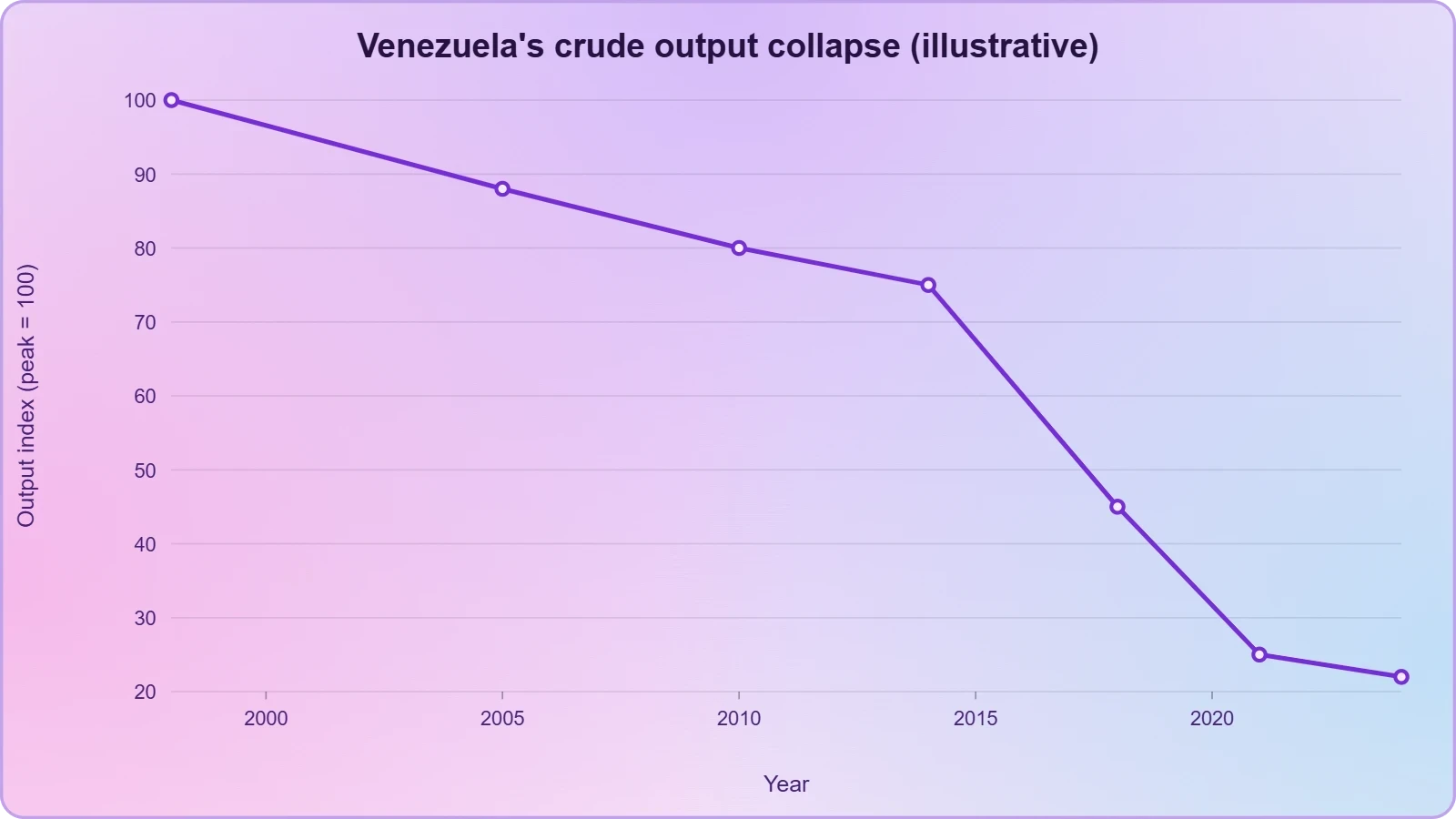
For trading houses, Venezuela represents both opportunity and hazard. Cargoes can be highly profitable when authorisations permit, and the counterparties are often eager for reliable offtake. But the legal perimeter shifts with each policy announcement, and companies that misjudge it face severe penalties. The result is a market where competitive advantage flows disproportionately to firms with the best political intelligence and the strongest relationships in both capitals. The reported Vitol contract fits neatly into that pattern, illustrating how access in Caracas and access in Washington can be complementary rather than contradictory.
How Sanctions Reshape Competitive Advantage
Sanctions do not eliminate trade; they redistribute it. When formal channels narrow, informal ones expand, and the firms best positioned to navigate the resulting complexity gain outsized returns. This is a well-documented feature of commodity markets, visible in the trade flows that emerged around Iran, Russia and Venezuela over the past decade. The premium earned by traders who can structure compliant deals in difficult jurisdictions reflects the scarcity of that capability, not merely the risk of the cargo. Understanding this helps explain why a single relationship can be worth so much to a company like Vitol.
The corollary is that sanctions regimes inevitably politicise commercial decisions. Every licence application, every payment route and every counterparty screening becomes a point where political considerations intrude. Companies respond by hiring former officials, cultivating policy expertise and maintaining relationships across administrations. These practices are legal and widespread, but they blur the boundary between commercial strategy and political influence. The Vitol–Vance report is best read as an unusually visible instance of a structural feature of sanctioned markets rather than as an isolated anomaly.
The Geopolitical Stakes Behind a Single Contract
Venezuelan crude matters to American foreign policy because it sits at the intersection of energy security, migration pressure and hemispheric influence. Washington has repeatedly used oil licensing as a lever to shape Caracas's behaviour, and any deal that appears to bypass or pre-empt that leverage attracts attention. If a commercial arrangement is perceived to have been facilitated by political connections, it raises questions about whether policy is being shaped by private interests rather than strategic calculation. Those questions carry weight regardless of whether any rule was broken.
The broader geopolitical context compounds the sensitivity. Global oil markets remain vulnerable to supply disruptions, and Venezuela's potential return to fuller production is watched closely by OPEC members and consuming nations alike. A contract that helps restore flows serves consumer interests, yet the manner of its award can undermine the credibility of the sanctions architecture that made those flows scarce in the first place. That tension between pragmatic energy diplomacy and principled enforcement is the deeper story beneath the Reuters headline.
- 01
- 02
- 03
- 04
Political Connections and the Ethics of Commercial Advantage
The ethical questions raised by the report extend well beyond Vitol. Across sectors, the children, relatives and associates of senior political figures have long occupied lucrative intermediary roles, and the resulting controversies recur with predictable regularity. What distinguishes the energy sector is the scale of the transactions and the strategic sensitivity of the assets involved. A favourable introduction in oil trading can be worth tens of millions of dollars, and the line between legitimate networking and improper influence becomes correspondingly harder to police.
Defenders of such arrangements argue that political access is a normal feature of international commerce, particularly in state-dominated industries where relationships with officials are unavoidable. Critics counter that the appearance of influence peddling erodes public trust and distorts markets by rewarding proximity to power over operational competence. Both positions contain truth, and the tension between them is unlikely to be resolved by any single investigation. What matters for governance is whether firms have transparent processes for identifying, disclosing and managing relationships that could create conflicts.
Where Legitimate Networking Ends and Influence Begins
Most jurisdictions draw the legal line at the exchange of value for official action, but the ethical line is considerably broader. A relationship that merely provides information or access may be lawful yet still corrosive if it gives one firm a structural advantage unavailable to competitors. In commodity markets, where information asymmetry is itself a source of profit, the distinction becomes especially fine. The reported Vance connection sits precisely in this grey zone, where the benefit is real but the mechanism may be entirely permissible.
Regulators have grown more attentive to these subtleties, particularly in the United States, where enforcement agencies have pursued trading houses for conduct occurring in far-flung jurisdictions. The trend reflects a broader recognition that commercial diplomacy and corruption can be difficult to separate in practice. Firms that treat political relationships as strategic assets without corresponding governance safeguards invite scrutiny, and the reputational cost of an investigation can exceed any single contract's value.
Reputation, Trust and the Cost of Ambiguity
For a privately held trading house, reputation functions as a form of capital. Banks extend credit, counterparties extend trust and governments grant licences partly on the basis of perceived integrity. An unresolved allegation of improper political influence can therefore impose costs that are difficult to quantify but no less real. Vitol's earlier settlements already placed it under heightened scrutiny, and any new controversy will be assessed against that history by regulators, lenders and state oil companies alike.
The ambiguity itself is damaging. Because the Reuters report provides no detail, the company cannot easily rebut a specific claim, and critics cannot easily substantiate one. That stalemate leaves the public with an impression rather than a finding, which is often more corrosive than a clear verdict. For an industry that depends on discretion, the lesson is that silence in the face of serious allegations carries its own reputational price, and that proactive transparency may ultimately be the more defensible posture.
We Also Published
Reading the Reuters Exclusive in a Wider Investigative Context
Reuters has a long record of breaking stories about commodity trading houses, and its exclusives often precede formal investigations by months or years. The 11 November 2026 report follows that tradition, surfacing a relationship that would otherwise remain invisible to public scrutiny. Its value lies less in what it proves than in what it prompts: questions from regulators, scrutiny from counterparties and pressure on the company to explain itself. In investigative journalism, the first report is rarely the last word, and subsequent reporting frequently fills the gaps that the initial story leaves open.
For readers, the appropriate response is disciplined scepticism in both directions. The report should not be dismissed merely because it lacks detail, nor should it be treated as a finding of wrongdoing. Instead, it should be understood as a credible signal that warrants follow-up, particularly given the strategic sensitivity of Venezuelan oil and the political prominence of the individual named. The coming months will likely reveal whether the allegation is substantiated, contested or quietly forgotten, and each outcome carries different implications for how the industry is governed.
What Follow-Up Reporting Would Need to Establish
Substantiation would require documentation of the relationship, evidence of its role in the contract award and clarity on whether any disclosure obligations applied. It would also require confirmation of the contract's terms, including its value, duration and the licensing basis under which it was executed. Without those elements, the story remains an allegation rather than an established fact. Journalists pursuing the thread would likely seek records from Vitol, the Venezuelan state oil company, the Treasury Department and the vice president's office, each of which may respond differently to inquiries.
Regulators, meanwhile, would focus on whether existing rules were followed rather than on whether the outcome was desirable. That distinction matters because much of what appears improper to the public is legally permissible, and much of what is legally permissible still warrants reform. The gap between legality and legitimacy is where reputations are made and lost, and it is the space in which this story will ultimately be judged.
Implications for Traders, Policymakers and the Public
For trading houses, the episode reinforces the need to treat political relationships as governed assets, subject to disclosure, review and clear limits. For policymakers, it highlights the difficulty of using sanctions as a tool while relying on private intermediaries to execute energy diplomacy. For the public, it offers a reminder that the commodities underpinning modern life are moved through networks that are only partially visible, and that the terms of that movement are shaped by relationships as much as by prices.
The deeper lesson concerns institutional design. Markets function best when access is governed by transparent rules rather than personal connections, yet in sanctioned and state-dominated sectors, personal connections are often the only mechanism available. Closing that gap requires stronger disclosure regimes, clearer licensing criteria and a willingness by firms to accept slower deals in exchange for cleaner ones. Whether the Vitol–Vance episode accelerates that shift or merely joins a long list of similar controversies remains to be seen.
Conclusion: What the Vitol–Vance Report Really Signals
The Reuters exclusive is a small story with large implications. It describes a relationship, a contract and a country, and in doing so illuminates a system in which commercial success in sanctioned markets depends on political access. Whether or not the specific allegation is ever substantiated, the structural conditions it reveals are real and enduring. Trading houses will continue to operate where states and sanctions intersect, and they will continue to rely on individuals whose networks span both worlds. The question is not whether such relationships exist, but whether they are governed with sufficient transparency.
For Vitol, the episode is a test of the compliance culture it has publicly committed to building. For the vice president's office, it is a reminder that proximity to commercial interests carries political risk. For regulators, it is an invitation to examine whether existing rules capture the informal channels through which modern commodity deals are made. And for the public, it is a case study in how the machinery of global energy works, revealing that the price of a barrel is shaped as much by who you know as by what you can pay.
From our network :
- How AI Agents Will Change the Way We Manage Personal FinancesExplore how AI agents are transforming personal finance through automated budgeting, bill payment, and investment management, while examining the critical security protocols and governance frameworks required for safe deployment.
- CISA’s Ten-Advisory Wave: Why Generic Patching Fails in OT and How to Build Product-Specific PlaybooksCISA released ten ICS advisories in one week, exposing critical infrastructure risks. Generic patching fails in OT. Learn to build product-specific remediation playbooks.
- Forbidden Matrix Patterns and Visible Lattice Points: A Geometric DictionaryExplore how multidimensional 0–1 matrices encode geometric truths, linking forbidden patterns to visible lattice points and hypergraph theory, with applications in combinatorics and computational geometry.
- The Hidden Cost of AI Convenience: Why Over-Permissioned Agents Are a Security Time BombDiscover why AI agents with excessive permissions create dangerous single points of failure, and learn how implementing least privilege principles can protect your organization from exploitation.
- The Final Descent: How ESA Retired the Legendary Cluster Constellation After 24 Years of Space Weather ScienceAfter 24 years mapping Earth’s magnetosphere, ESA’s Cluster mission concluded with a precisely controlled reentry over the South Pacific. This analysis explores the scientific legacy, engineering decisions, and debris mitigation principles behind one of space exploration’s most responsible retirements.
- University Language Proficiency Exams: Why Institutional Tests Demand Different Preparation Than IELTS and TOEFLDiscover why university-specific language proficiency examinations differ fundamentally from IELTS and TOEFL, and learn strategic preparation approaches for institutional assessment success.
- Committed Mediterranean Precipitation Decline: Why Emissions Cuts Alone Cannot Restore Winter RainsNew NOAA research reveals that Mediterranean winter rains may decline irreversibly even with emissions cuts. Explore the science of committed climate change and regional impacts.
- Mobile Learning and VR in English: What Global Evidence Reveals About Effective Language TechnologyA systematic review across 14 countries reveals which language-learning technologies genuinely work. Mobile learning, AI, and VR show measurable benefits when pedagogically integrated. This evidence-based guide helps educators and learners select technology that delivers real return on investment.
- Live Online English Classes for Kids: Do They Actually Reduce Anxiety?A ten-week study reveals that synchronous online English classes can significantly reduce child language anxiety while improving listening and reading skills. Discover what makes these programs effective and how parents can select the right one.
RESOURCES
- How a Vitol trader's ties to JD Vance helped land a prized ... - Reutersreuters.com3 hours ago ... How a Vitol trader's ties to JD Vance helped land a prized Venezuela oil contract ... "New reporting that JD…
- Anas Alhajji on X: " How a Vitol trader's ties to JD Vance helped ...x.com4 hours ago ... How a Vitol trader's ties to JD Vance helped land a prized Venezuela oil contract A Reuters exclusive details how…
- Vitol trader's ties to JD Vance helped land Venezuela oil deal worth ...app.dealroom.coVitol trader John Addison's ties to US Vice President J.D. Vance helped the commodities giant win a special licence to sell Venezuelan oil, Reuters…
- How a Vitol trader's ties to JD Vance helped land a prized ... - HI-99hi99.comHow a Vitol trader's ties to JD Vance helped land a prized Venezuela oil contract. By Thomson Reuters Nov 11, 2026 | 6:16 AM.…
- How a Vitol trader's ties to JD Vance helped land a prized ... - HOT 96hot96.comHow a Vitol trader's ties to JD Vance helped land a prized Venezuela oil contract. By Thomson Reuters Nov 11, 2026 | 5:16 AM.…
- How a Vitol trader's ties to JD Vance helped land a prized ... - AOL.comaol.com5 hours ago ... How a Vitol trader's ties to JD Vance helped land a prized Venezuela oil contract. Reuters. Tim McLaughlin. Updated Wed,…
- How a Vitol trader's ties to JD Vance helped land a ... - 95.5 WIFCwifc.comHow a Vitol trader's ties to JD Vance helped land a prized Venezuela oil contract. By Thomson Reuters Nov 11, 2026 | 5:16 AM.…
- Vitol trader's ties to Vance secured Venezuela oil dealegyptian-gazette.com3 hours ago ... There, he met an old friend and early financier of his political career, John Addison, a gasoline trader with commodities…
- Modesto & Central Valley CA Business Newsmodbee.comUpdated November 11, 2026 at 4:03 AM. How a Vitol trader's ties to JD Vance helped land a prized Venezuela oil contract · Business…
- Exclusive resort meeting raises questions about influence in deal.facebook.com4 hours ago ... ... JD Vance helped land prized Venezuela oil contract ... How Vitol trader's ties to JD Vance helped land prized…
- Vitol trader's Vance ties drew scrutiny over Venezuela oil contracttradersunion.com5 hours ago ... ... J.D. Vance and Vitol trader John Addison. The arrangement helped deliver lucrative licenses to Vitol and Trafigura within days…
- Lithuania needs 'NATO response' to Russian escalation, ex-minister ...sg.news.yahoo.comSep 28, 2026 ... How a Vitol trader's ties to JD Vance helped land a prized Venezuela oil contract. Nov 11 (Reuters) - A…
- Vance Donor Behind Venezuela Oil Deal Now Advises Trump's ...thedeepdive.ca4 hours ago ... John Addison, the former Vitol trader who helped secure early access to Venezuelan oil sales, now co-chairs the federal advisory…
- Business News | Tri-City Heraldtri-cityherald.com... Oil up 1% after Iran says no nuclear material will leave the country ... Vitol trader's ties to JD Vance helped land a…
- Local, State, and National News | Centre Daily Timescentredaily.comHow a Vitol trader's ties to JD Vance helped land a prized Venezuela oil contract · National · How a Vitol trader's ties to…
- 01
- 02
- 03
- 04
- 05
- 06
- 07
- 08
0 Comments