Meghna Bank PLC has secured a dual regulatory green light from Bangladesh Bank and the Bangladesh Securities and Exchange Commission to issue a seven-year subordinated bond valued at Tk 400 crore, equivalent to roughly Tk 4 billion. The instrument is designed to reinforce the bank's capital base while financing an expansion of its lending and investment book. Crucially, the bond qualifies as Tier-2 capital under Bangladesh's regulatory framework, meaning it strengthens the bank's capital adequacy ratio without diluting existing shareholder equity. For a mid-tier private commercial bank operating in a competitive credit market, that distinction matters enormously, because Tier-2 instruments allow lenders to grow their risk-weighted assets while staying comfortably above statutory capital thresholds.
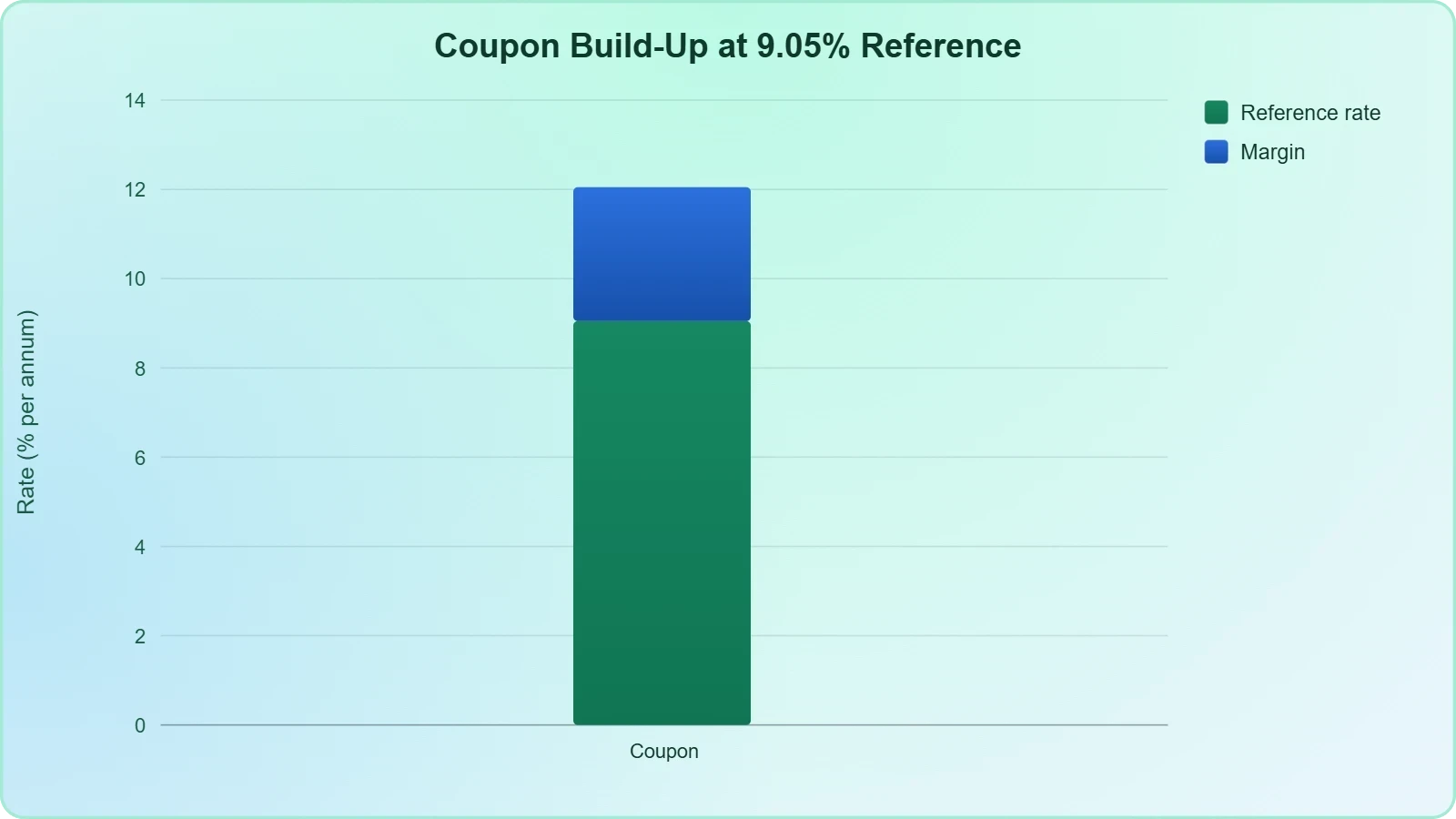
The structure of the bond reveals a carefully calibrated piece of financial engineering. It carries a variable coupon tied to the average of the six highest six-month fixed deposit rates offered by commercial banks in Bangladesh, excluding specialised, Islamic and foreign institutions, plus a margin of three percentage points. As of September 30, 2026, that formula produced an annual coupon of 12.05 percent, comprising a 9.05 percent reference rate and the fixed margin. Each bond unit has a face value of Tk 5 lakh, and the issuance will be placed privately with eligible individual and institutional investors before listing on the main board of the Dhaka Stock Exchange, where secondary-market trading becomes possible.
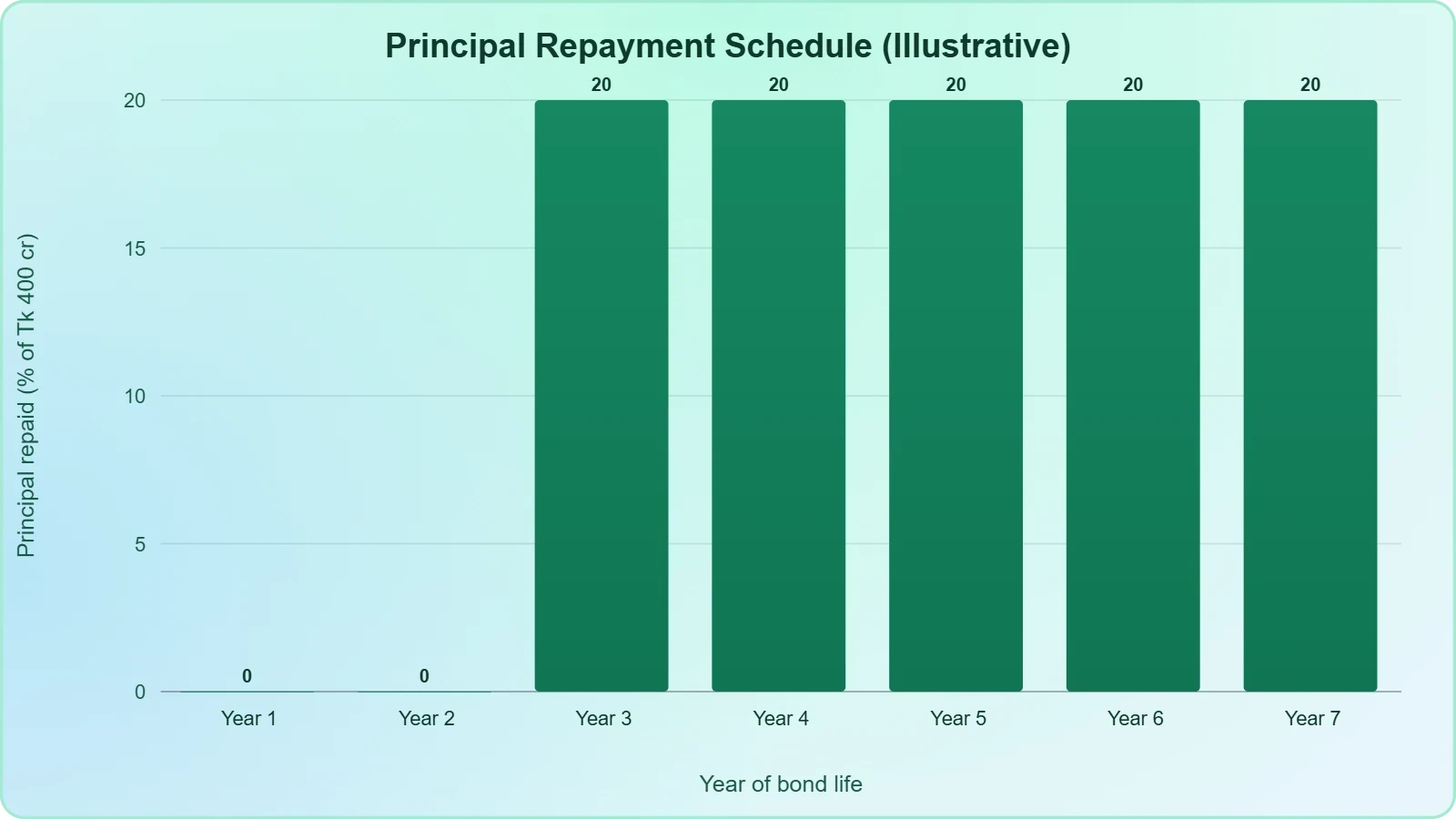
Beyond the headline numbers, the transaction carries broader significance for Bangladesh's capital markets. The repayment schedule is staggered rather than bullet-style: principal amortisation begins at the end of the third year, with 20 percent of the original principal repaid annually over the following five years, while coupon payments flow semi-annually. Individual investors may qualify for tax rebates under applicable income tax laws once the bond is listed, and the investment is exempt from excise duty subject to regulations. Meghna Bank frames the proceeds as support for productive sectors, industrial development and entrepreneurship, with knock-on benefits for employment and the maturation of the country's bond market.
On This Page
- The Regulatory Architecture Behind the Issuance
- Decoding the Variable Coupon Formula
- Instrument Terms and the Repayment Schedule
- Strategic Rationale for Meghna Bank
- Risk Considerations for Prospective Investors
- Implications for Bangladesh's Financial System
- What the Transaction Signals About Capital Strategy
TL;DR Meghna Bank PLC has received joint approval from Bangladesh Bank and BSEC to issue a Tk 400 crore, seven-year subordinated bond that will count as Tier-2 capital. The bond pays a variable coupon benchmarked to the average of the six highest six-month fixed deposit rates plus a 3 percentage point margin, yielding 12.05 percent as of September 30, 2026. Units carry a Tk 5 lakh face value, will be privately placed and then listed on the DSE main board, amortise 20 percent of principal annually from year three, and offer individual investors potential tax rebates and excise duty exemption.
The Regulatory Architecture Behind the Issuance
Subordinated debt issuance in Bangladesh is not a routine corporate financing decision; it sits at the intersection of banking regulation, securities law and monetary policy. A bank cannot simply borrow and label the proceeds as capital. The instrument must satisfy Bangladesh Bank's criteria for Tier-2 capital, which typically require a minimum original maturity, subordination to depositors and general creditors, and explicit amortisation rules as maturity approaches. Simultaneously, any public listing or private placement to investors falls under BSEC oversight, which governs disclosure, eligibility of investors and the terms of trading on the Dhaka Stock Exchange. The dual approval therefore represents two distinct regulatory judgments converging on a single instrument.
Why Tier-2 Capital Matters for a Growing Bank
Tier-2 capital occupies a specific place in the Basel-inspired capital hierarchy that Bangladesh Bank enforces. Common Equity Tier-1, the core measure, consists of paid-up capital and retained earnings and absorbs losses on a going-concern basis. Tier-2 instruments such as subordinated bonds absorb losses in liquidation and supplement Tier-1 in meeting the total capital adequacy ratio. For a bank like Meghna Bank, issuing Tier-2 debt is often more attractive than a rights issue because it avoids diluting existing shareholders while still expanding the lending headroom available under risk-weighted asset calculations. The capital boost is real, but it comes with a fixed obligation to bondholders.
The Dual Approval Process and Investor Protection
The involvement of both Bangladesh Bank and BSEC reflects a layered approach to investor protection. Bangladesh Bank scrutinises whether the instrument genuinely qualifies as regulatory capital and whether the issuing bank's overall financial condition justifies the additional leverage. BSEC, meanwhile, examines the terms offered to investors, the adequacy of disclosures and the mechanics of listing and trading. This division of labour means a bond can be structurally sound from a prudential standpoint yet still face delays if its investor-facing documentation falls short. Meghna Bank's successful navigation of both gates signals that its capital planning and its disclosure practices met the standards of two separate regulators.
Decoding the Variable Coupon Formula
The bond's pricing mechanism deserves close attention because it determines the actual return investors will receive over seven years. Rather than fixing a coupon at issuance, Meghna Bank has linked the payout to a floating reference rate: the average of the six highest six-month fixed deposit rates offered by commercial banks in Bangladesh, excluding specialised, Islamic and foreign banks. A fixed margin of three percentage points is then added. This design means the coupon rises when deposit competition intensifies and falls when funding costs ease, aligning the bond's cost to the bank with prevailing market conditions rather than locking in a rate that could become expensive or cheap relative to the market.
The Reference Rate and Margin Mechanics
As of September 30, 2026, the reference rate stood at 9.05 percent, producing a total coupon of 12.05 percent per annum. The choice of the six highest deposit rates, rather than an average across all banks, is deliberate: it captures the upper band of deposit pricing, where competitive pressure is most visible, and protects bondholders from being locked into a rate that lags a rising market. The three percentage point margin compensates investors for the subordinated status of the claim, since bondholders rank behind depositors and general creditors in the event of liquidation. The formula is transparent and verifiable, which supports investor confidence.
How the Coupon Compares Across Instruments
Placing a 12.05 percent coupon in context requires comparison with alternative savings instruments available to Bangladeshi investors. Fixed deposits, government savings certificates and corporate bonds each carry different risk profiles and tax treatments. The subordinated bond's yield sits above typical deposit rates because it demands a term premium and a subordination premium, but it also carries credit risk tied to Meghna Bank's solvency. The semi-annual coupon frequency provides regular income, while the variable structure introduces reinvestment uncertainty. Investors weighing the bond must therefore assess not just the headline yield but the trajectory of deposit rates over the seven-year horizon.
We Also Published
Instrument Terms and the Repayment Schedule
The bond's structural terms shape both the bank's liability profile and the investor's cash-flow experience. Each unit carries a face value of Tk 5 lakh, a denomination that positions the instrument toward high-net-worth individuals and institutional buyers rather than retail savers with modest balances. The seven-year tenor is split into a three-year interest-only phase followed by a five-year amortisation phase, during which 20 percent of the original principal is repaid annually. This staggered repayment reduces the bank's refinancing cliff at maturity and gives investors a predictable return of capital, though it also means the outstanding principal declines steadily after year three.
Private Placement, Listing and Secondary Trading
The issuance route is private placement to eligible individual and institutional investors, followed by listing on the main board of the Dhaka Stock Exchange. Private placement allows the bank to target sophisticated buyers who can assess the credit and structure without the cost of a full public offering, while the subsequent listing provides liquidity and price discovery. Once listed, bondholders can trade their units in the secondary market, converting an otherwise illiquid seven-year commitment into a transferable asset. That liquidity feature is significant in a market where long-dated corporate debt is scarce, and it may broaden the investor base over time as the bond's trading history develops.
Tax Treatment and Excise Duty Exemption
The tax and duty provisions add a meaningful layer to the bond's appeal. Individual investors may qualify for tax rebates under applicable income tax laws after the listing, an incentive that effectively raises the after-tax yield relative to instruments without such treatment. The investment is also exempt from excise duty, subject to applicable regulations, which removes a cost that can erode returns on larger holdings. These benefits are conditional on the bond being listed and on investors satisfying the relevant legal criteria, so prospective buyers should verify their eligibility with tax advisers rather than assume automatic entitlement. The combination nonetheless improves the instrument's competitive standing.
- 01
- 02
- 03
- 04
Strategic Rationale for Meghna Bank
For Meghna Bank, the bond is a capital-management tool as much as a funding event. Banks in Bangladesh face persistent pressure to grow lending in line with regulatory targets for priority sectors while maintaining capital adequacy ratios that can tighten when loan growth outpaces internal capital generation. A Tier-2 bond offers a middle path: it raises regulatory capital without the dilution and market timing risk of an equity offering, and it diversifies the liability base away from pure deposit funding. The bank's stated intention to channel proceeds toward productive sectors, industrial development and entrepreneurship aligns with broader national priorities, which may also ease regulatory receptiveness to future issuances.
Capital Adequacy and Lending Headroom
The arithmetic of capital adequacy explains why Tk 400 crore of Tier-2 capital matters. A bank's capital adequacy ratio is calculated as eligible capital divided by risk-weighted assets. Adding Tk 400 crore to the numerator allows the bank to support a multiple of that amount in additional risk-weighted lending, depending on the asset mix and applicable risk weights. Because subordinated debt counts as Tier-2 rather than Tier-1, it cannot substitute indefinitely for equity, but it provides a useful buffer that supports growth in the medium term. The staggered amortisation also means the capital benefit gradually declines as the bond approaches maturity, giving the bank time to rebuild retained earnings.
Contribution to Bangladesh's Bond Market
Each new listed corporate bond adds depth to a market that remains underdeveloped relative to the size of Bangladesh's banking sector. A listed, exchange-traded subordinated bond gives investors a benchmark for pricing similar instruments and provides the Dhaka Stock Exchange with another tradable security. Over time, a critical mass of such issuances can improve price discovery, encourage the emergence of bond funds and deepen the investor base beyond a handful of institutions. Meghna Bank's issuance is modest in absolute terms, but its structural features, including variable pricing and staged amortisation, set a template that other banks may follow as they seek Tier-2 capital.
Risk Considerations for Prospective Investors
Subordinated bonds are not risk-free instruments, and the Meghna Bank issuance carries several considerations that investors should weigh carefully. The most fundamental is credit risk: bondholders rank behind depositors and general creditors, so in a stress scenario their claims are satisfied only after senior obligations. The variable coupon introduces interest-rate risk in the sense that future payouts depend on deposit-rate movements that cannot be forecast with certainty. Liquidity risk persists despite the planned listing, because a newly listed bond may trade thinly until a secondary market develops. Investors should also consider the tax and regulatory conditions attached to the rebates and exemptions, which may change over the seven-year tenor.
Subordination, Credit Risk and Market Liquidity
The subordination feature is the source of the bond's higher yield, but it also concentrates risk. In liquidation, subordinated creditors are paid after depositors and senior creditors, meaning recovery rates in a severe scenario could be materially lower than for senior debt. Credit risk is therefore inseparable from the bank's asset quality and capital position over time. Liquidity risk adds a second layer: even with a DSE listing, trading volumes in corporate bonds can be modest, and investors seeking to exit before maturity may face wide bid-ask spreads or difficulty finding counterparties. These factors argue for a buy-and-hold approach rather than short-term trading.
Interest Rate Sensitivity and Regulatory Change
The floating coupon reduces, but does not eliminate, interest-rate sensitivity. Because the reference rate is tied to deposit rates rather than a government benchmark, the bond's yield responds to banking-sector funding competition, which can diverge from broader rate cycles. Regulatory change is a further variable: the tax rebate and excise duty exemption depend on applicable laws and regulations that could be revised during the bond's life. Investors should model outcomes under scenarios where the reference rate falls, where tax benefits are curtailed, and where secondary-market liquidity remains thin, rather than relying solely on the current 12.05 percent coupon as a guide to future returns.
Implications for Bangladesh's Financial System
Meghna Bank's bond is a small transaction in absolute terms, but its implications extend beyond a single lender's balance sheet. Bangladesh's corporate bond market has long lagged behind the country's equity market and banking sector, constrained by limited issuance, thin trading and a narrow investor base. Each listed subordinated bond adds a data point for pricing, a security for trading and an instrument for institutional portfolios. If more banks follow with similar Tier-2 issuances, the cumulative effect could be a more diversified funding landscape in which banks rely less exclusively on deposits and more on market-based capital instruments, which in turn supports financial stability.
Deepening the Corporate Bond Market
A functioning corporate bond market requires issuers, investors, infrastructure and regulation to develop in tandem. Meghna Bank's issuance contributes on the issuer side and, through its DSE listing, on the infrastructure side. The variable coupon structure, benchmarked to observable deposit rates, provides a transparent pricing convention that other issuers can reference. The private placement route, meanwhile, reflects the current reality that public bond offerings remain cumbersome and costly in Bangladesh. Over time, as investor familiarity grows and trading volumes increase, the balance may shift toward broader public issuance, but that transition will depend on regulatory simplification and the emergence of dedicated bond funds.
Capital Planning Across the Banking Sector
Other banks will watch the Meghna Bank issuance closely, because capital planning is a sector-wide challenge. As loan growth continues and regulatory capital requirements tighten in line with international standards, banks need a menu of capital instruments beyond retained earnings and equity. Subordinated bonds offer a flexible option that can be sized to need and timed to market conditions. The success of this issuance, measured by investor uptake and secondary-market performance, will inform how aggressively peers pursue similar transactions. A well-received bond could accelerate a wave of Tier-2 issuance; a poorly received one could delay it.
What the Transaction Signals About Capital Strategy
The Meghna Bank bond ultimately signals a maturing approach to capital strategy among Bangladesh's private commercial banks. Rather than relying solely on deposit mobilisation and retained earnings, the bank has chosen a market-based instrument that balances cost, dilution and regulatory capital treatment. The variable coupon aligns the bank's funding cost with market conditions, the staged amortisation manages refinancing risk, and the listing creates liquidity for investors. These features reflect a level of financial sophistication that, if replicated, could gradually reshape how Bangladeshi banks fund their growth and how investors allocate capital across the financial system.
For investors, the bond offers a yield above typical deposits in exchange for subordination, variable income and liquidity constraints, with tax and duty benefits improving the after-tax return for eligible holders. For the bank, it provides Tier-2 capital that supports lending expansion without diluting shareholders. For the market, it adds a listed instrument and a pricing reference. The transaction is modest in size but instructive in design, and its reception will reveal how far Bangladesh's corporate bond market has progressed and how much further it has to travel before market-based bank capital becomes routine rather than notable.
From our network :
- The Hidden Cost of AI Convenience: Why Over-Permissioned Agents Are a Security Time BombDiscover why AI agents with excessive permissions create dangerous single points of failure, and learn how implementing least privilege principles can protect your organization from exploitation.
- How AI Agents Will Change the Way We Manage Personal FinancesExplore how AI agents are transforming personal finance through automated budgeting, bill payment, and investment management, while examining the critical security protocols and governance frameworks required for safe deployment.
- University Language Proficiency Exams: Why Institutional Tests Demand Different Preparation Than IELTS and TOEFLDiscover why university-specific language proficiency examinations differ fundamentally from IELTS and TOEFL, and learn strategic preparation approaches for institutional assessment success.
- Forbidden Matrix Patterns and Visible Lattice Points: A Geometric DictionaryExplore how multidimensional 0–1 matrices encode geometric truths, linking forbidden patterns to visible lattice points and hypergraph theory, with applications in combinatorics and computational geometry.
- CISA’s Ten-Advisory Wave: Why Generic Patching Fails in OT and How to Build Product-Specific PlaybooksCISA released ten ICS advisories in one week, exposing critical infrastructure risks. Generic patching fails in OT. Learn to build product-specific remediation playbooks.
- Committed Mediterranean Precipitation Decline: Why Emissions Cuts Alone Cannot Restore Winter RainsNew NOAA research reveals that Mediterranean winter rains may decline irreversibly even with emissions cuts. Explore the science of committed climate change and regional impacts.
- The Final Descent: How ESA Retired the Legendary Cluster Constellation After 24 Years of Space Weather ScienceAfter 24 years mapping Earth’s magnetosphere, ESA’s Cluster mission concluded with a precisely controlled reentry over the South Pacific. This analysis explores the scientific legacy, engineering decisions, and debris mitigation principles behind one of space exploration’s most responsible retirements.
- Mobile Learning and VR in English: What Global Evidence Reveals About Effective Language TechnologyA systematic review across 14 countries reveals which language-learning technologies genuinely work. Mobile learning, AI, and VR show measurable benefits when pedagogically integrated. This evidence-based guide helps educators and learners select technology that delivers real return on investment.
- Live Online English Classes for Kids: Do They Actually Reduce Anxiety?A ten-week study reveals that synchronous online English classes can significantly reduce child language anxiety while improving listening and reading skills. Discover what makes these programs effective and how parents can select the right one.
RESOURCES
- Resources will be updated soon.
- 01
- 02
- 03
- 04
- 05
- 06
- 07
- 08
0 Comments