
On 5 November 2026, New Zealand's equity market delivered a session that traders will reference for years: the S&P/NZX 50 Index closed at 14,090.97, a gain of 307.52 points or 2.23%, eclipsing the previous record of 14,013.21 set on 26 August 2026. It was the index's strongest single day since 10 April 2025, when a 3.34% surge followed US President Donald Trump's pause on new tariffs. What makes the milestone analytically interesting is not merely the magnitude but the mechanism behind it — a political outcome in Washington transmitted through Wall Street, sovereign bond yields, currency swap rates and commodity prices into a small, trade-exposed South Pacific economy.
The proximate trigger was the Democratic Party's capture of both chambers of the US Congress in the midterm elections. Wall Street responded with unusual force: the Dow Jones Industrial Average climbed 1,569 points, or 3.03%, to 53,356.12 — its best day in eighteen months — while the S&P 500 added 1.58% to 7,688.62 and the Nasdaq Composite rose 1.44% to 25,736.51. Salt Funds Management managing director Matt Goodson attributed the rally to twin hopes: that the conflict with Iran may be drawing to a close, and that lower oil prices and falling bond yields could ease the inflation pressure that has constrained central bank policy across the developed world.
Beneath the headline index move lies a more textured story of sector rotation, funding-cost relief and geopolitical repricing. Brent crude had fallen nearly 10% to US$93.88 a barrel by 6pm New Zealand time, down from a high of US$116.73 on 23 October. The US 10-year Treasury yield eased to 4.848%, the New Zealand 10-year government bond yield settled at 4.656%, and the local three-year swap rate — a critical benchmark for bank funding and mortgage pricing — dropped from 4.24% to 3.79%. Those are the plumbing details that determine whether an equity rally has staying power or merely reflects a single session of relief.
On This Page
- The Political Shockwave: How US Midterms Repriced Global Risk
- Wall Street's Record Session and the Transmission Channel to Wellington
- Inside the NZX 50: Breadth, Leaders and the Infratil Block Trade
- The Rates and Commodities Backdrop Driving the Re-rating
- Asia's Divergence: Why Seoul and Tokyo Fell While Wellington Soared
- Positioning for What Comes Next: Risks, Catalysts and Portfolio Implications
TL;DR New Zealand's S&P/NZX 50 Index hit a record 14,090.97 on 5 November 2026, rising 2.23% after Democrats swept both chambers of the US Congress. Wall Street's rally, a near-10% fall in Brent crude and a sharp drop in the three-year swap rate from 4.24% to 3.79% combined to lift NZ equities. Fisher & Paykel Healthcare, Auckland Airport, Meridian Energy and Infratil led gains, while Asian markets diverged sharply — the ASX 200 rose 2.52% and the Hang Seng 3.09%, but the Kospi fell 4.86% and the Nikkei 225 lost 1.35% on AI-regulation fears.
The Political Shockwave: How US Midterms Repriced Global Risk
Midterm elections rarely move global markets with this kind of force, but the 2026 result carried an unusual concentration of unresolved policy questions. A Democratic-controlled Congress alters the arithmetic on the US debt ceiling, which is due for renewal next year, and introduces a new set of legislative priorities around technology regulation, fiscal spending and energy policy. Markets initially chose to read the outcome as a de-escalation signal rather than a governance risk, focusing on the prospect of a winding down of the Iran conflict and the fiscal discipline a divided government might impose.
Goodson's caution is worth weighing carefully. He noted that a Democratic-controlled Congress could generate more political tension over the debt ceiling renewal, a scenario that historically produces volatility in Treasury markets and, by extension, in every asset class priced off the US curve. The rally therefore embeds an assumption that legislative brinkmanship will be managed — an assumption that has been tested repeatedly over the past fifteen years and has not always held. Investors buying into the record should understand they are pricing optimism about political process, not just earnings.
The Iran De-escalation Trade and Oil's Sharp Retreat
Vice-President JD Vance attributed Republican losses to the Iran war and indicated that hopes for a peace deal had strengthened as oil prices fell nearly 10%. That linkage matters enormously for New Zealand, an energy importer with a small open economy highly sensitive to transport and input costs. Brent's slide from US$116.73 on 23 October to US$93.88 represents a substantial disinflationary impulse, easing pressure on airlines, logistics operators, manufacturers and households simultaneously. For a market dominated by infrastructure, healthcare and utility names, cheaper energy is a direct margin tailwind.
The mechanics of the oil move deserve scrutiny. A near-10% single-session decline reflects not gradual supply adjustment but a rapid repricing of geopolitical risk premia. When conflict probability falls, the speculative premium embedded in crude collapses quickly, and the beneficiaries are precisely the rate-sensitive and consumer-facing equities that led the NZX 50 higher. The risk, of course, is symmetry: if peace hopes fade, that premium can re-inflate with equal speed, and the equity gains built upon it would be vulnerable to reversal.
Debt Ceiling Arithmetic and the Fiscal Risk Premium
The debt ceiling is the sleeper issue in this rally. Renewal is due next year, and divided government historically converts a routine administrative step into a negotiation over spending priorities. Each extended standoff raises the spectre of technical default, widens Treasury bill spreads and forces risk assets to absorb a fiscal risk premium. New Zealand, as a small open economy reliant on offshore funding, is a price-taker in that environment; domestic yields follow the US curve with a spread that can widen abruptly during stress episodes.
What the market is currently doing is assigning a low probability to a disruptive outcome. That is a defensible base case, given that every modern debt ceiling confrontation has ultimately been resolved. But the distribution of outcomes around that base case is wide, and the tail risk is not trivial. Prudent portfolio construction should acknowledge that a record-high index built partly on political optimism carries an embedded sensitivity to legislative failure that headline valuation metrics do not capture.
Wall Street's Record Session and the Transmission Channel to Wellington
The Dow's 1,569-point advance — its strongest day in eighteen months — illustrates how quickly sentiment can shift when two negative catalysts, war risk and rate pressure, appear to weaken simultaneously. The S&P 500's 1.58% gain and the Nasdaq's 1.44% advance were more measured, suggesting the rally was broad but led by cyclical and rate-sensitive sectors rather than speculative growth. That composition is important: it implies investors were repricing macro conditions rather than chasing momentum in a narrow cohort of technology names.
Transmission to New Zealand operates through several distinct channels. The first is straightforward sentiment contagion, as fund managers rebalance toward risk. The second is the interest rate channel, where falling US yields compress the spread New Zealand borrowers pay offshore. The third is the commodity channel, where cheaper oil reduces the import bill and improves the terms of trade. The fourth is currency, where a risk-on environment typically supports the New Zealand dollar and, with it, the translation of offshore earnings for companies with international operations.
Bond Yields, Swap Rates and the Cost of Capital
The most consequential number in the entire session may not be the index level at all, but the three-year swap rate's fall from 4.24% to 3.79%. This is the benchmark against which New Zealand banks price fixed-rate mortgages and business lending. A 45-basis-point decline in a single session is a material easing of financial conditions, and it flows directly into the discount rates used to value infrastructure and utility assets — precisely the sectors that led the market higher. Meridian Energy's 1.81% gain and Infratil's 4% advance are direct expressions of this dynamic.
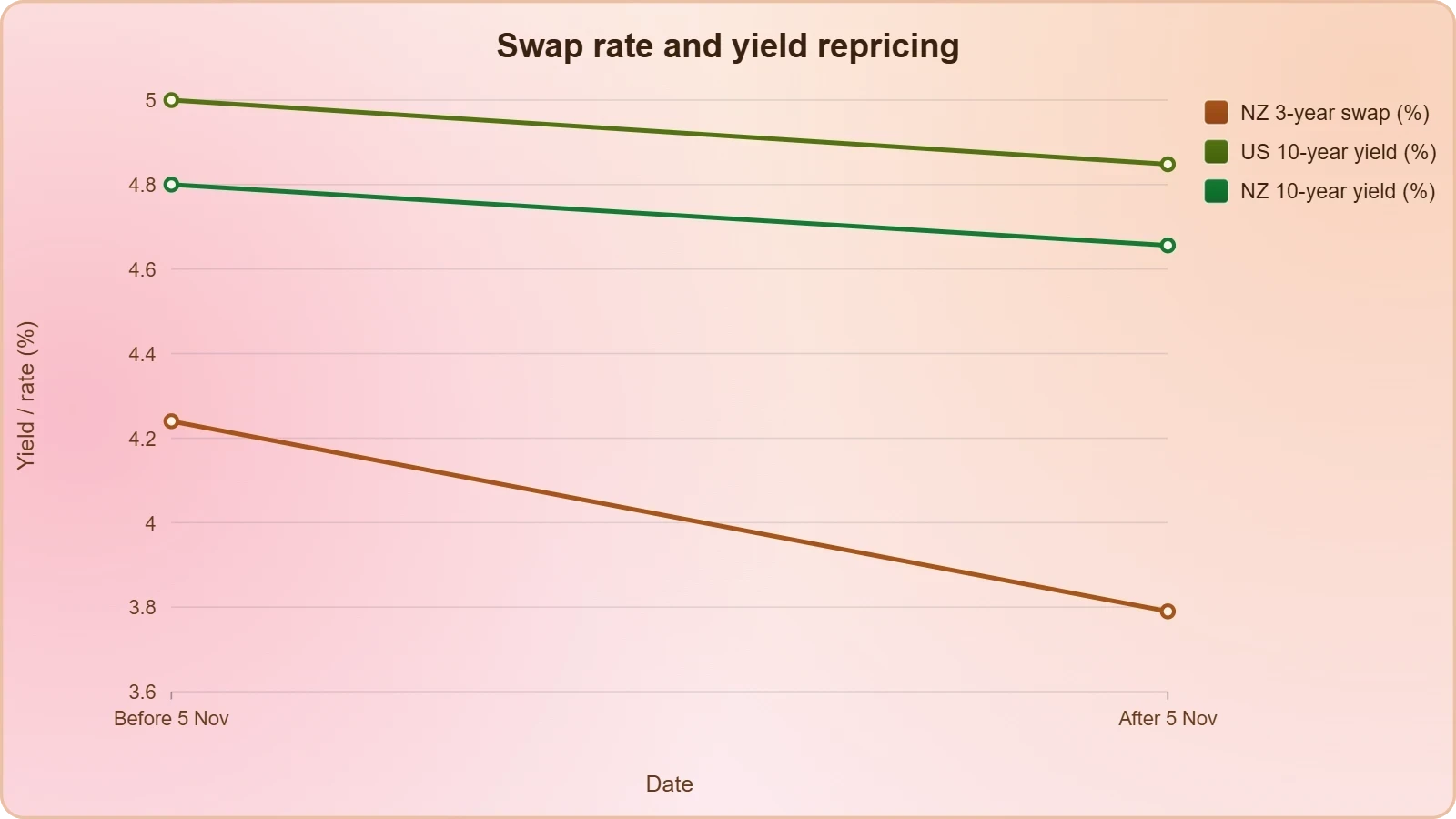
The US 10-year Treasury yield's retreat to 4.848% and the New Zealand 10-year government bond yield's move to 4.656% complete the picture. Lower long-end yields raise the present value of long-duration cash flows, which is why healthcare and airport assets — Fisher & Paykel and Auckland International Airport among them — participated strongly. Investors should note, however, that a single session's rate move is not a trend; the durability of these gains depends on whether disinflation proves persistent rather than merely headline-driven.
Currency, Carry and the Offshore Funding Question
New Zealand's persistent reliance on offshore wholesale funding means domestic credit conditions are partly imported. When global risk appetite improves and swap rates fall, the cost of that funding declines, but the benefit is contingent on the currency not depreciating sharply. A risk-on environment generally supports the kiwi, which helps contain imported inflation but pressures exporters' translation earnings. This tension is a permanent feature of the New Zealand market and explains why local equities often amplify global moves in both directions.
The carry trade dimension adds further complexity. New Zealand's relatively high yields have long attracted offshore capital seeking spread, and a decline in the three-year swap rate narrows that differential. If the compression continues, some of that capital may rotate elsewhere, which would weigh on the currency even as it supports domestic rate-sensitive equities. The net effect on the NZX 50 is therefore ambiguous over a multi-month horizon, even though the immediate session was unambiguously positive.
We Also Published
Inside the NZX 50: Breadth, Leaders and the Infratil Block Trade
Market breadth confirmed the rally's substance rather than merely its headline. On the main board, 113 shares rose against 26 declines, with 38.98 million shares traded worth $140.4 million. That ratio — better than four advancers for every decliner — indicates participation across the market rather than a handful of heavyweights dragging the index higher. Genuine breadth of this kind is a more reliable signal of durable sentiment shift than a narrow, momentum-driven advance, though a single session remains a single session.
The leadership cohort was instructive. Fisher & Paykel Healthcare rose 3.87% to $48.56, Auckland International Airport gained 2.58% to $8.74, Meridian Energy added 1.81% to $5.63, Skellerup increased 2.91% to $7.77 and a2 Milk climbed 3.35% to $8.95. These are long-duration, rate-sensitive and export-oriented businesses — precisely the profile that benefits from lower discount rates and a weaker oil price. The composition of the leaderboard tells you more about the drivers than any commentary could.
Infratil, NextDC and the Data Centre Re-rating
Infratil's 4% rise to $13.25 deserves separate treatment because it was catalysed by an offshore event: Australian data centre operator NextDC surged 47% to A$9.65, dragging the entire digital infrastructure complex higher. The subsequent disclosure that Goodman Group and Digital Realty Trust had built a 9.9% shareholding in Infratil at $9.50 a share after the market closed adds a strategic dimension. Institutional accumulation of that scale signals conviction about long-term data centre demand, and it validates Infratil's infrastructure positioning.
The data centre theme sits at an interesting intersection of the session's competing narratives. On one hand, AI infrastructure demand is a powerful structural growth driver attracting global capital. On the other, the Nikkei's 1.35% decline was attributed to concerns that Democrats may impose regulations on AI data centres — a reminder that the same political shift lifting markets broadly could constrain the sector-specific growth story. Investors in digital infrastructure must therefore weigh regulatory risk against demand fundamentals with unusual care.
Sector Rotation and the Defensive-Growth Balance
Healthcare, utilities, airports and infrastructure all participated, which is characteristic of a rate-driven rally rather than a pure risk-appetite surge. When the discount rate falls, the present value of distant cash flows rises most for stable, predictable businesses. That is why Fisher & Paykel and Meridian outperformed, and why the market's advance was concentrated in quality names rather than speculative small caps. This rotation pattern typically persists for weeks rather than days if the rate move holds.
The counterweight is that these same defensive-growth names had already performed strongly through 2026, and the index's record close reflects accumulated gains rather than a single day's enthusiasm. Valuation discipline matters at these levels. A 2.23% session gain layered onto an index already at record highs raises the question of how much good news is now embedded in prices, and whether the earnings outlook justifies further multiple expansion without a fresh catalyst.
The Rates and Commodities Backdrop Driving the Re-rating
Equity markets do not move on politics alone; they move on the discount rate and the earnings outlook, and both shifted materially on this session. The three-year swap rate's decline from 4.24% to 3.79% is the single most important domestic data point, because it directly lowers the cost of capital for every leveraged business in the country. Combined with the New Zealand 10-year government bond yield at 4.656% and the US 10-year at 4.848%, the entire yield curve shifted downward in a way that mechanically supports higher equity valuations.
Commodities reinforced the message. Brent crude at US$93.88, down from US$116.73 on 23 October, represents a substantial disinflationary impulse for an energy-importing economy. Lower fuel costs feed through to transport, logistics, manufacturing and household discretionary spending, all of which support domestic earnings. The combination of falling rates and falling energy costs is close to an ideal macro backdrop for a small open economy, which explains why the market responded with such conviction rather than caution.
Reading the Yield Curve Signal
A parallel downward shift in yields across the US and New Zealand curves signals that markets are repricing the inflation and policy path, not merely reacting to a risk-on impulse. When long-end yields fall alongside short-end swap rates, the implication is that investors expect easier financial conditions ahead. For equity investors, this is the most supportive configuration possible, because it raises valuations without requiring an immediate upgrade to earnings forecasts.
The caution is that bond markets have repeatedly mispriced the persistence of disinflation. If the oil decline proves temporary and the Iran peace hopes fade, yields could retrace quickly, and the equity gains built on lower discount rates would be exposed. The 45-basis-point swap rate move is large enough that some retracement is plausible; investors should treat it as a favourable shift rather than a permanent regime change until confirmed by subsequent data.
Oil, Terms of Trade and the Inflation Pass-Through
New Zealand's terms of trade improve directly when imported energy costs fall, and that improvement flows into national income, corporate margins and household purchasing power. A near-10% decline in Brent is meaningful in aggregate, though the pass-through to domestic fuel prices occurs with a lag and is mediated by currency movements and refining margins. The equity market, being forward-looking, prices the benefit immediately even though consumers will experience it gradually over subsequent weeks.
The inflation dimension is equally significant. Energy is a volatile but influential component of headline inflation, and a sustained decline would give the Reserve Bank more room to consider easier policy. That expectation is already embedded in the swap rate move. If it is validated by forthcoming inflation data, the equity rally has a fundamental foundation; if headline inflation proves sticky on core components, the rate-driven component of the rally could unwind even as oil remains low.
- 01
- 02
- 03
- 04
Asia's Divergence: Why Seoul and Tokyo Fell While Wellington Soared
The most analytically revealing feature of the session was the divergence within Asia-Pacific. Australia's S&P/ASX 200 rose 2.52% to 9,056.9 and Hong Kong's Hang Seng gained 3.09%, aligning with the Western risk-on move. Yet South Korea's Kospi fell 4.86% after a temporary trading suspension, and Japan's Nikkei 225 lost 1.35% on concerns that the incoming Democratic Congress may impose regulations on AI data centres. Same news, opposite reactions — a reminder that political outcomes distribute costs and benefits unevenly across economies.
The Kospi's decline is particularly striking given the broadly supportive global backdrop. A temporary trading suspension suggests either a technical dislocation or a concentrated shock to a heavyweight constituent, and the magnitude of the fall implies the latter. South Korea's market is heavily weighted toward semiconductor and technology exporters, and any signal that US technology regulation could tighten would hit those valuations disproportionately. The suspension itself may have amplified the move by trapping sellers.
AI Regulation Risk and the Technology Supply Chain
The Nikkei's decline crystallises a risk that the New Zealand market largely sidesteps: direct exposure to AI infrastructure regulation. Japan's market contains significant semiconductor equipment and data centre supply chain names, and the prospect of Democratic legislative action on AI data centres introduces genuine policy uncertainty. Investors in those names must now price a regulatory discount that did not exist before the election result, even as demand fundamentals remain strong.
This creates an interesting asymmetry. New Zealand's Infratil benefited from data centre enthusiasm via the NextDC read-across, yet New Zealand has minimal direct regulatory exposure to US AI policy. The country is a price-taker in the sector's growth but largely insulated from its regulatory risk. That positioning is attractive in a world where AI infrastructure demand is robust but policy treatment is uncertain, and it partly explains why offshore capital is willing to accumulate NZ infrastructure assets at scale.
What the Divergence Signals for Regional Allocation
For regional allocators, the session offers a clear lesson about correlation breakdown. A single political event produced gains of 2-3% in Wellington, Sydney and Hong Kong alongside losses approaching 5% in Seoul. Treating "Asia-Pacific" as a homogeneous exposure is therefore a category error; the region's markets respond to different drivers, and political events in Washington transmit through sector composition rather than geography. Portfolio construction should reflect that heterogeneity explicitly.
The practical implication is that diversification within the region requires attention to sector weights, not just country labels. A market dominated by rate-sensitive infrastructure behaves like a bond proxy; one dominated by semiconductor exporters behaves like a leveraged bet on US technology policy. Understanding which is which — and sizing positions accordingly — matters more than the headline index correlation statistics that most allocation models rely upon.
Positioning for What Comes Next: Risks, Catalysts and Portfolio Implications
A record close is a moment for discipline rather than euphoria. The NZX 50 at 14,090.97 has now priced a Democratic Congress, an Iran de-escalation, a near-10% oil decline and a 45-basis-point fall in the three-year swap rate — all within a single session. Each of those inputs is reversible, and the market's willingness to extrapolate them simultaneously is precisely what makes the current level vulnerable to disappointment. The question for investors is not whether the rally was justified, but how much of it is durable.
The most important forward catalyst is the debt ceiling renewal next year. Goodson's warning about political tension deserves prominence because it identifies a specific, dated event where the current optimism could be tested. Beyond that, the trajectory of the Iran conflict, the persistence of the oil decline and the Reserve Bank's response to falling energy costs will each determine whether the rate-driven component of the rally holds. Investors should map these catalysts explicitly rather than relying on generalised optimism.
Building a Risk Framework Around the Record
A practical framework begins with identifying which holdings benefited from lower discount rates versus lower oil prices versus pure sentiment. Rate-sensitive infrastructure and utilities are exposed to a bond yield reversal; energy-intensive businesses are exposed to an oil rebound; and broad market beta is exposed to sentiment normalisation. Sizing positions according to which specific risk each holding carries is more useful than treating the index as a single exposure with a single outlook.
The second element is monitoring the swap rate itself. If the three-year rate stabilises near 3.79%, the valuation support for rate-sensitive equities persists. If it retraces toward 4.24%, the gains in Meridian, Infratil and Fisher & Paykel become questionable. The swap rate is therefore the single most useful indicator for tracking whether this rally has fundamental backing, and it is observable daily without requiring any proprietary analysis.
Lessons for Long-Horizon Investors
The session reinforces a durable principle: political events matter to markets primarily through their effect on discount rates, commodity prices and sector-specific regulation, not through their ideological content. Investors who focused on the partisan outcome learned less than those who traced the transmission mechanism from Washington to Wall Street to the swap market to Wellington. That analytical discipline is transferable to every future political shock, regardless of which party prevails.
Finally, the divergence between Wellington and Seoul is a reminder that diversification must be understood at the sector level. A portfolio holding both markets believed it was diversified geographically but was in fact exposed to opposite sides of the AI regulation question. Genuine diversification requires understanding what each holding is actually sensitive to, and the events of 5 November 2026 provided an unusually clear demonstration of why that distinction matters.
From our network :
- CISA’s Ten-Advisory Wave: Why Generic Patching Fails in OT and How to Build Product-Specific PlaybooksCISA released ten ICS advisories in one week, exposing critical infrastructure risks. Generic patching fails in OT. Learn to build product-specific remediation playbooks.
- Mobile Learning and VR in English: What Global Evidence Reveals About Effective Language TechnologyA systematic review across 14 countries reveals which language-learning technologies genuinely work. Mobile learning, AI, and VR show measurable benefits when pedagogically integrated. This evidence-based guide helps educators and learners select technology that delivers real return on investment.
- How AI Agents Will Change the Way We Manage Personal FinancesExplore how AI agents are transforming personal finance through automated budgeting, bill payment, and investment management, while examining the critical security protocols and governance frameworks required for safe deployment.
- Live Online English Classes for Kids: Do They Actually Reduce Anxiety?A ten-week study reveals that synchronous online English classes can significantly reduce child language anxiety while improving listening and reading skills. Discover what makes these programs effective and how parents can select the right one.
- Forbidden Matrix Patterns and Visible Lattice Points: A Geometric DictionaryExplore how multidimensional 0–1 matrices encode geometric truths, linking forbidden patterns to visible lattice points and hypergraph theory, with applications in combinatorics and computational geometry.
- Committed Mediterranean Precipitation Decline: Why Emissions Cuts Alone Cannot Restore Winter RainsNew NOAA research reveals that Mediterranean winter rains may decline irreversibly even with emissions cuts. Explore the science of committed climate change and regional impacts.
- The Final Descent: How ESA Retired the Legendary Cluster Constellation After 24 Years of Space Weather ScienceAfter 24 years mapping Earth’s magnetosphere, ESA’s Cluster mission concluded with a precisely controlled reentry over the South Pacific. This analysis explores the scientific legacy, engineering decisions, and debris mitigation principles behind one of space exploration’s most responsible retirements.
- University Language Proficiency Exams: Why Institutional Tests Demand Different Preparation Than IELTS and TOEFLDiscover why university-specific language proficiency examinations differ fundamentally from IELTS and TOEFL, and learn strategic preparation approaches for institutional assessment success.
- The Hidden Cost of AI Convenience: Why Over-Permissioned Agents Are a Security Time BombDiscover why AI agents with excessive permissions create dangerous single points of failure, and learn how implementing least privilege principles can protect your organization from exploitation.
RESOURCES
- NZX 50 surges after Democrats sweep US midterm electionsnzherald.co.nz2 hours ago ... The New Zealand sharemarket caught the Wall Street surge, achieving its best day of trading in nearly 19 months and…
- Shared Lunch - Apple Podcastspodcasts.apple.comInvesting involves risk. This channel is brought to you by Sharesies Limited (NZ) in New Zealand. Information provided is general advice only and current…
- Global stocks rallied on Wednesday after Democrats seized control ...facebook.com8 hours ago ... Global stocks rallied on Wednesday after Democrats seized control of both chambers of Congress in the US midterm elections, ...
- Australia shares close at fresh 6-year high, up for sixth sessionreuters.comAug 20, 2014 ... New Zealand's benchmark NZX 50 index added 0.2 percent or 12.6 points to 5,152.9. ... Stocks, dollar slide after some…
- New Zealand Dollar - Quote - Chart - Historical Data - Newstradingeconomics.com... following a decisive victory by Democrats in the US midterm elections. The ... NZX 50 Hits 2-Month High, Tracking Wall Street Gains ·…
- Australian shares little changed as gold miners, consumer stocks dragreuters.comJul 6, 2026 ... In New Zealand, the benchmark S&P/NZX 50 index (.NZ50) , opens new ... US trade deficit narrows slightly in September;…
- AI Chipmakers in Korea, Taiwan Drive Asian Stocks to Recordbloomberg.comMay 4, 2026 ... Australia's S&P/ASX 200 Index fell 0.4%; New Zealand's S&P/NZX 50 Gross Index rose 0.4% ... An Asian Stock Trader's Guide…
- New Zealand Stocks Extend Gains, Finish 0.5% Highertradingeconomics.com1 day ago ... ... US midterm elections. Among the notable gainers were Meridian Energy ... New Zealand Stock Market (NZX 50)New ZealandStock Market.…
- Markets rally on back of Democrats' landslide midterm election winthepost.co.nz13 hours ago ... Stock indexes broadly jumped higher on Wednesday, but none were at record highs as US President Donald Trump said on…
- Kiwi assets face headwinds as election race tightens - The Starthestar.com.my2 days ago ... The benchmark S&P/NZX 50 Total Return Index has lost momentum after hitting a record high in August as investors turn…
- Medicinal cannabis company Cannasouth has soft share debut - RNZrnz.co.nzJun 19, 2019 ... New Zealand Stock Exchange (NZX) chief ... American Dr Zack Cooper is in New Zealand as the midterm elections loom…
- U.S. Stocks May Move Back To The Upside In Early Tradingrttnews.comOct 9, 2026 ... ... record closing high set on Tuesday. The Nasdaq ended the day ... Across the Tasman, New Zealand's benchmark S&P/NZX-50…
- ALL ORDINARIES [XAO] (^AORD) charts, data and newsau.finance.yahoo.com... after historic midterm election. Yahoo Finance • 8 hrs ago ...
- 01
- 02
- 03
- 04
- 05
- 06
- 07
- 08
0 Comments