Palantir Technologies occupies a peculiar position in modern equity markets: a company whose software sits at the intersection of government intelligence, defense analytics, and commercial data operations, yet whose share price has often behaved more like a momentum asset than an industrial software vendor. When the company reported third-quarter results on November 3, 2026, the immediate market verdict was unambiguous. The stock fell, not because the quarter was operationally weak, but because investors could not reconcile the reported performance with a valuation that had already priced in years of flawless execution. That distinction matters enormously for anyone trying to understand how markets actually price high-growth technology companies.
The episode is instructive precisely because it is so ordinary in structure and so revealing in substance. Earnings reports are usually framed as referendums on performance, yet the Palantir reaction demonstrated that the more consequential referendum concerns price. A company can deliver revenue growth, expand margins, and deepen customer relationships while still watching its equity decline, simply because the market's implied expectations were set higher than any plausible near-term outcome. Valuation, in this sense, functions as a compressed narrative about the future, and when that narrative is tested, the adjustment can be swift and indifferent to operational merit.
What follows examines the November 3 reaction through the lens of expectation management, multiple compression, and the structural forces that keep certain software names trading at persistent premiums. The analysis draws on the broader public record of Palantir's business model, its government and commercial segments, and the mechanics of how institutional investors reprice growth stories when the arithmetic becomes uncomfortable. The goal is not to forecast the next quarter but to explain why a single trading session can carry so much interpretive weight.
On This Page
- The Anatomy of an Earnings-Day Decline
- Valuation as the Central Battleground
- Palantir's Business Model and Its Pricing Consequences
- Reading Institutional Behavior Around Earnings
- Broader Lessons for Growth Equity Investors
- What the November 3 Session Reveals About Market Psychology
- Conclusion: Valuation Discipline in an Era of Narrative Investing
TL;DR Palantir's shares declined on November 3, 2026, after third-quarter results failed to satisfy a market already anchored to an exceptionally rich valuation. The reaction illustrates a recurring pattern in high-multiple software equities: operational delivery can be solid while the stock still falls, because price embeds expectations that results must either validate or reset. Investors are effectively trading a narrative about future cash flows rather than a snapshot of present performance, and when that narrative is stretched, even good news becomes insufficient. The episode underscores why valuation discipline, expectation mapping, and an understanding of institutional positioning matter as much as headline revenue growth when assessing companies of this profile.
The Anatomy of an Earnings-Day Decline
Earnings-day price moves are frequently misread as direct commentary on business quality. In practice, they are commentary on the gap between what a company delivered and what the market had already paid for. Palantir's third-quarter release gave investors a fresh set of numbers, but the share price reaction reflected a pre-existing consensus about how much future growth was baked into the multiple. When a stock trades at a level that assumes sustained hyper-growth, the burden of proof shifts decisively onto each successive report, and the margin for ambiguity narrows to almost nothing.
Why Good Results Can Still Produce Selling Pressure
The mechanics are straightforward once separated from the emotional language of market commentary. Institutional portfolios are constructed around expected returns, and expected returns depend on entry price. If a fund holds a position whose valuation has expanded faster than fundamentals, the rational response to any incremental information is to reassess position sizing. A solid quarter does not automatically justify a higher price; it may simply confirm that the existing price already captures the good news. Selling pressure in that context is not a verdict on management but a rebalancing of risk against reward at prevailing levels.
There is also a reflexive dimension that amplifies moves. High-multiple names attract momentum capital, and momentum capital is quick to exit when the direction of travel becomes uncertain. The resulting volume can overwhelm the slower, fundamentals-driven flows that would otherwise absorb supply. This is why valuation-sensitive stocks often exhibit outsized reactions to results that, on a purely operational reading, appear unremarkable. The market is not judging the quarter in isolation; it is judging the sustainability of a price that depended on the quarter being exceptional.
The Role of Guidance and Forward Expectations
Backward-looking results matter less than the forward curve they imply. Investors in growth software are effectively buying a stream of future revenue and margin expansion, discounted back at a rate that reflects risk. Guidance therefore carries disproportionate weight, because it updates the market's model of that stream. Even a strong reported quarter can trigger selling if the accompanying outlook suggests deceleration, margin pressure, or a longer path to sustained profitability than the valuation assumed. The November 3 reaction should be read in that framework rather than as a simple verdict on the reported period.
Guidance also functions as a coordination device. Analysts publish models, institutions position around those models, and the guidance becomes the reference point against which surprise is measured. When a company's valuation is stretched, the asymmetry of surprise works against it: modest beats are discounted as already priced, while any hint of moderation is treated as confirmation of overextension. This asymmetry explains why richly valued companies often need to clear a higher bar than their peers simply to hold their ground after reporting.
Valuation as the Central Battleground
Palantir has long been a company whose price invited argument. Its software platforms serve intelligence agencies, defense departments, and large commercial enterprises, giving it a revenue base that is both sticky and politically sensitive. That combination supports premium multiples in benign conditions and exposes the stock to sharp repricing when sentiment shifts. The November 3 decline was less a discovery of new risk than a reminder that the valuation debate had never been resolved, merely deferred by strong momentum and narrative appeal.
What a High Multiple Actually Assumes
A premium multiple is a mathematical claim about the future. It asserts that earnings or free cash flow will grow fast enough, for long enough, to justify paying many times current profits today. The implied growth rate can be estimated by inverting the valuation relationship, and the result is often startling. For a stock trading at a very high multiple, the market is effectively assuming years of above-market expansion, sustained margin improvement, and a durable competitive moat. Any evidence that one of those assumptions is weaker than believed forces a recalculation of the entire chain.
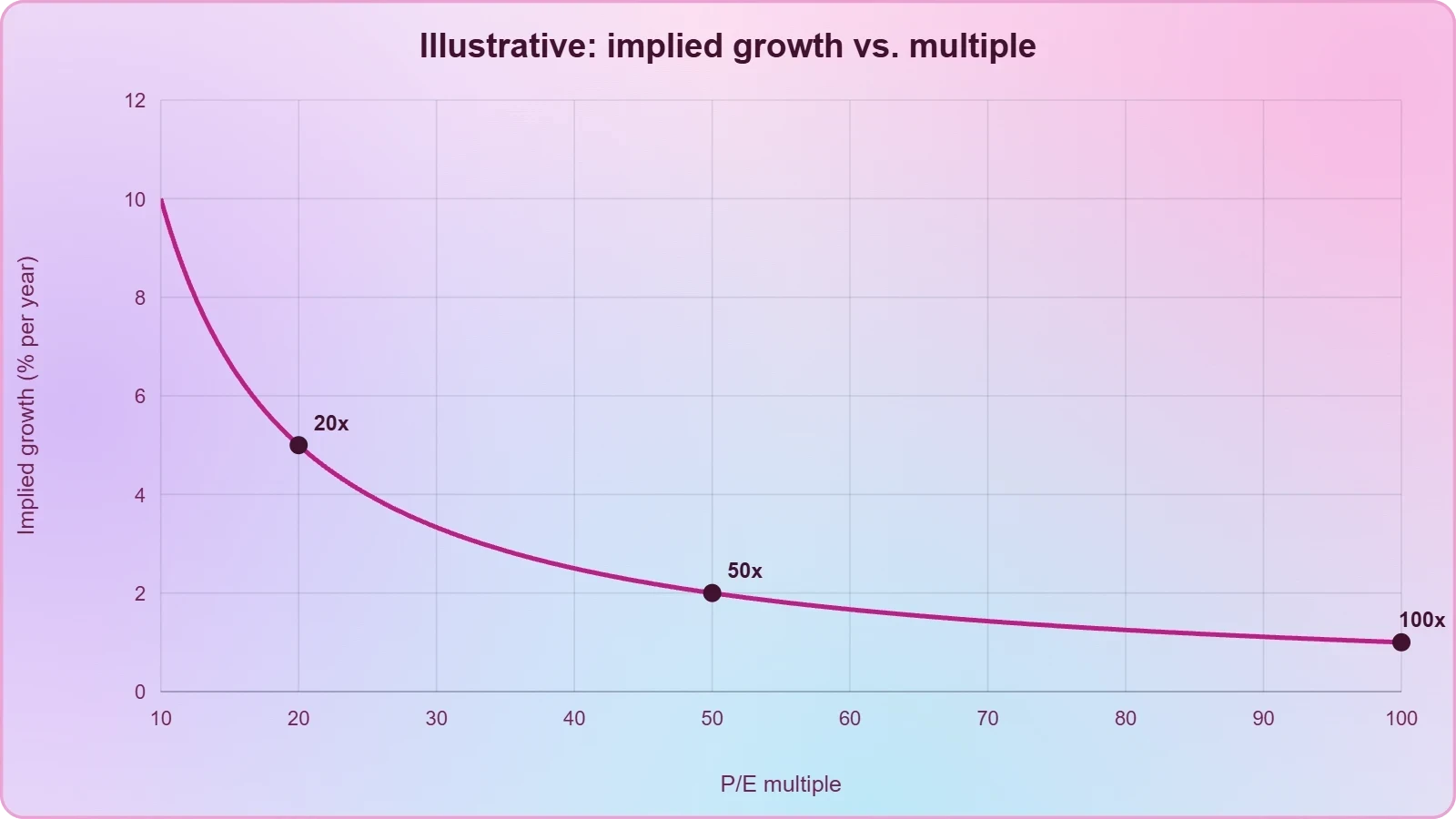
This is why valuation concerns persist even when quarterly numbers look healthy. The concern is not about the present but about the arithmetic of the future. Investors who understand this distinction avoid the trap of treating every price decline as a verdict on management competence. They instead ask which assumption moved, by how much, and whether the new price offers a better risk-adjusted return than the old one. That discipline separates analysis from reaction.
Multiple Compression and Its Transmission Channels
When a high-multiple stock de-rates, the effect travels through several channels simultaneously. Index and fund flows adjust as position weights change, options markets reprice implied volatility, and sell-side models revise target multiples. Each channel reinforces the others, which is why valuation-driven declines can be sharper than the underlying change in fundamentals would suggest. The transmission is mechanical, not mysterious, and it explains why richly valued names often move in clusters rather than in isolation.
There is also a psychological channel worth naming. High multiples attract investors who are comfortable with uncertainty, and that cohort is sensitive to signals about narrative durability. A single disappointing session can prompt a broader reassessment of the thesis, drawing in sellers who had been waiting for an excuse to reduce exposure. The resulting cascade is a feature of concentrated ownership in momentum-driven names, and it is one reason why valuation risk is best managed before it becomes consensus rather than after.
We Also Published
Palantir's Business Model and Its Pricing Consequences
Understanding the valuation debate requires appreciating what Palantir actually sells. Its platforms, Gotham and Foundry, integrate disparate data sources into operational decision systems for defense, intelligence, and commercial clients. The work is deeply embedded, often requiring years of deployment, and switching costs are correspondingly high. That stickiness supports long-duration revenue and justifies, in principle, a premium to conventional software vendors. The tension arises because the market must decide how large that premium should be relative to a business whose growth is real but not unlimited.
Government Contracts, Commercial Expansion, and Concentration Risk
Government work provides stability and credibility but also introduces concentration and political exposure. Contract renewals, budget cycles, and procurement timelines can create lumpiness in reported results that unsettles investors accustomed to smoother software metrics. The commercial segment offers a counterweight, with faster growth potential and broader addressable market, but it also invites competition from cloud platforms and analytics vendors with their own embedded advantages. The balance between these segments shapes both the growth trajectory and the risk profile that the market must price.
Concentration risk is not merely a footnote. When a meaningful share of revenue derives from a limited set of large customers, each renewal becomes a material event, and each delay becomes a source of uncertainty. Investors who focus only on headline growth can miss this structural feature, which is precisely why valuation debates around such companies tend to be persistent rather than resolved. The market is pricing not just growth but the reliability of that growth under varying political and budgetary conditions.
The Narrative Premium in Defense and Intelligence Software
There is an intangible component to Palantir's valuation that deserves explicit acknowledgment. The company operates in domains that carry strategic significance, and that positioning attracts a narrative premium beyond what discounted cash flow models would justify. Investors are partly buying exposure to a theme, whether that theme is defense modernization, artificial intelligence adoption, or sovereign data infrastructure. Narrative premiums are real and can persist, but they are also fragile, because they depend on sentiment that can shift faster than fundamentals.
Recognizing the narrative component is not cynicism; it is analytical honesty. A stock price that embeds thematic enthusiasm will react to changes in the theme as much as to changes in the business. The November 3 decline can be read as a partial repricing of that narrative premium, triggered by results that did not reinforce it strongly enough. Investors who understand this dynamic are better positioned to distinguish temporary sentiment shifts from durable changes in the investment case.
- 01
- 02
- 03
- 04
Reading Institutional Behavior Around Earnings
Retail investors often experience earnings days as sudden, inexplicable events. Institutional investors experience them as scheduled checkpoints in an ongoing process of position management. Large holders build models, set target weights, and adjust exposure as new information arrives. When a stock like Palantir reports, the relevant question for a fund manager is not whether the quarter was good but whether the position still earns its place in the portfolio at the current price. That framing explains why selling can occur alongside objectively solid results.
Position Sizing, Risk Budgets, and the Discipline of Selling
Portfolio construction imposes constraints that individual investors sometimes overlook. A fund may cap the weight of any single high-volatility name, and a price appreciation that pushes a position above its cap triggers mechanical trimming regardless of conviction. Similarly, risk budgets measured in volatility terms force reductions when implied volatility rises. These rules are not commentary on the company; they are the plumbing of professional money management. Understanding them helps explain why valuation-sensitive stocks experience selling pressure that seems disconnected from the reported fundamentals.
The discipline of selling is also a discipline of humility. Professional managers recognize that a stretched valuation transfers future returns from the buyer to the seller, and they act accordingly when the risk-reward balance deteriorates. That behavior can look like herd mentality from the outside, but it often reflects independent assessments converging on the same conclusion. When many holders reach that conclusion simultaneously, the resulting price move is sharp, and the earnings report becomes the proximate trigger rather than the underlying cause.
Options Markets and Implied Volatility Signals
Derivatives markets provide a real-time read on how much uncertainty investors are pricing around an event. Elevated implied volatility ahead of earnings indicates that participants expect a large move, and the direction of that expectation can be inferred from skew. When a high-multiple stock reports, options activity often reveals whether the market is positioned for upside surprise or downside protection. The November 3 session would have been shaped in part by these positioning dynamics, which can amplify or dampen the fundamental signal.
Implied volatility also matters after the event. A decline in implied volatility following earnings reflects the resolution of uncertainty, even if the price fell. Investors who track these signals can distinguish between a repricing driven by new information and one driven by the mechanical unwinding of hedges. That distinction is valuable because the two have different implications for subsequent price behavior, and conflating them leads to poor inferences about what the market actually believes.
Broader Lessons for Growth Equity Investors
The Palantir episode generalizes well beyond a single company. Every high-multiple growth stock carries an embedded expectation set, and every earnings report tests that set. Investors who internalize this pattern stop treating price declines as puzzles and start treating them as information about the market's implied assumptions. The useful question becomes not "why did the stock fall?" but "which assumption changed, and is the new price more or less attractive than the old one?" That reframing is the difference between reacting to markets and analyzing them.
Separating Signal from Sentiment
Sentiment and signal are entangled on earnings days, and disentangling them requires deliberate effort. Sentiment shows up in volume spikes, options skew, and the tone of commentary; signal shows up in revenue composition, retention, margin trajectory, and guidance revisions. A disciplined reader looks for divergence between the two. If sentiment deteriorates while signal remains stable, the resulting price weakness may be an opportunity. If signal deteriorates while sentiment holds, the risk is that the market has not yet caught up with reality.
This framework does not eliminate uncertainty, but it imposes structure on it. Investors can track a small set of variables that genuinely matter and ignore the noise that surrounds each reporting cycle. Over time, that discipline compounds, because it prevents the two classic errors: selling quality businesses during sentiment-driven drawdowns and holding deteriorating businesses because the narrative remains intact. The Palantir reaction is a useful case study precisely because both dynamics were plausibly in play.
Building a Valuation-Aware Watchlist
A practical response to episodes like this is to maintain a watchlist annotated with implied expectations rather than simple price targets. For each name, note the growth rate and margin profile that the current multiple requires, then track whether reported results are moving toward or away from those requirements. This practice converts valuation from an abstract debate into a concrete checklist. It also prepares investors to act decisively when a repricing creates an attractive entry point, rather than scrambling to reconstruct the thesis after the fact.
The watchlist approach has a secondary benefit: it disciplines position sizing. When the gap between price and required fundamentals is wide, position sizes should reflect that risk. When the gap narrows, the case for adding exposure strengthens. This is not a formula for guaranteed returns, but it is a coherent method for aligning conviction with evidence. The alternative, reacting to each headline in isolation, tends to produce the opposite of what long-term investors intend.
What the November 3 Session Reveals About Market Psychology
Market psychology is often treated as a soft topic, but the Palantir session shows it operating with mechanical precision. Prices are set at the margin by participants who must act, and their actions are constrained by mandates, risk limits, and the need to justify decisions to stakeholders. When a valuation is stretched, the set of participants willing to add exposure shrinks, while the set willing to reduce grows. The resulting imbalance does not require any dramatic news; it only requires a moment when the balance tips, and an earnings report provides exactly such a moment.
The Asymmetry of Disappointment in Premium Names
Premium valuations create an asymmetry that is easy to state and hard to internalize. Upside surprises produce modest gains because the good news was partly anticipated; downside surprises produce outsized losses because they challenge the premise of the premium. This asymmetry means that the expected return distribution for a richly valued stock is skewed in a way that rewards precision and punishes complacency. Investors who hold such names without acknowledging the skew are effectively accepting a bet whose odds they have not calculated.
The asymmetry also explains why valuation concerns persist across quarters even when results are adequate. Each report is an opportunity for the market to test the premium, and each test carries more downside than upside potential. Over time, this repeated testing can erode the premium even without a single catastrophic event, a process sometimes described as death by a thousand cuts. Recognizing the pattern helps investors decide whether the premium is justified by durable advantages or merely by momentum.
Why Valuation Debates Rarely Resolve Cleanly
Valuation debates resist resolution because they depend on assumptions that cannot be verified in advance. Reasonable analysts can disagree about terminal growth rates, competitive dynamics, and the appropriate discount rate, and their conclusions will differ accordingly. This is not a failure of analysis but a feature of investing under uncertainty. The practical implication is that investors should hold their conclusions with appropriate humility and update them as evidence accumulates, rather than treating any single valuation as definitive.
The persistence of the debate around Palantir reflects genuine ambiguity about the company's long-term trajectory. Its technology is differentiated, its customer relationships are deep, and its addressable market is large, but competition is intensifying and the path to sustained profitability at scale remains a subject of legitimate disagreement. The November 3 decline did not settle that debate; it simply reminded participants that the debate exists and that price is where it gets expressed.
Conclusion: Valuation Discipline in an Era of Narrative Investing
The November 3 decline in Palantir shares is best understood as a routine but revealing event in the life of a high-expectation equity. The company reported results, the market assessed them against a demanding valuation, and the price adjusted. Nothing in that sequence is unusual, yet the episode carries lessons that extend well beyond a single ticker. It demonstrates that price is a claim about the future, that claims can be tested, and that the testing process is often uncomfortable for holders who have not examined the assumptions embedded in their positions.
For investors, the practical takeaway is not to avoid premium-valued companies but to engage with them honestly. That means calculating implied expectations, tracking whether results validate them, and sizing positions in a way that acknowledges the asymmetry of outcomes. It also means resisting the temptation to interpret every price move as a verdict on management or every earnings beat as a vindication of the thesis. The market is a pricing mechanism, not a moral tribunal, and the sooner that distinction is internalized, the clearer the analysis becomes.
Palantir will continue to attract attention because its business sits at the intersection of technology, security, and geopolitics, and because its valuation invites argument. That combination ensures the debate will persist, with each quarter providing fresh material for both bulls and bears. The disciplined response is to participate in that debate with clear assumptions, documented reasoning, and a willingness to update when evidence warrants. Valuation concerns, in the end, are not obstacles to analysis; they are the substance of it.
From our network :
- The Final Descent: How ESA Retired the Legendary Cluster Constellation After 24 Years of Space Weather ScienceAfter 24 years mapping Earth’s magnetosphere, ESA’s Cluster mission concluded with a precisely controlled reentry over the South Pacific. This analysis explores the scientific legacy, engineering decisions, and debris mitigation principles behind one of space exploration’s most responsible retirements.
- Mobile Learning and VR in English: What Global Evidence Reveals About Effective Language TechnologyA systematic review across 14 countries reveals which language-learning technologies genuinely work. Mobile learning, AI, and VR show measurable benefits when pedagogically integrated. This evidence-based guide helps educators and learners select technology that delivers real return on investment.
- The Hidden Cost of AI Convenience: Why Over-Permissioned Agents Are a Security Time BombDiscover why AI agents with excessive permissions create dangerous single points of failure, and learn how implementing least privilege principles can protect your organization from exploitation.
- Committed Mediterranean Precipitation Decline: Why Emissions Cuts Alone Cannot Restore Winter RainsNew NOAA research reveals that Mediterranean winter rains may decline irreversibly even with emissions cuts. Explore the science of committed climate change and regional impacts.
- University Language Proficiency Exams: Why Institutional Tests Demand Different Preparation Than IELTS and TOEFLDiscover why university-specific language proficiency examinations differ fundamentally from IELTS and TOEFL, and learn strategic preparation approaches for institutional assessment success.
- CISA’s Ten-Advisory Wave: Why Generic Patching Fails in OT and How to Build Product-Specific PlaybooksCISA released ten ICS advisories in one week, exposing critical infrastructure risks. Generic patching fails in OT. Learn to build product-specific remediation playbooks.
- How AI Agents Will Change the Way We Manage Personal FinancesExplore how AI agents are transforming personal finance through automated budgeting, bill payment, and investment management, while examining the critical security protocols and governance frameworks required for safe deployment.
- Live Online English Classes for Kids: Do They Actually Reduce Anxiety?A ten-week study reveals that synchronous online English classes can significantly reduce child language anxiety while improving listening and reading skills. Discover what makes these programs effective and how parents can select the right one.
- Forbidden Matrix Patterns and Visible Lattice Points: A Geometric DictionaryExplore how multidimensional 0–1 matrices encode geometric truths, linking forbidden patterns to visible lattice points and hypergraph theory, with applications in combinatorics and computational geometry.
RESOURCES
- Resources will be updated soon.
- 01
- 02
- 03
- 04
- 05
- 06
- 07
- 08
0 Comments