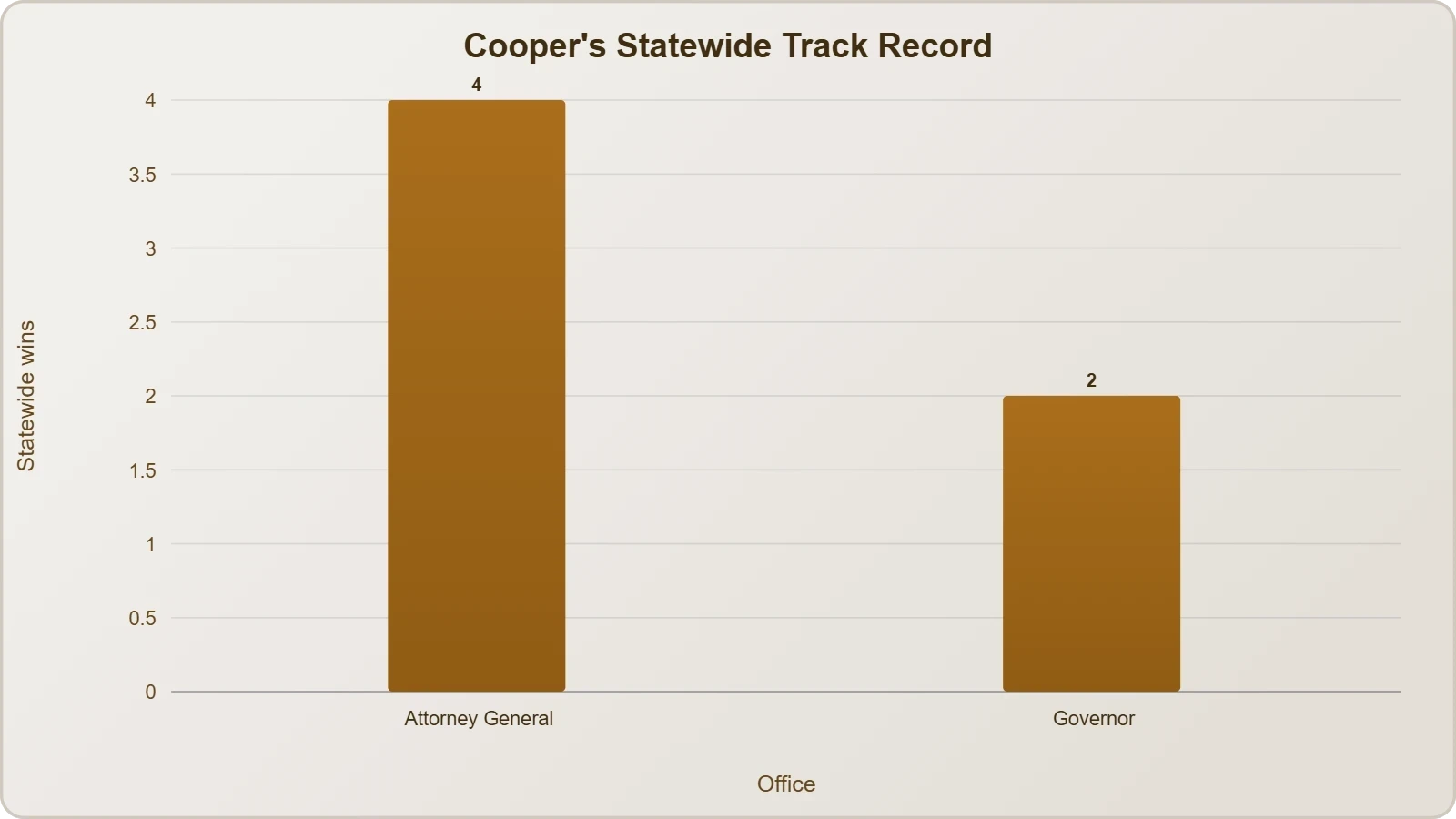
Roy Cooper's victory in the North Carolina Senate race represents one of the most instructive political stories of the 2026 cycle, not because it was surprising, but precisely because it was not. The former two-term governor and four-term attorney general converted a Republican-held seat into Democratic hands by leaning on assets that money cannot easily manufacture: near-universal name recognition, a scandal-free record, and a message disciplined enough to fit on a rally banner. As of 10 p.m. on election night, his margin stood at no less than 18 percentage points, a figure that transforms a battleground contest into something closer to a verdict.
What makes the outcome worth studying is the contrast between North Carolina's structural lean and Cooper's personal performance. The state had not sent a Democrat to the Senate or to the presidency since 2008, and it retains a slight Republican tilt in its baseline composition. Yet Cooper entered the race as a known quantity, having been thoroughly vetted across six statewide campaigns, and no personal scandal surfaced to complicate the arithmetic. Analysts credit national conditions with only part of his advantage; the remainder belongs to the candidate himself, his biography, and the consistency of his closing argument.
That argument was deliberately unglamorous. Cooper's rallies were billed as the Make Stuff Cost Less tour, and he spoke plainly about health insurance, grocery bills, and utility rates. Many Democratic candidates identified affordability as the electorate's central anxiety, but few sustained that emphasis with Cooper's discipline. Duke University professor Asher Hildebrand characterized the operation as low risk and workmanlike, using both terms as praise, and noted that voters responded to an authentic, no-nonsense competence that feels refreshingly unusual in an era of partisan flame-throwing.
On This Page
TL;DR Roy Cooper won North Carolina's U.S. Senate seat by at least 18 percentage points, flipping a Republican-held position in a state that had not elected a Democrat statewide since 2008. His victory rested on near-universal name recognition from six statewide wins, a scandal-free record, and an unusually consistent affordability message branded as the Make Stuff Cost Less tour. Analysts attribute only part of the margin to national conditions, crediting the candidate's low-key, workmanlike campaign and authentic competence for the rest.
The Anatomy of a Low-Key Victory
Cooper's campaign invites a structural reading rather than a dramatic one. He did not need to introduce himself to North Carolina voters, because six statewide victories had already done that work across two decades of public service. That single fact reshaped the campaign's economics: money that rivals spent on biographical advertising could be redirected toward persuasion and turnout. When a candidate begins with universal name recognition, the entire strategic calculus changes, and the contest becomes less about definition and more about reinforcement.
Name Recognition as Political Capital
Few American politicians can claim the kind of saturation Cooper carried into the race. Two terms as governor and four as attorney general meant that virtually every voter in the state had formed an impression of him, and most of those impressions had survived repeated electoral tests. This is a rare form of political capital because it compounds over time and cannot be purchased quickly. A challenger must spend months and millions simply to become familiar; Cooper began the race already known, already vetted, and already positioned in the public mind.
The absence of personal scandal matters just as much as the presence of recognition. Oppo research against a six-time statewide winner has already been run, litigated in public, and absorbed by the electorate. What remains is a record that voters have priced in. Hildebrand's observation that Cooper had been thoroughly vetted captures a subtle advantage: the campaign never had to spend defensive weeks extinguishing a controversy, and it never lost control of its own narrative to an unforced error.
The Make Stuff Cost Less Tour
The campaign's central conceit was almost aggressively plain. Billing rallies as the Make Stuff Cost Less tour signaled that Cooper intended to talk about household budgets rather than abstract ideology, and the phrasing itself did the work of a policy platform. Health insurance premiums, grocery receipts, and utility bills are the line items where inflation is felt most acutely, and Cooper returned to them with a consistency that rivals did not match. The message was memorable precisely because it refused to be clever.
Affordability was the consensus theme of the Democratic field, yet consensus themes reward only the candidate who owns them. Cooper's advantage lay in repetition and credibility: a governor who had actually administered a state budget could speak about costs with a specificity that legislative candidates often lack. Voters do not typically audit a candidate's fiscal fluency, but they do register whether the words sound practiced or lived. Cooper's plainspoken delivery suggested the latter, and that perception became the campaign's most valuable asset.
Reading the Margin Against the State's Lean
An 18-point margin in a state that tilts slightly Republican demands explanation beyond the national mood. Cooper led in polls from the earliest stages of the race and never relinquished that advantage, which suggests the outcome was priced in well before Election Day. When a lead is that durable, it usually reflects something structural about the candidate rather than a late swing in the electorate. The question analysts now face is how much of the result belongs to national conditions and how much to the individual on the ballot.
National Conditions Versus Candidate Strength
Hildebrand's assessment offers a calibrated answer: national conditions may have helped Cooper somewhat, but the rest of his margin reflected the strength of the candidate. That formulation matters because it resists the temptation to explain every result through the lens of the national environment. Wave elections do lift candidates, but they rarely produce 18-point gaps on their own. The residual belongs to name recognition, message discipline, and the absence of the kind of vulnerabilities that typically narrow a race in its final weeks.
This distinction has practical consequences for how both parties read the result. Democrats can point to a template for winning in competitive terrain, while Republicans must reckon with a candidate who proved unusually difficult to define negatively. The margin also complicates the assumption that North Carolina has drifted permanently out of reach for Democrats at the federal level. A single race does not reverse a trend, but it does demonstrate that the state's lean is soft enough to be overcome by a sufficiently strong candidate.
What the Polling Signal Revealed
Cooper's consistent polling lead functioned as an early warning that the race was not behaving like a typical toss-up. When a candidate leads from the outset and maintains that lead through the closing weeks, the underlying fundamentals are usually doing the work. In this case, those fundamentals included near-universal familiarity and a message that aligned with the electorate's dominant concern. The polls were not predicting a surprise; they were confirming a structural advantage that never eroded.
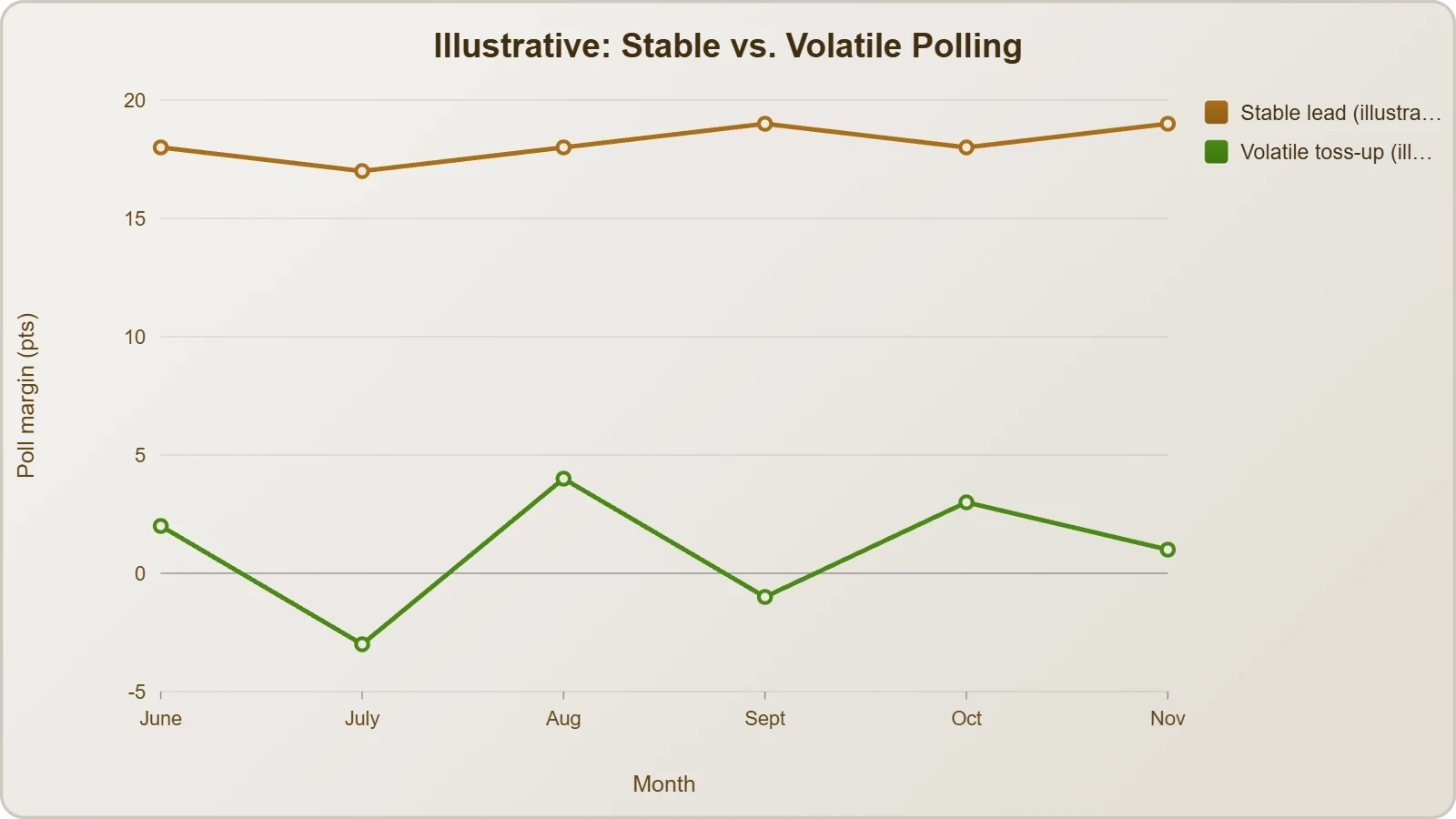
For campaign analysts, the more interesting signal is the stability itself. Volatile polling often indicates a race in which voters are still shopping, weighing unfamiliar names and unresolved arguments. Stable polling suggests the opposite: an electorate that has already reached a judgment and is unlikely to be moved by late advertising or debate moments. Cooper's numbers behaved like the latter, and the final margin vindicated that reading rather than overturning it.
We Also Published
Affordability as the Decisive Language
The most transferable lesson from Cooper's campaign concerns message selection rather than mechanics. Affordability was not a novel theme in 2026; it was the consensus concern of the Democratic field and, by most accounts, of the electorate itself. What distinguished Cooper was the refusal to dilute it. Every rally carried the same banner, every appearance returned to the same household line items, and the candidate never allowed himself to be pulled into arguments that did not connect back to cost. That kind of discipline is harder to sustain than it sounds.
Plain Speech in an Era of Flame-Throwing
Hildebrand's description of Cooper's appeal as authentic, no-nonsense competence, refreshingly unusual in an era of partisan flame-throwing, identifies a genuine gap in the political market. Voters are saturated with outrage and increasingly fluent in its rhythms, which makes plain speech register as a form of differentiation. Cooper did not need to promise transformation; he needed to sound like someone who would read the budget and understand the utility bill. That register traveled further than any ideological appeal could have in a state with a slight Republican tilt.
The phrase workmanlike, offered as praise, captures the aesthetic precisely. Cooper's campaign was not designed to generate viral moments or cultural commentary; it was designed to accumulate confidence. In a media environment that rewards escalation, a candidate who declines to escalate can appear either dull or trustworthy, and the outcome here suggests voters chose the latter reading. The lesson is not that low-key campaigns always win, but that low-key campaigns can win when the candidate's biography already supplies the drama.
Why Consistency Beats Volume
Advertising volume and message consistency are different currencies, and Cooper's campaign demonstrated the exchange rate. A candidate who says five things loudly may be remembered for none of them, while a candidate who says one thing repeatedly becomes associated with it by default. The Make Stuff Cost Less framing worked because it was concrete enough to survive repetition without becoming tiresome. Grocery costs and utility rates do not require explanation, and that simplicity allowed the message to travel through paid, earned, and organic channels without losing its shape.
Consistency also protects against the erosion that late-campaign attacks can cause. When a message is anchored in lived experience rather than policy abstraction, attacks on it tend to sound like attacks on the voter's own household budget. Cooper's opponents faced the unenviable task of arguing that costs were not, in fact, a problem worth addressing. That is a difficult position to hold in any economic climate, and it became more difficult as the campaign wore on and the message hardened into a kind of common sense.
- 01
- 02
- 03
- 04
The Vetting Dividend and the Scandal-Free Record
There is a quiet arithmetic to political vetting that rarely receives attention until it fails. A candidate who has survived six statewide elections has already had their finances, professional history, and personal conduct examined by opponents with every incentive to find something damaging. Cooper entered the Senate race with that examination behind him, which meant the campaign's final months could be spent on persuasion rather than containment. The absence of a late-breaking scandal is not luck in this framing; it is the predictable result of a record that had already been stress-tested.
Why Six Statewide Wins Matter
Each statewide victory functions as a public audit. Voters learn the candidate's biography, opponents learn the candidate's vulnerabilities, and the press learns where the documentary record is thin. By the time Cooper ran for Senate, the marginal information available to a new opponent was small, and the marginal damage that information could inflict was smaller still. This is the compounding advantage of long tenure in elected office, and it explains why experienced statewide officials often outperform fresher candidates in races where definitional attacks are the primary weapon.
The record also supplied a governing narrative that a first-time candidate could not have matched. Two terms as governor meant Cooper could speak about administering a state, negotiating with a legislature, and managing a budget during disruption. Those credentials are not merely biographical decoration; they answer the implicit voter question of whether the candidate can do the job. In a race where affordability dominated, the ability to claim executive experience with state finances gave Cooper's message an evidentiary foundation that rhetoric alone could not provide.
The Cost of an Untested Candidate
The inverse case is instructive. Candidates without a long statewide record must spend precious weeks and dollars constructing a public identity while simultaneously defending it, and every new revelation carries disproportionate weight because no baseline of familiarity exists to absorb it. Cooper's campaign never faced that double burden. The resources that would have gone into introduction and damage control were available for turnout and persuasion, which in a competitive state can be the difference between a comfortable win and a narrow one.
This dynamic also shaped how the race was covered. Journalists gravitate toward novelty and conflict, and a candidate with no fresh scandal offers little of either. Cooper's coverage therefore tended toward the substance of his message rather than the drama of his candidacy, which reinforced the workmanlike image his campaign was cultivating. The media environment and the campaign strategy aligned, and that alignment is itself a strategic achievement that few operations manage to produce deliberately.
What the Result Signals for 2028 and Beyond
A single Senate race cannot rewrite a state's political identity, but it can revise the assumptions that strategists carry into the next cycle. North Carolina's slight Republican lean remains real, and the 2008 benchmark still marks the last time Democrats won a Senate or presidential contest there. Yet an 18-point margin is not a fluke of turnout; it is a demonstration that the state's baseline can be overcome when the candidate fits the moment. Both parties will now argue about which lesson to draw, and the argument will shape recruitment decisions for years.
Recruitment Lessons for Both Parties
For Democrats, the Cooper template argues for candidates with deep statewide roots, tested records, and the discipline to campaign on household economics rather than cultural flashpoints. That is a demanding profile, and it is not easily replicated in states where no equivalent figure exists. For Republicans, the lesson is more uncomfortable: a well-known, scandal-free incumbent-style Democrat can outperform the state's partisan lean by a margin large enough to render national headwinds irrelevant. The response will likely involve earlier opposition research and a sharper affordability counter-message.
The recruitment implications extend beyond North Carolina. States with similar profiles, where one party holds a structural edge but the other possesses a deep bench of statewide officials, will be scrutinized for comparable opportunities. Cooper's victory suggests that candidate quality remains a variable worth investing in, even in an era when national polarization is assumed to determine most outcomes. That conclusion is not novel, but it is newly evidenced, and evidence tends to travel faster through party committees than theory does.
Reading the 2026 Cycle Through One Race
The broader 2026 environment will be interpreted through results like this one, and the interpretation will matter more than the raw numbers. If Cooper's margin reflects a national swing, it signals Democratic momentum heading into 2028. If it reflects candidate strength, it signals that the map remains competitive on a seat-by-seat basis. Hildebrand's calibrated reading, crediting national conditions with some help and the candidate with the rest, is likely to become the consensus view precisely because it accommodates both interpretations without resolving them.
What can be said with confidence is that the race rewarded a specific set of political virtues: familiarity earned over time, a record that survived scrutiny, and a message simple enough to be repeated without decay. Those virtues are unglamorous, and they do not generate the kind of coverage that modern campaigns often chase. But they produced an 18-point margin in a state that had not elected a Democrat to the Senate since 2008, and that outcome will be studied by strategists in both parties long after the cycle's noise has faded.
Conclusion: The Case for Unglamorous Politics
Roy Cooper's Senate victory will be remembered less for its drama than for its absence. A candidate with near-universal recognition, a record that had already survived six statewide audits, and a message simple enough to fit on a banner won by at least 18 points in a state that had not elected a Democrat to the Senate since 2008. The result is a reminder that political outcomes are shaped by accumulated advantages as much as by sudden shifts, and that the most durable campaigns are often the ones that resist the temptation to be interesting.
For strategists, the transferable insight is that affordability, delivered with consistency and credibility, remains a powerful organizing principle in competitive terrain. For voters, the lesson may be simpler: a candidate who speaks plainly about grocery bills and utility rates, and who has already been tested by the electorate, can overcome a structural disadvantage that many analysts considered fixed. Whether that lesson survives the next cycle is an open question, but the margin in North Carolina gives it considerable weight.
From our network :
- CISA’s Ten-Advisory Wave: Why Generic Patching Fails in OT and How to Build Product-Specific PlaybooksCISA released ten ICS advisories in one week, exposing critical infrastructure risks. Generic patching fails in OT. Learn to build product-specific remediation playbooks.
- Forbidden Matrix Patterns and Visible Lattice Points: A Geometric DictionaryExplore how multidimensional 0–1 matrices encode geometric truths, linking forbidden patterns to visible lattice points and hypergraph theory, with applications in combinatorics and computational geometry.
- Mobile Learning and VR in English: What Global Evidence Reveals About Effective Language TechnologyA systematic review across 14 countries reveals which language-learning technologies genuinely work. Mobile learning, AI, and VR show measurable benefits when pedagogically integrated. This evidence-based guide helps educators and learners select technology that delivers real return on investment.
- How AI Agents Will Change the Way We Manage Personal FinancesExplore how AI agents are transforming personal finance through automated budgeting, bill payment, and investment management, while examining the critical security protocols and governance frameworks required for safe deployment.
- The Final Descent: How ESA Retired the Legendary Cluster Constellation After 24 Years of Space Weather ScienceAfter 24 years mapping Earth’s magnetosphere, ESA’s Cluster mission concluded with a precisely controlled reentry over the South Pacific. This analysis explores the scientific legacy, engineering decisions, and debris mitigation principles behind one of space exploration’s most responsible retirements.
- Live Online English Classes for Kids: Do They Actually Reduce Anxiety?A ten-week study reveals that synchronous online English classes can significantly reduce child language anxiety while improving listening and reading skills. Discover what makes these programs effective and how parents can select the right one.
- The Hidden Cost of AI Convenience: Why Over-Permissioned Agents Are a Security Time BombDiscover why AI agents with excessive permissions create dangerous single points of failure, and learn how implementing least privilege principles can protect your organization from exploitation.
- Committed Mediterranean Precipitation Decline: Why Emissions Cuts Alone Cannot Restore Winter RainsNew NOAA research reveals that Mediterranean winter rains may decline irreversibly even with emissions cuts. Explore the science of committed climate change and regional impacts.
- University Language Proficiency Exams: Why Institutional Tests Demand Different Preparation Than IELTS and TOEFLDiscover why university-specific language proficiency examinations differ fundamentally from IELTS and TOEFL, and learn strategic preparation approaches for institutional assessment success.
RESOURCES
- Democrat Roy Cooper wins a North Carolina Senate seat - NPRnpr.org4 hours ago ... Democrat Roy Cooper has won North Carolina's open U.S. Senate seat, according to a race call from the Associated Press,…
- Live Results: Roy Cooper wins Senate race in North Carolina - PBSpbs.org20 hours ago ... Voters in North Carolina cast 2,726,325 early in-person and 93,597 mail-in ballots before Election Day 2026. 0 200K 400K ...
- North Carolina U.S. Senate Election 2026 Live Results - NBC Newsnbcnews.com3 hours ago ... Roy Cooper for the seat opened up by GOP Sen. Thom Tillis' retirement. Democrats haven't won a Senate race since…
- PBS News: News, Analysis, Top Headlines, Live Coveragepbs.org2026 US midterm elections. Vote 2026 8 mins ago. Live Updates: Democrat Roy Cooper flips key Senate seat in North Carolina · Follow all…
- Elon Poll: Cooper continues to lead in North Carolina U.S. Senate raceelon.eduAug 12, 2026 ... As North Carolina gears up for the 2026 midterm elections in November, a new Elon University Poll finds former Democratic…
- Roy Cooper Leads Michael Whatley by Five in North Carolinaquantusinsights.orgSep 23, 2026 ... ... Carolina survey, placing the Democrat ahead in a competitive Senate race 41 days before Election Day. (See presentation and…
- Cooper Leads Whatley in North Carolina Senate Race - ActiVoteactivote.netOct 20, 2026 ... ActiVote's October 20, 2026 North Carolina U.S. Senate poll finds that Democrat Roy Cooper leads Republican Michael Whatley by 13.8%.
- Cooper flips Senate seat in North Carolina as Democrats win ... - OPBopb.org4 hours ago ... North Carolina Democratic Senate candidate Roy Cooper speaks to supporters in Raleigh, N.C., on Election Day, Tuesday, Nov. 3, 2026.
- North Carolina's Senate race no longer a toss-up, top forecasters ...ncnewsline.comJun 11, 2026 ... ... 2026 rally in Durham. (Photo: Brandon ... Roy Cooper is now considered the favorite by top election forecasters to…
- NC's 2026 US Senate race could be the most expensive in history ...wunc.orgAug 4, 2025 ... Democrat Roy Cooper won North Carolina's open U.S. Senate seat Tuesday, according to a race call from The Associated Press.…
- Roy Cooper wins North Carolina's US Senate race | wcnc.comwcnc.comOct 15, 2026 ... ... North Carolina for the 2026 midterm election? Michael Whatley ... WCNC Charlotte will have live election results, updates and…
- United States Senate election in North Carolina, 2026 - Ballotpediaballotpedia.orgRoy Cooper (D) defeated Michael Whatley (R) in North Carolina's U.S. Senate election on November 3, 2026.
- Democrats pull back some North Carolina Senate spending after ...politico.comOct 5, 2026 ... The Democratic cut, which is much smaller than the decision by Republicans' Senate Leadership Fund, comes as Democrat Roy Cooper…
- North Carolina 2026 Poll: Cooper Starts US Senate Race with Six ...emersoncollegepolling.comAug 1, 2025 ... The first Emerson College Polling survey of the 2026 U.S. Senate race in North Carolina finds former Governor Roy Cooper…
- The Senate: The Race for the Majority is Not a Toss-up, But the ...centerforpolitics.orgJun 11, 2026 ... Roy Cooper (D) has the upper hand. ... However, our thinking in holding the race as a Toss-up was that…
- 01
- 02
- 03
- 04
- 05
- 06
- 07
- 08
0 Comments