A consumer advocacy organization in South Korea has formally accused Tesla of misleading buyers about the real-world capabilities of its automated-driving technology, according to reporting by Reuters. The allegation, filed in late 2026, centers on how the American automaker marketed its driver-assistance features to Korean customers, and whether that marketing created an inaccurate impression of what the systems can actually do. While the original report did not disclose the precise legal claims or Tesla's formal response, the complaint lands within a much larger global conversation about truthfulness in automotive marketing.
The dispute matters far beyond a single company or a single national market. Automated-driving systems sit at the intersection of engineering, consumer protection law, and public safety, and the language used to sell them carries genuine consequences. When a manufacturer describes a feature as "full self-driving" while its legal terms quietly require a human to remain attentive, the gap between promise and reality becomes a regulatory question rather than a marketing quibble. South Korea's consumer group is effectively testing whether that gap crosses the line into deception.
This analysis examines the substance of the accusation, the regulatory environment surrounding automated driving in South Korea, and the broader pattern of scrutiny facing Tesla and its peers worldwide. It also considers what the complaint signals about the future of vehicle marketing, the responsibilities of consumer watchdogs, and the practical risks that ambiguous terminology poses to drivers who trust what they read on a showroom floor.
On This Page
TL;DR A South Korean consumer group has accused Tesla of misleading buyers about its automated-driving technology, arguing that marketing language overstated what the systems can genuinely do. The complaint reflects a widening global pattern of regulatory and consumer scrutiny over how automakers describe driver-assistance features, and it raises fundamental questions about the boundary between aspirational branding and deceptive advertising. The outcome could influence how automated-driving capabilities are marketed across Asia and beyond.
The Substance of the South Korean Allegation
The core of the accusation is straightforward: a consumer advocacy body believes Tesla's promotional materials and sales conversations gave Korean buyers a distorted picture of its driver-assistance systems. The group's contention is not that the technology fails to function, but that the way it was described inflated buyer expectations beyond what the hardware and software can lawfully and safely deliver. That distinction between malfunction and misrepresentation is central to how consumer protection cases are typically framed.
Reuters reported the allegation without detailing the specific claims or Tesla's reply, which is common in early-stage consumer complaints. What remains clear is that the group is invoking the principle that advertising must not create a false impression, even when individual statements are technically defensible. Korean consumer law, like its counterparts in Europe and North America, tends to assess the overall impression conveyed rather than parsing each phrase in isolation.
Why Terminology Becomes a Legal Battleground
Automated-driving vocabulary is notoriously slippery. Terms such as "autopilot," "full self-driving," and "driver assistance" carry different technical meanings under the SAE International autonomy scale, which ranges from Level 0 to Level 5. Tesla's flagship consumer feature is branded "Full Self-Driving," yet the vehicle remains a Level 2 system requiring an attentive human driver. That branding gap is precisely the kind of ambiguity consumer groups argue can mislead ordinary buyers who lack engineering backgrounds.
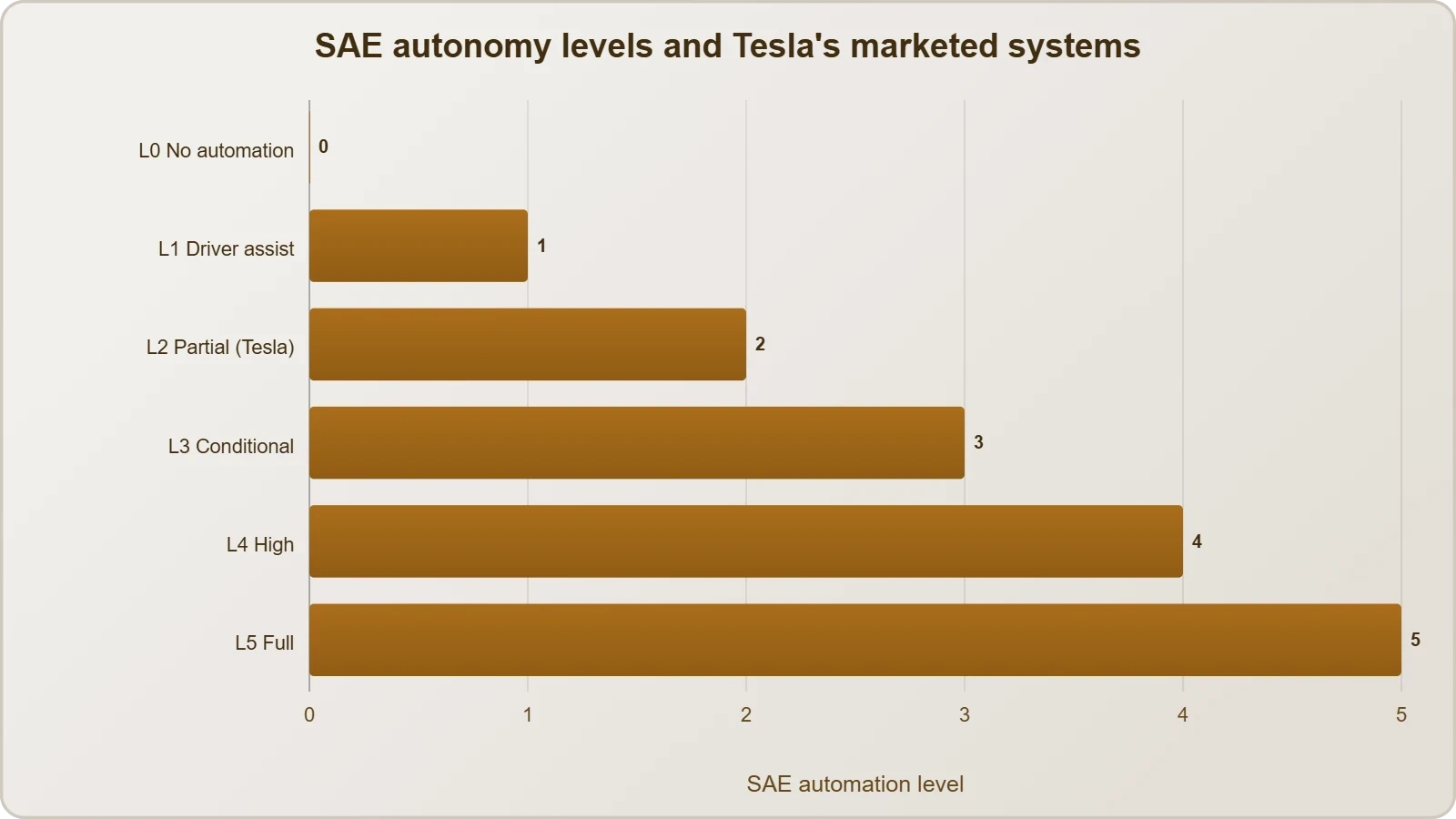
The legal question turns on reasonable consumer interpretation. Regulators increasingly ask whether a reasonable buyer, exposed to the totality of the marketing, would understand the system's limitations. When a name implies autonomy that the owner's manual contradicts, the burden shifts to the manufacturer to prove its messaging was clear. This is why naming conventions, not just technical specifications, have become a recurring flashpoint in enforcement actions worldwide.
The Korean Consumer Protection Framework
South Korea has developed an increasingly assertive consumer protection apparatus, with the Korea Consumer Agency and the Fair Trade Commission playing prominent roles in scrutinizing advertising claims. Korean law empowers consumer organizations to file collective complaints and, in some cases, pursue redress on behalf of affected buyers. The country's tech-savvy population and dense urban driving environment make it a particularly sensitive market for autonomous feature claims.
Korean regulators have also shown willingness to coordinate with international counterparts on automotive safety and advertising standards. That posture means a complaint filed in Seoul can reverberate through global compliance departments, prompting manufacturers to revisit localized marketing materials. For Tesla, which operates a significant presence in the Korean market, the allegation arrives at a moment when regulatory attention to driver-assistance claims is intensifying across multiple jurisdictions.
Tesla's Global Record on Driver-Assistance Claims
The South Korean complaint does not exist in isolation. Tesla has faced regulatory inquiries and litigation in the United States, Europe, and Asia over how it describes Autopilot and Full Self-Driving. American authorities have examined whether the company's marketing overstated capabilities, while European regulators have pushed for clearer labeling. The recurring theme is a perceived mismatch between the aspirational names of the features and the cautious language buried in owner manuals and terms of service.
Defenders of Tesla argue that the company consistently instructs drivers to remain attentive and that the features are explicitly supervised. They contend that branding is not the same as a technical specification and that buyers are informed through multiple channels. Critics counter that a name like "Full Self-Driving" is inherently misleading regardless of disclaimers, because the dominant impression formed by consumers is shaped by the name, not the fine print.
Patterns Across Jurisdictions
Regulators in different countries have approached the issue with varying degrees of severity. California's Department of Motor Vehicles has scrutinized Tesla's use of autonomy-related terminology, and German courts have examined whether promotional language crossed into prohibited claims. The common thread is a growing consensus that driver-assistance marketing must be evaluated through the lens of consumer comprehension rather than engineering precision. South Korea's complaint adds another data point to that emerging global standard.
For manufacturers, the practical implication is that localized marketing teams must align with legal and engineering departments more tightly than ever. A phrase that passes muster in one jurisdiction may trigger enforcement in another. The compliance burden is compounded by the fact that automated-driving technology evolves rapidly, meaning yesterday's accurate description may become today's overstatement as regulators refine their expectations.
Reputational and Commercial Stakes
Beyond legal exposure, the allegation carries reputational weight. Consumer trust is a fragile asset in the automotive sector, where safety perceptions directly influence purchase decisions. A public accusation of misleading marketing can erode confidence even if the company ultimately prevails in any formal proceeding. For Tesla, whose brand identity is closely tied to technological leadership, questions about the honesty of its autonomy claims strike at the heart of its market positioning.
The commercial stakes extend to the broader electric vehicle market, where competitors also offer advanced driver-assistance features. If regulators tighten standards in response to complaints like the Korean one, the entire industry may need to recalibrate its advertising vocabulary. That could mean fewer evocative names and more literal descriptions, a shift that would reshape how automated driving is sold to the public across global markets.
The Consumer Group's Role and Legal Leverage
Consumer advocacy organizations occupy a distinctive position in modern regulatory ecosystems. They lack the enforcement power of government agencies, but they can mobilize public attention, trigger formal investigations, and provide a voice for buyers who might otherwise lack the resources to challenge a multinational corporation. In South Korea, consumer groups have a track record of influencing corporate behavior through publicity and legal pressure, making their involvement a meaningful escalation.
The leverage such groups wield often comes from the reputational cost of public accusation. Even before any tribunal rules, a well-publicized complaint can prompt a company to revise its marketing, offer clarifications, or negotiate remedies. This dynamic means the Korean group's action may achieve practical results regardless of whether it ultimately prevails in a formal legal setting, a pattern observed in consumer disputes across many industries.
How Consumer Complaints Escalate
Complaints typically begin with a demand for correction or compensation, escalate to regulatory referral, and may culminate in litigation or collective redress. Each stage raises the cost for the accused company and increases public visibility. The Korean group's decision to publicize its allegation suggests it is pursuing the reputational channel deliberately, using media coverage as a complement to any formal filing. That strategy is common where legal remedies are slow or uncertain.
Tesla's response will shape how the dispute unfolds. A conciliatory approach, such as clarifying marketing language, could defuse the situation quickly. A combative stance, by contrast, risks prolonging media attention and inviting deeper regulatory interest. The company's public posture toward consumer complaints has historically been assertive, which makes the trajectory of this particular case difficult to predict with confidence.
Implications for Buyer Expectations
At the heart of the dispute is a question about what buyers reasonably expect when they purchase a vehicle advertised with autonomy-adjacent language. Consumer psychology research consistently shows that evocative names shape expectations more powerfully than technical disclaimers. A buyer who hears "Full Self-Driving" may mentally discount the caveats, especially in the excitement of a purchase. This cognitive reality is precisely why regulators focus on overall impression rather than literal accuracy.
If the Korean complaint leads to clearer labeling standards, buyers across the region could benefit from more honest communication about what their vehicles can and cannot do. That outcome would serve the underlying purpose of consumer protection law: ensuring that market transactions rest on accurate information. The case thus carries significance beyond Tesla, touching on how emerging technologies are presented to the public during their formative commercial years.
We Also Published
- 01
- 02
- 03
- 04
Technical Reality Versus Marketing Language
Understanding the dispute requires a clear-eyed look at what Tesla's systems actually do. Autopilot and Full Self-Driving are advanced driver-assistance systems, not autonomous vehicles in the Level 4 or Level 5 sense. They can perform steering, acceleration, and braking under supervision, but they require an attentive human driver ready to take control at any moment. The gap between this reality and the evocative branding is the crux of the consumer group's concern.
Engineers and safety researchers have long warned that terminology shapes driver behavior. Studies suggest that drivers using systems with autonomy-suggestive names may become less vigilant, a phenomenon sometimes called automation complacency. This behavioral dimension transforms the marketing question into a safety question, because misleading language can indirectly contribute to risky driving. Consumer groups cite this link when arguing that advertising standards must reflect real-world human psychology.
The Automation Complacency Problem
Automation complacency occurs when humans over-trust a system and reduce their monitoring attention. In driving, this can mean a driver who believes the car is handling more than it actually is. Research on supervised driving systems has documented instances of drivers disengaging from the task, sometimes with tragic consequences. The terminology used to describe a system can either reinforce vigilance or undermine it, which is why safety advocates treat naming as a substantive issue rather than a cosmetic one.
Mathematically, the risk can be framed as a function of attention decay over time. If a driver's monitoring attention ##A(t)## declines as trust in the system increases, then the probability of a timely intervention ##P_{int}## can be expressed as:
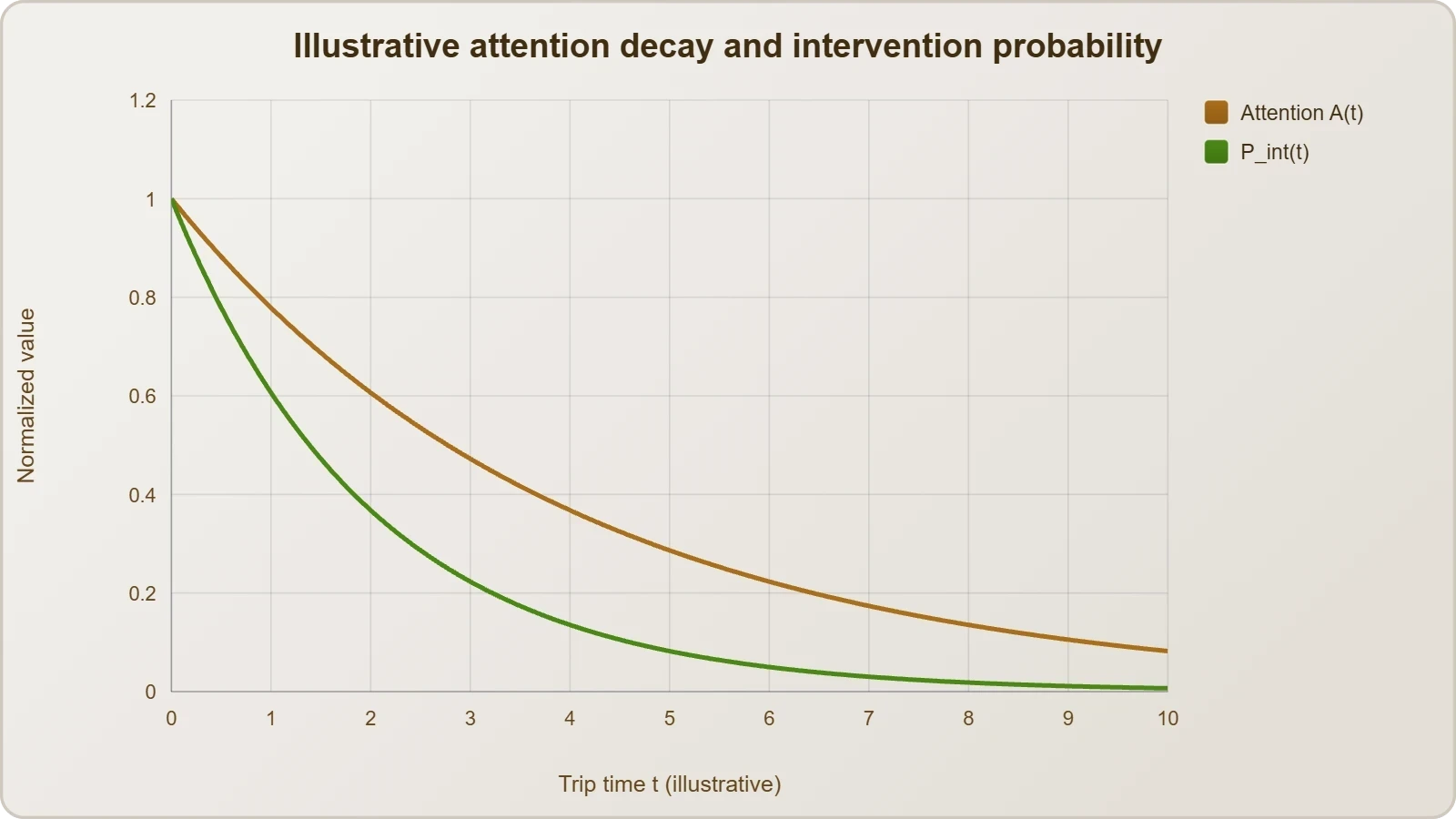
where ##R(t)## represents the reliability of the system at time ##t## and ##T## is the duration of the trip. This simplified model illustrates why marketing that inflates perceived reliability can reduce ##A(t)## and thereby lower the probability of safe human intervention. The equation is illustrative rather than definitive, but it captures the intuition that language and safety are linked through human attention.
What Buyers Are Actually Told
Tesla's owner manuals and on-screen prompts do instruct drivers to remain attentive and to keep hands on the wheel. These disclosures are legally significant because they demonstrate that the company communicates limitations. However, consumer advocates argue that disclosures buried in manuals cannot counteract the impression created by a feature name displayed prominently on the dashboard and in advertising. The question becomes one of prominence and framing rather than mere presence of information.
This tension between disclosure and impression is familiar in consumer law. Courts and regulators often hold that fine print cannot cure a misleading headline. If the dominant message suggests autonomy while the caveat whispers supervision, the overall impression may still be deceptive. The Korean complaint effectively asks regulators to apply this established principle to the fast-moving domain of automotive software, where naming conventions have outpaced regulatory vocabulary.
What the Case Means for the Industry
The Korean complaint arrives at a pivotal moment for the automotive industry. Automated-driving technology is transitioning from novelty to mainstream expectation, and the vocabulary used to sell it is still being standardized. A successful consumer challenge could accelerate the adoption of stricter labeling rules, influencing how every manufacturer describes its systems. The case therefore functions as a bellwether for the industry's regulatory future.
Manufacturers watching from the sidelines have reason to review their own marketing. If Korean regulators take the complaint seriously, other jurisdictions may follow suit, creating a patchwork of expectations that global companies must navigate. The safest strategic response is proactive clarity: describing features in literal, verifiable terms and ensuring that promotional materials align with owner manuals. Companies that move early may avoid the reputational costs of later enforcement.
Toward Clearer Standards
Industry observers increasingly favor standardized terminology anchored to the SAE autonomy scale. If every manufacturer used the same level-based descriptors, buyers could compare systems on a common footing. Such standardization would reduce the ambiguity that consumer groups find objectionable while preserving room for brand differentiation. Regulators in several markets are already exploring this approach, and the Korean case may add momentum to those efforts.
Clearer standards would also benefit manufacturers by reducing legal uncertainty. When the rules of the road for marketing are explicit, companies can design campaigns with confidence rather than guessing at enforcement boundaries. The transition may be uncomfortable for firms whose branding relies on evocative names, but the long-term result could be a more trustworthy marketplace for automated-driving technology.
The Road Ahead for Tesla in Korea
Tesla's next moves will be closely watched. The company could engage constructively with the consumer group, revise its Korean marketing materials, or contest the allegations vigorously. Each path carries different risks and rewards. Given the company's history of assertive public communication, a combative response is plausible, but the reputational calculus in a key Asian market may counsel a more conciliatory approach.
Whatever the immediate outcome, the episode underscores a durable truth about emerging technologies: public trust is earned through honest communication, not clever branding. Automated driving will only achieve widespread acceptance if buyers understand what the systems can and cannot do. The Korean consumer group's accusation, however it resolves, contributes to that necessary reckoning and may ultimately make the market more transparent for everyone involved.
From our network :
- The Final Descent: How ESA Retired the Legendary Cluster Constellation After 24 Years of Space Weather ScienceAfter 24 years mapping Earth’s magnetosphere, ESA’s Cluster mission concluded with a precisely controlled reentry over the South Pacific. This analysis explores the scientific legacy, engineering decisions, and debris mitigation principles behind one of space exploration’s most responsible retirements.
- Live Online English Classes for Kids: Do They Actually Reduce Anxiety?A ten-week study reveals that synchronous online English classes can significantly reduce child language anxiety while improving listening and reading skills. Discover what makes these programs effective and how parents can select the right one.
- CISA’s Ten-Advisory Wave: Why Generic Patching Fails in OT and How to Build Product-Specific PlaybooksCISA released ten ICS advisories in one week, exposing critical infrastructure risks. Generic patching fails in OT. Learn to build product-specific remediation playbooks.
- How AI Agents Will Change the Way We Manage Personal FinancesExplore how AI agents are transforming personal finance through automated budgeting, bill payment, and investment management, while examining the critical security protocols and governance frameworks required for safe deployment.
- The Hidden Cost of AI Convenience: Why Over-Permissioned Agents Are a Security Time BombDiscover why AI agents with excessive permissions create dangerous single points of failure, and learn how implementing least privilege principles can protect your organization from exploitation.
- Committed Mediterranean Precipitation Decline: Why Emissions Cuts Alone Cannot Restore Winter RainsNew NOAA research reveals that Mediterranean winter rains may decline irreversibly even with emissions cuts. Explore the science of committed climate change and regional impacts.
- Mobile Learning and VR in English: What Global Evidence Reveals About Effective Language TechnologyA systematic review across 14 countries reveals which language-learning technologies genuinely work. Mobile learning, AI, and VR show measurable benefits when pedagogically integrated. This evidence-based guide helps educators and learners select technology that delivers real return on investment.
- Forbidden Matrix Patterns and Visible Lattice Points: A Geometric DictionaryExplore how multidimensional 0–1 matrices encode geometric truths, linking forbidden patterns to visible lattice points and hypergraph theory, with applications in combinatorics and computational geometry.
- University Language Proficiency Exams: Why Institutional Tests Demand Different Preparation Than IELTS and TOEFLDiscover why university-specific language proficiency examinations differ fundamentally from IELTS and TOEFL, and learn strategic preparation approaches for institutional assessment success.
RESOURCES
- Tesla misled South Korean customers about automated-driving tech ...reuters.com6 hours ago ... Summary; Companies. Tesla sold Full Self-Driving software to South Korean customers who couldn't use it, complaint alleges; Consumer group ...
- Mountain Rats - Xx.com5 hours ago ... Tesla is facing a consumer complaint in South Korea over allegedly misleading customers by selling its Full Self-Driving (FSD) software…
- Tesla engaged in deceptive marketing for Autopilot and Full Self ...reddit.comDec 17, 2025 ... Tesla doesn't trust their own system to drive down a one lane tunnel built by Tesla where all other vehicles…
- Tesla created secret team to suppress thousands of driving range ...cnbc.comJul 27, 2023 ... Korean regulators required Tesla to publicly admit it had misled consumers. ... wrong with the car, he had called and…
- DMV Finds Tesla Violated California State Lawdmv.ca.govDec 16, 2025 ... ... and “Full Self-Driving Capability” to describe its vehicles' Advanced Driving Assistance Features (ADAS) is misleading and violates state law.
- Tesla Faces California Sales Halt Over Marketing of Autopilotbloomberg.comDec 17, 2025 ... ... mislead consumers about the automated-driving capabilities of its vehicles ... Both Autopilot and the system Tesla calls Full Self-Driving ...
- File a Complaint - Nevada Division of Insurancedoi.nv.govWe can help clarify your policy and address any questions regarding claims or insurance companies. We encourage all consumers facing difficulties to resolve ...
- Tesla Autopilot - Wikipediaen.wikipedia.orgTesla Autopilot/Full Self-Driving is an advanced driver-assistance system (ADAS) developed by Tesla, Inc. that provides partial vehicle automation, ...
- Consumer Complaint Against A Business/Companyoag.ca.govThe Attorney General cannot provide you with legal advice or represent you in personal legal actions. Have you contacted the company about this issue?…
- File a dealer or auto repairer complaint - CT.govportal.ct.govUsed car warranty (new car warranty/lemon law issues are handled by the Department of Consumer Protection); Deposits and billing; Repair orders, repair ...
- California Department of Insurance brings enforcement actions ...insurance.ca.govOct 3, 2025 ... and Tesla Insurance Company (Tesla Companies), plus State National Insurance Company (State National), in order to protect consumers after the ...
- Consumer Complaints (English) - PA Office of Attorney Generalattorneygeneral.govFile a consumer complaint with the PA Office of Attorney General's Bureau of Consumer Protection, online or by mail, with forms in multiple languages.
- File a Complaint with the North Carolina Department of Justicencdoj.govWe may file lawsuits if we determine a business or individual may have violated North Carolina's consumer protection laws and harmed consumers, but we…
- File a consumer complaint - Mass.govmass.govThe Attorney General's Office can help with most consumer issues. The most common consumer issues include: Defective products;; Car sales and financing;; Auto ...
- U.S. safety regulators receive over 750 complaints of Teslas braking ...cbsnews.comJun 3, 2022 ... It also asks whether the company's "Full Self Driving" and automatic emergency braking systems were active at the time of…
- 01
- 02
- 03
- 04
- 05
- 06
- 07
- 08
0 Comments