
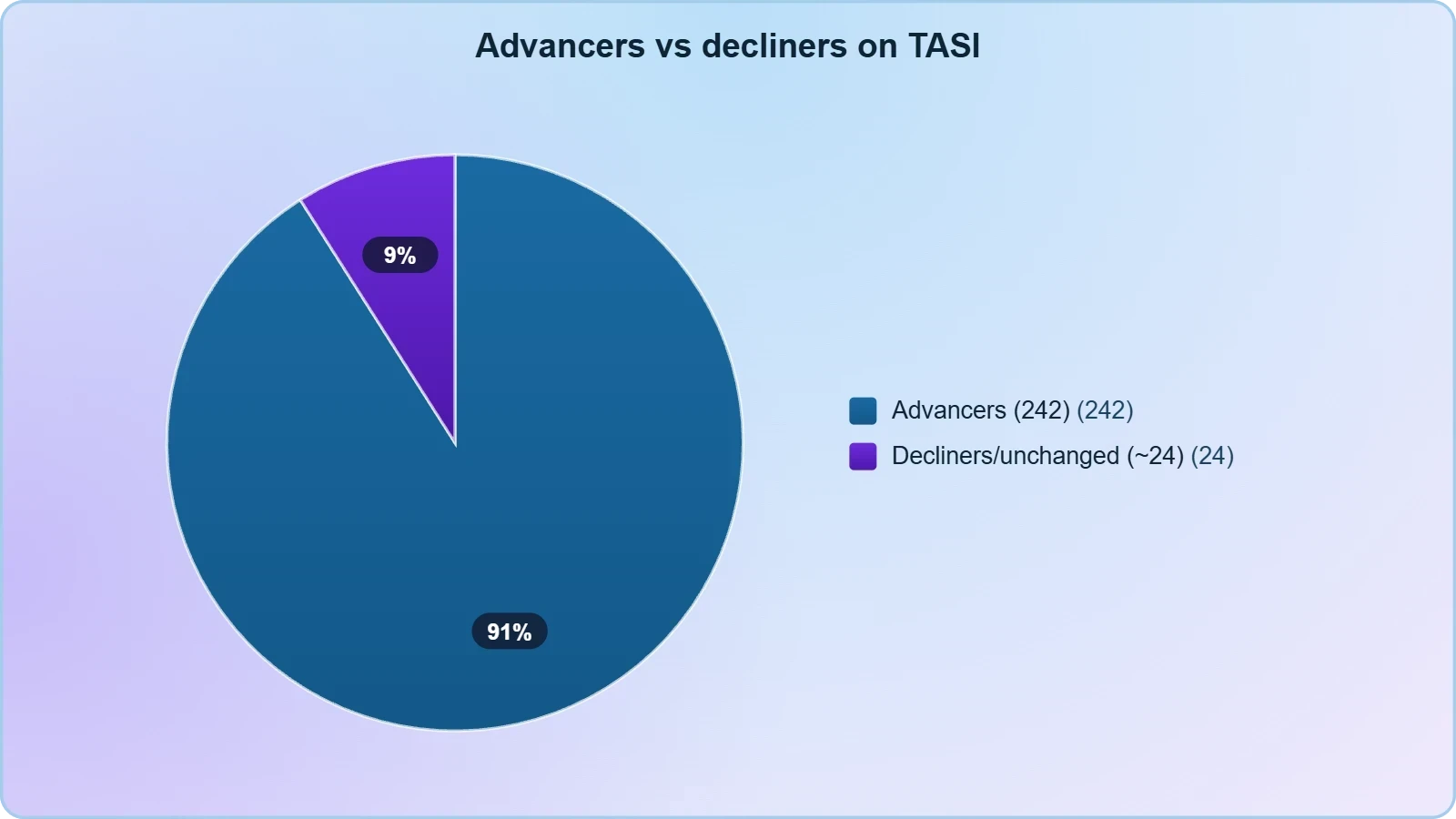
Saudi Arabia's Tadawul All Share Index crossed back above the psychologically significant 10,000 threshold on Wednesday, gaining 162.76 points, or 1.65 percent, to settle at 10,038.89. The advance was broad rather than narrow, with 242 companies closing higher against only 24 decliners, a ratio that signals genuine participation across sectors rather than a rally carried by a handful of heavyweights. Trading turnover exceeded SR4.48 billion, roughly $1.20 billion, across approximately 252.6 million shares, confirming that the move carried real conviction from institutional and retail participants alike.
The session's internal architecture deserves close attention because it reveals where capital is rotating within the Kingdom's equity market. Insurance, industrial gases, and food services led the upside, while cement, retail grocery, and real estate investment trusts lagged. That divergence matters: it suggests investors are rewarding earnings momentum and corporate catalysts rather than simply buying beta. The parallel Nomu market added 0.37 percent to 21,527.63, and the MSCI Tadawul 30 Index climbed 1.58 percent to 1,363.96, reinforcing the impression of a coordinated, index-wide re-rating rather than an isolated speculative spike.
Beyond the headline numbers, the closing bell carried a dense cluster of corporate disclosures that explain much of the day's dispersion. Petro Rabigh elevated its chief executive to the board, Amwaj International disclosed appellate court victories worth a combined SR22 million, Riyal Investment signed a five-year fleet services framework, and Sure Global Tech's payments subsidiary secured a regulatory certificate for e-commerce processing. Each announcement maps onto a distinct investment thesis, and together they illustrate how single-stock news flow shapes index-level performance in a market as concentrated as Saudi Arabia's.
On This Page
TL;DR Saudi Arabia's TASI rose 1.65 percent to close at 10,038.89, reclaiming the 10,000 level on turnover above SR4.48 billion with 242 gainers against 24 decliners. Insurance and industrial names led, while cement and REITs softened. Corporate catalysts dominated the tape: Petro Rabigh appointed its CEO to the board, Amwaj International won SR22 million in upheld appellate judgments, Riyal Investment signed a SR31.05 million framework agreement, and Sure Global Tech's SurePay unit obtained a payment services certificate. The session reflects a market rewarding earnings visibility and legal resolution over passive index exposure.
Decoding the TASI Breakout Above 10,000
Reclaiming the 10,000 mark is more than a round-number curiosity for Saudi equities; it functions as a sentiment anchor for domestic institutions and foreign allocators monitoring the Kingdom's capital market deepening. The index had been oscillating beneath that level, and a decisive close above it with expanding breadth gives technical traders a reference point for trend continuation. The 1.65 percent advance, paired with a gainer-to-decliner ratio of roughly ten to one, suggests the move was driven by accumulation rather than short covering or index rebalancing flows.
Breadth, Turnover, and What They Signal
Market breadth is the most underrated diagnostic in equity analysis, and Wednesday's session offered a textbook example of healthy participation. When 242 of roughly 266 actively traded names advance, the rally is not dependent on a single sector or a sovereign wealth fund's buying program. Turnover of SR4.48 billion against 252.6 million shares implies an average transaction value consistent with institutional block activity rather than purely speculative retail churn, which lends the move a more durable character than a low-volume drift higher would.
Volume alone, however, cannot confirm sustainability. What matters is whether follow-through occurs in the subsequent sessions and whether the advance is accompanied by improving fundamentals. The Tadawul's composition, weighted heavily toward banking, petrochemicals, and telecommunications, means index direction often tracks oil price expectations and domestic credit growth. A close above 10,000 therefore becomes meaningful only if it coincides with stable crude benchmarks and continued government capital expenditure momentum.
The Parallel and Institutional Benchmarks
The Nomu parallel market's 0.37 percent gain to 21,527.63 tells a quieter story about small and mid-cap risk appetite. With 36 stocks advancing and 26 declining, Nomu's narrower breadth relative to the main board suggests investors remain selective about smaller companies, where liquidity constraints and disclosure gaps amplify risk. Nomu serves as a feeder for eventual main-market listings, so its modest participation hints that speculative enthusiasm is measured rather than euphoric, a constructive sign for market quality.
The MSCI Tadawul 30 Index, which tracks the largest and most liquid names, rose 1.58 percent to 1,363.96, closely mirroring the headline index. This alignment is significant because it indicates that large-cap institutional favorites participated fully in the rally rather than lagging behind speculative small caps. For foreign investors benchmarking against MSCI emerging market indices, that coherence between the broad index and the institutional benchmark reduces tracking-error concerns and supports the case for continued passive inflows into Saudi equities.
We Also Published
Corporate Catalysts That Moved Individual Names
Index-level moves are ultimately the arithmetic sum of individual securities, and Wednesday's tape offered an unusually rich set of company-specific disclosures. Four announcements stood out for their materiality: a board appointment at Petro Rabigh, appellate court victories for Amwaj International, a multi-year services contract for Riyal Investment, and a regulatory certification for Sure Global Tech's payments subsidiary. Each carries different implications for earnings visibility, governance quality, and strategic positioning, and each explains why certain stocks diverged sharply from the broader market direction.
Petro Rabigh and the Governance Signal
Rabigh Refining and Petrochemical Co. appointed its President and CEO, Hassan bin Hamad Al-Yami, as an executive board member to fill a vacant seat, effective November 3 following a board resolution, subject to approval at the next general assembly. Al-Yami brings more than three decades of refining and petrochemical experience. The stock rose 1.45 percent to SR15.37. Executive board representation is often read as a governance efficiency signal, aligning management incentives with shareholder oversight, though the pending assembly approval means the arrangement remains provisional until ratified.
For a company operating in the capital-intensive refining and petrochemical complex, board composition carries real weight. Petrochemical margins are cyclical, and strategic decisions about feedstock allocation, turnaround timing, and joint venture participation require deep technical judgment at the board level. Having an operator with thirty years of sector experience in the room can accelerate decision cycles, but it also concentrates influence. Investors will watch whether the appointment improves capital allocation discipline or simply formalizes an existing management hierarchy.
Amwaj International's Appellate Wins
Amwaj International announced that two appellate court rulings upheld judgments ordering two companies to pay it a combined SR22 million. The First Appellate Circuit of the Commercial Court in Madinah upheld a SR7.59 million award against Adwaa Al Qamar Al Haditha for Home Appliances, while the Third Appellate Circuit in Jeddah upheld a SR14.4 million judgment against Baz United Trading. The company prudently noted that the rulings do not mean the amounts have been collected. Its shares rose 10 percent to SR12.10, reflecting investor relief at legal resolution.
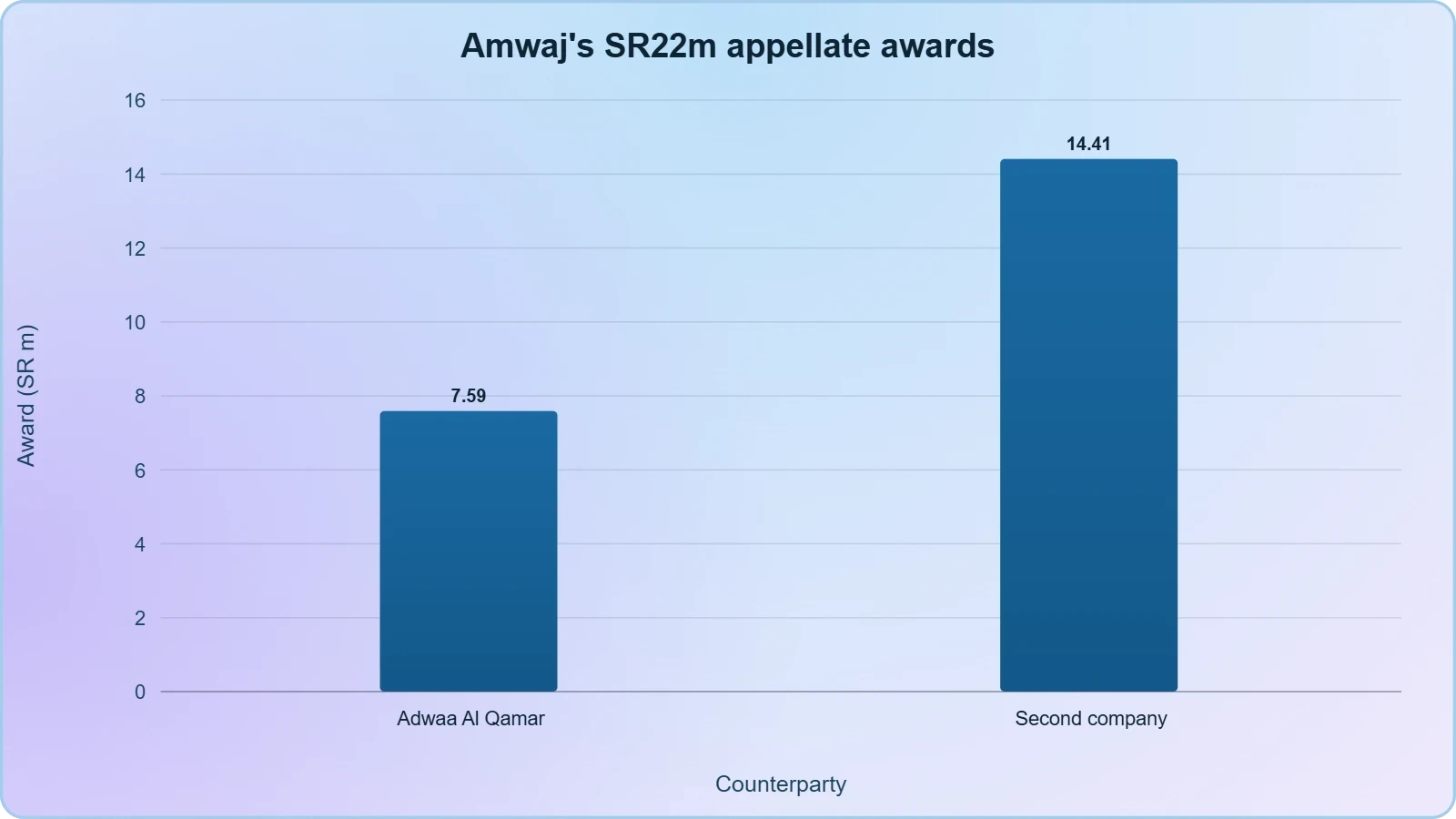
The distinction between a judgment and a collection is critical in receivables-intensive businesses. Winning an appellate ruling removes legal uncertainty but does not guarantee cash recovery, particularly when counterparties may face their own liquidity constraints. Amwaj's disclosure discipline in flagging this gap is commendable and reflects improving transparency standards on the Tadawul. The market's 10 percent re-rating suggests investors are pricing in a meaningful probability of recovery, which may prove optimistic if enforcement proceedings stretch across multiple quarters.
Riyal Investment and the Contract Economy
Riyal Investment and Development Co. signed a five-year framework agreement with MASA Services Co. for operation and maintenance worth approximately SR31.05 million including VAT. Under the arrangement, Riyal will provide vehicle leasing and rental services to MASA, with the financial impact expected to materialize over the contract period beginning January 1, 2027. The share price remained unchanged at SR11.55, a muted reaction that reflects both the deferred revenue recognition timeline and the modest scale of the contract relative to the company's overall revenue base.
Why the Market Shrugged
Framework agreements are structurally different from firm purchase orders. They establish terms and pricing but often leave actual volumes subject to call-off decisions by the counterparty. Investors have learned to discount headline contract values accordingly, particularly when the financial impact is explicitly deferred by more than a year. Riyal's flat close is therefore rational rather than dismissive: the deal adds recurring revenue visibility, but it does not alter near-term earnings forecasts enough to justify immediate repricing.
Vehicle leasing and fleet management is nonetheless a strategically attractive niche in Saudi Arabia, where corporate mobility demand is rising alongside Vision 2030 economic diversification. Long-duration service contracts create predictable cash flows that lenders and rating agencies value. If Riyal can convert this framework into additional enterprise clients, the cumulative effect on valuation could be meaningful, but the market will wait for evidence of execution before adjusting its view.
SurePay's Regulatory Milestone
Sure Global Tech announced that its 20.46 percent-owned subsidiary, SurePay, obtained a Payment Technical Service Provider certificate for e-commerce payments. The company expects the certification to support SurePay's expansion in electronic payments and create cooperation opportunities with industry partners. While the direct financial impact was not quantified, the strategic significance is clear: regulatory licensing in payments is a barrier to entry that, once cleared, opens the door to merchant acquisition and platform integration across the Kingdom's rapidly digitizing retail sector.
Saudi Arabia's fintech licensing regime, administered by the Saudi Central Bank, has become progressively more structured as the Kingdom pursues its goal of a largely cashless economy. A Payment Technical Service Provider certificate positions SurePay within that regulated perimeter, granting credibility with merchants and banks that might otherwise hesitate to integrate unlicensed processors. For Sure Global Tech, the minority stake means the earnings contribution will be modest initially, but optionality around future ownership consolidation or partnership value is real.
- 01
- 02
- 03
- 04
Reading the Laggards: Cement, Retail, and REITs
Not every stock participated in Wednesday's advance, and the laggards are as instructive as the leaders. Yanbu Cement fell 3.87 percent to SR12.90, BinDawood Holding dropped 2.33 percent to SR4.62, and Bonyan REIT Fund slipped 2.15 percent to SR57.72. These declines occurred against a backdrop of overwhelming market strength, which means the selling was company-specific or sector-driven rather than a symptom of broad risk aversion. Understanding why certain names resisted the rally helps clarify the market's underlying preferences.
Construction-Linked Demand and Cement Margins
Cement producers sit at the intersection of government infrastructure spending and private construction activity. Yanbu Cement's decline may reflect concerns about pricing pressure as regional capacity expands faster than demand, or it could signal profit-taking after a prior run. Saudi Arabia's giga-project pipeline remains substantial, but cement is a commodity business where logistics costs and utilization rates determine margins. A single-day decline does not establish a trend, yet persistent underperformance in the sector would suggest investors are questioning the pace of construction awards.
Retail grocery faces a different set of pressures. BinDawood's 2.33 percent decline comes amid intensifying competition from discount formats and e-commerce grocery platforms, both of which compress margins in a low-inflation environment. Saudi consumers are increasingly price-sensitive, and loyalty programs alone cannot offset structural cost disadvantages. The company's valuation reflects these headwinds, and until there is evidence of basket-size growth or operating leverage improvement, the stock may continue to lag a rising market.
REITs and the Rate Sensitivity Question
Bonyan REIT's 2.15 percent decline highlights the persistent sensitivity of yield-oriented instruments to interest rate expectations. REITs compete with fixed income for income-seeking capital, and when bond yields remain elevated, distribution yields must rise to stay competitive, pressuring unit prices. Saudi REITs have also faced questions about asset quality and occupancy rates in certain segments. The sector's underperformance on a strong market day suggests investors are rotating toward growth and cyclical exposure rather than defensive income vehicles.
This rotation pattern is consistent with a market that believes the domestic growth outlook is improving. When investors anticipate stronger corporate earnings, they typically favor equities with operating leverage over those with bond-like cash flow profiles. The REIT sector's fate therefore hinges on the trajectory of Saudi interest rates and the credibility of distribution guidance. If rates begin to ease, REITs could reclaim their appeal, but Wednesday's tape offered no such signal.
Macro Context: Vision 2030 and Market Deepening
Wednesday's rally cannot be understood in isolation from the broader transformation of Saudi capital markets. The Tadawul has evolved from a largely domestic retail-driven exchange into a market with meaningful foreign institutional participation, index inclusion across MSCI and FTSE benchmarks, and a growing pipeline of initial public offerings. Each of these structural changes amplifies the significance of sessions like this one, because they demonstrate to global allocators that the market can absorb positive news flow and translate it into broad-based price discovery.
Liquidity, Listings, and Foreign Participation
Turnover above SR4.48 billion is healthy but not exceptional by the standards of the market's most active sessions. That moderation is arguably constructive: it suggests the rally was driven by genuine repositioning rather than a burst of speculative excess. The Kingdom's privatization program and the listing of state-linked assets have steadily expanded the investable universe, giving portfolio managers more instruments through which to express views on Saudi growth. Deeper liquidity reduces the cost of entry and exit, which in turn attracts larger allocations.
Foreign ownership limits have been progressively relaxed, and the MSCI Tadawul 30's 1.58 percent gain reflects the performance of precisely the names that international index funds hold. When the institutional benchmark and the broad index move in lockstep, it signals that large-cap liquidity is functioning properly. That coherence is a quiet but important endorsement of the market's infrastructure, settlement efficiency, and regulatory maturity, all of which matter to allocators evaluating emerging market exposure.
Oil, Fiscal Policy, and Earnings Visibility
Saudi equities remain tethered to the oil price cycle, even as diversification efforts reduce the economy's direct dependence on hydrocarbons. Petrochemical names like Petro Rabigh are directly exposed to feedstock economics and global chemical spreads, while banks are sensitive to credit growth tied to government spending. The session's leadership in insurance and industrials suggests investors are looking beyond pure commodity beta toward domestically driven earnings streams, a rotation that aligns with the Vision 2030 emphasis on non-oil sectors.
Fiscal policy remains supportive, with giga-project spending and infrastructure investment providing a multi-year demand backdrop for construction, logistics, and financial services. The risk is execution and financing: if oil revenues soften, the government may need to prioritize spending, which could delay project awards and pressure the very sectors that led Wednesday's rally. Investors should therefore monitor budget announcements and project award data as leading indicators for the durability of current earnings expectations.
What Investors Should Watch Next
The durability of Wednesday's breakout depends on follow-through in the coming sessions and on whether corporate earnings validate the optimism embedded in prices. Three variables deserve particular attention: the trajectory of oil prices and their effect on petrochemical margins, the pace of government project awards that underpin construction and industrial demand, and the direction of interest rate expectations that shape REIT and bank valuations. Each of these factors interacts with the others, and none can be assessed in isolation from the Kingdom's broader fiscal and monetary framework.
Earnings Season and Guidance Quality
Upcoming earnings disclosures will test whether the market's re-rating is justified by fundamentals. Investors should scrutinize not just headline profit growth but the quality of that growth: recurring revenue versus one-off gains, cash conversion versus accrual accounting, and management guidance credibility. Amwaj's disclosure that appellate judgments do not equate to collected cash is a useful reminder that legal victories and accounting income are not the same thing. Companies that demonstrate disciplined disclosure tend to earn durable valuation premiums over time.
Sector-level dispersion will likely widen as earnings season progresses. Insurance names that led Wednesday's rally will need to show underwriting discipline and reserve adequacy, not merely premium growth. Industrial gas producers benefit from long-term supply contracts but face energy cost volatility. Food services companies must navigate input cost inflation and consumer spending sensitivity. The market's willingness to reward specific catalysts rather than indiscriminately buying the index suggests a more mature, fundamentals-driven investor base.
Positioning for a Higher Index Level
With the index above 10,000, portfolio construction becomes a question of balancing momentum against valuation discipline. Investors who chased the day's biggest gainers may find themselves exposed to reversal risk if the catalysts prove less material than initially interpreted. A more measured approach favors companies with visible earnings streams, conservative balance sheets, and management teams that communicate clearly. The session's breadth suggests opportunity exists across sectors, but selectivity remains essential in a market where single-stock news can move prices by double digits.
Risk management deserves equal emphasis. Concentration in any single sector or name amplifies drawdowns when sentiment shifts, and the Saudi market's correlation with oil prices means external shocks can transmit quickly. Diversification across domestically driven and export-oriented businesses, combined with attention to liquidity and free float, helps mitigate these risks. Wednesday's rally was encouraging, but it was one session, and disciplined investors will treat it as a data point rather than a conclusion.
From our network :
- Live Online English Classes for Kids: Do They Actually Reduce Anxiety?A ten-week study reveals that synchronous online English classes can significantly reduce child language anxiety while improving listening and reading skills. Discover what makes these programs effective and how parents can select the right one.
- Mobile Learning and VR in English: What Global Evidence Reveals About Effective Language TechnologyA systematic review across 14 countries reveals which language-learning technologies genuinely work. Mobile learning, AI, and VR show measurable benefits when pedagogically integrated. This evidence-based guide helps educators and learners select technology that delivers real return on investment.
- CISA’s Ten-Advisory Wave: Why Generic Patching Fails in OT and How to Build Product-Specific PlaybooksCISA released ten ICS advisories in one week, exposing critical infrastructure risks. Generic patching fails in OT. Learn to build product-specific remediation playbooks.
- The Final Descent: How ESA Retired the Legendary Cluster Constellation After 24 Years of Space Weather ScienceAfter 24 years mapping Earth’s magnetosphere, ESA’s Cluster mission concluded with a precisely controlled reentry over the South Pacific. This analysis explores the scientific legacy, engineering decisions, and debris mitigation principles behind one of space exploration’s most responsible retirements.
- The Hidden Cost of AI Convenience: Why Over-Permissioned Agents Are a Security Time BombDiscover why AI agents with excessive permissions create dangerous single points of failure, and learn how implementing least privilege principles can protect your organization from exploitation.
- Committed Mediterranean Precipitation Decline: Why Emissions Cuts Alone Cannot Restore Winter RainsNew NOAA research reveals that Mediterranean winter rains may decline irreversibly even with emissions cuts. Explore the science of committed climate change and regional impacts.
- University Language Proficiency Exams: Why Institutional Tests Demand Different Preparation Than IELTS and TOEFLDiscover why university-specific language proficiency examinations differ fundamentally from IELTS and TOEFL, and learn strategic preparation approaches for institutional assessment success.
- Forbidden Matrix Patterns and Visible Lattice Points: A Geometric DictionaryExplore how multidimensional 0–1 matrices encode geometric truths, linking forbidden patterns to visible lattice points and hypergraph theory, with applications in combinatorics and computational geometry.
- How AI Agents Will Change the Way We Manage Personal FinancesExplore how AI agents are transforming personal finance through automated budgeting, bill payment, and investment management, while examining the critical security protocols and governance frameworks required for safe deployment.
RESOURCES
- Saudi Arabia's Tadawul All Share Index increased by 37.02 points ...facebook.comOct 28, 2026 ... Closing Bell: Saudi stock market rise gaining 0.37% to close above 10,000 ... Closing Bell: TASI edges up 16.72 points,…
- Closing Bell: Saudi stock market rise gaining 0.37% to ... - Arab Newsarabnews.comOct 28, 2026 ... ... Saudi stock market rise gaining 0.37% to close above 10,000 ... Topics:Closing BellTadawul All Share Index (TASI)Saudi Stock Exchange…
- Forecasting the Daily Stock Market Volatility of the TASI Indexsama.gov.sathe volatility of the Tadawul (i.e., the Saudi stock exchange) All Share Index ... Their study used daily data from Saudi Arabia's TASI index…
- Closing Bell: Saudi main index slips to close at 9838 - Arab Newsarabnews.com4 days ago ... Topics:Closing BellTadawul All Share Index (TASI)TASI Nomustocks. R ... Closing Bell: Saudi stock market rise gaining 0.37% to close above…
- Statistical Report - Saudi Exchangesaudiexchange.saJul 29, 2018 ... At the end of July 2018 Tadawul All Share. Index (TASI) closed at 8,294.83 points, ... Tadawul All Share Index…
- TASI rises 0.4% to above 10,000 pts, total turnover at SAR 5.2Bargaam.comOct 28, 2026 ... Saudi Arabia's benchmark Tadawul All Share Index (TASI) rose 0.4 ... Petro Rabigh and Zain KSA closed more than 1%…
- Annual Statistical Report - Saudi Exchangesaudiexchange.saAt the end of the year 2020 Tadawul All Share Index (TASI) closed at a level of 8,689.53 points compared to 8,389.23 points for…
- Blink Capital Saudi Index (BCSI) Weekly Update | Week 9saudimarketmonitor.substack.com2 days ago ... ... Tadawul's (TASI) headline moves, and the occasional PIF headline. ... A smaller 0.4% rise on Wednesday took the index…
- Using Statistical Model to Study the Daily Closing Price Index in the ...onlinelibrary.wiley.comMar 22, 2021 ... *e data source is from Tadawul. KSA [12]. Figure 1 displays the data that is taken daily over 1/1/2013 to…
- Closing bell: Saudi Arabia's benchmark index edges up to close at ...arabnews.pkAug 9, 2023 ... RIYADH: Saudi Arabia's Tadawul All Share Index rose on ... Closing Bell: Saudi stock market rise gaining 0.37% to close…
- Saudi Arabia has fully opened its capital market to all categories of ...instagram.comFeb 1, 2026 ... 1. This allows all types of overseas institutions and funds to trade directly on Tadawul All Share Index (TASI), the…
- Smart Robotic Strategies and Advice for Stock Trading Using Deep ...mdpi.comDec 7, 2022 ... ... Saudi Stock Exchange (Tadawul). ... Comparison of performance of the four selected indices with that of the Tadawul All…
- TASI records lowest close since April 2021, with a 0.6% fall to below ...saudigazette.com.saFeb 27, 2023 ... Saudi Arabia's benchmark Tadawul All Share Index (TASI) closed 0.6 percent or 57 points lower at 9995 points on Monday,…
- Daily Reportaljaziracapital.com.saOct 18, 2026 ... TASI has an immediate support level around 10,000. ... AlJazira Capital is the continuation of a long success story in…
- 01
- 02
- 03
- 04
- 05
- 06
- 07
- 08
0 Comments