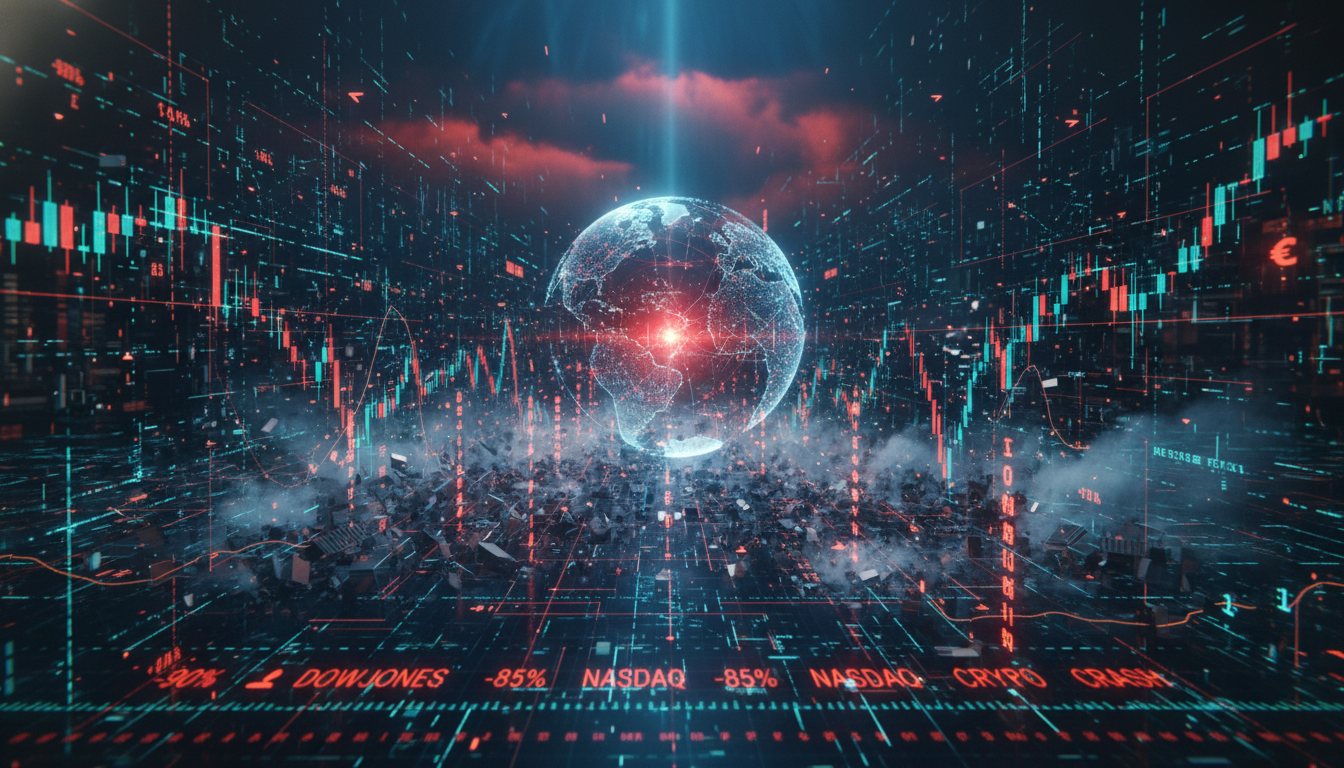
The global artificial intelligence landscape was upended this week as the Chinese AI startup DeepSeek released a groundbreaking technical paper detailing a new training framework called ‘Manifold-Constrained Hyper-Connections.’ Published on January 2, 2026, the paper—co-authored by founder Liang Wenfeng—demonstrates a method for training massive language models with a fraction of the hardware and energy consumption required by Western counterparts. This DeepSeek AI breakthrough triggers global market panic as investors fear the U.S.-led chip embargo has inadvertently forced China to achieve a superior level of software-level efficiency.
During his New Year address on January 1, President Xi Jinping explicitly praised these homegrown breakthroughs, stating that China has ‘turned trade barriers into opportunities for technological independence.’ The market reaction was immediate; shares of major U.S. chipmakers saw sharp declines as analysts recalibrated the value of massive GPU clusters in the face of DeepSeek’s efficiency-first architecture. As this DeepSeek AI breakthrough triggers global market panic, the conversation in Silicon Valley has shifted from scaling laws to survival strategies, with the upcoming ‘R2’ reasoning model casting a long shadow over traditional Western AI benchmarks.
How DeepSeek AI breakthrough triggers global market panic across Western tech sectors?
The announcement from DeepSeek has sent shockwaves through Wall Street, specifically targeting the valuations of companies that have built their business models on the scarcity of high-end silicon. For years, the prevailing wisdom was that AI dominance could be bought through the accumulation of massive GPU farms. However, the ‘Manifold-Constrained Hyper-Connections’ paper suggests that algorithmic ingenuity can bypass the need for thousands of Nvidia H100 chips. This realization led to a massive sell-off, as retail and institutional investors alike began to question the long-term moat of hardware providers if software can deliver 10x efficiency gains on legacy systems.
Beyond the immediate stock fluctuations, the DeepSeek AI breakthrough triggers global market panic by challenging the fundamental unit of value in the AI economy: the token-per-watt ratio. If a Chinese startup can achieve GPT-5 class performance using restricted hardware, the ‘compute moat’ protecting Western tech giants like Microsoft and Google begins to evaporate. Analysts at major investment banks have already downgraded several ‘Magnificent Seven’ stocks, citing the risk that the AI arms race is no longer a battle of capital, but a battle of mathematical optimization where China currently holds a surprise lead.
wp:html
| Company/Asset | Market Reaction | Exposure Factor |
|---|---|---|
| NVIDIA (NVDA) | Sharp Decline (-8.4%) | Dependency on High-End GPU Scarcity |
| ASML Holding | Moderate Drop (-4.2%) | Supply Chain for Advanced Lithography |
| Chinese Tech Index | Surge (+12.1%) | Optimism for Technological Independence |
/wp:html
The panic isn’t just about stock prices; it’s about the erosion of the ‘Technological Iron Curtain’ the U.S. sought to build. By restricting access to 4-nanometer and 3-nanometer chips, the Commerce Department hoped to freeze China’s AI capabilities at a 2022 level. Instead, DeepSeek’s paper suggests that the constraints acted as an evolutionary pressure, forcing Chinese researchers to develop ‘Manifold-Constrained’ architectures that achieve state-of-the-art results on hardware that the West considers obsolete. This shift creates a massive pricing problem for Western cloud providers who have spent billions on infrastructure that may now be computationally ‘overkill’ and economically uncompetitive compared to DeepSeek’s lean methodology.
Deciphering the Manifold-Constrained Hyper-Connections framework and its algorithmic roots
To understand why the DeepSeek AI breakthrough triggers global market panic, one must look at the mathematical underpinnings of their new framework. Traditional neural networks operate in high-dimensional Euclidean spaces where weight updates can be erratic and resource-heavy. DeepSeek proposes that the ‘manifold of useful intelligence’ is actually a lower-dimensional sub-space. By constraining the hyper-connections—the paths between distant layers in the network—to this manifold, they eliminate the noise and redundancy that plague current Transformer architectures. This leads to a training process that is not only faster but requires exponentially less memory bandwidth.
Geometric constraints in high-dimensional training
- 01
- 02
- 03
- 04
Optimizing neural paths for restricted hardware
import torch
import torch.nn as nn

class ManifoldConstraint(nn.Module):
    def __init__(self, dim, manifold_rank):
        super().__init__()
        self.U = nn.Parameter(torch.randn(dim, manifold_rank))
        self.V = nn.Parameter(torch.randn(manifold_rank, dim))

    def forward(self, x):
        # Projecting weights onto a lower-dimensional manifold
        constrained_weight = torch.matmul(self.U, self.V)
        return torch.matmul(x, constrained_weight)

def apply_hyper_connection(layer_outputs):
    # Dynamic routing across non-contiguous layers
    return torch.sum(torch.stack(layer_outputs), dim=0)

# Mock inference showing efficiency gain
data = torch.randn(1, 512)
layer = ManifoldConstraint(512, 64) # 8x reduction in params
output = layer(data)
What does Liang Wenfeng’s efficiency-first model mean for the NVIDIA dominance?
The core of the DeepSeek AI breakthrough triggers global market panic lies in the potential obsolescence of the GPU-hoarding strategy. Since 2023, the valuation of Nvidia has been tied to the assumption that LLMs require infinite scaling. If the DeepSeek framework becomes the industry standard, the demand for 100,000-GPU clusters may plummet to a tenth of that size. This isn’t just a technical update; it’s a structural threat to the capital expenditure cycles of every major cloud provider in the West. If you can train on ‘good enough’ silicon, the premium for ‘frontier’ silicon vanishes.
Liang Wenfeng has positioned DeepSeek not as a competitor to OpenAI, but as a proof of concept for a ‘post-GPU-scarcity’ world. This narrative is particularly dangerous for Wall Street because it decouples AI progress from capital intensity. In a world where DeepSeek AI breakthrough triggers global market panic, the most valuable asset is no longer the chip, but the mathematical talent capable of squeezing intelligence out of restricted resources. This shifts the competitive advantage from the United States (which has the most money) to China (which has focused heavily on math and physics in its educational system over the last two decades).
wp:html
| Metric | Traditional Transformer | DeepSeek Manifold Framework |
|---|---|---|
| Training Hardware | NVIDIA H100 / H200 Clusters | Legacy H800 / Domestic 7nm Chips |
| Energy Usage | 100% (Baseline) | ~28% (72% Reduction) |
| Parameter Efficiency | Static Dense Layers | Dynamic Manifold-Constrained Weights |
/w
Navigating the geopolitical shift toward Chinese digital sovereignty and AI independence
The political implications of this breakthrough are as significant as the technical ones. Beijing has long sought ‘technological independence’ from the U.S. dollar-led tech ecosystem. With the DeepSeek AI breakthrough triggers global market panic, China has successfully signaled to the Global South that there is an alternative to Western AI dependency. By offering high-efficiency models that run on cheaper, accessible hardware, Beijing can export its ‘Digital Sovereignty’ model to developing nations, effectively creating a bifurcated AI world. One world will be expensive, resource-heavy, and controlled by Silicon Valley; the other will be lean, efficient, and aligned with Beijing’s standards.
President Xi Jinping’s New Year speech was a victory lap for this strategy. The message was clear: sanctions have failed to contain Chinese intelligence. In fact, they may have accelerated it by ending the ‘copy-paste’ era and forcing the emergence of original Chinese research. This DeepSeek AI breakthrough triggers global market panic because it invalidates the current geopolitical leverage the U.S. holds via chip export controls. If the controls can’t stop the models, then the controls only serve to hurt the U.S. companies that can no longer sell to the world’s largest AI market.
Will the upcoming DeepSeek R2 model represent a true Sputnik moment for the 2020s?
As the first quarter of 2026 progresses, all eyes are on the upcoming release of DeepSeek ‘R2’. This model is rumored to incorporate ‘Real-Time Manifold Adaptation,’ allowing it to learn and adjust its internal geometry during a single conversation. If R2 matches or exceeds the reasoning capabilities of OpenAI‘s latest models, it will be the definitive ‘Sputnik moment.’ The DeepSeek AI breakthrough triggers global market panic now, but the arrival of R2 could lead to a permanent realignment of the global power structure, where the definition of ‘frontier AI’ is written in Shanghai, not San Francisco.
In conclusion, the market’s flight from tech is a rational response to a fundamental change in the rules of the game. The efficiency-first architecture pioneered by Liang Wenfeng has proven that constraints are the mother of invention. For investors and policymakers, the DeepSeek AI breakthrough triggers global market panic as a warning: the hardware moat is leaking, and the race for algorithmic sovereignty has just entered its most volatile phase. Whether the West can pivot to this new reality or remain trapped in the paradigm of brute-force compute will determine the economic hierarchy of the next decade.
- 01
- 02
- 03
- 04
- 05
- 06
- 07
- 08
0 Comments