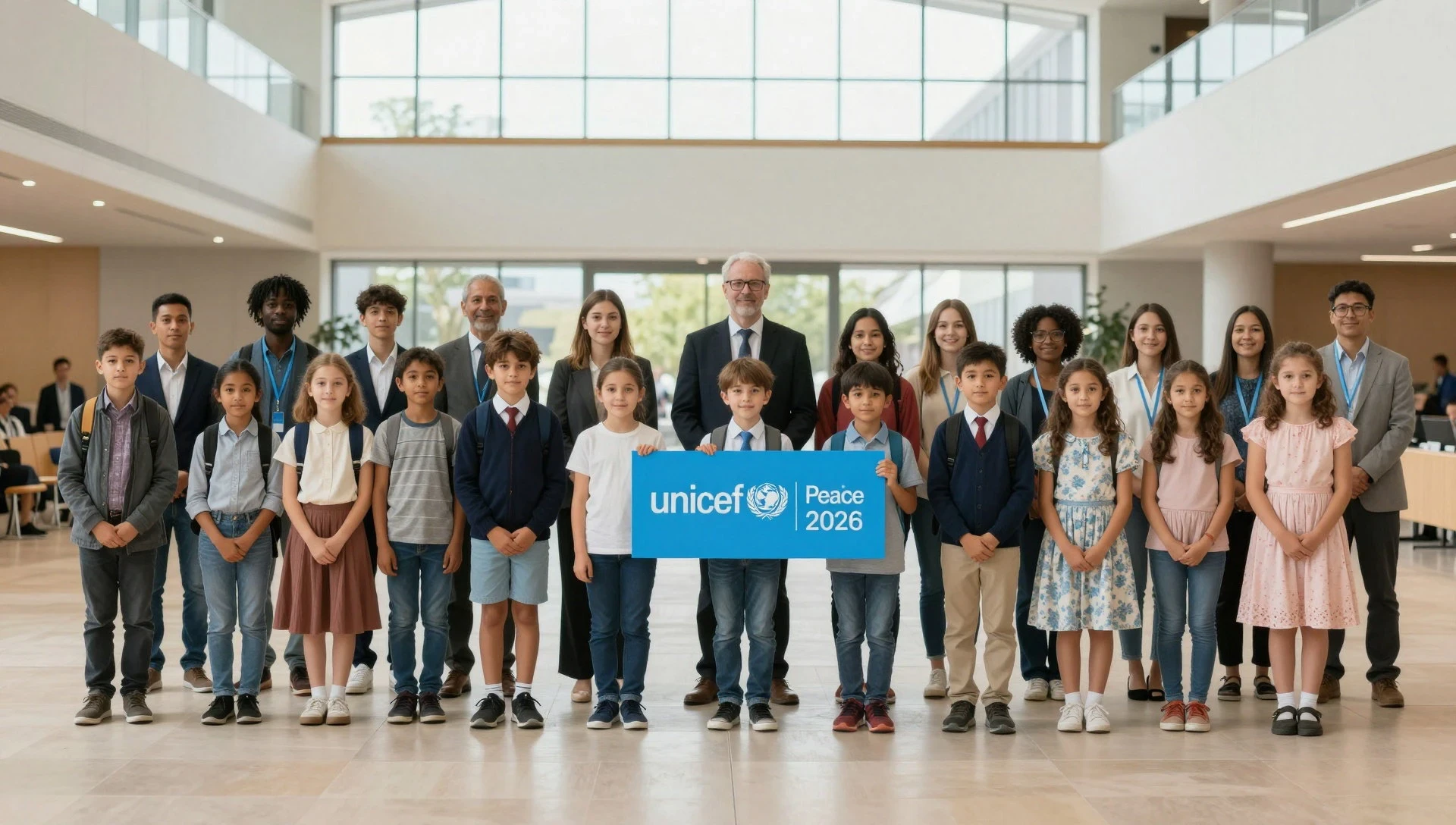
When UNICEF Executive Director Catherine Russell took the stage at the Paris Peace Forum in November 2026, she carried a message that transcended the usual diplomatic pleasantries: the well-being of children is not a peripheral humanitarian concern but the central architecture of any nation's future. More than fifty countries, alongside twenty non-governmental and philanthropic organisations and a cohort of multinational companies, gathered in the French capital to pledge that children's rights would become a foundational pillar of their policies and operational actions. The commitment, announced during a forum where children's rights commanded headline attention, signals a deliberate shift from symbolic advocacy toward binding, cross-sector accountability.
The significance of this pledge lies in its coalition. Historically, child welfare commitments have emerged from development agencies and charitable foundations operating in relative isolation. Paris 2026 broke that mould by drawing governments, civil society, and private enterprise into a single declarative framework. Russell's interview with France 24's Perspective programme underscored the moral logic behind the gathering: if children are neglected within a country's borders, the trajectory of that country becomes difficult to imagine in any hopeful terms. That formulation reframes child protection as an instrument of national resilience rather than a charitable afterthought, linking early childhood conditions directly to long-term economic and social stability.
Yet the pledge arrives against a backdrop of acute global stress. The war in Gaza, the rapid diffusion of artificial intelligence into children's daily environments, and widening inequality across the developing world all complicate the promise made in Paris. The source material does not disclose the specific mechanisms, funding envelopes, or verification procedures attached to the agreement, leaving open the question of how signatories will be held to their word. What remains clear is the political signal: a critical mass of states and corporations has publicly accepted that children's rights belong at the centre of policy design, not at its margins. The task ahead is translating that consensus into measurable outcomes.
On This Page
- The Paris Peace Forum as a Stage for Child Rights Diplomacy
- Russell's Argument: Children as the Measure of a Nation's Future
- Gaza, Artificial Intelligence, and the Pressures Shaping the Agenda
- The Accountability Gap: What the Pledge Does Not Say
- UNICEF's Institutional Role and the Multilateral Child Rights Architecture
- What Comes Next: Turning a Paris Commitment into Measurable Change
TL;DR At the Paris Peace Forum in November 2026, more than fifty countries, twenty NGOs and philanthropic bodies, and several multinational companies pledged to place children's rights at the core of their policies and actions. UNICEF Executive Director Catherine Russell framed the commitment as a matter of national survival, arguing that countries which fail their children cannot imagine a viable future. The pledge draws governments, civil society, and business into one framework, though operational details remain undisclosed. This analysis examines the coalition's composition, the moral and economic logic behind it, the pressures of Gaza and artificial intelligence, and the accountability gap that will determine whether Paris becomes a turning point or another communiqué.
The Paris Peace Forum as a Stage for Child Rights Diplomacy
The Paris Peace Forum has, since its inception, positioned itself as a convening space where multilateral ambition meets practical governance. Its November 2026 edition elevated children's rights from a thematic sidebar to the centrepiece of proceedings, a decision that reflects both the urgency of global child welfare indicators and the forum's appetite for headline commitments. Bringing governments, organisations, and businesses into a single room to announce a shared pact is a diplomatic technique the forum has refined over successive years, and the child rights pledge represents its most expansive application to date. The venue itself carries symbolic weight, placing the announcement within a tradition of French-led multilateralism.
What distinguishes this announcement from a routine declaration is the breadth of the signatory base. More than fifty countries committing simultaneously suggests coordinated diplomatic groundwork rather than spontaneous endorsement. The inclusion of twenty non-governmental and philanthropic organisations adds implementation capacity, while the participation of multinational companies introduces a private-sector dimension that child rights advocacy has historically struggled to secure. The forum's structure, which pairs plenary announcements with working sessions, likely allowed signatories to align on language before the public pledge. Further details of the agreement were not provided in the source material, a gap that leaves the enforcement architecture opaque.
The Coalition Behind the Pledge
The coalition assembled in Paris spans an unusually wide institutional spectrum. Governments bring regulatory authority and public budgets; NGOs and philanthropic organisations contribute field expertise, monitoring capability, and community trust; multinational corporations supply supply-chain influence, marketing reach, and capital. Each actor holds a different lever over children's lives, and the pledge's design appears to recognise that no single sector can address child welfare alone. UNICEF's leadership role provides a convening authority with global legitimacy, while the forum's neutrality offers a neutral table where corporate and state interests can be reconciled without the friction of bilateral negotiation. The result is a multi-stakeholder architecture that mirrors contemporary governance trends.
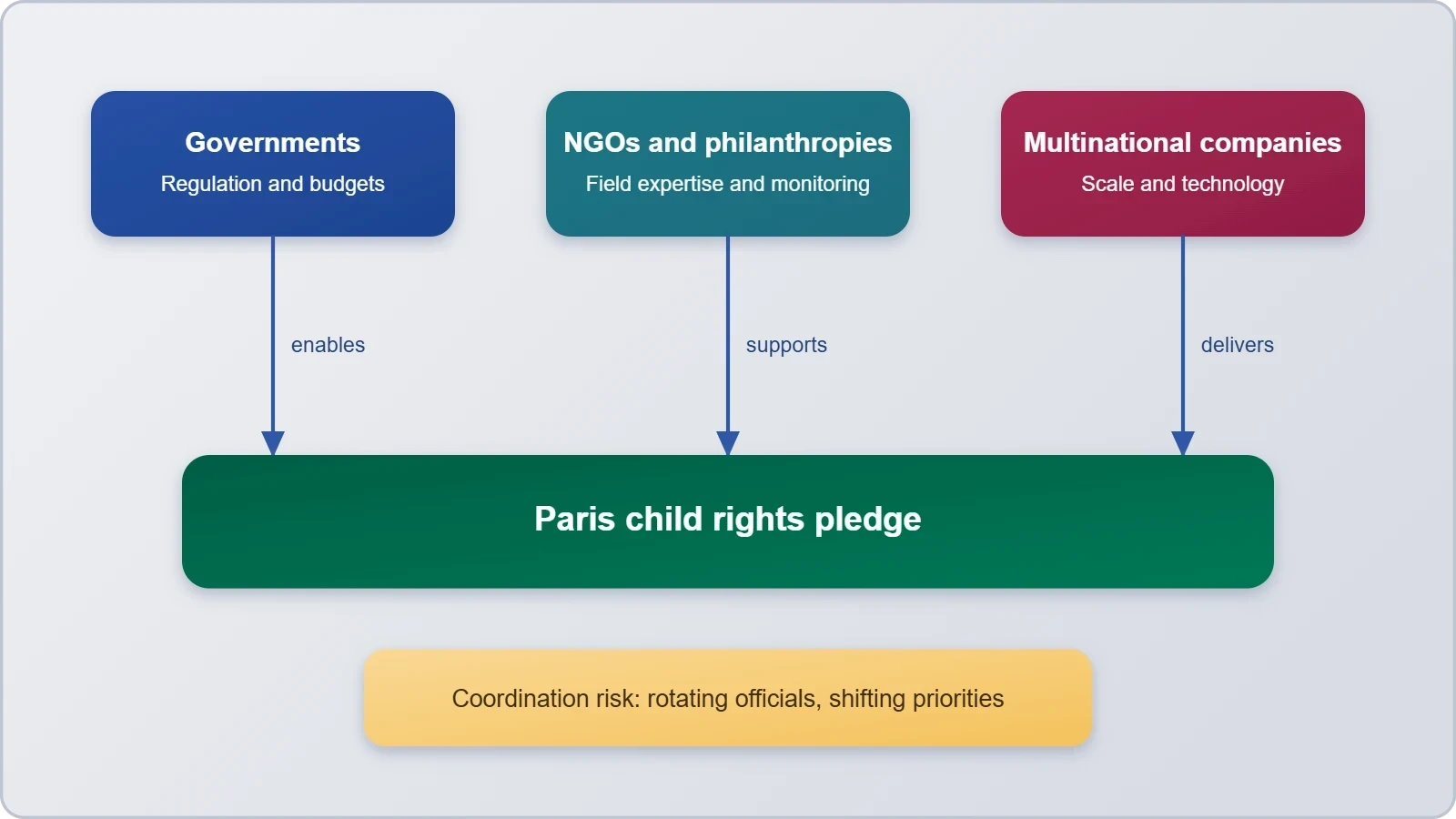
Yet coalition breadth also introduces coordination risk. Governments rotate, corporate priorities shift with quarterly earnings, and philanthropic funding cycles are notoriously volatile. The pledge's durability will depend on whether the signatories establish permanent secretariat functions, shared metrics, and periodic review mechanisms. Without such scaffolding, broad coalitions tend to dissolve into press releases. The presence of UNICEF as a lead actor offers some institutional continuity, since the agency maintains country offices and data systems that can track progress. Whether that infrastructure will be formally harnessed to the Paris pledge remains an open question that the coming months should clarify.
Russell's Argument: Children as the Measure of a Nation's Future
Catherine Russell's formulation in the France 24 interview carries a rhetorical force that deserves close reading. She argued that if children are not cared for in countries, it becomes hard to imagine what a country will look like in the future. This is not merely a humanitarian appeal; it is a claim about causality. Neglected children become adults with diminished health, education, and economic participation, which in turn erodes productivity, social cohesion, and political stability. By framing child welfare as predictive of national trajectory, Russell moves the debate from compassion to consequence, a shift that resonates with finance ministries and corporate boards alike.
The argument also carries an implicit critique of short-term governance. Electoral cycles reward visible, immediate spending, while investments in early childhood nutrition, education, and protection yield returns over decades. Russell's logic exposes this temporal mismatch: countries that discount children are effectively borrowing against their own future capacity. In an era when many nations face ageing populations and shrinking workforces, the quality of the next generation becomes a strategic asset rather than a welfare line item. That reframing gives the Paris pledge an economic rationale that can survive changes of government and corporate leadership.
From Moral Appeal to Economic Logic
Development economics has long recognised that human capital formation begins in the earliest years. Nutrition, cognitive stimulation, and protection from violence during childhood shape lifelong earnings potential, health outcomes, and civic participation. When Russell speaks of children as the determinant of a country's future, she is echoing a substantial body of evidence linking early investment to aggregate productivity. The Paris pledge, by drawing multinational companies into the framework, implicitly acknowledges that businesses depend on the human capital pipeline that childhood conditions create. Labour markets, consumer bases, and innovation ecosystems all rest on foundations laid before a child reaches school age.
The economic framing also opens avenues for financing. If child welfare is understood as infrastructure, it becomes eligible for development bank lending, sovereign wealth allocation, and corporate social investment budgets that treat it as strategic rather than charitable. Several signatory governments may use the pledge to justify reallocating budgets toward early childhood programmes, while companies could align supply-chain standards with child protection norms. The source material does not specify financing mechanisms, but the rhetorical shift from morality to economics creates the conceptual space for such instruments to emerge in subsequent negotiations.
We Also Published
Gaza, Artificial Intelligence, and the Pressures Shaping the Agenda
The Paris pledge cannot be read in isolation from the crises that frame it. The war in Gaza has produced among the most severe child protection emergencies of the decade, with displacement, malnutrition, and disrupted schooling affecting an entire generation. For signatory governments, endorsing a child rights pledge while navigating Gaza's humanitarian catastrophe creates an uncomfortable tension between principle and practice. The forum's emphasis on children's rights inevitably invites scrutiny of how the same governments respond to conflicts where children bear the heaviest cost. That tension does not invalidate the pledge, but it complicates its moral authority.
Artificial intelligence adds a second, less visible pressure. Children are now among the most intensive users of AI-driven platforms, from recommendation algorithms to conversational assistants, often without meaningful safeguards. The pledge's reference to making children's rights central to policies and actions implicitly extends to digital environments, where data protection, content moderation, and algorithmic design determine developmental outcomes. Multinational technology companies in the coalition face particular scrutiny here, since their products shape childhood experience at scale. The source material does not detail AI-specific commitments, but the keyword association suggests the forum treated digital harm as part of the child rights agenda.
Humanitarian Crisis and Digital Harm as Test Cases
Gaza functions as the pledge's most immediate stress test. Any framework claiming to centre children's rights must reckon with a conflict where schools, hospitals, and homes have been destroyed and where aid access remains contested. Signatories that endorse the Paris commitment while limiting humanitarian access face a credibility problem that advocacy organisations will exploit. The pledge's silence on specific conflicts, at least in the available material, may reflect diplomatic caution, but it also creates space for critics to argue that the agreement is aspirational rather than operational. How the coalition addresses Gaza in the coming year will signal whether the commitment carries real weight.
Digital harm presents a subtler but equally consequential test. Artificial intelligence systems now mediate children's education, entertainment, and social interaction, often through opaque algorithms optimised for engagement rather than development. The pledge's corporate signatories, particularly in technology and media, hold direct influence over these systems. If the Paris framework produces concrete standards for age-appropriate AI design, data minimisation, and transparency, it could become a reference point for regulators worldwide. If it remains silent on digital specifics, the pledge risks irrelevance to the environments where modern children actually spend their formative hours.
The Accountability Gap: What the Pledge Does Not Say
The most consequential absence in the Paris announcement is detail. The source material explicitly notes that further details of the agreement were not provided, leaving unanswered questions about funding, timelines, verification, and consequences for non-compliance. A pledge endorsed by fifty governments and a score of corporations carries rhetorical weight, but without measurable targets and independent monitoring, it risks becoming a diplomatic photograph rather than a governance instrument. History offers cautionary examples of grand multilateral declarations that dissolved upon contact with budget cycles and political transitions. The Paris framework's value will be judged by what follows the announcement.
Accountability in child rights governance is notoriously difficult because the beneficiaries cannot advocate for themselves. Children lack voting power, litigation capacity, and media access, which is precisely why pledges like Paris matter and precisely why they are easy to neglect. Effective frameworks typically rely on third-party monitoring, published indicators, and civil society pressure. The coalition's inclusion of NGOs and philanthropic organisations offers a potential monitoring base, but only if those organisations are granted access, funding, and independence. Whether the Paris signatories will accept external scrutiny or retreat into self-reporting will be the decisive test of seriousness.
Designing Verification That Works
Verification mechanisms for child rights commitments generally combine quantitative indicators, such as child mortality, school enrolment, and malnutrition rates, with qualitative assessments of policy environments and legal protections. UNICEF's country data systems provide a ready foundation, and the agency's participation suggests that measurement infrastructure could be repurposed for pledge tracking. The harder challenge is attribution: distinguishing progress caused by the pledge from progress driven by economic growth, demographic change, or unrelated reforms. Robust verification requires baseline data, counterfactual analysis, and transparent methodology, all of which demand resources that the announcement did not specify.
Corporate accountability adds another layer of complexity. Multinational companies can commit to supply-chain standards, advertising restrictions, and product design principles, but enforcement depends on disclosure regimes and consumer pressure. The pledge's corporate dimension could prove transformative if it produces shared standards that regulators later adopt, or it could prove hollow if companies treat endorsement as reputational decoration. The absence of named corporate signatories in the source material makes assessment difficult. Future reporting on which companies joined, and what they specifically committed to, will clarify whether the private-sector dimension is substantive or symbolic.
- 01
- 02
- 03
- 04
UNICEF's Institutional Role and the Multilateral Child Rights Architecture
UNICEF's position at the centre of the Paris pledge reflects its unique standing within the multilateral system. As the UN agency mandated to protect children's rights, it combines normative authority, country-level presence, and data infrastructure that few organisations can match. Russell's personal participation elevated the announcement's profile, but the agency's deeper contribution lies in its ability to translate pledges into programmes. UNICEF has spent decades building relationships with governments, training health workers, and maintaining surveillance systems for child mortality and malnutrition. That operational machinery is precisely what a broad coalition needs to move from declaration to delivery.
The pledge also fits within a wider architecture of international child rights instruments, including the Convention on the Rights of the Child and the Sustainable Development Goals. What Paris adds is a multi-stakeholder delivery model that explicitly incorporates the private sector, addressing a long-standing gap in child rights governance. Previous frameworks relied primarily on states, with businesses treated as objects of regulation rather than partners in implementation. By inviting corporations to pledge alongside governments, the forum acknowledges that children's lives are shaped as much by markets as by ministries. Whether that acknowledgment produces better outcomes depends on the specificity of corporate commitments.
From Convention to Coalition
The Convention on the Rights of the Child, adopted in 1989, established a comprehensive legal framework that nearly every country has ratified. Its weakness has always been enforcement: ratification does not guarantee implementation, and reporting cycles are slow and often self-assessed. The Paris pledge does not replace the Convention but attempts to supplement it with a voluntary coalition that includes non-state actors. This layered approach mirrors developments in climate governance, where treaty obligations coexist with voluntary pledges and corporate commitments. The analogy is instructive: climate pledges have produced measurable progress in some areas and greenwashing in others, depending on verification strength.
UNICEF's role in this layered system is to provide continuity and technical credibility. The agency can convene, measure, and advocate in ways that individual governments cannot, and its reputation lends legitimacy to coalition efforts. But UNICEF also depends on voluntary contributions and political goodwill, which limits its ability to sanction non-compliance. The Paris pledge therefore rests on a familiar multilateral bargain: shared norms, voluntary participation, and reputational pressure in place of enforceable penalties. That bargain has produced real gains in child survival and education over recent decades, even as it has failed to prevent acute crises.
What Comes Next: Turning a Paris Commitment into Measurable Change
The months following the Paris announcement will reveal whether the pledge matures into a working framework or fades into the crowded archive of multilateral declarations. Three developments merit close attention. First, the publication of specific commitments from signatory governments, including budget lines and legislative changes, would demonstrate seriousness. Second, the naming of corporate participants and their concrete obligations would clarify whether the private-sector dimension is substantive. Third, the establishment of a monitoring mechanism with independent verification would provide the accountability infrastructure that the announcement lacked. Absent these steps, the pledge remains a statement of intent rather than a governance instrument.
Civil society will play a decisive role in maintaining pressure. Organisations with field presence can document whether pledges translate into changed conditions for children, and media scrutiny can sustain public attention beyond the announcement cycle. The forum's convening power gives it a platform to request progress reports at future editions, creating a recurring accountability moment. UNICEF's data systems provide the evidentiary backbone for such reporting. The combination of civil society monitoring, media attention, and agency data creates a plausible pathway to accountability, even without formal enforcement powers. Whether that pathway is used depends on the coalition's political will.
Indicators to Watch in the Coming Year
Observers should track a small set of indicators that reveal whether the pledge is operationalising. Government budget allocations for early childhood programmes, legislative amendments incorporating child rights impact assessments, and the publication of national action plans would all signal genuine commitment. On the corporate side, disclosure of supply-chain policies, advertising standards, and AI design principles affecting minors would indicate substantive engagement. At the multilateral level, the creation of a secretariat, the appointment of a monitoring body, and the scheduling of progress reviews would demonstrate institutional follow-through. Each indicator is observable and verifiable, allowing informed assessment.
The broader significance of Paris 2026 may lie less in its immediate deliverables than in its demonstration that child rights can convene a coalition spanning states, civil society, and markets. If that coalition holds, it establishes a template for addressing other issues where children bear disproportionate harm, from climate displacement to digital exploitation. If it fragments, the lesson will be that breadth without depth produces photographs rather than progress. Russell's warning that neglected children foreclose a country's future remains the most powerful argument for persistence. The pledge's legacy will be determined by whether signatories treat that warning as a binding premise or a rhetorical flourish.
From our network :
- Committed Mediterranean Precipitation Decline: Why Emissions Cuts Alone Cannot Restore Winter RainsNew NOAA research reveals that Mediterranean winter rains may decline irreversibly even with emissions cuts. Explore the science of committed climate change and regional impacts.
- How AI Agents Will Change the Way We Manage Personal FinancesExplore how AI agents are transforming personal finance through automated budgeting, bill payment, and investment management, while examining the critical security protocols and governance frameworks required for safe deployment.
- Mobile Learning and VR in English: What Global Evidence Reveals About Effective Language TechnologyA systematic review across 14 countries reveals which language-learning technologies genuinely work. Mobile learning, AI, and VR show measurable benefits when pedagogically integrated. This evidence-based guide helps educators and learners select technology that delivers real return on investment.
- Live Online English Classes for Kids: Do They Actually Reduce Anxiety?A ten-week study reveals that synchronous online English classes can significantly reduce child language anxiety while improving listening and reading skills. Discover what makes these programs effective and how parents can select the right one.
- The Final Descent: How ESA Retired the Legendary Cluster Constellation After 24 Years of Space Weather ScienceAfter 24 years mapping Earth’s magnetosphere, ESA’s Cluster mission concluded with a precisely controlled reentry over the South Pacific. This analysis explores the scientific legacy, engineering decisions, and debris mitigation principles behind one of space exploration’s most responsible retirements.
- CISA’s Ten-Advisory Wave: Why Generic Patching Fails in OT and How to Build Product-Specific PlaybooksCISA released ten ICS advisories in one week, exposing critical infrastructure risks. Generic patching fails in OT. Learn to build product-specific remediation playbooks.
- University Language Proficiency Exams: Why Institutional Tests Demand Different Preparation Than IELTS and TOEFLDiscover why university-specific language proficiency examinations differ fundamentally from IELTS and TOEFL, and learn strategic preparation approaches for institutional assessment success.
- Forbidden Matrix Patterns and Visible Lattice Points: A Geometric DictionaryExplore how multidimensional 0–1 matrices encode geometric truths, linking forbidden patterns to visible lattice points and hypergraph theory, with applications in combinatorics and computational geometry.
- The Hidden Cost of AI Convenience: Why Over-Permissioned Agents Are a Security Time BombDiscover why AI agents with excessive permissions create dangerous single points of failure, and learn how implementing least privilege principles can protect your organization from exploitation.
RESOURCES
- Highlights of the 4th Edition - Paris Peace Forumparispeaceforum.org... children's rights in the digital environment. French President Emmanuel Macron and UNICEF, along with seven other states, a dozen non-governmental ...
- The Pledging Dashboard | United Nations Network on Migrationmigrationnetwork.un.orgMake a GCM Pledge. Navigate the map, explore pledging initiatives, and learn more about existing pledges. This dashboard showcases the specific actions that ...
- Advances in AI, humanitarian law and security in the Great Lakes ...parispeaceforum.orgOct 30, 2025 ... Paris, October 30, 2025 - The 8th edition of the Paris Peace Forum, which took place over two days on…
- The right to a strong foundation - UNICEFunicef.orgEarly childhood care and education (ECCE) is the most transformative investment a country can make to give all children a fair start in life…
- Centring child rights in the 2030 agenda - UNICEF Datadata.unicef.orgSep 12, 2023 ... UNICEF, Progress on Children's Well-Being: Centring child rights in the 2030 agenda –. For every child, a sustainable future seeks…
- Paris peace forum child wellbeing roundtable 2026 - Facebookfacebook.com2 days ago ... UNICEF newly released State of the World's Children 2025 report focused on Ending Child Poverty provides critical insights into how…
- Beyond Short-Term Intervention: Peacekeeping's Child Protection ...stimson.orgOct 21, 2026 ... As one of the earliest peacekeeping missions deployed with a child protection mandate, the former UN Mission in Liberia (UNMIL)…
- 2025 proved what partnership can achieve: action on child nutrition ...facebook.comJan 1, 2026 ... Paris Peace Forum. 1y · Public · ✨ “Investing in children is the ... children's rights. Putting children first in…
- Education Cannot Wait | The Global Fund For Education In ...educationcannotwait.orgECW is the first global fund dedicated to education in emergencies. It was launched by international humanitarian and development aid actors, ...
- UNICEF Burundi Situation Report 12 Jul 2001 - ReliefWebreliefweb.intJul 12, 2001 ... ... pledges given at the Paris Donor Conference on 11-12 December 2000; and; remains actively seized of the ... ©…
- Statement by Emmanuel Macron, President of the French Republic ...america-times.comSep 23, 2026 ... ... Peace Fund. This will be on the sidelines of the Paris Peace Forum. I call on all potential funders…
- The Sustainable Development Goals Report 2025unstats.un.orgEvery child who gains access to quality education, every family lifted out of poverty and every community protected from climate impacts represents what ...
- [NMUN•DC 2026] nmundc26-bgg-unea.docxnmun.org177 According to the United Nations Children's Fund (UNICEF), when young ... 184 United Nations, Committee on the Rights of the Child. General comment…
- UN Transcriptstranscripts.un.orgHuman Rights Council511. More. Transcripts available ... General Assembly. 12:00. T, COP31, El Niño, Paris Peace Forum & other topics - Daily Press Briefing
- 01
- 02
- 03
- 04
- 05
- 06
- 07
- 08
0 Comments