
List building remains one of the most quietly powerful disciplines in digital marketing, yet it is frequently overshadowed by louder conversations about viral content, paid acquisition, and algorithmic reach. At its core, the practice is deceptively simple: a website offers something genuinely useful to an anonymous visitor in exchange for permission to stay in touch. That permission, expressed through an email address, a first name, and occasionally a phone number, transforms a fleeting session into a durable relationship. The visitor stops being a statistic in an analytics dashboard and becomes a person you can address, educate, and serve repeatedly without paying a platform for the privilege.
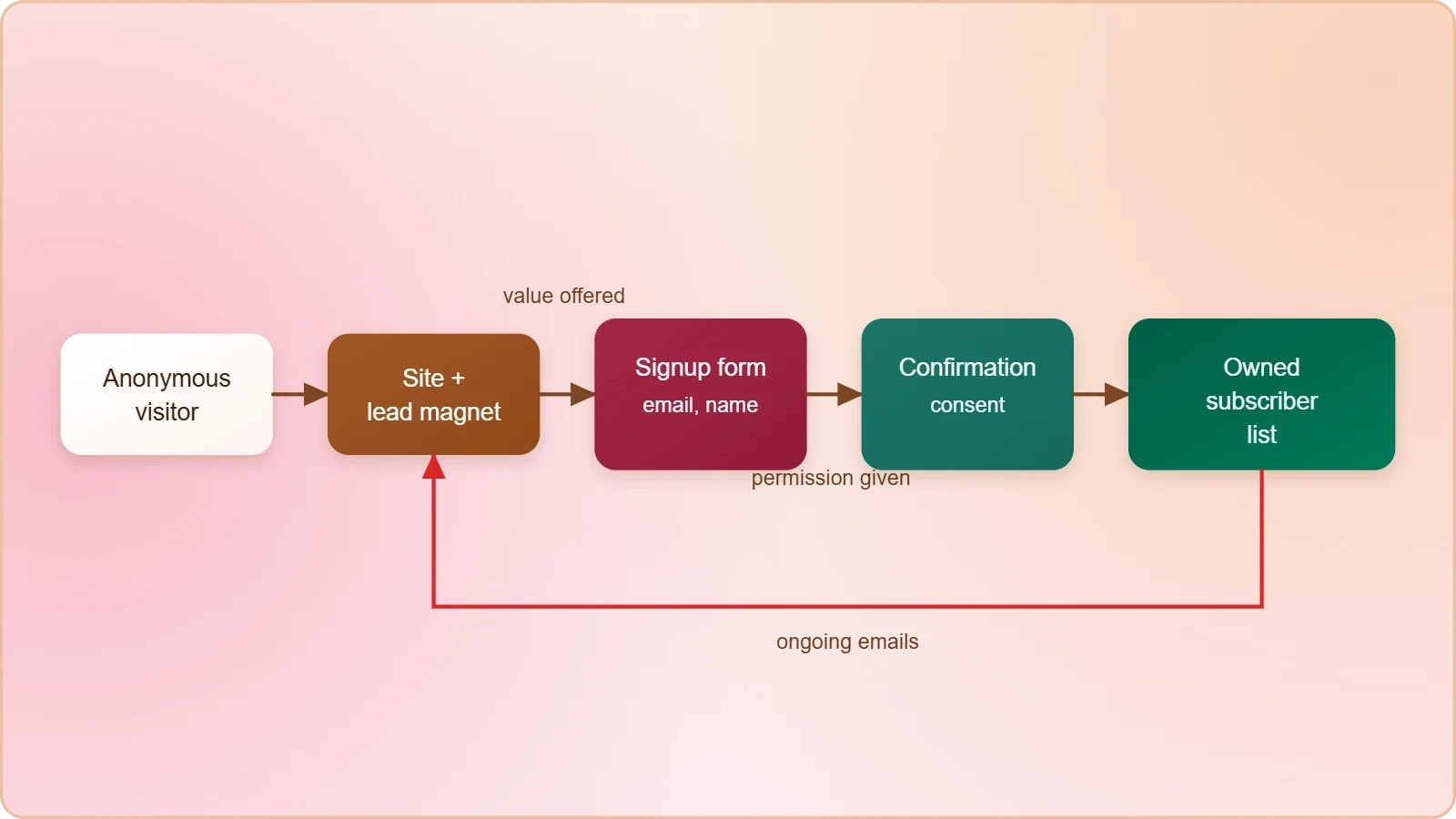
What makes this exchange so consequential is the shift in ownership it represents. Social followers and search rankings live on rented land, subject to policy changes, throttled distribution, and sudden volatility. A subscriber list, by contrast, is an asset the publisher controls directly. When someone voluntarily hands over their contact details, they are signalling real interest in what you publish, which is why marketers describe such audiences as targeted and responsive. The quality of that signal, not merely the size of the list, determines whether the asset compounds in value or quietly decays into an unopened folder of forgotten addresses.
This analysis examines the mechanics behind that exchange, the distinction between a large list and a valuable one, and the practical starting points for publishers who have delayed building this capability. It also considers the ethical and regulatory obligations that now accompany contact data, because consent has become a legal matter as much as a marketing one. The aim is a clear, grounded understanding of why list building still matters for a site of any size, and how to approach it without treating visitors as raw material to be harvested.
On This Page
TL;DR List building converts anonymous site traffic into a permission-based audience by exchanging genuinely useful information for contact details such as email, name, and phone number. The resulting list of targeted, responsive subscribers becomes a durable marketing asset that the publisher owns outright, insulated from platform volatility. Success depends less on list size than on relevance, consent quality, and consistent follow-through. Publishers who treat the exchange as a fair trade, honour privacy obligations, and segment their audience carefully build a compounding advantage that paid channels cannot easily replicate.
The Core Mechanics of the Contact Exchange

Every list-building programme rests on a straightforward bargain: value flows one way, permission flows the other. A visitor arrives with a question, a problem, or a curiosity, and the site presents something that addresses it directly, whether a checklist, a template, a short course, or a detailed guide. In return, the visitor supplies identifying details. The elegance of the model lies in its voluntariness; nobody is coerced, and the exchange only works when the offered resource is genuinely worth the inbox space it will later occupy.
The mechanics behind that bargain are more layered than they first appear. A landing page must communicate the offer clearly, a form must capture data without friction, and a confirmation step must verify intent. Each element introduces its own failure points, from ambiguous headlines to forms that ask for too much too soon. Understanding these mechanics allows publishers to diagnose why a page attracts traffic but converts none of it, and to fix the weakest link rather than rebuilding everything at once.
What Counts as a Fair Trade
The currency of list building is trust, and trust is earned through relevance. A generic newsletter signup promising "updates" asks the visitor to gamble on unknown future value. A specific offer, such as a procurement checklist for operations managers or a planting calendar for home gardeners, removes the gamble by delivering value immediately. The narrower the promise, the stronger the response, because specificity signals that the publisher understands the visitor's situation rather than broadcasting to everyone indiscriminately.
Quality of the offered information matters as much as its specificity. A thin PDF assembled in an afternoon may generate signups, but it also sets expectations the subsequent emails must meet. Publishers who overpromise at the point of capture inherit an audience primed for disappointment, and disappointment converts into unsubscribes or, worse, spam complaints. The durable approach treats the lead magnet as a sample of the publisher's best work, ensuring the first impression accurately represents everything that follows.
The Anatomy of a Responsive Subscriber
A responsive subscriber is one who opens, clicks, and acts, and responsiveness is a behavioural trait rather than a demographic label. Someone who downloads a detailed guide on a specific problem and then engages with follow-up material has demonstrated intent twice over. Someone who entered a sweepstakes for a prize has demonstrated only an appetite for free things. Both may sit on the same list, but only the first contributes meaningfully to revenue, referral, and reputation, which is why segmentation begins at the moment of capture.
This distinction explains why practitioners speak of laser-targeted lists rather than simply large ones. A list of five thousand engaged readers in a defined niche routinely outperforms a list of fifty thousand collected through vague incentives. The engaged readers recognise the sender, anticipate the content, and forgive the occasional promotional message because the relationship has accumulated credit. The unengaged majority drags down deliverability metrics and obscures the true performance of a campaign, making the list harder to manage and less profitable to operate.
We Also Published
Why a Responsive List Outperforms a Large One

Volume is the most seductive metric in list building and the least informative. A large list feels like an achievement, but inbox providers increasingly judge senders by engagement rather than raw count. When a significant portion of recipients ignore or delete messages without opening them, deliverability algorithms begin routing future mail to spam folders. The publisher then faces a paradox: the bigger the disengaged list, the harder it becomes to reach the engaged portion within it, and the more expensive each genuine contact becomes.
Responsiveness, by contrast, functions as a compounding asset. Engaged subscribers open consistently, which trains inbox providers to trust the sender, which improves placement, which increases the likelihood of further engagement. This virtuous cycle means a modest, well-maintained list can deliver more revenue per thousand recipients than a sprawling one. The practical implication is that list hygiene, segmentation, and honest expectation-setting are not administrative chores but core growth activities that protect the value of everything the publisher has collected.
Deliverability and the Engagement Signal
Modern inbox providers weigh sender reputation heavily, and reputation is built from behavioural evidence. A sender whose recipients open, reply, and move messages out of spam accumulates positive signals. A sender whose recipients ignore everything accumulates negative ones. Because these judgments are automated and continuous, a list that was healthy a year ago can quietly degrade if the publisher stops pruning inactive addresses or begins sending to segments that never asked for that particular content.
Managing this signal requires discipline. Re-engagement campaigns can revive dormant subscribers, but those who remain silent after a genuine attempt should be removed rather than retained for vanity. Suppressing inactive addresses feels like shrinking an asset, yet it reliably improves open rates, protects domain reputation, and reduces the cost of sending to people who will never respond. The arithmetic favours subtraction, even though the psychology of list building pushes relentlessly toward addition.
Segmentation as a Multiplier
Segmentation converts a single list into several more precise conversations. Subscribers can be divided by the offer that attracted them, the pages they have visited, the links they have clicked, or the products they have purchased. Each division allows the publisher to send material that matches demonstrated interest, which raises relevance and, in turn, responsiveness. A gardening site that separates vegetable growers from ornamental plant enthusiasts can speak to each group with language and timing that fits their seasonal priorities.
The multiplier effect emerges because relevance compounds across every subsequent message. A subscriber who receives consistently pertinent content learns to expect value and opens habitually. That habit makes future campaigns cheaper to run and more effective when a commercial offer eventually arrives. Segmentation also protects against fatigue, since no single subscriber is exposed to every message the publisher produces. The list becomes a portfolio of relationships rather than a broadcast channel, and each relationship carries its own cadence and its own commercial potential.
Building the Capture Infrastructure
Turning intent into a stored contact requires infrastructure, and the choices made here determine how much friction the visitor encounters. A landing page should present a single offer with a single action, stripping away navigation and competing links that invite distraction. The form itself should request only what is immediately necessary; every additional field reduces completion, and details such as phone numbers should be justified by a clear use case rather than collected by default. Simplicity at the point of capture is a conversion strategy, not a concession.
Behind the page sits an email service provider responsible for storing contacts, managing consent records, and delivering messages. The selection of that provider matters less than the discipline applied to it. Lists must be tagged by source, consent must be timestamped, and unsubscribe requests must be honoured promptly and automatically. These are unglamorous requirements, but they form the foundation on which every subsequent campaign rests, and neglect at this layer produces problems that no amount of clever copywriting can repair later.
Designing the Landing Page
An effective landing page answers three questions before the visitor can ask them: what is being offered, who it is for, and what happens after signup. The headline carries most of this weight, and specificity outperforms cleverness consistently. A promise of "a twelve-point audit checklist for e-commerce checkout flows" communicates more than "improve your conversions" ever could. Supporting copy should describe the format and length of the resource so the visitor knows exactly what will arrive and when.
Visual hierarchy reinforces the message. The form should sit above the fold on desktop and remain reachable without excessive scrolling on mobile, where the majority of traffic now arrives. Trust signals, such as a privacy statement and a clear note that the address will not be sold, reduce hesitation at the decisive moment. Testing headline variants, button labels, and form lengths yields incremental gains that accumulate, and the page should be treated as a living asset rather than a one-time build.
Consent, Privacy, and Legal Obligations
Contact data carries legal weight, and the regulatory environment has tightened considerably over the past decade. Frameworks such as the General Data Protection Regulation in Europe and comparable statutes elsewhere require clear consent, transparent purpose, and straightforward withdrawal. A subscriber must understand what they are agreeing to and must be able to revoke that agreement without obstacle. Publishers who treat consent as a checkbox to be buried in fine print invite complaints, penalties, and reputational damage that far outweigh any short-term gain in list size.
Compliance is also a commercial advantage. Audiences respond better to senders they trust, and visible respect for privacy reinforces that trust with every message. Double opt-in, in which a subscriber confirms their address through a follow-up email, reduces fraudulent signups and produces a cleaner list even though it lowers headline conversion numbers. The trade is worthwhile: a smaller list of verified, willing recipients is more valuable than a larger one contaminated by mistyped addresses and accidental submissions.
- 01
- 02
- 03
- 04
Nurturing the Relationship After Capture
Capture is the beginning of the relationship, not its conclusion, and the weeks immediately following signup determine whether the subscriber becomes an asset or an inert record. A welcome sequence should deliver the promised resource promptly, introduce the publisher's perspective, and set expectations about frequency and subject matter. This early window carries disproportionate influence because attention is at its peak; a subscriber who receives nothing for a month has likely forgotten why they signed up at all.
Beyond the welcome, nurturing becomes a rhythm of useful communication punctuated by occasional commercial offers. The ratio matters less than the integrity of each message. Subscribers tolerate promotion when it is relevant and infrequent, and they resent it when it interrupts a stream of otherwise helpful content. Publishers who treat every email as an opportunity to sell erode the goodwill accumulated at capture, while those who lead with usefulness find that commercial messages land more effectively when they eventually arrive.
The Welcome Sequence
A well-constructed welcome sequence performs several tasks in sequence. The first message delivers the promised resource and confirms the subscription, establishing reliability. The second introduces the publisher's background and the specific perspective that distinguishes the content. Subsequent messages address common questions, surface the most valuable existing material, and gently indicate what the subscriber might do next. Each message should stand alone as useful, so that even a subscriber who reads only one emerges with something of value.
Timing within the sequence deserves attention. Messages spaced too closely overwhelm; messages spaced too widely lose momentum. A cadence of a few days between early messages, gradually lengthening as the relationship matures, tends to match natural attention patterns. The sequence should also invite a reply, because responses signal engagement to inbox providers and provide direct intelligence about what the audience cares about. A simple question at the end of an early message often yields more insight than any analytics dashboard.
Content Cadence and Commercial Balance
Sustainable cadence is a function of capacity rather than ambition. A publisher who commits to daily emails and delivers for three weeks before collapsing has done more harm than one who promises weekly and maintains it for years. Consistency builds anticipation, and anticipation is what distinguishes a list that gets opened from one that gets filtered. The schedule should be realistic enough to survive busy periods and flexible enough to accommodate genuinely timely material when it arises.
Commercial balance follows a similar logic of honesty. Subscribers understand that publishers must earn a living, and they generally accept promotional messages when the underlying content has earned their attention. The mistake lies in disguising promotion as editorial or in flooding the inbox once a product launches. Transparent, occasional offers that genuinely serve the audience preserve trust, while manipulative tactics convert a responsive list into a resentful one with remarkable speed.
Measuring Value and Avoiding Common Pitfalls
Measurement in list building extends beyond subscriber counts to the economic value each contact generates over time. A useful calculation divides total revenue attributable to email by the number of active subscribers, producing an average value per subscriber that can guide investment in acquisition and retention. This figure, sometimes called subscriber lifetime value, allows publishers to judge whether a given acquisition cost is justified and whether retention efforts are paying for themselves.
The formula is straightforward: ##\text{Value per Subscriber} = \dfrac{\text{Total Email Revenue}}{\text{Active Subscribers}}##. Tracking this ratio over successive quarters reveals whether the list is appreciating or eroding, and it exposes the hidden cost of retaining disengaged addresses. A list that grows while value per subscriber falls is expanding in the wrong direction, and the corrective action is usually pruning and segmentation rather than more aggressive acquisition.
Calculating Subscriber Value
Revenue attribution requires care, since email rarely operates in isolation. A subscriber may read a newsletter, later search for the brand directly, and purchase through a different channel. Last-click attribution understates email's contribution, while generous attribution overstates it. A reasonable approach assigns value based on tracked clicks and coupon codes while acknowledging that influence extends beyond measurable paths. Consistency in method matters more than precision, because the goal is trend detection rather than accounting exactitude.
Once a value per subscriber is established, acquisition decisions become clearer. If a subscriber is worth a known amount over a year, a publisher can determine how much to spend on advertising, partnerships, or content that attracts new signups. The calculation also informs retention investment, since preventing a subscriber from leaving is usually cheaper than acquiring a replacement. Publishers who understand these economics negotiate the trade-offs of growth with far greater confidence than those who chase raw numbers.
Pitfalls That Undermine a List
The most common failure is buying or renting contact lists, a practice that produces addresses belonging to people who never expressed interest. Such lists generate complaints, damage sender reputation, and often violate the terms of email service providers. A close second is neglecting list hygiene, allowing inactive addresses to accumulate until deliverability suffers across the entire audience. Both failures share a root cause: treating the list as a quantity to be maximised rather than a relationship to be maintained.
Other pitfalls include over-mailing, which exhausts attention, and under-mailing, which allows the relationship to fade. Inconsistent sender identity confuses subscribers, and unclear unsubscribe processes generate frustration that spills into complaints. Each of these problems is preventable through straightforward operational discipline, and each becomes more expensive to fix the longer it persists. The publishers who succeed treat list maintenance as an ongoing commitment rather than a project with a completion date.
Where to Begin and Why It Still Matters
For a publisher starting from nothing, the first step is not technology but clarity about who the audience is and what they need. A single well-defined offer, aimed at a specific problem, placed on a simple landing page, will outperform an elaborate funnel built without that clarity. The initial goal should be a hundred genuinely interested subscribers rather than a thousand indifferent ones, because the first hundred reveal what resonates and provide the feedback needed to refine everything that follows.
From that foundation, the work becomes iterative. Test the offer, refine the page, adjust the welcome sequence, and prune the list regularly. Each cycle produces modest improvements that compound over time, and the accumulated asset grows more valuable with every passing quarter. The publishers who persist discover that list building is less a campaign than a discipline, and that its rewards accrue to those who treat subscribers as people rather than rows in a database.
A Practical First Ninety Days
The opening quarter should focus on establishing the essentials. Weeks one to four involve defining the audience, creating one strong offer, and building a landing page with a clear form. Weeks five to eight involve writing the welcome sequence, configuring the email provider, and ensuring consent records are properly stored. Weeks nine to twelve involve sending consistently, reviewing the metrics, and making the first round of adjustments based on what the data reveals.
Throughout this period, the emphasis should remain on quality of contact rather than volume. A hundred engaged subscribers who open every message provide more useful signal than a thousand who ignore them, and the habits formed in the early months determine the trajectory of the list for years. Patience during this phase is not passivity; it is the deliberate construction of a foundation that will support far larger numbers later without collapsing under the weight of disengagement.
The Enduring Case for Owned Audiences
The strategic argument for list building has strengthened rather than weakened as platforms have matured. Algorithmic feeds now mediate most social distribution, and their priorities shift without warning. Search engines revise their presentation of results, reducing the traffic that once flowed freely to publishers. Against this backdrop, a list of people who have explicitly asked to hear from you represents a rare form of stability, one that no platform policy can revoke and no ranking change can diminish.
That stability translates into commercial resilience. Publishers with strong lists can launch products, test ideas, and weather traffic droughts because they retain a direct line to their audience. The list also serves as a research instrument, revealing what readers actually want through their clicks and replies. In an environment where attention is contested and distribution is rented, the owned audience remains the most dependable asset a site can build, and the discipline of list building remains the most reliable way to build it.
From our network :
- Forbidden Matrix Patterns and Visible Lattice Points: A Geometric DictionaryExplore how multidimensional 0–1 matrices encode geometric truths, linking forbidden patterns to visible lattice points and hypergraph theory, with applications in combinatorics and computational geometry.
- Live Online English Classes for Kids: Do They Actually Reduce Anxiety?A ten-week study reveals that synchronous online English classes can significantly reduce child language anxiety while improving listening and reading skills. Discover what makes these programs effective and how parents can select the right one.
- University Language Proficiency Exams: Why Institutional Tests Demand Different Preparation Than IELTS and TOEFLDiscover why university-specific language proficiency examinations differ fundamentally from IELTS and TOEFL, and learn strategic preparation approaches for institutional assessment success.
- Committed Mediterranean Precipitation Decline: Why Emissions Cuts Alone Cannot Restore Winter RainsNew NOAA research reveals that Mediterranean winter rains may decline irreversibly even with emissions cuts. Explore the science of committed climate change and regional impacts.
- Mobile Learning and VR in English: What Global Evidence Reveals About Effective Language TechnologyA systematic review across 14 countries reveals which language-learning technologies genuinely work. Mobile learning, AI, and VR show measurable benefits when pedagogically integrated. This evidence-based guide helps educators and learners select technology that delivers real return on investment.
- How AI Agents Will Change the Way We Manage Personal FinancesExplore how AI agents are transforming personal finance through automated budgeting, bill payment, and investment management, while examining the critical security protocols and governance frameworks required for safe deployment.
- The Hidden Cost of AI Convenience: Why Over-Permissioned Agents Are a Security Time BombDiscover why AI agents with excessive permissions create dangerous single points of failure, and learn how implementing least privilege principles can protect your organization from exploitation.
- The Final Descent: How ESA Retired the Legendary Cluster Constellation After 24 Years of Space Weather ScienceAfter 24 years mapping Earth’s magnetosphere, ESA’s Cluster mission concluded with a precisely controlled reentry over the South Pacific. This analysis explores the scientific legacy, engineering decisions, and debris mitigation principles behind one of space exploration’s most responsible retirements.
- CISA’s Ten-Advisory Wave: Why Generic Patching Fails in OT and How to Build Product-Specific PlaybooksCISA released ten ICS advisories in one week, exposing critical infrastructure risks. Generic patching fails in OT. Learn to build product-specific remediation playbooks.
RESOURCES
- How do I start building an email list? : r/DigitalMarketing - Redditreddit.comSep 30, 2024 ... Set up a sign-up form using platforms like Mailchimp or Substack. Offer something cool, like a freebie or exclusive content,…
- How To Build An Email List From Scratch - Copy Possecopyposse.com#1 – Sign Up For Email Sender. First things first – you need to actually sign up for email marketing service. There are many…
- Build mailing lists - Squarespace Help Centersupport.squarespace.comNov 16, 2026 ... Create a mailing list · Open the Lists & Segments panel . · Click Create Mailing List and give the…
- How to Build an Email List From Scratch (the Right Way) - Twiliotwilio.comLearn how to build an email list from scratch with proven examples, best practices, and step-by-step processes.
- Hire the Best email list builders - Fiverr Propro.fiverr.comExpand your reach with targeted email list building. Filter. Pro catalog. Full ... How do Email List Builders differ from Email Campaign Managers? While ...
- Why Every Writer Needs an Email List - Jeff Goinsgoinswriter.comEvery writer wants her message to be heard. But many don't get the attention they deserve. Why? Because they neglect the most important part:…
- How to Build an Email List: Strategies for 2026 - Salesforcesalesforce.comWondering how to build your email list? Start here. This guide shows how to get started, how to optimize, and what to look out…
- Free Masterclass: How To Get Started Building An Email Listamyporterfield.comSign up for Amy Porterfield's free masterclass to learn 7 simple solutions to start attracting subscribers at lightning speed.
- How to Build an Email List: 10 Proven Strategies - Klaviyoklaviyo.comFeb 25, 2025 ... 5 strategies for building an email list · 1. Give people a compelling reason to sign up · 2. Use…
- The Double-Edged Sword of List Building Promotions | Jane Friedmanjanefriedman.comMay 16, 2024 ... Third-party promoters who offer to pad your email subscriber list for a fee might be attracting the wrong type of…
- The Ultimate Guide to Building An Email List - Bri Castellini - Mediumbrisownworld.medium.comMay 28, 2026 ... The Ultimate Guide to Building An Email List · Step 1: Why Email? · Step 2: Pick a template ·…
- 7 Experts on Why Building Your Email List Is So Importantcampaignmonitor.comApr 18, 2019 ... Email list building is an important and effective way to grow your business. Here are 7 expert tips on how…
- How to Build an Email List……And Actually Make Money From Itsocialtriggers.comGetting Started: How To Build An Email List The Right Way · Step 1: First, You Need Good Email List Software · Step 2:…
- How to Build an Email List: 10 Tactics That Work (2025) - Brevobrevo.comJul 21, 2024 ... ... Building an email list is key to a successful email marketing strategy. Don't know where to start? This guide…
- Email Marketing Freebies Hub | Tools For Building An Email Listlisttolaunch.jennakutcher.comExplore our Email Marketing Freebies Hub to access free tools, guides and resources for building, growing & nurturing your list.
- 01
- 02
- 03
- 04
- 05
- 06
- 07
- 08
0 Comments