On a single Wednesday morning in November 2026, hundreds of schools stretching from the Alps to Sicily emptied into the streets of Italy after anonymous emails promised mass slaughter. At least 300 institutions received identical threats, and Education Minister Giuseppe Valditara warned the figure could still climb as administrators worked through their inboxes. Police, Carabinieri military police, and explosives specialists swept campuses in Rome, Milan, Florence, Naples, Turin, Bari, Cagliari, and Palermo. No device was found anywhere. Yet the machinery of the Italian state moved with unmistakable urgency, because a threat delivered by email costs almost nothing to send and demands an expensive, immediate response.
The episode exposes a structural vulnerability that modern societies have not solved: the asymmetry between the trivial cost of a hoax and the enormous cost of treating it seriously. One message, replicated across hundreds of addresses, can paralyse an education system for a morning, summon bomb squads, and force a prime minister to convene an emergency cabinet. The content of the email, signed by a self-styled commander of a group calling itself "Vilayat Misoginistan," reads less like a coherent insurgency than like the fantasy of a disturbed individual. Cristina Costarelli, who leads the Lazio region's school masters association, described the sender bluntly as a mythomaniac whose stunt triggered absurd panic.
What follows examines the incident as a case study in contemporary security governance: how institutions distinguish credible threats from noise, why schools have become preferred targets for psychological warfare, what the Italian response reveals about crisis coordination, and where the boundary lies between prudent precaution and capitulation to fear. The analysis draws on the reported facts of the evacuation, the geography of the targeting, the language of the threatening email, and the institutional reactions that followed, while situating them within the wider pattern of email-borne intimidation that has unsettled European public life in recent years.
On This Page
TL;DR Hundreds of Italian schools were evacuated on 11 November 2026 after identical emailed bomb threats reached administrators in Rome, Milan, Naples, Florence, and other cities. At least 300 institutions were affected, with Education Minister Giuseppe Valditara warning the count could rise. Police, Carabinieri, and explosives experts found no evidence supporting the threats, and students were sent home purely as a precaution. The email, signed by a purported leader of "Vilayat Misoginistan," claimed explosives had been planted in every targeted school and in the education minister's car. Prime Minister Giorgia Meloni convened an urgent cabinet meeting. The incident illustrates the outsized institutional cost of low-effort hoaxes and the difficulty of calibrating public response when credibility cannot be established quickly.
The Anatomy of a Mass Email Threat
The threatening message was not a sophisticated instrument of terror. According to La Repubblica, which obtained a copy from school staff, it opened with a grandiose self-introduction: "This is Mikhail Andropov, leader of the Vilayat Misoginistan. We have come to annihilate you. We are going to carry out a genocide against Italians." The text then asserted that a "powerful explosive device" had been planted in each targeted school and that a bomb had been placed in the car of the education minister. The phrasing is theatrical, the claims unverifiable, and the signature attached to a group about which almost nothing is publicly known.
Yet the operational logic of such a message does not depend on its truthfulness. A bomb threat succeeds, from the sender's perspective, the moment it is read and believed enough to act upon. The email reached at least twelve schools in the province of Rome, including primary schools and nurseries, twelve in Milan and the surrounding Lombardy region, and twelve more in Naples and Campania. Additional targets appeared in Turin, Sanremo, and Vicenza in the north, and in Bari, Cagliari, and Palermo in the south. The distribution pattern suggests a bulk send to publicly listed administrative addresses rather than any targeted reconnaissance.
The Geography of Targeting
The spread of the threats across Italy's major urban centres is itself informative. Rome, Milan, and Naples each absorbed a dozen or more alerts, while smaller cities in both northern and southern regions received their share. This even distribution points to an automated mailing list compiled from publicly available school directories, a low-cost method that maximises disruption per unit of effort. No region was spared, and no discernible ideological or geographic logic distinguished the targets, which is consistent with a sender seeking spectacle rather than a specific grievance against particular institutions.
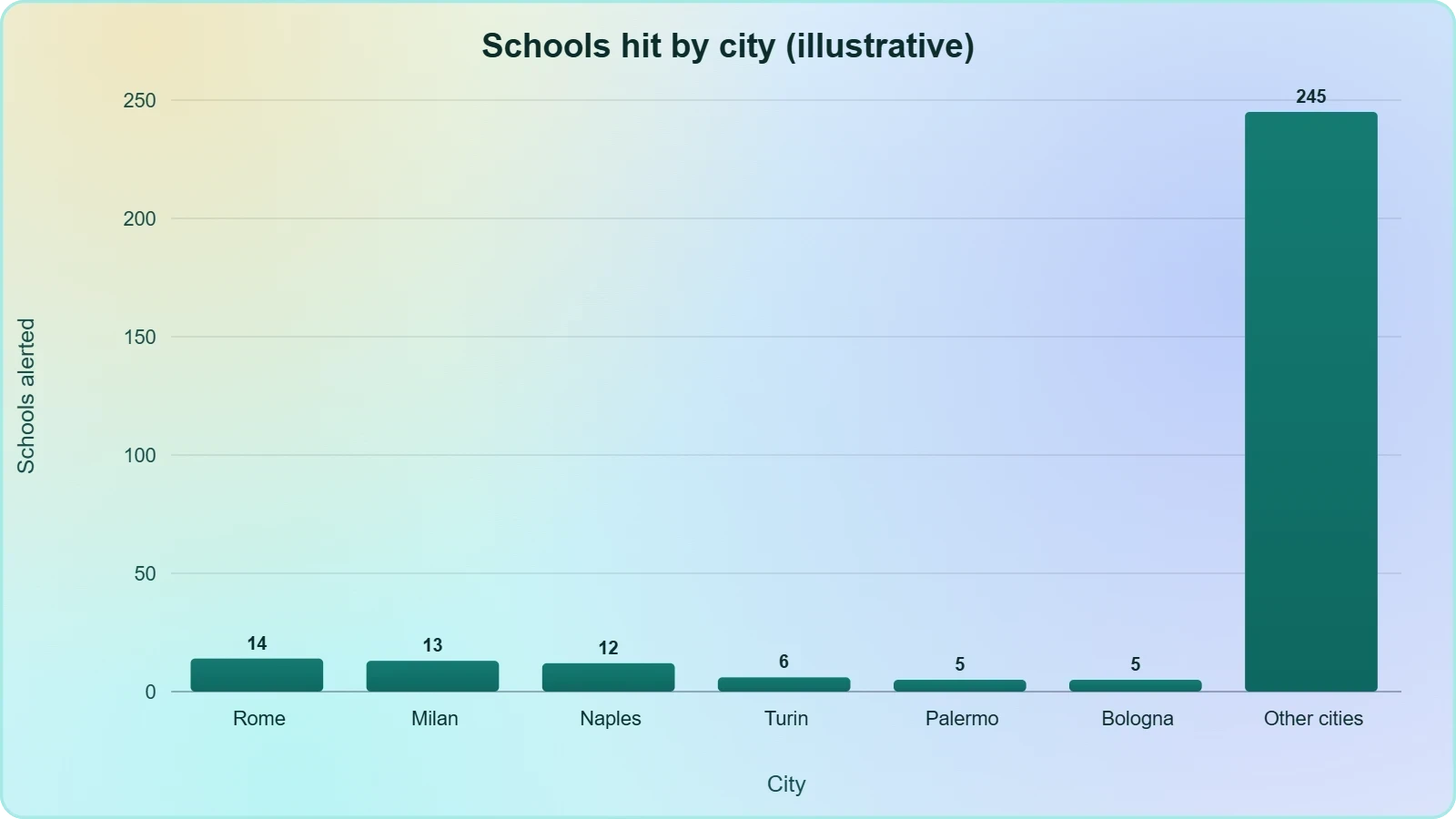
Primary schools and nurseries were included among the Roman targets, a detail that amplifies the emotional impact of the episode. Targeting the youngest children guarantees maximal public alarm and media coverage, because evacuating infants carries a visceral charge that evacuating office workers does not. Whether the sender calculated this effect deliberately or simply harvested every address available is impossible to determine, but the consequence was the same: a nationwide security response triggered by a single act of mass communication aimed at the most sensitive institutions in the country.
The Language of the Threat
The email's rhetoric blends apocalyptic menace with conspiratorial fantasy. The name "Vilayat Misoginistan" echoes the nomenclature of jihadist administrative units, yet the group appears to exist nowhere in the public record of recognised organisations. The signature "Mikhail Andropov" borrows from Soviet history, invoking a surname associated with the KGB, while the first name is conventionally Russian. This pastiche of Islamist and Soviet imagery suggests a sender drawing on cultural tropes rather than operational affiliation, a pattern familiar to analysts who study lone-actor threat communication.
Cristina Costarelli's assessment that the author is likely a "myth maniac" captures the professional consensus forming in the hours after the evacuation. Genuine terrorist campaigns typically claim responsibility through established channels and often provide verifiable details to establish credibility. This email did neither. It offered no proof, no deadline, and no political demand beyond annihilation, which is not a negotiable objective but a rhetorical flourish. The absence of any coherent claim-making structure is one of the strongest signals that the threat was performative rather than operational.
We Also Published
Institutional Response and Crisis Coordination
The Italian state's reaction unfolded along a familiar emergency template. Local police and Carabinieri units, supported by explosives experts, conducted security checks at affected campuses while students and teachers were sent home as a precaution. No evidence supporting the threats emerged during the sweeps. At the political level, Prime Minister Giorgia Meloni reportedly called an urgent cabinet meeting for 4 p.m. local time, or 1500 GMT, to assess the situation. The speed of that escalation, from inbox to cabinet table within hours, demonstrates how quickly a mass threat can consume the attention of a national government.
Education Minister Giuseppe Valditara's public statements served a dual function. By confirming that at least 300 schools had been affected and warning that the number could rise, he acknowledged the scale of the disruption honestly. By framing the response as precautionary, he signalled that authorities were not treating the threats as confirmed. This calibration matters enormously in crisis communication: overstating the danger fuels panic, while understating it invites accusations of negligence if a device is later found. The minister walked that line in public while the security apparatus worked through the evidence behind the scenes.
Policing a Threat Without a Crime Scene
Investigators faced a distinctive challenge. A conventional bomb scare provides physical traces, suspicious packages, or witness accounts. An email threat provides only a digital artefact, and the origin and credibility of the message were still under investigation by ANSA's account. Tracing the sender requires cooperation across email providers and jurisdictions, a process measured in days or weeks rather than hours. In the meantime, every affected school had to be treated as a potential crime scene, which meant hundreds of simultaneous searches conducted under time pressure with no confirmed target.
The resource implications are substantial. Bomb squads, dog units, and explosives specialists are finite assets, and deploying them to hundreds of sites in a single morning strains any national capacity. Each search consumes personnel hours that cannot be spent elsewhere. Even a conclusively false alarm imposes real costs: overtime, transport, equipment wear, and the opportunity cost of diverting security resources from genuine risks. This is the economics of hoaxing, in which the attacker spends nothing and the defender spends everything, repeatedly, for as long as the campaign continues.
The Cabinet Meeting as Signal
Convening an urgent cabinet meeting is never a neutral act. It communicates to the public that the government regards the situation as serious enough to warrant collective deliberation at the highest level. It also coordinates the response across ministries, ensuring that education, interior, and security portfolios speak with one voice. In the Italian system, where regional authorities hold significant competence over schooling, such coordination is not automatic and requires deliberate political effort. The meeting therefore functioned both as operational necessity and as reassurance theatre.
There is a risk in over-signalling, however. When a hoax triggers cabinet-level attention, it rewards the sender with exactly the prominence such actors crave. Future hoaxers observe that a mass email can summon the prime minister's agenda, and the incentive to repeat the performance grows. Security scholars have long debated this dilemma: whether visible high-level responses deter further attacks by demonstrating vigilance or encourage them by demonstrating susceptibility. The Italian case offers no clean answer, only evidence that the dilemma is real and recurring.
Schools as Strategic Targets in Modern Conflict
Schools occupy a singular position in the target hierarchy of those who seek to inflict psychological harm on a society. They concentrate children, the most protected category of citizen, in buildings that are difficult to secure and easy to identify. An attack on a school, real or threatened, generates grief, outrage, and fear in proportions that an attack on almost any other institution cannot match. This is why schools appear so frequently in the annals of terrorism, from Beslan to the countless hoaxes that have emptied classrooms across Europe and North America in recent years.
The choice of schools also reflects a calculation about state capacity. Governments cannot ignore threats to children, which means every credible-sounding warning must be investigated regardless of its plausibility. The attacker thus forces the defender to spend resources on demand, at a time and place of the attacker's choosing. This dynamic has been exploited by actors ranging from organised terrorist networks to pranksters, and the boundary between the two is often less clear than the public assumes. A hoaxer who understands this leverage wields a weapon of disruption as surely as one who plants a device.
The Psychology of Mass Alarm
Fear propagates through populations faster than facts can be verified. When hundreds of schools evacuate simultaneously, parents receive messages from multiple sources, social media fills with speculation, and the absence of confirmed explosives does little to calm nerves because absence of evidence is not evidence of absence in the anxious mind. The email's genocidal rhetoric intensified this effect by invoking the spectre of ethnic annihilation, a framing designed to bypass rational assessment and trigger existential dread. Even after authorities declared the threats unsupported, the emotional residue lingered in communities across the country.
Cristina Costarelli's phrase about "absurd panic" is telling precisely because it acknowledges the disproportion between the trigger and the reaction while conceding that the reaction was real. Human beings are not Bayesian calculators in moments of danger; they respond to the emotional content of a threat before they evaluate its probability. A security strategy that ignores this dimension will consistently underestimate the social cost of hoaxes. The panic is not absurd from the perspective of a parent who has just been told that a bomb may be in their child's classroom, whatever the sender's actual capabilities.
Copycat Dynamics and the Attention Economy
Every widely reported hoax lowers the barrier for the next one. The mechanics are well documented in the study of copycat behaviour: publicity provides a template, demonstrates that the tactic works, and offers the promise of similar attention to anyone who replicates it. Italy has experienced waves of school bomb threats before, and each wave has tended to follow a period of intense media coverage. The 2026 incident, with its cabinet meeting and international headlines, supplies precisely the kind of amplification that sustains such cycles.
Digital communication has accelerated this dynamic. An email can be composed once and dispatched to thousands of addresses in minutes, with no need for physical presence, specialised knowledge, or logistical support. The sender need not be in Italy, or even in Europe, to empty Italian schools. This deterritorialisation complicates prosecution and raises the question of whether traditional criminal deterrence can meaningfully address a phenomenon whose perpetrators may be adolescents, isolated individuals, or actors in jurisdictions with no interest in cooperation.
Investigating an Anonymous Sender
The investigative trail in a case like this begins with the email itself. Headers can reveal originating servers, routing paths, and sometimes the services used to dispatch the message. Investigators will examine whether the sender used a commercial provider, a compromised account, or an anonymising service, each of which presents different obstacles. ANSA reported that police were investigating both the origin and the credibility of the message, a dual mandate that reflects the uncertainty surrounding the incident. Until attribution is established, authorities cannot know whether they are dealing with a prank, a disturbed individual, or something more organised.
International cooperation becomes essential the moment the trail crosses a border, which in email cases it almost always does. Mutual legal assistance treaties govern requests for data from foreign providers, and the process is notoriously slow relative to the speed of the threat. A sender operating from a jurisdiction hostile to Italian interests may never be identified, let alone prosecuted. This impunity gap is one of the structural weaknesses that makes email-based intimidation attractive, and closing it requires diplomatic and technical investments that no single country can make alone.
The Credibility Assessment Problem
Determining credibility is not a binary exercise. Investigators weigh the specificity of the threat, the sender's claimed capabilities, the presence of corroborating details, and the historical behaviour of any named group. In this case, the claimed group is essentially unknown, the threats are generic, and no corroborating evidence has surfaced. These factors point toward a low-credibility assessment, but low credibility is not zero credibility, and the cost of being wrong about a school full of children is catastrophic. That asymmetry of consequences, rather than the probability of the threat, drives the decision to evacuate.
This is the core dilemma of protective security. Decision-makers must act on incomplete information under time pressure, knowing that false positives impose real costs while false negatives impose unacceptable ones. The rational response is to evacuate and search, accepting the disruption as the price of safety. But when the same calculation is repeated hundreds of times in a single morning, the aggregate cost becomes a strategic vulnerability in its own right. Adversaries who understand this can impose damage without ever building a device.
Legal Frameworks and Deterrence
Italian law treats bomb hoaxes as criminal offences, and convictions can carry custodial sentences, particularly where the disruption is extensive. Yet deterrence depends on the perceived probability of detection and punishment, both of which are low in anonymous email cases. The sender who believes they cannot be traced has little reason to fear prosecution. Strengthening deterrence therefore requires improving attribution capabilities, which in turn requires investment in digital forensics and international cooperation. None of this is cheap, and none of it produces visible results that politicians can point to.
There is also a question of proportionality in sentencing. A teenager who sends a threatening email as a prank is not morally equivalent to an organised terrorist, yet the social harm can be similar in scale. Legal systems struggle to calibrate punishment across this spectrum, and public opinion often demands severity that the facts do not support. The Italian response to previous hoax waves has varied, suggesting that the jurisprudence in this area remains unsettled. Clearer sentencing guidelines and specialised prosecution units would help, but they address symptoms rather than causes.
- 01
- 02
- 03
- 04
Comparative Context: Europe's Hoax Epidemic
Italy is not alone in confronting this phenomenon. France, Germany, Spain, and the United Kingdom have all experienced waves of emailed bomb threats against schools, airports, and public institutions in recent years. The pattern is remarkably consistent: bulk messages, grandiose claims, mass evacuations, no devices found, and investigations that rarely produce arrests. The European Union has begun to treat the phenomenon as a security issue in its own right, recognising that the cumulative economic and psychological cost of hoaxes rivals that of some genuine attacks. Coordination across member states remains uneven, however, and the legal frameworks differ substantially.
The comparative record offers some lessons. Jurisdictions that have invested in rapid tracing capabilities and centralised reporting mechanisms have reduced both the frequency and the impact of hoax waves. Those that treat each incident in isolation, without aggregating data or sharing intelligence, tend to remain trapped in reactive cycles. The difference is institutional rather than cultural, which suggests that Italy's experience could be improved through structural reform rather than merely through tougher rhetoric. Whether the political will exists to fund such reform is a separate question.
Lessons from Prior Incidents
Earlier European hoax campaigns have demonstrated the value of pre-established protocols. Schools that have rehearsed evacuation procedures execute them calmly, reducing the risk of injury during the exit itself. Communication templates that authorities can deploy quickly prevent the information vacuum that rumour fills. And centralised tip lines allow the public to report suspicious messages without overwhelming local police switchboards. These are unglamorous measures, but they determine whether a hoax produces a controlled disruption or a chaotic one. Italy's response on 11 November suggests that some of these protocols were in place and functioning.
The longer-term lesson concerns resilience. Societies that accept that hoaxes will occur, and plan accordingly, suffer less than those that treat each incident as an unprecedented emergency. Resilience does not mean ignoring threats; it means building systems that can absorb them without cascading failure. For schools, this might mean remote-learning contingencies, pre-authorised communication channels with parents, and clear criteria for when evacuation is warranted. For governments, it means funding the unglamorous infrastructure of attribution and coordination that makes deterrence credible.
What the Italian Case Reveals About Modern Security
The evacuation of hundreds of Italian schools on a single morning is, in one sense, a success story. The system detected a threat, mobilised resources, protected children, and found no danger. No one was hurt, and the institutions performed as designed. Yet the episode also reveals a structural weakness that no amount of operational competence can fully resolve: the defender must be right every time, while the attacker need only be believed once. A society that treats every hoax as a potential mass-casualty event will spend enormous sums on false alarms, and a society that discounts them risks the unthinkable.
The Italian government's response, from local police sweeps to a prime ministerial cabinet meeting, reflected an implicit judgment that the cost of overreaction is preferable to the cost of underreaction. That judgment is almost certainly correct in any single instance. The question is whether it remains sustainable when repeated across hundreds of incidents and multiple countries over years. Cumulative overreaction can exhaust the security apparatus, erode public trust in warnings, and normalise disruption to the point where genuine threats are met with fatigue rather than vigilance.
Balancing Precaution and Resilience
Resilience requires distinguishing between the probability of a threat and its consequences. A low-probability, high-consequence event warrants precaution even when the evidence is thin, but the form of that precaution matters. Evacuating every school that receives an email is one response; verifying the message's provenance before evacuating is another. The second approach requires faster attribution capabilities and better coordination between schools and police, investments that pay dividends across every future incident. Italy's response suggests it has some of these capabilities but not yet enough to shorten the window between threat and resolution.
Public communication is equally important. Authorities who explain their reasoning, rather than merely announcing outcomes, build the trust necessary for future cooperation. When the education minister confirms the scale of an incident while noting the absence of supporting evidence, he gives the public the tools to calibrate their own fear. When officials remain silent or evasive, rumour fills the gap. The Italian statements on 11 November struck a reasonable balance, acknowledging the disruption without amplifying the threat beyond what the evidence supported.
The Future of Email-Borne Intimidation
Nothing about the technology involved is novel, and that is precisely what makes the phenomenon durable. Email is ubiquitous, cheap, and difficult to police without unacceptable intrusions on privacy. Artificial intelligence may worsen the problem by making threatening messages more convincing, more personalised, and harder to distinguish from genuine communications. A future hoax could include synthetic audio or video purporting to show a device being planted, raising the credibility of the threat without raising its actuality. Defenders will need to adapt their verification methods accordingly.
The deeper challenge is political. Democracies must protect their citizens without becoming permanently mobilised against phantom dangers. Every evacuation is a small victory for the attacker's logic, even when no device exists, because it demonstrates that a single email can redirect the resources of a state. The only durable answer is a combination of technical capability, institutional coordination, and public resilience that reduces the return on hoaxing to the point where it ceases to be attractive. Italy's experience on 11 November 2026 is a case study in how far that work has progressed, and how far it still has to go.
From our network :
- The Hidden Cost of AI Convenience: Why Over-Permissioned Agents Are a Security Time BombDiscover why AI agents with excessive permissions create dangerous single points of failure, and learn how implementing least privilege principles can protect your organization from exploitation.
- How AI Agents Will Change the Way We Manage Personal FinancesExplore how AI agents are transforming personal finance through automated budgeting, bill payment, and investment management, while examining the critical security protocols and governance frameworks required for safe deployment.
- CISA’s Ten-Advisory Wave: Why Generic Patching Fails in OT and How to Build Product-Specific PlaybooksCISA released ten ICS advisories in one week, exposing critical infrastructure risks. Generic patching fails in OT. Learn to build product-specific remediation playbooks.
- The Final Descent: How ESA Retired the Legendary Cluster Constellation After 24 Years of Space Weather ScienceAfter 24 years mapping Earth’s magnetosphere, ESA’s Cluster mission concluded with a precisely controlled reentry over the South Pacific. This analysis explores the scientific legacy, engineering decisions, and debris mitigation principles behind one of space exploration’s most responsible retirements.
- Mobile Learning and VR in English: What Global Evidence Reveals About Effective Language TechnologyA systematic review across 14 countries reveals which language-learning technologies genuinely work. Mobile learning, AI, and VR show measurable benefits when pedagogically integrated. This evidence-based guide helps educators and learners select technology that delivers real return on investment.
- Live Online English Classes for Kids: Do They Actually Reduce Anxiety?A ten-week study reveals that synchronous online English classes can significantly reduce child language anxiety while improving listening and reading skills. Discover what makes these programs effective and how parents can select the right one.
- Committed Mediterranean Precipitation Decline: Why Emissions Cuts Alone Cannot Restore Winter RainsNew NOAA research reveals that Mediterranean winter rains may decline irreversibly even with emissions cuts. Explore the science of committed climate change and regional impacts.
- University Language Proficiency Exams: Why Institutional Tests Demand Different Preparation Than IELTS and TOEFLDiscover why university-specific language proficiency examinations differ fundamentally from IELTS and TOEFL, and learn strategic preparation approaches for institutional assessment success.
- Forbidden Matrix Patterns and Visible Lattice Points: A Geometric DictionaryExplore how multidimensional 0–1 matrices encode geometric truths, linking forbidden patterns to visible lattice points and hypergraph theory, with applications in combinatorics and computational geometry.
RESOURCES
- Bomb threats prompt evacuation of Italian schools in suspected ...cnn.com5 hours ago ... Hundreds of schools were evacuated in Italy on Wednesday after bomb threats were sent via email, police told CNN, becoming…
- Hoax bomb alerts sent to schools in Italy, UK and Ireland ... - Reutersreuters.com2 hours ago ... Schools across Italy were evacuated on Wednesday after around 6300 of them received bomb warnings, the latest in a series…
- At least 300 schools evacuated in Italy after email bomb alerts | Newsaljazeera.com3 hours ago ... Italian soldiers patrol as a police bomb squad armoured car enters the stadium ahead of Tuesday's. Italian police are investigating…
- Wave of hoax bomb threats sent to schools in UK, Ireland and Italyfrance24.com5 hours ago ... ... email on Wednesday now being treated as a hoax by authorities. Italy earlier evacuated roughly 300 schools over the…
- Italy schools evacuated: At least 300 receive identical bomb threatnbcnews.com2 hours ago ... “The (school) emails are public. (Sending the bomb alert messages) was as easy as drinking a glass of water,” a…
- Hundreds of Italian schools hit by threats in suspected bomb hoaxbbc.com4 hours ago ... Emails containing the false warnings were sent to schools in Rome, Naples, Vicenza, Florence, Pisa, Trieste and other Italian cities, ...
- Hundreds of schools in Italy, UK evacuated over 'hoax' bomb threatscnbc.com5 hours ago ... ... bomb threats to Italian schools were presumed to be hoaxes. Emails were signed "Mikhail Andropov, leader of the Vilayat…
- Italy: At least 300 schools evacuated after email bomb alertsfacebook.com5 hours ago ... #FPVideo: Dozens of schools across India's capital region faced evacuations on May 1, due to bomb threats received via email,…
- Some 300 Italian schools evacuated due to bomb threats - ABC Newsabcnews.com4 hours ago ... Italian authorities evacuated around 300 schools on Wednesday after receiving a bomb threat via email.
- Hundreds of Schools in Italy Are Evacuated as More Bomb Threats ...nytimes.com3 hours ago ... Similar emails sent to schools across Northern Ireland were “being treated as a hoax,” the country's Education Authority said in…
- Italy Evacuates Over 300 Schools Due to Bomb Alert, With Threats in ...usnews.com4 hours ago ... Italian authorities evacuated more than schools after an emailed bomb threat ... schools had been evacuated after receiving email threats.…
- Schools in Italy, Ireland and UK evacuated after hoax bomb threatseuronews.com5 hours ago ... More than 300 schools across Italy were evacuated on Wednesday after receiving emailed bomb threats ... email to a school,…
- Bomb threats prompt evacuations at more than 100 schools across ...aa.com.tr5 hours ago ... More than 100 schools across Italy reported bomb threats after receiving an anonymous email warning of an explosive device on…
- Some 300 Italian schools evacuated due to bomb threatsbozemandailychronicle.com4 hours ago ... Italian authorities evacuated around 300 schools on Wednesday after receiving a bomb threat via email. Italian Premier Giorgia Meloni said ...
- Schools in Italy, U.K. and Ireland get hoax bomb threats amid ...cbsnews.com2 hours ago ... ... bomb threats Wednesday, prompting mass evacuations in Italy. The ... The email also contained threats to Italian Prime Minister…
- 01
- 02
- 03
- 04
- 05
- 06
- 07
- 08
0 Comments