
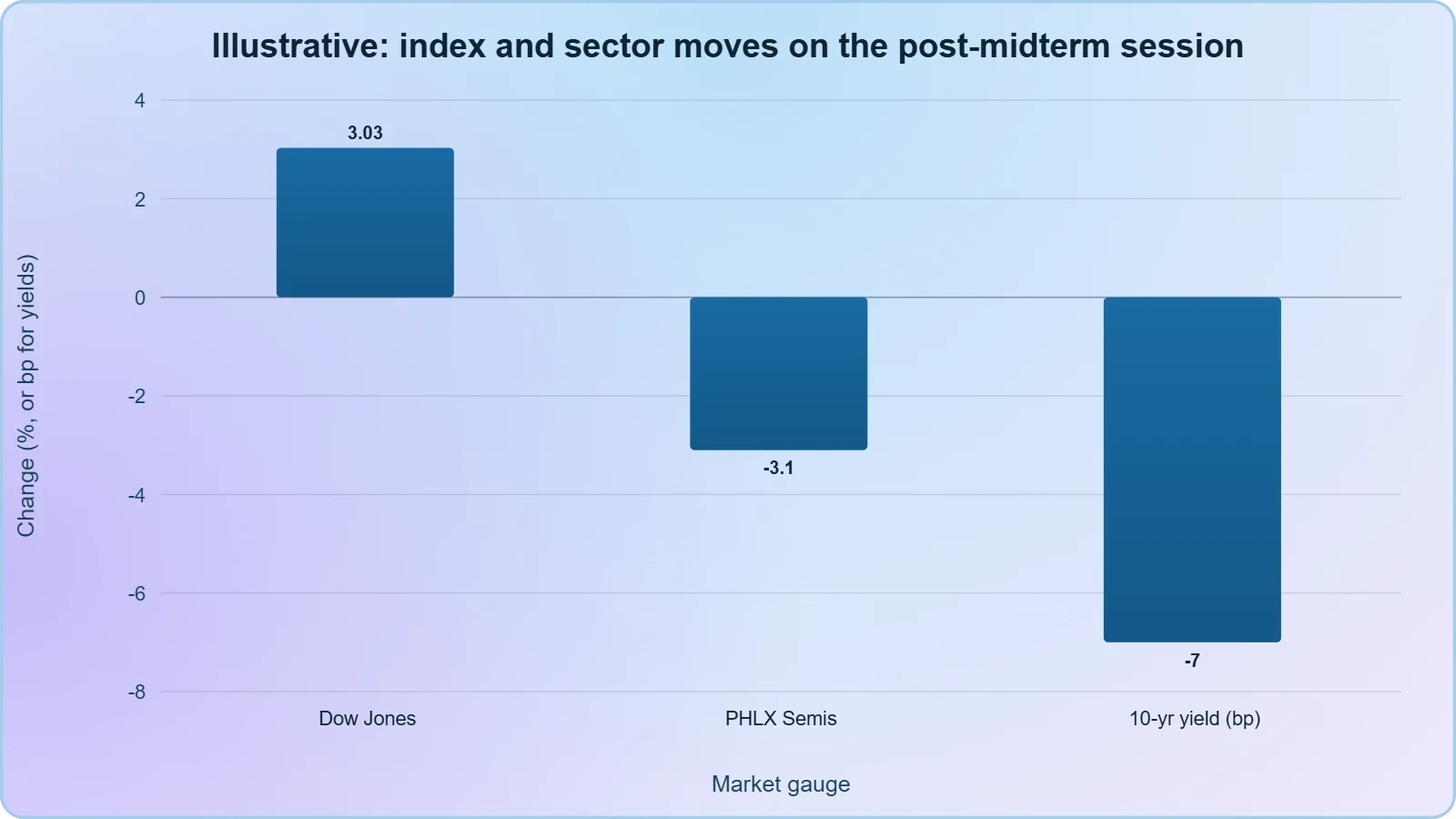
When American voters delivered a divided Congress in the 2026 midterm elections, Wall Street responded not with anxiety but with relief. The Dow Jones Industrial Average surged 3.03 percent, or 1,569.40 points, marking its strongest single session since April 2025, while the S&P 500 climbed 1.58 percent and the Nasdaq added 1.44 percent. North of the border, Canada's S&P/TSX Composite Index rose 2.28 percent to its highest close since September 4. The message from trading floors was unmistakable: investors welcomed gridlock in Washington because it promised fewer sweeping policy shocks of the kind that had repeatedly rattled global markets over the preceding two years.
The rally was never really about partisan preference. It was about predictability. During the Trump administration, tariffs, an armed conflict with Iran, and rapid-fire regulatory shifts had moved markets with little congressional resistance. A Democratic-controlled chamber changes that calculus, making large new initiatives harder to pass and, in the eyes of many strategists, easier to price. Mark Hackett of Nationwide captured the mood succinctly, observing that markets treat Washington gridlock positively because anything non-essential simply will not clear the legislative gauntlet. Bond yields fell roughly seven basis points on both sides of the border as oil prices softened, reinforcing the risk-on tone.
Beneath the headline index moves, however, a more nuanced story unfolded across sectors. Large technology names such as Amazon, Meta, and Alphabet advanced, yet the PHLX Semiconductor Sector Index dropped 3.1 percent, and several data center operators slid as investors weighed the prospect of sharper Democratic scrutiny of artificial intelligence. Jefferies strategists offered a counterpoint, suggesting that Democratic victories in five key states could actually make AI politically more secure, since incoming governors are likely to pursue safeguards rather than outright bans. Meanwhile, Vice President JD Vance publicly distanced himself from the Iran decision, fueling expectations of de-escalation. This article examines what the midterm outcome means for equities, bonds, AI regulation, and the historical pattern of post-midterm returns.
On This Page
TL;DR US and Canadian equities rallied sharply after Democrats made major midterm gains, with the Dow posting its best day since April 2025 as investors priced in a divided government that reduces policy uncertainty. Bond yields fell about seven basis points on both sides of the border, oil softened, and large-cap technology advanced while semiconductors and data center operators lagged on regulatory concerns. Strategists view gridlock as market-friendly, and historical data shows the S&P 500 has averaged a 19.9 percent return in the twelve months following midterm elections since 1946.
The Market Reaction to Divided Government
The immediate market response to the midterm results was a textbook expression of what strategists call policy relief. When control of Congress splits between parties, the legislative engine slows, and slower legislation means fewer surprises for investors who make multi-year capital allocation decisions. The Dow's 3.03 percent jump, its best session since April 2025, reflected not euphoria about Democratic policies but comfort that neither party could impose a sweeping agenda. The S&P 500 and Nasdaq followed with gains of 1.58 percent and 1.44 percent respectively, while Canada's benchmark index rose 2.28 percent, its strongest close since early September.
This reaction fits a well-documented pattern in market psychology. Uncertainty, rather than any particular policy outcome, is what investors punish most severely. The preceding two years had delivered tariff shocks, geopolitical conflict, and regulatory improvisation with minimal legislative friction, forcing portfolio managers to constantly reprice risk. A divided Congress restores a degree of institutional friction that markets interpret as stability. The synchronized decline in US and Canadian ten-year yields, each down roughly seven basis points, confirmed that investors were rotating toward confidence rather than fleeing to safety, a distinction that matters enormously for interpreting the rally's durability.
Why Gridlock Functions as a Market Catalyst
Mark Hackett, chief market strategist at Nationwide, articulated the prevailing view with unusual clarity: gridlock in Washington is viewed positively by markets because anything not essential is unlikely to pass. This is not cynicism but a practical assessment of how capital markets digest legislative risk. When the probability of major tax changes, spending packages, or regulatory overhauls declines, the dispersion of possible future outcomes narrows, and narrower outcome distributions command higher valuations. Investors effectively pay a premium for legislative predictability, and divided government supplies it more reliably than unified control of any ideological stripe.
The mechanics extend beyond sentiment into actual positioning. Portfolio managers who had hedged against election-driven volatility began unwinding those hedges, and the resulting flows amplified index moves. The rally's breadth, spanning both US and Canadian markets, suggests institutional rather than retail-driven buying. Canadian equities benefited from their heavy weighting in financials and energy, sectors that tend to perform well when cross-border policy uncertainty recedes. The TSX's 2.28 percent gain to its highest close since September 4 underscored how closely North American markets move together when the underlying driver is Washington rather than domestic Canadian policy.
Bond Yields, Oil, and the De-Escalation Trade
The seven-basis-point decline in ten-year yields on both sides of the border deserves careful attention because it signals more than simple risk appetite. Falling yields alongside rising equities typically indicate that investors are revising inflation and growth expectations downward, or that they anticipate reduced fiscal borrowing. A divided Congress is less likely to pass large deficit-financed spending programs, which reduces the supply of government debt and supports bond prices. Simultaneously, softer oil prices, driven partly by hopes of de-escalation with Iran, eased inflationary pressure at the margin, giving central bankers additional room to maneuver.
Vice President JD Vance's public distancing from President Trump's decision to go to war with Iran added a political dimension to the de-escalation trade. By questioning whether the conflict was worth its costs and attributing Republican election losses partly to it, Vance signaled that the administration's foreign policy consensus may be shifting. Investors interpreted this as a reduced probability of further military escalation, which explains why energy markets softened even as equity risk appetite improved. The combination of lower oil, lower yields, and higher stocks is a coherent macro configuration that reflects genuine reassessment rather than reflexive buying.
We Also Published
Artificial Intelligence Under a Divided Congress
Few sectors faced the midterm election with as much regulatory anxiety as artificial intelligence, and the results produced a genuinely split verdict. Investors had spent weeks fretting that rapid AI expansion could be slowed by aggressive new rules, particularly around data centers, energy consumption, and model safety. A Democratic-controlled chamber is widely expected to scrutinize the sector more closely, and that expectation weighed on parts of the AI supply chain. Yet the same divided government that invites scrutiny also forecloses the possibility of sweeping federal restrictions, leaving the regulatory landscape fragmented but bounded, a configuration many operators quietly prefer to unpredictable executive action.
The sector-level divergence told the story more precisely than any index. Large platform companies including Amazon, Meta, and Alphabet rose, benefiting from the general risk-on mood and from the absence of existential legislative threats. Meanwhile, the PHLX Semiconductor Sector Index fell 3.1 percent, and several data center operators declined, as investors distinguished between companies that sell AI services and those whose valuations depend on uninterrupted infrastructure buildout. This rotation reflects a rational repricing of regulatory risk along the supply chain rather than a rejection of AI's long-term trajectory, and it suggests markets are becoming more discriminating about where policy exposure actually resides.
State-Level Politics and Data Center Exposure
Jefferies strategists introduced a perspective that complicates the simple narrative of Democratic hostility toward AI. They noted that Democratic wins in five states tracked for data center exposure could, counterintuitively, make AI more politically secure. The reasoning is that incoming governors facing local concerns about power grids, water use, and land allocation are likely to seek safeguards rather than outright bans. Safeguards create durable operating frameworks, whereas bans create legal uncertainty and litigation risk. In this reading, state-level Democratic governance may legitimize AI infrastructure politically, converting a volatile national controversy into a manageable series of local permitting and compliance processes.
This insight matters because AI regulation in practice is increasingly state-driven. Federal gridlock pushes the action to governors, public utility commissions, and municipal authorities, where decisions about electricity allocation and data center siting are actually made. Investors who focus only on Washington risk missing the regulatory signals that most directly affect project economics. The Jefferies analysis implies that the midterm outcome may have reduced tail risk for AI infrastructure even as it increased headline scrutiny, a subtle distinction that explains why platform stocks rallied while chipmakers and data center operators sold off on the same day.
Valuation Implications for Platform and Chip Stocks
The divergence between platform and semiconductor performance carries meaningful valuation implications. Platform companies generate revenue from AI applications and advertising, and their earnings are relatively insulated from permitting delays or energy constraints. Chipmakers and data center operators, by contrast, depend on physical buildout timelines that regulatory friction can extend, raising capital costs and delaying revenue recognition. When investors perceive higher regulatory scrutiny, they rationally apply higher discount rates to infrastructure-dependent cash flows while leaving application-layer valuations largely intact. The 3.1 percent decline in the semiconductor index is consistent with this repricing rather than with any change in underlying demand.
Looking forward, the key variable is whether Democratic oversight produces concrete legislation or merely investigative pressure. Congressional hearings and agency scrutiny generate headlines and volatility but rarely alter operating economics directly. Actual statutes, by contrast, can reshape competitive dynamics overnight. With divided government, the probability of comprehensive federal AI legislation declines sharply, which paradoxically reduces the risk of the most disruptive regulatory scenarios. Investors appear to be pricing this nuance, rewarding companies whose business models can adapt to fragmented state-level rules while penalizing those whose valuations assume frictionless infrastructure expansion.
Geopolitics, Iran, and the De-Escalation Signal
The Iran war loomed over the midterm campaign and, in its aftermath, over market expectations. Vice President JD Vance's decision to distance himself from President Trump's war decision, questioning whether the conflict was worth its costs and attributing Republican losses partly to it, introduced a new variable into geopolitical pricing. Investors read the statement as evidence that the administration's appetite for further escalation may be waning. Oil prices fell on the day, and the decline helped push bond yields lower, creating the rare configuration of rising equities, falling yields, and softening crude that typically accompanies genuine de-escalation expectations rather than mere risk appetite.
Geopolitical risk is notoriously difficult to price because it resists probabilistic modeling. Markets had been nervous for weeks about how the election would affect the budget outlook, AI rules, and the Iran conflict, and those anxieties had kept volatility elevated. The post-election combination of divided government and visible internal dissent over the war reduced the perceived probability of extreme outcomes on multiple fronts simultaneously. That convergence, rather than any single factor, explains the magnitude of the rally. When several tail risks recede at once, the resulting repricing can be sharp, and the Dow's 1,569-point gain reflects exactly that kind of multi-front relief.
Oil Prices and Inflationary Relief
Softer oil prices played a supporting role that deserves separate emphasis. Energy costs feed directly into headline inflation, transportation expenses, and household discretionary spending, so any sustained decline eases pressure on central banks and supports bond valuations. The de-escalation signal from the administration, combined with reduced probability of new supply disruptions, allowed crude to soften without a corresponding collapse in demand expectations. That distinction matters: oil falling because conflict risk recedes is constructive for equities, whereas oil falling because global growth is stalling is not. Investors appear to have concluded the former, which is why the bond market rallied alongside stocks rather than diverging.
The inflationary relief also interacts with fiscal expectations. A divided Congress is less likely to pass large deficit-financed spending programs, which reduces Treasury supply and supports bond prices independently of energy dynamics. When lower oil and lower expected deficits coincide, ten-year yields can fall meaningfully even as equities rise, and the roughly seven-basis-point decline on both sides of the border fits this pattern. For Canadian markets, softer energy prices are more ambiguous given the TSX's energy weighting, yet the index still rose 2.28 percent, suggesting that financials and broader risk appetite outweighed the drag from crude.
Implications for Defense and Energy Allocations
Portfolio implications extend to sector allocation. Reduced escalation probability typically pressures defense stocks while supporting airlines, transport, and consumer discretionary names that benefit from lower fuel costs. Energy producers face a more complex calculus: lower crude hurts near-term cash flows but reduces the risk of wartime supply shocks that can trigger demand destruction. Investors navigating this environment must distinguish between companies whose earnings depend on elevated geopolitical risk premiums and those whose margins improve when input costs fall. The midterm outcome, by introducing divided government and visible dissent over the war, tilts the probability distribution toward de-escalation and rewards positioning accordingly.
For long-horizon allocators, the more important question is whether de-escalation proves durable. Political statements are cheap, and foreign policy can shift quickly regardless of congressional composition. What divided government does provide is a structural check on the executive's ability to fund and sustain major military commitments without legislative support. That institutional constraint, more than any single statement from the Vice President, is what markets are ultimately pricing. Investors should monitor appropriations processes and committee oversight activity as leading indicators, since these mechanisms determine whether de-escalation rhetoric translates into actual resource reallocation.
- 01
- 02
- 03
- 04
The Historical Record of Post-Midterm Returns
History offers a reassuring backdrop for the current rally. According to a Glenmede analysis, the S&P 500 has returned an average of 19.9 percent in the twelve months following midterm elections since 1946. This statistic is frequently cited for good reason: midterm elections resolve a major source of uncertainty, and markets historically reward that resolution regardless of which party prevails. The pattern does not guarantee future performance, and averages conceal wide dispersion across individual cycles, but it provides a useful baseline against which to assess whether current optimism is excessive or merely consistent with historical norms.
The mechanism behind the historical pattern is straightforward. Midterm elections occur two years into a presidential term, typically at a point when the incumbent party loses congressional seats and the policy agenda becomes harder to advance. Markets, which prefer legislative stability to legislative ambition, respond favorably to this predictable mid-course correction. The 2026 cycle appears to fit the template closely: Democrats gained substantially, divided government emerged, and equities rallied on reduced policy uncertainty. Whether the full 19.9 percent average materializes depends on factors beyond politics, including earnings growth, interest rates, and global conditions.
Interpreting the 19.9 Percent Average
Investors should treat the 19.9 percent figure with appropriate statistical humility. An average across roughly twenty midterm cycles since 1946 encompasses enormous variation, from strong bull-market continuations to modest gains and occasional losses. The distribution matters more than the mean for risk management. What the historical record does suggest is that the twelve months following midterms have tended to be favorable more often than not, which supports constructive positioning without justifying complacency. The current environment adds specific tailwinds, including falling yields and de-escalation hopes, that could push returns toward the upper end of the historical range if they persist.
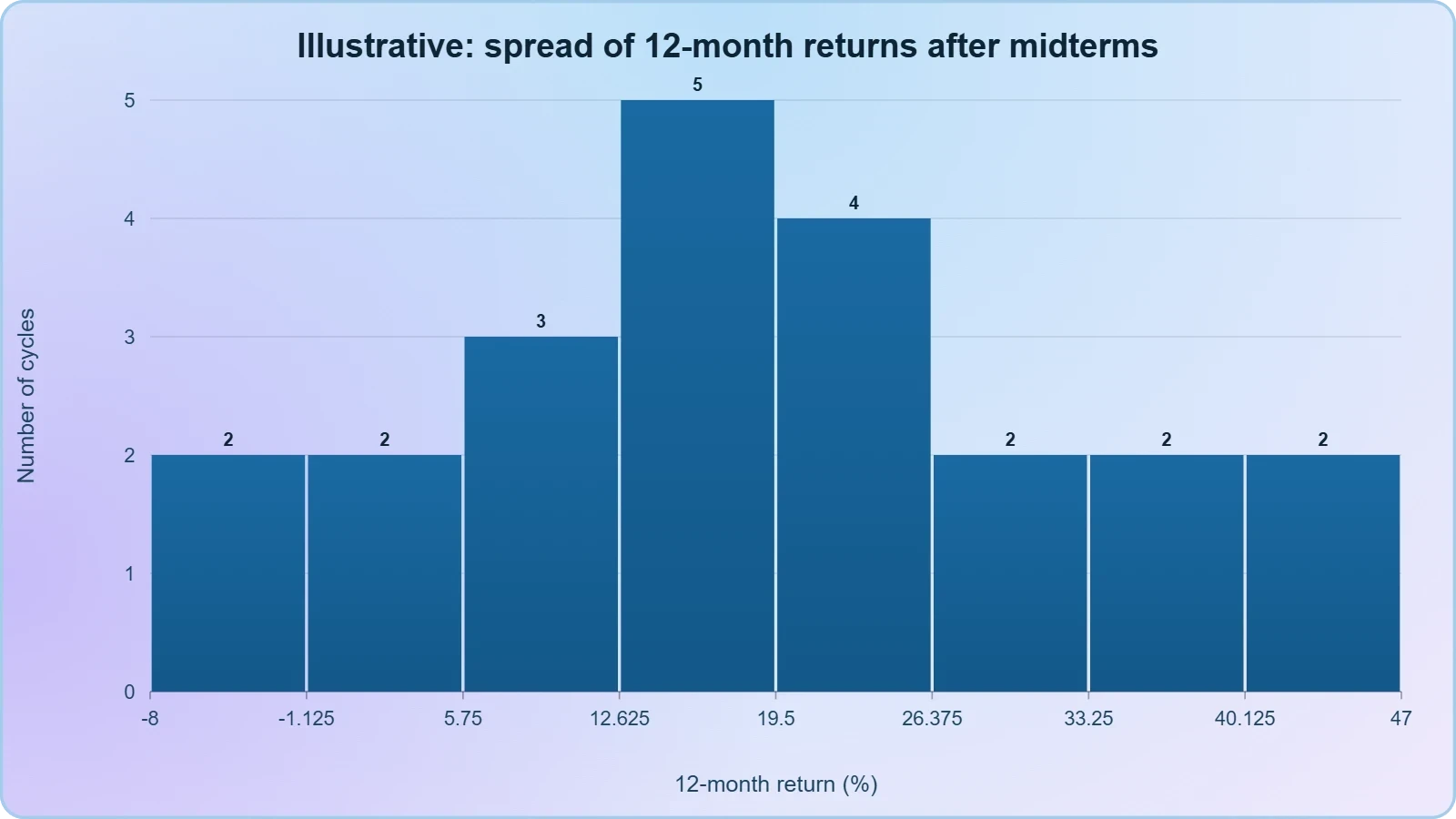
It is also worth noting that the historical pattern is not a causal law but a reflection of recurring conditions. Midterms resolve uncertainty, and resolved uncertainty tends to be rewarded. When the resolution coincides with supportive monetary conditions, as it does when yields are falling, the effect amplifies. When it coincides with tightening or recession, it can be overwhelmed. Investors should therefore use the historical baseline as one input among many, weighing it against current valuations, earnings trajectories, and the specific policy configuration that divided government produces.
Positioning for the Year Ahead
Practical positioning for the coming year should reflect both the historical tailwind and the specific sector dynamics the midterms revealed. Large-cap technology platforms appear well positioned given reduced legislative tail risk, while semiconductor and data center exposure requires more selective analysis of state-level regulatory developments. Financials and energy warrant attention depending on the trajectory of yields and crude prices. Canadian equities, buoyed by their financial and resource weighting, may continue to benefit from cross-border stability. Diversification across these exposures, rather than concentrated bets on any single narrative, remains the most defensible approach.
Risk management deserves equal emphasis. The rally's magnitude means some optimism is already priced in, and any disappointment on de-escalation, earnings, or inflation could trigger sharp reversals. Investors should monitor congressional oversight activity, appropriations processes, and state-level AI rulemaking as concrete indicators of whether the favorable scenario is materializing. Position sizing and rebalancing discipline matter more than directional conviction when multiple tail risks are receding simultaneously, because the same convergence that produces sharp rallies can produce equally sharp corrections if the underlying assumptions shift.
Fiscal Policy, Debt, and the Bond Market Outlook
The budget outlook was among the anxieties that had weighed on markets for weeks before the election, and the results directly addressed it. A divided Congress makes large deficit-financed spending programs substantially harder to enact, which reduces expected Treasury issuance and supports bond prices. The roughly seven-basis-point decline in ten-year yields on both sides of the border reflects this fiscal channel alongside the oil-driven inflation relief. Investors who had worried that unified government would produce another round of fiscal expansion found their concerns alleviated, and the bond market's response was correspondingly constructive rather than merely reflexive.
Debt dynamics, however, do not disappear under divided government. Existing obligations continue to mature and require refinancing, and mandatory spending programs grow regardless of legislative gridlock. What changes is the marginal trajectory: fewer new programs, less incremental borrowing, and a slower pace of debt accumulation. For bond investors, this means the supply-demand balance for Treasuries improves at the margin, which supports yields at lower levels than would otherwise prevail. The improvement is incremental rather than transformative, and it depends on the absence of emergency fiscal responses to recession or crisis, which can override political constraints entirely.
Supply-Demand Dynamics for Government Debt
The supply-demand framework for government debt deserves careful attention because it determines whether the yield decline persists. Reduced expected issuance lowers the volume of new bonds that must be absorbed by the market, easing pressure on term premiums. Simultaneously, if de-escalation and softer oil reduce inflation expectations, real yields can decline without requiring any change in growth forecasts. The combination is powerful: less supply and lower inflation expectations both push yields down. Investors should watch auction demand and foreign participation data as indicators of whether this favorable configuration is holding or beginning to reverse.
Term premium, the extra compensation investors demand for holding longer-dated bonds, is particularly sensitive to fiscal expectations. When markets anticipate large deficits, term premiums rise; when they anticipate restraint, term premiums compress. The midterm outcome plausibly compresses term premiums by reducing the probability of major new spending. This effect can be substantial even if the absolute level of debt remains high, because what matters for pricing is the expected future path rather than the current stock. The seven-basis-point move is consistent with a modest term premium compression rather than a fundamental reassessment of fiscal sustainability.
Currency and Cross-Border Capital Flows
Cross-border capital flows add another layer to the analysis. Falling US yields can weaken the dollar, which supports commodity prices and benefits Canadian exporters, though the relationship is complicated when both countries' yields decline in tandem. The synchronized seven-basis-point move suggests that investors are repricing North American risk collectively rather than rotating between the two markets. For Canadian investors, this means the TSX's 2.28 percent gain reflects genuine domestic and continental optimism rather than currency effects, a distinction that matters for assessing whether the rally has fundamental support.
Currency dynamics also influence sector performance. A softer dollar tends to benefit multinational US companies with large overseas earnings, supporting the large-cap technology names that rallied. It can pressure financials through narrower interest rate spreads, though the effect varies by institution. For Canadian markets, the currency relationship with energy prices is particularly important given the TSX's resource weighting. Investors navigating this environment should consider currency exposure as an active variable rather than a passive residual, since the same policy shifts that drive equity and bond moves also reshape relative currency valuations.
What Investors Should Watch Next
The coming months will reveal whether the market's optimistic interpretation of divided government proves durable. Several concrete indicators deserve close monitoring. Congressional oversight activity, particularly hearings involving technology companies and defense appropriations, will signal how aggressively Democrats intend to scrutinize the AI sector and the Iran conflict. State-level regulatory developments in the five states Jefferies tracks will determine whether data center buildout faces safeguards or obstacles. Treasury auction demand and foreign participation data will indicate whether the fiscal channel is holding. Each of these indicators translates political developments into measurable market variables, and together they form a practical dashboard for the year ahead.
Earnings season will provide the ultimate test of whether the rally's optimism is justified by fundamentals. The midterm-driven repricing assumed that reduced policy uncertainty would support valuations, but valuations ultimately depend on cash flows. If large-cap technology continues to deliver strong earnings, the rally has a solid foundation. If semiconductor and data center earnings disappoint because of regulatory delays or capital cost increases, the sector divergence observed on election day may widen. Investors should treat the political analysis as a framework for understanding risk rather than a substitute for fundamental research, since policy shifts create opportunities and hazards that only company-level analysis can fully capture.
Key Indicators and Monitoring Framework
A disciplined monitoring framework should prioritize leading indicators over lagging ones. Congressional committee announcements, gubernatorial policy statements, and appropriations markup schedules all precede actual legislative outcomes and therefore provide earlier signals. Similarly, credit default swap spreads for data center operators can reveal stress before equity prices adjust. Oil futures curves indicate whether de-escalation expectations are deepening or fading. Yield curve shape, particularly the term premium component, shows whether fiscal restraint is being priced. Investors who track these variables systematically will be better positioned than those reacting to headlines after the fact.
The framework should also include explicit scenario analysis. A benign scenario involves sustained de-escalation, falling yields, and strong earnings, producing returns consistent with the historical 19.9 percent average. A neutral scenario involves policy gridlock without major shocks, producing moderate gains. An adverse scenario involves renewed geopolitical escalation, inflation resurgence, or earnings disappointments, producing volatility and potential losses. Assigning rough probabilities to each scenario and sizing positions accordingly is more robust than betting entirely on the favorable outcome, particularly after a rally that has already priced in considerable optimism.
Balancing Optimism with Risk Discipline
The most important discipline in the current environment is balancing justified optimism with rigorous risk management. The historical record, the policy relief, and the de-escalation signals all support constructive positioning. But the rally's magnitude means that much of the good news is already reflected in prices, and the same convergence of favorable factors that produced the surge can reverse if any component falters. Investors should maintain diversification across sectors and geographies, avoid excessive concentration in any single narrative, and keep sufficient liquidity to respond to opportunities that volatility may create.
Ultimately, the midterm elections delivered what markets wanted: reduced uncertainty, divided government, and a lower probability of extreme policy outcomes. That is a genuine and meaningful development, and the rally it produced was rational. But markets move in cycles, and the conditions that favor equities today can evolve. The investors who navigate the next year most successfully will be those who appreciate both the historical tailwind and the specific risks embedded in the current configuration, holding conviction where evidence supports it and humility where it does not.
From our network :
- Forbidden Matrix Patterns and Visible Lattice Points: A Geometric DictionaryExplore how multidimensional 0–1 matrices encode geometric truths, linking forbidden patterns to visible lattice points and hypergraph theory, with applications in combinatorics and computational geometry.
- University Language Proficiency Exams: Why Institutional Tests Demand Different Preparation Than IELTS and TOEFLDiscover why university-specific language proficiency examinations differ fundamentally from IELTS and TOEFL, and learn strategic preparation approaches for institutional assessment success.
- CISA’s Ten-Advisory Wave: Why Generic Patching Fails in OT and How to Build Product-Specific PlaybooksCISA released ten ICS advisories in one week, exposing critical infrastructure risks. Generic patching fails in OT. Learn to build product-specific remediation playbooks.
- Mobile Learning and VR in English: What Global Evidence Reveals About Effective Language TechnologyA systematic review across 14 countries reveals which language-learning technologies genuinely work. Mobile learning, AI, and VR show measurable benefits when pedagogically integrated. This evidence-based guide helps educators and learners select technology that delivers real return on investment.
- The Hidden Cost of AI Convenience: Why Over-Permissioned Agents Are a Security Time BombDiscover why AI agents with excessive permissions create dangerous single points of failure, and learn how implementing least privilege principles can protect your organization from exploitation.
- Committed Mediterranean Precipitation Decline: Why Emissions Cuts Alone Cannot Restore Winter RainsNew NOAA research reveals that Mediterranean winter rains may decline irreversibly even with emissions cuts. Explore the science of committed climate change and regional impacts.
- The Final Descent: How ESA Retired the Legendary Cluster Constellation After 24 Years of Space Weather ScienceAfter 24 years mapping Earth’s magnetosphere, ESA’s Cluster mission concluded with a precisely controlled reentry over the South Pacific. This analysis explores the scientific legacy, engineering decisions, and debris mitigation principles behind one of space exploration’s most responsible retirements.
- Live Online English Classes for Kids: Do They Actually Reduce Anxiety?A ten-week study reveals that synchronous online English classes can significantly reduce child language anxiety while improving listening and reading skills. Discover what makes these programs effective and how parents can select the right one.
- How AI Agents Will Change the Way We Manage Personal FinancesExplore how AI agents are transforming personal finance through automated budgeting, bill payment, and investment management, while examining the critical security protocols and governance frameworks required for safe deployment.
RESOURCES
- Resources will be updated soon.
- 01
- 02
- 03
- 04
- 05
- 06
- 07
- 08
0 Comments