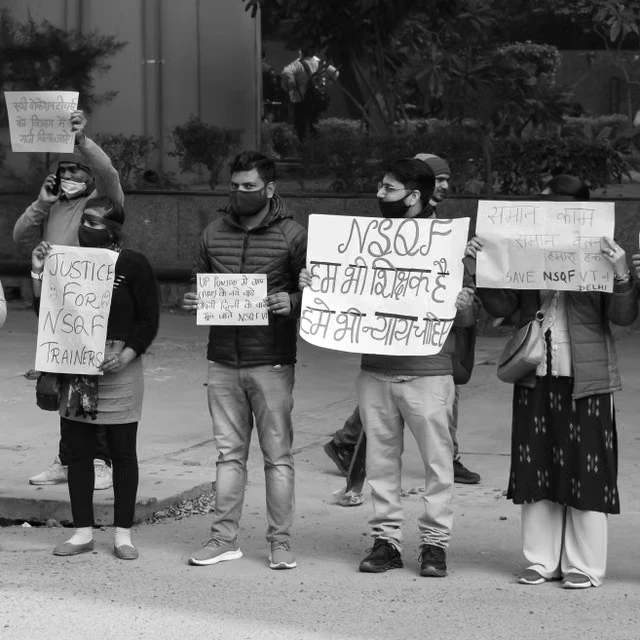
Delhi’s latest confrontation over protest rights has moved from the street to the constitutional arena, and the stakes are unmistakably high. A habeas corpus-style petition has reached the Supreme Court seeking the immediate release and disclosure of whereabouts of Cockroach Janta Party leaders and associates allegedly detained after arriving in the capital for a demonstration tied to electoral-roll revision and the Chief Election Commissioner.
The dispute is not merely about one protest or one political formation. It cuts to the hard center of civil liberties: whether authorities may prevent a gathering, then proceed to detain organizers, supporters, or prospective participants without transparent legal grounds.
The petition demands records, identities, custody details, and CCTV preservation—an unmistakable effort to force state power into the open and make every detention answerable to law.
On This Page
The legal significance is sharpened by timing. The petition was filed under Article 32, the Constitution’s most direct remedy for fundamental-rights enforcement, and asked for an urgent hearing before a Special Bench. That choice signals a claim that the alleged detentions are not routine policing matters but a serious constitutional injury requiring immediate judicial scrutiny.
TL;DR A petition has been filed in the Supreme Court seeking disclosure and release of CJP founder Abhijeet Dipke, co-convener Saurav Das, spokesperson Ashutosh Ranka, and others allegedly detained in Delhi after a protest linked to the Chief Election Commissioner and electoral-roll revision. The plea invokes Article 32, demands arrest records, custody details, and CCTV preservation, and argues that denial of protest permission does not justify opaque detentions.
What the petition actually seeks
The petition is structured as a direct constitutional challenge to alleged custodial action following a political protest. It asks the court to order the immediate release of anyone detained without lawful authority and to compel disclosure of who was taken, where they were taken, and on what basis the authorities acted. In effect, it seeks both liberty and accountability.
Disclosure of identities and custody status
One of the strongest features of the plea is its insistence on transparency. It requests the names of every detained person, the grounds communicated to them, and their current whereabouts. Such demands are central to habeas corpus logic, because unlawful custody becomes especially dangerous when the state refuses to identify where a person is being held.
The petition also seeks production of arrest records, police station diaries, and movement registers. Those documents matter because they establish a lawful chain of custody, reveal the time and location of detention, and help test whether the state followed proper procedure or merely improvised a detention narrative after the fact.
Preservation of evidence and surveillance material
The plea goes further by asking for CCTV footage from the airport, police stations, lock-ups, and related locations, alongside control-room logs. That is a serious and calculated request, because video and dispatch records often decide whether official accounts hold up under scrutiny. Without preservation, the evidentiary trail can disappear quickly.
In practical terms, this means the petition is not relying only on assertion; it is trying to anchor the court’s review in material proof. If the judiciary orders preservation, it prevents retroactive sanitization of the record and protects the factual basis needed to judge whether detention was lawful, arbitrary, or politically motivated.
| Legal demand | Purpose |
|---|---|
| Immediate release | End detention found to lack lawful authority |
| Disclosure of whereabouts | Confirm the location and status of each detained person |
| Arrest and station records | Verify procedure, timing, and legal basis |
| CCTV and logs | Preserve evidence against later dispute or deletion |
Why Article 32 matters here
Article 32 is not a ceremonial clause; it is the Constitution’s emergency valve for rights enforcement. By approaching the Supreme Court under this provision, the petitioner is asserting that the alleged detention implicates fundamental rights so directly that ordinary delay would itself deepen the injury. The choice of remedy is therefore as important as the underlying grievance.
Habeas corpus and the burden on the state
The logic of habeas corpus is mercilessly simple: if a person is being restrained, the state must justify it. Once the petitioner alleges unlawful detention, the burden shifts toward explanation, documentation, and disclosure. In cases like this, ambiguity is not a defense; it is often the very problem the court is being asked to cure.
That is why the petition seeks a hearing before a Special Bench the very next day. Urgency is not ornamental here. In alleged custodial matters, time can determine whether a person is produced, transferred, coerced, or left in an evidentiary void that later becomes impossible to reconstruct.
What the court will likely examine first
The court’s immediate concern will be whether these were lawful detentions made under a valid power or a suppressive response to a planned protest. It will also assess whether the petitioners have enough factual material to justify extraordinary relief. If the pleadings are credible, the court may require quick status reports and custody disclosures.
A second issue is procedural fairness. Even where police action is claimed to be preventive, the state must still show a lawful basis, proper records, and a coherent chain of events. In constitutional litigation, the quality of the paperwork can become the quality of the defense.
We Also Published
Why the protest itself became legally sensitive
The underlying protest involved the Chief Election Commissioner and a special intensive revision of electoral rolls, which places the event squarely within the sensitive intersection of election administration and political dissent. When electoral processes are contested, public demonstrations can quickly become politically charged. That does not erase the right to protest, but it does heighten state sensitivity.
From political gathering to custody dispute
According to the petition, the leaders were intercepted after landing at Indira Gandhi International Airport and before they could reach Jantar Mantar. That detail is important because it suggests the alleged restraint occurred not at the protest site but before the demonstration could even begin. In constitutional terms, that changes the factual texture of the case.
If the state acted to prevent participation rather than respond to disorder, the legal justification becomes more delicate and more exposed to challenge. Authorities may regulate assemblies, but they cannot casually convert regulatory displeasure into opaque custody. The distinction between dispersing a gathering and detaining its organizers is not academic; it is constitutional.
What makes this different from a routine policing matter
The petition argues that denial of permission for a demonstration cannot, by itself, justify detaining organizers, advocates, supporters, or potential participants. That principle matters because protest permission and personal liberty are not interchangeable. A refusal to permit assembly may be contested, but detention requires an independent lawful basis.
Seen that way, the petition tries to prevent a troubling shortcut: suppressing dissent through custody rather than through a legally defensible restriction. Courts are usually attentive to such shortcuts because once protest and custody are blurred together, the ordinary safeguards of public order begin to erode.
| Key question | Why it matters |
|---|---|
| Was there a valid arrest? | Determines whether confinement was lawful or arbitrary |
| Was a grounds memo provided? | Tests compliance with procedural fairness |
| Was the detention preventive? | Shows whether authorities claim public-order justification |
| Were records preserved? | Ensures the court can verify the state’s version |
Who has been named and why the respondent list matters
The petition names the Union government, the Government of the National Capital Territory of Delhi, senior Delhi Police officials, and the States of Haryana, Maharashtra, and Uttar Pradesh as respondents. That spread is not accidental. It suggests the petitioner believes the chain of responsibility may extend beyond one city police operation and may involve coordination across jurisdictions.
Multi-state naming as a strategic signal
When respondents span multiple governments, the pleading is telling the court that the custody trail may cross administrative boundaries. That can matter if transportation, surveillance, pickup, or transfer involved different agencies. It also prevents a narrow denial from one authority from obscuring a broader operational network.
In high-profile liberty disputes, naming multiple respondents often serves a practical function: it blocks institutional buck-passing. If one agency claims ignorance, another cannot quietly benefit from the gap. The court is then asked to force a complete and coordinated account rather than a fragmented official story.
The larger constitutional message
The broader message of the case is stark. A democracy cannot convincingly defend electoral legitimacy while leaving allegations of unexplained detention unanswered. Even where public order is invoked, legal authority must be visible, documented, and reviewable. That is the price of constitutional governance.
If the court grants prompt scrutiny, it may reinforce a clear rule: protest may be regulated, but liberty cannot be hidden behind administrative silence. If it does not, the consequences will be read far beyond one political party and one march in Delhi. The dispute is therefore larger than the names attached to it; it is about the discipline of state power itself.
- 01
- 02
- 03
- 04
What this case could mean beyond the immediate dispute
This matter may become a test of how seriously the system treats custodial transparency in politically sensitive situations. If the court requires swift disclosure, the case could strengthen the practical meaning of liberty safeguards. If the record remains opaque, it will deepen anxieties about how protest-related detentions are managed behind institutional walls.
A test of democratic restraint
Democratic order is not measured by how aggressively authority can interrupt dissent. It is measured by how carefully that authority can justify itself afterward. The petition places that principle before the court in a concrete, uncomfortable form: if the state detained these individuals, it must say so plainly and prove it.
That is why the case matters well beyond the CJP and its leadership. It asks whether constitutional language still disciplines power in moments of political friction. If it does, the records will speak. If they do not, the silence itself will become the story.
The practical consequences of judicial intervention
Should the court intervene immediately, the result could include production orders, custody disclosures, and preservation directions that freeze the evidentiary landscape. Such orders would not decide the protest’s politics; they would decide whether the state behaved within law. That distinction is essential and often misunderstood.
Even a limited procedural order can have large institutional effects. It signals that liberty claims will not be brushed aside simply because the underlying episode involves protest, politics, and public controversy. In that sense, the petition is not only asking where people are; it is asking how power is allowed to operate in the first place.
The final takeaway
This is a liberty case dressed in the language of protest and public administration. The petition does not merely seek sympathy for detained leaders; it seeks legal visibility. In constitutional matters, visibility is often the first condition of accountability, and accountability is the first condition of legitimacy.
The core lesson
The core lesson is direct and uncompromising: if the state detains, it must document; if it transfers, it must trace; if it restricts protest, it must justify the restriction without hiding behind procedural fog. That is the discipline the petition is trying to enforce, and that is the standard the court may be asked to apply.
Whatever the political temperature of the underlying protest, the legal question remains the same. Were these detentions lawful, documented, and reviewable? If not, the Constitution offers a remedy not out of sentiment, but out of necessity.
| Issue | Bottom-line reading |
|---|---|
| Detention claim | Alleged custody after airport interception in Delhi |
| Legal remedy | Article 32 petition seeking release and disclosure |
| Evidence sought | Records, logs, diaries, and CCTV preservation |
| Constitutional issue | Whether protest control can lawfully become opaque detention |
From our network :
- Committed Mediterranean Precipitation Decline: Why Emissions Cuts Alone Cannot Restore Winter RainsNew NOAA research reveals that Mediterranean winter rains may decline irreversibly even with emissions cuts. Explore the science of committed climate change and regional impacts.
- University Language Proficiency Exams: Why Institutional Tests Demand Different Preparation Than IELTS and TOEFLDiscover why university-specific language proficiency examinations differ fundamentally from IELTS and TOEFL, and learn strategic preparation approaches for institutional assessment success.
- Forbidden Matrix Patterns and Visible Lattice Points: A Geometric DictionaryExplore how multidimensional 0–1 matrices encode geometric truths, linking forbidden patterns to visible lattice points and hypergraph theory, with applications in combinatorics and computational geometry.
- The Hidden Cost of AI Convenience: Why Over-Permissioned Agents Are a Security Time BombDiscover why AI agents with excessive permissions create dangerous single points of failure, and learn how implementing least privilege principles can protect your organization from exploitation.
- CISA’s Ten-Advisory Wave: Why Generic Patching Fails in OT and How to Build Product-Specific PlaybooksCISA released ten ICS advisories in one week, exposing critical infrastructure risks. Generic patching fails in OT. Learn to build product-specific remediation playbooks.
- Mobile Learning and VR in English: What Global Evidence Reveals About Effective Language TechnologyA systematic review across 14 countries reveals which language-learning technologies genuinely work. Mobile learning, AI, and VR show measurable benefits when pedagogically integrated. This evidence-based guide helps educators and learners select technology that delivers real return on investment.
- Live Online English Classes for Kids: Do They Actually Reduce Anxiety?A ten-week study reveals that synchronous online English classes can significantly reduce child language anxiety while improving listening and reading skills. Discover what makes these programs effective and how parents can select the right one.
- The Final Descent: How ESA Retired the Legendary Cluster Constellation After 24 Years of Space Weather ScienceAfter 24 years mapping Earth’s magnetosphere, ESA’s Cluster mission concluded with a precisely controlled reentry over the South Pacific. This analysis explores the scientific legacy, engineering decisions, and debris mitigation principles behind one of space exploration’s most responsible retirements.
- How AI Agents Will Change the Way We Manage Personal FinancesExplore how AI agents are transforming personal finance through automated budgeting, bill payment, and investment management, while examining the critical security protocols and governance frameworks required for safe deployment.
RESOURCES
- Indian opposition marches to Supreme Court, seeks suspension of ...reuters.com1 day ago ... ... detained thousands of protesters, including CJP leaders, and locked down central Delhi. COURT HEARING EXPECTED ON TUESDAY. The opposition ...
- Cockroach Janata Party member has filed a habeas corpus petition ...instagram.com2 days ago ... CJP Leaders Released from Detention The Delhi Executive Magistrate Court has ordered the release of CJP leaders Abhijeet Dipke, Saurav…
- Protest Leaders Rounded Up as New Delhi Is Locked Downnytimes.com1 hour ago ... ... detained on Saturday during protests outside the Supreme Court and Patiala House court. ... Delhi airport at 10 a.m.…
- The Supreme Court will hold a special hearing on petitions ...facebook.com2 days ago ... Another challenges the legality of preventive detentions and seeks the release of detained leaders, including West Bengal Chief Minister Mamata ...
- Anti-CEC protest Highlights, October 11: CJI Surya Kant declines to ...thehindu.com2 days ago ... CJP protests in Delhi claim peaceful demonstrations were unlawfully restrained, police detained leaders, and Supreme Court urged normal metro ...
- CJP co-ordinator moves SC seeking release of Dipke, other detaineesnewindianexpress.com3 days ago ... ... Delhi airport on October 10 ahead of a protest against CEC ... MUMBAI: A habeas corpus petition has been…
- Anti-CEC protest Highlights, Oct 10: CJP calls for ... - The Hinduthehindu.com3 days ago ... ... leaders detained by Delhi Police. Delhi protest: Left leaders ... Contempt petition filed in Supreme Court over continued blanket ...
- India news: Opposition parties march to Supreme Court - DW.comdw.com17 hours ago ... INDIA bloc files petition at Supreme Court ... However, the protests were forcefully thwarted and the CJP leaders were detained…
- India court orders release of 'cockroach' movement leaders after ...france24.com2 days ago ... CJP founder Abhijeet Dipke and two other leaders were detained before ... India's Supreme Court was set to hear a…
- CEC Protest: CJP Moves Supreme Court Seeking Release of ...livelaw.in3 days ago ... Cockroach Janata Party member has filed a habeas corpus petition in the Supreme Court seeking production and release of its…
- Delhi protests: Supreme Court moved for release of detained CJP ...barandbench.com3 days ago ... The habeas corpus petition seeks disclosure of the whereabouts of detained leaders and preservation of CCTV footage, police diaries and ...
- CJP denies filing SC petition over detention of party leaders - AP7AMap7am.com2 days ago ... ... Supreme Court petition for the release of detained leaders. Over 3000 protesters were held in Delhi during demonstrations..
- Several Petitions in Supreme Court, CJP Leaders Detained at Jantar ...m.thewire.in8 hours ago ... Detentions of journalists, activists, students, an MP, and everyone gathered in and around central Delhi, have often been brutal, ...
- India locks down capital, detains Gen Z protest leaders over voter ...christiandaily.com3 days ago ... Delhi Police also detained CJP founder Abhijeet Dipke and party leaders ... A CJP member, Gaurav Bharti, has asked the…
- Indian opposition protesters in New Delhi call on election chief to quitaljazeera.com20 hours ago ... Indian media reported that Gandhi filed a petition with the Supreme Court Monday on behalf of opposition leaders against the…
- 01
- 02
- 03
- 04
- 05
- 06
- 07
- 08
0 Comments