The verdict delivered at Auckland District Court on 3 November 2026 closes a difficult chapter in a case that has tested the patience of complainants, prosecutors, and the jury alike. A retired music teacher now stands convicted of sex offences against three teenage girls, a man whose professional life had once been built around instruction, trust, and the mentorship of young people. The jury's findings, reached after deliberation that required a majority direction from Judge Kathryn Maxwell, carry weight far beyond the courtroom itself. They speak to how institutions entrusted with children's development can become sites of profound harm, and to the slow, often painful machinery through which survivors seek accountability.
What makes this case instructive is not merely the outcome but the texture of the evidence and the arguments deployed in defence. The defendant admitted sexual contact with two complainants yet insisted they were over sixteen at the time, and he further claimed that a fourteen-year-old girl initiated contact with him. The jury rejected both propositions. Under cross-examination he conceded that a kiss with the fourteen-year-old was "not unpleasant" in its opening seconds, and he acknowledged that statements given in a police interview diverged from his trial testimony, attributing the discrepancy to a faulty memory. These admissions, layered atop the complainants' accounts, formed the evidentiary spine of the prosecution's case.
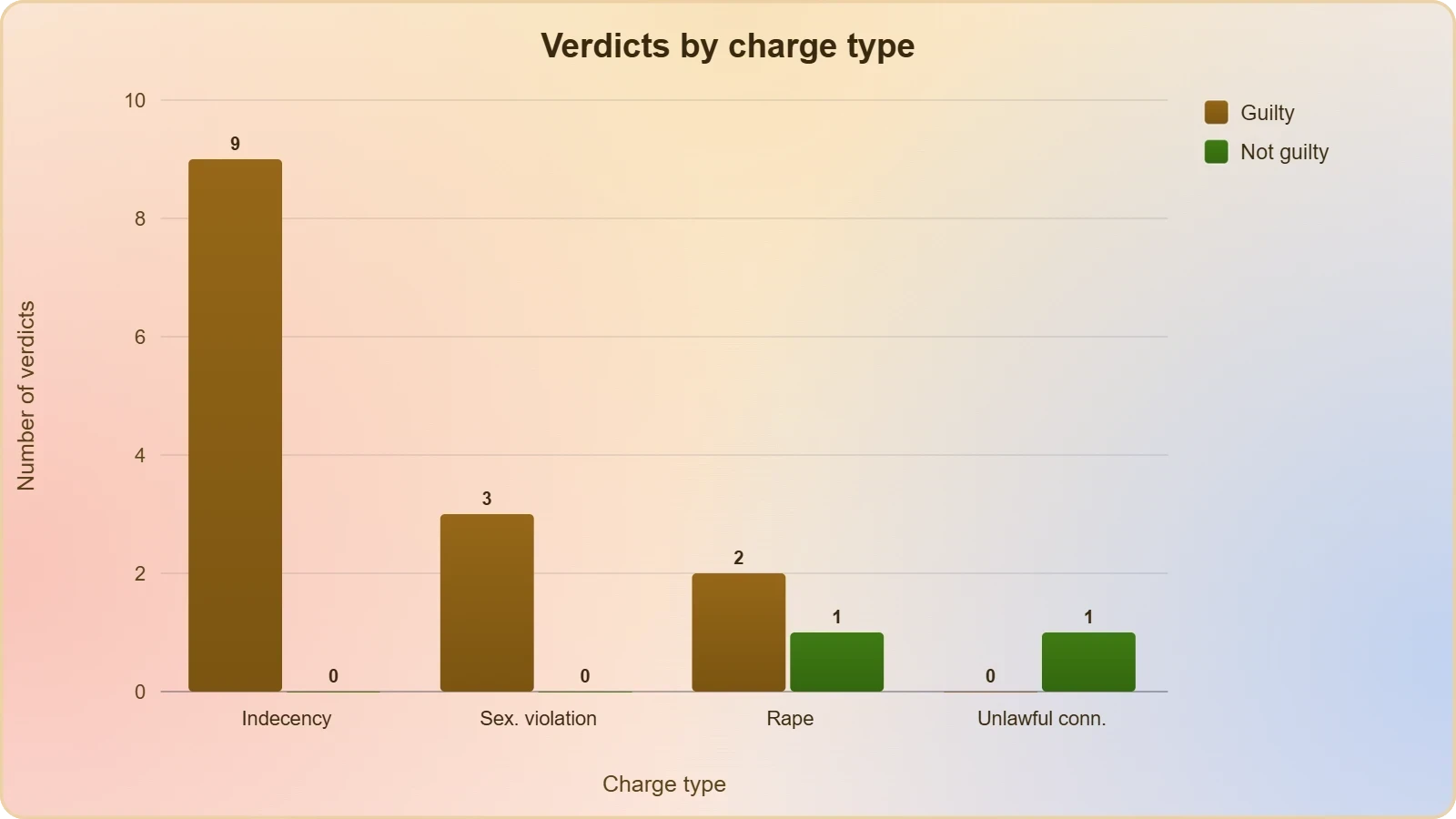
The procedural dimensions deserve equal attention. Twelve charges produced guilty verdicts, spanning nine counts of indecency with a girl, three of sexual violation, and two of sexual violation by rape, while the jury acquitted on one rape charge and one charge of unlawful sexual connection. Because unanimity proved elusive on most counts, the judge permitted majority verdicts provided all but one juror concurred. Interim name suppression, originally set to lapse after the verdicts, was extended pending a hearing, with defence counsel Anoushka Bloem signalling possible appeal and seeking bail on compassionate grounds. The man faces a maximum of twenty years' imprisonment when sentenced next year.
On This Page
TL;DR A retired Auckland music teacher has been convicted on twelve charges of sexual offending against three teenage girls, following a District Court jury trial in which majority verdicts were accepted on most counts. The defendant admitted sexual contact with two complainants but disputed their ages, and claimed a fourteen-year-old initiated contact; the jury rejected these defences. He was acquitted on two charges, has had interim name suppression extended until a hearing, and faces up to twenty years in prison at sentencing next year. The case raises enduring questions about safeguarding, institutional trust, and the treatment of young complainants within the criminal justice system.
The Anatomy of the Verdict and Its Legal Weight
The verdict is best understood as a composite rather than a single finding. Twelve guilty verdicts across three complainants represent a pattern the jury found credible beyond reasonable doubt, even where individual counts produced disagreement. New Zealand's jury system permits majority verdicts only after a judge is satisfied that further deliberation will not yield unanimity, a safeguard designed to prevent mistrials without diluting the standard of proof. Judge Maxwell's decision to accept majority verdicts on most charges, while the jury acquitted outright on two counts, illustrates a panel that weighed evidence count by count rather than treating the allegations as an undifferentiated whole.
Majority Verdicts and the Standard of Proof
The mechanics of a majority verdict deserve careful explanation because they are frequently misunderstood by the public. In New Zealand, section 46C of the Juries Act 1981 allows a judge to accept a verdict reached by all but one juror, but only after the jury has deliberated for at least four hours and the judge is satisfied that reasonable further deliberation will not produce unanimity. The safeguard exists to balance two competing values: the right of a defendant to a verdict reflecting genuine consensus, and the public interest in avoiding the expense and trauma of retrial where a single holdout juror obstructs closure.
In this case, the pattern of verdicts is telling. The jury convicted on nine indecency charges, three sexual violation charges, and two charges of sexual violation by rape, yet acquitted on one rape charge and one charge of unlawful sexual connection. That granularity suggests the panel scrutinised each allegation against the specific complainant's evidence, rather than allowing a general impression of guilt to sweep across all counts. For appellate purposes, such discrimination in verdicts often strengthens rather than weakens a conviction, because it demonstrates that the jury applied its mind to the particulars of each charge.
Suppression, Bail, and the Road to Sentencing
Interim name suppression in New Zealand is governed by section 200 of the Criminal Procedure Act 2011, which permits a court to suppress a defendant's identity where publication would create a real risk of prejudice to a fair trial, or where extreme hardship to the defendant or others outweighs the public interest in open justice. Here, suppression was originally scheduled to lapse upon verdict, but defence counsel Anoushka Bloem successfully sought continuation until a hearing the following week, citing the defendant's consideration of appeal options. The extension is temporary and contested terrain; courts are generally reluctant to sustain suppression post-conviction absent compelling grounds.
The bail application adds another layer. Bloem cited a family member's ill health as the basis for continued liberty until sentencing, but prosecutor Kasey Nihill opposed the request, noting that the family member had last been hospitalised in April. Judge Maxwell's observation that the outcome was inevitable, given the jury's findings, signals a court disinclined to treat the convicted man as a candidate for bail. In practice, defendants convicted of serious sexual offences are remanded in custody pending sentence unless exceptional circumstances apply, and the judge's remarks suggest the threshold was not met.
We Also Published
Defence Strategy and the Credibility Contest
Trials of this nature almost always reduce to a contest of credibility, and the defence here pursued a familiar architecture: concede contact, contest consent and age, and challenge the reliability of the complainants' recollections. The defendant admitted having sex with two of the complainants but asserted they were over sixteen, the age of consent in New Zealand. He further argued that a fourteen-year-old girl initiated sexual contact with him. These propositions placed the burden squarely on the jury to decide whether the complainants' accounts or the defendant's version carried the ring of truth, and the panel's verdicts indicate it found the former far more persuasive.
The "Not Unpleasant" Admission and Its Consequences
Perhaps the most damaging moment for the defence came under cross-examination, when the teacher accepted that a kiss with the fourteen-year-old was "not unpleasant" for the first few seconds. That concession did considerable work for the prosecution. It undercut any suggestion of revulsion, mistake, or passive victimhood on his part, and it framed the contact as something he experienced with a measure of enjoyment. In a case turning on whether a child initiated sexual contact, an admission of pleasure in the encounter is difficult to reconcile with the narrative of an unwitting participant, and the jury plainly drew that inference.
The admission also illustrates a broader prosecutorial technique in sexual offending trials: isolating a single, vivid concession and allowing it to illuminate the defendant's state of mind. Jurors are instructed to consider the evidence as a whole, but human reasoning gravitates toward concrete details. A phrase like "not unpleasant" lodges in memory and colours the interpretation of surrounding testimony. Defence counsel must therefore weigh carefully whether to challenge such statements or to contextualise them, and in this instance the attempt to explain away the contact appears to have failed.
Memory, Police Interviews, and Prior Statements
The defendant's acknowledgement that his police interview statements differed from his trial evidence, explained by reference to a faulty memory, introduced a further vulnerability. Prior inconsistent statements are a staple of cross-examination because they invite the jury to ask a simple question: which version is true, and why did the account change? When a defendant attributes discrepancies to memory failure, the explanation may be accepted if it is plausible and consistent with the surrounding evidence, but it can also be read as convenient amnesia triggered by the gravity of the charges.
New Zealand evidence law permits prior statements to be used both to impeach credibility and, in certain circumstances, as substantive evidence. The practical effect here was to place the defendant's reliability at the centre of the trial. Once a jury concludes that a witness has given materially different accounts at different stages, every subsequent assertion is viewed through a lens of scepticism. The acquittals on two counts show the jury did not simply reject everything the defence said, but the convictions demonstrate that the core of the complainants' evidence survived the challenge intact.
Safeguarding Failures in Educational Settings
Cases involving teachers inevitably invite scrutiny of the institutions that employed them. Music tuition carries particular characteristics that complicate safeguarding: lessons are frequently one-to-one, often conducted in enclosed rooms, and may involve physical proximity as a matter of pedagogy. These features are not inherently improper, but they create conditions in which boundaries can be tested and, where oversight is weak, breached. The conviction of a retired teacher with a long career behind him raises uncomfortable questions about whether warning signs were missed, whether complaints were handled promptly, and whether the profession's safeguarding architecture is adequate to the risks it accommodates.
One-to-One Tuition and Boundary Management
Professional music teaching bodies in New Zealand and abroad have increasingly codified expectations around solo instruction. Recommended practice includes leaving doors ajar or glazing panels unobstructed, maintaining a visible line of sight from outside the room, keeping records of lesson times, and avoiding transport of students in private vehicles. These measures are not accusations against teachers; they are structural safeguards that protect both students and practitioners. Where such protocols are absent or unenforced, the burden of boundary maintenance falls disproportionately on young people, who are least equipped to assert it against an authority figure.
The vulnerability is compounded by the nature of musical mentorship. A teacher who has guided a student through examinations, competitions, and performances occupies a position of genuine significance in that young person's life. Gratitude, admiration, and dependence can blur the clarity of judgment that safeguarding requires. The law recognises this asymmetry through the age of consent and through specific offences covering sexual conduct with young persons in care or authority relationships. The verdicts in this case affirm that the passage of time and the retirement of the offender do not diminish the seriousness of conduct that exploited that asymmetry.
Delayed Disclosure and the Complainant's Path
Sexual offending against young people is frequently disclosed years after the events, a pattern well documented in criminal justice research. Victims may remain silent because of shame, fear of not being believed, confusion about what occurred, or the influence of the offender. Delayed disclosure creates evidentiary challenges: physical evidence is absent, memories have faded, and the passage of time may be invoked by the defence to suggest fabrication or reconstruction. Yet courts have increasingly recognised that delay is itself a common feature of genuine complaints, and that the absence of contemporaneous reporting should not be treated as proof of falsity.
The three complainants in this case evidently came forward and gave evidence, a process that requires considerable courage. Cross-examination in sexual offending trials is notoriously demanding, and complainants must recount intimate details before strangers while the defendant watches. New Zealand has introduced measures such as alternative ways of giving evidence, including pre-recorded testimony and screens, to reduce the trauma of participation. The verdicts suggest that the jury found the complainants' accounts credible despite the pressures of the process, which is a modest vindication of a system that too often struggles to serve those it is meant to protect.
- 01
- 02
- 03
- 04
Sentencing Exposure and Appellate Prospects
With conviction secured, attention turns to sentencing, where the court must translate twelve verdicts into a finite term of imprisonment. The maximum penalty for sexual violation by rape in New Zealand is twenty years, and the Sentencing Act 2002 requires judges to apply guideline judgments that calibrate starting points according to the seriousness of the offending, the vulnerability of the victims, and the breach of trust involved. A teacher offending against teenage girls engages multiple aggravating factors simultaneously: the age of the complainants, the professional relationship, the repetition across three victims, and the duration of the conduct.
Guideline Judgments and Aggravating Features
New Zealand's Court of Appeal has issued guideline judgments for sexual offending that establish bands of starting points based on the nature of the acts and the presence of aggravating features. Breach of trust is among the most significant, and courts consistently treat offending by teachers, coaches, and clergy as warranting uplift beyond the baseline for the physical acts alone. The fact that three separate complainants gave evidence compounds the gravity, because it demonstrates a pattern rather than an isolated lapse. The defendant's age and retirement are unlikely to attract meaningful discount, though health and family circumstances may be considered at the margins.
Counsel for the defendant has signalled that appeal options are under consideration, which is unsurprising given the stakes. Grounds for appeal might include challenges to the adequacy of the judge's summing-up, the admission or exclusion of evidence, or the reasonableness of the verdicts. Appeals against conviction in jury trials face a high bar, because appellate courts are reluctant to second-guess a panel that heard the witnesses directly. An appeal against sentence is more common and typically turns on whether the starting point was correctly identified and whether discounts were properly applied. The extension of name suppression pending a hearing suggests the defence is preserving all avenues.
Victim Impact and the Purposes of Sentence
Sentencing in cases of this kind serves several statutory purposes: punishment, denunciation, deterrence, protection of the community, and recognition of the harm done to victims. Victim impact statements, if provided, will inform the judge's assessment of that harm, though they are not a mechanism for inflating penalty beyond what the law permits. The court must also consider the defendant's prospects of rehabilitation, which for an elderly first-time offender may be framed in terms of reduced risk rather than active reform. The tension between denunciation and humanity is a perennial feature of sentencing, and judges are required to hold both in view.
For the complainants, the sentence represents a formal acknowledgment of what they endured, though no term of imprisonment can restore what was taken. The criminal justice system's capacity to deliver closure is limited, and many survivors describe sentencing as one step in a longer process of recovery. What the verdicts do establish, unambiguously, is that the conduct was criminal, that the complainants were believed, and that professional standing offers no shield against accountability. That message carries beyond this courtroom, into schools, studios, and homes where similar dynamics may be unfolding unnoticed.
Public Interest, Open Justice, and Name Suppression
The suppression question sits at the intersection of two constitutional principles: open justice, which holds that courts conduct their business in public and that the public may know who has been convicted, and fair trial rights, which protect defendants from prejudicial publicity. New Zealand courts begin from a presumption of openness, and suppression orders are the exception. Post-conviction, the balance shifts further toward publication, because the risk of prejudicing a trial that has already concluded is diminished. The defence's request to extend suppression until sentencing, and the judge's decision to continue it pending a hearing, reflects the procedural caution courts apply when appeal is contemplated.
Open Justice and the Presumption of Publication
The principle of open justice is not merely a convention; it is embedded in the senior courts' inherent jurisdiction and reinforced by statutory provisions governing criminal procedure. Publication of a convicted person's name serves several functions: it informs the community, it holds the justice system accountable, and it may encourage other victims to come forward. In cases involving multiple complainants, the last of these functions is particularly salient, because publicity can prompt disclosure from others who have experienced similar conduct. Courts are alert to this dynamic and weigh it against the defendant's privacy interests.
Suppression may nonetheless be justified where publication would cause extreme hardship, where it would identify complainants, or where it would prejudice pending proceedings. The defence's reliance on appeal options is a recognised but limited ground; courts generally require more than a bare intention to appeal. The hearing scheduled for the following week will require the defendant to demonstrate specific, evidence-based reasons why continued suppression serves the interests of justice. If those reasons are not made out, the presumption of publication will prevail, and the man's identity will enter the public record.
Media Reporting and the Boundaries of Fair Coverage
Reporting on sexual offending trials imposes obligations on media that go beyond ordinary accuracy. Statutory prohibitions protect the identity of complainants, and breaches can result in prosecution. Journalists must also navigate the line between informative coverage and material that could prejudice related proceedings or retraumatise victims. The NZ Herald's report on this case, which forms the basis of this analysis, illustrates the conventions: the defendant is described by occupation and location rather than name, the complainants are not identified, and the evidence is summarised with attention to its legal significance rather than its sensational detail.
These conventions are not merely polite; they are legally mandated and ethically grounded. Sensational coverage of sexual offending can deter future complainants from reporting, undermine public confidence in the fairness of trials, and inflict further harm on those who have already testified. Responsible reporting treats the courtroom as a site of serious public business, deserving of careful description and contextual explanation. The challenge for media is to convey the gravity of the conduct while respecting the dignity of the people affected by it, a balance that is easier to state than to achieve under deadline pressure.
Broader Lessons for Institutions and Communities
Beyond the individual defendant, this case functions as a case study in institutional vulnerability. Schools, music academies, sports clubs, and community organisations all rely on adults who work closely with young people, and all face the same structural challenge: how to grant practitioners the autonomy their work requires while maintaining oversight sufficient to detect boundary violations. The answer is not suspicion of every teacher, which would corrode the relationships that make mentorship possible, but rather clear codes of conduct, accessible reporting mechanisms, and a culture in which concerns can be raised without fear of reprisal or disbelief.
Building Cultures of Disclosure
Research on safeguarding consistently finds that the most important protective factor is not any single policy but the culture in which policies operate. Organisations that respond promptly and seriously to concerns, that protect those who raise them, and that treat safeguarding as a shared responsibility rather than a compliance box to be ticked, are materially safer than those that rely on paperwork alone. Conversely, institutions that dismiss complaints as misunderstandings, or that prioritise reputation over the welfare of young people, create the conditions in which offending can persist undetected for years.
The passage of time in this case, with the defendant having retired before the allegations reached court, underscores the importance of historical complaints. Organisations should maintain records and processes capable of handling allegations about former staff, and they should recognise that a report about events years in the past may still be actionable and still matter profoundly to the person making it. The instinct to treat old complaints as stale or unprovable is precisely the instinct that allows patterns of abuse to continue across careers and institutions.
Supporting Complainants Through the Process
The criminal justice process is demanding for complainants, and the verdicts in this case represent the culmination of a journey that likely began long before any charge was laid. Support services, including victim advisors, court preparation programmes, and counselling, play a critical role in enabling complainants to participate. Their availability varies by region and resource, and gaps in provision can deter reporting or undermine the quality of evidence. Investment in these services is not a soft add-on to the justice system; it is a precondition of its effective operation in sexual offending cases.
Communities also have a role that extends beyond the courtroom. Families, schools, and peers shape whether a young person feels able to disclose harm and whether they are believed when they do. The verdicts here affirm that disclosure can lead to accountability, but they also remind us that the path is long, public, and often painful. A society that takes safeguarding seriously must attend not only to punishment of offenders but to the conditions that make disclosure possible and the support that makes participation survivable.
From our network :
- University Language Proficiency Exams: Why Institutional Tests Demand Different Preparation Than IELTS and TOEFLDiscover why university-specific language proficiency examinations differ fundamentally from IELTS and TOEFL, and learn strategic preparation approaches for institutional assessment success.
- How AI Agents Will Change the Way We Manage Personal FinancesExplore how AI agents are transforming personal finance through automated budgeting, bill payment, and investment management, while examining the critical security protocols and governance frameworks required for safe deployment.
- The Final Descent: How ESA Retired the Legendary Cluster Constellation After 24 Years of Space Weather ScienceAfter 24 years mapping Earth’s magnetosphere, ESA’s Cluster mission concluded with a precisely controlled reentry over the South Pacific. This analysis explores the scientific legacy, engineering decisions, and debris mitigation principles behind one of space exploration’s most responsible retirements.
- Live Online English Classes for Kids: Do They Actually Reduce Anxiety?A ten-week study reveals that synchronous online English classes can significantly reduce child language anxiety while improving listening and reading skills. Discover what makes these programs effective and how parents can select the right one.
- Committed Mediterranean Precipitation Decline: Why Emissions Cuts Alone Cannot Restore Winter RainsNew NOAA research reveals that Mediterranean winter rains may decline irreversibly even with emissions cuts. Explore the science of committed climate change and regional impacts.
- Forbidden Matrix Patterns and Visible Lattice Points: A Geometric DictionaryExplore how multidimensional 0–1 matrices encode geometric truths, linking forbidden patterns to visible lattice points and hypergraph theory, with applications in combinatorics and computational geometry.
- CISA’s Ten-Advisory Wave: Why Generic Patching Fails in OT and How to Build Product-Specific PlaybooksCISA released ten ICS advisories in one week, exposing critical infrastructure risks. Generic patching fails in OT. Learn to build product-specific remediation playbooks.
- The Hidden Cost of AI Convenience: Why Over-Permissioned Agents Are a Security Time BombDiscover why AI agents with excessive permissions create dangerous single points of failure, and learn how implementing least privilege principles can protect your organization from exploitation.
- Mobile Learning and VR in English: What Global Evidence Reveals About Effective Language TechnologyA systematic review across 14 countries reveals which language-learning technologies genuinely work. Mobile learning, AI, and VR show measurable benefits when pedagogically integrated. This evidence-based guide helps educators and learners select technology that delivers real return on investment.
RESOURCES
- Resources will be updated soon.
- 01
- 02
- 03
- 04
- 05
- 06
- 07
- 08
0 Comments