Bangladesh is preparing to convene its first AI Business Summit on 5 November 2026 in Dhaka, a two-day gathering organised jointly by the Dhaka Chamber of Commerce and Industry (DCCI) and the Ministry of Science and Technology. The venue, the Bangladesh-China Friendship Conference Centre in Agargaon, will host local and international companies, entrepreneurs and innovators under the theme "AI-fication for Tomorrow's Economy." The event signals a deliberate national pivot: a developing economy attempting to position artificial intelligence not as a distant laboratory curiosity but as an operational instrument of commerce, trade and industrial policy.
The summit's architecture reflects that ambition. An inaugural session, three thematic sessions and a business-to-business matchmaking session form the core programme, while an AI Business Expo will feature 150 stalls from domestic and international AI companies. Students and young entrepreneurs from 20 public and private universities will present their innovations, an inclusion that matters because it links the policy conversation to the pipeline of talent that must eventually sustain it. Science and Technology Minister Faqir Mahbub Anam framed the event around AI's role in the global economy and the promotion of responsible adoption across industry and commerce.
Beneath the ceremonial language sits a harder strategic question. DCCI President Taskeen Ahmed argued that AI is reshaping business, trade, industrial production, financial services and communications, and that adoption is now a condition of competitiveness rather than an optional advantage. He called for effective policies, updated education curricula and adequate infrastructure, three prerequisites that rarely arrive together in emerging markets. Science and Technology Secretary Md Anwar Hossain added that the ministry is concentrating on STEM education, the commercialisation of research, stronger links among researchers, investors and markets, and emerging technologies spanning AI, semiconductors, biotechnology, nanotechnology, space research and the blue economy.
On This Page
- The Strategic Logic Behind Bangladesh's First AI Business Summit
- Why AI Adoption Has Become a Competitiveness Question for Dhaka
- The Ministry's Four-Pillar Technology Agenda
- Students, Startups and the Talent Pipeline
- Responsible Adoption and the Governance Question
- What Success Would Look Like After the Summit Closes
TL;DR Bangladesh will host its first AI Business Summit on 5 November 2026 at the Bangladesh-China Friendship Conference Centre in Dhaka, organised by the DCCI and the Ministry of Science and Technology under the theme "AI-fication for Tomorrow's Economy." The two-day programme combines an inaugural session, three thematic sessions, B2B matchmaking, a 150-stall expo and student innovation showcases from 20 universities. Officials frame the event around responsible adoption, competitiveness and a sustainable AI ecosystem, while the ministry pursues STEM education, research commercialisation and emerging technologies including semiconductors, biotechnology and the blue economy.
The Strategic Logic Behind Bangladesh's First AI Business Summit
A national summit is never merely a calendar entry; it is a statement of intent dressed in logistics. Bangladesh's decision to convene its first AI Business Summit carries that weight precisely because the country's economic identity has, for three decades, rested on garments, remittances and a growing services sector rather than on deep technology. By placing artificial intelligence at the centre of a chamber-of-commerce agenda, the DCCI and the Ministry of Science and Technology are effectively arguing that the next phase of national income growth will be decided by how quickly existing industries absorb intelligent systems. The theme, "AI-fication for Tomorrow's Economy," is clumsy as a phrase but unambiguous as a doctrine.
Reading the Institutional Signal
The choice of organisers tells its own story. A chamber of commerce co-hosting with a science ministry suggests that the summit is designed to bridge two worlds that frequently talk past each other: the private sector, which measures success in margins and market share, and the public sector, which measures success in mandates and national capability. Minister Faqir Mahbub Anam's emphasis on AI's role in the global economy and on responsible adoption across industry and commerce places the state in the role of enabler rather than operator. That framing matters in a market where regulatory uncertainty can chill investment faster than any tariff.
DCCI President Taskeen Ahmed's remarks sharpen the commercial case. He described AI as a force already reshaping business, trade, industrial production, financial services and communications, and insisted that adoption is necessary to remain competitive. His accompanying demands, for effective policies, updated curricula and adequate infrastructure, read as a quiet checklist of what Bangladesh currently lacks. The summit therefore functions as both a showcase and a negotiation, an occasion on which the private sector publicly states its conditions for embracing the technology at scale.
What the Two-Day Programme Actually Delivers
The programme is compact but purposeful. An inaugural session establishes political legitimacy, three thematic sessions provide the analytical substance, and a business-to-business matchmaking session converts conversation into contracts. The AI Business Expo, with 150 stalls from local and international companies, gives vendors a marketplace and buyers a comparison set. Meanwhile, students and young entrepreneurs from 20 public and private universities will present innovations, an element that quietly addresses the country's most persistent technology constraint: the gap between graduating talent and employable capability.
Secretary Md Anwar Hossain's four focus areas, promoting STEM education, commercialising research, strengthening links among researchers, investors and markets, and advancing emerging technologies, reveal the ministry's broader industrial thesis. The list is notable for its breadth, spanning AI, semiconductors, biotechnology, nanotechnology, space research and the blue economy. Breadth of this kind can signal vision or dispersion, and the summit's real test will be whether it produces durable institutional follow-through rather than a well-photographed communiqué.
Why AI Adoption Has Become a Competitiveness Question for Dhaka
The economics behind the summit are straightforward and unforgiving. Bangladesh's export machine has long competed on cost, scale and reliability, advantages that erode as wages rise and automation reshapes global supply chains. AI enters this picture as both threat and remedy: it threatens labour-intensive assembly work while offering productivity gains in design, quality control, logistics and financial services. Taskeen Ahmed's assertion that adoption is necessary to stay competitive is therefore less a slogan than a description of the narrowing corridor within which export-led economies must now operate.
The Productivity Argument in Plain Terms
For a garment manufacturer, AI-driven demand forecasting reduces inventory waste; for a bank, algorithmic credit scoring widens access while containing default risk; for a logistics operator, route optimisation trims fuel and delivery time. These are unglamorous applications, and they are precisely where emerging economies capture value fastest. The summit's thematic sessions are expected to address such practical deployments rather than speculative frontier research, a sensible emphasis given that most Bangladeshi firms remain at an early stage of digital maturity.
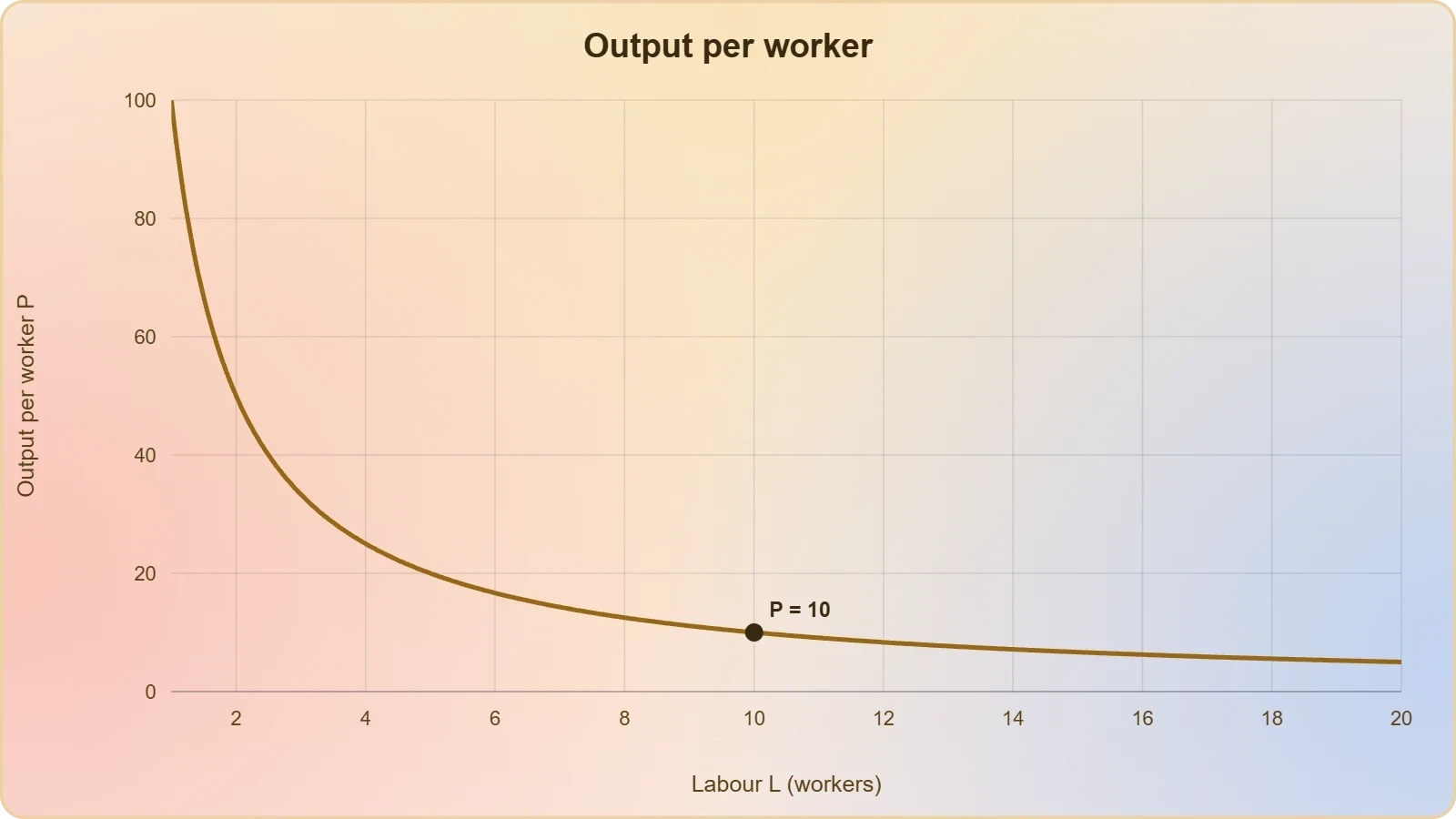
The productivity gap can be expressed simply. If output per worker is ##P = \frac{Q}{L}##, where ##Q## is output and ##L## is labour, then AI adoption raises ##P## either by increasing ##Q## through better decisions or by reducing the labour input required per unit of output. For economies where ##L## is abundant and cheap, the incentive to substitute capital for labour is weaker, which is why policy must actively accelerate adoption rather than assume the market will do so.
Infrastructure, Policy and Curriculum as Binding Constraints
Ahmed's three demands, effective policies, updated curricula and adequate infrastructure, map neatly onto the standard constraints that stall technology diffusion in developing markets. Policy uncertainty deters long-horizon investment; outdated curricula produce graduates whose skills do not match employer needs; and weak infrastructure, whether electricity, connectivity or data systems, raises the cost of every digital transaction. Addressing all three simultaneously is difficult, which is why summits of this kind tend to produce commitments rather than completed reforms.
Yet the sequencing matters less than the direction of travel. A country that convenes its first AI business summit in 2026 is signalling that it intends to compete for investment, talent and partnerships in a domain where late entry is not automatically disqualifying. The presence of international companies alongside local firms at the expo suggests that foreign vendors see a market worth cultivating, however modest its current size.
The Ministry's Four-Pillar Technology Agenda
Md Anwar Hossain's description of the ministry's focus areas deserves closer reading than a press release usually invites. Promoting STEM education, commercialising research, strengthening links among researchers, investors and markets, and advancing emerging technologies together form a coherent, if ambitious, industrial policy sequence. The logic runs from talent to translation to capital to frontier capability, and each stage depends on the one before it. A country that cannot commercialise its own research will struggle to absorb imported technology, let alone generate indigenous innovation.
From STEM Classrooms to Commercial Laboratories
STEM education is the foundation, but the phrase conceals a measurement problem. Enrolment in science and engineering programmes can rise while the quality of instruction stagnates, producing credentials without competence. The summit's inclusion of student innovators from 20 universities is a modest corrective, giving visibility to applied work and creating a bridge between academic projects and commercial partners. Whether that bridge becomes a permanent structure or a biennial photo opportunity depends on follow-through that no single event can guarantee.
Research commercialisation is the harder step. Universities in emerging economies frequently produce work that never reaches a market because intellectual property regimes, technology transfer offices and early-stage capital are all underdeveloped. The ministry's stated intention to strengthen links among researchers, investors and markets acknowledges this gap directly. The B2B matchmaking session at the summit is, in effect, a small-scale experiment in closing it.
Semiconductors, Biotechnology and the Blue Economy
The emerging technology list is expansive: AI, semiconductors, biotechnology, nanotechnology, space research and the blue economy. Each carries distinct capital requirements and timelines. Semiconductor fabrication demands investment on a scale few developing economies can sustain alone, whereas the blue economy, which concerns the sustainable use of ocean resources, leverages Bangladesh's substantial maritime territory and existing fishing and shipping industries. Biotechnology and nanotechnology sit somewhere between, requiring specialised laboratories and regulatory capacity.
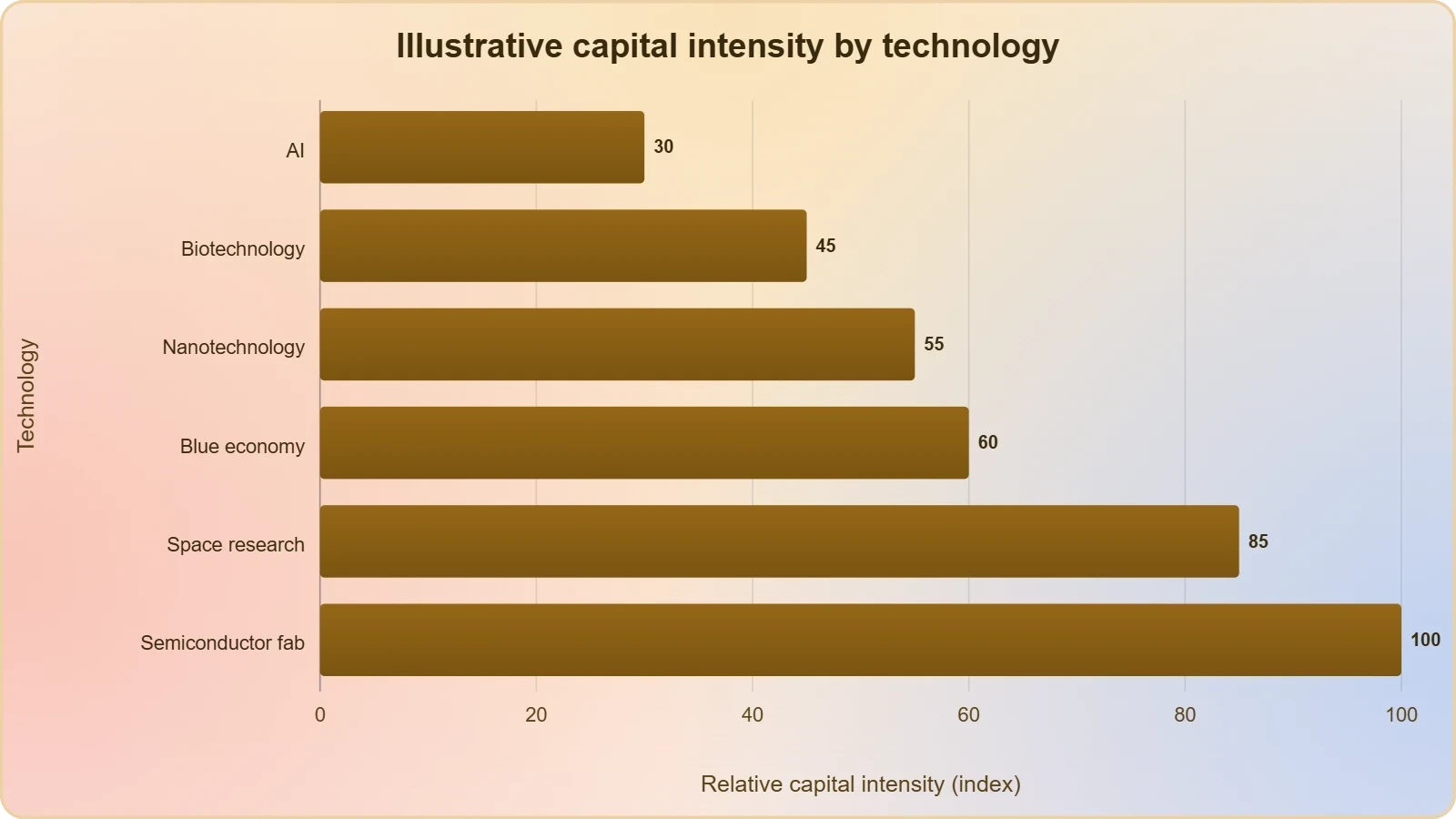
Breadth here is defensible as portfolio logic. A country cannot know in advance which technology bets will pay off, so it spreads risk across several domains while building common enabling infrastructure. The danger is that resources are spread so thinly that no domain achieves critical mass. The summit's value may lie less in the technologies it celebrates than in the coordination it forces among ministries, universities and firms that otherwise operate in separate silos.
- 01
- 02
- 03
- 04
Students, Startups and the Talent Pipeline
Twenty universities presenting innovations at a national business summit is a small number in absolute terms and a meaningful one in symbolic terms. It signals that the organisers regard the talent pipeline as part of the AI agenda rather than an afterthought. In practice, the gap between a student prototype and a fundable product is vast, and most university showcases produce demonstrations rather than companies. Yet the visibility such events confer can connect young developers to mentors, customers and early capital that academic settings rarely provide.
The Employability Gap in Applied AI
Bangladesh produces a growing number of computer science graduates, but employer surveys across South Asia consistently report that applied skills, version control, cloud deployment, data engineering and model evaluation, lag behind theoretical knowledge. The ministry's emphasis on STEM education addresses the supply side, but curricula change slowly and industry requirements shift quickly. Short-cycle training, industry partnerships and internship pipelines often close the gap faster than formal degree reform, and the summit's matchmaking session could seed such arrangements.
There is also a retention problem. Skilled AI practitioners in Dhaka can earn multiples of local salaries by working remotely for foreign firms or by emigrating. This is not unique to Bangladesh, but it constrains the domestic ecosystem's ability to build institutional memory. Policies that encourage remote work while capturing tax revenue, or that create attractive domestic roles at internationally competitive firms, become part of the AI strategy by default.
What Young Entrepreneurs Need Beyond Visibility
Startups require three things that a summit cannot directly supply: capital, customers and regulatory clarity. The expo's 150 stalls give founders a chance to meet potential buyers and partners, and the B2B session formalises those introductions. But early-stage funding in Bangladesh remains thin, and venture capital for AI ventures is thinner still. Government-backed funds, angel networks and corporate venture arms all have roles to play, and the summit provides a venue for those conversations to begin.
Regulatory clarity is equally important. Entrepreneurs building on customer data need to know what they may collect, store and process, and under what conditions. Absent clear rules, cautious founders build less ambitious products and foreign investors discount the market. The minister's call for responsible adoption is a starting point, but responsibility requires a legal framework, not merely a sentiment.
We Also Published
Responsible Adoption and the Governance Question
Minister Faqir Mahbub Anam's phrase "responsible adoption" carries more weight than its diplomatic tone suggests. Responsible adoption implies guardrails: rules on data protection, algorithmic accountability, consumer redress and the use of automated decision-making in credit, hiring and public services. Bangladesh does not yet possess a mature framework for any of these, and building one requires legislative capacity that is often scarce. The summit's emphasis on responsibility is therefore an invitation to legislate, not a substitute for it.
Data Protection as the Foundation
Every meaningful AI application depends on data, and every data-dependent application raises questions about consent, retention and cross-border transfer. Without a clear data protection regime, firms face legal ambiguity and citizens face unaccountable processing. The ministry's focus on strengthening links among researchers, investors and markets implicitly assumes that data can flow lawfully between them. That assumption requires statutory backing, and the summit provides a public platform for making the case.
Regional comparisons are instructive. India's approach combines a data protection statute with sectoral regulators, while several Southeast Asian economies have adopted lighter-touch frameworks to attract investment. Bangladesh must choose its own balance between protection and facilitation, and the choice will shape which AI businesses find the market attractive. A regime that is too permissive invites reputational risk; one that is too restrictive deters the very investment the summit seeks to attract.
Building a Sustainable Ecosystem
The minister's stated goal of building a sustainable AI ecosystem is the summit's most ambitious objective and its least measurable. Ecosystems comprise firms, universities, regulators, investors and infrastructure, and they grow through repeated interaction rather than declaration. A two-day event can accelerate those interactions, but sustainability depends on institutions that persist between summits: technology transfer offices, industry associations, standards bodies and funding mechanisms. The DCCI's involvement suggests that at least one such institution intends to remain engaged.
There is also a regional dimension. Bangladesh competes and cooperates with India, Vietnam and other Asian economies for technology investment, and its ability to attract AI firms depends on relative costs, skills and regulatory predictability. The summit's international exhibitors are, in effect, conducting due diligence on the market. Their assessment will be shaped less by the quality of the keynote speeches than by the practical ease of doing business in Dhaka.
What Success Would Look Like After the Summit Closes
The measure of any summit is what happens in the twelve months that follow. For Dhaka's AI Business Summit, success would mean concrete outcomes: memoranda of understanding that convert into investment, university partnerships that produce joint research or internships, and policy announcements that give firms the clarity they need to commit capital. Failure would mean a well-attended event followed by silence, a pattern familiar to observers of technology conferences in emerging markets. The organisers have set expectations high by billing the event as the country's first, and firsts invite scrutiny.
Indicators Worth Tracking
Several indicators merit attention. The number of B2B matchmaking meetings that result in signed agreements, the volume of follow-on investment in student ventures, and the emergence of any formal industry working group on AI standards would all signal genuine momentum. Equally telling would be whether the ministry's four focus areas receive budget allocations in the next fiscal cycle. Rhetoric is cheap; appropriations are not, and the gap between the two is where most technology strategies quietly expire.
International participation offers another gauge. If foreign AI companies treat the expo as a one-off marketing exercise, the summit's commercial value is limited. If they return, establish local offices or partner with Bangladeshi firms, the event has done its job. The presence of 150 stalls is impressive on paper, but the durability of those relationships matters more than the count.
The Longer Arc of AI in Bangladesh
Beyond any single event, Bangladesh's AI trajectory will be shaped by forces larger than a two-day conference. Global demand for AI services creates opportunities for outsourcing and remote work; regional competition for investment sets the benchmark for policy quality; and domestic political stability determines whether long-horizon projects survive electoral cycles. The summit can align these forces momentarily, but it cannot control them. What it can do is establish a convening habit, a recurring occasion on which government, industry and academia are compelled to report progress to one another.
That habit, sustained over years, is how ecosystems form. The first summit is therefore best understood not as an arrival but as an opening move, a public commitment that invites follow-through. Whether Dhaka's AI economy matures will depend on the unglamorous work of curriculum reform, infrastructure investment, regulatory drafting and capital formation, conducted long after the exhibition halls in Agargaon have been dismantled and the banners taken down.
From our network :
- The Final Descent: How ESA Retired the Legendary Cluster Constellation After 24 Years of Space Weather ScienceAfter 24 years mapping Earth’s magnetosphere, ESA’s Cluster mission concluded with a precisely controlled reentry over the South Pacific. This analysis explores the scientific legacy, engineering decisions, and debris mitigation principles behind one of space exploration’s most responsible retirements.
- Live Online English Classes for Kids: Do They Actually Reduce Anxiety?A ten-week study reveals that synchronous online English classes can significantly reduce child language anxiety while improving listening and reading skills. Discover what makes these programs effective and how parents can select the right one.
- Committed Mediterranean Precipitation Decline: Why Emissions Cuts Alone Cannot Restore Winter RainsNew NOAA research reveals that Mediterranean winter rains may decline irreversibly even with emissions cuts. Explore the science of committed climate change and regional impacts.
- How AI Agents Will Change the Way We Manage Personal FinancesExplore how AI agents are transforming personal finance through automated budgeting, bill payment, and investment management, while examining the critical security protocols and governance frameworks required for safe deployment.
- The Hidden Cost of AI Convenience: Why Over-Permissioned Agents Are a Security Time BombDiscover why AI agents with excessive permissions create dangerous single points of failure, and learn how implementing least privilege principles can protect your organization from exploitation.
- Mobile Learning and VR in English: What Global Evidence Reveals About Effective Language TechnologyA systematic review across 14 countries reveals which language-learning technologies genuinely work. Mobile learning, AI, and VR show measurable benefits when pedagogically integrated. This evidence-based guide helps educators and learners select technology that delivers real return on investment.
- University Language Proficiency Exams: Why Institutional Tests Demand Different Preparation Than IELTS and TOEFLDiscover why university-specific language proficiency examinations differ fundamentally from IELTS and TOEFL, and learn strategic preparation approaches for institutional assessment success.
- Forbidden Matrix Patterns and Visible Lattice Points: A Geometric DictionaryExplore how multidimensional 0–1 matrices encode geometric truths, linking forbidden patterns to visible lattice points and hypergraph theory, with applications in combinatorics and computational geometry.
- CISA’s Ten-Advisory Wave: Why Generic Patching Fails in OT and How to Build Product-Specific PlaybooksCISA released ten ICS advisories in one week, exposing critical infrastructure risks. Generic patching fails in OT. Learn to build product-specific remediation playbooks.
RESOURCES
- Resources will be updated soon.
- 01
- 02
- 03
- 04
- 05
- 06
- 07
- 08
0 Comments