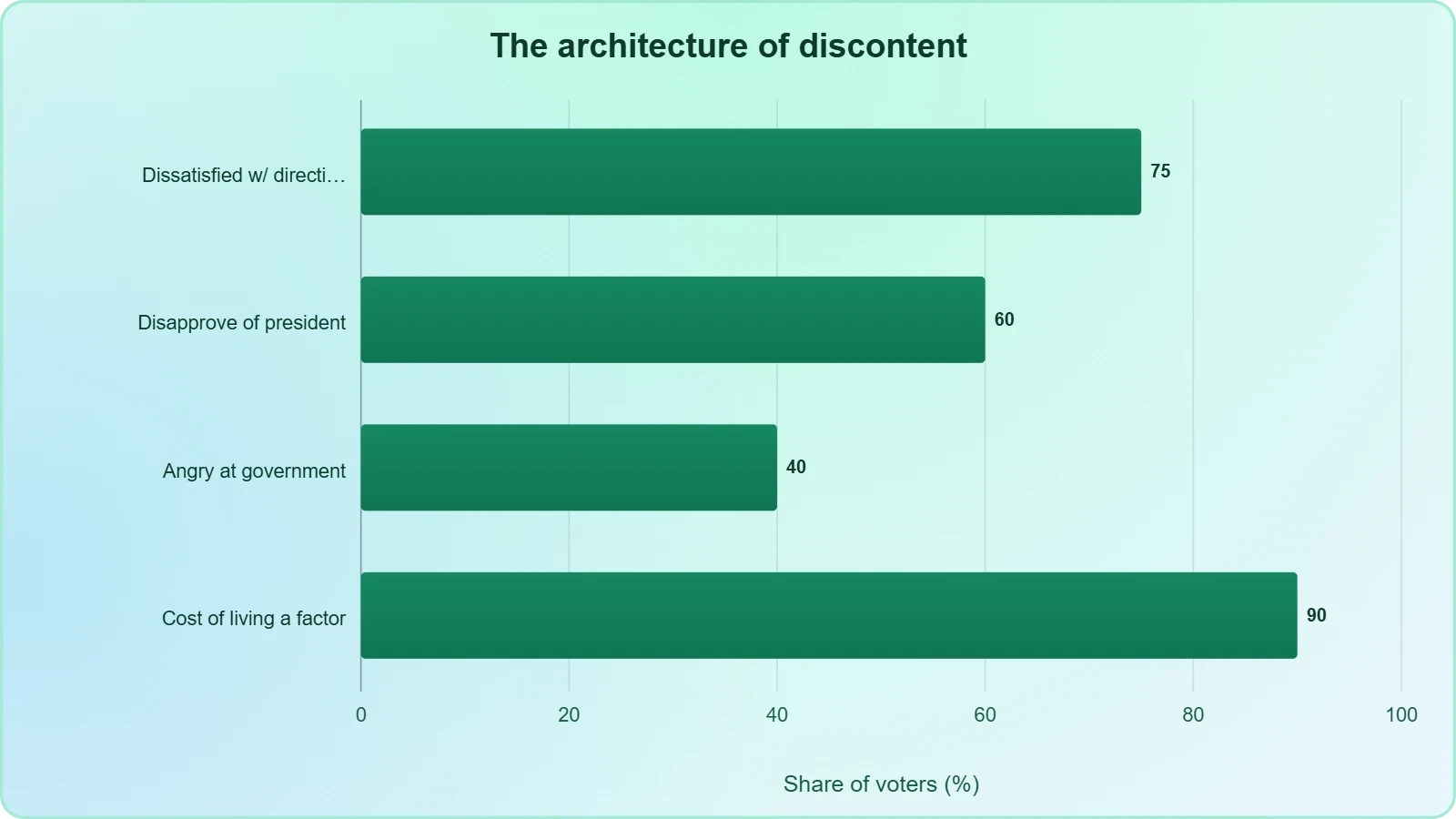
The early reading from CNN's national voter survey, conducted by SSRS between October 19 and November 3, 2026, describes an electorate in a sour and unsettled mood. Roughly three-quarters of respondents say they are dissatisfied or worse with the direction of the country, and close to four in ten describe themselves as outright angry. Those headline numbers are not isolated sentiment; they cluster around two identifiable sources of grievance, namely the president's job performance and the lived experience of prices at the checkout counter. What makes the survey notable is not simply that voters are unhappy, but that the discontent appears structured, consistent, and pointed at identifiable actors rather than diffused across the political system.
The poll's scale gives it unusual weight for an early estimate. With an expected representative sample of about 100,000 voters nationwide, combining Election Day interviews with weeks of pre-election fieldwork, the dataset is large enough to support subgroup analysis that smaller surveys cannot sustain. That breadth allows analysts to separate the intensity of disapproval from its breadth, to distinguish voters who are merely disappointed from those who are angry, and to trace how economic anxiety translates into judgments about competence and priorities. The survey is, of course, still an estimate: margins of error apply, and the earliest figures have not been weighted to final election results, so the numbers should be read as directional signals rather than settled verdicts.
Beneath the topline dissatisfaction lies a more consequential finding about attribution. Voters are not simply registering that the economy feels bad; a substantial majority are assigning responsibility for those conditions to the president and his policies. Around two-thirds say he has made economic conditions worse, and most attribute higher costs to his decisions rather than to forces beyond his control. That shift in blame, more than the raw level of economic pain, is what gives the survey its political edge. When hardship is blamed on circumstance, incumbents can wait it out; when it is blamed on policy, the cost is paid at the ballot box.
On This Page
TL;DR CNN's early 2026 voter poll, fielded by SSRS from October 19 to November 3 with an expected sample of roughly 100,000 voters, portrays an electorate defined by dissatisfaction, economic anxiety, and declining confidence in President Trump. About three-quarters are dissatisfied with the country's direction, roughly six in ten disapprove of Trump's job performance, and around two-thirds believe his policies have worsened the economy. The economy is the most frequently named top issue, followed by the state of democracy, while immigration, healthcare, foreign policy, and crime rank lower. Voters also doubt the president's priorities, view Congress and both parties negatively, and expect the next generation to fare worse.
The Architecture of Voter Discontent
Discontent in this survey is not a vague cloud hanging over the electorate; it has a measurable architecture. Three-quarters dissatisfied with the nation's direction, four in ten angry, six in ten disapproving of the president, and nine in ten calling the cost of living a crucial or major factor in their vote together describe a public that has converted diffuse unease into specific judgments. The intensity matters as much as the breadth. A voter who is dissatisfied may still be persuadable; a voter who is angry and blames policy for personal hardship is a different political animal entirely, and the survey suggests the second category is large enough to shape outcomes.
Measuring Intensity, Not Just Direction
Polling often collapses nuance into a single approval number, but the CNN instrument separates direction from intensity in ways that reward closer reading. Roughly half of voters disapprove of Trump strongly, a figure that sits well above the share who disapprove only somewhat. Strong disapproval is the more predictive measure in electoral analysis because it correlates with turnout, donation behavior, and willingness to vote against a candidate rather than merely abstain. The gap between total disapproval and strong disapproval tells analysts how much of the opposition is soft and how much is hardened, and in this dataset the hardened share is substantial.
The anger metric reinforces that reading. Around four in ten voters describing themselves as angry is an extraordinary figure in a peacetime survey, and anger tends to be self-reinforcing: it drives engagement, which drives turnout, which in turn amplifies the very sentiment being measured. Analysts should treat the anger number cautiously, since self-reported emotion is sensitive to question wording and to the news environment at the time of interview. Still, the consistency between anger, strong disapproval, and economic blame suggests a coherent emotional posture rather than a statistical artifact of a single badly worded item.
The Defection of 2024 Trump Voters
Perhaps the most politically significant subgroup in the survey is the roughly one-fifth of 2024 Trump voters who now disapprove of his job performance. Defection at that scale, if it holds, would represent a meaningful erosion of the coalition that produced his victory. It is worth noting that disapproval among one's own voters does not automatically translate into votes for the opposing party; many such voters may simply stay home, which in a midterm environment can be just as damaging. The survey does not resolve whether these defectors have moved toward the Democrats or merely away from the president, and that distinction will matter enormously in interpreting downstream results.
Contextual reporting from the campaign period suggests these defectors are concentrated among voters who supported the president primarily for economic reasons and who now feel that the promised relief has not materialized. That profile is consistent with the broader finding that cost of living dominated vote choice. Voters who switch allegiance over prices tend to switch back just as readily if prices stabilize, which makes this group volatile rather than permanently realigned. The survey captures a moment, not a movement, and the durability of the defection remains an open question that later waves of data will need to answer.
We Also Published
The Economy as the Central Grievance
No issue in the survey rivals the economy for salience. It is the most commonly named top issue, and roughly nine in ten voters say the cost of living was a crucial or major factor in their vote. That combination, high salience plus near-universal relevance, is politically potent because it means economic sentiment reaches voters who might otherwise be disengaged. A voter who cares deeply about foreign policy may still vote on prices if prices dominate their daily experience. The survey suggests precisely that dynamic: the economy is not one issue among many but the lens through which other issues are evaluated.
Inflation, Hardship, and the Shift in Blame
The share of voters reporting that inflation has caused hardship is similar to 2024, which is a crucial detail. The pain has not deepened dramatically; what has changed is who voters hold responsible. In 2024, hardship could be attributed to pandemic-era disruptions, supply chains, or a predecessor's policies. By 2026, with a president in office who campaigned explicitly on bringing prices down, the attribution has shifted toward the incumbent. This is the classic accountability mechanism of democratic politics: promises of relief create a benchmark against which performance is measured, and when relief does not arrive, the promise becomes a liability rather than an asset.
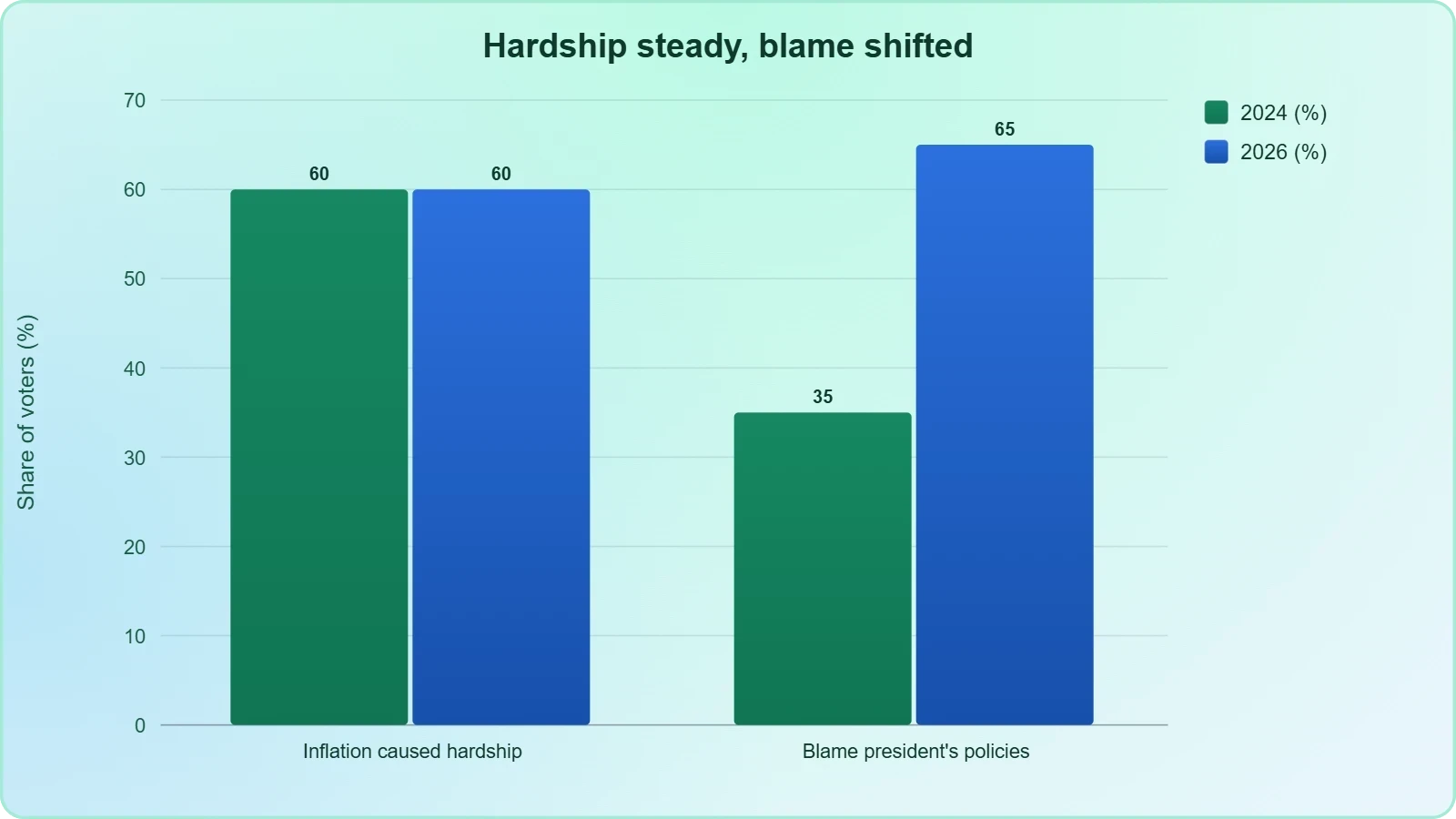
Around two-thirds of voters saying the president has made economic conditions worse, and most attributing higher costs to his policies rather than to factors beyond his control, represents a decisive rejection of the administration's economic narrative. It is worth noting that this is a perception measure, not an economic one; the survey does not tell us whether prices actually rose or fell, only that voters believe the president's actions hurt rather than helped. In electoral terms, perception is what matters. A government can preside over objectively improving conditions and still lose if voters do not feel the improvement, and the survey suggests the felt experience is negative.
Trust to Handle the Economy
Democrats hold a slight early edge on trust to handle the economy, a finding that would have seemed improbable given historical Republican advantages on the issue. The edge is modest, and about one-fifth of voters trust neither party, which is itself a striking figure. A fifth of the electorate rejecting both parties on the central issue of the cycle suggests a reservoir of alienation that neither side has successfully tapped. That group is not necessarily persuadable in a partisan direction; it may simply abstain, which complicates turnout models and makes the eventual outcome harder to forecast from trust numbers alone.
The neither-party share also complicates the interpretation of the Democratic edge. If the edge derives mainly from voters who are disillusioned with the president rather than enthusiastic about the opposition, it may be fragile. Oppositional trust tends to evaporate once the opposition is asked to govern or to present a credible alternative. The survey captures a moment when the incumbent is being punished; it does not establish that the challenger has earned durable confidence. Analysts should read the trust numbers as a measure of current dissatisfaction with the incumbent more than as an endorsement of any alternative economic program.
Beyond Prices: Immigration, Foreign Policy, and Institutions
Voter dissatisfaction in the survey extends well past the household budget. Most respondents say the administration has gone too far on immigration enforcement, and most also say the United States made the wrong decision in taking military action against Iran. These are not marginal findings; they suggest that the president's signature non-economic initiatives are viewed as overreach rather than strength. The pattern is consistent with the broader theme of the survey: voters are not simply unhappy with outcomes, they are skeptical of the judgment behind the decisions that produced them. That skepticism about judgment is harder to reverse than dissatisfaction with a single policy.
Immigration Enforcement and Perceived Overreach
The finding that most voters believe immigration enforcement has gone too far is significant because immigration enforcement is often assumed to be broadly popular in the abstract. The survey suggests a distinction between supporting enforcement as a principle and rejecting its intensity as practiced. Voters may favor border control while objecting to the manner, scale, or targets of enforcement, and the survey's wording points toward the latter. For the administration, this is a warning that a policy can be directionally popular and still generate backlash if the execution is perceived as excessive. Intensity, in enforcement as in politics, carries its own costs.
It is worth situating this finding within the campaign themes the survey echoes. Immigration was expected to be a strong issue for the president, and in some subgroups it undoubtedly remains so. But when the economy dominates salience and voters are already primed to see the administration as overreaching, immigration enforcement becomes another data point confirming a narrative of excess rather than a separate, winning issue. The interaction between issues matters more than any single issue's standalone popularity, and in this survey the economic mood colors everything else.
Military Action and Institutional Confidence
The Iran finding carries similar weight. Most voters calling military action the wrong decision suggests that foreign policy, while not a top-ranked issue, still contributes to the overall judgment of presidential competence. Military action is one of the clearest tests of presidential judgment because it is discretionary, consequential, and difficult to reverse. A public that believes the decision was wrong is a public that doubts the decision-maker, and that doubt bleeds into evaluations of economic management even when the two domains are analytically separate. Voters rarely compartmentalize; they form a general impression and fit new information into it.
Institutional confidence reinforces the pattern. Views of Congress, the Supreme Court, and both political parties are negative, with the Republican Party viewed more unfavorably than the Democratic Party. Negative views of both parties alongside a Republican disadvantage describe an electorate that is dissatisfied with the incumbent coalition without being enamored of the alternative. That configuration tends to produce volatile, low-enthusiasm elections in which turnout and marginal shifts decide outcomes. It also raises the possibility of protest voting or abstention on a scale that complicates any simple translation of disapproval into seat changes.
- 01
- 02
- 03
- 04
Priorities, Self-Interest, and the Referendum Question
Voters in the survey express deep doubt about the president's priorities. Most say he does not have the right priorities and that he puts his own interests above the country's. This is a distinct finding from economic dissatisfaction, and it may be the more durable one. Economic conditions can improve; perceptions of character and priority are stickier. When voters conclude that a leader is serving himself rather than the public, the conclusion tends to survive policy wins and good news cycles. The survey suggests that conclusion has taken hold across a substantial majority, which is a serious structural problem for any incumbent seeking to rebuild support.
The Referendum That Wasn't
The president reportedly urged supporters to vote as if he were on the ballot, but fewer than one-fifth of voters say their House vote was cast in support of him. The rest voted in opposition or said he was not a factor. This is a striking gap between the president's framing and voters' behavior. It suggests that the election functioned less as a referendum on the president than he hoped and more as a referendum on the economy and on the administration's broader conduct. For down-ballot candidates, the implication is that presidential coattails were limited and that association with the president may have been a liability rather than an asset in many districts.
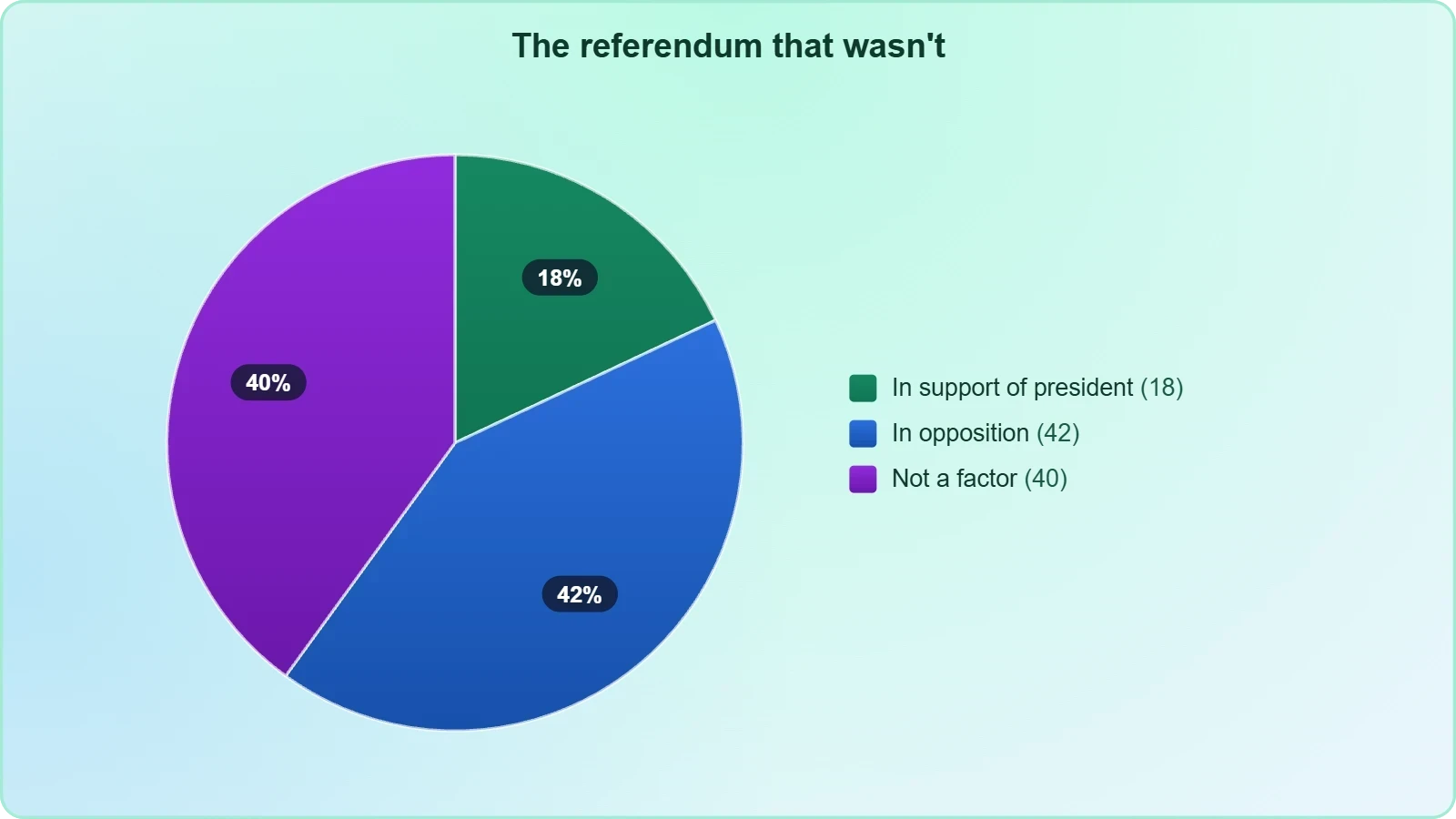
The finding also complicates the interpretation of any gains or losses. If most voters were not voting for or against the president, then seat changes may reflect local factors, candidate quality, and economic sentiment rather than a coherent national verdict. Analysts should resist reading the results as a single message. The survey suggests a public that is dissatisfied with the president but not necessarily aligned with his opponents, which is a more fragmented and less predictable electorate than a simple referendum model would imply.
Pessimism About the Next Generation
Most voters expect life for the next generation to be worse, and only about one-third say the economic system is fair to most Americans. Intergenerational pessimism is one of the most consequential attitudes in politics because it undermines the implicit bargain that sacrifice today yields improvement tomorrow. When voters doubt that bargain, they become more receptive to disruptive politics and less tolerant of incrementalism. The fairness finding compounds this: a system viewed as unfair to most Americans loses legitimacy, and legitimacy is the currency on which market-friendly policy depends. Together, these attitudes describe a public that is not merely unhappy but disillusioned with the trajectory of the country itself.
This pessimism also shapes how voters evaluate policy. If the future looks worse, present-oriented relief becomes more attractive than long-term investment, and politicians who promise immediate help gain an advantage over those who counsel patience. The survey does not tell us which policies voters would prefer, but it does suggest that the appetite for delayed gratification is thin. Any administration, regardless of party, would face a public primed to punish perceived inaction and to reward visible, near-term improvements in daily life.
Methodology, Margins of Error, and Reading the Numbers
The credibility of any poll rests on its method, and the CNN survey's method is unusually ambitious. Conducted by SSRS from October 19 to November 3, it combines in-person interviews on Election Day with interviews conducted in the weeks before, and it is expected to include a representative sample of about 100,000 voters nationwide. That hybrid design captures both the late-deciding electorate and the early-voting electorate, which is increasingly important as voting patterns diversify. The scale supports subgroup analysis, but scale does not eliminate error, and the survey's own documentation is candid about its limits.
Why Early Numbers Are Estimates
The earliest numbers have not yet been adjusted to match final election results, which means they are best treated as estimates rather than conclusions. Polls are typically weighted to known population parameters and, in exit-poll contexts, to actual vote totals once those become available. Before that adjustment, early readings can drift, sometimes substantially, as the composition of the interviewed sample is reconciled with the composition of the actual electorate. Analysts who treat the first release as final risk overinterpreting noise. The responsible approach is to read the direction and the magnitude of the findings while holding the precise percentages loosely.
Margins of error apply to every figure, and they widen for subgroups. The one-fifth of 2024 Trump voters who now disapprove, for example, is a subgroup estimate with a wider confidence interval than the topline disapproval number. That does not make the finding unimportant; it makes it provisional. The appropriate posture is to note the pattern, watch for confirmation in later waves and in independent surveys, and avoid building elaborate narratives on a single early reading. The survey's value lies in the breadth of its signal, not in the precision of any single decimal.
What the Poll Can and Cannot Tell Us
The survey can tell us that dissatisfaction is broad, that the economy dominates salience, that blame has shifted toward the president, and that institutional confidence is low. It cannot tell us how those attitudes will translate into seats, because translation depends on district-level dynamics, candidate quality, turnout, and the rules of the electoral system. It also cannot tell us whether the defection of some 2024 Trump voters is durable or temporary. Those are questions for subsequent data and for the actual results. Reading the poll well means extracting its signal while respecting its boundaries, which is the discipline that separates analysis from speculation.
Finally, the survey echoes themes from the midterm campaign, which is itself a form of validation. When pre-election fieldwork and Election Day interviews converge on the same concerns, the findings are more likely to reflect genuine public sentiment than a transient news cycle. The convergence around the economy, the president's priorities, and institutional dissatisfaction suggests a coherent public mood rather than a collection of unrelated grievances. That coherence is what makes the survey useful: it describes not just what voters are angry about, but how their anger fits together into a political posture that any analyst of the cycle must take seriously.
What the Numbers Mean for the Political Cycle
The survey's composite picture is of an electorate that has rendered a negative verdict on the incumbent and his party without extending enthusiastic confidence to the opposition. That configuration is historically associated with midterm losses for the party in power, but the survey's own caveats counsel against mechanical extrapolation. The economy's dominance, the shift in blame, the defection of some 2024 supporters, and the low trust in both parties together describe a volatile environment in which turnout and marginal shifts will matter more than broad sentiment. The numbers are a warning, not a prophecy, and the difference between the two is where careful analysis lives.
Implications for the Incumbent Party
For the president's party, the survey identifies three distinct problems that require different remedies. The first is economic perception, which is responsive to visible improvements in prices and incomes but slow to change. The second is the judgment deficit, reflected in doubts about priorities and self-interest, which is resistant to policy wins and may require a change in communication and conduct. The third is the enthusiasm gap, visible in the small share who say they voted in support of the president, which affects turnout and down-ballot performance. Addressing one without the others is unlikely to reverse the overall trajectory, and the survey offers no evidence that any single intervention would suffice.
The defection of roughly one-fifth of 2024 Trump voters is the most actionable finding for the incumbent party, because those voters are reachable. They supported the president once and may do so again if the economic experience improves or if the alternative appears worse. But reachability cuts both ways: the same voters who moved away can move back, and their volatility makes them a poor foundation for long-term planning. The party's strategic choice is between doubling down on the base and attempting to win back defectors, and the survey suggests the defector pool is large enough to be worth contesting.
Implications for the Opposition
For the Democratic Party, the survey offers opportunity tempered by caution. A slight edge on economic trust and a Republican Party viewed more unfavorably are advantages, but the one-fifth of voters who trust neither party on the economy is a reminder that opposition to the incumbent is not the same as confidence in the alternative. The opposition's task is to convert dissatisfaction into support, which requires presenting a credible economic program rather than simply cataloguing the incumbent's failures. The survey does not indicate whether the opposition has done so; it indicates only that the door is open.
The institutional dissatisfaction finding is also a caution for the opposition. Voters who view Congress, the Supreme Court, and both parties negatively are not natural enthusiasts for any governing coalition. If the opposition wins, it will inherit a public that is skeptical of institutions generally, and the goodwill that comes with victory may be short-lived. The survey's pessimism about the next generation and its doubts about the fairness of the economic system suggest that the public's expectations are low across the board, which raises the bar for any party seeking to govern credibly.
From our network :
- The Hidden Cost of AI Convenience: Why Over-Permissioned Agents Are a Security Time BombDiscover why AI agents with excessive permissions create dangerous single points of failure, and learn how implementing least privilege principles can protect your organization from exploitation.
- The Final Descent: How ESA Retired the Legendary Cluster Constellation After 24 Years of Space Weather ScienceAfter 24 years mapping Earth’s magnetosphere, ESA’s Cluster mission concluded with a precisely controlled reentry over the South Pacific. This analysis explores the scientific legacy, engineering decisions, and debris mitigation principles behind one of space exploration’s most responsible retirements.
- Forbidden Matrix Patterns and Visible Lattice Points: A Geometric DictionaryExplore how multidimensional 0–1 matrices encode geometric truths, linking forbidden patterns to visible lattice points and hypergraph theory, with applications in combinatorics and computational geometry.
- How AI Agents Will Change the Way We Manage Personal FinancesExplore how AI agents are transforming personal finance through automated budgeting, bill payment, and investment management, while examining the critical security protocols and governance frameworks required for safe deployment.
- Committed Mediterranean Precipitation Decline: Why Emissions Cuts Alone Cannot Restore Winter RainsNew NOAA research reveals that Mediterranean winter rains may decline irreversibly even with emissions cuts. Explore the science of committed climate change and regional impacts.
- University Language Proficiency Exams: Why Institutional Tests Demand Different Preparation Than IELTS and TOEFLDiscover why university-specific language proficiency examinations differ fundamentally from IELTS and TOEFL, and learn strategic preparation approaches for institutional assessment success.
- Mobile Learning and VR in English: What Global Evidence Reveals About Effective Language TechnologyA systematic review across 14 countries reveals which language-learning technologies genuinely work. Mobile learning, AI, and VR show measurable benefits when pedagogically integrated. This evidence-based guide helps educators and learners select technology that delivers real return on investment.
- Live Online English Classes for Kids: Do They Actually Reduce Anxiety?A ten-week study reveals that synchronous online English classes can significantly reduce child language anxiety while improving listening and reading skills. Discover what makes these programs effective and how parents can select the right one.
- CISA’s Ten-Advisory Wave: Why Generic Patching Fails in OT and How to Build Product-Specific PlaybooksCISA released ten ICS advisories in one week, exposing critical infrastructure risks. Generic patching fails in OT. Learn to build product-specific remediation playbooks.
RESOURCES
- Resources will be updated soon.
- 01
- 02
- 03
- 04
- 05
- 06
- 07
- 08
0 Comments