When a publicly listed company commissions an external adviser to test the market for a buyer and then announces, months later, that no transaction will proceed, the market learns something more valuable than a headline sale price. It learns where the board believes intrinsic value sits, how management intends to close the gap between that belief and the traded share price, and what discipline will govern capital from that point forward. My Food Bag, the New Zealand meal-kit and direct-to-consumer food business, has just completed precisely this exercise under the internal codename "Project Truffle," and its conclusion carries lessons that extend well beyond one small-cap retailer on the NZX.
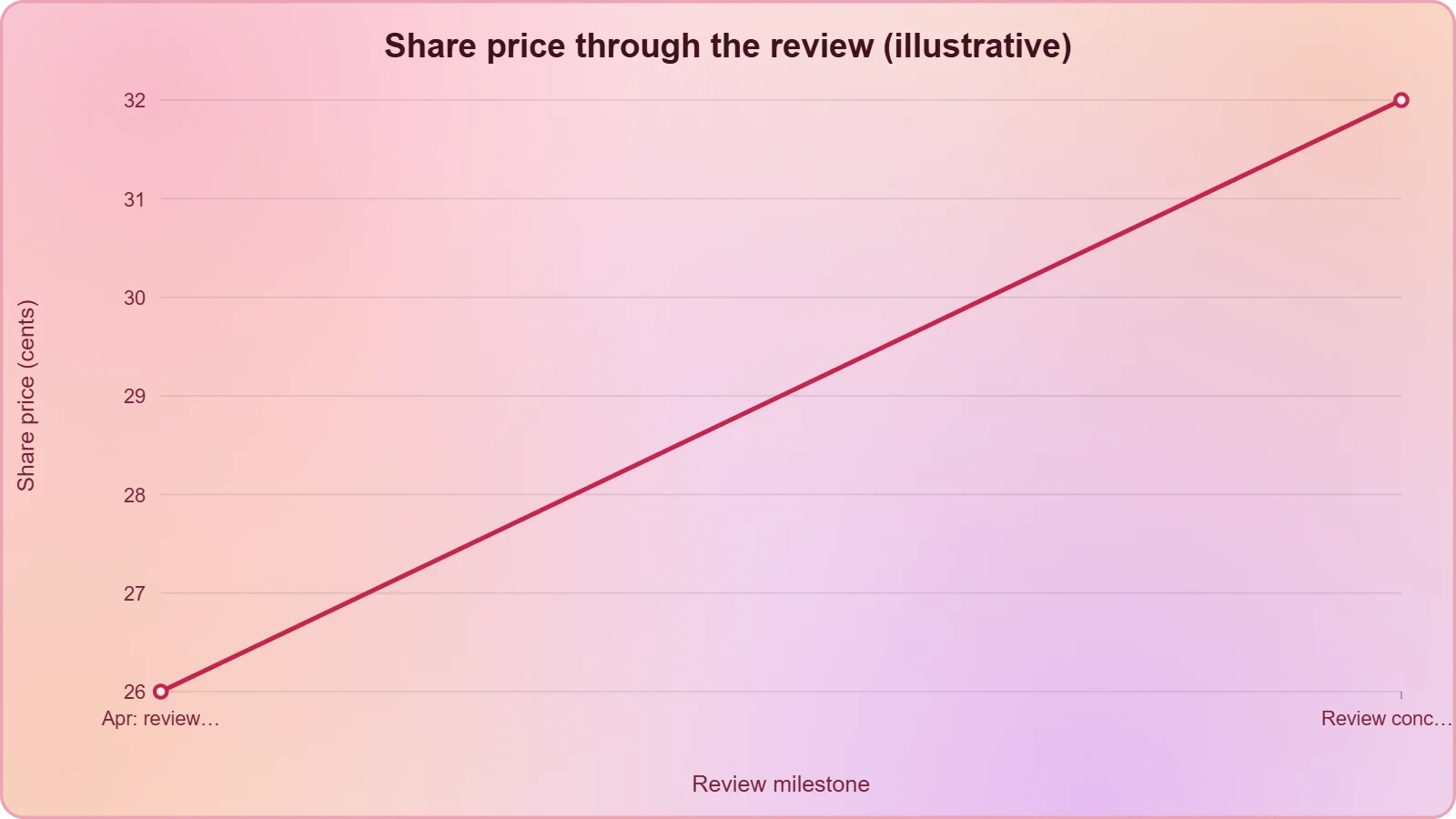
The review, launched in April and supported by financial adviser Cameron Partners, canvassed interest from several investors in New Zealand and overseas. It produced useful intelligence about how outsiders value the platform, yet it did not produce a buyer willing to transact on terms the board could recommend. Rather than treat that outcome as a failure, the directors have reframed it as validation: the company will remain listed, execute its standalone growth plan, and lean on a profitable operating model and a sound balance sheet. The share price, which stood at 26 cents when the review was announced, has since drifted up to 32 cents, a modest but telling signal that the market had priced in more downside than the process ultimately delivered.
What follows examines the strategic logic behind that decision, the four priorities now guiding the business, the dividend and capital-return framework the board has adopted, and the operating results that underpin the whole argument. It also considers the wider question every small-cap board faces when a sale process comes up empty: how to convert a non-event into a credible equity story. The analysis draws on the company's disclosed financials for the year to March 31, 2026, and on the language of the board's own statements, which are unusually candid about both the strengths and the limits of the standalone case.
On This Page
TL;DR My Food Bag will remain listed on the NZX after its "Project Truffle" strategic review, advised by Cameron Partners, failed to secure a buyer despite talks with local and overseas investors. The board argues the process confirmed the strength of its brands, nationwide direct-to-consumer platform, profitable operating model and balance sheet, and has committed to a standalone plan built on four priorities led by core customer and brand growth. Management targets fully imputed ordinary dividends of 70% to 90% of net profit after tax and is weighing an additional return of surplus capital in the following year. For the year to March 31, 2026, revenue reached $170.2 million, up 5%, net profit rose 5.3% to $6.7 million, and active customers grew to 57,100.
The Strategic Review That Ended Without a Sale
Strategic reviews are often announced with an implicit promise: that the board has exhausted internal options and believes an external owner can extract more value. When the process concludes without a transaction, the burden shifts to directors to explain why independence is now the superior path. My Food Bag's board has done so by emphasizing what the review actually tested and what it revealed. Cameron Partners was engaged not merely to run an auction but to probe market interest while the company simultaneously examined its capital structure and allocation priorities, a dual mandate that produced commercial intelligence regardless of whether a cheque was ever written.
The timeline matters. The review began in April, a period when the share price sat at 26 cents, and concluded with the stock at 32 cents. That 23% re-rating during a process that ultimately produced no deal suggests the market was correcting an overly pessimistic view rather than pricing a takeover premium. Boards frequently use review announcements to signal that assets are undervalued; here the signal appears to have been absorbed. The company also disclosed that discussions with several potential investors generated useful insights, language that stops short of claiming a near-miss but implies genuine engagement rather than a token market check.
Why No Buyer Emerged
Meal-kit businesses occupy an awkward position in the private capital landscape. They combine subscription economics, perishable supply chains and heavy customer acquisition costs, a profile that demands confidence in retention metrics before a buyer will underwrite growth. My Food Bag's active customer base of 57,100 is meaningful in a New Zealand context but small in absolute terms, which narrows the universe of strategic acquirers able to extract synergies. Financial sponsors, meanwhile, would need a clear exit path, and a thinly traded small-cap listing offers limited liquidity for a later sale.
The board's own framing is instructive. It noted that recent performance was not yet reflected in the share price, a statement that implicitly acknowledges the company had been trading below what insiders consider fair value. In such circumstances, a sale process can become a price discovery mechanism that disappoints sellers rather than a genuine route to liquidity. When bids fail to clear the board's threshold, the rational response is to retain the asset, tighten the equity narrative and let operating performance do the work that a transaction could not.
What the Process Delivered Anyway
Even without a buyer, the review produced tangible governance benefits. It forced management to articulate the standalone plan with a clarity that day-to-day listed company communication rarely demands, and it gave the board external validation of the brand portfolio, the direct-to-consumer platform and the balance sheet. Those confirmations are not trivial: they underpin the confidence with which the company now commits to a dividend policy and contemplates returning surplus capital, decisions that would be difficult to justify without an independent assessment of value.
The process also clarified capital allocation priorities, which the board explicitly cited as an outcome. For a company of this size, the discipline of deciding between reinvestment, debt reduction and shareholder distributions is the central strategic question. Having tested the market and found no superior alternative, the directors can now allocate capital with the confidence that they have compared the standalone path against a real external benchmark rather than an imagined one.
The Standalone Plan and Its Four Priorities
With a sale off the table, the company's equity story now rests entirely on execution. The board has structured the standalone plan around four priorities, the first and most important being the growth and strengthening of the core customer base and brand portfolio. Organic growth from the existing platform is explicitly designated as the primary focus, a deliberate choice that keeps capital and management attention concentrated on the mechanics the company already understands: acquiring subscribers, retaining them, and increasing the value of each order through recipe development and range extension.
The remaining priorities flow from that anchor. Operational efficiency, supply-chain resilience and disciplined capital allocation round out a framework that is deliberately unglamorous. There is no transformational acquisition at its centre, no pivot into adjacent categories, and no promise of rapid geographic expansion. For investors accustomed to growth companies announcing bold new chapters after a failed sale, the restraint is notable. It reflects a board that has tested the market, understands how outsiders value the business, and has concluded that incremental improvement on proven mechanics is the most reliable route to shareholder returns.
Organic Growth as the Primary Engine
The emphasis on organic growth is a statement about where the company believes its competitive advantage lies. My Food Bag's nationwide direct-to-consumer platform reaches households across New Zealand without the overhead of physical retail, and its brand portfolio spans multiple meal occasions and price points. Growing the core means deepening penetration among existing customers and converting trial into habitual subscription, a discipline that depends on menu variety, delivery reliability and price perception rather than on capital-intensive expansion.
Higher volumes and average order values already drove the revenue increase in the latest financial year, evidence that the organic engine is functioning. The company has also invested in recipe development and direct sourcing from growers, both of which support margin without requiring customer price increases beyond modest levels. That combination, volume growth alongside contained churn, is the signature of a subscription business executing well rather than one buying growth through discounting.
Mergers and Acquisitions Behind a High Threshold
The plan does not depend on mergers or acquisitions, and the board has been explicit that any such opportunity would need to clear a high strategic and financial threshold. The company said it would generally consider deals that help it increase scale or gain capabilities it cannot build as effectively itself. That formulation is carefully worded: it leaves the door open without creating an expectation, and it prioritises capability acquisition over mere size for its own sake.
This posture is consistent with the review's findings. Having tested the market for a buyer and found none at an acceptable price, the company is unlikely to turn around and pay a premium for someone else. The threshold language also protects management from the pressure to do deals simply because a review has concluded and stakeholders expect action. In small-cap governance, the discipline to say no to acquisitions is often as valuable as the capacity to complete them.
We Also Published
Dividend Policy and the Prospect of Surplus Capital
For income-focused investors, the most consequential disclosure in the entire announcement is the dividend framework. The board aims to pay fully imputed ordinary dividends of 70% to 90% of net profit after tax over the full financial year, subject to financial performance, cash needs, solvency, balance-sheet position and investment opportunities. That is a high payout ratio by the standards of most listed consumer businesses, and it signals that management does not foresee a capital-hungry expansion phase. It also implicitly caps the scale of any acquisition the company might contemplate, since large deals would compete directly with distributions.
The imputation element deserves attention. In New Zealand, fully imputed dividends carry tax credits that make them considerably more valuable to domestic shareholders than an equivalent unfranked distribution. For a company with a predominantly local investor base, committing to fully imputed ordinary dividends is a deliberate retention strategy, rewarding the shareholders who have stayed through a period of share-price weakness. The conditions attached to the policy are standard and prudent, but the headline ratio is the clearest statement yet that the board views the business as a cash generator rather than a growth-at-all-costs platform.
Reading the 70% to 90% Payout Range
A payout range rather than a fixed ratio gives the board flexibility to absorb year-to-year volatility in net profit without repeatedly resetting expectations. It also accommodates the working capital swings inherent in a perishable-goods subscription model, where inventory and delivery costs move with order volumes. The upper end of the range, 90%, leaves little retained earnings, which is only sustainable if the balance sheet is genuinely strong and capital expenditure requirements are modest. The board's confidence in both conditions is itself a signal about the quality of the underlying business.
Investors should note the qualifiers. The policy is subject to financial performance, cash needs, solvency, balance-sheet position and investment opportunities, which is boilerplate in form but meaningful in substance for a company that has just tested its own valuation. If an acquisition clearing the high threshold emerged, the payout could compress. If trading deteriorated, the board retains discretion. The framework is a statement of intent, not a contractual obligation, and should be read as such.
Surplus Capital: Optionality Without Commitment
The board is also considering returning surplus capital to shareholders next year in addition to ordinary dividends, though it has made clear that no decision has been taken on whether this will happen or on its form, amount or timing. This is optionality language, and it is worth parsing carefully. A special dividend, a share buyback or a capital return are all plausible forms, and each has different tax and signalling implications. A buyback would be most accretive if the board believes the shares remain undervalued, which the review's findings would support.
The absence of a decision is not a weakness. Announcing a specific capital return before the balance sheet and investment pipeline are fully assessed would be premature, particularly in the same announcement that commits to a standalone plan. What matters is that the board has publicly acknowledged surplus capital may exist, which tells the market that the dividend policy is not the ceiling on distributions. That acknowledgement alone can support the share price while the operating plan is executed.
- 01
- 02
- 03
- 04
Financial Performance for the Year to March 2026
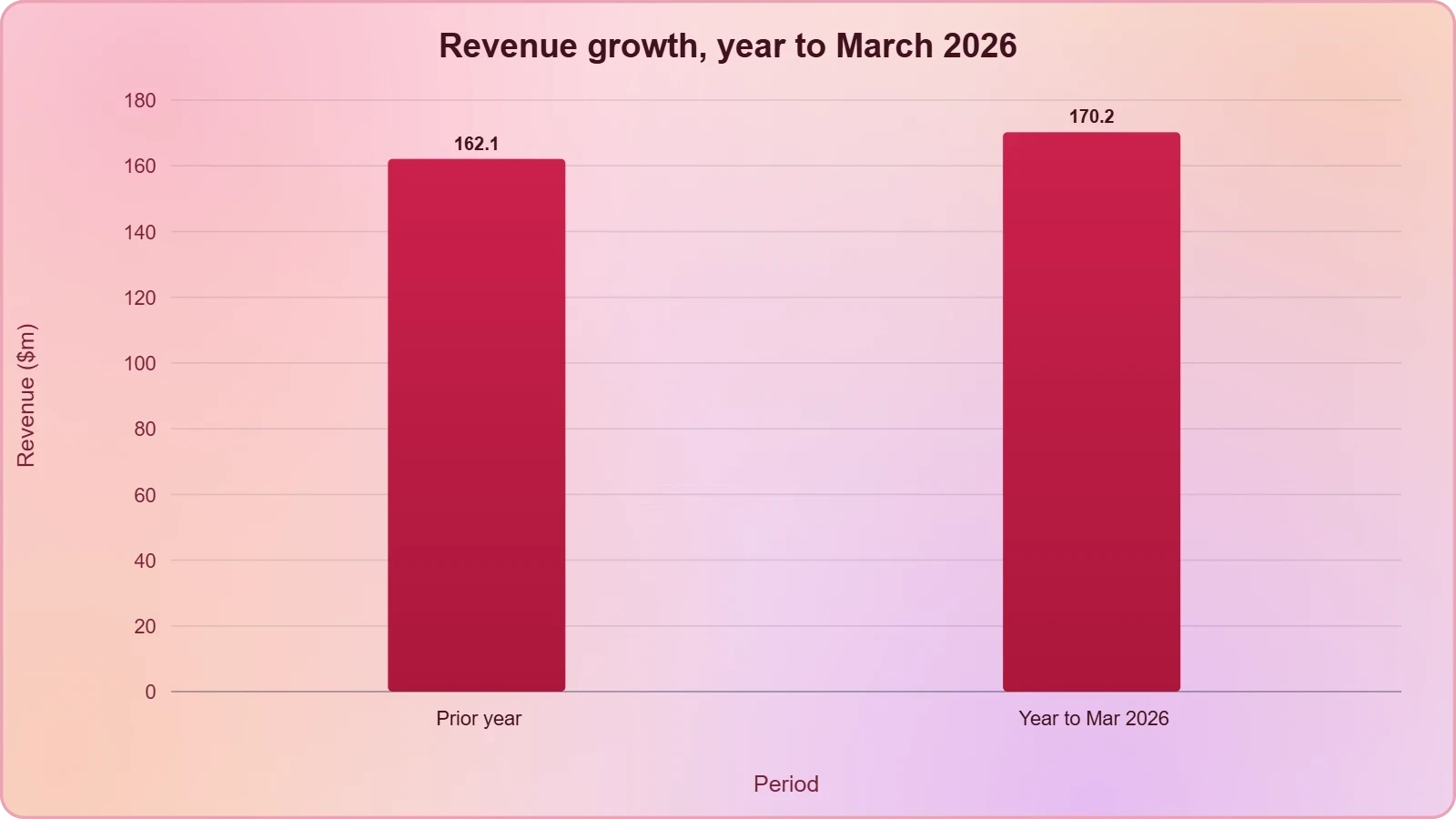
The standalone case rests on numbers, and the numbers are respectable if not spectacular. Revenue for the year to March 31, 2026 reached $170.2 million, up 5% on the prior year, supported by higher volumes and average order values. Second-half revenue rose 6.2% year on year, indicating momentum accelerated through the period rather than fading. Net profit came in at $6.7 million, up 5.3%, and active customers grew to 57,100. For a business that has just been through an ownership review, the consistency of top-line and bottom-line growth is the most persuasive argument that independence is viable.
Margin management deserves particular scrutiny. The company reported that it managed cost pressures through supply-chain initiatives, including sourcing directly from growers and recipe development, alongside modest price increases that produced minimal customer churn. That combination is difficult to achieve. Direct sourcing reduces input costs and improves freshness, recipe development allows the business to engineer menus around available produce, and modest price increases test the elasticity of demand without triggering cancellations. The fact that churn remained minimal through those increases suggests the brand retains genuine pricing power within its segment.
Revenue Quality and Customer Metrics
A 5% revenue increase driven by both volume and average order value is higher quality than growth driven by price alone. Volume growth implies more households ordering more frequently, which strengthens the subscription base and improves the economics of the delivery network. Average order value growth, meanwhile, suggests customers are adding items or selecting premium recipes, a sign of engagement rather than mere inertia. Together they indicate a business expanding its relationship with existing customers rather than relying solely on new customer acquisition, which is typically more expensive.
The active customer figure of 57,100 provides the denominator for much of the company's unit economics. In a New Zealand market of roughly five million people, that base represents meaningful household penetration, but it also highlights the ceiling on domestic growth. Expanding the base further requires either converting new households or increasing order frequency among existing ones, which is precisely why the standalone plan leads with core customer and brand growth rather than geographic expansion.
Cost Discipline and Supply-Chain Initiatives
Direct sourcing from growers is a structural advantage for a meal-kit operator. It shortens the supply chain, reduces intermediary margins and gives the company more control over quality and availability. Recipe development complements this by allowing the business to design menus around seasonal and cost-effective ingredients, smoothing input cost volatility without passing it straight to customers. These are unglamorous operational improvements, but they are the kind that compound over time and protect margins when inflation pressures return.
The modest price increases with minimal churn complete the picture. Pricing is the most sensitive lever in subscription businesses, and the company appears to have moved carefully, testing increases against retention. The result is a cost base that has been managed through operational change rather than blunt price rises, which is more sustainable and less likely to provoke a competitive response. For investors assessing the durability of the 5.3% profit growth, the quality of the margin management matters as much as the headline figure.
Valuation, Share Price and the Small-Cap Discount
The gap between the board's view of intrinsic value and the traded share price is the quiet theme running through the entire announcement. At 26 cents when the review began, the stock was evidently pricing in scepticism about the standalone future. At 32 cents, it has recovered some ground, but the board's insistence that recent performance is not yet reflected in the price implies it believes fair value sits higher still. For a company earning $6.7 million in net profit, the market capitalisation implied by these prices warrants closer examination.
Small-cap companies on the NZX frequently trade at discounts to what their fundamentals would justify, a phenomenon driven by limited analyst coverage, thin liquidity and the reluctance of institutional investors to build positions they cannot easily exit. My Food Bag sits squarely within that cohort. The review process, by introducing an external adviser and testing market interest, may have done as much for price discovery as any earnings release could, because it forced potential buyers to articulate what they would pay, even if none ultimately did.
Why the Market Re-Rated During the Process
The movement from 26 to 32 cents during a review that produced no transaction is counterintuitive only at first glance. When a company announces a strategic review, the market typically prices in a probability-weighted takeover premium. If no deal emerges, that premium should collapse. Here the opposite occurred, which suggests the initial price had already discounted a worst-case scenario, perhaps fears of a dilutive capital raise or a distressed sale. The review's conclusion, with its confirmation of balance-sheet strength and a firm dividend policy, removed those tail risks.
There is also a signalling dimension. The board's willingness to commit to a 70% to 90% payout ratio and to contemplate surplus capital returns tells the market that management sees no need for defensive capital retention. Companies facing genuine financial stress do not announce high payout policies. The re-rating, modest as it is, reflects a reassessment of risk rather than a reassessment of growth, and that is a more durable foundation for a higher share price.
The Case for a Buyback Over a Special Dividend
If surplus capital is indeed returned, the form will matter. A share buyback is most accretive when the shares trade below intrinsic value, which the board's own commentary implies is the case. Buying back stock at 32 cents would concentrate future earnings among fewer shares and signal confidence in the standalone plan. A special dividend, by contrast, distributes cash to all shareholders equally and carries immediate tax consequences, though fully imputed dividends are attractive to domestic holders.
The board has wisely declined to pre-commit. The appropriate form depends on the share price at the time, the balance-sheet position, and the investment opportunities available. What investors should watch for is the sequencing: if the company completes the standalone plan's first year, demonstrates sustained customer growth, and still trades at a discount, a buyback becomes the logical instrument. If the share price re-rates toward fair value, a dividend becomes more efficient.
What This Decision Means for Investors and the Wider Market
The My Food Bag outcome is a case study in how listed companies convert a failed sale process into a credible equity narrative. The essential moves are consistent: acknowledge the market's valuation gap, disclose the external validation obtained, commit to a specific operating plan with named priorities, and reinforce shareholder returns through a clear distribution policy. Each element addresses a different investor concern, and together they form a coherent argument that independence is not a fallback but a deliberate choice. Other small-cap boards facing similar review outcomes would do well to study the sequence.
For investors, the practical implications are threefold. First, the dividend policy provides a floor to total return expectations, assuming performance holds. Second, the standalone plan offers identifiable milestones, particularly active customer growth and revenue momentum, against which progress can be measured. Third, the possibility of a surplus capital return creates optionality that is not yet priced. The risks are equally clear: domestic market saturation, competitive pressure in meal kits, and the persistent small-cap discount that could keep the share price below intrinsic value regardless of operating success.
Signals to Monitor Over the Next Twelve Months
The most important metric to watch is active customer growth. At 57,100, the base is the engine of revenue and the clearest indicator of whether the core growth priority is working. A second signal is the trajectory of average order value, which reveals whether customers are engaging more deeply or merely maintaining habit. Third is the dividend declaration itself: the actual payout within the 70% to 90% range will communicate management's confidence in cash generation more precisely than any forward statement.
Beyond the numbers, watch for any movement on acquisitions. The high threshold language is a commitment, and any deal announced would need to be assessed against it. A capability acquisition that accelerates the standalone plan would be consistent with the strategy; a scale-driven deal that dilutes returns would not. Finally, any announcement on surplus capital, whether buyback or special dividend, will signal how the board views the share price relative to intrinsic value at that moment.
The Broader Lesson for Small-Cap Governance
Strategic reviews that end without a transaction are frequently portrayed as failures, but that framing misses their governance value. The process forces directors to test their assumptions against real market participants, produces an independent assessment of asset quality, and clarifies capital allocation priorities. My Food Bag's board emerged with confirmation of its brands, platform, operating model and balance sheet, and used that confirmation to justify a more generous distribution policy. That is a productive use of a review, even without a cheque changing hands.
The wider market should also note the discipline involved. The company did not chase a deal at a discount to intrinsic value, did not announce a transformational acquisition to satisfy expectations of action, and did not overpromise on capital returns. It set a high bar for future M&A, committed to a specific payout range, and left surplus capital as genuine optionality. In an environment where corporate announcements often inflate expectations, that restraint is itself a form of credibility, and credibility is the scarcest asset a small-cap can possess.
From our network :
- Live Online English Classes for Kids: Do They Actually Reduce Anxiety?A ten-week study reveals that synchronous online English classes can significantly reduce child language anxiety while improving listening and reading skills. Discover what makes these programs effective and how parents can select the right one.
- University Language Proficiency Exams: Why Institutional Tests Demand Different Preparation Than IELTS and TOEFLDiscover why university-specific language proficiency examinations differ fundamentally from IELTS and TOEFL, and learn strategic preparation approaches for institutional assessment success.
- The Final Descent: How ESA Retired the Legendary Cluster Constellation After 24 Years of Space Weather ScienceAfter 24 years mapping Earth’s magnetosphere, ESA’s Cluster mission concluded with a precisely controlled reentry over the South Pacific. This analysis explores the scientific legacy, engineering decisions, and debris mitigation principles behind one of space exploration’s most responsible retirements.
- Committed Mediterranean Precipitation Decline: Why Emissions Cuts Alone Cannot Restore Winter RainsNew NOAA research reveals that Mediterranean winter rains may decline irreversibly even with emissions cuts. Explore the science of committed climate change and regional impacts.
- Forbidden Matrix Patterns and Visible Lattice Points: A Geometric DictionaryExplore how multidimensional 0–1 matrices encode geometric truths, linking forbidden patterns to visible lattice points and hypergraph theory, with applications in combinatorics and computational geometry.
- How AI Agents Will Change the Way We Manage Personal FinancesExplore how AI agents are transforming personal finance through automated budgeting, bill payment, and investment management, while examining the critical security protocols and governance frameworks required for safe deployment.
- The Hidden Cost of AI Convenience: Why Over-Permissioned Agents Are a Security Time BombDiscover why AI agents with excessive permissions create dangerous single points of failure, and learn how implementing least privilege principles can protect your organization from exploitation.
- Mobile Learning and VR in English: What Global Evidence Reveals About Effective Language TechnologyA systematic review across 14 countries reveals which language-learning technologies genuinely work. Mobile learning, AI, and VR show measurable benefits when pedagogically integrated. This evidence-based guide helps educators and learners select technology that delivers real return on investment.
- CISA’s Ten-Advisory Wave: Why Generic Patching Fails in OT and How to Build Product-Specific PlaybooksCISA released ten ICS advisories in one week, exposing critical infrastructure risks. Generic patching fails in OT. Learn to build product-specific remediation playbooks.
RESOURCES
- Resources will be updated soon.
- 01
- 02
- 03
- 04
- 05
- 06
- 07
- 08
0 Comments