Google's November 2026 policy shift for education accounts marks one of the most consequential decisions yet in the uneasy relationship between classroom technology and artificial intelligence. The company announced that its Gemini assistant and AI-driven search features will now be switched off by default for K-12 student accounts, requiring school administrators to explicitly opt in before any of these tools become available. This reverses a decision made only months earlier, in August, when Google turned Gemini on by default inside its Classroom app. The reversal signals that sustained pressure from parents, educators, and district leaders has begun to reshape product defaults at the highest levels of the education technology industry.
What makes the announcement genuinely complicated is the coupling of artificial intelligence with search itself. Schools that wish to disable AI entirely will discover that Google Search disappears along with it, because the company has woven AI Overviews and AI Mode so deeply into its flagship search product that the two can no longer be separated cleanly. Chris Phillips, Google's vice president of education, confirmed that institutions banning AI will see a school-issued message declaring search unavailable. For districts already wary of generative tools, this creates an uncomfortable bargain: accept some AI exposure, or surrender the most widely used research instrument in modern schooling.
The timing reflects a broader cultural recalibration around screens and algorithms in childhood. New York City and Los Angeles public schools have restricted generative AI for many or all students this academic year, and Chromebooks remain ubiquitous from kindergarten onward in millions of households. Google's new "guided learning" principle, which prompts students to work through homework problems step by step rather than receiving instant answers, attempts to position the company as a partner in pedagogy rather than a shortcut engine. Whether that framing satisfies skeptical communities will depend on details Google has promised to share with schools in the months before the changes take effect.
On This Page
TL;DR Google will disable Gemini and AI-powered search features by default for K-12 student accounts, requiring administrators to opt in explicitly. The reversal of its August default-on policy responds to district bans in New York City, Los Angeles, and elsewhere. Critically, schools that block AI entirely also lose Google Search, since AI Overviews and AI Mode are now inseparable from the search experience. Google frames the change as expanded choice and introduces a "guided learning" principle that nudges students toward step-by-step problem solving instead of instant answers.
The Architecture of the New Defaults
At the mechanical level, Google's revised policy inverts the logic that governed education accounts for years. Previously, features arrived switched on and administrators had to hunt through settings to disable them; now the burden of activation sits with the school. Gemini, Gemini Notebook, and Search can each be enabled individually, according to the company, which argues this granularity gives institutions more control rather than less. The default-off posture applies specifically to K-12 accounts, leaving higher education largely untouched. Google has not yet published the precise interface students will encounter, nor the exact administrative console workflow, promising fuller documentation before rollout.
Default-On Versus Default-Off Governance
The distinction between opt-in and opt-out design is not cosmetic; it determines who bears the cognitive and administrative cost of caution. When features default to on, busy administrators rarely intervene, and exposure becomes the path of least resistance. Default-off architectures reverse that inertia, forcing deliberate institutional decisions before students encounter generative systems. Privacy researchers have long argued that defaults function as a form of policy, quietly encoding values about risk tolerance and institutional capacity. Google's shift therefore represents a meaningful concession, even if the company frames it as responsiveness to customer feedback rather than retreat under pressure.
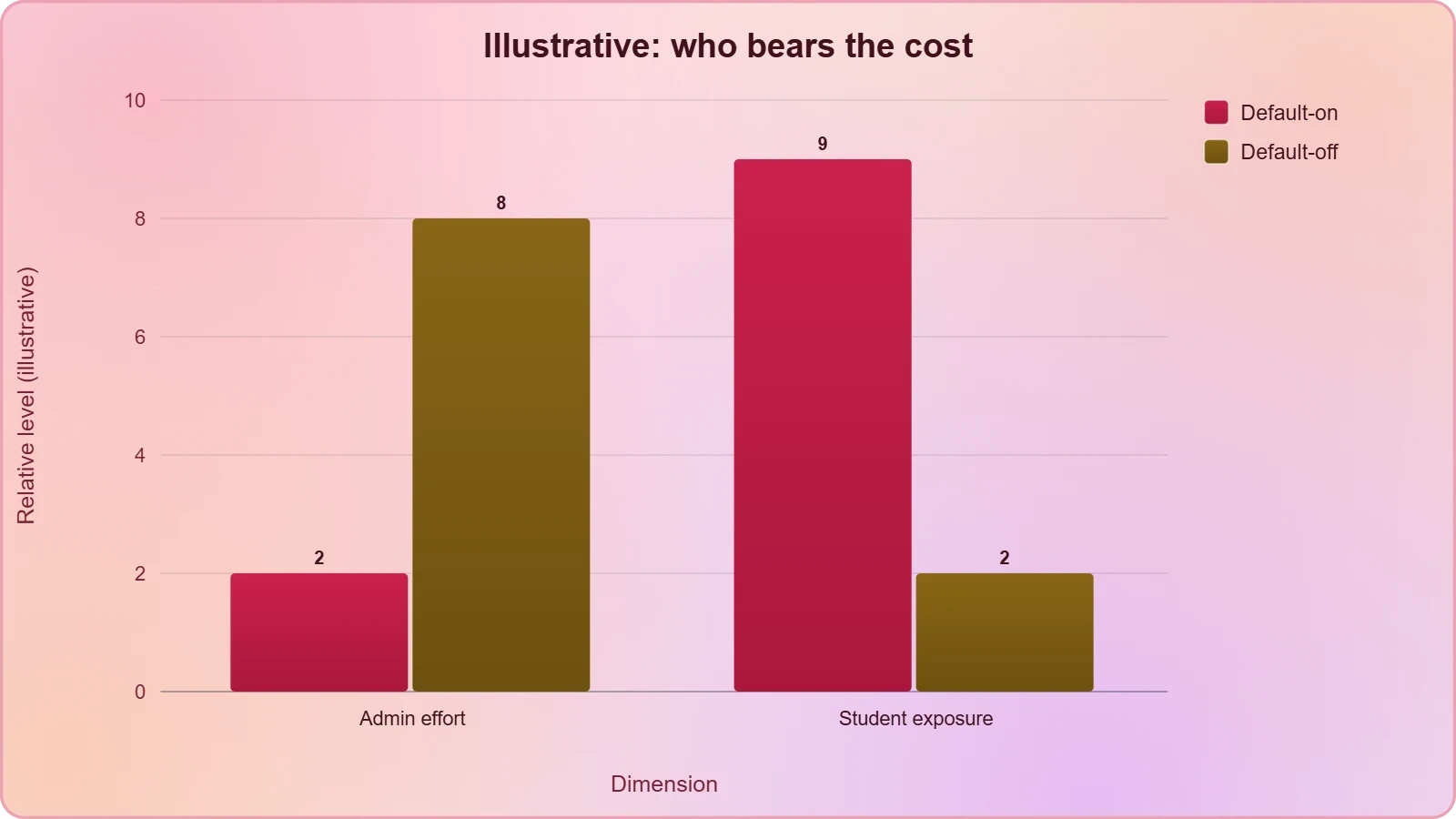
Yet the concession carries an asterisk that undercuts its generosity. Because search and AI are technically fused, the most cautious districts cannot simply decline the AI layer while retaining the research layer. They must choose between a bundled product and nothing at all. This bundling strategy is familiar from enterprise software, where vendors tie desirable legacy functionality to newer offerings to discourage partial adoption. For schools, the practical effect is that the strongest opponents of classroom AI face the steepest functional losses, a dynamic that critics describe as coercive and that Google describes as technical reality.
The Search-AI Fusion Problem
Google has spent several years rebuilding Search around generative summaries, enlarging the query bar, and placing AI Overviews atop results pages. These changes were designed for general consumers, but they migrated into education accounts without a separate governance track. Phillips explained that search and AI are now so closely integrated that separating them would require dismantling the product's core architecture. The company's own announcement acknowledges that AI Mode and AI Overviews deliver guided, step-by-step learning experiences, implying that the AI layer is not an add-on but the pedagogical mechanism itself.
This fusion creates a genuine dilemma for district technology officers. Blocking AI means blocking the tool students use for research across every subject, from history essays to science fair projects. Allowing AI means accepting Overviews that may summarize sources students never open. Neither option is clean, and the absence of a middle path has drawn criticism from advocates who argue that a mature vendor should offer a search-only tier for minors. Google's response, that schools retain individual toggles for Gemini and Notebook, does not resolve the underlying coupling of search with its AI enhancements.
District Bans and the Community Pressure Campaign
The policy arrives against a backdrop of organized resistance that has been building for several years. New York City and Los Angeles public schools, two of the largest districts in the United States, restricted generative AI tools for many or all students during the current school year. These decisions were not technophobic reflexes; they emerged from structured reviews involving teachers, parents, and child development specialists who questioned whether conversational assistants belonged in classrooms at all. When major districts move, vendors listen, because procurement contracts in urban systems can run into tens of millions of dollars and set precedents that smaller districts follow.
Screen Time and Developmental Concerns
Parental anxiety about screens has shifted from quantity to quality. The concern is no longer simply hours logged but the nature of the interaction: passive consumption versus active problem solving, human instruction versus algorithmic response. Chromebooks in kindergarten classrooms mean that some children encounter Google's ecosystem before they can read fluently, a fact that intensifies scrutiny of every default setting. Educators worry that instant answers erode the productive struggle through which learning consolidates, and developmental psychologists have cautioned that conversational AI may substitute for the peer and teacher dialogue children need. Google's guided learning principle reads as a direct answer to these concerns.
Yet the guided learning framing also functions as marketing. By promising step-by-step prompts instead of final answers, Google positions its AI as a tutor rather than an answer key, aligning with the pedagogical language districts use in their own policies. The company is not alone in this approach; other AI vendors have adopted similar tutoring narratives to persuade skeptical educators that their products belong in classrooms. The persuasive challenge is substantial, because trust in education technology has been dented by years of overpromised devices and underdelivered outcomes, and administrators now demand evidence rather than enthusiasm.
Workforce Readiness as Counterargument
Against the restrictionist tide stands a powerful counterargument: that familiarity with AI is now a workforce competency, and shielding students from it may disadvantage them later. Technology executives and labor economists argue that entry-level jobs increasingly assume fluency with generative tools, and that schools banning AI risk graduating students into a workplace they do not understand. This argument resonates with many parents who see AI literacy as analogous to computer literacy in the 1990s. The debate therefore pits developmental caution against economic preparation, and Google's opt-in design attempts to let each community resolve that tension locally rather than imposing a single national answer.
The local-control framing is politically astute because it defers contentious judgments to school boards, where communities can argue in public. It also fragments accountability: if a district enables Gemini and problems follow, the district chose it; if students lose search access, the district chose that too. Google retains the role of neutral toolmaker offering options. Critics note that the options themselves were designed by the vendor, and that the most restrictive option carries a functional penalty, which shapes the choice architecture even when the formal decision rests with schools.
Guided Learning and the Pedagogy of Restraint
Beneath the administrative toggles sits a pedagogical claim worth examining on its own terms. Google says its systems will detect when a student is using Search for homework help and respond by prompting step-by-step reasoning rather than delivering a finished answer. This is a meaningful design choice, because the difference between a tutor and an answer machine is precisely the willingness to withhold. Cognitive science supports the underlying intuition: retrieval practice and productive struggle strengthen memory and transfer, while passive copying produces fluency illusions that collapse under examination conditions. If the detection works as described, the feature could genuinely alter how students interact with search.
Detection, Nudges, and Their Limits
The critical unknown is detection accuracy. How does a system distinguish a student seeking homework help from a student researching a topic out of curiosity, or a student checking a fact, or a student writing creatively? Misclassification in either direction carries costs: over-triggering frustrates legitimate inquiry, while under-triggering leaves the shortcut intact. Google has not published technical details, and independent evaluation will be difficult without access to the underlying models. Nudges, moreover, are advisory by design; a determined student can ignore a prompt to work step by step and simply rephrase the query until a direct answer appears.
Behavioral research on digital self-control suggests that friction helps only when it is modest and well-timed. A prompt that appears at the moment of temptation can redirect behavior; a prompt that feels punitive invites circumvention. Google's challenge is calibrating that friction across developmental stages, since a second grader and a senior have vastly different capacities for self-regulation and different legitimate needs for direct information. The company has promised more specifics before rollout, and those specifics will determine whether guided learning is a substantive pedagogical intervention or a reassuring label applied to unchanged behavior.
Competitive Dynamics Among AI Vendors
Google's move must be read alongside similar gestures from competitors courting the education market. Every major AI vendor now publishes education frameworks, offers discounted institutional tiers, and emphasizes tutoring over answer generation, because the school market is both lucrative and reputationally decisive. Districts that adopt a vendor's tools train future consumers in that ecosystem, a dynamic Google understands intimately given its Chromebook dominance. The race is therefore not merely for current contracts but for the habits of a generation, which explains why defaults, parental trust, and public perception matter as much as raw model capability.
Competitors face the same structural tension Google does: the more capable the assistant, the harder it is to constrain without degrading the product. A vendor that offers a genuinely search-only tier for minors would differentiate itself, but doing so requires maintaining parallel infrastructure and accepting lower engagement metrics. So far, no major provider has taken that step, which suggests the industry collectively prefers bundling. Until one breaks ranks, districts will continue choosing among imperfect bundles, and the search-AI coupling will remain the central fault line in education technology policy.
We Also Published
- 01
- 02
- 03
- 04
What Administrators Must Decide Before Rollout
School leaders now face a decision that is simultaneously technical, pedagogical, and political. The technical dimension involves mapping which grade levels and subjects will receive which tools, and configuring administrative consoles accordingly. The pedagogical dimension requires articulating why a given configuration serves learning rather than merely satisfying procurement convenience. The political dimension is perhaps the sharpest: any choice will be contested by some constituency, whether parents demanding stricter limits or teachers who have already built lessons around available tools. Google's promise to share specifics in the coming months gives districts a window to prepare, but not much more than a window.
Building an Evaluation Framework
A defensible district process begins with explicit learning goals rather than vendor defaults. What should students be able to do independently that AI might short-circuit? Where might AI genuinely extend capability, such as drafting practice or language exposure? Answering these questions before touching a settings console prevents the configuration from becoming an accidental curriculum. Districts that have already restricted generative tools generally built such frameworks, often with teacher committees and parent input, and their experience suggests that the process itself builds trust even when conclusions differ across communities.
Evaluation also requires measurement. If a district enables guided learning features, it should track whether students actually engage with step-by-step prompts or bypass them, whether teacher workload shifts, and whether assessment outcomes move. Without baseline data, districts cannot distinguish a pedagogical success from a marketing claim. Google could support this by providing aggregate usage analytics, though privacy constraints limit what student-level data can be shared. The most credible evaluations will likely come from independent research partnerships, which take time and funding that many districts lack.
Communicating With Families
Parent communication will determine whether the new defaults are experienced as responsiveness or as confusion. Families whose children suddenly lose search access may interpret it as a malfunction rather than a policy choice, especially if the school-issued message is terse. Districts should explain the coupling of search and AI plainly, describe what students will see, and offer channels for feedback. Transparency about the trade-offs, including the fact that full AI bans cost search functionality, respects parents as decision partners rather than passive recipients of vendor policy.
There is also an opportunity in the moment. The debate over classroom AI has often been conducted in abstractions; the new settings force concrete choices that families can discuss meaningfully. A school that explains why it enabled Gemini for seniors but not for second graders demonstrates pedagogical judgment rather than reflexive adoption or reflexive refusal. That kind of explanation builds the institutional trust that education technology has too often spent rather than accumulated, and it may prove more durable than any default setting Google configures.
The Wider Contest Over Childhood and Computation
Step back from the settings console and a larger question comes into view: what role should algorithmic systems play in the formation of young minds? Google's policy change is a tactical adjustment within a much longer struggle over attention, autonomy, and the meaning of education in a computational age. The company's framing, that it offers schools more choice, is technically accurate and strategically convenient, because it relocates a societal argument into thousands of local administrative decisions. That relocation may be appropriate in a country with decentralized schooling, but it also means the outcome will be uneven, with children in different zip codes encountering radically different technological environments.
Defaults as Cultural Signals
Defaults carry cultural weight beyond their mechanical function. When a company ships a feature switched on, it communicates confidence that the feature belongs; when it ships switched off, it communicates caution. Google's reversal therefore signals that the burden of proof has shifted, at least for minors, from skeptics to adopters. That shift is significant because it acknowledges, implicitly, that earlier default-on decisions were premature. Companies rarely admit this directly, but the architecture of the new policy speaks plainly enough, and other vendors will likely follow the same default-off pattern for K-12 accounts within a product cycle or two.
The deeper signal concerns who bears responsibility for AI's effects on learning. By making schools choose, Google distributes that responsibility outward while retaining control over the option set. This is a familiar pattern in platform governance, where vendors set the menu and institutions select from it. Genuine local control would require the ability to build alternatives, such as a search-only tier, which the current architecture forecloses. Until such options exist, the rhetoric of choice will outrun the reality, and districts will continue negotiating within boundaries drawn elsewhere.
What Would Genuine Choice Require
A truly choice-preserving design would decouple search from generative AI for education accounts, allowing districts to retain research access while disabling summarization and conversational assistance. It would publish detection methodologies for guided learning so that independent researchers could assess accuracy. It would provide aggregate analytics sufficient for district evaluation without compromising student privacy. And it would offer a clear escalation path when a school's configuration produces unexpected results. None of these requirements is technically exotic; each is a product decision that a sufficiently motivated vendor could implement, which is why their absence is instructive about priorities.
Whether Google moves in that direction depends on competitive pressure and public scrutiny. The company has promised more specifics before the changes take effect, and those specifics deserve close reading from journalists, researchers, and district leaders alike. The education market rewards trust slowly and loses it quickly, and a policy that appears responsive while preserving the underlying coupling may satisfy no one. The coming months will reveal whether the new controls represent a genuine rebalancing of power between vendor and school, or a public relations adjustment layered atop an unchanged architecture.
Reading the Announcement Critically
Announcements of this kind reward careful reading between the lines. Google's statement that the policy gives schools more choice, not less, is defensible at the level of individual toggles but strained at the level of the bundle. The company's own post concedes that AI Mode and AI Overviews will deliver guided learning, which means search without AI is not among the offered configurations. A reader who accepts the framing at face value will conclude that schools have gained control; a reader who examines the architecture will conclude that schools have gained a menu whose most restrictive item is priced to be unattractive.
Framing, Omission, and the Missing Details
The most telling feature of the announcement is what it does not specify. How will the administrative console present the trade-off between AI and search? What exact message will students see when search is unavailable? Will the guided learning detection apply to all queries or only those classified as homework? Will schools receive usage reports? These operational details determine the lived experience of the policy far more than the headline reversal does. Google's promise to share specifics later is reasonable for a complex rollout, but it also means the announcement currently functions more as positioning than as specification.
Journalists and district leaders should press for those details in writing, because verbal assurances have a way of evolving during implementation. The history of education technology is littered with features announced with fanfare and quietly altered before deployment. A public commitment to publish the configuration interface, the student-facing messages, and the detection methodology would give the policy credibility that press releases alone cannot supply. Until then, the appropriate posture is informed skepticism, neither dismissing the change nor accepting its framing uncritically.
Implications Beyond Google
Whatever Google does, the broader pattern is clear: AI vendors are converging on education as a strategic market while communities are converging on caution. The resulting friction will produce a patchwork of local policies, periodic vendor adjustments, and ongoing argument about evidence. That is not a failure of the system so much as its normal operation in a decentralized country, but it places a premium on informed local decision-making. Districts that invest in genuine evaluation capacity will navigate the next several years far better than those that simply toggle settings in response to the loudest complaint.
For students, the practical stakes are concrete. A child in a district that disables AI entirely loses a research tool; a child in a district that enables everything gains an assistant that may or may not scaffold learning effectively. Neither child's experience is determined by Google's default alone; teachers, parents, and curricula mediate everything. The most important variable remains the quality of adult guidance around whatever tools are present, which no vendor setting can supply and no policy can guarantee. That is the uncomfortable truth beneath the announcement, and it deserves more attention than the toggle itself.
From our network :
- The Final Descent: How ESA Retired the Legendary Cluster Constellation After 24 Years of Space Weather ScienceAfter 24 years mapping Earth’s magnetosphere, ESA’s Cluster mission concluded with a precisely controlled reentry over the South Pacific. This analysis explores the scientific legacy, engineering decisions, and debris mitigation principles behind one of space exploration’s most responsible retirements.
- How AI Agents Will Change the Way We Manage Personal FinancesExplore how AI agents are transforming personal finance through automated budgeting, bill payment, and investment management, while examining the critical security protocols and governance frameworks required for safe deployment.
- Committed Mediterranean Precipitation Decline: Why Emissions Cuts Alone Cannot Restore Winter RainsNew NOAA research reveals that Mediterranean winter rains may decline irreversibly even with emissions cuts. Explore the science of committed climate change and regional impacts.
- The Hidden Cost of AI Convenience: Why Over-Permissioned Agents Are a Security Time BombDiscover why AI agents with excessive permissions create dangerous single points of failure, and learn how implementing least privilege principles can protect your organization from exploitation.
- Mobile Learning and VR in English: What Global Evidence Reveals About Effective Language TechnologyA systematic review across 14 countries reveals which language-learning technologies genuinely work. Mobile learning, AI, and VR show measurable benefits when pedagogically integrated. This evidence-based guide helps educators and learners select technology that delivers real return on investment.
- University Language Proficiency Exams: Why Institutional Tests Demand Different Preparation Than IELTS and TOEFLDiscover why university-specific language proficiency examinations differ fundamentally from IELTS and TOEFL, and learn strategic preparation approaches for institutional assessment success.
- Forbidden Matrix Patterns and Visible Lattice Points: A Geometric DictionaryExplore how multidimensional 0–1 matrices encode geometric truths, linking forbidden patterns to visible lattice points and hypergraph theory, with applications in combinatorics and computational geometry.
- CISA’s Ten-Advisory Wave: Why Generic Patching Fails in OT and How to Build Product-Specific PlaybooksCISA released ten ICS advisories in one week, exposing critical infrastructure risks. Generic patching fails in OT. Learn to build product-specific remediation playbooks.
- Live Online English Classes for Kids: Do They Actually Reduce Anxiety?A ten-week study reveals that synchronous online English classes can significantly reduce child language anxiety while improving listening and reading skills. Discover what makes these programs effective and how parents can select the right one.
RESOURCES
- Resources will be updated soon.
- 01
- 02
- 03
- 04
- 05
- 06
- 07
- 08
0 Comments