When American voters hand control of Congress to the Democratic Party, equity markets rarely respond with a single, uniform verdict. The Reuters dispatch dated November 4, 2026, captures precisely this duality: US stocks closed higher on the session, yet shares in data center companies fell sharply, a divergence that tells a far richer story than the headline alone suggests. The report is deliberately spare, offering no figures on the magnitude of either move and no explicit attribution for the split, which means the analytical work of interpretation falls to the reader. What the wire service provides is a directional signal, and in market journalism a directional signal is often more valuable than a verbose explanation.
The apparent paradox of a broad index rally coexisting with a sector-specific selloff is not a contradiction but a rotation. Political power in Washington reshapes the expected path of regulation, taxation, and public spending, and different industries sit on different sides of that ledger. Data center operators, whose fortunes are tied to capital expenditure cycles, energy contracts, and the policy treatment of large-scale digital infrastructure, are unusually sensitive to legislative change. Meanwhile, the wider market may read divided or newly aligned government as a reduction in policy uncertainty, a force that historically supports valuations across many sectors at once.
This analysis unpacks the Reuters item into its constituent economic and political mechanics, examining why a Democratic congressional victory might lift the broad tape while depressing a narrow but strategically vital industry. It also considers the limits of the source material, the danger of over-reading a single session, and the frameworks investors use to translate election outcomes into portfolio decisions. The goal is not to predict the next trading day but to build a durable interpretive lens for reading political shocks through market prices.
On This Page
TL;DR US equities finished higher after Democrats won control of Congress, but data center shares dropped sharply, according to a Reuters report from November 4, 2026. The split reflects sector rotation rather than contradiction: broad indices may welcome reduced policy uncertainty, while capital-intensive digital infrastructure names absorb fears of tighter regulation, higher energy costs, or altered spending priorities. Because the source provides no magnitude or causal detail, the episode is best read as a directional signal about how political transitions redistribute risk across industries rather than as a verdict on the whole market.
The Political Shock and the Market's Split Verdict
Election outcomes function as information shocks, and markets digest them by repricing the probability distribution of future policy. When Democrats take Congress, investors immediately begin revising assumptions about fiscal packages, regulatory intensity, antitrust posture, and the composition of federal spending. The Reuters headline records the aggregate result of that repricing: a higher close for US stocks. Yet the same headline records a sharp decline in data center shares, which implies that the repricing was not uniform. Somewhere in the market's internal accounting, the Democratic victory was read as net positive for the broad index and net negative for a specific, infrastructure-heavy corner of the technology complex.
This is the classic signature of a rotation, where capital exits one thematic bucket and redeploys into others without necessarily leaving the equity market altogether. The absence of detail in the source is itself instructive. Wire services often publish rapid directional summaries before the full causal picture emerges, and the market's initial reaction frequently precedes the analyst notes and policy commentary that later explain it. Readers should therefore treat the report as a first-order observation, valuable for its timing and its clarity of direction, but incomplete as an explanation of mechanism.
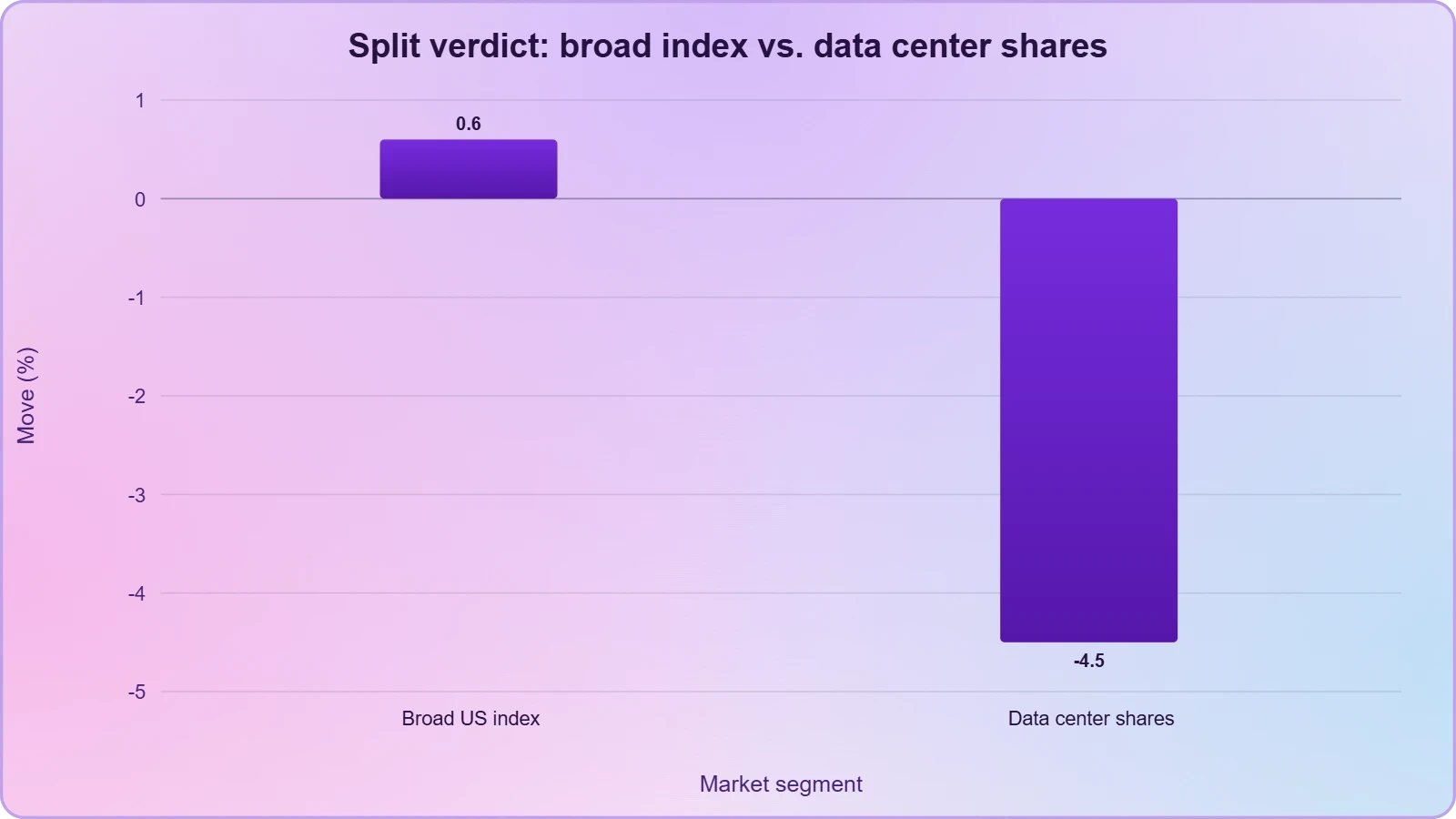
Why Broad Indices Rose
Equity markets generally prefer clarity to ambiguity, and a decisive congressional result removes one layer of uncertainty from the outlook. When one party controls a chamber, the legislative agenda becomes more predictable, and investors can model tax and spending paths with greater confidence. A higher close on the day is consistent with this "uncertainty reduction" effect, which academic research has documented around elections in many developed markets. The rally need not imply enthusiasm for Democratic policies; it may simply reflect relief that a contested outcome was avoided and that the policy environment is now legible.
There is also a compositional explanation. Broad indices are dominated by large, diversified companies whose revenue bases span many sectors and geographies, diluting exposure to any single policy vector. A shift in congressional control affects these firms at the margin rather than at the core. For the index as a whole, the net effect of a political transition is often modest and occasionally positive, particularly when the incoming agenda includes spending programs that support aggregate demand. The Reuters report's "close higher" phrasing fits comfortably within this framework of diversified resilience.
The Data Center Exception
Data center operators occupy a structurally different position. Their business models rest on enormous upfront capital expenditure, long-dated power purchase agreements, and physical infrastructure whose economics are acutely sensitive to electricity prices, land use rules, and environmental regulation. A political shift that raises the expected cost of energy, tightens permitting, or redirects incentives away from large-scale digital buildout can compress margins and delay projects. The sharp fall in these shares suggests investors assigned meaningful probability to such outcomes once the Democratic victory became clear, even before any specific legislation was drafted.
The sector's concentrated ownership and thematic character amplify moves. Data center equities are often held by investors expressing a specific thesis about artificial intelligence and cloud demand, and when the policy backdrop for that thesis shifts, positioning unwinds quickly. The result can be a decline disproportionate to the actual policy change, driven as much by crowding and narrative as by fundamentals. The Reuters item does not quantify the drop, but the word "sharply" signals that the move was large enough to register as a distinct market event rather than routine noise.
Reading Sector Rotation Through a Political Lens
Sector rotation is the market's way of translating a macro or political event into relative prices. When a single catalyst arrives, capital does not simply enter or exit equities as a bloc; it migrates between industries according to each one's sensitivity to the new information. The November 4 session illustrates this mechanism cleanly. The broad index absorbed the Democratic victory as a modest positive, while data center shares absorbed it as a clear negative. The aggregate market level masks a vigorous internal reallocation, and understanding that reallocation requires looking beneath the index number to the sector-level flows.
This internal churn matters for portfolio construction because it determines which exposures are rewarded and which are penalized during political transitions. Investors who hold diversified index funds experience the net effect, which was positive on the day. Investors concentrated in data center equities experienced the sector effect, which was sharply negative. The same news event produced opposite outcomes depending on where one stood in the market's structure, a reminder that "the market" is never a monolith but a collection of distinct risk exposures responding to a shared shock.
Regulatory Risk as a Repricing Force
Data centers sit at the intersection of several regulatory domains: energy markets, land use, environmental standards, and increasingly the governance of artificial intelligence infrastructure. A Democratic Congress is widely associated with more assertive oversight in these areas, and markets price expected regulation before any bill is written. The sharp decline in data center shares can be read as an immediate markdown of future cash flows under a higher-regulation scenario. Even if legislation proves slow or diluted, the probability-weighted effect on valuations is negative, and equities trade on probabilities rather than certainties.
The repricing also reflects the sector's capital intensity. Firms that must commit billions to multi-year buildouts are more exposed to changes in the cost of capital and the regulatory cost of operation than asset-light businesses. When the policy environment becomes less favorable, the discount rate applied to distant cash flows rises, and long-duration equities fall disproportionately. This duration effect explains why infrastructure-heavy names can move so violently on political news that leaves the broader market largely undisturbed.
Energy Economics and Infrastructure Constraints
Electricity is the lifeblood of the data center economy, and power costs are among the largest operating expenses for large facilities. Political shifts that alter energy policy, whether through subsidies, grid regulation, or environmental permitting, flow directly into the sector's cost structure. A Congress inclined toward stricter environmental standards may raise compliance costs or slow the expansion of generation capacity, tightening supply and lifting prices. Investors reading the Democratic victory as a signal of such changes would rationally reduce exposure to the companies most dependent on cheap, abundant power.
Infrastructure constraints compound the effect. Data center growth requires land, water, transmission capacity, and community consent, each of which is mediated by policy. When the political balance shifts, the expected time and cost to secure these inputs change, and project pipelines face delay risk. The market's sharp reaction suggests investors assigned meaningful weight to these frictions, even absent specific legislative detail. The Reuters report's silence on causes leaves this interpretation open, but the sector's structural characteristics make it the most plausible channel.
We Also Published
What the Source Says, and What It Leaves Unsaid
Journalistic discipline requires distinguishing between what a report states and what readers infer. The Reuters item states three things: US stocks closed higher, Democrats won control of Congress, and data center shares fell sharply. It explicitly notes that the original report did not provide further details on the size of the moves or the reasons behind them. That caveat is important because it prevents the analyst from attributing causation where the source offers only correlation. The political event and the market moves occurred on the same day, but the wire service does not assert a mechanism.
This restraint is characteristic of fast-moving financial newswires, which prioritize speed and accuracy of observation over interpretive depth. The value to the reader lies in the timestamp and the directional clarity, which allow subsequent analysis to anchor itself to a verified fact pattern. Any explanation of why data center shares fell, whether regulation, energy costs, or simple profit-taking, is an inference rather than a reported fact. Responsible commentary must label it as such, and investors should weight the headline as a signal to investigate rather than a conclusion to act upon.
The Limits of Single-Session Interpretation
One trading session is a thin slice of evidence. Markets are noisy, and a single day's move can reflect positioning, liquidity, and unrelated news as much as the political catalyst in the headline. The Reuters report captures a moment, not a trend, and the absence of magnitude data makes it impossible to judge whether the moves were statistically meaningful or merely directional. Analysts who build narratives on a single close risk confusing coincidence with causation, a classic error in event studies where the treatment effect must be separated from background volatility.
Prudent interpretation therefore treats the session as a hypothesis-generating observation. If the political explanation is correct, subsequent sessions should show persistence: continued weakness in data center names, relative strength in sectors favored by the new congressional agenda, and analyst commentary linking the two. If the moves reverse quickly, the political story weakens and other explanations gain weight. The source gives us the opening data point; the market's own follow-through will supply the confirmation or refutation.
Information Asymmetry and Market Efficiency
The episode also illustrates how markets process incomplete information. Prices moved before a full causal account existed, which is exactly what efficiency predicts: markets aggregate dispersed beliefs and impound them into prices in real time, even when no single participant can articulate the complete story. The sharp fall in data center shares reflects the collective judgment of many traders, each responding to their own model of policy risk. The resulting price is an information-bearing signal, albeit a noisy one, that later reporting and analysis can interrogate.
For the individual investor, the lesson is humility about narrative. The market's initial reaction is a forecast, not a fact, and forecasts about policy are especially error-prone because legislative outcomes depend on negotiation, compromise, and unforeseen events. The Democratic victory is a known input; the policy output is not. Treating the sector move as a definitive verdict on data center economics would overstate what a single session can tell us, while ignoring it entirely would discard genuinely useful information about how investors are positioning for the road ahead.
- 01
- 02
- 03
- 04
Historical Patterns of Post-Election Market Behavior
Markets have digested congressional transitions many times, and the historical record offers useful, if imperfect, guidance. Broad indices have generally shown modest positive returns in the months following midterm and general elections, a pattern often attributed to the resolution of uncertainty rather than to partisan preference. Sector-level responses, by contrast, vary widely depending on which industries face the sharpest changes in expected regulation or spending. The November 4 session fits this template: a mildly positive aggregate response paired with a pronounced sector-specific reaction.
History also cautions against overgeneralization. The policy environment of 2026 differs from earlier cycles in the centrality of digital infrastructure, artificial intelligence, and energy transition to the economy. Data centers were a marginal sector in past decades; today they are a substantial component of capital markets and a strategic policy concern. This novelty means historical analogues provide direction but not precision, and investors should weight structural change alongside cyclical precedent when interpreting the current episode.
Uncertainty Resolution and the Equity Risk Premium
A central mechanism in post-election rallies is the compression of the equity risk premium as uncertainty resolves. Investors demand compensation for ambiguity, and when an election produces a clear result, that compensation can fall, lifting valuations across the market. The effect is typically modest but broad-based, consistent with the higher close reported by Reuters. It does not require investors to favor the winning party; it requires only that the range of possible policy outcomes narrows, allowing portfolios to be positioned with greater confidence.
For data center shares, the same resolution can work in reverse. If the election clarifies that a less favorable regulatory regime is coming, the uncertainty premium for that sector may rise even as the market-wide premium falls. The divergence is thus internally consistent: resolution helps the aggregate but can hurt specific industries whose expected policy environment deteriorates. This asymmetry explains why political clarity is not universally bullish and why sector selection matters as much as directional market calls.
Sector Sensitivity Rankings
Not all industries respond equally to congressional change. Utilities, healthcare, financial services, and energy are traditionally among the most policy-sensitive, while consumer staples and technology hardware are less directly exposed. Data centers straddle categories, behaving like utilities in their energy dependence and like technology in their growth orientation. This hybrid character makes them unusually responsive to political news, and it explains why a single election result can produce a sharp, concentrated move in their shares while leaving diversified indices comparatively calm.
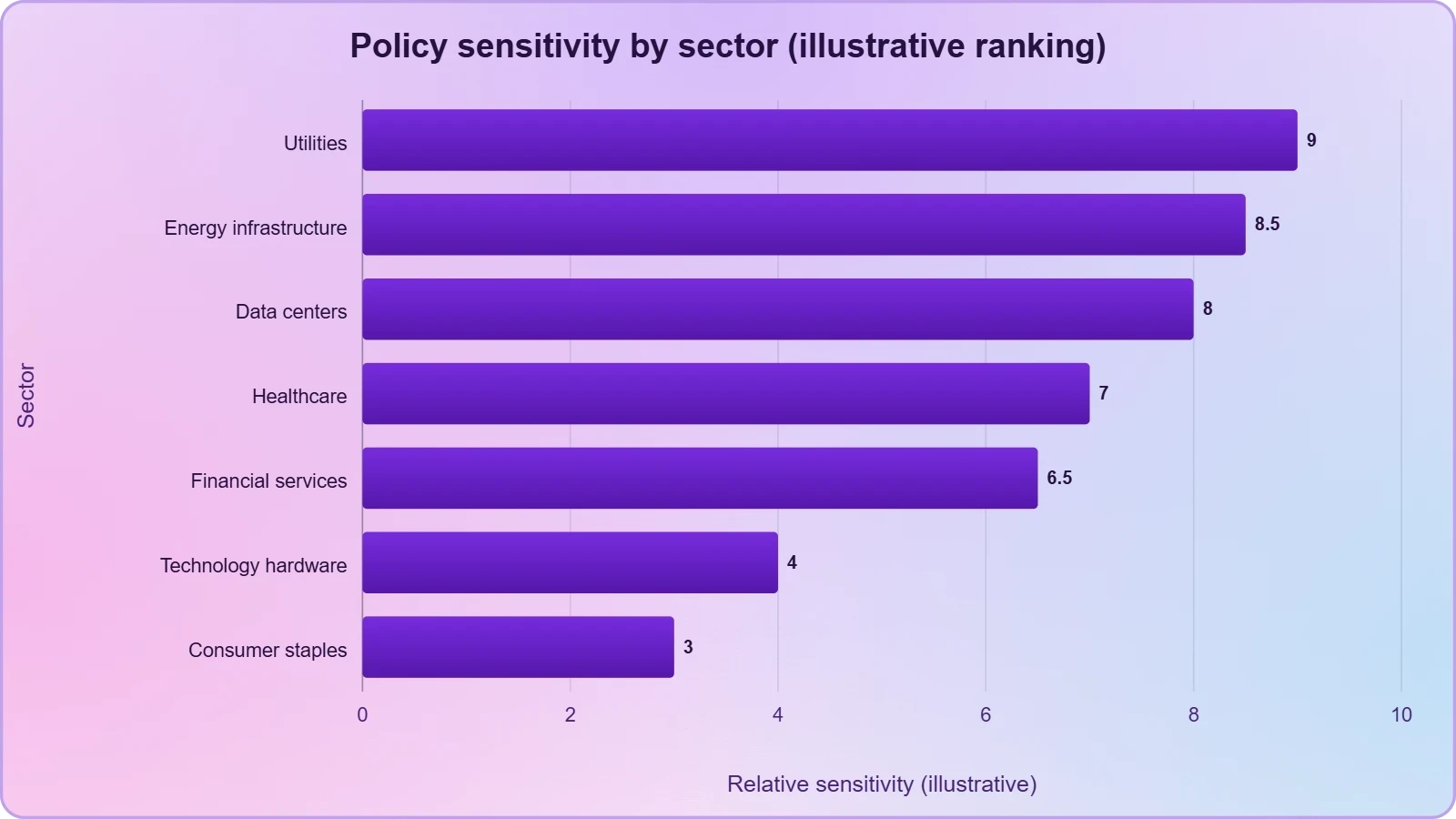
Investors can use sensitivity rankings to anticipate where political shocks will land hardest. The November 4 episode suggests markets currently place data centers high on the sensitivity list, alongside regulated utilities and energy infrastructure. That ranking is itself information: it tells us which sectors the market believes are most exposed to the incoming Congress's agenda. Monitoring these sensitivities over subsequent sessions can reveal whether the initial ranking persists or fades as legislative details emerge.
Implications for Investors and the Road Ahead
For portfolio managers, the November 4 session offers a practical lesson in diversification and scenario planning. A portfolio concentrated in data center equities would have suffered a sharp drawdown on a day when the broad market rose, illustrating the cost of thematic concentration during political transitions. A diversified allocation would have captured the aggregate gain while absorbing the sector loss. Neither outcome is inherently superior, but the episode clarifies the trade-off between conviction and resilience that every investor must navigate when policy risk is elevated.
The forward-looking question is whether the initial reaction persists. If the Democratic Congress pursues legislation affecting energy markets, permitting, or AI infrastructure, data center valuations may face sustained pressure. If the agenda proves moderate or gridlocked by internal divisions, the selloff may reverse as fears prove overstated. Investors should watch for concrete signals, such as committee assignments, draft bills, and regulatory appointments, rather than relying on the first day's price action as a durable forecast.
Positioning for Policy Uncertainty
Prudent positioning in a period of political change emphasizes optionality and balance. Investors can maintain core exposure to diversified indices while sizing sector bets to reflect elevated policy risk. Hedging strategies, including options overlays on concentrated positions, can protect against sharp moves like the one data center shares experienced. The goal is not to predict the legislative outcome but to ensure that any single plausible outcome does not inflict disproportionate damage on the portfolio, a principle that applies with particular force when the policy environment is in flux.
Scenario analysis is a useful discipline here. Investors can model data center valuations under several regulatory regimes, from benign to restrictive, and assess whether current prices adequately compensate for the range of outcomes. If the market has already priced a harsh scenario, further declines may be limited; if it has priced a benign one, the risk is asymmetric to the downside. The Reuters report does not tell us which scenario the market has chosen, but the sharp decline suggests meaningful pessimism has already been incorporated.
Watchpoints for the Coming Sessions
Several observable developments will clarify whether the political interpretation holds. Sustained relative underperformance of data center shares would confirm that investors see the Democratic victory as sector-negative. Commentary from company management about permitting, power contracts, or regulatory engagement would provide ground-level evidence. Movements in utility and energy equities would reveal whether the market expects broader changes in power economics. Each of these signals can refine the initial hypothesis and guide adjustments to positioning.
Conversely, a rapid reversal in data center shares would suggest the selloff was driven by positioning or unrelated factors rather than durable policy expectations. Investors should resist the temptation to overfit to a single session and instead build a evidence-based view as new information arrives. The value of the Reuters report lies in establishing a clear starting point, a timestamped observation against which subsequent developments can be measured. From that anchor, a disciplined investor can construct a reasoned, adaptable response to a genuinely uncertain political landscape.
Conclusion: A Signal Worth Reading Carefully
The Reuters report of November 4, 2026, is brief, but brevity is not emptiness. It records a genuine and instructive divergence: a broad market that rose on a Democratic congressional victory and a data center sector that fell sharply on the same news. That divergence encodes the market's judgment about how political change redistributes risk across industries, and it offers a compact case study in sector rotation, policy transmission, and the limits of single-session interpretation. The absence of magnitude and causation data is a constraint, but it also clarifies the boundary between observation and inference.
For investors and analysts, the appropriate response is neither to dismiss the headline nor to over-read it. The session is a hypothesis, and the coming weeks will supply the evidence needed to confirm or revise it. What endures is the framework: political transitions reshape expected cash flows and discount rates unevenly, and markets express those expectations through relative prices long before legislation is written. Reading those prices with discipline, and distinguishing what is known from what is assumed, remains the most reliable way to navigate the uncertainty that elections inevitably create.
From our network :
- The Hidden Cost of AI Convenience: Why Over-Permissioned Agents Are a Security Time BombDiscover why AI agents with excessive permissions create dangerous single points of failure, and learn how implementing least privilege principles can protect your organization from exploitation.
- Live Online English Classes for Kids: Do They Actually Reduce Anxiety?A ten-week study reveals that synchronous online English classes can significantly reduce child language anxiety while improving listening and reading skills. Discover what makes these programs effective and how parents can select the right one.
- University Language Proficiency Exams: Why Institutional Tests Demand Different Preparation Than IELTS and TOEFLDiscover why university-specific language proficiency examinations differ fundamentally from IELTS and TOEFL, and learn strategic preparation approaches for institutional assessment success.
- Mobile Learning and VR in English: What Global Evidence Reveals About Effective Language TechnologyA systematic review across 14 countries reveals which language-learning technologies genuinely work. Mobile learning, AI, and VR show measurable benefits when pedagogically integrated. This evidence-based guide helps educators and learners select technology that delivers real return on investment.
- CISA’s Ten-Advisory Wave: Why Generic Patching Fails in OT and How to Build Product-Specific PlaybooksCISA released ten ICS advisories in one week, exposing critical infrastructure risks. Generic patching fails in OT. Learn to build product-specific remediation playbooks.
- The Final Descent: How ESA Retired the Legendary Cluster Constellation After 24 Years of Space Weather ScienceAfter 24 years mapping Earth’s magnetosphere, ESA’s Cluster mission concluded with a precisely controlled reentry over the South Pacific. This analysis explores the scientific legacy, engineering decisions, and debris mitigation principles behind one of space exploration’s most responsible retirements.
- Forbidden Matrix Patterns and Visible Lattice Points: A Geometric DictionaryExplore how multidimensional 0–1 matrices encode geometric truths, linking forbidden patterns to visible lattice points and hypergraph theory, with applications in combinatorics and computational geometry.
- Committed Mediterranean Precipitation Decline: Why Emissions Cuts Alone Cannot Restore Winter RainsNew NOAA research reveals that Mediterranean winter rains may decline irreversibly even with emissions cuts. Explore the science of committed climate change and regional impacts.
- How AI Agents Will Change the Way We Manage Personal FinancesExplore how AI agents are transforming personal finance through automated budgeting, bill payment, and investment management, while examining the critical security protocols and governance frameworks required for safe deployment.
RESOURCES
- Wall Street ends higher after Democrats win Congress; data center ...reuters.com8 hours ago ... AI HEAVYWEIGHTS RISE, DATA CENTER OPERATORS FALL. AI stocks were split. Shares of cash-rich AI heavyweights rose, while chipmakers and…
- Stock market news for Nov. 4, 2026 - CNBCcnbc.com10 hours ago ... Investors feared a big Democratic win could mean more restrictions on data centers nationwide. The Texas governor win by Gina…
- AI data-center stocks slide, renewables rally after Democratic US ...reuters.com14 hours ago ... Data-center stocks slid on Wednesday, while clean-energy shares rallied after Democrats seized control of Congress, prompting investors to ...
- Wall Street ends higher after Democrats win Congress; data center ...finance.yahoo.com10 hours ago ... AI stocks were split. Shares of cash-rich AI heavyweights rose, while chipmakers and data center operators fell after Democrats made…
- Data center stocks slide as Democrats win Congress, clean energy ...journalrecord.com13 hours ago ... Shares of Elon Musk's rocket and space technology company SpaceX fell 3.5% to their lowest since mid-August, while EV maker…
- US stock markets and government bonds rally while dollar falls after ...theguardian.com1 day ago ... Although we know that having a Democrat-run congress will increase the likelihood of increased scrutiny for AI, data centres and…
- Stocks Rise as Democrats Flip Control of Congressnytimes.com10 hours ago ... Stock markets gained on Wednesday, as it became clear that Democrats were set to seize control of Congress in a…
- Midterm mindset seeping into the U.S. stock marketrbcwealthmanagement.comSep 9, 2026 ... ... Democrats win the House and Senate, especially for Consumer Staples and Utilities. Even if U.S. stock market volatility rises…
- Dow Has Best Post-Midterm Elections Day in 44 Years as ...news.wttw.com9 hours ago ... ... Democrats Take Control of Congress ... shares of semiconductor chipmakers and other companies involved in the data center buildout…
- Stocks Surge: Big Democratic Win Eases Uncertaintyschwab.comStocks surged in early trading after the Democrats nearly swept midterm elections last night, ending uncertainty over results. AI and chip shares were ...
- US Midterms: How Markets Are Reacting to Democrat Victoryglobal.morningstar.com16 hours ago ... Stocks, bonds, and gold are on the move as Trump's Republican party loses the Senate and the House.
- US Stocks Surge as Election Drives Oil Down, Fuels Tech Optimismbloomberg.com10 hours ago ... “Congressional Democrats could use the debt-ceiling negotiations as leverage to challenge 100% expensing for data centers, while Democratic ...
- AI data-center stocks slide, renewables rally after Democratic US ...wtvbam.com19 hours ago ... ... center stocks slid on Wednesday, while clean-energy shares rallied after Democrats seized control of Congress, prompting investors to ...
- What the Midterm Elections Will Mean for Markets | Morningstarmorningstar.comOct 8, 2026 ... ... while Democrats gain control of the House. More recently, the odds have risen of a Democratic victory in the…
- NATIONAL: U.S. stock futures surged after the U.S. midterm election ...facebook.com18 hours ago ... ... Congress. Read more: https://www.fox5vegas.com/2026/11/04/stock-futures-rise-after-democrats-take-control-congress/. Log in. FOX5 Las Vegas's ...
- 01
- 02
- 03
- 04
- 05
- 06
- 07
- 08
0 Comments