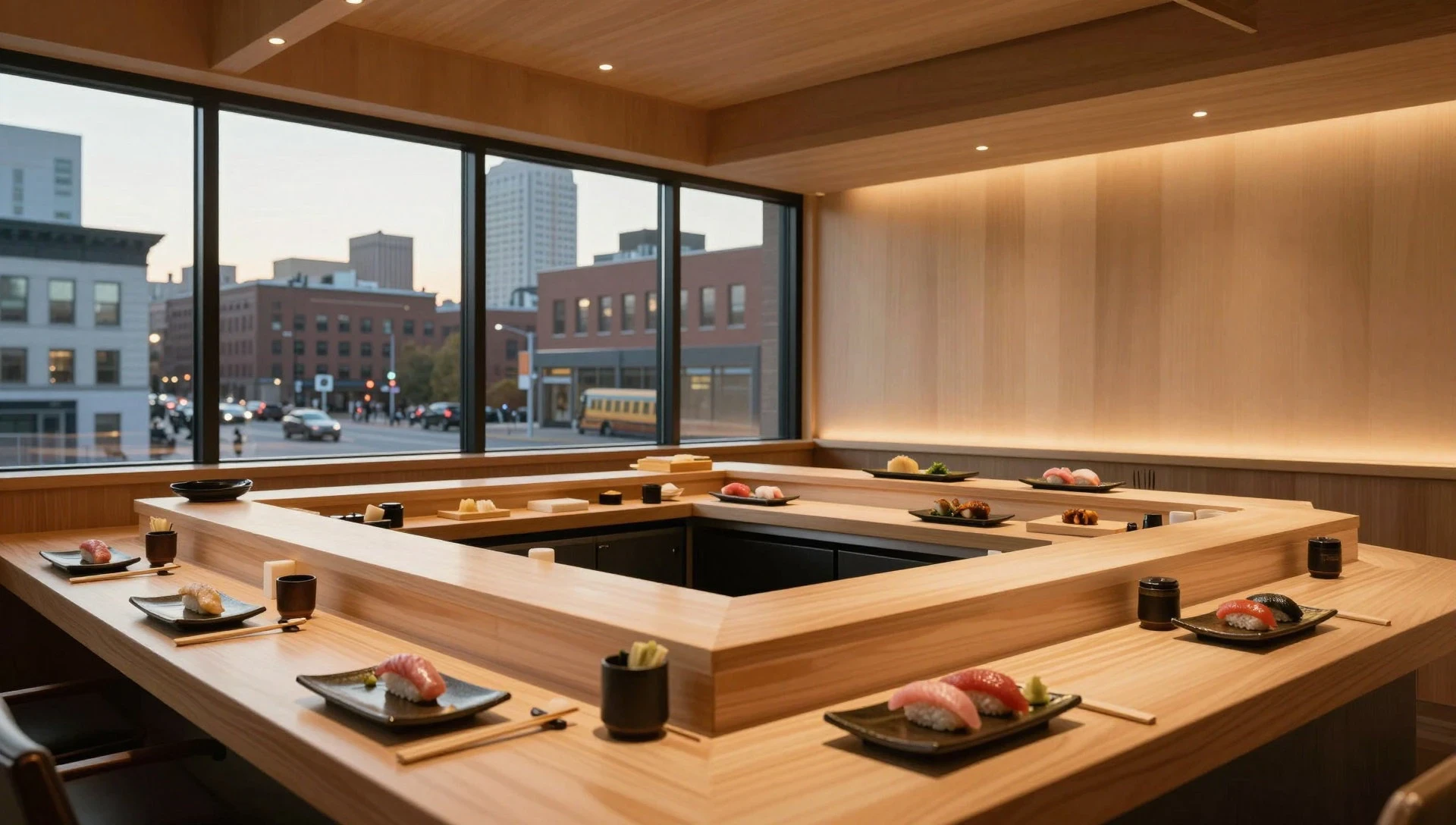
The report concerns a small but meaningful change for a Northeast Minneapolis business: a sushi restaurant that had stopped trading after a fire has reopened in a different space in the same area.
Its central fact is the return to operation, not the cause or scale of the fire, which the supplied account does not describe.
A move after a fire can represent more than a change of address. For a restaurant, reopening means customers can once again find the business, staff may resume their work, and the familiar service can continue in a new setting. Those wider implications are possibilities, however; the source confirms only the closure, relocation, and reopening.
On This Page
The account is brief, so a careful reading must keep confirmed details separate from unanswered questions. It attributes the news to CBS News but gives no restaurant name, street address, reopening date, damage estimate, or explanation of the new premises.
The story is therefore best understood as a reported neighborhood reopening, not a complete account of the incident.
TL;DR A sushi restaurant in Northeast Minneapolis has reopened in a different location in the same area after closing because of a fire, according to the supplied CBS News summary. The report establishes the basic sequence—fire-related closure, relocation, and resumed operations—but does not identify the restaurant or provide details about the fire, the new premises, or the timing of reopening.
What the report confirms
The central update is that a sushi restaurant in Northeast Minneapolis is operating again after a fire interrupted its business. The restaurant has reopened at another location in the same area, preserving a local presence while changing its premises. The available report does not provide further identifying or operational details.
The essential sequence of events
The account presents three linked developments: a fire, a closure, and a reopening in a new space. This sequence conveys why the restaurant stopped operating and how it returned, while leaving the timing and precise circumstances of each stage unspecified.
It identifies the business only by type and broad location: a sushi restaurant in Northeast Minneapolis. Without a business name or street address, readers cannot reliably connect the report to a particular restaurant or determine exactly where customers should go.
The description says the new location is in the same area. That suggests continuity within the neighborhood, but it does not establish whether the premises are nearby, on the same street, or within any particular distance of the former site.
The report says operations have resumed. It does not state whether every service is available, whether hours have changed, or whether the restaurant has returned to its prior capacity. Those details should not be inferred from the fact of reopening alone.
What “reopened” means—and does not mean
In the account, “reopened” means the restaurant is again conducting business from a different space. It is a practical milestone after a closure, but it does not by itself describe the scale of the recovery or the condition of the former premises.
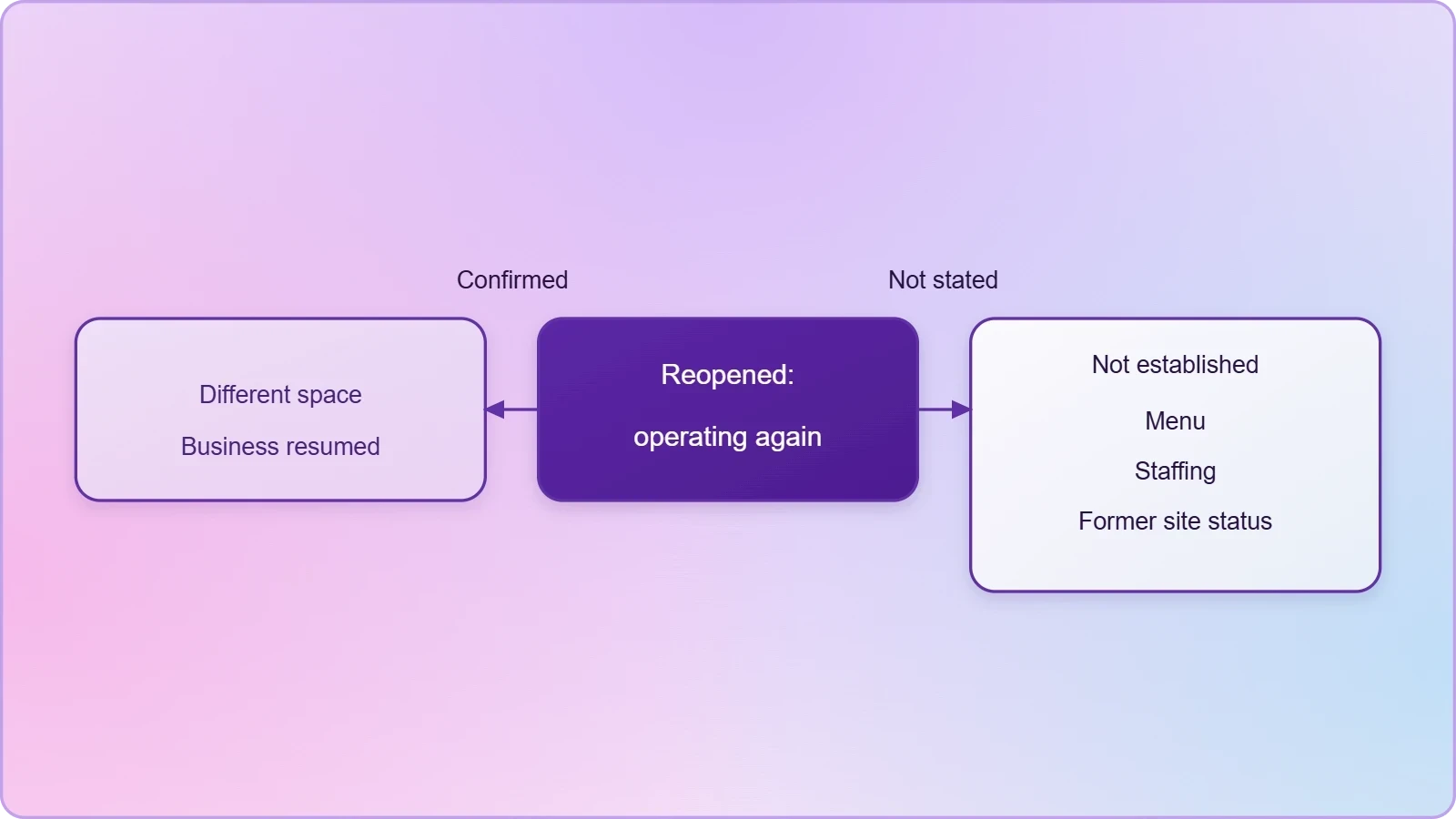
A move can allow a business to serve customers while repairs or other decisions about an earlier site remain unresolved. Yet the source does not say that repairs are underway, that the former location is permanently closed, or that the new premises are temporary.
Nor does the brief report establish whether the restaurant’s menu, ownership, staffing, or service model has changed. These may be relevant questions for customers and employees, but they remain outside the facts supplied in the account.
The most reliable takeaway is consequently narrow and clear: a fire prompted a closure, and the sushi restaurant has since resumed operations somewhere else in Northeast Minneapolis. Additional claims require confirmation from the restaurant or fuller reporting.
A neighborhood business returns
The reopening matters in local terms because the restaurant has returned to the area where it previously operated. For neighborhood customers, that can preserve a familiar food option close to home, though the report does not say how many patrons or workers are affected.
Local continuity after a disruption
Restaurants often become part of the everyday pattern of a neighborhood, serving nearby residents, workers, and visitors. A business returning within its original area may preserve that local connection, even when the physical setting changes after a disruptive event.
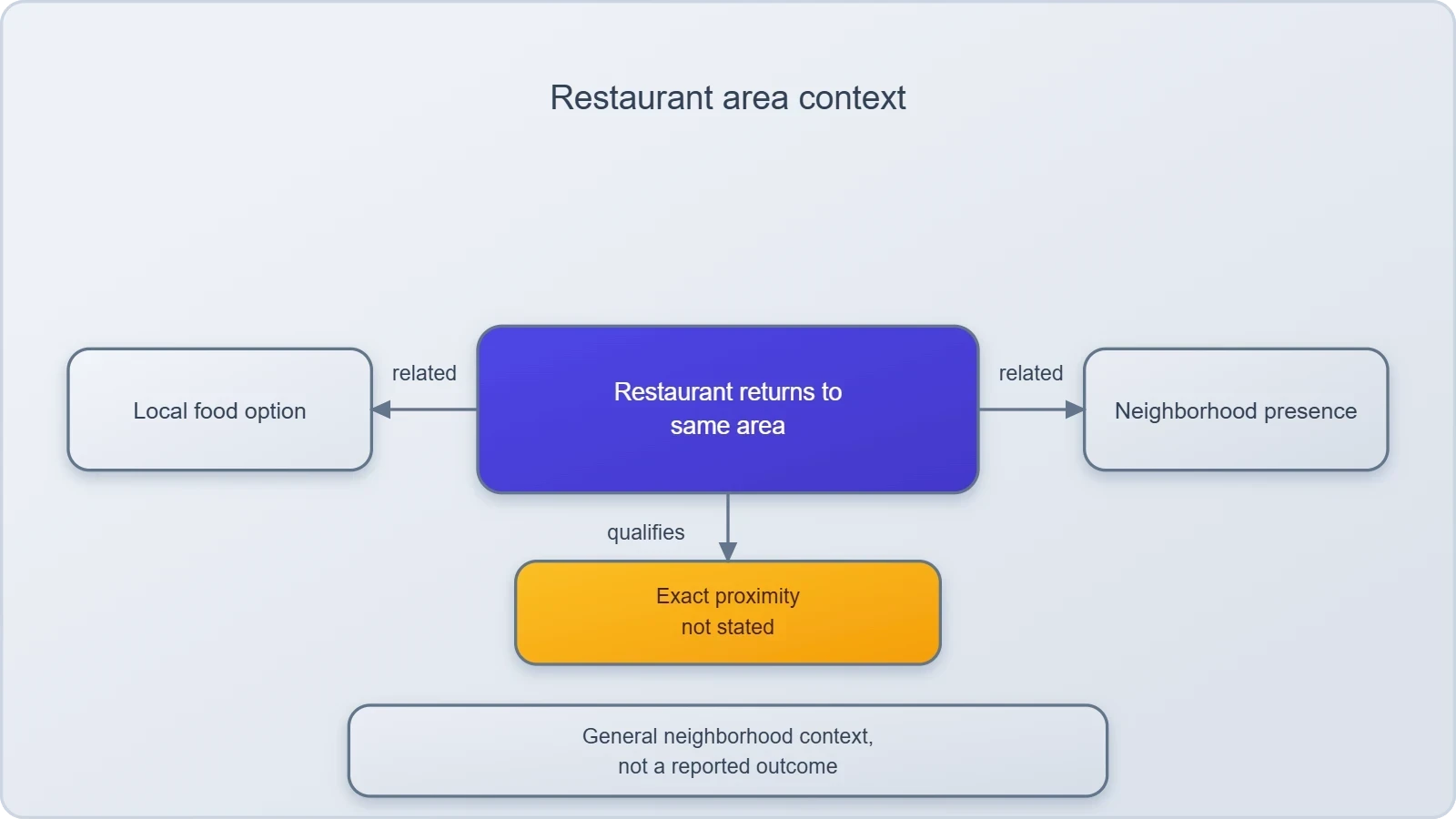
In this instance, continuity is supported by the report’s statement that the new location is in the same area. It does not support a more precise claim about proximity, visibility, accessibility, or whether the restaurant retains its previous customer base.
The reopening also restores a sushi option to the local mix of businesses, at least in the broad sense that this type of restaurant is operating again. The report does not compare neighborhood dining choices before and after the closure.
For nearby businesses, a restaurant’s return may contribute to ongoing street activity and consumer choice. Those are general possibilities rather than reported outcomes here; no figures or comments from neighboring businesses appear in the supplied account.
Why the new address matters to customers
Even when a restaurant remains in the same neighborhood, a new address can affect how customers find it. Visitors may need updated directions, and regulars may need to confirm which entrance or premises are now serving the public.
The source does not provide a street address, so the phrase “same area” is not enough to guide a customer to the door. A reader should consult a current business listing or the restaurant’s own announcement before making a visit.
Customers may also want to confirm service details such as opening times, dine-in availability, takeout, and delivery. The account confirms resumed operations but does not specify the channels or schedule through which the restaurant is serving patrons.
Keeping these practical questions separate from the headline prevents a common misunderstanding: reopening does not necessarily mean that every familiar detail has remained unchanged. Current information from the business is the best guide to its present arrangements.
The fire and the limits of available detail
The fire explains why the restaurant was closed, but the supplied account gives no incident-specific information. It does not identify when the fire occurred, what caused it, how extensive the damage was, or whether anyone was injured. Those omissions define the limits of responsible interpretation.
What remains unknown about the incident
There is no description of the fire’s origin, location within the premises, or duration. The summary also does not say whether emergency services attended, whether an investigation took place, or whether authorities issued any findings about the event.
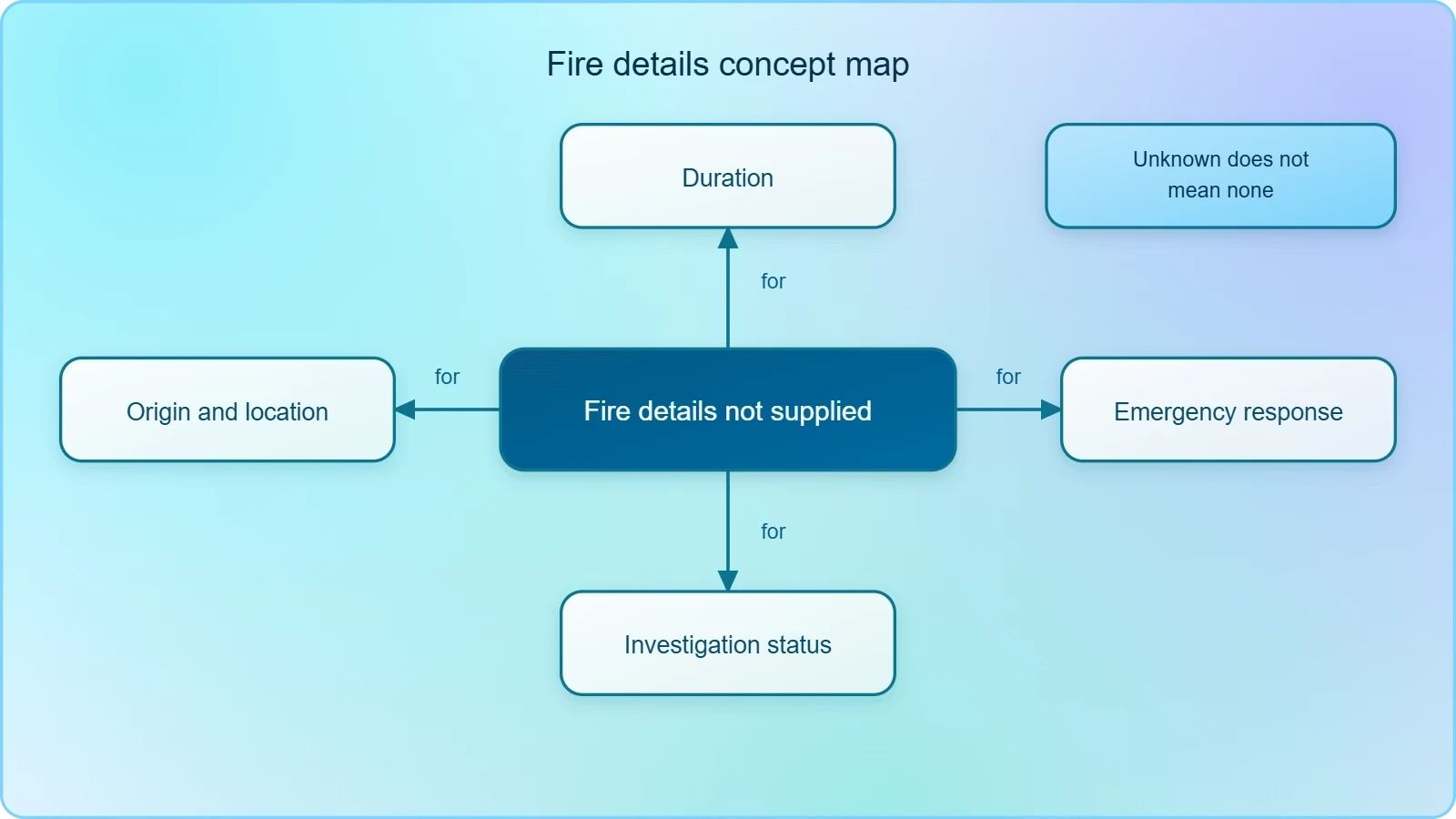
No damage estimate appears, and the report does not say whether the former premises were repaired, remain closed, or are being used for another purpose. Without those facts, the scale and long-term consequences of the incident cannot be assessed.
The source does not mention injuries, employee impacts, or effects on neighboring properties. It would be inappropriate to infer that such consequences occurred—or that they did not—based solely on a short reopening notice.
Likewise, the account offers no timeline for the closure or transition to a new location. Readers cannot determine how long the business was closed or how quickly the restaurant found and prepared its replacement space.
Why restraint matters in reporting
Fire-related stories can invite speculation about safety, building conditions, or responsibility. A reliable summary should not assign blame or suggest a cause unless credible reporting or official findings support that conclusion.
The available account supports a straightforward statement that the restaurant closed because of a fire and later reopened elsewhere. It does not support claims about negligence, insurance, code compliance, a deliberate act, or the financial cost of the incident.
Distinguishing confirmed information from missing detail is not a weakness in analysis; it is a safeguard against turning a limited report into a misleading narrative. In this case, the most accurate account remains deliberately concise.
Any future account that adds the cause, damage, or recovery timeline would need to be evaluated on its own sourcing. Until such information is available, the fire should be treated as context for the closure, not as an explained event.
Relocation as a route back to operation
The move to a different space is the practical mechanism by which the restaurant returned to business. The report does not explain how the new premises were selected or prepared, but the relocation itself marks a distinction between restoring service and restoring the original site.
Resuming service from another space
For a restaurant affected by an interruption, a different location can provide a way to serve customers without waiting for the original premises to become usable. That is a general operational possibility, not a documented explanation of this restaurant’s decision.
The source confirms that the new space is in the same area, which signals a local move rather than a reported departure from Northeast Minneapolis. It does not state whether the restaurant owns, leases, or shares the premises.
Nor does the account describe renovations, permits, equipment transfers, or staffing arrangements. These are common practical considerations when a food business moves, but none can be attributed to this particular reopening without supporting information.
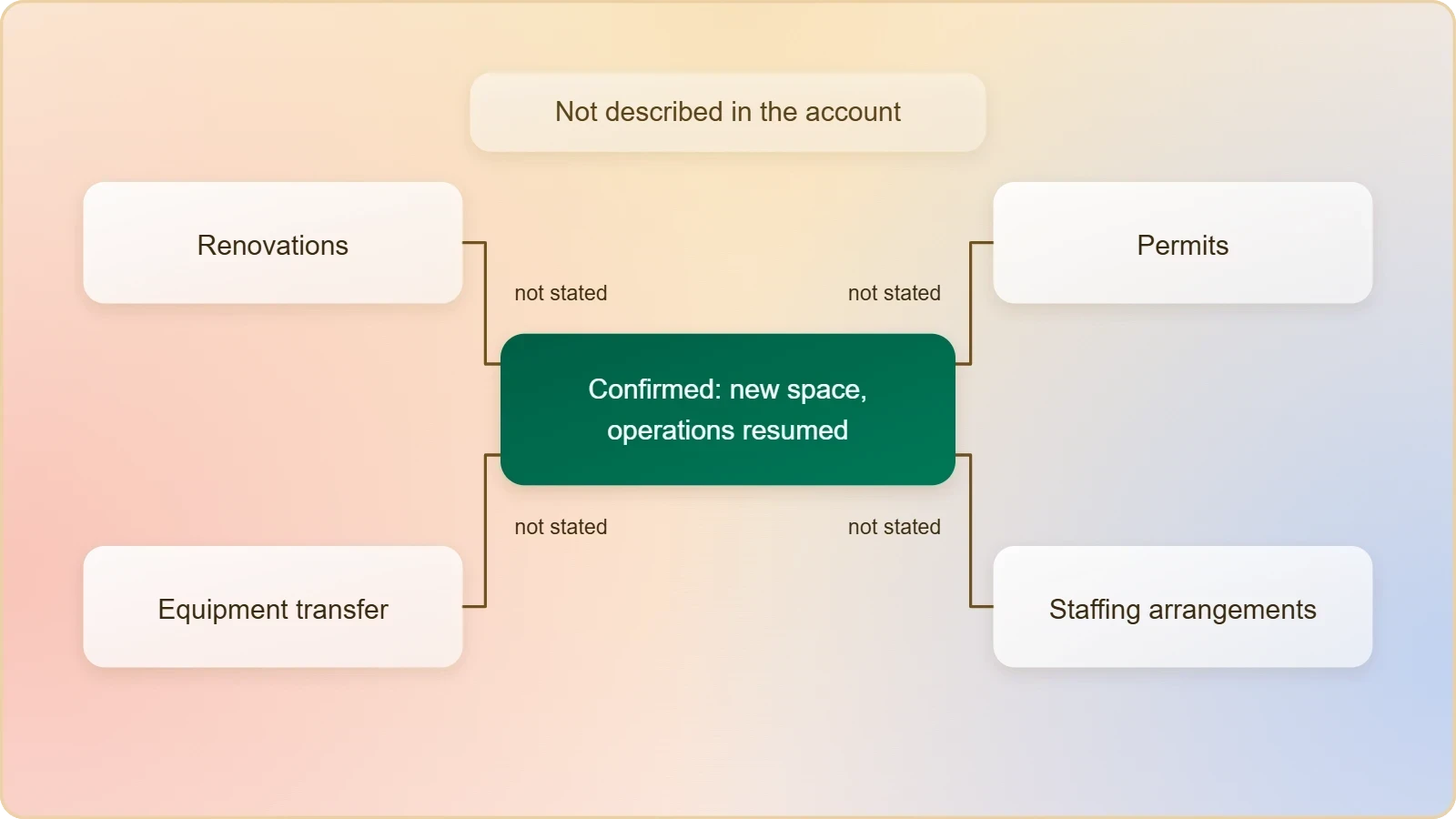
The confirmed result is simpler: operations have resumed from another space. That outcome allows the story to be described as a reopening after disruption, while leaving the business’s transition process undocumented.
What a relocation does not establish
A new location does not automatically mean the former address has been abandoned permanently. The restaurant might have options for the original premises, but the report says nothing about its status or the business’s plans there.
Similarly, a move does not prove that the new site offers the same seating, accessibility, ambience, or capacity. Those features are important to diners, yet they are not supplied in the short source summary.
There is also no stated reopening date, so the report does not permit a precise chronology from fire to relocation to renewed service. The timestamp attached to the source record should not be mistaken for a confirmed opening date.
Readers should therefore interpret “new location” as a factual description of where the restaurant has resumed operations, not as a complete account of the business’s property, financial, or strategic decisions.
- 01
- 02
- 03
- 04
What customers and workers may want to know
A headline can announce a return without answering the practical questions that shape a visit or a workday. The supplied summary leaves customers and employees without an address, hours, service details, or information about staffing, so confirmation from the restaurant remains important.
Useful details for diners
The first practical question is where the new location is. Because no address is provided, customers should not rely on the broad neighborhood description alone when planning a visit or arranging a pickup.
Hours and service options are also unstated. A restaurant may reopen on a modified schedule or offer a limited set of services, but the report does not confirm whether that applies here.
Customers who need information about reservations, accessibility, delivery, or takeout should seek current details directly from the business or a verified listing. The report does not establish any of those arrangements.
Likewise, the account does not mention changes to the menu or prices. It confirms the restaurant’s return, not the exact dining experience customers will encounter at the new premises.
Questions around staff and business operations
The reopening may be relevant to employees as well as patrons, but the source does not discuss staffing, schedules, job continuity, or the number of people working at the new space. Any account of those matters would require additional reporting.
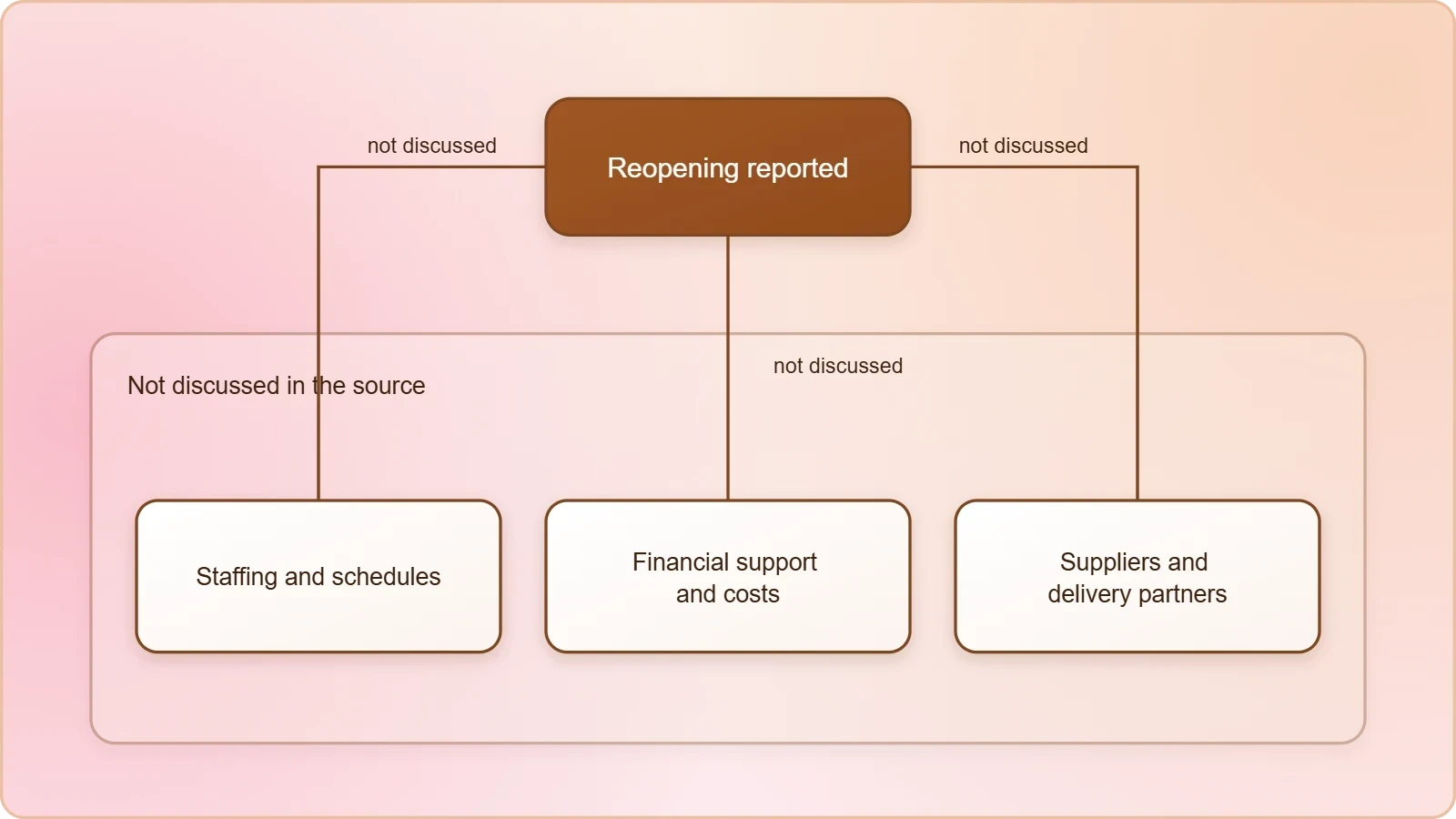
It also provides no information about financial support, insurance, fundraising, or the costs associated with moving. Such issues can arise after a business interruption, but they should not be presumed in this particular case.
Local suppliers and delivery partners could have an interest in the resumption of service, yet the report does not describe the restaurant’s supply arrangements or any effect on other businesses.
For a fuller picture, follow-up reporting would need to seek direct confirmation from the restaurant and, where relevant, public records or official statements. The short summary establishes a reopening, not the complete story behind it.
How to read this brief local-news update
The report’s value lies in a concrete neighborhood development: a sushi restaurant has returned after a fire-related closure, using another space in the same area. Its brevity calls for careful interpretation rather than speculation about the incident or the business’s future.
Source attribution and the date record
The supplied summary attributes the reopening report to CBS News. The linked item is presented through a Google News RSS address, but the summary itself contains no direct quotation, named spokesperson, or detailed account from the outlet.
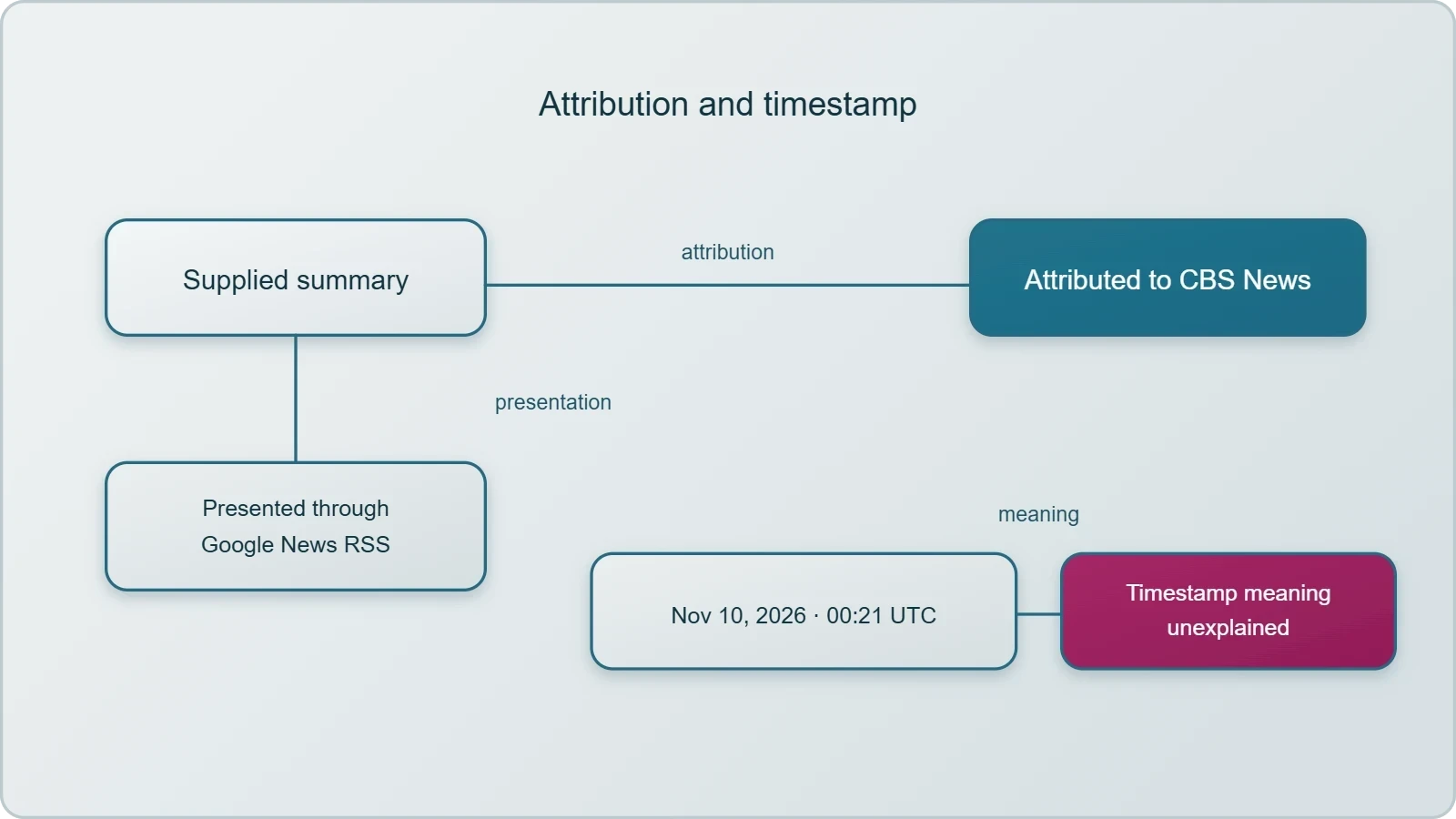
The record includes a timestamp of November 10, 2026, at 00:21 UTC. That is a timestamp attached to the supplied source data; the summary does not explain whether it denotes publication, collection, or another event in the feed.
Because the account is so brief, attribution should remain precise: according to the supplied summary, CBS News reported that the restaurant reopened in a new location after a fire. More specific claims cannot be traced to details in the supplied text.
Readers seeking confirmation or additional context should consult the original reporting and any current communication from the restaurant. A short secondary summary may omit details that appear in fuller coverage or later updates.
The central message and its limits
At its core, the story is about recovery through relocation. A local restaurant that had been closed after a fire is once again serving its area from a different space, offering a clear point of continuity amid an otherwise unspecified disruption.
The report does not frame the reopening as a grand expansion, a permanent move away from the neighborhood, or a completed rebuilding project. It simply states that a new location is now operating in the same area.
That modest framing is important. It preserves the human and commercial significance of a business returning while avoiding unsupported claims about the fire’s consequences, the restaurant’s finances, or the experience awaiting customers.
Until further information is available, the most complete and accurate understanding is also the most restrained: the restaurant is back in business locally, but the details behind the fire and the move remain unreported in the supplied account.
From our network :
- Forbidden Matrix Patterns and Visible Lattice Points: A Geometric DictionaryExplore how multidimensional 0–1 matrices encode geometric truths, linking forbidden patterns to visible lattice points and hypergraph theory, with applications in combinatorics and computational geometry.
- How AI Agents Will Change the Way We Manage Personal FinancesExplore how AI agents are transforming personal finance through automated budgeting, bill payment, and investment management, while examining the critical security protocols and governance frameworks required for safe deployment.
- Mobile Learning and VR in English: What Global Evidence Reveals About Effective Language TechnologyA systematic review across 14 countries reveals which language-learning technologies genuinely work. Mobile learning, AI, and VR show measurable benefits when pedagogically integrated. This evidence-based guide helps educators and learners select technology that delivers real return on investment.
- The Hidden Cost of AI Convenience: Why Over-Permissioned Agents Are a Security Time BombDiscover why AI agents with excessive permissions create dangerous single points of failure, and learn how implementing least privilege principles can protect your organization from exploitation.
- Committed Mediterranean Precipitation Decline: Why Emissions Cuts Alone Cannot Restore Winter RainsNew NOAA research reveals that Mediterranean winter rains may decline irreversibly even with emissions cuts. Explore the science of committed climate change and regional impacts.
- Live Online English Classes for Kids: Do They Actually Reduce Anxiety?A ten-week study reveals that synchronous online English classes can significantly reduce child language anxiety while improving listening and reading skills. Discover what makes these programs effective and how parents can select the right one.
- CISA’s Ten-Advisory Wave: Why Generic Patching Fails in OT and How to Build Product-Specific PlaybooksCISA released ten ICS advisories in one week, exposing critical infrastructure risks. Generic patching fails in OT. Learn to build product-specific remediation playbooks.
- The Final Descent: How ESA Retired the Legendary Cluster Constellation After 24 Years of Space Weather ScienceAfter 24 years mapping Earth’s magnetosphere, ESA’s Cluster mission concluded with a precisely controlled reentry over the South Pacific. This analysis explores the scientific legacy, engineering decisions, and debris mitigation principles behind one of space exploration’s most responsible retirements.
- University Language Proficiency Exams: Why Institutional Tests Demand Different Preparation Than IELTS and TOEFLDiscover why university-specific language proficiency examinations differ fundamentally from IELTS and TOEFL, and learn strategic preparation approaches for institutional assessment success.
RESOURCES
- Sushi restaurant reopens in NE Minneapolis - Facebookfacebook.com5 days ago ... My favorite sushi restaurant is back open in a new location in NE Minneapolis MOMO SUSHI after a devastating kitchen…
- After devastating fire, Momo Sushi close to reopening in new ...kare11.comOct 22, 2026 ... After devastating fire, Momo Sushi close to reopening in new northeast Minneapolis location ... Japanese restaurant after a fire forced…
- The Minneapolis Japanese-Tibetan restaurant says it's committed to ...facebook.comDec 9, 2025 ... Momo Sushi is reopening this summer in a new northeast Minneapolis location after a fire closed its kitchen last December.…
- Minneapolis sushi restaurant left temporarily closed after firebringmethenews.comSep 5, 2025 ... A fire broke out at Momo Sushi at 1839 Central Ave. NE. during the early hours of Aug. 30. The…
- Momo Sushi Reopening in Former Beast Barbecue Spacemspmag.comMay 22, 2026 ... After a fire tore through its Central Avenue location last summer, Northeast's favorite sushi restaurant is reopening in a new…
- A Northeast favorite is making a long-awaited comeback. After a fire ...instagram.comJun 1, 2026 ... After a fire closed its Central Avenue location last year, Momo Sushi is getting ready to reopen just over a…
- Momo Sushi reopening in northeast Minneapolis at new location ...fox9.comMay 23, 2026 ... Momo Sushi reopening in northeast Minneapolis at new location after fire ... restaurants, including Momo Cafe, Ama Sushi and Apa…
- Momo Sushi Reopens - Minnesota Monthlyminnesotamonthly.com7 days ago ... The sushi restaurant in Northeast Minneapolis closed more than a year ago due to a kitchen fire.
- I miss Momo Sushi! Did you know they have two other sister ...instagram.comFeb 13, 2026 ... Sadly, Momo, a treasure in Northeast Minneapolis, is closed for now after a fire. So I figured I'd let you…
- Sushi restaurant reels after overnight fire - MyNortheaster.commynortheaster.comSep 9, 2025 ... News, Events, Northeast Minneapolis, St. Anthony, Columbia Heights ... Nyorie currently plans to rebuild Momo Sushi and reopen the restaurant…
- Momo Sushi Reopening in Former Beast Barbecue Space - Redditreddit.comMay 23, 2026 ... 329 votes, 46 comments. After a fire tore through its Central Avenue location last summer, Northeast's favorite sushi restaurant is ...
- New restaurant openings in Minneapolis, St. Paul and Twin Citiesstartribune.comOct 5, 2026 ... E., Mpls., instagram.com/momosushimn) Momo Sushi will reopen inside the former Beast Barbecue space in northeast Minneapolis after a fire ...
- Momo Sushi plots return to Northeast Minneapolis after destructive fireyahoo.comMay 26, 2026 ... ... reopen in Northeast Minneapolis about a year after an overnight fire forced its closure. The Japanese and Tibetan restaurant…
- MOMO SUSHI | Tibetan, Japanese & Sushi in NE Mplsmomosushimn.comColorful Japanese restaurant bar with sake bottles, red paper lanterns, wood counters, hanging · After a devastating fire closed our Central Avenue restaurant in ...
- Support Momo Sushi Staff After Devastating Fire - GoFundMegofundme.comSep 3, 2025 ... ... restaurant's reopening timeline unknown and its wonderful staff without a source of income. For the employees of Momo Sushi,…
- 01
- 02
- 03
- 04
- 05
- 06
- 07
- 08
0 Comments